Feeds:
Posts
Comments

Archive for the ‘General’ Category


This road diary is primarily about just that – the road. Although, in one sense, the purpose of the road is merely to link one natural wonder after another, it is that act of movement, through time and space, and the sights, sounds and adventures that inhabit them, that is the focus of these articles.

So I will not be exclaiming at length about the extraordinary parks and canyons that we are visiting. In fact, I don’t really have the words, or at least the time to find the right words, to describe some of the most beautiful spots on earth, let alone the United States.

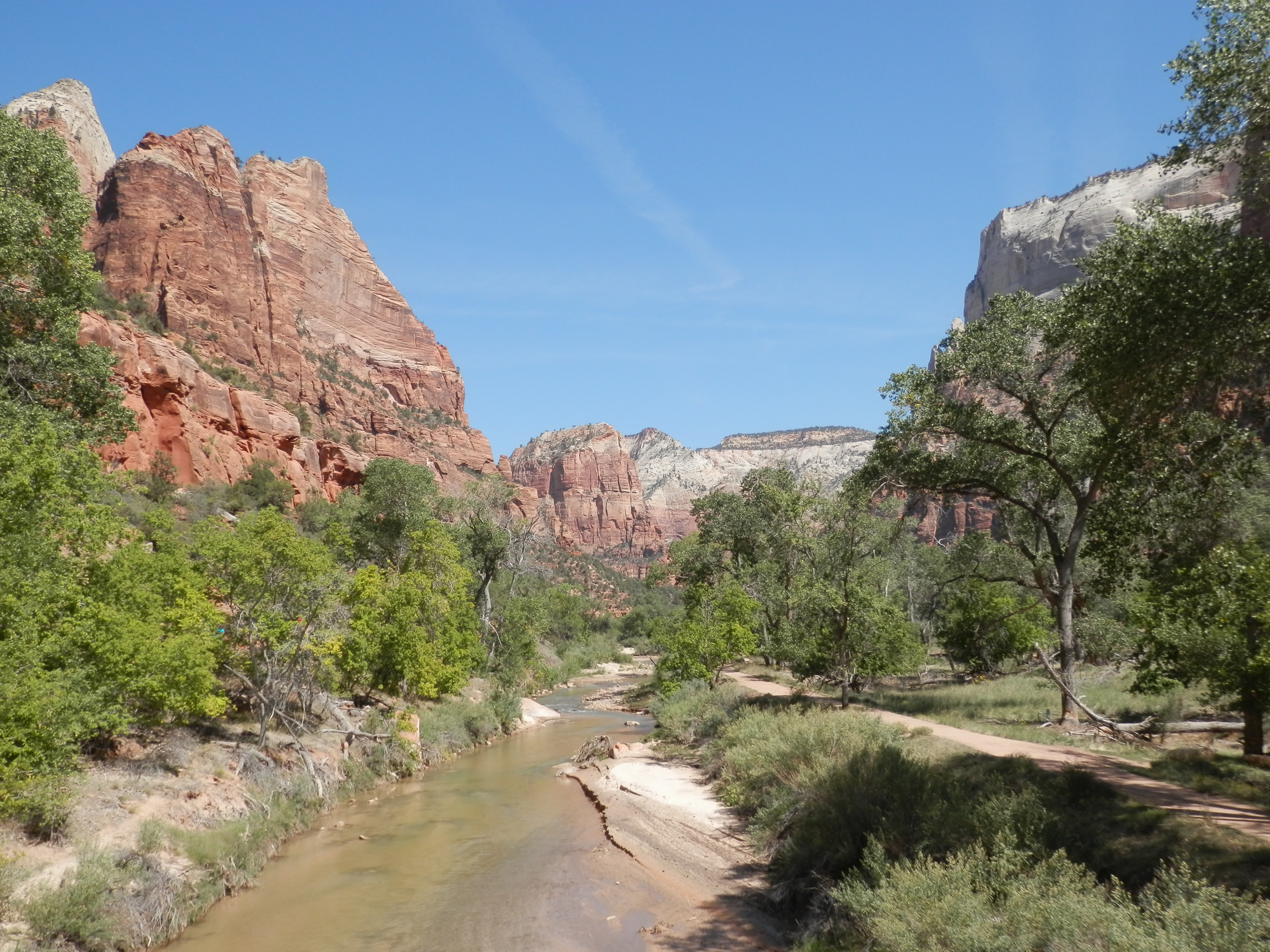
Moreover, I hope that the photographs that will increasingly feature in these pieces will speak more eloquently than ever I can.

Hurricane, Utah, whose culinary delights I have already commented upon, was our base for Zion National Park, which we visited on our second full day. It is not as close as funkier Springdale, effectively the gateway to the park, but still convenient and much cheaper.

Our trip to Zion was prefaced by a sumptuous breakfast in Bear Bites, actually room 116 in the Travelodge, one in which it might have been difficult to swing a kitten, let alone a fully grown cat. Here we banqueted on toast, juice and coffee – we hadn’t the confidence to negotiate the waffle machine – with an assortment of non-English speaking residents.

One mature German couple sat down next to us with four slices of toast. The woman then produced a carrier bag containing a whole cucumber and half a green pepper – complete with seeds – which she cut up and scraped onto the toast.  No accounting for taste.

As we were packing the car, two surprisingly beardless, but not bandana-less, bikers were lovingly tending to their Harleys before setting off on the next leg of their own road trip.

In the short drive to Zion we passed Doggy Dudes Pet Care. Oh to have had a pooch in tow at that point.

On arrival at the entrance to Zion we purchased an annual pass for all US national parks for the phenomenally low price of $80 (total), representing a huge saving even by the end of this trip. Had I been a few years older it would have been $10! British visitor attractions please take note.

We parked at the visitor centre and took the shuttle to the furthermost point of the park, the Temple of Sinawava, and worked our way back, hiking several trails, including Riverside, Weeping Rock, the Lower Emerald Pool and the Pa’rus Trail in near hundred degree heat.

Zion is not dissimilar to Yosemite in that it contains awe inspiring cliffs and rocks, lush vegetation, and flowing rivers and waterfalls (though the latter were not much in evidence today). In fact, I preferred it to Yosemite, proclaiming it the loveliest place I had ever seen. I was to change that judgement more than once over the next week.

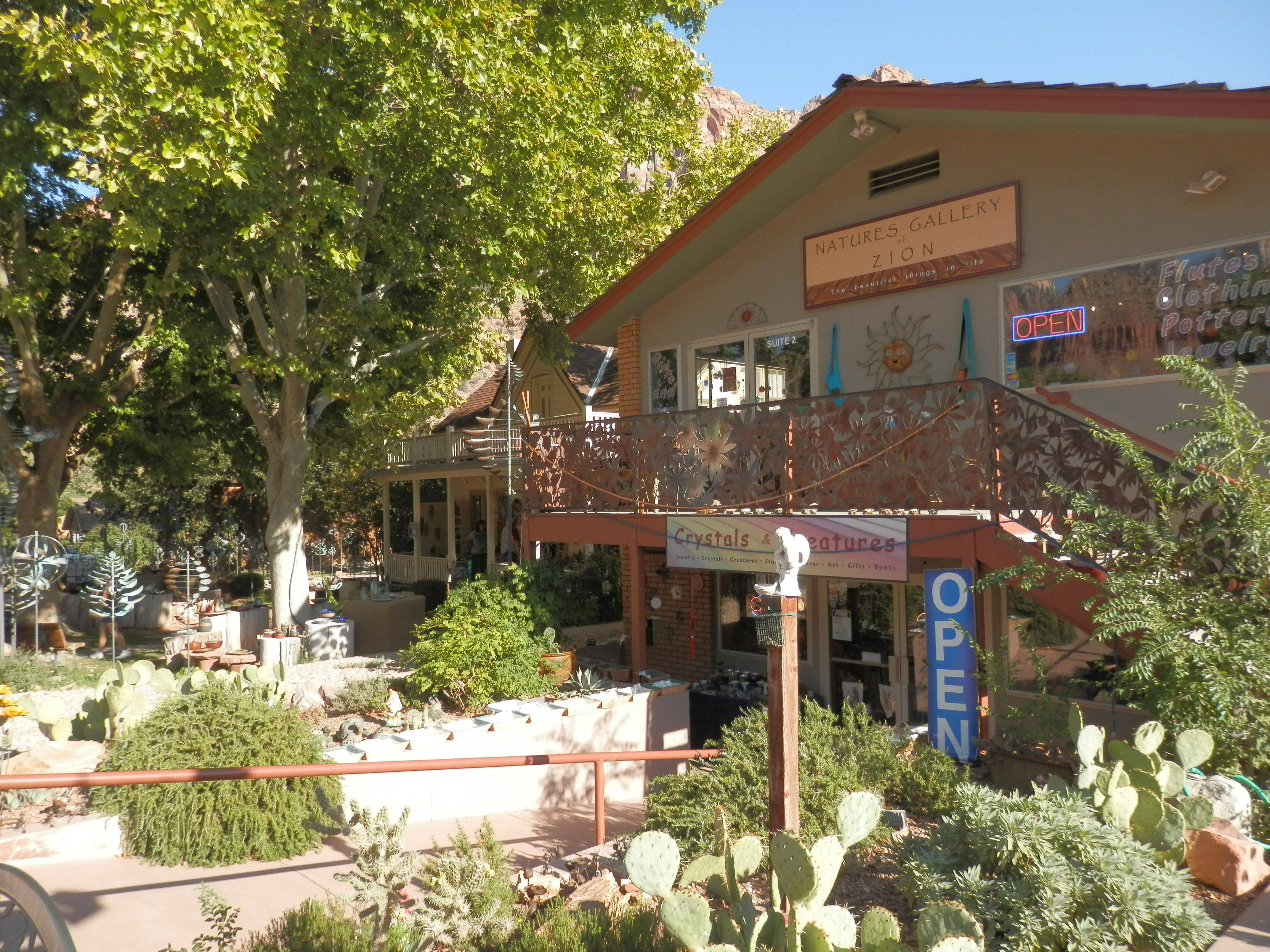
We called at Springdale on our return to the motel and found it an urbane and attractive town.  Were we to visit again this would be our base. We could not resist the Bumbleberry Inn where we rewarded ourselves for our strenuous walking all day with a slice of the “famous” (how is everything “famous” or even “world famous” in America?) bumbleberry pie. It might not truly be famous but it was delicious. Apparently, they grow on giggle bushes, which is pretty cute.

The gourmet evening was completed by a Domino’s pizza and wedges back in Hurricane – across the road from the infamous Barista’s – washed down by beer from the local gas station. Wine remained out of the question.

The road to Panguitch, Utah beckoned the next morning, where the story will continue.

Read Full Post »


One of the most distinctive landmarks on the San Franciscan horizon, visible from most of the eastern half of the city, is 210 foot high Coit Tower on top of Telegraph Hill.

This is the story of the eccentric woman whose lifelong dedication to the city’s firefighters culminated in bequeathing a third of her fortune for its construction.

Lillian Hitchcock was born on 23 August 1843 at West Point, New York, the only child of Martha and Dr Charles M Hitchcock, a distinguished army surgeon, who had operated on the leg of Colonel Jefferson Davis. She moved with her parents to San Francisco in 1851.

Two days before Christmas that year she was rescued from the upper floor of the hotel in which she and her father were staying. Thanks to the firefighters from Knickerbocker Engine Company No.5. she was unharmed, fuelling a lifetime’s devotion to the same crew in their red shirts and war-like helmets.

This was in an era when fire carriages were designed to be pulled by hand. Firefighters lined up along a rope and pulled, like tug-of-war teams, in order to haul their engine to the fire. They would often be in competition with other companies to get to the blaze first. Such was the case when “Lillie” first saw her opportunity to repay “her men” for saving her when she was only eight years old.

Seven years after that event, the pretty, tomboyish 15 year old was walking home from school when she spied an underhanded Knickerbocker Engine Company No. 5 falling behind the Manhattan No. 2 and Howard No. 3 companies in responding to a fire call on Telegraph Hill.

Intelligent and quick-witted, Lillie hurled her school books to the ground nd rushed to help, finding a vacant position on the rope and calling out to other bystanders to help get the engine up the hill.  Largely through her intervention, No.5 was the first to the fire.

Frederick J. Bowlen, Battalion Chief of the San Francisco Fire Department (SFFD), wrote that it “was the story of Jeanne d’Arc at Orleans, The Maid of Saragossa and the Molly Pitcher of Revolutionary fame all over again” as she “exerted her feeble strength and began to pull, at the same time turning her flushed face to the bystanders and calling “Come on you men! Everybody pull and we’ll beat ‘em!”

From then Lillie became the Knickerbocker Engine Company No.5 mascot and honorary firefighter, swinging into action at the sound of every bell. She was elected an honorary member of the company on 3 October 1863, making her the only woman in the US to belong to a volunteer fire station. Her energy and speed were the envy of even the fittest of firemen. She rode frequently with No. 5, especially in street parades and other celebrations, bedecked in flowers and flags.

She wore a diamond-studded fireman’s badge reading “No.5” for the remainder of her life, started signing her name with a 5 after it, and even had its emblem embroidered on her bedsheets (some have suggested her undergarments too!). If a fireman fell ill she would sit with him in his sickroom, and provide floral tributes for the families of those who died.

By the age of 18 she was the “undisputed belle” of San Francisco according to Chief Bowlen.

Stories abound about her eccentric lifestyle. She was believed to have been engaged at one point to two men, wearing their engagement rings on alternate days. But she had resolved to marry wealthy easterner Howard Coit, a caller at the San Francisco Stock and Bond Exchange. Even after they had tied the knot in 1868, she continued to attend firemen’s balls and played poker with the men who nicknamed her “Firebell Lil”? She smoked cigars and wore trousers long before it was socially acceptable for women to do so, gaining her access to men-only establishments in North Beach. She is reputed even to have shaved her head to make the wigs fit better.

Her position in polite society did not prevent her from following her heart and dashing from parties and weddings in her barouche at the call of the doleful clang of a fire engine. Embarassing though this was for her respectable husband, she was generally regarded as an amiable eccentric and ladies either ignored or humoured her.

She was an “accomplished singer, dancer and guitarist” and enjoyed fine food, dining often at the famous French restaurant The Poodle Dog. She also kept her own recipe book.

Like her North Carolina mother, she was a southern sympathiser during the Civil War, spending the early war years there before moving to Paris where she became a notable figure at the court of Napoleon III, on one occasion marching into a prestigious masked ball dressed head to toe as a firefighter. She also travelled extensively in the east, particularly India, where she befriended the Maharaj.

But the lure of her adopted city, and in particularly its firefighters, was too much and she always returned to it, often bringing with her gifts from her regal contacts, notably rare gems, objets d’art and souvenirs.

Her long-suffering husband died in 1885, leaving a $250,000 estate. This was the trigger for Lillie to return to her wilder days, accompanying five men on an overnight camping trip and disguising herself as a man in order to lurk around the grubbiest dives at the waterfront.

Anxious to witness a prize fight she arranged for a pair of boxers to perform for her in her suite in the grand and elegant Palace Hotel in which she spent much of her later years. After she had the room cleared of furniture and breakables, the two men stripped and begun to pummel each other. Lillie watched this perched on a plush chair atop a table. After several rounds, and as the men had hit each other to a virtual standstill, the referee pleaded that the match be declared a draw, to which Lille retorted they should continue until a “bloody knockout”. The Boston Globe hailed the event as “pioneering a new way of life for women” but the New York Globe was appalled, labelling it a “staggering shock”.

In 1904 a distant cousin, angered by her refusal to let him manage her financial affairs, broke into her room whilst she was entertaining a Major McClurry with the intention of killing her. McClurry stepped in and saved Lillie but was injured and died of his wounds. With the scandal still fresh, she left San Francisco and spent the last two decades of her life abroad.

She inherited a further $60,000 and property from her grandfather.

She died on 22 July 1929 at the Dante Sanatorium in San Francisco, bequeathing the city $118,000 (estimates vary from $100,000 to $125,000) to “be expended in an appropriate manner for the purpose of adding to the beauty of the city I have always loved”.

After lengthy deliberation, during which two of its members resigned on the grounds that Lillie had actually hated towers, the Coit Advisory Committee used the funds to build Coit Tower on the site of the first west coast telegraph 5 years later.  In addition, it also erected the statue of three firefighters, one carrying a woman in his arms, that Lillie had commissioned herself, in Washington Square Park.  It is this statue that she had intended should be the one to adorn Telegraph Hill.     

Because of the association with Lillie, the shape of the tower is generally, and not unreasonably, felt to resemble a fire nozzle.  However, Arthur Brown Jnr, who also designed City Hall, refuted this suggestion. Other theories, including one not unrelated to her affection for the men she rode with, have been postulated, but none of these are any more plausible.

She remains the unofficial patron saint of all firefighters in San Francisco to this day.

Read Full Post »


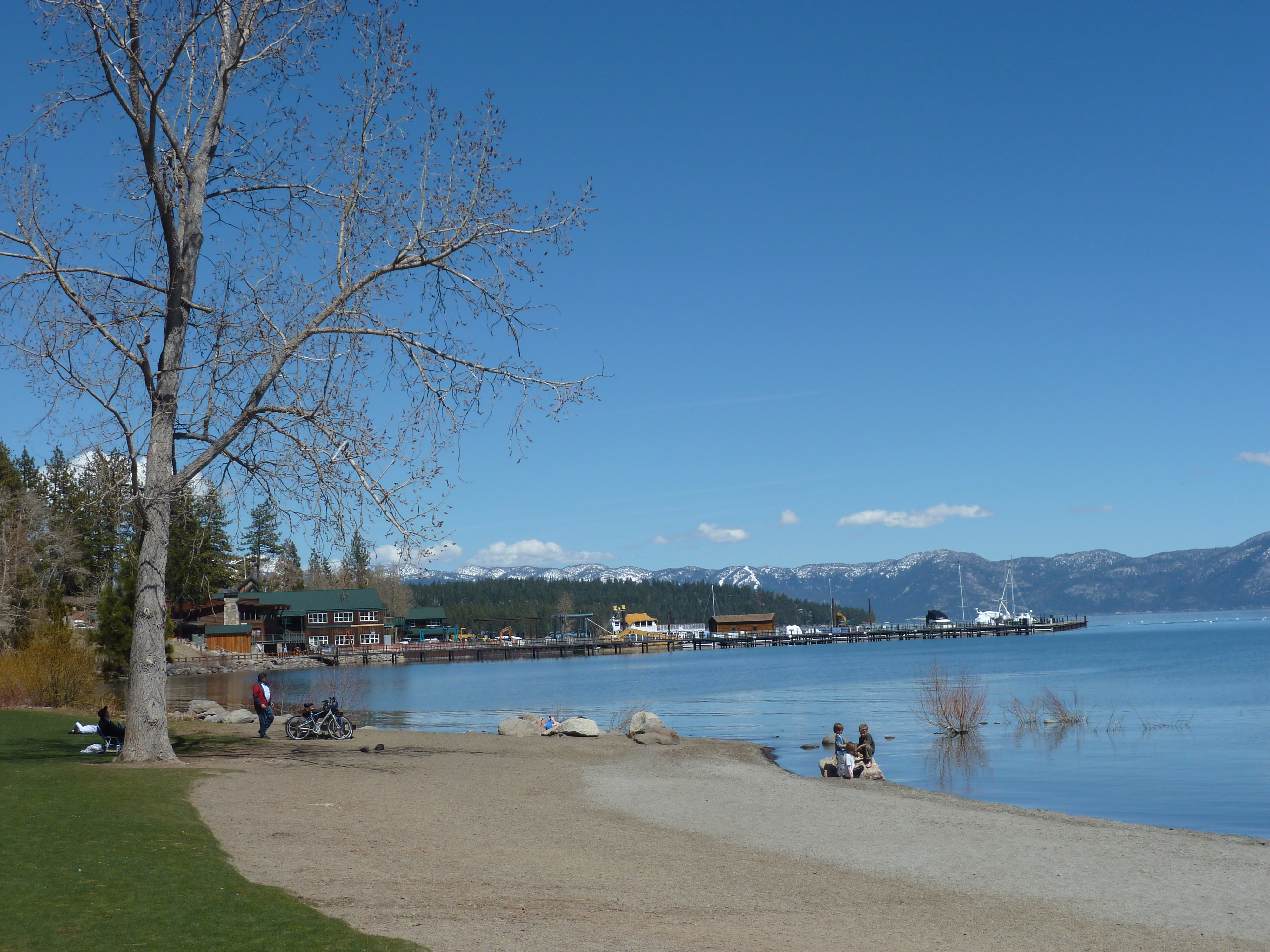
With the skiing leg of our recent trip to California decimated by illness (the subject of an upcoming post), we took the opportunity of the glorious spring weather on our last day in South Lake Tahoe to finally realise a decade long ambition of driving round the entirety the lake.

Below are some of the photos we took, which I hope provide some illustration as to why Mark Twain claimed that “it must surely be the fairest picture the whole world affords”.

Read Full Post »


I have never understood, or cared to understand, American football.  That is until last night.

Purely because of our affinity with the city of San Francisco, my wife and I had considered celebrating our first wedding anniversary at Wembley Stadium in October 2010 when the 49ers came to town with the Denver Broncos – until we saw the exorbitant prices. We went to Dublin for the weekend instead.

Last season, as dozens of others before, had completely passed me by but I have followed the upturn in their fortunes this year, if  only by casting a cursory glance at the final scores. I had also read a lot about the exploits of quarterback, Alex Smith, which reminded me of the only 49ers player from the past I could honestly claim I could remember – Joe Montana.

So as they had reached the playoffs and were live on TV last night at a manageable hour (9.30pm) – even if it meant missing The Football League Show on BBC – I decided to tune in to the final two quarters as they were leading 17-14 against the New Orleans Saints at the time. Having led 14-0 earlier in the game but the prospects for the remainder of the game did not appear promising to one unsuspecting football virgin.  However, the sight of a scarlet hued Candlestick Park convinced me to stay the course.

I can’t claim to have followed everything of what was going on, though touchdowns and field goals were at least comprehensible.  And I can appreciate a long, accurate pass and even a mighty hit (I have always enjoyed these on the ice rink).  Anyway, the third quarter passed without much incident, other than that San Francisco extended its lead to 20-14.

The margin was still 6 points (23-17) as those final 3 portentous minutes started. It appeared to me that the home side was defending with increasing desperation and, with a history of supporting sports teams who so often ripped defeat from the jaws of victory, I felt staying up until nearly 1.30am would prove ultimately futile. 

And when the Saints went 24-23 ahead, it looked all over. But then Alex Smith, who had hardly had a bad game beforehand, ran in a 28 yard touchdown (I believe that’s the correct expression).  So we’d (notice that?) won it 29-24 hadn’t we? Now, hold on a cotton picking minute (who was it used to say that, Deputy Dawg I think) – back come the Saints with a touchdown of their own to “win” it 32-29.

Glorious failure then – a not uncommon feeling for this sports fan. With 14 seconds left, and my thumb poised on the off button on the remote control, Smith calls what seems to me to be a pointless timeout.  Now this is where my ignorance of American sport kicks in. Of course I should have known that within 5 seconds he would plant the ball in the arms of the grateful, and soon to be sobbing uncontrollably, tight end, Vernon Davis, for the winning touchdown. 36-32! 

I was reminded in the midst of all this mayhem of the word “torture” that so eloquently described the San Francisco Giants march to the World Series 15 months before.

I don’t think that I will still ever develop the affiliation I now have with the city’s baseball team – you might like to read my earlier post about how I fell in love with the San Francisco Giants (www.tonyquarrington.wordpress.com/2011/05/12/bitten-by-the-giants-baseball-bug) – but I have acquired sufficient interest to prompt me to learn more about the rules and tactics, purchase some 49ers merchandise, and be there in front of the TV for the next playoff game and, of course, the Super Bowl. OK, I’m probably getting  a little ahead of myself now, but that’s what fans do don’t they?

Read Full Post »


When my wife first suggested that we celebrate our second anniversary in Barcelona, a city I had wanted to visit for some time, my thoughts immediately turned to whether the city’s premier football team would be at home on the Sunday evening (we were due to arrive in mid afternoon). And the initial signs were promising – FC Barcelona were hosting Real Mallorca on Sunday in the Camp Nou stadium.

So far, so good, although an initial scan of the seating plan indicated that, unsurprisingly, there were very few of the near 99,000 seats available, and those that were, tended to be single seats in the upper tiers.  Having resigned myself to sitting adjacent to the flight path of incoming planes, I noticed that there was still a chance, less than a month before the game, that it might be rescheduled to Saturday evening when we would be at Gatwick Airport. Apparently, this is common practice in Spain, presumably dictated to by the broadcasters.

So an anxious wait ensued, until a fortnight before we were due to go, it was confirmed that the game was being brought forward to Saturday.  To add insult to injury, with a performance described as “phenomenal”, the home side won 5-0 with the incomparable Lionel Messi “ending his goal drought” (three games!) by scoring a hat trick – and the official attendance was “only” 80,153, nearly 20,000 below capacity!  The Argentinian World Player of the Year repeated the feat three days later, on our last evening in the city, as Barca won 4-0 away to 2011 Czech League winners, Viktoria Plzen, in the UEFA Champions League.

At least we had the consolation of having booked tickets for the stadium tour, the “Camp Nou Experience”, on our last morning.  Now, the largely uncovered Camp Nou was completed in 1957 and does not possess, at least when empty, the beauty of many of the new and redeveloped stadia elsewhere in Europe.  In fact, Janet, not unreasonably, described it as “tired”.  But, with nearly 100,000 spectators on a balmy Champions League evening, there can be few venues to beat either the spectacle or atmosphere.

But the self-guided tour is excellent, including opportunities to visit pitch side as well as sit in some of the best seats in the house.  The changing rooms, press box, shop, multi-media centre and museum are equally impressive, and I could not imagine that there could be so many trophies in one place on the planet!  You can even hold the European Cup aloft and have your photo taken with your favourite player (superimposed of course) – if at a premium price.

We stayed at a new hotel in the adjoining city of L’Hospitalet de Llobregat, a mere fifteen minute ride on the efficient metro to Plaça de Catalunya in the heart of the city. We were blessed with mild, dry weather for our three night stay, though heavy colds sapped our energy and restricted our sightseeing.

With this in mind, and in view of our unfamiliarity with Barcelona, we spent the first day, our anniversary, sat atop an official sightseeing bus.  Or rather two – one exploring the west of the city and the other the east.  Amounting to more than four hours and covering every major attraction in the greater city, this was outstanding value at €23 each.

We still managed to fit in some of the more celebrated sights.  On the first evening we joined the strolling throngs on the length of La Rambla from Plaςa de Catalunya to the Mirador de Colom alongside the port.  Touristy – yes, but fun and atmospheric nonetheless.  We even ate passable tapas at one of the restaurants en route.  Our anniversary meal – seafood paella – was taken at Costa Gallega on the fashionable shopping street of Passeig de Gràcia whilst, on the final evening, we had halibut and turbot respectively at an attractive restaurant at Port Vell.

I had not come to honour Lionel Messi alone (which, in retrospect, is just as well), but also to witness some of the astonishing Art Nouveau works of Antoni Gaudí, the architect / artist synonymous with Barcelona. Large queues outside the Basilica de la  Sagrada Família and La Pedrera limited us to only exploring the interior of La Casa Battló, which was fantastical and enriching enough.  The reality of the exteriors of the other works also surpassed the photographs and films I had seen in the past.  Those other works, along with Park Güell, will certainly form the centrepiece of our next trip to the Catalan capital – along with a live game at Camp Nou of course.

Read Full Post »


It is a bright, balmy early summer’s day in Knole Park near Sevenoaks.  The 1,000 acre park not only contains the great house of the Sackville family, but one of the few remaining  medieval deer parks in England where both fallow and sika varieties roam freely.

I spot a buck that has been separated from the rest of its herd.  It does not appear overly discomfited by the human crowds. I edge towards it in pursuit of a close-up photograph as it watches me intently.  But then I discover that we are not alone.

A young girl, maybe four or five years old, in a polka dot dress is approaching it, equally cautiously, from a different angle, proffering a packet of crisps (potato chips).  Understandably, the deer’s gaze turns to her intriguing gift.

There are signs scattered around the park urging the human visitors not to feed the animal residents.  I call across to the girl to remind her that she must not feed the deer. She cannot understand why animals wouldn’t also enjoy crisps, and I try to explain the reasoning for the ruling, namely that they have their own dietary needs which are different from humans, and eating food designed for the latter might upset the delicate balance of their constitution and make them dependent upon visitors and, potentially, lead to conflict between man and beast.

The girl continues to look unconvinced whilst the buck’s increasing agitation suggests that he would welcome us coming to a mutually agreed solution sometime soon.  In response to her insistence that crisps could not possibly be harmful, I repeat my arguments.

After politely and patiently listening to this silly man’s sensible but boring explanation, she pauses and then delivers the clinching argument:

“But they are cheese and onion”.

I haven’t the heart to look back to see whether the deer prefers salt and vinegar or prawn cocktail.

But at least I got my photo.

Read Full Post »

« Newer Posts