Feeds:
Posts
Comments

Archive for the ‘Great San Franciscan Characters’ Category


Be sure of a big surprise

because that innocent looking bush of eucalyptus leaves parked near that trash can on Jefferson Street may just harbour someone loitering, waiting to scare the wits out of you.

As you saunter by admiring the bay and contemplating at which restaurant or sidewalk stand you might get your fix of crab, the self-styled World Famous Bushman is poised to spring from behind that bush or wave it in your direction, accompanying the action with sounds that have variously been described as “ugga bugga” and “arrgh….ooooo. rrrrr.uff”.

Once you have recovered from the shock and finally suppressed your giggling, the done thing is to reward his performance by placing a coin or, better still a dollar bill, in his can (though, on the evidence I have seen, this is more honoured in the breach than the observance).

OLYMPUS DIGITAL CAMERA

David Johnson – yes, he has a boring, ordinary name too – was born in Indiana where he worked as a crane operator, steel mill worker and truck driver before moving to San Francisco and setting up one of the first shoe shine stands in Market Street.  As competition for the lucrative Financial District pitches grew and he developed arthritis, he moved to.  After an unsuccessful spell as a robot (!) and discovering some fallen branches under a tree he conceived the idea for his new vocation.

Despite the fact that he has his own permit – class 7 business license number 309280 – controversy has dogged his thirty year career.  He has had several altercations with boat and restaurant owners who claimed he has been blocking the sidewalk and deflecting trade from their businesses.  This has necessitated him moving his pitch from time to time.

Among the complaints made to the police by people who have sustained injuries after being “bushed” have been the man who suffered a heart condition being “half scared to death” by him, a retired woman who fell back and twisted her ankle and another woman who jumped back and smashed her mother in the jaw.

OLYMPUS DIGITAL CAMERA

In 2004 he was acquitted of four misdemeanours by jury in the Hall of Justice and the District Attorney dropped a number of other public nuisance complaints as a result. There have even been stories – probably apocryphal – that the then Mayor Willie Brown had visited him to advise him to tone his act down, but Johnson proclaims that “they’ll have to go to the Supreme Court to make a whole new law to stop me”.

He insists that he chooses his targets carefully, claiming to avoid anyone whom he believes might be overly upset or offended by his act.  “I look at their age, their eyes, how they walk, how they breathe….it’s all in the timing”.  Whilst not excluding the elderly and disabled from his list of victims, after all they “need to laugh too”, he invariably shies away from alarming them.

Which is where the “other” Bushman comes in.

Johnson was “recruited” originally for the role by Gregory Jacobs, a part-time short order cook, who acted as his promoter and bodyguard, cracking jokes whilst he lurked behind his bush, and then collecting the tips from startled but hysterical tourists after the event.

His patter would include “Hey, the Bushman got you fair and square! Pay the man! Hey, if you’re going to take a picture, there’s a $1 photo tax.  There’s a $2 video tax”.  He would also alert Johnson to approaching seniors, cautioning against inflicting his antics on them. Jacobs claimed that he “looked after” Johnson and “watched his back”.  However, after he accused Johnson of running off with the proceeds they became sworn enemies.  The Bushman has stated that Jacobs still stalks the Wharf with his aggressive panhandling.

OLYMPUS DIGITAL CAMERA

Claiming at various times to earn between $60,000 and $90,000 in a “good year” Johnson is as proud of the contribution he makes to the economy as he is of his skill to scare people, to “snatch them right out of their bodies”.  “I’m an entertainer.  I pay my taxes. I contribute.  I give people enjoyment. What’s wrong with that”. And he has no plans to retire, vowing to carry on “until they pack dirt in my eyes”.

Nanette Thrasher, a visitor from Tulsa, summed up the view of the majority of the Bushman’s victims when she told the San Francisco Chronicle in 1999: “Sure it was worth a buck….I mean the man worked for it.  He did something.  He made an effort.  He’s not just sitting around on his butt”.

And yes, dear reader, this writer was himself taken unawares by the Bushman on his first trip in 1995.

My pride precludes me from confessing to any subsequent scarings.

Read Full Post »


San Francisco can proudly boast more than its fair share of eccentrics, but few can rival Joshua Abraham Norton, the self-proclaimed “Emperor of these United States” and “Protector of Mexico”, for their presumption, bravado and, at times, visionary genius.

Born of Jewish parents (somewhere) in London, England (sometime) between 1814 and 1819, he spent his early manhood in South Africa, serving as a colonial rifleman.  He emigrated to San Francisco in 1849 with $40,000 to his name and quickly amassed a fortune of $250,000, primarily from real estate but also from speculating in commodities. However, he lost it all when his attempts to corner the market for imported Peruvian rice (China had banned the export of their own) backfired spectacularly.  Lengthy litigation resulted in the Supreme Court of California ruling against him, forcing him to declare bankruptcy in 1853.

He fled San Francisco, only to return several years later, a changed man.  Embittered and, many might argue, severely mentally disturbed, by his earlier experiences, he spent the next two decades perpetuating a one man campaign to denounce and dissolve the nation’s political and financial infrastructure.

On 17th September 1859 he issued letters to the city’s newspapers declaring  himself “Emperor of these United States”, adding that:
“At the peremptory request and desire of a large majority of the citizens of these United States, I, Joshua Norton……….declare and proclaim myself Emperor of these United States, and in virtue of the authority thereby in me vested, do hereby order and direct the representatives of the different States of the Union to assemble in Musical Hall, of this city, on the 1st day of Feb. next, then and there to make such alterations in the existing laws of the Union as may ameliorate the evils under which the country is laboring, and thereby cause confidence to exist, both at home and abroad, in our stability and integrity”.

On 12th October he formally dissolved Congress.  Amongst his numerous subsequent decrees were an invocation to the Army to depose the elected officials of Congress, the ordering of the Roman Catholic and Protestant Churches to publicly ordain him as “Emperor” and a telegram proposal to Abraham Lincoln that he should marry Queen Victoria to cement relations between the U.S. and Great Britain. He also thought nothing of issuing orders too to the German Kaiser and Russian Czar.

And on 12th August 1869 he abolished the Democratic and Republican parties (now there’s a thought)!

One portentious pronouncement would have struck a chord later, not only with legendary San Francisco Chronicle columnist, Herb Caen, but many other San Francisco natives:

“Whoever after due and proper warning shall be heard to utter the abonimable word “Frisco”, which has no linguistic or other warrant, shall be deemed guilty of High Misdemeanour, and shall pay into the Imperial Treasury as penalty the sum of twenty-five dollars”.

Irrespective of his mental state, Norton was, at times, a real visionary and some of his “Imperial Decrees” demonstrated great prescience.  He urged the formation of a League of Nations and forbade conflict between religions.  Most dramatically, he called persistently for a suspension bridge or tunnel to be built connecting San Francisco with Oakland. Both eventually saw the light of day with the constructions of the San Francisco-Oakland Bay Bridge and the Bay Area Rapid Transit’s Transbay Tube in 1936 and 1974 respectively.

Another proclamation ordered that a huge Christmas tree should be erected in Union Square. Duly accepted, it has stood there ever since.

Each day for more than 20 years, the “Emperor” would leave his “Imperial Palace”, a minute room in a boarding house at 642, Commercial Street, to walk the streets in a grand blue uniform with brass buttons, gold-plated epaulets and royal purple sash, a beaver hat embellished by a peacock feather (his “dusty plume”) and a rosette.

He was rarely seen without his cane or umbrella as he inspected the condition of the cable cars and sidewalks, the state of public property and even the appearance of police officers. After an over-zealous young police officer had been soundly reprimanded for arresting him, and subsequently been granted an “Imperial Pardon” by Norton himself, all police officers made a point of saluting him when they met in the street.

Many cities would have persecuted, incarcerated or, at best, ridiculed him for being insane. But this was San Francisco in the full flush of post-Gold Rush glory, and the citizens loved and revered him.  He was welcomed at the best restaurants, where he would dine for free, enabling the owner thereafter to erect blass plaques proclaiming “by Appointment to his Imperial Majesty, Emperor Norton I of the United States”.

Front row balcony seats were also reserved for him at local theaters, including the Opera, where he was cheered on arrival. His active involvement in civic affairs even led to him being granted a reserved seat in the visitors’ gallery of the State Senate, from which he was occasionally invited onto the floor to speak on matters close to his heart.

He was alleged to have been accompanied often – including at the theatre – by two mongrel dogs, Bummer and Lazarus, local celebrities in their own right, whom he supplied with food scraps from the free lunch counters that he frequented.  Lazarus died after being run over by a truck of the same fire company – Knickerbocker Engine Co. No. 5 – that Lillian Coit revered and subsequently befriended. When Bummer died shortly afterwards, allegedly of a broken heart, Mark Twain wrote: “He died full of years, and honor, and disease, and fleas”. Their fame led to them posthumously being depicted in Life in San Francisco, a comic opera.

Now, he could not have been a true Emperor without the right to coin his own currency, and his “Imperial Government of Norton” notes, all bearing his royal image and ranging from 50 cents to 10 dollars, were accepted wherever he did business.  Every day he used one of his own fifty cent bills to pay for his lodgings. And when his uniform started to deteriorate, the Board of Supervisors bought him a “suitably regal replacement” and the city charter was amended to permit Norton to collect $30 annually for its replacement and repair.

On the evening of 8th January 1880, after completing his daily rounds of the city, Norton collapsed on the corner of California Street and Dupont Street (now Grant Avenue) in front of Old St. Mary’s Church as he was on his way to a lecture at the California Academy of Sciences.  He died before medical attention could arrive.

The following day the San Francisco Chronicle published his obituary on its front page under the headline “Le Roi est Mort” (“The King is Dead”).  He had died in abject poverty.  His funeral, two days later, was a sad, dignified event, honoured by the attendance of the Mayor and the playing of a military band. Upwards of 30,000 people, a seventh of the entire population of the city at the time, lined the streets to pay their respects to the two mile long funeral cortege.  The City of San Francisco and Pacific Club paid all his funeral expenses.

Mark Twain and Robert Louis Stevenson, amongst others, paid homage to Norton by modelling characters on him in Adventures of Huckleberry Finn  and The Wrecker respectively. Seventy years after his death, the Chronicle sponsored an annual treasure hunt in his name.

But perhaps his, and his adopted city’s, finest epitaph is that provided by Stevenson’s stepdaughter, Isobel Field, who wrote that he “was a gentle and kindly man, and fortunately found himself in the friendliest and most sentimental city in the world, the idea being “let him be emperor if he wants to”.  San Francisco played the game with him”.

More, in the words of John C. Ralston, a “tourist attraction in his own time” than a “significant historical figure”, there can be few lives that better personify that much-quoted phrase “Only in San Francisco”.

Postcript:

Emperor Norton Lives! Not only does he conduct walking tours of his empire but he maintains an excellent Facebook page: https://www.facebook.com/pages/Emperor-Nortons-Fantastic-San-Francisco-Time-Machine/104510419615984

Read Full Post »


Washington may have had its Art Buchwald, London its J.B. Morton (“Beachcomber”) and Dublin the mercurial Myles Na gCopaleen, but few cities can have been as fortunate as San Francisco in having a chronicler (no pun intended) as prolific, urbane and popular as Herb Caen who wrote in its daily newspapers about life in the city, for almost sixty years.  With more than 16,000 columns of over 1,000 words each, lifelong friend, author and restaurateur, Barnaby Conrad, estimated that if “laid end to end, his columns would stretch 5.6 miles, from the Ferry Building to the Golden Gate Bridge”.

Herbert Eugene Caen was born on 3rd April 1916 in Sacramento, though he claimed to have been conceived on the Marina in San Francisco during the 1915 Panama-Pacific International Exposition as his parents spent the summer there “complaining about the cold”.

He joined the Sacramento Union as a sports reporter in 1932 on graduating from high school.  Four years later he was hired to write a radio column for the San Francisco Chronicle, beginning an association that was to last for 50 of the next 61 years.

On the scrapping of the radio column he persuaded the editor, Paul Smith, that he could write a daily column on the city, and  It’s News to Me duly debuted on 5th July 1938, appearing thereafter for six days a week.

When the U.S. entered the Second World War in 1942 he joined the Air Force, assigned to communications, and reached the rank of captain.  Returning to his Chronicle column, he continued to record and comment upon the foibles of local government and personailities.

Caen often referred to San Francisco as Baghdad-by-the-Bay,  a term he coined to reflect the city’s exotic multiculturism.  A collection of his essays bearing the same title was published in 1949, going through seven printings.  In 1953 he published the book Don’t Call it Frisco after an Examiner news item of the same name on 3rd April 1918 when Judge Mogan, presiding in a divorce case, stated that “No one refers to San Francisco by that title except people from Los Angeles”.  Emperor Norton had previously raged against the use of the term and issued one of his imperial proclamations to that effect.

However, a year later, Caen left the Chronicle for higher paid work at the San Francisco Examiner, for which he worked until 1958 when he was persuaded to return to his former employer on the promise of a better salary.  His “homecoming” column was published on 15th January of that year.

In 1976 he published One Man’s San Francisco, a fine collection of some of the best writing from his columns.  In 1988, the fiftieth anniversary of the column was marked by a special edition of the Chronicle’s “Sunday Punch”.  At the age of 75 he decided to slow down by reducing his output from six to five days a week!

Caen was hugely popular and a highly influential figure in San Francisco society.  He was described by the Chronicle as a “major wit and unwavering liberal who could be charming, outspoken and, at times, disagreeable.”

He called his work “three-dot journalism”, in reference to the ellipses by which he separated his column’s short items, all composed on his “Loyal Royal” typewriter.

His writing was imbued with a gentle, dry wit and an intimate knowledge of the politics, society and culture of his adopted city and the wider Bay Area. Hardly a show, party or any other significant event in San Francisco was complete without Caen’s gregarious presence, and his clever, sometimes acerbic, comments on it the next morning in his column.  Conrad said that “he seemed to know everyone in the world; he somehow made them honorary San Franciscans and let us, his readers, have the privilege of knowing them, too”.

His witticisms and plays on words would fill another ten features, but here are a few:

  • “the trouble with born-again Christians is that they are an even bigger pain the second time around”;
  • “I tend to live in the past because most of my life is there”;
  • “cockroaches and socialites are the only things that can stay up all night and eat anything”; and
  • “the only thing wrong with immortality is that it tends to go on forever”.

The Bay Bridge was “the car-strangled spanner”, City Hall “Silly Hall” and Berkeley was “Berserkeley”.

Whilst many of his invented words have passed into history, others have become not only synonymous with San Francisco but entered the everyday language.  On 2nd April 1958, in a Pocketful of Notes, he reported on a party hosted by 50 “Beatniks” which spread to “over 250 bearded cats and kits”.  This is the first known use of the word.  And during the Summer of Love in 1967 he contributed more than anybody to popularising the term “hippie”.

In 1996 he was the recipient of a special award from the Pulitzer Prize Board which acclaimed his “extraordinary and continuing contribution as a voice and conscience of the city”.  On 14th June of the same year 75,000 people, including Walter Cronkite, Robin Williams, Willie Mays, Don  Johnson and Mayor Willie Brown who presided over the event, celebrated Herb Caen Day.

He espoused many liberal causes over his career, including a life long opposition to the death penalty.  He was also one of the first mainstream newspaper men to question the Vietnam War.  But it is to his beloved San Francisco that we return for one of his most passionate campaigns, namely to have the hideous and excessively busy Embarcadero Freeway, or “Dambarcadero” as he called it, demolished.  Success came, but from an unexpected source.  The Loma Prieta earthquake in 1989 damaged it so severely that the decision was taken to pull it all down.  A three mile sweep  of the Embarcadero is now named “Herb Caen Way” in his honour.  The wide promenade is the most eastern street in San Francisco, curving round its northeast corner, proceeding along the waterfront, and ending near AT & T Park, home of the San Francisco Giants, the team Caen adored.

Despite a terminal lung-cancer diagnosis, Caen continued to write almost until his death on 1st February 1997, though his output understandably shrunk over time. His funeral six days later was held in the Grace Cathedral on Nob Hill, attended by 250 people with hundreds more outside listening to the hymns and eulogies over loudspeaker.

Caen had willed to the city a fireworks display which was given in Aquatic Park in front of Ghiradelli Square, concluding with a pyrotechnic image of a typewriter on the bay.  This tribute was attended by many of his friends and fans, who gathered on Herb Caen Way… on the Embarcadero, lit candles protected from the wind by dixie cups, and walked north along the waterfront to Aquatic Park.

And all this for a local hack!

John Steinbeck wrote that he “made a many-faceted character of the city of San Francisco….It is very probable that Herb’s city will be the one that is remembered”.

But the last fitting words should be left to Caen himself:

“One day if I go to heaven…I’ll look around and say ‘It ain’t bad, but it ain’t San Francisco'”.

Read Full Post »


Those “little cable cars” climbing “halfway to the stars” are one of the best loved and most iconic experiences for any visitor to San Francisco.  But few tourists hanging onto that lead rail as the Powell-Hyde car plunges down to the bay, or commuters perched atop Nob Hill on a California Street car about to sweep past the swanky hotels en route to the Financial District, will be aware that there was a time, shortly after the Second World War, when they became an endangered species.  Or even less so of the fact that they were saved for future generations through the foresight and resilience of a genteel, middle-aged lady from the eastern slopes of Telegraph Hill.

P1000416

The devastating earthquake and fire of 1906 destroyed much of the cable car system and triggered the rapid expansion in construction of electric streetcars with overhead wires, the first of which had been built in 1892.  And once it had been shown that the latest municipal buses, unlike the streetcars, could negotiate the steep hills, the continued viability of Andrew Hallidie’s invention was called into sharp focus.

By 1944 there were only five lines left in operation – the three independently owned by the California  Street Cable Railroad (Cal Cable) and the Powell-Mason and Washington-Jackson lines owned by the San Francisco Municipal Railway (Muni).

On 27th January 1947, in his annual message to the Board of Supervisors, Mayor Roger Lapham, a New York businessman who had been elected with a mandate to streamline the city’s finances, announced that the “city should get rid of its cable cars as soon as possible”, claiming that they were losing $200,000 a year.

Lapham’s vision of “super buses” replacing the cable cars met with little public favour, and the San Francisco Chronicle encapsulated the opposition’s argument in its editorial of 3rd February when it wrote that: “bus lines would be a good deal less expensive. But against this saving should be weighted………the market value of an institution which helps make the city stand out among cities of the world”.

Klussmann

But the strongest advocate for their retention came in the unlikely form of prominent socialite, Mrs Friedel Klussmann, who, outraged by this pronouncement, immediately began to mobilise opposition through the equally improbable auspices of the California Spring Blossom and Wildflowers Association and the San Francisco Federation of the Arts.

On 4th March, within sight of the Mayor’s office, she held a joint meeting attended by leaders of 27 women’s civic groups and formed a Citizen’s Committee to Save the Cable Cars, collecting more than 1,000 signatures in the first four hours of its campaign for an initiative charter amendment, a figure that was to rise to 50,000 by the end of the battle with City Hall. Despite the increasingly desperate arguments emanating from the Mayor’s office, the Board of Supervisors voted 7 to 4 to place Measure 10 on the November ballot.

Neither Mrs Klussmann nor her Committee were mere soft-hearted sentimentalists, and they put forth a robust rebuttal of the economic argument for closure in a detailed press release that spoke about the “$34,630,522 of new money” generated by tourism in the previous year, adding that San Francisco “is constantly striving to interest the rest of the world in its historical and colorful background, of which the cable cars are the No.1 attraction”.  The loss of the Powell and Market turnaround would be a blow to the city’s identity that “cannot be measured”.

P1000407

As Life Magazine put in in its 24th February edition: “It was as though Venice had proposed ridding itself of its gondolas”.  Visiting celebrities, including Elenor Roosevelt, publicly endorsed Mrs Klussmann’s campaign.  Newspapers were inundated with letters of support for the cable cars and accounts from passengers of their grim experiences waiting for and riding buses.

Measure 10 compelling the City to maintain and operate the existing cable car system was passed overwhelmingly by 166,989 votes to 51,457.  In her victory statement Mrs Klussmann said: “It is wonderful to know that San Franciscans appreciate their famous, efficient and safe cable cars”.  The Committee was galvanised again in 1950, 1951, 1954 and 1971 to fight further cost-cutting measures, with modest success.

OLYMPUS DIGITAL CAMERA

In the same year Mrs Klussmann also founded San Francisco Beautiful (www.sfbeautiful.org), the “only organisation in San Francisco whose sole purpose is to protect and enhance the city’s urban environment”, working to “improve the quality of daily life, strengthen communities and empower citizens to maintain the character of the city’s parks, neighbourhoods and streets”.  It continues to do excellent work today, not least through its Friedel Klussmann grants made to organisations that “seek to maintain or enhance San Francisco’s unique beauty and livability”.

When she died at the age of 90 in 1986 the cable cars were decorated in black in her memory.  On 4th March 1997, the fiftieth anniversary of the Committee’s initial meeting outside City Hall, the Friends of the Cable Car Museum dedicated a mural to Mrs Klussmann at the cable car barn.  The turntable at the outer terminal of the Powell-Hyde line was also dedicated to her.

So next time, dear visitor, when you skirt the ridge of Russian Hill on a clanking, rumbling Powell-Hyde cable car and catch your breath at the bay vista spread out before you, spare a thought for the prosperous, middle-aged lady, whose vision and courage sixty years ago ensured that you can have those unforgettable experiences today.

P1010990

I am particularly indebted to Walter Rice and Val Lupiz’s excellent article The Cable Car and the Mayor (www.cable-car-guy.com/html/cclm.html#top) for much of the detail provided above.

Read Full Post »


San Francisco can claim more than its share of personalities who have changed the course of society and popular culture, and Carol Ann Doda ranks high on that list.

She was born on 29 August 1937 in Solano County, California, and grew up in Napa.  Her parents divorced when she was three. She dropped out of school and became a cocktail waitress and lounge entertainer at aged 14.

Described as a “lovely, busty and curvaceous blonde bombshell” she achieved fame, or notoriety depending upon your point of view, on 19 June 1964 at the Condor Club at the corner of Broadway and Columbus in North Beachby dancing in a topless swimsuit, the first recognised entertainer of the era to do so, and spawning similar exhibitionism across the country. In fact, within 48 hours, the neighbouring bars had also gone topless, and at one point, 28 clubs along the Broadway strip were advertising bare-breasted dancers.

Her act, which she performed twelve times nightly, “began with a grand piano lowered from the ceiling by hydraulic motors;  Doda would be atop the piano dancing.  She descended from a hole in the ceiling.  She go-go danced the Swim to a rock and roll combo headed by Bobby Freeman as her piano settled on the stage.  From the waist up Doda emulated aquatic movements like the Australian crawl.  She also performed the Twist, the Frug and the Watusi“, all dances familiar to those of us growing up in the sixties.

She later spent $20,000 on enhancing her bust size from 34B to 44DD through a total of 44 (“just a coincidence” she said) direct silicone injections (now illegal because the plastic tends to migrate), earning her breasts the nickname of “the new Twin Peaks of San Francisco”.  She had them insured for $1.5 million with Lloyd’s of London, but never had recourse to claim on it. In his 1968 book, The Pump House Gang, Tom Wolfe referred to them as “two incredible mammiform protrusions, no mere pliable mass of feminine tissues and fats there but living arterial sculpture – viscera spigot – great blown-up aureate morning glories”.

Such was her popularity that delegates from the 1964 Republican National Convention flocked to see her and, four years later, she was given a film role as Sally Silicone in Head, created by Jack Nicholson and Bob Rafelson, and featuring The Monkees.  She appeared in another six films. The U.S.S. Kittyhawk aircraft carrier named her Pinup Girl of the Year and she even received a Business Person of the Year award from Harvard.

Doda created a further seismic impact in the entertainment industry on 3 September 1969 by dancing completely naked at the Condor, though she was obliged to reinstate the bottom part of her costume in 1972 after the California alcoholic beverages commission prohibited nude dancing in establishments that served alcohol.

She explained that “even in liberal San Francisco, what I did was technically a crime. The cops raided. The owner and I ended up in the slammer. I was back slamming on stage in two shakes of a stripper’s tail”.

In an interview with the San Francisco Chronicle in October 2011 Doda stated that she only caused a scandal “about a year and a half after I started, because the cops came in and said no more bottomless unless  you move the tables back 5 feet. I had to explain to the people we can’t do bottomless and topless because the health department folks are afraid our pubic hairs will jump into your drinks”.

As a witness during the trial of two completely naked dancers at the pink pussy Kat in Orangevale, California, arrested for “indecent exposure and lewd and dissolute conduct”, she performed to live song and dance numbers and a 17 minute movie entitled Guru You, at the Chuck Landis Largo Club in Sunset Boulevard, Los Angeles, which was set up as a temporary courtroom. Cross-examined by a deputy district attorney, Carol, dressed in a red miniskirt with blue piping and beige boots, explained that her act, rather than being pornographic in itself, represented a a satire on it, “to show people the humourous side of sex”.

She also became a spokesperson for Channel 36, now known as KGSC-TV, in San Jose when, filmed from the waist up and wearing clothes, she’d intone “you’re watching the perfect 36” (there was no channel 44 at the time).

Doda returned to dancing at the Condor three times a night in 1982, at the age of 45, performing to blues, ragtime and rock ‘n’ roll, dressed “in a gold gown, traditional elbow-length gloves, and a diaphanous-wraparound.  Her clothing was removed until she wore only a G-string and the wraparound.  In the final portion she was attired in only the wraparound.  Her small body looked slimmer without clothes which was emphasised by the dwarfing effect of her breasts”.

Despite the notoriety she earned by being the first dancer to break the topless / bottomless taboos in the U.S., her act was rarely regarded as sleazy.  As she herself said: “I always just wanted to give people a good time, have fun.  Nothing really dirty – just fun”.

Larry Inla, who spent most of 1966 playing in a band called Stark Naked and the Car Thieves at the Galaxy, a couple of blocks from the Condor, reiterates this point, recalling that, thanks in no small part (sic) to Carol, “it was a fantastic place at an incredible time” and that the “ambience was more naughty-but-nice, in a sophisticated European city kind of way, not a sleazy, dirty kind of way”.

Retiring from stripping later in her mid forties (“you can’t go on stripping forever”), she formed her own rock band, the Lucky Stiffs, with whom she played for several years.

Doda now runs the highly respectable “Carol Doda’s Champagne and Lace Lingerie Boutique” in a pretty courtyard at 1850 Union Street in Cow Hollow, which she opened after San Francisco Chronicle columnist, Herb Caen, who was a clear fan, announced in the paper that she was going to do so. She specialises in “plus” sizes and waits on customers personally. She takes particular pride in being recommended by Macy’s, Nordstrom, Sacs, Neiman-Marcus and bridal stores who can’t cater for larger sizes.

Well into the new millennium, she has continued to put ten years of voice training to good effect by singing, whilst fully clothed, club standards like All of Me  at a variety of North Beach clubs, including Amante’s and Enrico’s Supper Club. In late 2011, at the age of 74, she was still performing at Gino and Carlo’s Bar on Green Street in North Beach, where she had been for around twelve years.

And finally, in a city with high foodie credentials, she has been truly immortalised in having a gourmet hamburger named after her at Bill’s Place at 2315 Clement at 24th in the Outer Richmond! Unsurprisingly, it consists of “two third of a pound plus hamburger patties served side by side on a sesame seed bun, each patty topped with an olive and full garnish on the side”.

Read Full Post »


One of the most distinctive landmarks on the San Franciscan horizon, visible from most of the eastern half of the city, is 210 foot high Coit Tower on top of Telegraph Hill.

This is the story of the eccentric woman whose lifelong dedication to the city’s firefighters culminated in bequeathing a third of her fortune for its construction.

Lillian Hitchcock was born on 23 August 1843 at West Point, New York, the only child of Martha and Dr Charles M Hitchcock, a distinguished army surgeon, who had operated on the leg of Colonel Jefferson Davis. She moved with her parents to San Francisco in 1851.

Two days before Christmas that year she was rescued from the upper floor of the hotel in which she and her father were staying. Thanks to the firefighters from Knickerbocker Engine Company No.5. she was unharmed, fuelling a lifetime’s devotion to the same crew in their red shirts and war-like helmets.

This was in an era when fire carriages were designed to be pulled by hand. Firefighters lined up along a rope and pulled, like tug-of-war teams, in order to haul their engine to the fire. They would often be in competition with other companies to get to the blaze first. Such was the case when “Lillie” first saw her opportunity to repay “her men” for saving her when she was only eight years old.

Seven years after that event, the pretty, tomboyish 15 year old was walking home from school when she spied an underhanded Knickerbocker Engine Company No. 5 falling behind the Manhattan No. 2 and Howard No. 3 companies in responding to a fire call on Telegraph Hill.

Intelligent and quick-witted, Lillie hurled her school books to the ground nd rushed to help, finding a vacant position on the rope and calling out to other bystanders to help get the engine up the hill.  Largely through her intervention, No.5 was the first to the fire.

Frederick J. Bowlen, Battalion Chief of the San Francisco Fire Department (SFFD), wrote that it “was the story of Jeanne d’Arc at Orleans, The Maid of Saragossa and the Molly Pitcher of Revolutionary fame all over again” as she “exerted her feeble strength and began to pull, at the same time turning her flushed face to the bystanders and calling “Come on you men! Everybody pull and we’ll beat ‘em!”

From then Lillie became the Knickerbocker Engine Company No.5 mascot and honorary firefighter, swinging into action at the sound of every bell. She was elected an honorary member of the company on 3 October 1863, making her the only woman in the US to belong to a volunteer fire station. Her energy and speed were the envy of even the fittest of firemen. She rode frequently with No. 5, especially in street parades and other celebrations, bedecked in flowers and flags.

She wore a diamond-studded fireman’s badge reading “No.5” for the remainder of her life, started signing her name with a 5 after it, and even had its emblem embroidered on her bedsheets (some have suggested her undergarments too!). If a fireman fell ill she would sit with him in his sickroom, and provide floral tributes for the families of those who died.

By the age of 18 she was the “undisputed belle” of San Francisco according to Chief Bowlen.

Stories abound about her eccentric lifestyle. She was believed to have been engaged at one point to two men, wearing their engagement rings on alternate days. But she had resolved to marry wealthy easterner Howard Coit, a caller at the San Francisco Stock and Bond Exchange. Even after they had tied the knot in 1868, she continued to attend firemen’s balls and played poker with the men who nicknamed her “Firebell Lil”? She smoked cigars and wore trousers long before it was socially acceptable for women to do so, gaining her access to men-only establishments in North Beach. She is reputed even to have shaved her head to make the wigs fit better.

Her position in polite society did not prevent her from following her heart and dashing from parties and weddings in her barouche at the call of the doleful clang of a fire engine. Embarassing though this was for her respectable husband, she was generally regarded as an amiable eccentric and ladies either ignored or humoured her.

She was an “accomplished singer, dancer and guitarist” and enjoyed fine food, dining often at the famous French restaurant The Poodle Dog. She also kept her own recipe book.

Like her North Carolina mother, she was a southern sympathiser during the Civil War, spending the early war years there before moving to Paris where she became a notable figure at the court of Napoleon III, on one occasion marching into a prestigious masked ball dressed head to toe as a firefighter. She also travelled extensively in the east, particularly India, where she befriended the Maharaj.

But the lure of her adopted city, and in particularly its firefighters, was too much and she always returned to it, often bringing with her gifts from her regal contacts, notably rare gems, objets d’art and souvenirs.

Her long-suffering husband died in 1885, leaving a $250,000 estate. This was the trigger for Lillie to return to her wilder days, accompanying five men on an overnight camping trip and disguising herself as a man in order to lurk around the grubbiest dives at the waterfront.

Anxious to witness a prize fight she arranged for a pair of boxers to perform for her in her suite in the grand and elegant Palace Hotel in which she spent much of her later years. After she had the room cleared of furniture and breakables, the two men stripped and begun to pummel each other. Lillie watched this perched on a plush chair atop a table. After several rounds, and as the men had hit each other to a virtual standstill, the referee pleaded that the match be declared a draw, to which Lille retorted they should continue until a “bloody knockout”. The Boston Globe hailed the event as “pioneering a new way of life for women” but the New York Globe was appalled, labelling it a “staggering shock”.

In 1904 a distant cousin, angered by her refusal to let him manage her financial affairs, broke into her room whilst she was entertaining a Major McClurry with the intention of killing her. McClurry stepped in and saved Lillie but was injured and died of his wounds. With the scandal still fresh, she left San Francisco and spent the last two decades of her life abroad.

She inherited a further $60,000 and property from her grandfather.

She died on 22 July 1929 at the Dante Sanatorium in San Francisco, bequeathing the city $118,000 (estimates vary from $100,000 to $125,000) to “be expended in an appropriate manner for the purpose of adding to the beauty of the city I have always loved”.

After lengthy deliberation, during which two of its members resigned on the grounds that Lillie had actually hated towers, the Coit Advisory Committee used the funds to build Coit Tower on the site of the first west coast telegraph 5 years later.  In addition, it also erected the statue of three firefighters, one carrying a woman in his arms, that Lillie had commissioned herself, in Washington Square Park.  It is this statue that she had intended should be the one to adorn Telegraph Hill.     

Because of the association with Lillie, the shape of the tower is generally, and not unreasonably, felt to resemble a fire nozzle.  However, Arthur Brown Jnr, who also designed City Hall, refuted this suggestion. Other theories, including one not unrelated to her affection for the men she rode with, have been postulated, but none of these are any more plausible.

She remains the unofficial patron saint of all firefighters in San Francisco to this day.

Read Full Post »


Having now posted the 16th article in the series, I think it is time to review the role of the “Great San Franciscan Characters” in my overall writing strategy. 

In my penultimate post of the last year (www.tonyquarrington.wordpress.com/2011/12/30/99-not-out) I stated that not only would I be reinforcing the San Francisco theme of the blog, but also “working on more substantial, long term projects”.  One of those projects relates to this series. It had always been my intention that the material it contains might ultimately, with a fair wind, develop into a firm book proposal.  

Now if I am to make that a reality, and preserve the integrity of the subject matter, I will have to curtail publication of any more “chapters”, or else the book will already be in the public domain and available for free! Moreover, having read through a number of the preceding articles, I feel there is a clear need for significant revision, both to improve the quality of the individual articles and to ensure a coherent style and approach to the whole.  

So apologies for anyone who was actually enjoying the series.  I hope I can replace it on the blog with (equally) interesting and entertaining pieces.

Now Lillie Hitchcock Coit and Joe Montana are calling.

Read Full Post »


“But soft, what light through yonder window breaks? It is the east and Juliet is the sun”.

Even those with the most basic knowledge of, or interest in, Shakespeare, will be familiar with these words from Romeo and Juliet. Of course, they are uttered by Romeo in the famous balcony scene in Act 2.

However, the scene before us is no Royal Shakespeare Company production in Stratford-upon-Avon but a gambling palace turned melodeon or music hall called the Bella Union, located at Washington and Kearney Streets in late nineteenth century San Francisco. 

And our “star-cross’d” lovers are not Laurence Olivier and Vivien Leigh, or even Leonard Whiting and Olivia Hussey, but a baseball bat wielding wild man and a 20 stone woman of whom it could not have been said for at least 30 years that she was “not yet fourteen”.  The incongruity does not end there – because of her bulk she cannot be trusted not to demolish the balcony the moment that she steps on to it, so she is placed centre stage whilst Romeo growls his immortal words from the balcony instead.

Romeo is played by Oofty Goofty, whom we have met already in this series (www.tonyquarrington.wordpress.com/2011/05/17/great-san-franciscan-characters-12-oofty-goofty)   And his “all-seeing sun” was portrayed by Big Bertha, a wealthy woman with a dubious past.  Their performances are the talk of the town, although Oofty’s violent displays leave Bertha “covered with bruises from head to toe” every night, leading to her vowing never to play the part again.

Big Bertha, who is described by Herbert Asbury in his splendid The Barbary Coast as a “sprightly lass of 280 pounds”, had first appeared in the city in the mid 1880s claiming to be a wealthy Jewish widow in search of a man to help protect her fortune.  In order to test any suitor’s value and good faith, she required him to hand over to her a sum of money that she would then double and risk on an unnamed investment. 

This worked so successfully that she “collected several thousand dollars from a score of lovelorn males, not a penny of which was ever seen again by its rightful owner”. Although she was eventually arrested for a succession of such scams, none of her victims had the courage to charge her for fear of public humiliation. She was released on nominal bail and the case against her dropped.

She now decided to turn her attentions to a stage career, approaching Ned Foster and Jach Hallinan, managers of the Bella Union and Cremorne melodeons respectively. Recognising her potential they hired her immediately under joint management and put her on display in an empty storefront on Market Street. Dubbed the “Queen of the Confidence Women”, for ten cents she would, at regular intervals, rise from her reinforced chair and recount the list of dreadful crimes that she had committed in San Francisco and other cities, “embellishing her account with many vivid details”. 

She would then regale the assembled throng with horribly off key renditions of the only two songs she ever knew: A Flower from my Angel Mother’s Grave” and The Cabin Where the Old Folks Died. This proved so popular that, after a brief engagement at Bottle Koenig’s, where her erstwhile Romeo had also performed briefly, her act transferred to the Bella Union stage and converted into what became an equally celebrated song and dance revue in which she sang “sentimental ballads in a squeaky voice”.    

Aside from the Romeo and Juliet farce, Bertha was involved in one other crazy theatrical moment. She was cast in Byron’s Malzeppa as the eponymous hero strapped to a horse or, in her case, donkey as punishment for having an affair with a young countess. Her entrance always drew ecstatic applause, but one evening it all went horribly wrong.

Wilting under the nightly strain of carrying Bertha, the donkey lost its footing and crashed into the orchestra pit, taking the massively proportioned Bertha with it.  The musicians’ reaction has not been preserved for posterity but it is not unreasonable to speculate that their language was not equally as colourful as that bellowing from the lips of the hero / heroine’s. Neither can I report whether the hapless donkey sustained any lasting injury.

But it did herald the end of Bertha’s bizarre acting career, who confined herself to singing and, on occasions, dancing. This proved more successful, culminating in her wrestling ownership and management of the Bella Union in 1895. However, restrictions placed on the sale of liquor three years previously eventually forced her to sell up and leave.  And that is the last we hear of her.

“So please you, let me now be left alone”.  

Read Full Post »


“King of the Crimps”, James “Shanghai” Kelly was not, as you might have thought, a world renowned hairdresser or Vegas high roller but a notorious criminal in 19th century San Francisco. Crimping, or shanghaiing, was the practice of kidnapping men and forcing them to work on ships, and Kelly was the undisputed master of the art.

He was, as described by Herbert Asbury in his excellent “The Barbary Coast – An Informal History of the San Francisco Underworld”, a “short, thick-set Irishman, with flaming red hair, a bristling red beard, and an irascible disposition”.  Seduced, like many of his contemporaries, by the prospect of great wealth as a result of the 1848 Gold Rush in California, he fled to San Francisco where he immediately established a three-storey sailors’ boardinghouse at 33 Pacific Street, between Drum and Davis Streets, in the heart of the area known as the Barbary Coast.  However, this was essentially a “front” for his unscrupulous but lucrative business of supplying sea captains with men to fill boats rendered increasingly empty by the desertion inland of prospective crew members to seek their fortune.

Kelly satisfied the ship captains’ need by arranging for runners to row out to arriving ships and offer free drink and other inducements to frequent his  boardinghouse and saloons. Once there, the unsuspecting sailors would be drugged with the “Miss Piggott Special”, his own cocktail of schnapps and beer spiked with opium, laudanum or chloral hydrate. The “Shanghai smoke”, a cigar heavily laced with opium, would follow, and that lethal combination failed to render them unconscious then they would be hit on the head” As one historian put it: “the tools of his trade were knock-out drops and a blackjack”.

Once divested of their belongings – including their clothes – they were wrapped in a blanket, lowered through one of three trapdoors in the front of the bar and rowed out to a waiting vessel. The captain paid the crimp the agreed fee, hauled anchor, and set sail. When the sailors regained consciousness, they were well out to sea – heading to such faraway destinations as Shanghai.

His pre-eminence in the crimping game was most dramatically illustrated in what has become known as his “birthday party” escapade.  With his boardinghouse uncharacterstically short of guests, he was commissioned by one desperate sea captain to find 100 sailors urgently. The ever-resourceful Kelly quickly came up with a plan. Chartering a decrepit old paddlewheel steamer, the Goliah, he put the word out on the streets that it was his birthday and everyone was invited aboard to celebrate with free food and drink.


Ninety men showed up and the Goliah put out to sea “amid great merriment of drinking, eating, and song”. As it left dock, Kelly proposed a toast: “to all my faithful friends, you’ve made me what I am today (heh-heh).  Now down the hatch”. As soon as all the drugged guests had passed out, Kelly ferried them to the infamous New York based sailing ship, the Reefer, and two other vessels anchored off the Heads, just outside the Golden Gate. The still unconscious “sailors” were handed over to their new captains, who sailed away.

Mindful that questions were sure to be asked when he returned with an empty Goliah, Kelly sailed down the California coast to ponder his next move – and struck lucky.  Encountering the Yankee Blade off Point Concepcion, west of Santa Barbara, that had run aground and was taking on water, he saved its whole crew and sailed them up to the Market Street Wharf where, unaware of the true story, the citizens of San Francisco proclaimed him a hero.

Some chroniclers of the Barbary Coast have shed doubt over the accuracy of this story but, nonetheless, it lives on in San Francisco legend. In fact, it was featured in an episode of the long-running TV show, Death Valley Days, narrated by Robert Taylor, in 1967. Kelly’s place in the city’s mythology was reinforced in 1985 by the opening of an old-time saloon named after him at Polk between Pacific and Broadway on Nob Hill.

His crimping days were over when he himself was shanghaied and ended up jumping ship in Peru, although the message that got back to his adopted city was that he had been shot by one of his former runners.

I am indebted to Gail MacGowan’s article on Kelly on www.sfcityguides.org which, in turn, is based upon works by Charles F. Adams, Herbert Asbury, Samuel Dickson and Bill Pickelhaupt.

Read Full Post »


Of all the eccentric characters that have graced San Francisco’s history, Oofty Goofty must rank amongst the most bizarre.  His real name (Leonard Borchardt appears to be the most likely contender), background (he may have been a deserter from the US Cavalry), and place and date of  both his birth and death are all bones of contention, yet his strange antics intrigued and entertained residents of the City during the latter part of the nineteenth century.

Herbert Asbury‘s 1933 book The Barbary Coast, An Informal History of the San Francisco Underworld, upon which most of the limited knowledge we have of of Oofty is based, explained that he acquired his name during his first sideshow appearance before the San Francisco public as a wild man on Market Street:

“From crown to heel he was covered with road tar, into which were stuck great quantities of horsehair, lending him a savage and ferocious appearance.  He was then installed in a heavy cage, and when a sufficiently large number of people had paid their dimes to gaze upon the wild man recently captured in the jungles of Borneo and brought to San Francisco at enormous expense, large chunks of raw meat were poked between the bars by an attendant.  This provender the wild man gobbled ravenously, occasionally growling, shaking the bars, and yelping these fearsome words: “Oofty goofty! Oofty goofty!””

This frightening spectacle lasted no more than a week before he became ill, unable to perspire through his thick covering of tar and hair.  Doctors at the Receving Hospital tried in vain for several days to remove his costume, and only when he was “liberally doused with a tar solvent” and “laid out upon the roof of the hospital” did it finally come off.

His wild man career abruptly cut short, Oofty turned to the theatre, initially securing a spot at Bottle Koenig’s, a Barbary Coast beer hall.  After just one song and dance, however, he was flung into the street, a humiliating and painful experience had it not been for the fact that it showed him the direction in which his career, or “work” as he termed it, should now turn.

Despite being kicked ferociously and landing heavily upon a stone sidewalk, he discovered that he felt no physical pain. For the next 15 years he exploited this new found talent by touring the city and allowing himself, at a price dependent upon the degree of brutality inflicted, to be kicked and battered by others.  Let Asbury again describe his modus operandi:

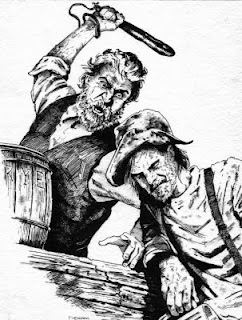
“Upon payment of ten cents a man might kick Oofty Goofty as hard as he pleased, and for a quarter……..with a walking stick.  For fifty cents Oofty Goofty would become the willing, and even prideful, recipient of a blow with a baseball bat, which he always carried with him…..It was his custom to approach groups of men, in the streets and in bar-rooms, and diffidently inquire:  “Hit me with a bat for four bits, gents.  Only four bits to hit me with this bat, gents”.

It was only when heavyweight boxer John L. Sullivan struck Oofty with a billiard cue, fracturing three vertebrae, that he finally called it a day. He will no doubt have enjoyed Sullivan’s later World Championship defeat at the hands of San Francisco’s own James J. Corbett.  The blow from Sullivan caused Oofty to walk with a limp for the rest of his life, and he was no longer immune to pain, flinching at the slightest touch.

There are many other colourful stories surrounding Oofty, for example:

  • acting as a human skittle in Woodward’s Garden where customers could win a cigar if they hit him with a baseball;
  • performing alongside Big Bertha (another candidate for inclusion in this series) in a Shakespearean parody entitled “Borneo and Juliet”;
  • attempting to push a shiny red wheelbarrow to New York for a bet (a challenge that failed after just 40 miles when he was knocked over in the dark and landed head first in a creek); and
  • being shipped upside down in a box to Sacramento as a joke gift for a young lady and being left in the unopened package over the weekend.

Despite his physical debility he moved to Texas where he continued to play the fool for his living, drinking beer with a bar spoon and engaging in quail eating contests.

Read Full Post »

Older Posts »