Feeds:
Posts
Comments

Archive for the ‘Travel Diary’ Category


We had not skied Heavenly since 2011, although we had visited in both of the intervening years.

In 2012, a planned three day break slotted between visits to San Francisco coincided with both of us contracting flu and being physically too weak to ski. And last June, logs, pipes and assorted wooden debris were all that lay on the mountain.

And for much of this winter the signs were ominous.

The guaranteed snow levels normally associated with Tahoe, and Heavenly in particular, had failed to materialise. Every day since Christmas, we scoured the webcams and weather forecasts, only to discover that many of the lifts and trails remained closed and the famed snow making operation was being pressed into overdrive.

We have always skied late in the season in the expectation that a) the snow would be plentiful and b) spring sunshine would dominate. So when we heard when we arrived in San Francisco at the beginning of the week that the long awaited snowfall would be pulling into town at the same time as us, and staying for the duration, we had mixed feelings.

OLYMPUS DIGITAL CAMERA

But we have been incredibly lucky.

We had purchased a four day lift pass, taking the Saturday off when the worst (or best depending upon your point of view) of the storms was projected to arrive.

OLYMPUS DIGITAL CAMERA

And it worked to perfection.

Although, with the exception of our final day, sun was in short supply, the wind that often affects resort operations, closing the higher lifts and restricting the capacity of skiers and riders to travel between the Nevada and California sides, was equally ineffective.

OLYMPUS DIGITAL CAMERA

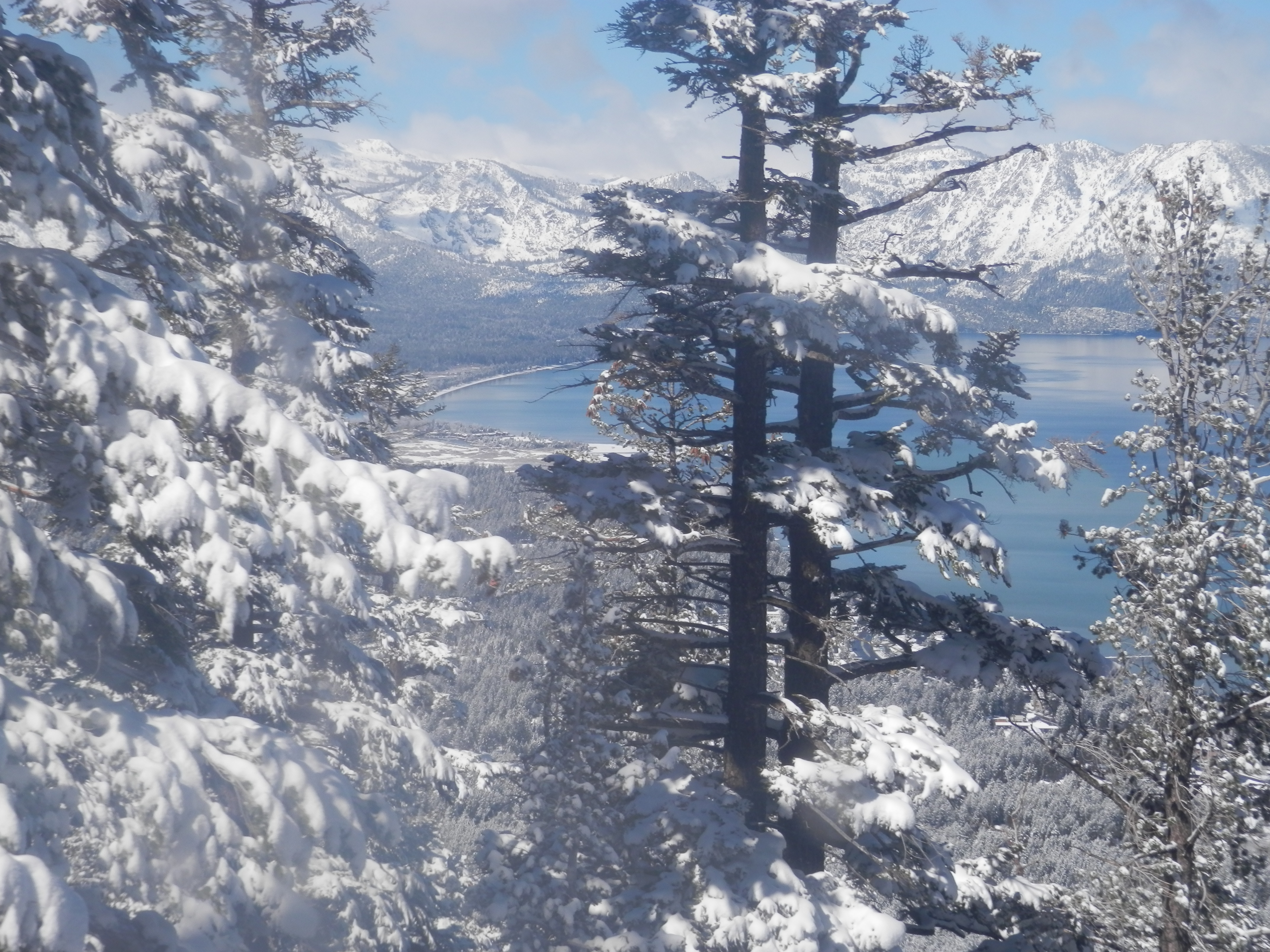
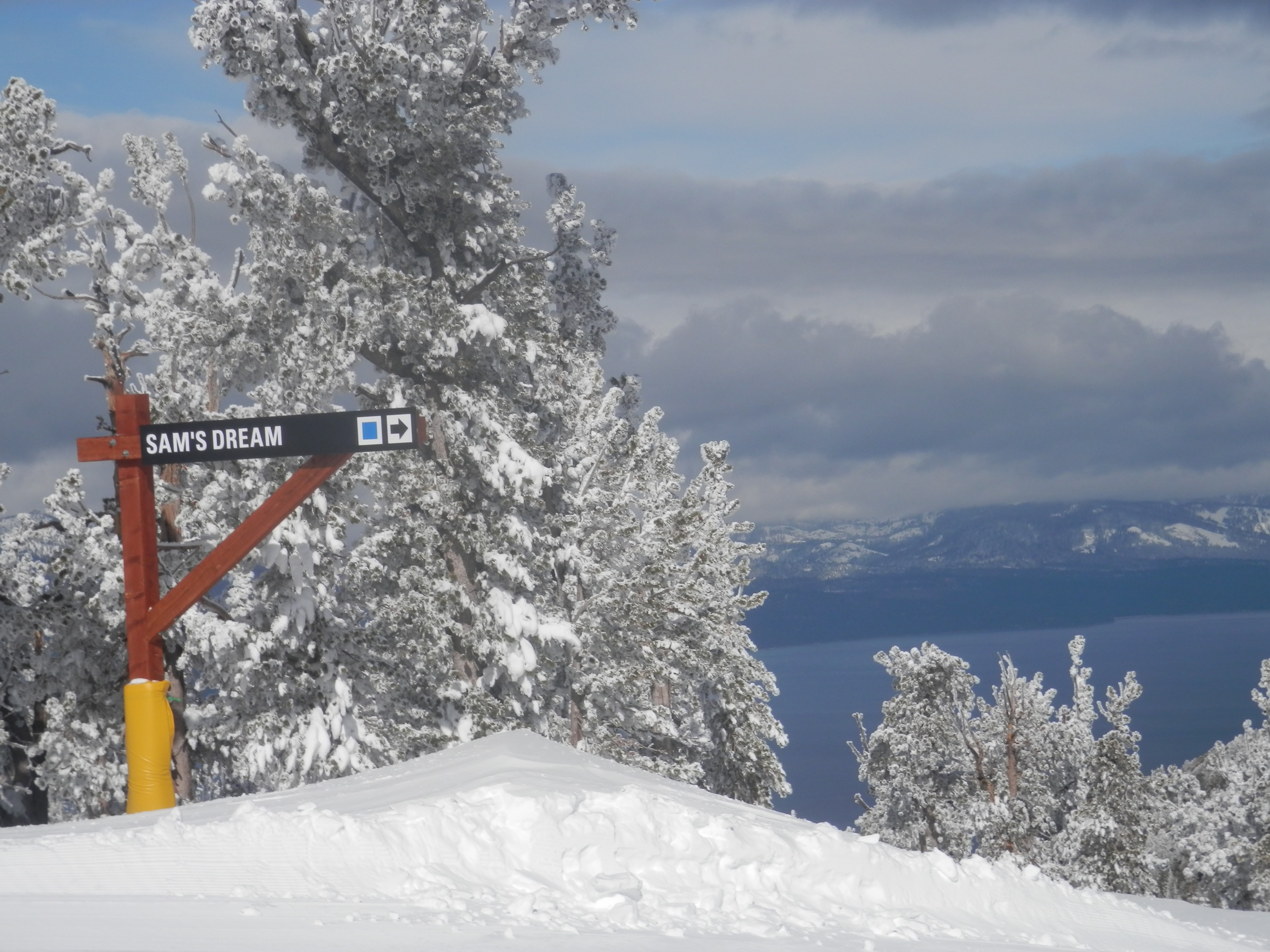
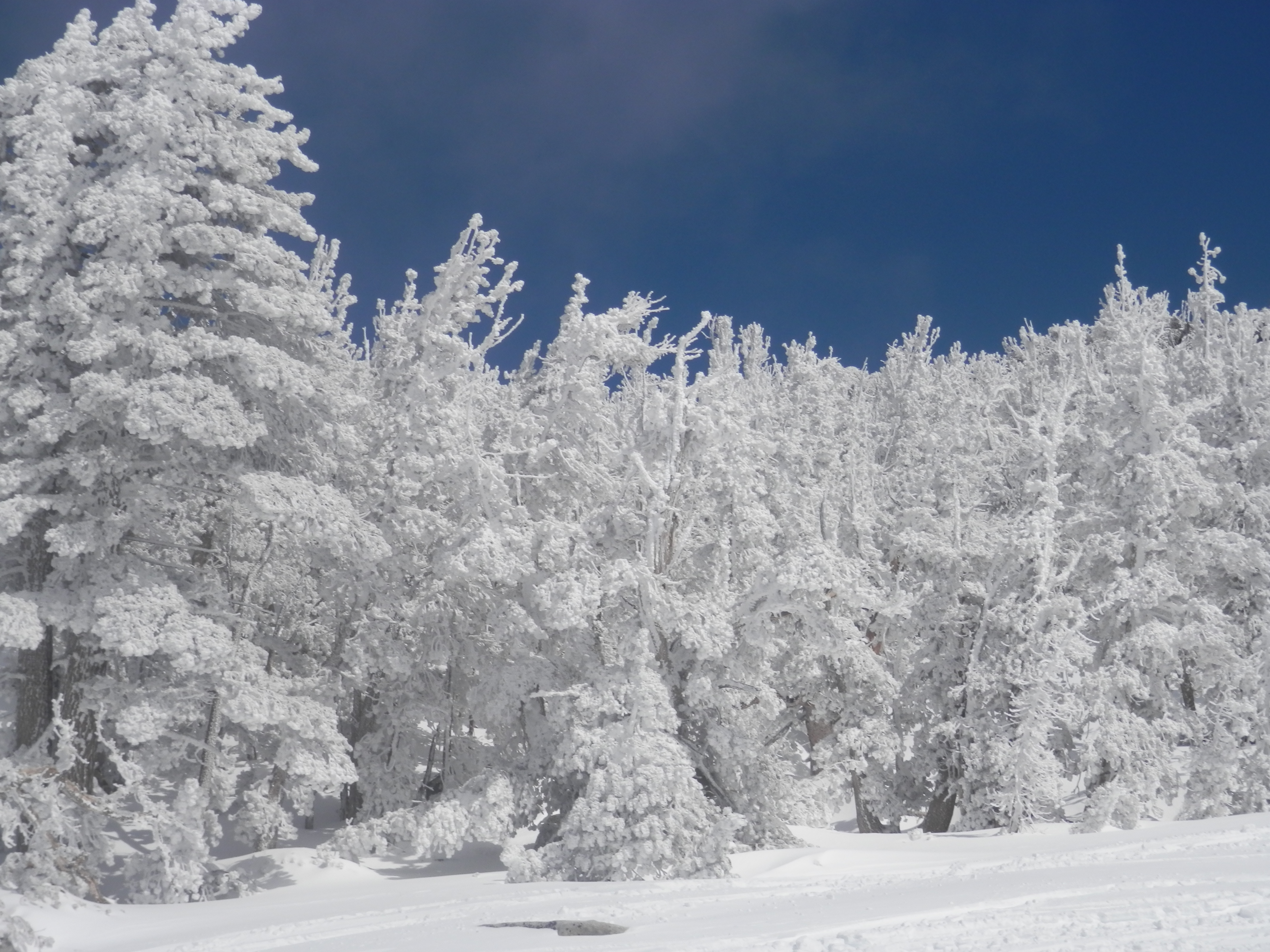
The intermittent gloom and smattering of snow flurries of the first couple of days enabled just to take some satisfyingly moody photographs.

OLYMPUS DIGITAL CAMERA

We were able to ski virtually the entire mountain over the four days. Only on the first day were we prevented from cruising both states, being confined to the California side due to the closure of the Tamarack chair. This was welcome, however, as we tend to spend more time on the longer trails in Nevada. With the Sky Express chair leading to the highest point in the resort open, we were allowed to spend time on our favourite trail, Ridge, which arguably provides the best views of the lake, and the High Five trail that we had not skied before.

OLYMPUS DIGITAL CAMERA

We also managed morning hot chocolate stops and lunch breaks at all the major mountain lodges – California, Tamarack (pictured), East Peak, Sky Deck and Stagecoach – that were open.

OLYMPUS DIGITAL CAMERA

OLYMPUS DIGITAL CAMERA

OLYMPUS DIGITAL CAMERA

My only regret?

Not having the presence of mind to reach for the camera as Janet struggled to get to her feet, having fallen on the Galaxy trail only minutes after she had joyfully proclaimed ONE NIL when I had suffered a similar indignity.

Ah well, you can’t have it all.

We may not have seen the last of the snow as we look set to grapple with the next big storm on our return to San Francisco tomorrow.


Read Full Post »


Our first full day in San Francisco and there was much to look forward to, including brunch at the Cliff House and our fifth trip to Steve Silver’s Beach Blanket Babylon in the evening, he timing of both dictated by tradition and designed to orientate us quickly back into life in the city.

After a comfortable night’s sleep in our new apartment in the North of the Panhandle, we woke to gentle but steady March rain that left large pools at the bottom of the wooden steps leading down from the kitchen to the shared back garden.  The forecast, however, was for it to clear later in the morning to leave a cloudy but dry afternoon and evening.

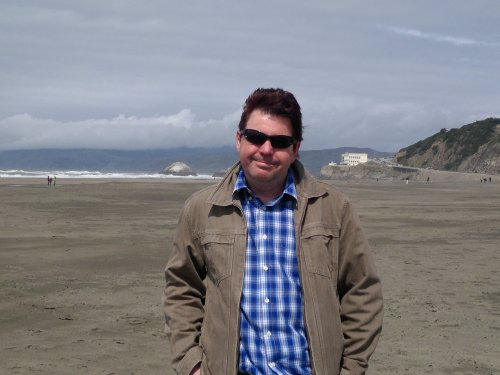
The Cliff House at Ocean Beach was just a straight ten to fifteen minute drive along Fulton Street to the Pacific Ocean. We passed a verdant Golden Gate Park on our left, whilst on our right, we caught tantalising glimpses of the towers of the glorious Golden Gate Bridge looming over the dense foliage of the Presidio.

We parked several hundred yards short of the Cliff House to enable us to take in the bracing appetite-inducing air for a few minutes before we entered the bistro.  The ocean presented a turbulent picture with a swift succession of high rolling waves chasing away anyone brave or foolhardy enough to venture too close to it.

The scene was, however, still a busy one – joggers passing in either direction at varying speeds;  people , like us, strolling contentedly in a wind ravaged state of dishevelment; but most of all, dogs everywhere bathing in the freedom and exhilaration of exploring the endless expanse of beach.  We must have seen a dozen different species, from caped miniature poodles and chihuahuas and enigmatic huskies to slavering rottweilers. It is claimed that there are more dogs than babies in San Francisco, and on a morning like this, you would not doubt it.

We felt as if we were committing an act of animal cruelty by not having one of our own to exercise.  Momentarily, I contemplated hiring one for the week because, after all, this is San Francisco and anything is possible.  But pets are not allowed in the apartment – probably just as well.

We had a twenty minute wait for our table, allowing us the opportunity to check on upcoming events such as the Wednesday prix fixe dinner and jazz evenings, and look in the gift shop.  As ever we both ordered Eggs San Francisco (two poached eggs and crab on toasted sourdough bread with roasted potatoes and fruit), accompanied by the establishment’s signature warm rolls – delicious.

Feeling replete we took another longer walk in the adolescent sunshine along the beach towards the south, inspecting the periodic bonfire pits on the beach.  Crossing the Great Highway for the return to our car, we called in at the Beach Chalet to marvel at the fabulous Lucien Labaudt frescoes depicting everyday life in the thirties in the city. The brewery and restaurant on the first floor apparently have outstanding views of the ocean, a fact we need to verify before much longer.

We abandoned our planned food shopping trip as we needed time to get ready for the evening (and for me to finish my previous blog post).  The mild, partly cloudy late afternoon weather encouraged us to take the long walk to Club Fugazi in North Beach for the early evening performance of Beach Blanket Babylon.  The near hour and a half  journey took in some of the less salubrious parts of the city (Fillmore and Civic Center) before turning off Market Street to snake through Grant in the heart of Chinatown.

Sadly and inevitably, there was no shortage of vagrants around the Civic Center vicinity, though we experienced no intimidating panhandling.  I did purchase a copy of Street Sheet from a man who bore an uncanny resemblance to the queen in Snow White and the Seven Dwarfs when she dresses as a witch and tempts Snow White with a poisoned apple.  He even sported the hunch back and hood.  But he was very friendly and appreciative of my $2 donation.

For the uninitiated, the Street Sheet is a magazine that has been published by the Coalition on Homelessness since 1989, and is designed to provide information and support programmes for homeless people in the city.  The philosophy is not dissimilar to that of The Big Issue in the UK, in providing its vendors with the opportunity to earn money for food, shelter and other necessities.

We joined an already lengthy line outside Club Fugazi around fifty minutes before showtime.  I collected our tickets from will call (box office) and joined Janet in the queue.  We were surrounded by a dozen boisterous ladies of a certain age in varying states of drunkenness attending the show as part of a bachelorette party.  Whilst we didn’t begrudge them their fun, we couldn’t help but hope that their seats were in a different part of the auditorium.

Our prayers were answered as they lurched off to the area close to the stage on the ground floor whilst we were escorted to our seats in the center balcony – our preferred area to watch the show.  Arming ourselves with a bottle of Woodbridge White Zinfandel and a large packet of pretzels we were ready to support  Snow White in her worldwide search for a prince. No sign of the queen this time – which is just as well as Snow White had a hard enough (or not as the case may be) time without her.

Once again, Beach Blanket Babylon delivered.  Although we had only been twelve months before, there was still a lot of new content along with the familiar staples.  The highlight for me was when San Francisco Giants baseball stars Buster Posey, Tim Lincecum and Brian Wilson (no, not the real ones) burst onto the stage holding the World Series trophy and singing We Are the Champions. Her Majesty the Queen’s appalled put down of the upcoming wedding of Prince William and Kate Middleton was hilarious and a typical Beach Blanket Babylon satirical slant on a subject often treated too reverently, no more so than in the States.

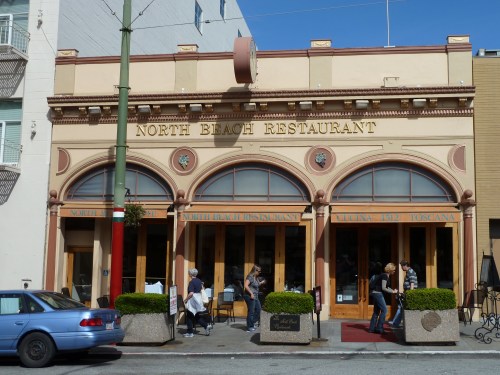
We had decided that we would try the North Beach Restaurant for dinner for the first time, provided we could gain entry (we hadn’t booked).  The restaurant looked very busy, but on presenting ourselves at the front desk, we were whisked to the only free table for two, adjacent to the kitchen.  That may not sound the most appealing location, and it was rather cramped, but Janet found it fascinating, catching regular momentary glimpses of the frenzy behind the scenes action as the front of house staff crashed through the doors leading in and out of the kitchen.

But what of the food and service?  This was traditional Italian fine dining at its best.  My linguine with porcini mushrooms and scallops was outstanding, as was Janet’s seafood risotto – even surpassing the excellent meals we had enjoyed at the Riva Grill in South Lake Tahoe a few days before.  And our waiter was suave, attentive and witty – well, Italian.

I had wanted to visit The Beat Museum on Broadway for some time, so as the night was still young (10pm), we called in.  The museum itself had already closed for the day, but we spent some time perusing the bookshelves and other fascinating memorabilia, and I bought a couple of books I had not seen before, one the 700 page Hippie Dictionary –  A Cultural Encyclopedia of the 1960s and 1970s by John Bassett McCleary and The Beats – A Graphic History.

After a canter past the fleshpots of Broadway, we sought refuge in Vesuvio’s bar on Jack Kerouac Boulevard – yes, another first night tradition.  Once more we succeeded in claiming the only two seats available, at the bar.  After a couple of drinks we walked down Montgomery through the Financial District before boarding a number 5 MUNI bus at Market to transport us back to the apartment.

It had been a long day but a satisfying one. We were truly “at home” again in our favourite city.

Read Full Post »


So, 2,325 miles and 17 days later, was the road trip worthwhile?

Absolutely.

It could not have gone any better:

  • check-in was courteous and efficient at every hotel /motel, and most rooms were spacious, comfortable and well furnished;
  • the planned itinerary for each day delivered us to the right place at the right time;
  • the hire car was completely reliable and a pleasure to drive;
  • we encountered very little traffic;
  • the weather was fabulous;
  • all the attractions we had planned to visit lived up to or exceeded our expectations;
  • most meals were excellent, including those on the road itself;
  • most people we met were extremely friendly and interested in our journey; and
  • WiFi was reliable in all locations, with only occasional gaps in connection; and
  • we never fell out, other than briefly on one occasion over directions to the hotel.

There were some irritations of course – the noisy room in Kayenta and the abstemious culture of southern Utah – but these were minor.

We did not manage to get to every sight we would have liked, notably Dead Horse Point State Park and stretches of Route 66, but we did visit others that we had not planned. And besides, it means we have a ready made itinerary for the next trip!

The main disappointment – and one that had no overall impact on our enjoyment of the trip – were the two hour delays each way perpetrated by Virgin Atlantic.

***********************************************************************

Some friends and colleagues had actually been worried on our behalf about the prospect of the trip. Wouldn’t it be dangerous, just the two of you, alone in remote areas of a foreign country, a proudly gun-owning nation with a history of gas station hold ups and crazed killers mowing down hordes of people in schools, shopping malls and cinemas?

We had never given this a single thought.

Nor was our safety ever compromised on the trip.

***********************************************************************

Most aficionados of the road trip advise that the way to enjoy it most is to just jump in the car and drive, staying when and where the mood takes you. Above all, don’t plan.

I understand that, but we decided to plan everything – from accommodation to daily itineraries – and it worked beautifully. But in future we might live just a little more dangerously and leave some of the lodging stops to a whim.

***********************************************************************

So would we do it again?

Absolutely. We’d do it tomorrow if we could.

There have been other trips in the U.S. we would like to do – Highway 61, the prairies, north west, cowboy country – to which we can now add several variants of the one we have just finished.

***********************************************************************

Sinatra sang that “it’s nice to go travelling” but “it’s oh so nice to come home”. And who can forget Dorothy clicking her ruby slippers whilst reciting “there’s no place like home”? They both have a valid point.

And the road can be tiring. Nobody has ever claimed that they enjoyed living out of a suitcase. And caravans, RVs and even the most luxurious of Winnebagos are not the most comfortables place to sleep, eat and relax in.

So why would anyone want to spend any more of their time than is necessary on the move?

Freedom, or as Richard Grant put it in his wonderful book, Ghost Riders, in which he travelled around with diverse groups of nomadic Americans:

the only true freedom is the freedom to roam across the land , beholden to no one.

The open road, the big skies, the ever-changing landscape, the excitement of who and what is awaiting you around the next corner or in the next town, discovering new cultures and pursuits, stopping when and where you want to eat and sleep.

Aren’t these – rather than engaging inanely via social media, gawping at lowest common denominator TV or moping around a shopping mall collecting things you neither need nor can truly afford – what make life fulfilling?

Life is about movement – physical and spiritual. What better way to experience this than to “get hip to this timely tip”? Hit the road!

**********************************************************************

Finally, my thanks to Allen Manning who not only encouraged us to take the trip and designed our original itinerary, but also patiently answered all my uninformed questions along the way. It was fun too to compare notes via daily e mail from our respective trips whilst we were both in the land of the free (his tour included Tennessee, Kentucky and Texas).

Allen, you have a lot to answer for!

Read Full Post »


Our last day on the road and one on which we hoped to catch more vintage Route 66 sights before we said a fond farewell to The Mother Road. We had nearly 300 miles in front of us before we reached Las Vegas, where we had tickets for the Dark Star Orchestra concert in the House of Blues in Mandalay Bay at 8pm. With that in mind, we left the Little America Hotel in Flagstaff at 8.35am, our earliest start of the trip.

Before we joined the I-40 west we needed to fill up the car. As we had contracted to return it with an empty tank, we did not want to put in any more than was necessary. We estimated $30 should do the trick.

Our first planned stop was at Bellemont, location for a classic scene from Easy Rider. Early in the movie Dennis Hopper and Peter Fonda pull up in front of the Pine Breeze Motel, hopeful of a room for the night. However, the owner, peering from within, spots their motorcycles and promptly switches the neon sign from VACANCY to NO VACANCY. Although the motel is now closed, the sign is still displayed at the nearby Route 66 Roadhouse Bar & Grill – which does welcome bikers. It is that we went in search of.

We left the interstate at junction 185 as directed and followed the signs to Bellemont – or so we thought. Our first attempt ended in a pothole ridden track that ran out in a forest clearing. Undaunted, we crossed back over the I-40 and took the frontage road, but after two miles we reached a similar dead end. With no access to the freeway we were forced to turn back.

We could not afford too many such fruitless detours on a day when we had so many miles to cover. At least this diversion had given us the opportunity, on an empty stomach, to witness a group of cows defying the flies to feast on a rotten deer carcase.

The other Route 66 destination that we were anxious to visit was Williams, just thirty miles from our starting point. Taking exit 165 we entered the town, whose welcome sign stated that “You are wanted in Williams”. And so we were.

After parking the car we started to walk down the main street in search of a suitable breakfast venue. We were tempted first by Goldie’s Route 66 Diner, but the sight of ten bikers roaring into the forecourt in front of us suggested we might have to wait a while!  The nearby Red Garter Bed & Bakery retained outward hints of its former notoriety as a bordello.

This town has the distressing or proud, depending on your point of view, distinction of being the last one to be bypassed by the interstate on 13th October 1984 when Bobby Troup, the writer of (Get Your Kicks on) Route 66 attended the closing ceremony. That might have proved the death knell of the community, but its railroad history and proximity to the Grand Canyon enabled it not only to survive but thrive as an important major tourist location.

We were immediately attracted to Williams with its frontier feel and vibrant Route 66 connections. Nearly every establishment, whether a gift store, diner, trading post or motel, appeared to be selling a large selection of road memorabilia.

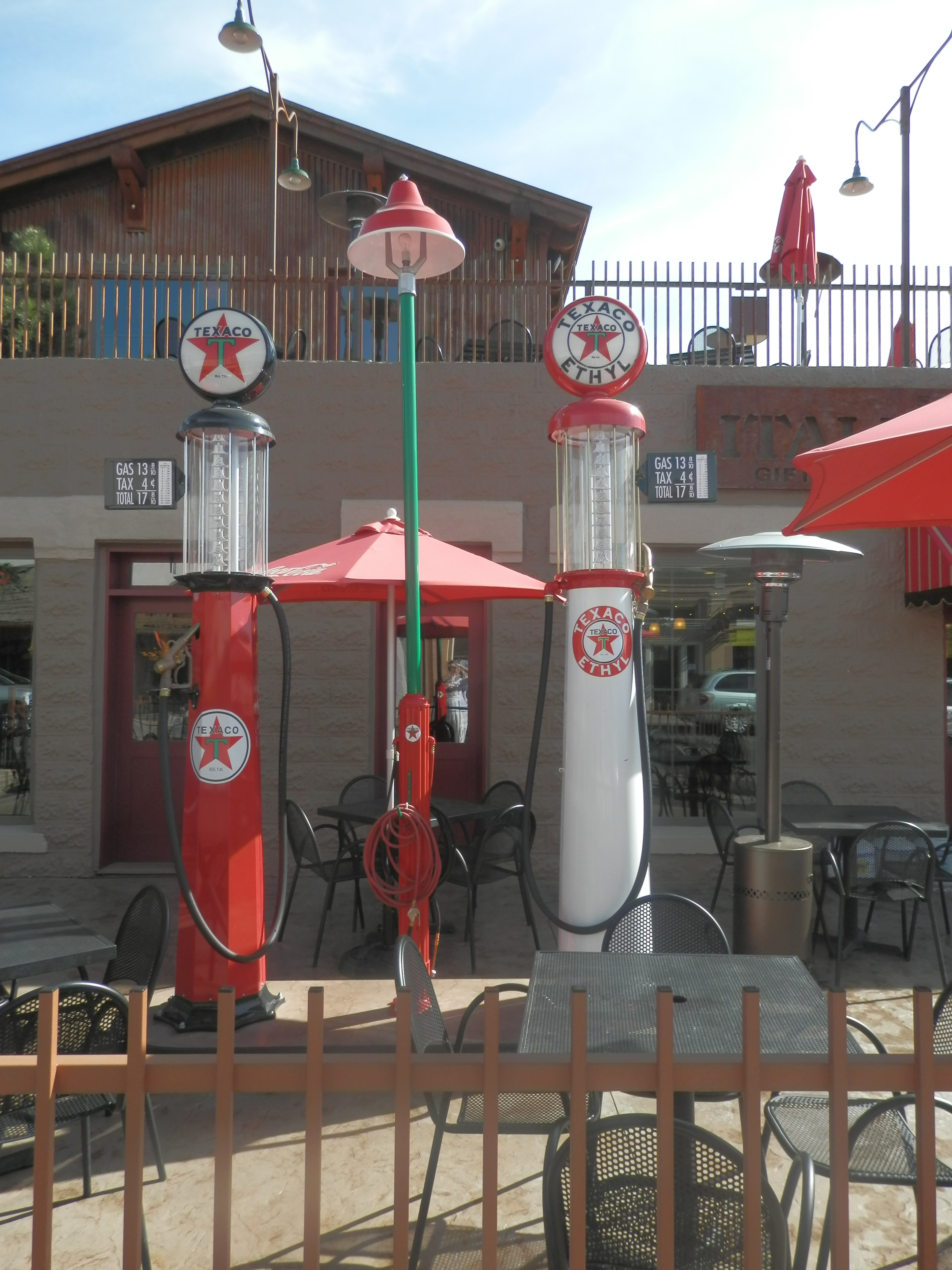
We were spoilt for choice of dining options here too. Cruisers Café 66 Bar & Grill, which would have been my original preference, was, sadly, closed, though we were still able to roam its delightful patio with its vintage gas pumps (above), murals and and quirky Halloween paraphernalia (below).

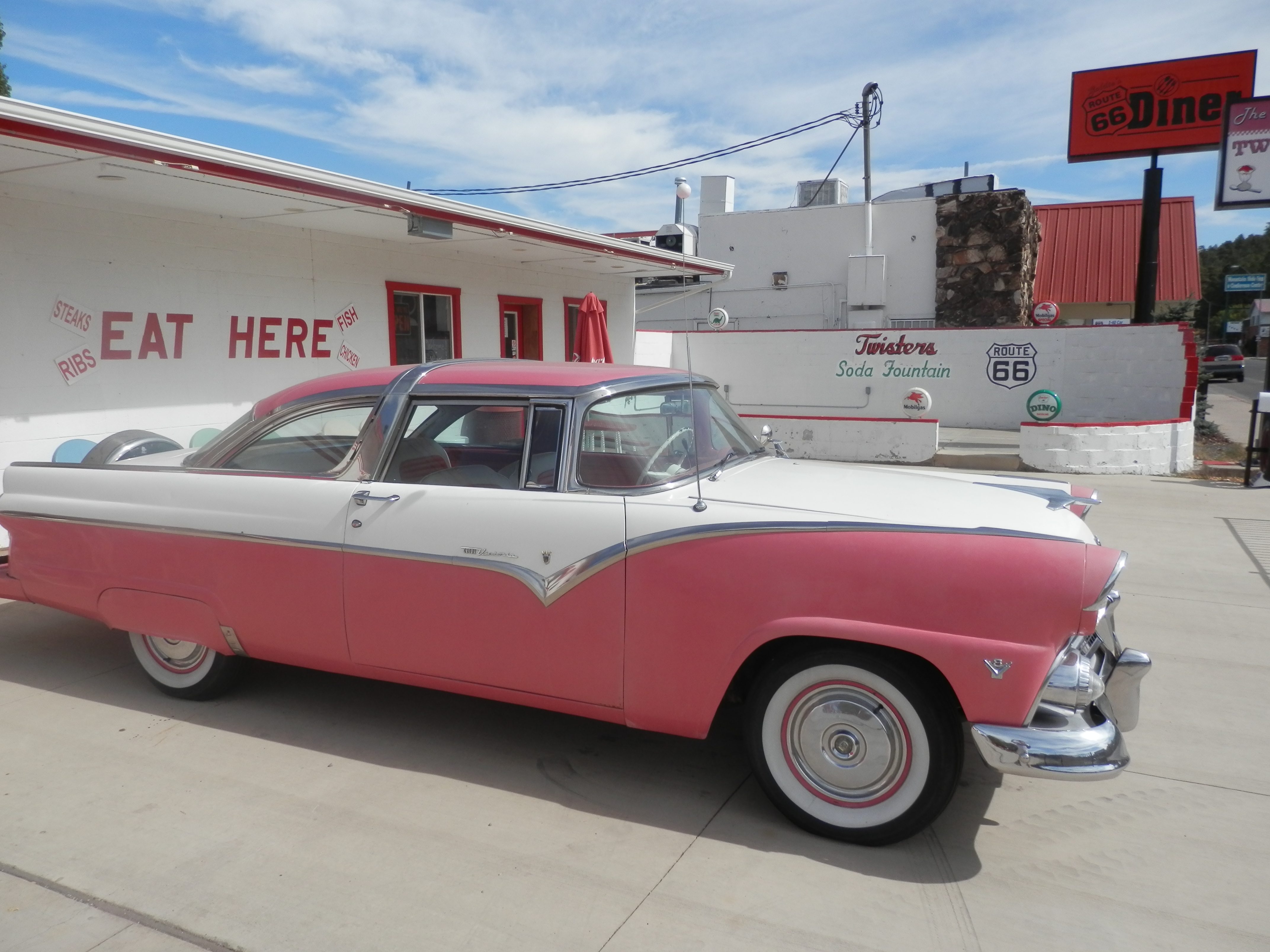
Of all the towns we had visited on our trek through New Mexico and Arizona on America’s Main Street, nowhere flaunted its Route 66 heritage more than Williams, as the restaurant sign below illustrates. And we loved it!

Eventually we decided on breakfast at the Pine Country restaurant, a classic diner with friendly staff,  family atmosphere and, of course, its own mini gift shop. Two fried eggs sunny side up, hash browns, sausage patty, lashings of ketchup, sourdough bread and, of course, unlimited coffee, was just the right fuel for the long road ahead.

Aside from its Route 66 frisson, it is Williams’ railroad history that brings the visitors flocking in today. The Santa Fe Railroad first connected it with the Grand Canyon in 1901 but it went out of business sixty seven years later.

Then in 1989 it reopened as the embarcation point for the Grand Canyon Railway which now carries tourists the 65 miles daily to the South Rim through the high plains and pine forests. An essential excursion on our next trip.

Another of the town’s nostalgic diners is Twisters, full of road memorabilia and complete with original fifties soda fountain and bar stools. The reasons for a return trip in the not too distant future mount up – only time today for a handful of photographs of the exterior.

We would have loved to have spent longer in Williams (it was now nearly 11 o’clock), not least to explore the Arizona State Railroad Museum (and sample each of the diners!), but were mindful that we needed to reach Vegas as early as possible in order to avoid a lengthy queue at hotel check-in. And there was that gig to get to.

This meant we had to remain on the interstate rather than join the Route 66 loop which included Seligman and its legendary Sno-Cap Drive-In and the equally famous Hackberry General Store. 

I am so looking forward to that next trip!

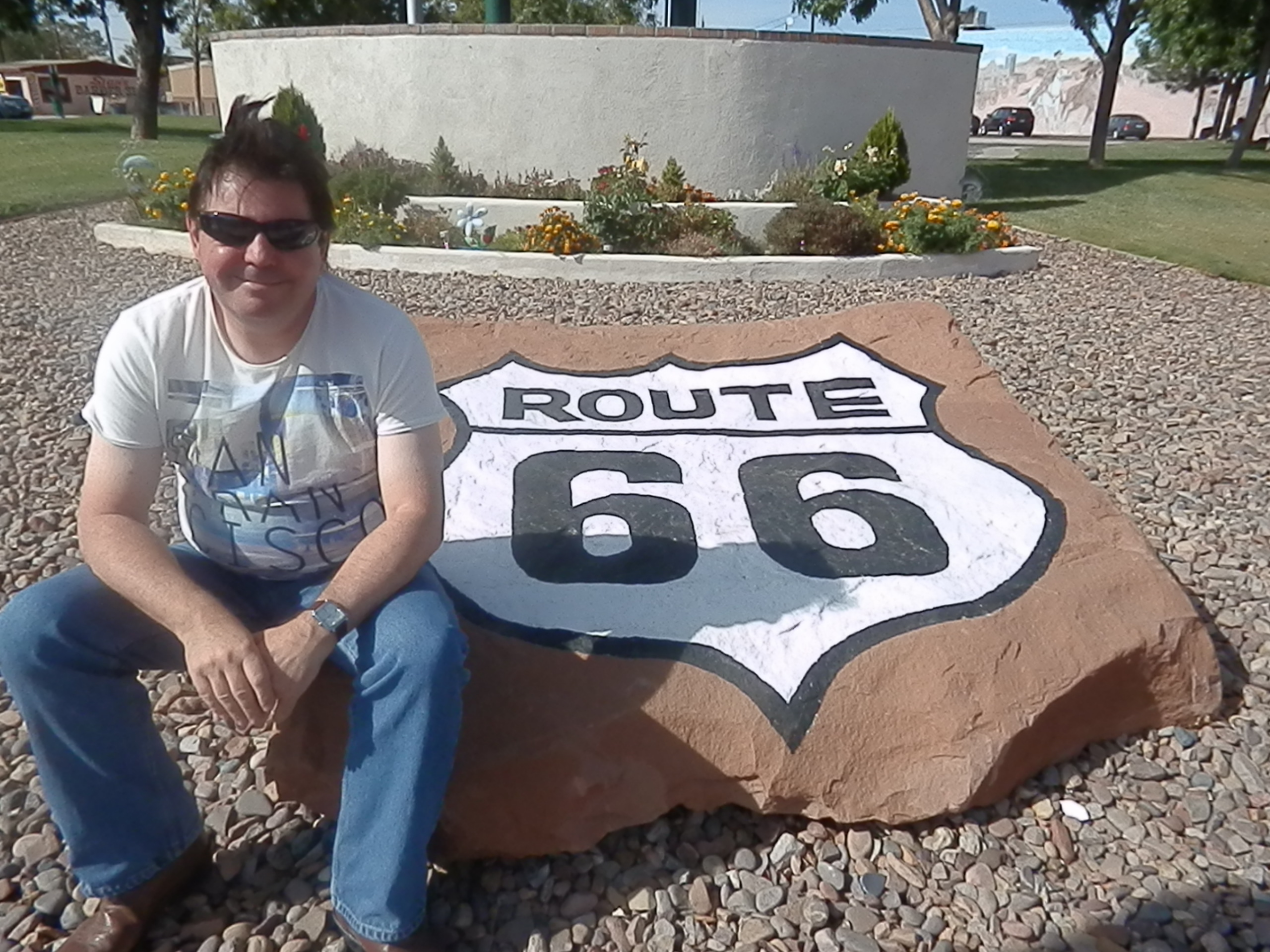
Route 66 may not have been the primary focus of the trip when we first planned it. But we had virtually lived on it since Albuquerque and fallen under its spell – even when we couldn’t find it! There is no other road in the U.S., or anywhere in the world for that matter, that carries as much resonance – not bad for a road that no longer officially exists! Tim Steel put it best in his eponymous book:

There are few things in life as alluring as a road trip, and few roads beckon as seductively as Route 66.

We may now have been concentrating on eating up the miles rather than looking for obscure Route 66 spots, but it did not dull our powers of observation. Hitchhikers dotted this stretch of the interstate, a reminder of a gentler time and one we had not seen at all on the trip heretofore. Perhaps they were Deadheads trying to get to the Dark Star Orchestra gig in Vegas! No tie-dye in evidence, so probably not. We passed a truck carrying an  unusual “oversize load” – an aircraft wing! Blown tires strewed the road and hard shoulder.

At exit 48 at Kingman (along with Barstow and San Bernadino, celebrated in the final line of Bobby Troup’s classic song), we finally left the I-40 (and Route 66) to join the I-68 West and, shortly afterwards, the I-93 North to Las Vegas. It was a quarter to one, eighty four degrees (twenty three degrees warmer than it had been when we left Flagstaff but still eight degrees cooler than when we arrived in Vegas). We had exactly one hundred miles to go. We took a comfort break in a gas station and discussed whether we needed to “top” the fuel up, concluding that we might just make it – which we did, endorsing the decision we had made at the beginning of the day). Billboards for the casinos in Vegas were already a regular roadside sight.

Much of the I-93 was desert with occasional shacks the only habitation. Plots of five, ten and twenty acres were on sale, though the landscape was bare and unprepossessing. Within the hour we had passed the Hoover Dam and crossed into Nevada. Having made such good time since Williams, we stopped in Henderson for an iced coffee before the final cruise into Vegas.

Nothing in the past seventeen days had prepared us for the volume of traffic that greeted us on the run in to Vegas! We approached via Flamingo Road’s three lanes that seemed to go on forever, and made the right turn onto the Strip towards our hotel.

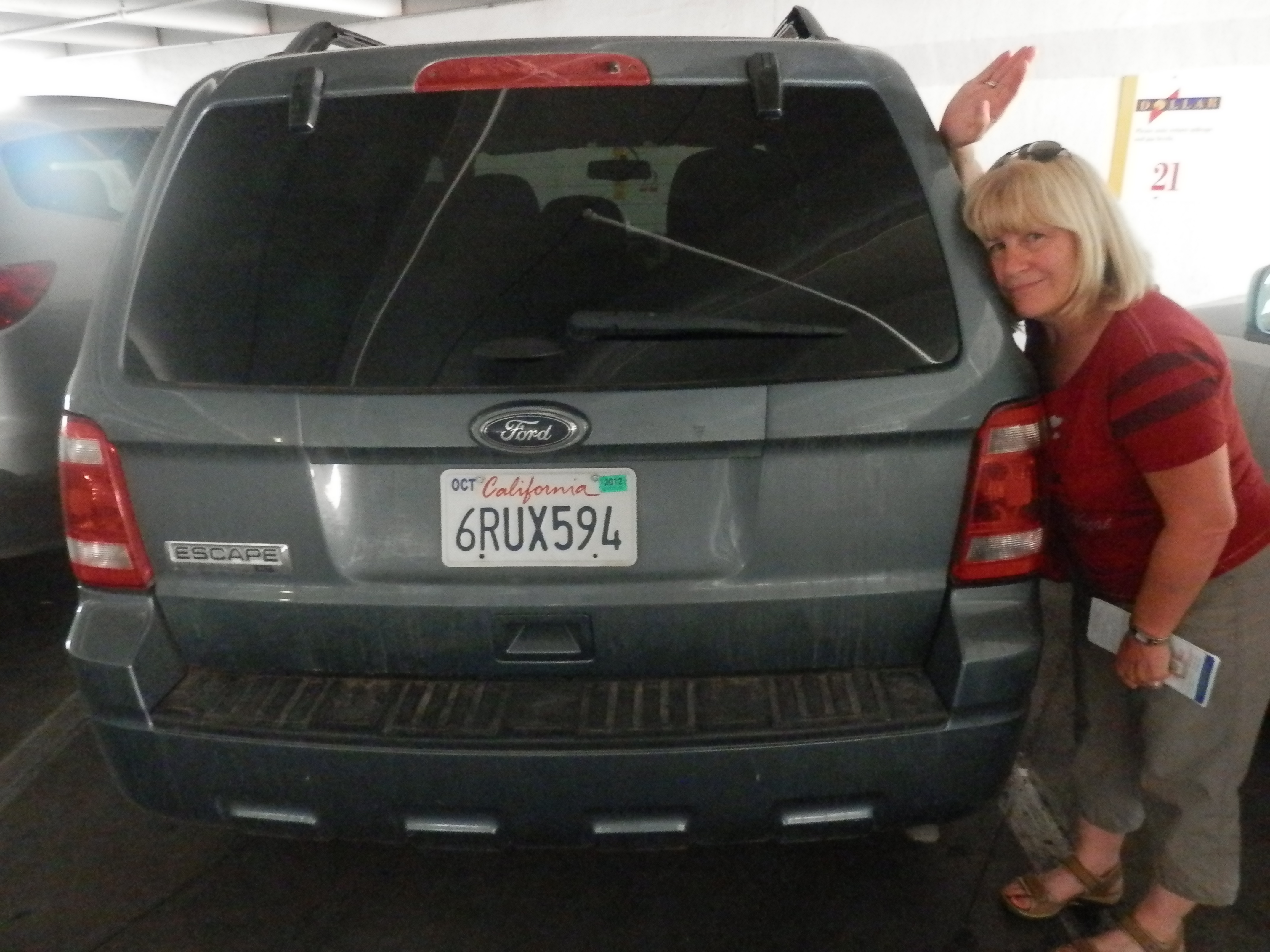
After a tearful goodbye to “Ruxy”, who had transported us, without a hitch, 2,325 miles across five states and innumerable extraplanetary vistas, we headed for check-in at Treasure Island. And yes, it was crammed! As the receptionist explained “half of Southern California is here this weekend” and most of them had just landed!

But within the hour we were in our room overlooking the Strip. And not only did we make the gig but we arrived in sufficient time to eat in the House of Blues first – where it had all started two and a half weeks ago.

The concert was great – well I thought so! We walked the length of the Strip in the balmy early hours, and had a nightcap in the Breeze Bar in the casino before retiring.

It was already my sixtieth birthday, and we now had a long weekend in Las Vegas to look forward to.

As to what we got up to over the next four days – well, you know the phrase, don’t you?

Read Full Post »


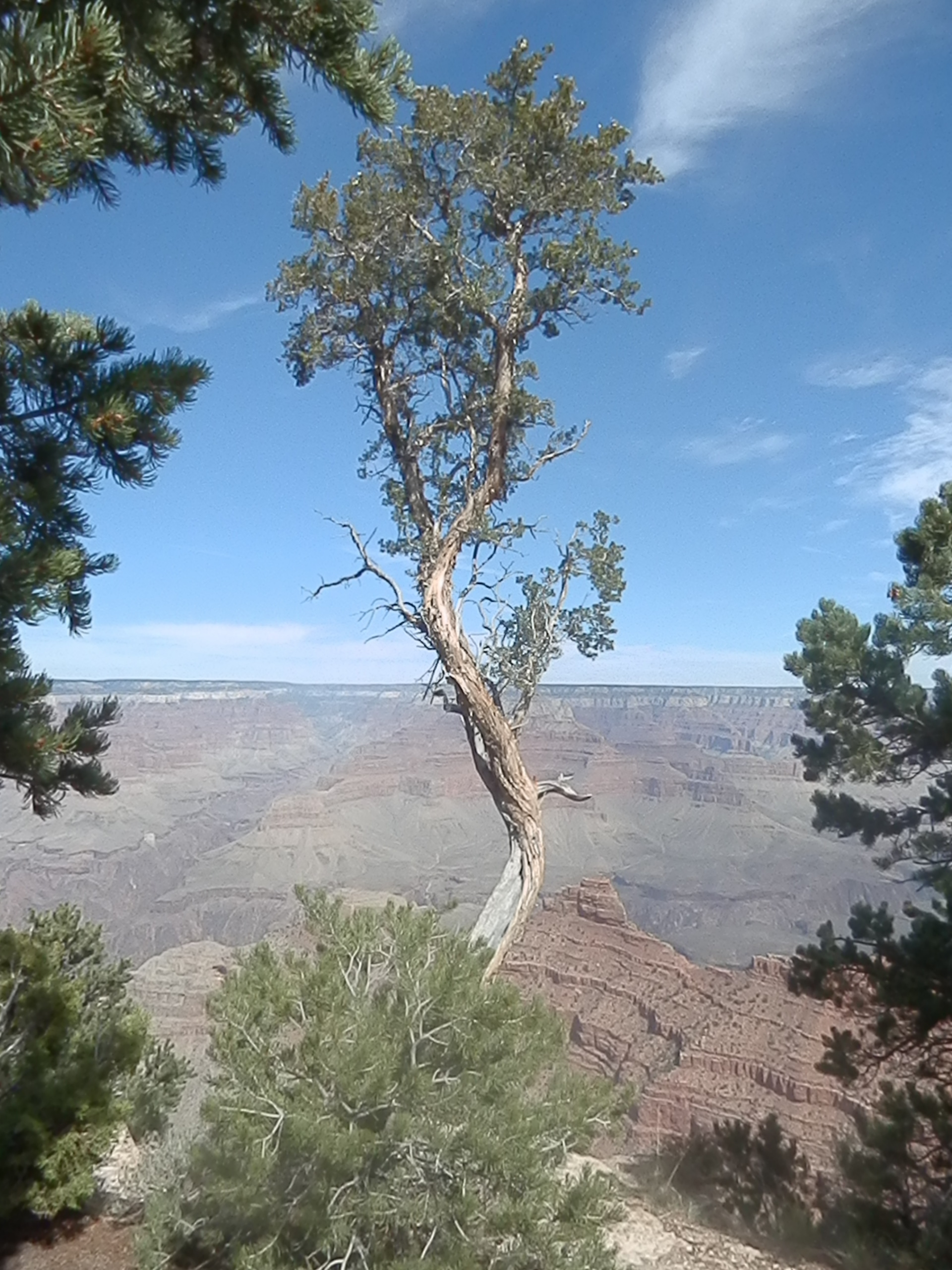
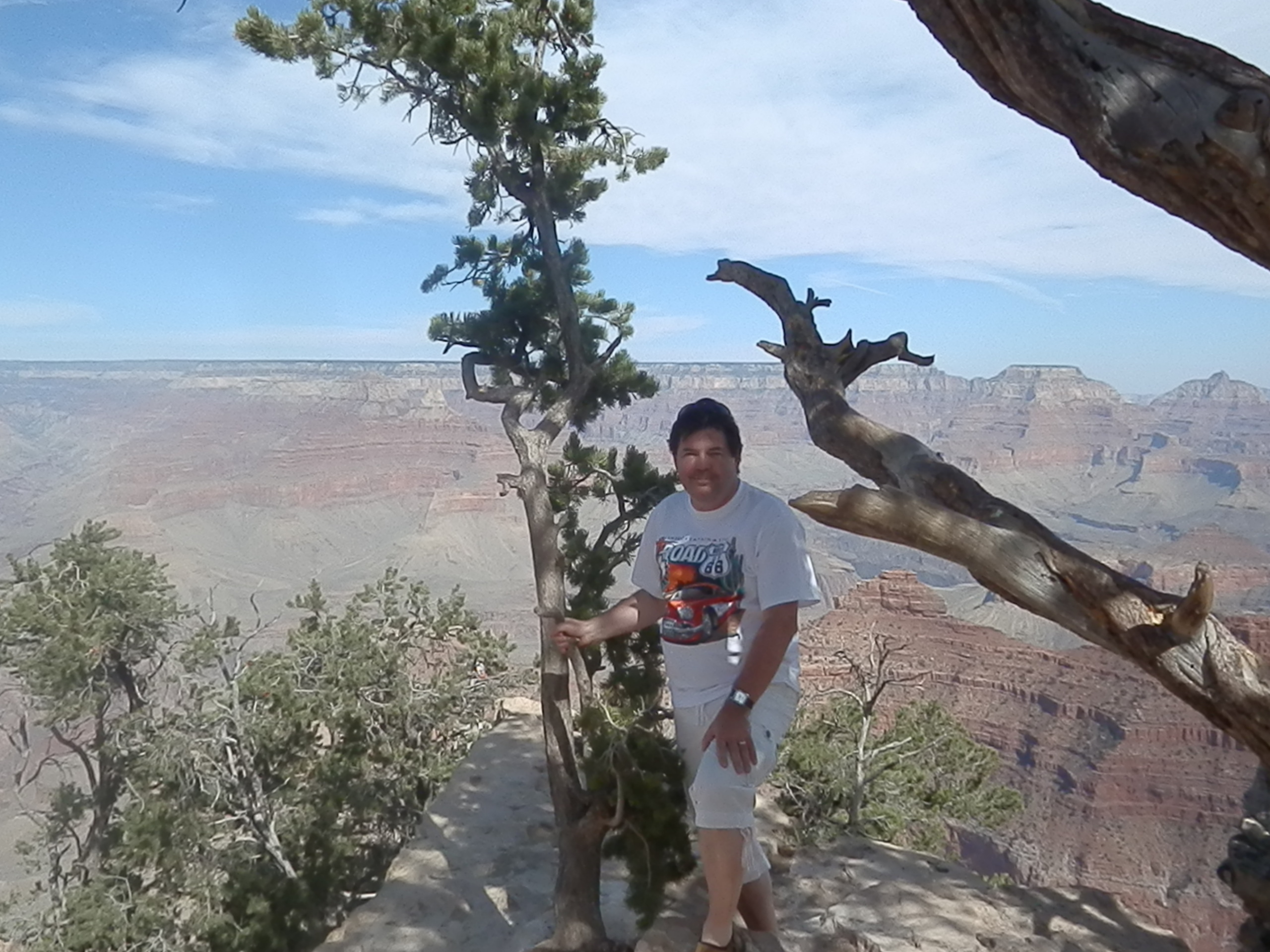
When we put together the original itinerary for this trip we decided, in the light of the array of other stunning sights on offer, none of which we had visited before, we would omit the Grand Canyon. After all, we had been twice before, the South Rim in 1995 and the North Rim nine years later.

On the later visit, we had fl0wn in a helicopter down to the canyon floor for a short boat ride on the Colorado River. This had been followed by a hair-raising jeep trip onto the Havasupai reservation for lunch and, inevitably, a tour round the open air jewelry stalls.

But as this vacation drew nearer, we came to our senses and realised that we would be insane not to go, especially as we were staying two nights in Flagstaff, Arizona, a mere eighty miles from the South Rim. Downtown Flagstaff and nearby Sedona would have to wait another day.

And, of course, we were proved right. Much as we were mesmerised by Bryce Canyon and humbled by Monument Valley, this mother is truly the daddy of them all.

We set off on yet another clear blue morning and 66 degrees. Once through downtown we branched north-west onto the I-180 West. We had, at least for now, seen the last of the buttes, mesas and crazy sandstone rock creations as we received a ponderosa pine guard of honour through the middle of the Kaibab National Forest. The San Francisco Peaks lay behind.

At Valle we met the I-64 coming north from Williams and followed the I-180 due north. Reba McEntire sang Consider Me Gone on 92.9 FM Kaff Country Radio. The Flintstones Bedrock Campground with Fred’s Diner and a huge sign exclaiming “Yabbadabbadoo” looked inviting but we were anxious to get to our destination.

We approached Grand Canyon Airport, from where Janet had got a flight to Vegas on our first visit, on a stretch of highway adopted by “Elmina Freeman I Love You Mike Freeman”, one of the more bizarre romantic gestures I have seen. Shortly before Tusayan, at what appeared to be a relatively new complex of  hotels and other lodging, restaurants and trading posts, we re-joined the forest.

Using our America the Beautiful national parks pass once again we entered the park, but before taking that first momentous look, we called in at the Grand Canyon Village for breakfast. Parking at the Canyon Lodge information Plaza, we were astonished to see how the facilities had been upgraded since our previous visit to the South Rim seventeen years before.

On that brisk October morning, when we had first gaped in astonishment at that massive crack in the earth, we had been deposited at Mather Point for just a few minutes before being herded back on our tour bus for the trip to Vegas. My only other recollection, and one from which I still bear the mental scars, is of the birds, grosbeaks I believe, stealing our breakfast of warm mini-donuts. This time our granola bars (a sign of the changing times?) were stashed safely in our rucksacks on this occasion.

So we knew what to expect.

Wrong.

Nothing can prepare you, however often you might visit, for this most inspiring and uplifting of spectacles. The expectation alone in walking the couple of hundred yards from the plaza to your first sighting at Mather Point was thrilling enough.

But then – that view!

We talked to a couple from Florida who were halfway through a three month road trip to celebrate the husband’s retirement. They were also visiting many of the same sights as us, as well as driving through the midwest and the south (well, they had to in able to get home).

It had been exactly a week since our last serious hiking – in the Arches National Park. All our walking of late had been in largely urban settings. So we were a little out of practice, if not of breath. But the trails along the rim were paved, though for anyone foolhardy enough to do so, and there were plenty, there were many opportunities for hanging over the canyon on jagged precipices.

Initially, we walked east, the less populous route, but after about a mile and a half we turned back and returned to Mather Point. From there we headed west along the Rim Trail to Yavapai Point where the displays in the Yavapai Observation Station explained how the canyon may have been formed.

Now, the guidebooks suggest that the latter extract of the trail takes about ten minutes. That may be true – if you are running for a bus with no heed for the scenery. But every few steps brings another jaw-dropping vista or overlook at which you find yourself drifting off in a reverie, only to be woken by a Japanese voice asking you to take a photograph of him and his girlfriend.

Attempting to pick out teasing glimpses of the bottle green Colorado River as it weaved its way around the canyon floor was a fascinating exercise in itself.

As evidence of just how quickly time had passed it was now 2.30 in the afternoon, time to drive the 23 miles east along the Desert View Drive, stopping at Grandview, Moran and Navajo Points to gaze at the timeless, ever-changing landscape of the canyon.

At Desert View, the park’s eastern boundary, we witnessed a group of hikers taking the last few steps of an ascent from the canyon itself. Now that is what we will do on our next trip. If we can negotiate the Navajo Loop Trail in Bryce Canyon in a hundred degrees, this would be perfectly manageable. Perhaps not the gruelling, and occasionally life threatening, Bright Angel Trail, but certainly one that takes us down into the canyon – and hopefully back up again!

In the Ancestran Pueblo-style Desert View Watchtower – which has an excellent gift shop on the ground floor and three circular chambers above decorated with authentic Hopi murals on the floors above – we talked to the proprietor who had lived in West Yorkshire. His experience had taught him that the British were much more polite than his fellow countrymen, an opinion which, on balance, we were, in all humility, inclined to agree with.

Armed with a bundle of souvenirs from the Watchtower gift shop, we had a coffee in the nearby snack bar. With the sun already hinting it was ready to call it a day, we dragged ourselves, reluctantly, from the park.

Rather than double back on ourselves, we took the I-64 East to Cameron where we picked up the I-89 South just as we passed 2,000 miles for the trip. The revised route allowed us the opportunity to call in at the Navajo run, but virtually deserted, Little Colorado River Gorge. It may have been the time of day but we saw more abandoned, or perhaps closed, jewelry / pottery stalls on this stretch of road than anywhere else in the Navajo Nation.

At Elden Pueblo a giant stars and stripes flag with an imprecation inscribed below of “Romney Save the USA”, lay limp at the roadside, a premonition perhaps, despite the previous evening’s presidential debate, of the ultimate fate of his challenge for the highest office.

The welcome sign for Flagstaff pronounced it the “World’s First International Dark Sky City”, a worthy accolade and one, I think, its residents should be proud of. It made me like Flagstaff even more and resolve to pay it a longer visit very soon.

Given that our room, or should I say suite, was so comfortable and spacious, and that we had to pack and prepare for our last. and longest, day on the road tomorrow, we decided to have room service.

One of the reasons we had originally chosen Sedona over the Grand Canyon for this day had been the short drive from Flagstaff. In the end, we had clocked up almost 200 miles.

But it had been worth every inch.

Read Full Post »


Fuelled (no pun intended) by coffee from the Armco gas station next door, we left the El Rancho Hotel in Gallup early, not only because the journey was 225 miles to Flagstaff where we were scheduled to stay for two nights, but because there were several notable attractions on Historic Route 66 that we were keen to explore.

Although we had become accustomed to the frequency of stores selling Indian merchandise on the road, the profusion of trading posts on the outskirts of the town, including Richardson’s, Pow Wow’s and Ortega’s, reminded us that Gallup, home to members of the Navajo, Zuni and Hopi tribes, was the “Indian Capital of the World”.

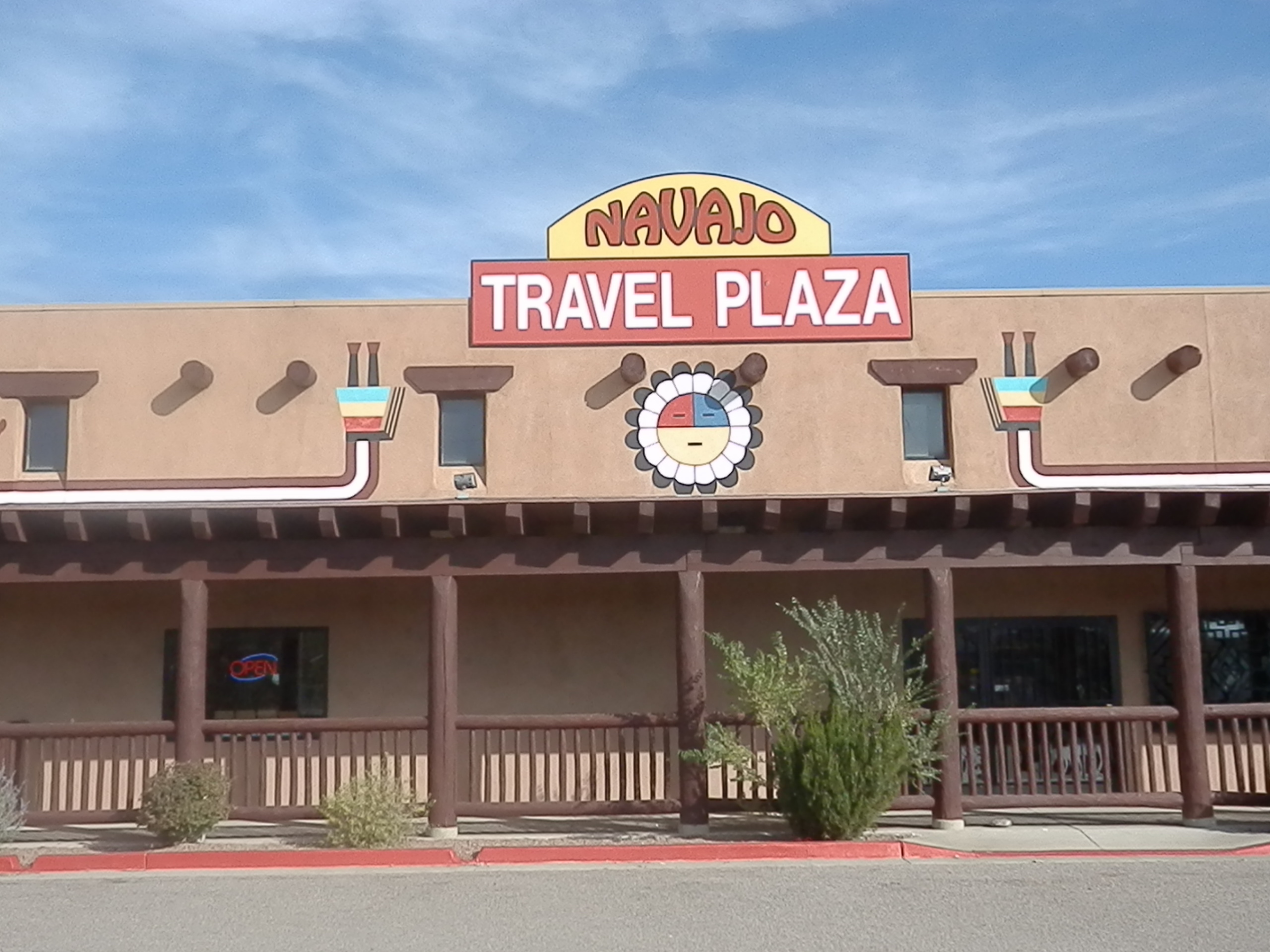
Our weakness for such establishments slowed our progress this morning, but we had the consolation of knowing that, on crossing into Arizona, we would be clawing back the hour that we had lost when we entered Utah for the first time a fortnight before. We plumped initially for the Navajo Travel Plaza, essentially an immense truck stop but one that we were lured to by the imposing Indian statue in the forecourt.

On leaving the plaza we made two unplanned detours in an endeavour to get back onto the I-40W. The now ubiquitous Burlington North and Santa Fe Railroad trains snaked eastward alongside desert scrub where sheep scrabbled for scarce food.

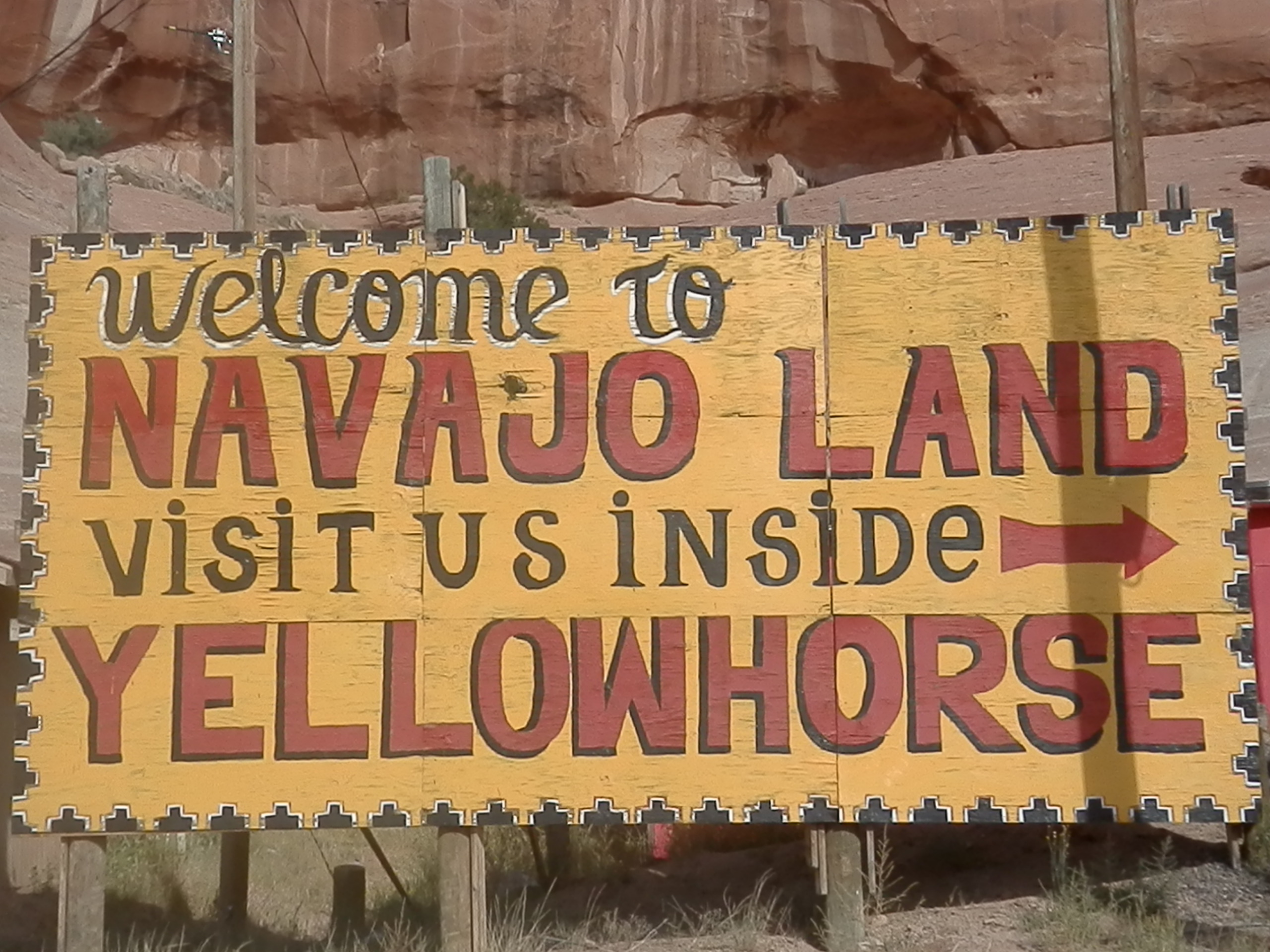
On re-entering the Navajo Nation once again, we stopped at the Chief Yellowhorse Trading Post near Lupton, a ramshackle collection of wooden buildings selling the usual Native American jewelry, rugs and other gifts.

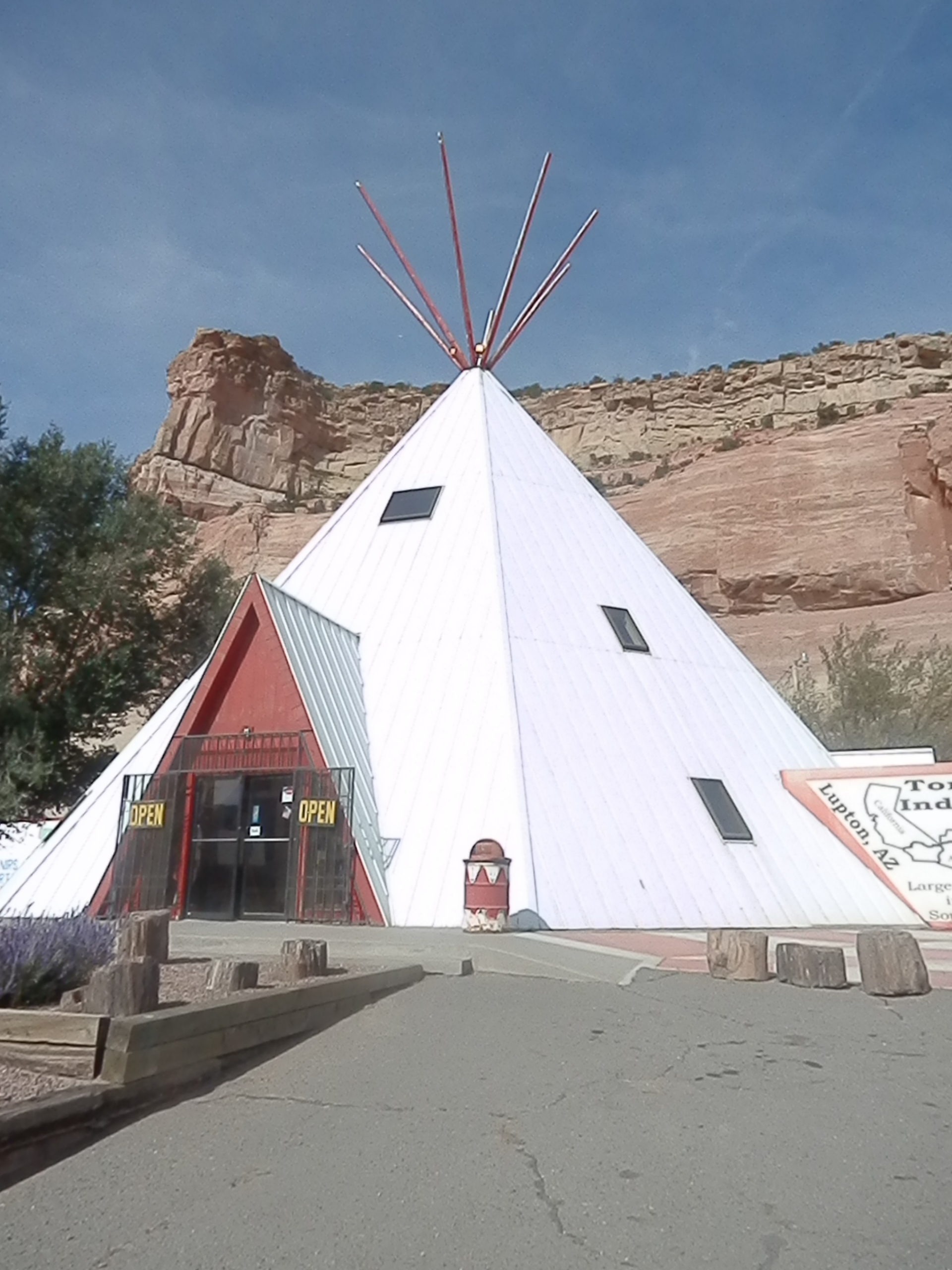
The most interesting part of the complex were the sheer cliffs that overhung it, where the owners had had large statues built of the animal species that frequented the area. Further along was the Tomahawk Indian Store, housed in “the largest teepee in the southwest”.

I cannot recall for certain whether we actually purchased anything here as a) we bought a lot of Indian jewelry on the trip, and b) the structures looked very much the same once you were inside.

Tempted by its vigorous roadside publicity for the past few miles, we turned off the road next at Indian City near Houck. This comprised two distinct buildings – Chee’s Indian Store, once a Navajo rug stand, and the newer pueblo-style building called, strangely enough, Indian City.

Despite the clean, modern look of the latter I preferred Chee’s, not least as I was able to purchase the beautiful Navajo by Susanne and Jake Page from its  extensive bookshelves. I nearly contrived to leave it behind in the shop, however, as the woman at the counter, not having seen it before, wanted to read it first, gushing over the photographs and excitedly explaining to me that her mother still wore the same traditional clothes and jewelry as the women depicted in the book.
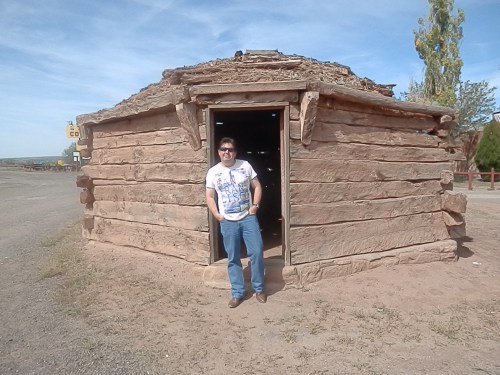
We continued to follow the frontage road which ran parallel to the I-40 for a number of miles before arriving at the Fort Courage Trading Post, another store attached to the rickety facade of a western fort. If any reader thinks the place looks familiar, it was the setting for the mid-late sixties TV sitcom, F Troop. Given that it was broadcast on the ITV network in the UK, I never saw it (my parents were BBC loyalists), but Janet was able to relate more to it.

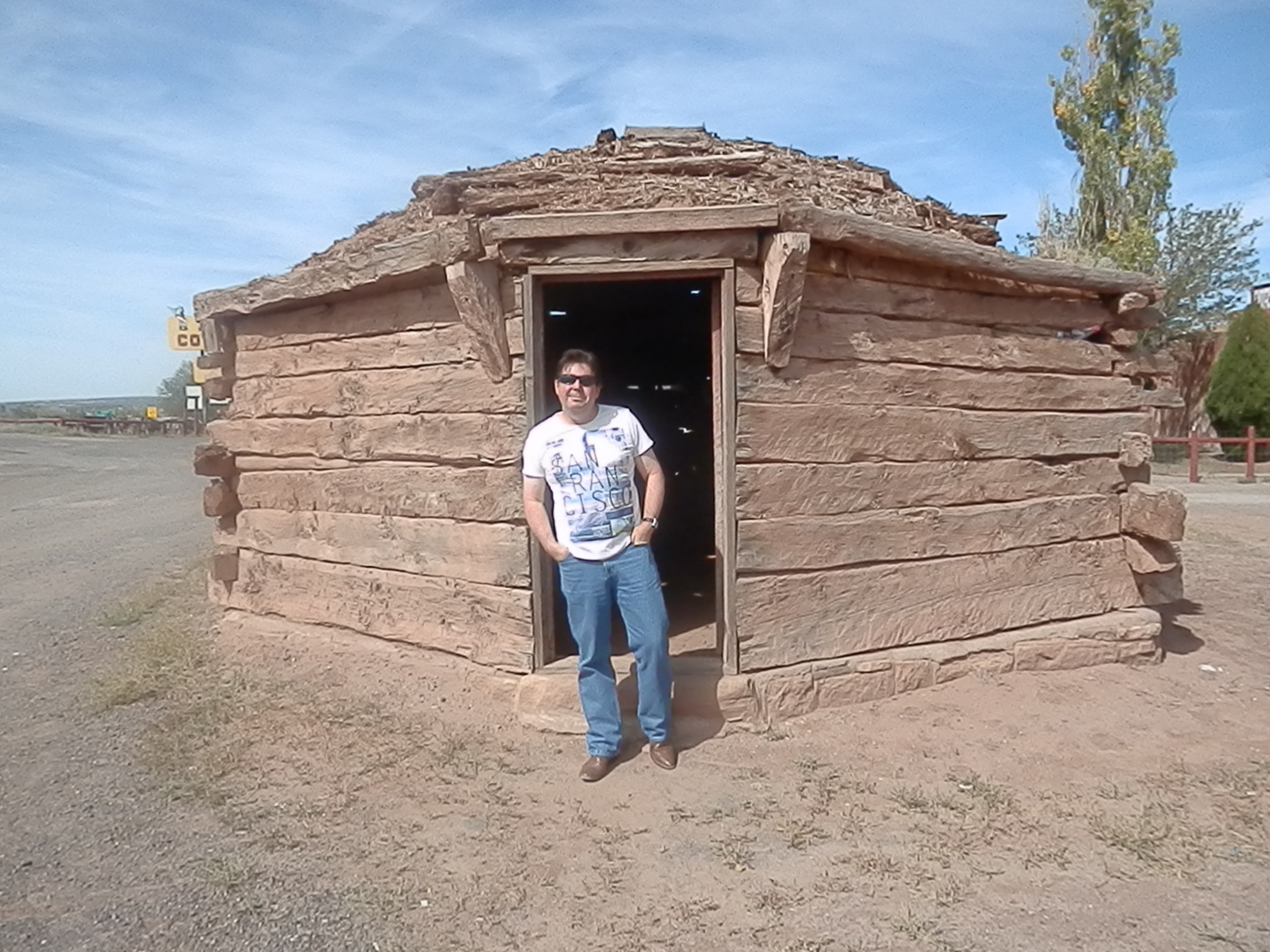
An abandoned gas station and adjoining windmill-shaped pancake house added a note of sadness to the whimsy. The reason I am standing outside the hogan in the photograph above has more to do with the prevailing stench inside than any decision to get the best light for the shot.

Despite the welcome extra hour, we were not making as much progress as we might have liked. And with several stops still before us, we needed to recoup some time. Balanced against that, we were getting hungry. Our previously reliable supply of granola bars on the back seat of the car was dwindling and something more substantial was required.

Our next scheduled “stops” were the Painted Desert and Petrified Forest, neither of which provided refreshment facilities beyond the usual gift store fare. We parked and walked to several of the overlooks to survey the stunning colours of the former, but, reluctantly, did not give the Petrified Forest the time it deserved, driving through it without stopping. Had we done so, we would have had to alter the title of this post.

Holbrook, the halfway point on today’s route and natural lunch location, was reached via the gunbarrel straight I-180. As we proceeded through a downtown that was not afraid to flaunt its Route 66 connections, we searched for one of the more fabled dining stops on this section of the road – Joe & Aggie’s Cafe.
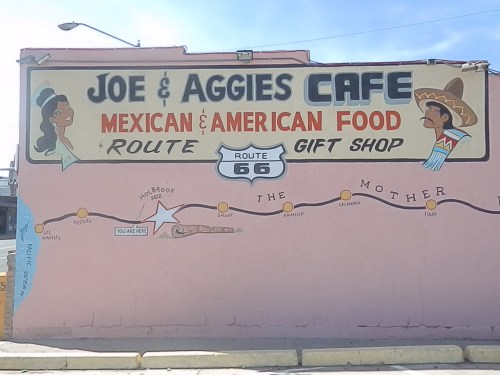
Aside from their blend of Mexican and American cuisine, the restaurant doubles up as a small museum displaying Route 66 memorabilia. It also has an enviable place in movie history as the inspiration for the depiction of America’s Main Street in the Pixar film, Cars.

Waiting for our sandwich orders, we had no choice but to listen to an elderly regular proclaiming his pride at receiving his new hearing aid. A pair of bikers at the next table argued about their next move as they shuffled maps around.

Service was friendly and efficient, although the sandwiches did not quite live up to our expectations. We were not permitted to leave the establishment without signing the visitors’ book.

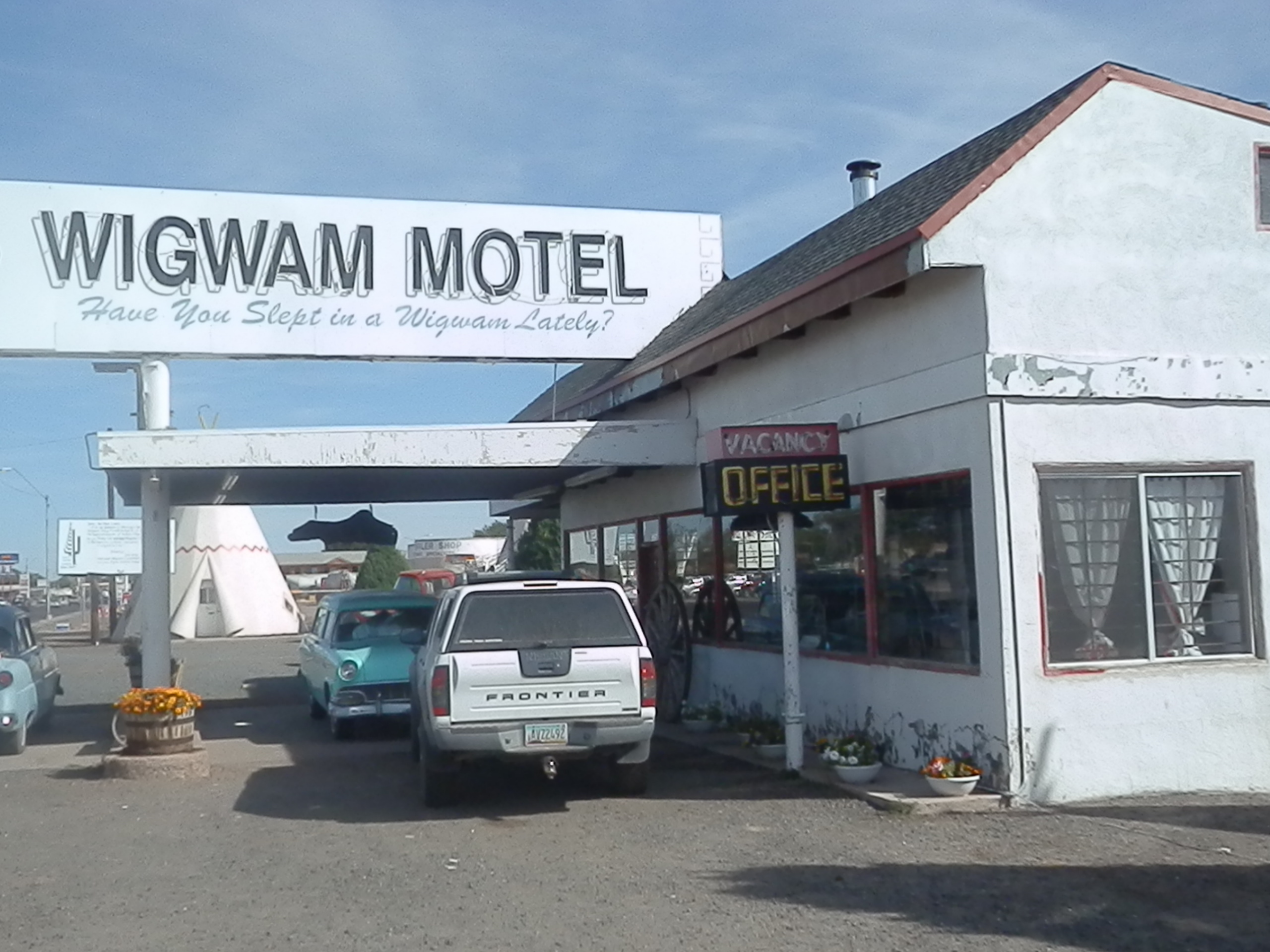
With the temperature nearing ninety degrees, it was a very short drive to the next iconic sight on today’s list – the Wigwam Motel. Once there were similar lodgings all along The Mother Road but only two remain today, the other in Rialto, California.
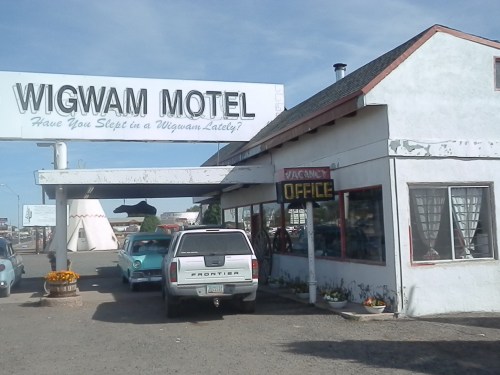
With its marketing slogan of “Have You Slept in a Wigwam Lately?”, the motel continues to thrive as both a novel lodging option and an open air museum that parades vintage cars outside each “unit”.

Attractive though the 32 feet high “rooms” look from the outside, I doubt I would wish to spend more than a single night in one, and that only for the novelty value. But would I choose the El Rancho Hotel in Gallup over this? I suspect not. On woefully short acquaintance, Holbrook joined the growing list of towns that we would have welcomed the chance to explore further. But not on this trip.

For a brief moment I think Janet thought seriously of exchanging our house and car for the alternatives on display below.

The procession of bizarre attractions just kept on coming. Next stop was the Jackrabbit Trading Post in Joseph City. The billboard declaring “Here It Is” is celebrated as one of the most iconic signs on the entirety of Route 66. In the road’s heyday of the post war years, motorists approaching from all directions were forewarned by a succession of yellow and black signs with a crouching rabbit counting down the miles. There may be fewer now, but the sense of anticipation remains.

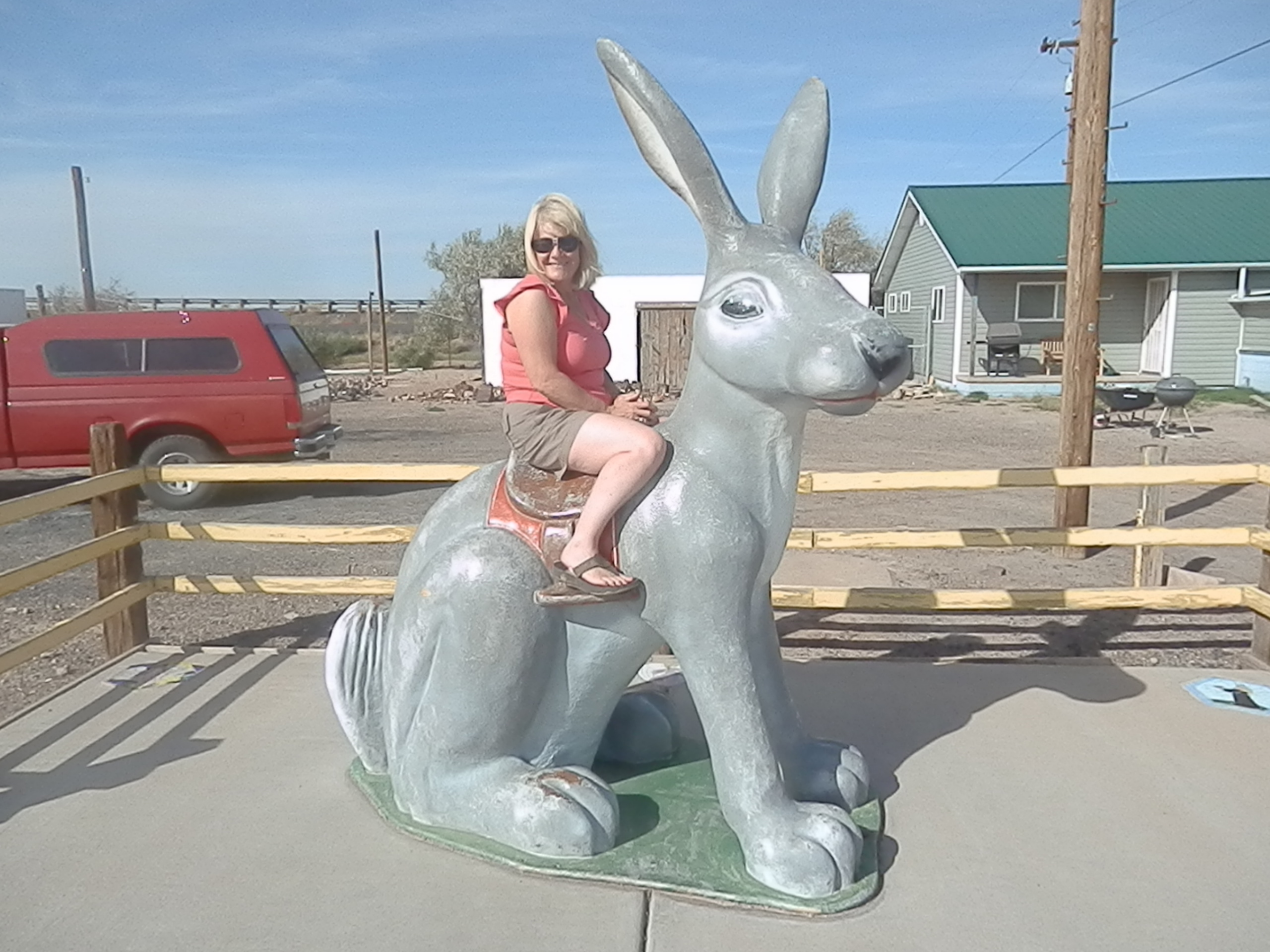
I doubt we were alone, however, in being disappointed at the failure of the reality, in the form of the average trading post, to live up to the hype. Nonetheless, Janet enjoyed her ride on the giant fibreglass statue in the parking lot – another of those “well, you just have to do it, don’t you?” moments (I didn’t by the way).

The last prominent town before Flagstaff on Route 66 is Winslow, Arizona, a name that resonates with any self-respecting hippie of the late sixties and seventies. Singer-songwriter Jackson Browne co-wrote with Glenn Frey the song, Take It Easy, which was the first track on the Eagles’ platinum debut album in 1972.

The second verse begins:

Standin’ on a corner in Winslow, Arizona

Such a fine sight to see

It’s a girl, my Lord, in a flatbed Ford,

Slowin’ down to take a look at me.

The good burghers of Winslow seized on the marketing opportunity afforded by the song and erected a monument on the northwest corner of Second Street and Kinsley Avenue. It is now a place of pilgrimage for rock fans from all over the world, bringing renewed revenue and profile to the town. Whilst we leant against the figure, a young man on business from Baltimore, swung by and offered to take our photograph.

The girl, by the way, in the flatbed Ford, can be seen in the window behind the statue, which does bear a striking resemblance to a young Jackson Browne.

An excellent gift store selling a large amount of “Standin’ on the Corner” merchandise sits directly opposite the statue. As we perused the t-shirts (yes, I bought two), mugs, fridge magnets, postcards, CDs and miscellaneous items, Eagles DVDs were being shown on the large TV screen overhead.

Incongruously, the store was “manned” by two ladies of mature years who could not have given a better impression of disliking their job if they had tried. Not only did they fail to acknowledge the music (perhaps they had become immune to it), but they also made no effort to engage us in conversation, either about our purchases or our reason for visiting. It is rare not to be asked “where are you folks from” at least.

Anxious to get to Flagstaff before dark we gave Meteor Crater a miss and pushed on. But not without attempting to visit one final location.Bobby Troup’s classic song, (Get Your Kicks) on Route 66, has the line “Flagstaff Arizona, Don’t forget Winona”. We didn’t, Bobby. Unfortunately, however, we couldn’t find it!

We took the advice of Roger Naylor, whose beautiful book, Arizona Kicks on Route 66, had been our primary guide, and took exit 211 on I-40, picking up the original Route 66 alignment, Townsend-Winona. The scenery – Ponderosa pine woods, farms and meadows – was lovely, but, somehow, we failed to locate the town. Or perhaps we did and we didn’t realise it.

This late afternoon detour meant we had deviated from our planned itinerary for the day. We were now approaching Flagstaff from the north on I-89 rather than from the east on I-40. After much map rustling and an increasingly fraught exchange of views as dusk descended on the edge of town, we succeeded in spotting the Little America Hotel on East Butler Avenue, sat alongside the entrance to I-40 West (and Route 66) in the direction of Los Angeles – very convenient for our getaway the morning after next.

After our dark, cramped accommodation in Gallup we instantly brightened at the gleaming, welcoming lobby. The hotel consisted of a number of interconnected buildings and we needed to drive through the parking lot for several hundred yards before reaching ours in a lovely, forested setting. Janet did not hesitate in taking advantage of the outdoor heated swimming pool whilst I acquainted myself with a room that resembled a suite.

I write this piece on the morning after Barack Obama has been re-elected President of the United States (and I have had barely an hour’s sleep). That seemed a distant prospect as I watched in disbelief his lacklustre performance in the first presidential debate with Mitt Romney on CNN.

My spirits were raised by the excellent dinner and highly attentive service in the elegant hotel restaurant that followed. It was a few short steps from there to the adjoining bar where we topped up our bottle of Pinot Grigio with a couple of Jack Daniel’s and gin and tonics respectively whilst engaging in a fascinating conversation about the road with a trucker from St. Louis, Missouri. He was en route to Los Angeles, a regular trip in which he covered between 600 and 800 miles a day, a figure we had difficulty in relating to (the shortest route using classified roads between Land’s End and John O’Groats is 874 miles).

Today had been one of the most eagerly awaited legs of the trip, and whilst we had not managed to visit every attraction we had planned, it had not disappointed. Trading posts, a roadside diner, a hotel comprised of wigwams, sitting on a giant jackrabbit, reliving a great pop lyric – we had done them all whilst progressing 225 miles west. The weather, as it almost always appeared to be on the trip, had been lovely. We were now genuine Route 66 groupees. But we had to wait another day for the chance to enjoy it further for tomorrow was “the big one”!

Read Full Post »

Today was the first of a four day drive back to our starting point in Las Vegas. Much of that journey would be on, or close to, Historic Route 66. Excited at the prospect, we left Albuquerque on I-40 west. We had contemplated heading east initially to sample breakfast in the famous 66 Diner, but decided to press on – besides there would be other worthwhile sights to see before we arrived in Gallup (“Indian Jewelry Capital of the World”) for our overnight stop.

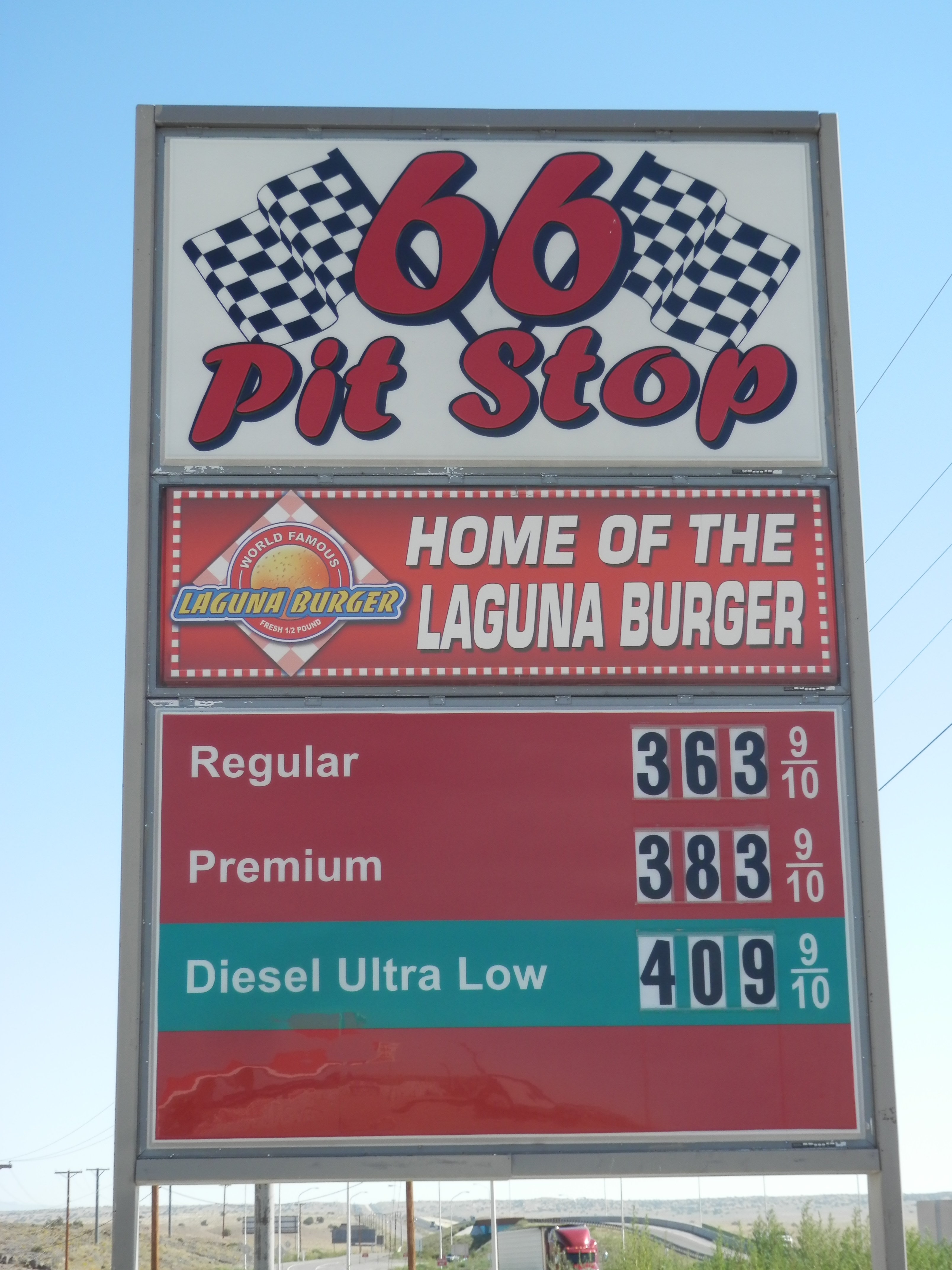
The first priority was to fill the car, which we did at the 66 Pit Stop. Although we had not eaten, we could not be tempted at such an early hour by the “world famous” burger that was a speciality here. A short while later we drove through Laguna, the self-styled “New Home of the Laguna Burger”, which appeared to reinforce our earlier decision not to risk the “old” one back at the gas station.

The Navajo and Laguna reservations hugged us on either side of the road as we looked for opportunities to slip off the interstate and test the four wheel drive credentials of the car on the often rough road that passed for America’s Main Street. It did not take long for us to skirt our first dead animal of the day – a calf shortly before the exit for Hajillee.

At Grants – the midpoint and principal town on today’s journey – we came across, or at least acknowledged for the first time, a phenomenon that was to thrill, fascinate and haunt us in equal measure for the next three days – the sight of cargo trains of centipede proportions, motored by upwards of five engines, proceeding magisterially along the tracks only a few yards from the main road.

We had long become accustomed to gargantuan trucks hurtling past us in excess of the speed limit, but this was something else, something that I had, clearly erroneously, thought was a thing of the past in the land where the automobile is king, when hobos rode the rails during the Depression.

If the sight was not awe-inspiring enough, the sound of the train’s deep, mournful whistle sent the same chill through me as only the bell of the Campanile di San Marco in Venice had previously done.

We drove through Grants on The Mother Road past a series of uninspiring motels, eating establishments and local businesses with such exotic names as Tim’s Muffler Service, Loeffler’s Guns and Handy Andy Quick Shop before turning back onto I-40 (the two roads, and for that matter, the railroad were rarely far apart) for the short drive to Milan.

It was nearly 12.30pm and last night’s rib eye steak was long forgotten. This was not the first time that the romance of the road and the anticipation of what might await us over the horizon had overcome any hunger.

As we were about to swap the frontage road for the interstate again we spotted the Kiva Cafe and adjoining Chaco Canyon Trading Company. Having had no breakfast this would effectively be the only meal today before dinner. That was my rationalisation anyway for indulging in the Chaco Cheeseburger with bacon, fried egg and steak fries. Janet plumped for the much healthier guacomole wrap (though I do recall the mysterious disappearance of a number of my steak fries).

Waiting for our meal, we became reacquainted with our friend, Ben Goode, whose books had graced the diner in Mesquite on our first day on the road. Intriguing titles such as How to Make People Think You’re NormalMen Exposed and The Joy of Being Broke were propped behind the condiments on our table.

The diner is truly one of the marvels of American culture, and especially of the road, and this was no exception. Wholesome, inexpensive food, friendly service (our server, Monique, was lovely), unlimited coffee and the opportunity for some serious people watching – an unbeatable combination. Moreover, they perform the valuable service of reminding us that we are not as fat as we thought we were – a condition that could only be sustained if we did not visit such establishments too often.

The couple at the next table were a case in point. She was probably in her late forties, around thirty stone with long greasy, grey hair, the number of her chins only marginally surpassed by the amount of zits on her face, and wearing a  voluminous flowery blouse and tight denim shorts. He must have been in his seventies, around half his companion’s weight and wearing check shirt, blue jeans and USA baseball cap. They satisfied themselves with huge sodas whilst they waited for their meal, a vast morass of nachos and salsa that they were still devouring with relish when we left.

The restaurant was adjacent to a new, sparkling adobe-style trading post where local Native Americans worked at their craft a few feet from the counters that displayed the finished products.

Initially resuming our journey on the interstate, we soon spotted another stretch of old Route 66 to explore. The Bluewater Inn and Motel lay derelict, an all too common sight on the road’s (approximate) 2,448 miles, and one we were to witness several times again in the next few days.

But there was some life left in this particular old dog. The inn and motel had long shut up shop but the sight of a couple of dozen used cars, pickup trucks and VW microbuses indicated that there might be a business going on here. Indeed, as I stepped out of the car to take some photographs of the wistful scene, an elderly man in a Chevy pulled up alongside and invited me to “take all the pictures you like”. At first I thought he was being sarcastic and that this was his way of telling me to skedaddle, but he seemed genuinely friendly, adding he was “just trying to make a living”. We pulled away, hoping that he would make a sale that day.

Back on the I-40 and with fifty miles to go to our destination, billboards advertising the El Rancho Hotel in Gallup, “home to the movie stars”, started to appear. Another mile long hot dog of a train trundled past a mere thirty yards away from us.

Banks of mesas re-emerged as we passed through Prewitt and Thoreau before reaching Continental Divide, where a line of highly elevated terrain causes rainfall on one side to drain away to one body of water and the other to a different one, in this case the Pacific and Atlantic Oceans.

The number of signs extolling the wonders of the El Rancho Hotel were only exceeded by those recommending a stop at the Indian Market. However, this was a classic example of product marketing over the quality of the product itself, though I did succumb to purchasing a Route 66 t-shirt.

We passed the towns of Gonzales, Wingate, Iyanbito and Church Rock before leaving the I-40 one last time to arrive at the El Rancho Hotel on Historic Route 66.

When we had booked our overnight stop, our guidebook had insisted that, because of its historic significance, this was “absolutely the place to stay” in Gallup, despite the presence of a number of considerably cheaper motels. A member of the National Register of Historic Places, the El Rancho, with its slogan “Charm of Yesterday, Convenience of Tomorrow”, had provided a bed for dozens of movie stars from the golden era of Hollywood whilst they were filming in the area.

As we wandered down the corridors on each of its three floors, we encountered rooms named after just about every actor and actress that had graced the silver screen either side of the second world war. JohnWayne, Katherine Hepburn, Spencer Tracy, Joan Crawford and Kirk Douglas were just a few.

I fully expected us to be given the one room that commemorated an actor we had never heard of, hence my surprise and delight at having been allocated the Humphrey Bogart room!

Sadly, the reality did not live up to the star billing. This was palpably the worst room we stayed in on the entire trip – dark, cramped, small bed, tiny bath, no iron/ironing board (cut-off versions only available at reception) or tea or coffee making facilities – and the wi-fi was temperamental. Moreover, the evening meal in the restaurant was bland and the bar dark and expensive. But hey – it was steeped in history, and it is that that the hotel trades on and derives its undoubted success from. And that is why we chose it.

And to be fair, it had character – the saloon-like lobby / lounge, the Indian store, the framed photographs of the movie stars and the murals depicting western scenes all contributed to an authentic atmosphere. It was just that many of the convenient features expected by modern travellers were missing, perhaps intentionally so. And the size of the rooms was a major constraint.

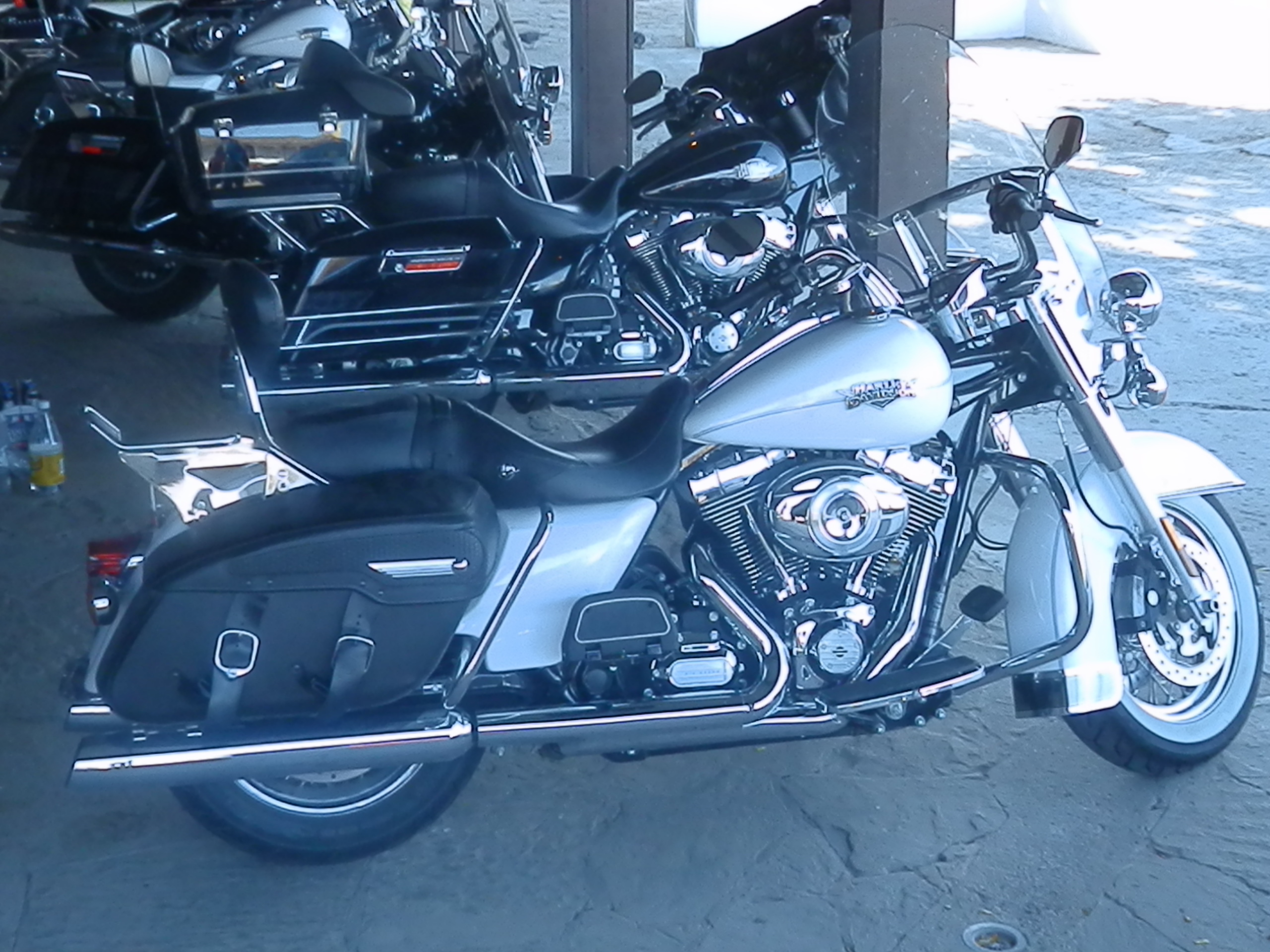
If any evidence was needed that we had now enrolled in the army of  Historic Route 66 devotees, the line of Harleys parked outside the hotel sealed the deal.

Once we had squeezed both ourselves and our luggage into our room we walked along the road to Goodfellas Sports Lounge. To describe it as dingy and characterless would be an understatement, but we received a friendly enough greeting from the three good ol’ boys sat talking football and politics at the only other occupied table. Fortunately, Joe Pesci was not around at this time. And the Coors light beers were refreshing after a day on the road.

Whilst the bar might have been expensive, two (very) large Jack Daniel’s went some way to erase the memory of a disappointing dinner, as well as  induce a reasonable night’s sleep, only interrupted periodically by the baleful, beautiful whistle of the Burlington North and Santa Fe Railroad.

Now that’s almost worth being an insomniac for!

Read Full Post »


After its day off in Santa Fe, we were easing the car back into action today with the short journey, just 61 miles, to our next overnight stop, Albuquerque. Although it was likely to take little over an hour to get there, we resolved to make the most of New Mexico’s largest city and arrive early enough to get some serious sightseeing in.

Leaving Santa Fe shortly after 10am on an initially hazy morning and 72 degrees already on the temperature gauge, we quickly found the I-25 that would take us direct to Albuquerque. Adobe houses nestled beneath low lying mountains as we passed the southern suburbs, and a small plane came into land at Santa Fe Municipal Airport.

The Spanish / Mexican heritage of the area was reinforced in the names of the principal towns on the route – La Cienega, Santo Domingo Pueblo, Algodones, Bernallio, Corrales and Rio Rancho. Another native american casino gleamed by the roadside in San Felipe Pueblo but we resisted its undoubted allure on this occasion.

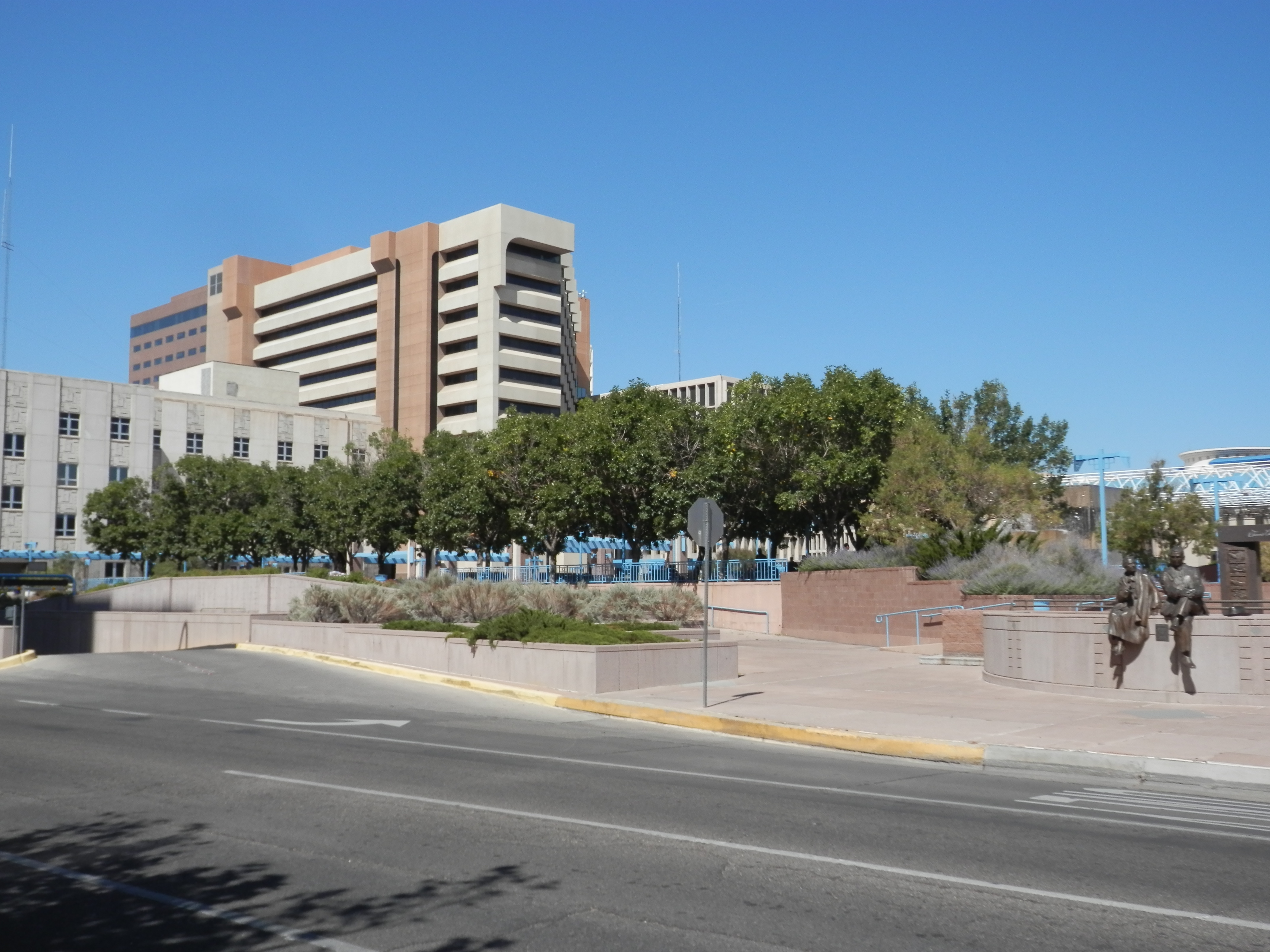
After an hour the metropolis of Albuquerque loomed, the first sight we had had of what one could call a city since we had left Las Vegas almost a fortnight before. Indeed, our hotel, the Hilton by Doubletree in downtown, was a far cry from the motels and generally low rise hotels we had become accustomed to. It even had a lift – well, actually, four! And, in one sense, I cannot deny that it was a relief to know that we were staying in a “real” hotel for a change.

We were permitted by the extremely welcoming reception staff to check in straightaway, and left our luggage in the spacious, well furnished room before venturing out into the warm sunshine.

With only a few hours to play with, we had to make a choice between the modern city and the Old Town. This was no contest and we set off walking the two miles along Central Avenue, the old Route 66, in the direction of the latter.

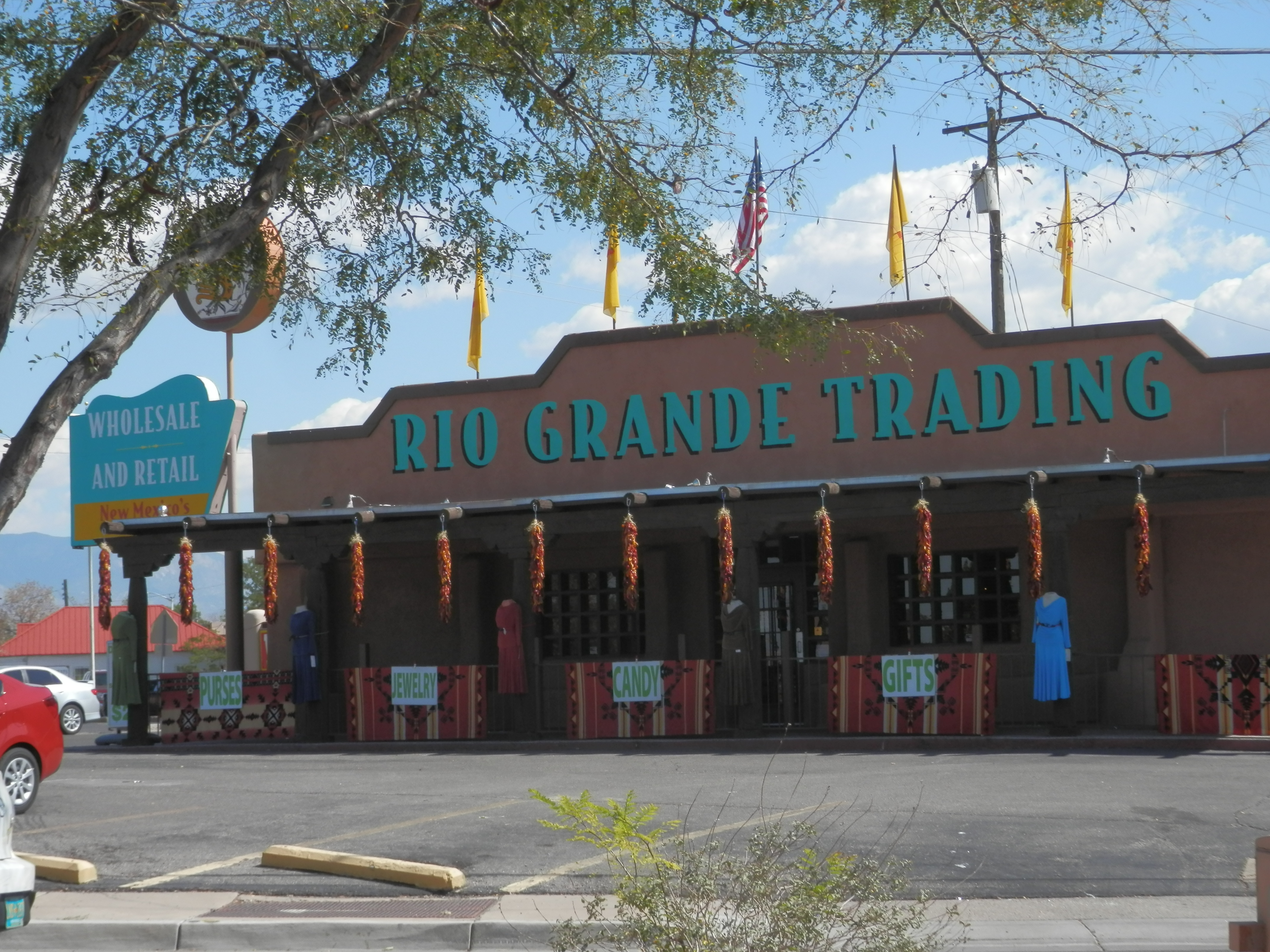
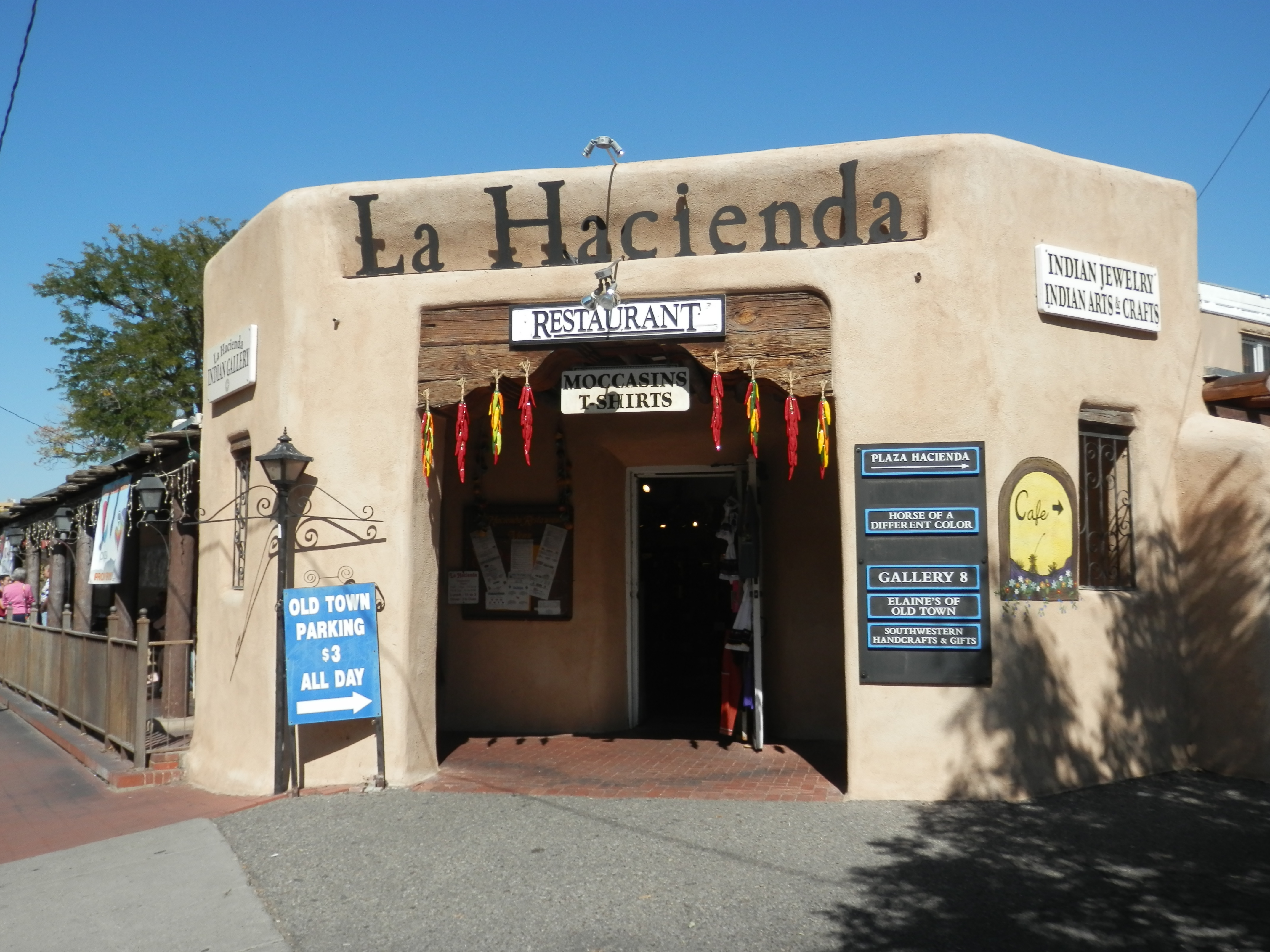
Old Town has been the focal point of community life in Albuquerque since 1706. The layout follows the traditional Spanish pattern of a central plaza and church, surrounded by homes and businesses. Many of the historic homes are still standing, though some have been converted into shops, galleries and restaurants to meet the burgeoning tourist demand.

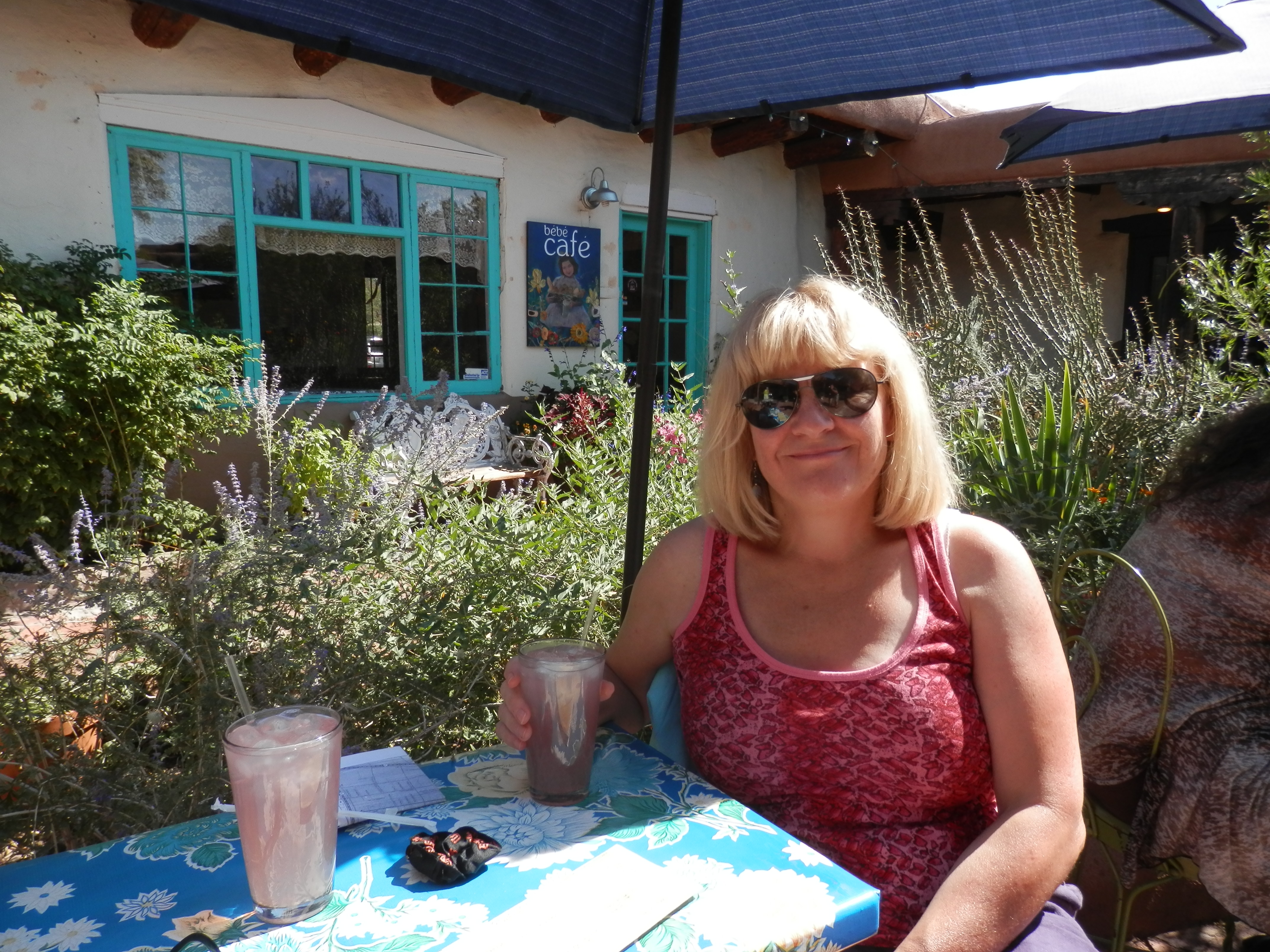
In need of refreshment after our walk in the heat, we had a light lunch in the Be Be café in a delightful arcade leading off from San Felipe Street, one of the main thoroughfares.

Most people who have at least heard of Albuquerque will associate it with the annual International Balloon Fiesta, the world’s premier balloon event, held at the beginning of October. Although we were a few days too early, we had hoped to see some “rehearsals” for the weekend, but despite the clear, calm weather, there was no sign.  Oh well, something else to build into the itinerary for the next visit.

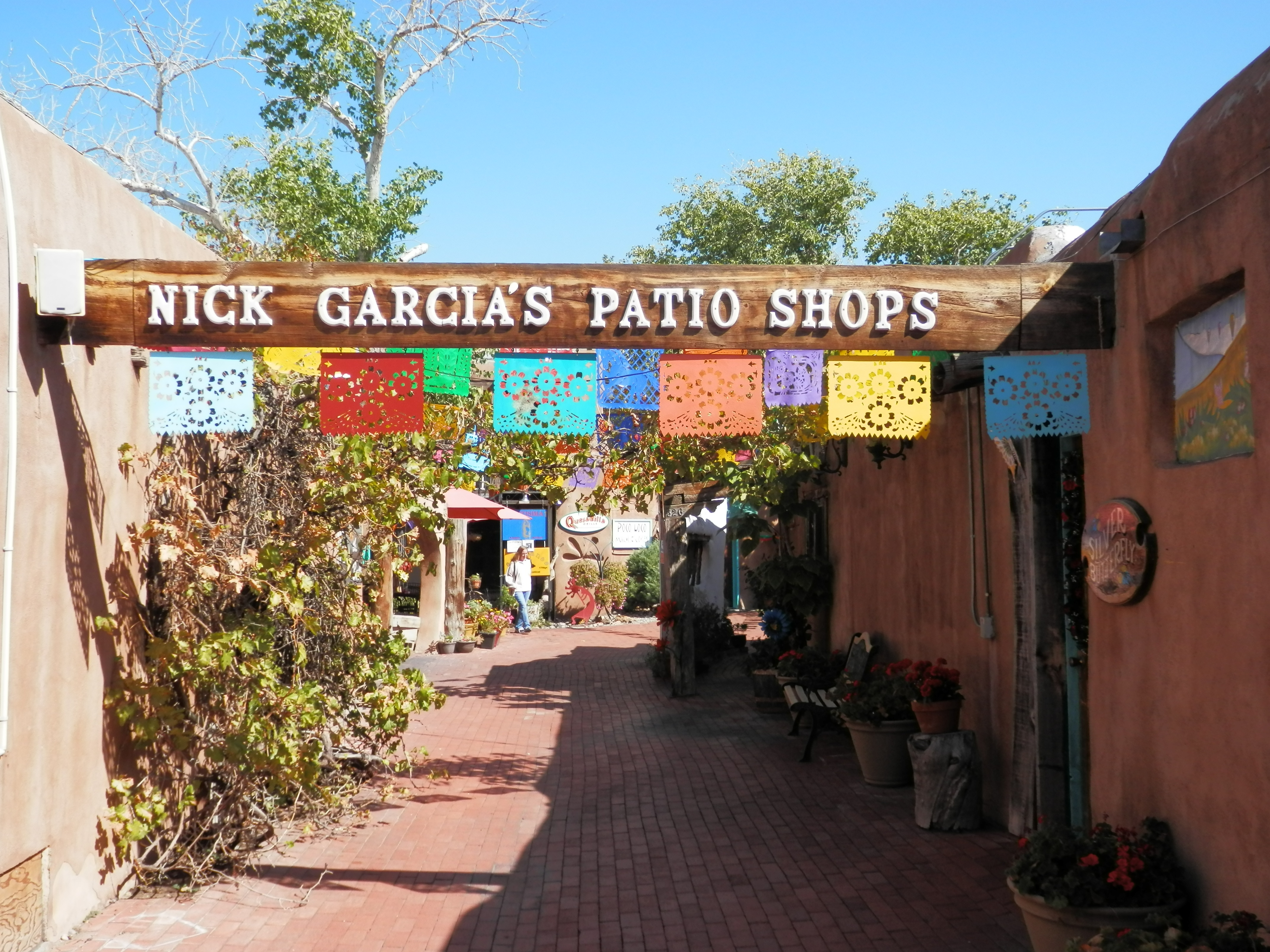
Old Town boasts more than 150 attractive antique shops, trading posts, galleries and museums selling unique gifts not only from the southwest but also around the world. More relaxed and peaceful than Santa Fe, walking around the streets, arcades and pretty cul de sacs was a lovely way to spend the afternoon.

A bonus for Janet was coming across her other favourite man in one of the western-style stores. He insisted on us having our photo taken together. I would, of course, not presume to suggest which of us looks best in it.

Aside from the main plaza, there are several other colourful, flower-filled squares, overlooked by balconies and arcades. Fountains, wrought iron benches upon which to take a siesta if you wish and live music complete a delightful scene.

The lovely San Felipe de Neri church presides over the north side of the main plaza.

After around four hours we headed back to the hotel, a more strenuous hike in the hot late afternoon sun, especially as we had virtually walked ourselves to a standstill already.

We decided to eat in the elegant hotel restaurant, La Oja. However, on arriving at 9pm we found ourselves its only patrons! Whilst that might sometimes be a bad sign, this was not the case, and not only because we did not have to wait long for our meal!

I ordered rib eye steak for probably the first time in my life, accompanied by blue cheese dauphinoise potatoes, asparagus and carrots, and it was divine. I have it from a reliable source that Janet’s pork chop was equally scrumptious. We were so glad we had included the Colorado and New Mexico legs of the tour in our itinerary – the food alone had been outstanding!

We now had three days driving Route 66 and a day in the Grand Canyon ahead of us before we returned to Vegas – for a rest!

Read Full Post »

Santa Fe, or indeed any part of New Mexico, had not been in our original itinerary for this trip. But once we had decided to substitute yet more canyons for a spell of sophisticated southwestern slumming, we had looked forward to our visit to the former Spanish and Mexican outpost with particular excitement.

It was also the one day between leaving and returning to Las Vegas two and a half weeks later that did not involve any driving.

After breakfast in the hotel we walked to the adjacent trolley stop as it was too far even for us, toned and shaped though we were from our hiking exploits in Zion, Bryce and the Arches, to walk to downtown along a busy, noisy ring road. Unfortunately, we saw the vehicle roaring past our stop, and on scrutiny of the timetable, the next bus was not due, this being Sunday, for another 45 minutes. Though it was another clear, bright morning, there was a nip to the air, so standing at the stop for that length of time was out of the question.

So we started walking with half an eye over our shoulders for the next trolley, which duly arrived on time. Alighting just off the Plaza in Palace Avenue we collected maps and entered a French patisserie for coffee and a discussion on our itinerary for the day.

One of the most popular and beautiful cities in the U.S., Santa Fe is renowned for its stunning adobe architecture. Originally made by the ancient Puebloans, such buildings were constructed of blocks of mud, cut from the riverbeds and mixed with grass. Built into walls, the bricks were set with a mortar of a similar composition, and then plastered over with mud and straw. There are several fine examples of public buildings constructed in this way in downtown Santa Fe, including the New Mexico Museum of Modern Art.

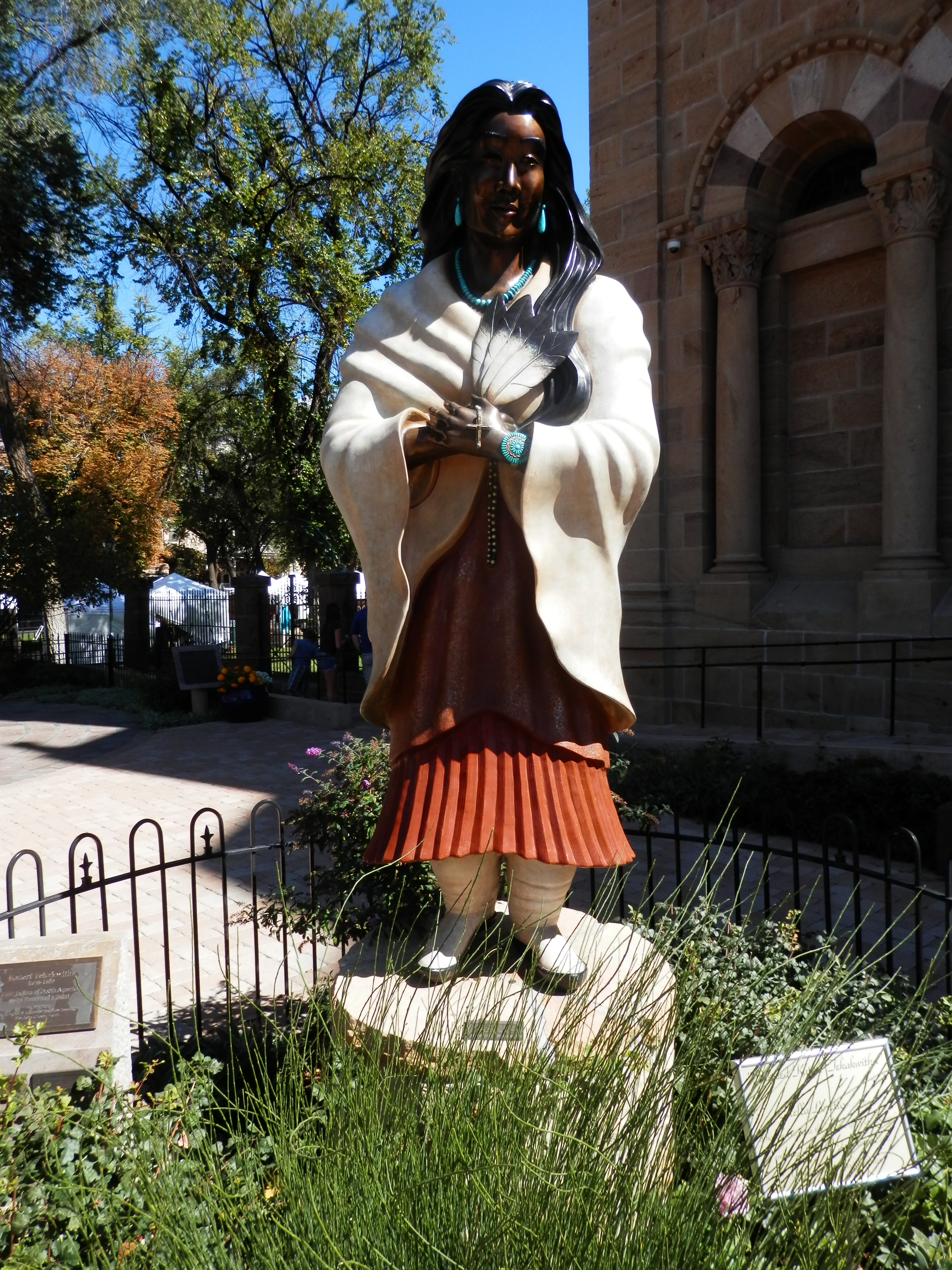
Although the steady stream of Sunday services prevented us from venturing venturing over the threshold, we took a stroll round the handsome French Romanesque-style St Francis Cathedral. Besides a fine statue of St Francis of Assissi himself, I was impressed with that of the Blessed Kateri Tekakwitha, a seventeenth century Iroquios-Mohawk woman who was scheduled to be canonised in October 2012.

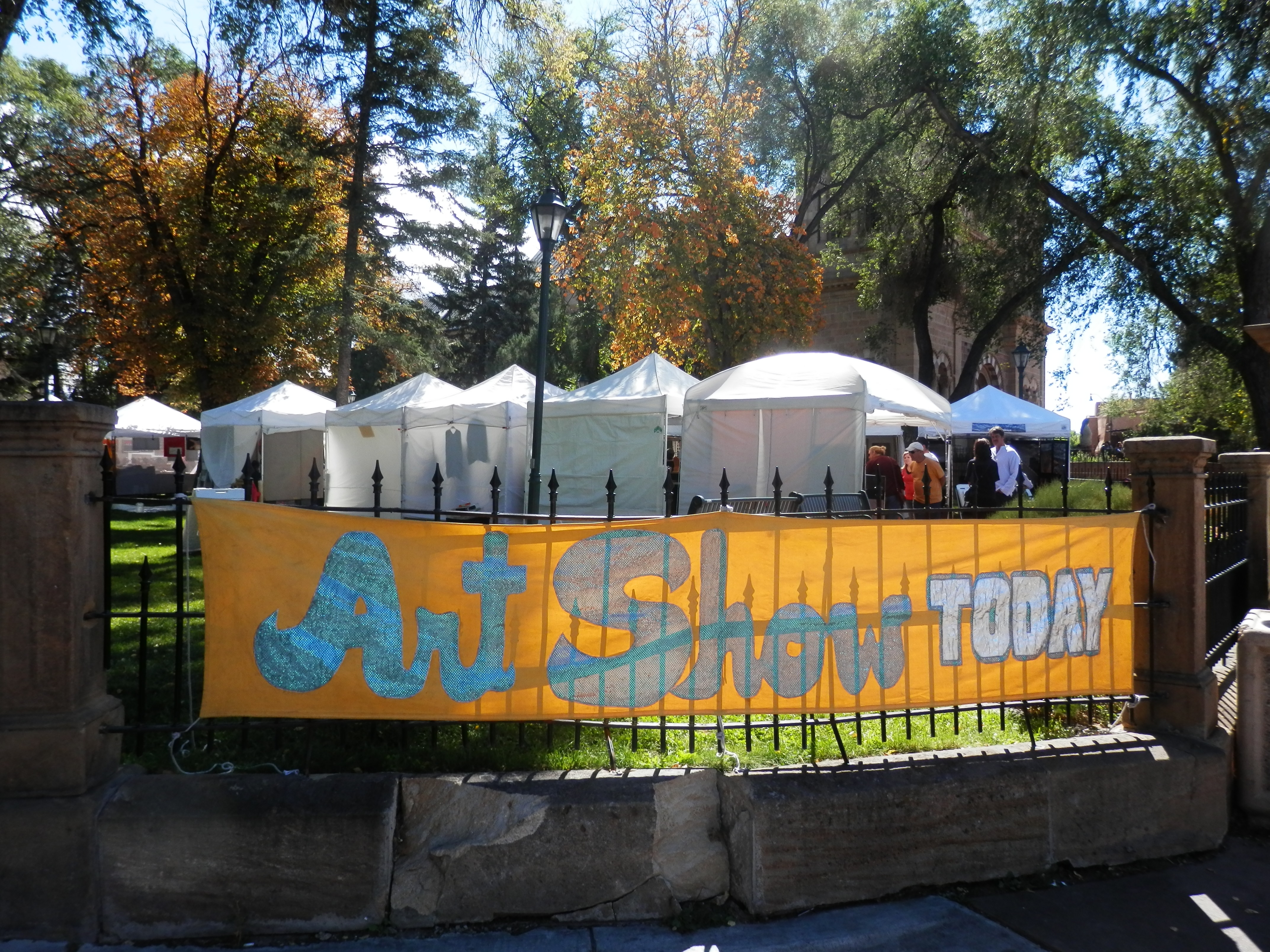
It is not only Santa Fe’s architecture that brings visitors flocking to the city. Few locations in the U.S. can match it for its artistic and cultural scene. Indeed, we came across a number of outdoor art shows, galleries and exhibitions.

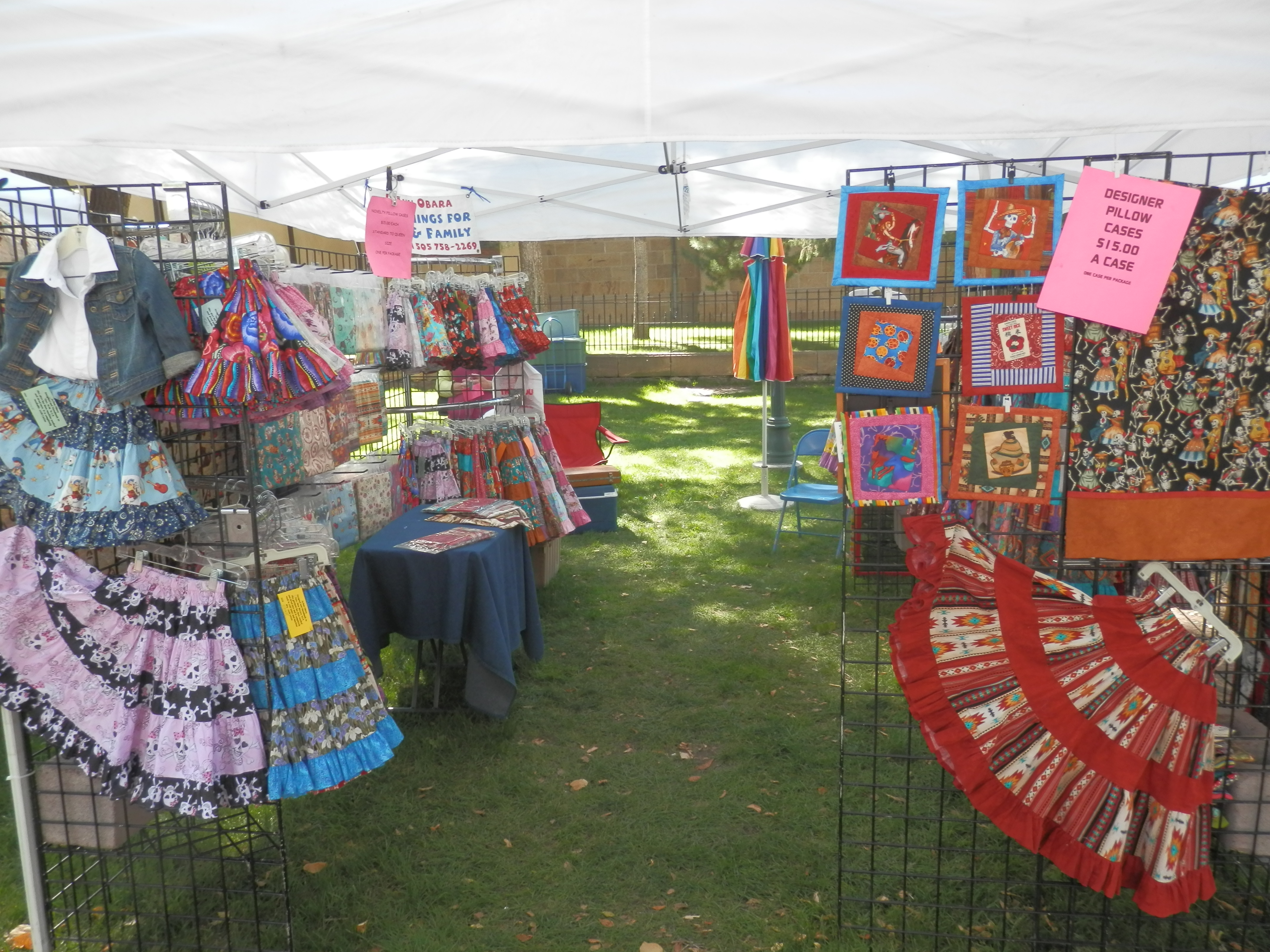
We bought some gorgeous western-themed pillowcases and cushion covers from one stall and had another of those extended conversations about our trip with fascinated Americans that were such a feature of it.

The Plaza itself, from which the streets packed with gift and home furnishings stores, cafes, restaurants and galleries spread out, is a lovely space and home to more stalls and public art. The exterior of the Palace of the Governors, the oldest public building in the U.S., which runs along one side, is occupied by native americans selling jewelery and other gift items.

Our only reservation about the attractive array of  shops, and one we should not have been altogether surprised about, was that prices were generally high.

After lunch, incongruously you might think in the light of my praise for the Santa Fe dining scene, in Starbuck’s, we took an open-air, single tier trolley tour, which enabled us not only to learn more about the city’s history and many of its most imposing landmarks, but to travel part of the legendary Santa Fe Trail, the nineteenth century transport route that connected Franklin, Missouri with the city, thus opening up the southwest for economic development and settlement.

The tour also included Canyon Road, an artists’ colony that abounded with both open-air and enclosed galleries and workshops as well as attractive restaurants.

The tour, which cost $30, promised “1 hour and 15 minutes of history, sights, stories, and good old-fashioned fun”, certainly delivered on all of those criteria bar the last one. The driver / guide was extremely knowledgeable and informative, but lacked charisma.

After a drink at the Marble Brewery overlooking the Plaza, we returned on foot to Canyon Road for a closer inspection, only to find that most of the galleries were closing. The walk did, however, whet our appetites.

After two successive nights of Tex-Mex food we both craved something different.   The Rooftop Pizzeria in the Santa Fe Arcade on San Francisco Street proved an ideal spot where we were able to watch the sun disappearing over the horizon. Having had the best enchiladas I had ever tasted only two night before, we felt spoilt to be served unequivocally the best pizzas we had ever had, a topping of lobster, shrimp and bacon. We even recommended it to the adjoining table of theatrical locals who were, thankfully, equally impressed.

Another $1 taxi fare back to the El Rey Inn completed a relaxing and enjoyable day. Whilst Santa Fe may not have quite lived up to both our expectations, it had come very close and is somewhere we would wish to explore further.

Read Full Post »


On a day that would eventually caress eighty degrees the early morning chill forced me to don a jacket for the first time since leaving the UK to visit the breakfast room for coffee and load the car. The local Albuquerque based TV station announced it was on “drought watch” predicting a “sea of sun for the next few days”.

With another 200 mile journey before us we filled up with gas, sharing the forecourt with two hefty Harleys and a monstrous Winnebago. We had resolved to explore “historic downtown Durango” before hitting the road – am I alone in finding that the use of “historic” to describe so many places in the US as a tad ironic?

Durango’s biggest tourist attraction is the “historic” (there I’ve used that word again) Durango & Silverton Railroad that chugs 45 miles to the mining town of Silverton through the breathtaking scenery of the San Juan Mountains. Sadly, our itinerary did not allow us to experience it on this occasion. The journey takes three and a half hours each way and we had only a couple of hours at our disposal. We did, however, see the early morning departure trundling out of town as we searched for a parking space.

And besides, breakfast was our priority. We alighted upon the Carver Brewing Co. and walked into what was clearly “where it was at” on a Saturday morning. We  managed to grab a table in the large brew pub and restaurant before a lengthy line developed outside. The steady hum of conversation inside was only intermittently stilled to enable the interrogation of ipad and mobile phone screens before the backslapping and debate on sport and politics resumed.

Durango resembled Moab in that it had a cosmopolitan, high-energy vibe that was alien to the towns we had visited in the earlier part of the trip. Mountain biking and river-rafting are equally as popular as in its Utah counterpart. It also has a small ski resort, formerly called Purgatory – I can understand why they changed the name!

In addition, it felt now as if we were “out west”, unsurprising in that the town had been founded in 1880 as a rail junction for the Gold Rush community of Silverton.

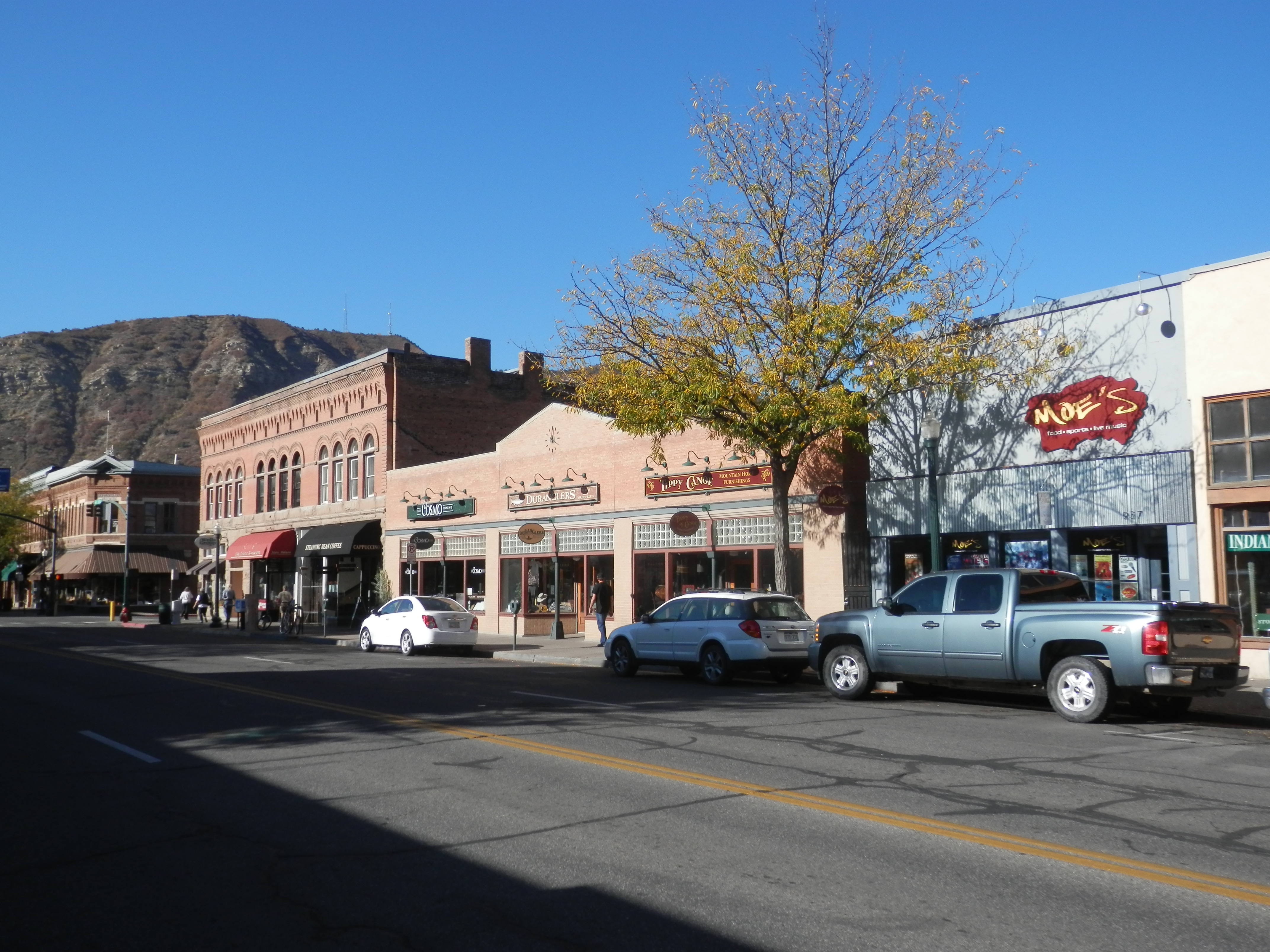
Our guidebook had claimed that downtown Durango was the “liveliest urban area in the Four Corners” and “worth an hour or two of anyone’s time”.  And indeed it was. Gift shops, outdoor clothing emporia and coffee houses gave it a youthful, vibrant feel. And the brilliant sky and slowly mounting temperatures made for an agreeable stroll along its streets.

We were impressed too with the free trolley service that connected downtown with the outlying areas and which had transported us back to our motel the night before.

We could not leave the town without visiting the railroad musuem and wander among the vintage steam trains and huge model railway layouts.

Everybody we met during the trip, on hearing that we had been to Durango, asked whether we had taken a ride on the railroad, so it sits high on a list of things to do when we are next passing by.

We finally dragged ourselves away from Durango just before noon, joining the US-160 East towards Pagosa Springs.

Once we had passed a series of out of town plazas, stores and malls, the scenery reverted to the same look as we had encountered the day before – rolling hills with periodic farms and homesteads, embraced by the San Juan National Forest. The occasional yellowing of the trees that we had observed more than a week before in Utah was becoming more widespread as we drove through Bayfield and Chimney Rock. A raccoon in the middle of the road was added to the growing list of animal species we had seen splattered by passing traffic.

We were scheduled to turn south at Pagosa Springs onto US-84  a few miles north of the New Mexico county line, but as with so many spread out U.S. towns, it was difficult to establish where the centre was. Dubbed “The Best of Colorado” it seemed to go on forever! But just as we were about to concede that we had unaccountably missed the turning, we reached downtown (we think), took the opportunity to avail ourselves of the restrooms of a local bar (me) and gas station (Janet), and check the map. In fact, the turning was visible around the next bend. My map reading reputation was intact!

In view of our substantial breakfast and late departure from Durango, we agreed to kick on and take our chances with lunch. This part of southern Colorado and northern New Mexico was undoubtedly cowboy country as the profusion of ranches  (Squaw Valley, Crowley Creek and Spring Creek to name just a few) indicated. We even saw a large head of cattle being herded into a field by a group of men in full western regalia.

We were welcomed into “New Mexico: The Land of Enchantment” with spectacular lightning strikes over the mountains ahead, though these amounted to nothing. With Santa Fe still more than a hundred miles away we pressed on through the distinctly Mexican sounding communities of Los Brazos, Los Ojos, Ensenada and Tierra Amarilla. Even the majority of stations on the car radio were now playing mariarchi music and the advertisements were in Spanish. We were still in the US but…………….

The San Juan National Forest had given way now to the Carson National Forest to the east and the Santa Fe National Forest to the west. At Cebolla we encountered a stray dog sauntering along in our lane – at least he was alive, and remained so after we had swerved round him (I’m assuming it was a him though I didn’t check the gender). Much more exciting was the sight of a roadrunner scooting in front of us a little further on. It would appear that he had already shaken off  Wily Coyote (no change there then).

I have already embarrassed Janet once in this diary about her being caught short so I will not mention the unscheduled stop we had to make 50 miles short of Santa Fe to allow her to make the acquaintance of a (very) small bush in an otherwise unoccupied picnic area.

Placitas, Abiquito, Chamita, Espanola, Arroya La Madera and Medalanes were left behind as we targeted a 4pm arrival in Santa Fe. Lunch had been forgotten in our quest to get settled at one of the stops we had most looked forward to. As we approached the town we experienced heavier traffic than we had been accustomed to all vacation. Nevertheless, we found the El Rey Inn without too much difficulty.

Built in a traditional northern New Mexico adobe style, the El Rey Inn opened in 1936 with just 12 rooms, since expanded to 86. The rooms and suites occupy 5 acres landscaped with trees, shrubs and flowers. Each room is unique, decorated with southwestern-style furniture and antiques. The inn itself boasts paintings, murals and sculptures from around the world.

After a brief walk around the grounds, we prepared ourselves for what would be a long overdue meal in town. As the trolley had stopped for the day, this necessitated a taxi ride into the plaza.

Having barely eaten since breakfast we wasted little time in selecting where to eat. Santa Fe’s most famous hotel, La Fonda, has an award winning dining room, La Plazuela, at which we were fortunate enough to arrive when a table was about to become vacant. Just off the lobby, the restaurant is in a lovely conservatory style setting with two trees filled with lights and a small central pond sharing the space with the solid, beautifully decorated wood dining furniture.

Delicious enchiladas (again), excellent service and a warm atmosphere made for one of the best dining experiences of the trip.

The  evening was capped off with a single dollar taxi ride back to our hotel, an arrangement that I’m sure, dear reader, you would like to see replicated in your town. We were even regaled with stories of the “mob” in Las Vegas by the driver who seemed to have several “buddies” with connections – well worth his 500% tip!

Read Full Post »

« Newer Posts - Older Posts »