Feeds:
Posts
Comments

Regular readers of this blog will know of my admiration for Herb Caen, the celebrated San Francisco Chronicle columnist. Indeed, it is often through the prism of his vision that I see the city myself, and I find myself turning to him invariably for an apposite remark in a variety of circumstances. It is why too I chose him as one of the first subjects in my “Great San Franciscan Characters” series, the revised version of which can be found at:

http://www.tonyquarrington.wordpress.com/2013/06/14/herb-a-very-able-caen/

That post explored his life and career and contained a sprinkling of some of his most famous quotes. I have selected fifty for this article from a variety of publications, though I could have included ten times as many. Some illustrate his customary wit, but others are more wistful and contemplative. Above all, they illustrate his literary skill and “loove”, as he put it, for the city.

No photos, just words.

1. I’ve been living here man and boy, since nine months before I was born, having been conceived during the 1915 Panama Pacific International Exposition on what became the Marina.  (No, my parents were not in a sideshow, they merely spent the summer here, complaining about the cold).

2. A city is where you can sign a petition, boo the chief justice, fish off a pier, gaze at a hippopotamus, buy a flower at the corner, or get a good hamburger or a bad girl at 4 A.M. A city is where sirens make white streaks of sound in the sky and foghorns speak in dark grays. San Francisco is such a city.

3. Isn’t it nice that people who prefer Los Angeles to San Francisco live there?

4. San Francisco has a bond of self-satisfaction bordering on smugness.

5. A city is not gauged by its length and width, but by the broadness of its vision and the height of its dreams.

6.One of my pet ambitions is to run screaming through the lobby of the Fairmont, bowling old ladies off their red plush perches and tweaking the noses of aged elevator boys.

7. No mystery about the 60,288 San Franciscans missing in the Census. They’re all down in the Union Square Garage waiting for their cars.

8. San Francisco, city of the world, worlds within a city, forty-nine square miles of ups and downs, ins and outs, and going around in circles, most of them dizzy. A small “d” democrat city run by big-buck conservatives, a place where the winds of freedom will blow your mind and your hat off, where eccentricity is the norm and sentimentality the ultimate cynicism. Cable cars and conventions, boosterism living uncomfortable with sophistication, a built-in smugness announcing simply that we are simply the best.

9. The number of foggy days over the city is never reported reportedly. But take it from me – there’s enough to satisfy everyone, and dissatisfy somebody.

10. I rose in my mythical helicopter and looked down on the hippies and the heppies, the brokers and the broken, the champs and the charlatans, the Mime Troupe performing on the Marina Square, the fog chasing the boats off the Bay, the old geezers lounging in the sun at Powell and Market, the kids playing in the alleys of the Mission, and I knew I was still in love with the whole beautiful mess. And I knew I was not alone.

11. Fresh cracked crab with Boudin’s “dark bake” sourdough and a well-chilled bottle of Californian Chardonnay is still the quintessential S.F. meal.

12. one has to wonder how the San Franciscans of today would deal with a catastrophe of similar proportions (Earthquake and Fire of 1906). If the evidence is to be believed, our forerunners faced that disaster with a smile and a Jeanette MacDonald song, and, whistling while they worked, built a city even more glittering and glamorous than its doomed predecessor. Out of the ashes rose the cliche about the phoenix bird that would haunt cub reporters furthermore. “Like the phoenix bird, the Milpitas Mustangs rose out of the ashes of defeat to” – to what? To make the boozy old copy reader spit on the floor in disgust as he applied his big blue pencil.

13. Gray Line buses hauling gray-faced tourists through the gray city on a gray day, a city crew waking the Broadway Tunnel as the rain splashes outside, Chinese selling Japanese trinkets to South Americans carrying German cameras…..gee, what a crazy town.

14. The Sounds of the city. Once they were a heady mix of sidewheeler splash, seagull scream, Ferry building siren, sea lion bark, click-clang of birdcage signal and “one more for the road”. Today, the auto horns blow impatiently, amid hippie bagpipe, flutes, bongo drums, “Any spare change?”, a blind man’s accordion wheezing out “Wabash Cannonball” and – lest we forget – “Have a good day, have a nice day” and smile, damn ya, smile.

15. The trouble with born-again Christians is that they are an even bigger pain the second time around.

16. On the top-most corners of Nob Hill, I see tourists go crazy. Standing in the intersection, they whirl like dervishes as they shoot photos in four directions: hills, valleys, distant peaks, the cables, the bay, Alcatraz and Angel, sailboats and freighters, Chinatown’s pagoda’d roofs, a snatch of the Bay Bridge. From their antics, you can tell they’ve never seen anything like this before and they are entranced. The jaded San Franciscan looks twice and becomes entranced all over again.

17. The only thing wrong with immortality is that it tends to go on forever.

18. nobody runs a headstrong city like this for long. She is still untamed. A wild streak of rebellion simmers and stews just below the surface, refusing to conform to the orthodoxies of religion and society. That is why San Francisco is a mecca – that non-Christian term – for those who have been cast out from lesser temples.

19. San Francisco is a city for all seasons (sometimes four in one day) and various reasons. A city that thinks nothing of spending $60 million and rebuild a cable car system that was obsolete a century ago, and even less of letting drunks lie on the street as long as they aren’t in the way of the cables.

20. This is the 14th largest city in the country, has the fourth largest number of so-called homeless, and the gauntlet of paper-cupped pitifuls gets longer and longer. I’m still good for a quarter but that pittance doesn’t go as far as it used to!

21. On foggy nights, where memories grow suddenly sharp in the gloom, you know the old city is still around you, just below the surface – an Atlantis on the Pacific. Maybe it’s the foghorns calling mournfully to each other, the only voices still around that evoke the swish of paddlewheels on ghostly ferries. Or, barely visible in the mist, a cable car disappearing over a hill on its plunge into yesterday. Halos on streetlamps over empty sidewalks that knew the tread of feet long gone….On a long January night in the quiet city (just before it stops being late and starts to get early), the ghosts begin dancing again, atop the creaking ferry slips, through the venal parking lots where lovely buildings once stood, across the steel bones of cable car lines that were buried without funerals. Bits and pieces remain, the leftover pieces of a jigsaw puzzle we could never quite fit together.

22. I tend to live in the past because most of my life is there.

23. Waiting for the Muni. Spent some of the best years of my life waiting for the Muni at corner of Five and Mish’, where at is situated this pillar of veracity. It’s like Richard Armour’s catsup bottle – at first none will come and then a lot’ll…….While waiting for the Muni, must think about other things. Anything. “They’re doing the best they can,” is OK thought. Also true. One thing you mustn’t do, after, say, about 15 minutes, is step into street and look for buses that aren’t there. Watched bus never boils into view. When you look up street for buses and don’t see any, get very depressed. Wonder if a strike has been called and nobody mentioned it. You think about writing your District Supervisor, whoever he or she may be if at all. Kick mailbox, which is dumb.

24. It is hard to stay depressed in San Francisco, on a crisp November afternoon, with flowers and pretzels for sale on the street corners and the tourists going Instamatically mad at the bright wonder of it all. We are so lucky to have a proper downtown, where people can parade.

25. “What a great town!” The words come blurting out at dusk on the night of a full moon, erasing the doubts and returning the child-like shine to eyes grown cynical. The beauty is slowly vanishing, but enough remains, more than enough, as the lights come on and the bridges turn golden and a pinkish glow softens the hard lines of the marching buildings that could almost stamp out the spirit of a great city. Almost, but not quite.

26. San Francisco has a large gay population, and it keeps increasing, although exactly how gays multiply has not been explained. Nothing is ever explained in San Francisco.

27. The downtown streets of the naked city are peopled with rare and exotic birds, making their various jungle sounds: mating calls (“if you don’t like my sister how about my brother?”), cackles of insane mirth, pleas for help, attempts at music, poetry and sermons on stones. The scene is at once compelling and repellent – the smell of dirt and poverty, the flopsweat of desperation., If looks could kill, you in your neat suit, carrying your briefcase, hurrying along in your well-shined shoes, would have been dead a long time ago, bones left to bleach under the warm September sun blazing out of a washed denim sky.

28. San Francisco can be a perfectly maddening city. But when there’s a good bar across the street, almost any street, and a decent restaurant around almost any corner, we are not yet a lost civilization.

29. This past summer, the bee-busy Delancey Streeters somehow found time to take fifty kids a day, from “disadvantaged” neighborhoods, on tours to Alcatraz. One day, the guide pointed out a solitary confinement cell – “Just this tiny room, with a toilet and a bed” – at which an incredulous voice from the ghetto piped up to inquire, “You mean he had a whole room to himself?”

30. Nostalgia for a catastrophe may seem odd, but this is an odd city. We glory in our past while busily tearing down the evidence of it. Those who truly care about San Francisco know in their bones that there was something very special about the Founding Fathers, those grave, bearded, hang-the-expense types who built a world city overnight, saw most of it go up in smoke, and started all over again without, seemingly, a whimper.

31. A cable car may be the last surviving piece of public transportation that is still fun to ride. You see people actually smiling aboard them. You see people standing in LINE with a smile, just to ride them. A bus is a chore, a streetcar is infinitely better and a cable car is unarguably in a class by itself, being unique……I think most of us are willing to take their chances on the outside step of a cable, simply because it IS outside. The wind, the air, the view of San Francisco passing slowly by, to be savored – no other public transport provides these lifts to the sagging urban soil.

32. I don’t care what people call us as long as they call us, besides which “Frisco” is a salty nickname, redolent of the days when we had a bustling waterfront.

33. “I’d like to lunch at some place that’s typically old San Francisco,” said the Baron Philippe de Rothschild to his good friend, art dealer Bill Pearson – so Bill took him to Tadich’s, which, being typically old San Francisco, doesn’t take reservations. After they’d waited thirty minutes in the crowded little bar area, the baron sighed, “I dislike doing things like this, but perhaps it would help if you told them who I am,” “I dislike telling you this,” said Bill, grinning, “but I did – fifteen minutes ago!”

34. I ride Muni to get closer to The People, who I wish would get closer to deodorants.

35. I don’t think that place of origin or number of years on the scene have anything to do with it, really. There are newcomers who become San Franciscans overnight – delighted with and interest in the city’s traditions and history. They can see the Ferry Building for what it represents (not for what it is), they are fascinated with the sagas of Sharons, Ralstons, Floods and Crockers, they savor the uniqueness of cable car and foghorn. By the same token, I know natives who will never be San Franciscans if they outlive Methuselah. To them a cable car is a traffic obstruction, the fog is something that keeps them from getting a tan, and Los Angeles is where they really know how to Get Things Done.

36. The Tenderloin – so what’s to like? Rundown blocks, rundown people, rundown apartment houses between the big and sterile Federal Building on one side (is that what we really want?) and the Hilton Schmilton on the other. What’s to like is the action, the struggle to survive on one’s own terms, the togetherness of losers and loners…..Hands in raincoat pocket, head down, I walk among the poor, the sad and the ugly, one of them. It would be sentimental and nice to say that they all have hearts of gold, but I wouldn’t count on it.

37. Cockroaches and socialities are the only things that can stay up all night and eat anything.

38. The Giants were the perfect baseball team for San Francisco. They couldn’t win for losing in New York, and were going broke. Now they are going broke here. It figures. A lot of old-timers got nervous when they won a pennant in 1962, but they managed to lose the Series and everybody relaxed again. Who could live with a winner?

39. Spring training! One of the nicest two-word phrases in the language, along with “check enclosed”, “open bar”, and “class dismissed.”

40. Unaccountable millions of words have been written and spoken about San Francisco since the Guyana horrors and the City Hall slayings. In newspapers around the world, on radio and TV stations, this city has been loved and hated, praised and damned, discussed and dissected. Some of the words, and I include myself as a perpetrator, have been overblown, oversentimental, maudlin. There has been a tremendous outpouring of sympathetic concern, and a surprising (to me) amount of bitterness. There has not been this much concentrated “analysis” of San Francisco since the hippie era of the 1960s, and what emerges is the jumbled outline of the city that is all things to all people. For every person who finds this “the most civilized place in the country” there seems to be one who regards it as a cesspool and sinkhole, awaiting only the wrath of God.

41. The Hippies made their deepest penetration of the current campaign on Monday night…..By the hundreds, they poured into the heart of Straightville – by foot, via bus, on hogs, in psychedelically painted VWs, in buses so ancient they might have seen service in the First Battle of the Marne. Bells tinkled, beads jangled, beards bristled, plumes waved in the salubrious evening overcast, a brave sight, and no fuzz to tighten up the scene.

42. Wilkes Bashford revealed the Willie Brown formula for dating: “As he gets older, his dates get younger. That’s because the total of Willie’s age and the age of his date must never exceed 100.”

43. Cartoonist Charles “Peanuts” Schulz, resplendent in an out-of-date Nehru jacket, dined in the Sea Cliff home of cartoonist Marty “Bobby Sox” Links. “You should wear a medallion with that” said Marty, ” and I’ve got the perfect one – I bought it in the Haight-Ashbury.” She ran upstairs and reappeared with a heavy chain from which dangled a medallion reading “LOVE” in beautiful entwined letters. After fingering it for a few seconds, Schulz handed it back with a Charlie Brown smile. “It’s just a little too much for me,” he said. “Do you have one that says ‘LIKE’?”

44. Broadway today is just another wide street with too much traffic. North Beach is just around the corner, as charming and irresistible as ever.

45. Here’s Tinytown USA with big league baseball and football, major league opera and ballet and symphony, big theater, little theater, a thousand clowns in a thousand bars, world-class hotels, a financial district with 500 banks…..and all…..those……restaurants. And it all started because a gold miner needed a place to eat and a home-sick Frenchman needed a place to cook.

46. Can a town that has sour-dough bread and honey butter muffins be all bad? Not on your life! The crab may be frozen but it’s fresh frozen, and the Swan Oyster Depot is more redolent of oysters than swans and everything is fresh there, especially the paisans. The cheap white wine smells like a wet collie, so hold your nose delicately ‘twixt thumb and forefinger and drink, for tomorrow, keed, we die. I keep telling you, it’s a great town. You’ve got to be crazy to think so and crazier not to. Stay off the cable cars and out of the health food stores and you’ll outlive us all.

47. It is no longer the beloved city that poets rhapsodized over, visitors fell in love with and natives worshipped. Gone are the spires and minarets of Baghdad-by-the-Bay. The fight now is to save what is left, and fortunately, there is still a lot worth fighting for. If ever a city had an embarrassment of riches, it is this one, even after the squandering.

48. There is a new Mr. San Francisco, plural. Mover over Cyril Magnin – and make room for Bill Walsh and the 49ers, the new rulers of the universe of football and assorted galaxies…..I don’t really know what a Super Bowl can do for a city, but San Francisco must be a different place right now. A little more joyous, a little more confident and perhaps happy to shed the title of Kook Capital of the World. Now, we have the muscles, we have the Title, we have the kind of brawling image that goes back to the real 49ers.

49. Life is a bad item, short but pointless. You stand at the bar and play liar’s dice with fate. It’s the San Francisco way. You might win, and even if you lose, the scenery’s great and the weather isn’t too bad.

And, of course:

50. One day if I go to heaven…….I’ll look around and say “It ain’t bad, but it ain’t San Francisco”.


This post first appeared two years ago as “My Ten Favourite Christmas Songs”. It had a mixed reception, some accounting it a “great list” whilst others, as is their right, rubbishing certain selections and offering their own alternatives.

I stated at the beginning of the earlier post:

there’s the thankless challenge of breaking down an initial list approaching fifty into ten. That said, after much soul searching, I’d like to think that the ten I have chosen – at least for today would be broadly similar to those I would have plumped for last year and will do next year, and in the years to come. The order may differ slightly but the contenders will remain the same. I make that assertion in the full expectation that the future is unlikely to unearth some sensational new numbers that will threaten the current status quo (those old rockers are not in it by the way.

That statement still rings true, and I have re-released that same list today, with only minor textual amendments.

A word of warning first.

One type of “music” you will not find in this list are the aggravating seventies pop confections of Slade, Wizzard, Mud, Shakin’ Stevens and many others that are heard everywhere at this time of year – TV programmes, shopping malls, parties. So if they’re your favourites, I’d stop reading now. And don’t expect to see any of the annual serving of mush served up by Cliff Richard either.

I am also unmoved by those songs that may or may not have a Christmas theme and content, but are forever associated with the holiday period purely because that is the time of year when they first came to our attention, often for commercial reasons. This is why I don’t share the almost universal idolatry of “Fairytale of New York”, despite the fact that I love both Shane MacGowan and Kirsty MacColl. I don’t dislike Band Aid’s “Do They Know It’s Christmas” and you cannot knock the tremendous work it has done in addressing famine in Africa. But these are false friends and do not, for me, carry that indefinable spirit and “feel” of Christmas.

I’m an unashamed traditionalist, even sentimentalist, when it comes to Christmas music, indeed Christmas per se. So the list is essentially nostalgic, redolent of past times, especially childhood. And yes, I’m prepared to concede that, on this occasion, age is a contributory factor to this outlook. Maybe it also derives from being surrounded by Dickens from a young age.

Am I saying then that, for a Christmas song to earn my respect or adulation, it must either serve a lengthy apprenticeship – at least half a century – or evoke a romanticised version of a bygone age?

Perhaps I am.

But enough of this – let’s get on with my selection. Cue immediate quizzical looks with number ten.

10. Must Be Santa – Bob Dylan 

Bob Dylan doing a Christmas song? You must be mad, or you’ve clearly had too much egg nog – or both, I hear you scream in disbelief. Well, maybe, but he produced a whole album of them back in 2009. And some of it is rather good. The grizzled near seventy year old voice, ravaged by red wine, cigarettes and constant touring, lends itself rather nicely to some of the old standards like “Do You Hear What I Hear? Winter Wonderland” and “Have Yourself a Merry Little Christmas”, though perhaps less so to the assortment of Christmas carols he tackles.

But this is my particular favourite – a rollicking, boisterous romp with some less than traditional lyrics.

So who’s had too much egg nog now?

9. Let it Snow, Let it Snow, Let it Snow  Dean Martin

Another standard sung in a more conventional manner. Recorded countless times but, for me, this is the best version. Deano’s lascivious, martini-soaked croon nails it for me.

8. It Came Upon a Midnight Clear – The Choir of Winchester Cathedral

Initially, this slot was filled by “In the Bleak Midwinter”, a lovely carol but perhaps just a little too familiar for inclusion here. I was then reminded, on hearing it for the first time this year, of this beautiful and too little heard melody. But, in truth, it could have been any number of other carols.

7. Here We Come A-Wassailing Kate Rusby

The first of two – there could again have been more – offerings from the Barnsley Belle. It may only be number seven – at least for today – but it tends to be the first song I listen to each December to kick start the festive season with its atmosphere of celebration and community. A song ripe too for inclusion in an adaptation of any Thomas Hardy novel.

6. Angels From the Realms of Glory King’s College, Cambridge

And glorious this indeed is. Truly thrilling. As a child, this would fill Rochester Cathedral at the school’s end of term concert more satisfyingly than any other carol, even if I and my school friends were more interested in our card and dice games beneath the pews. But we always found time to join in with our own version of the last line of each verse – something to do with a West London football team if I recall correctly.

5. Have Yourself a Merry Little Christmas Ella Fitzgerald

“The Voice” has to have a place on this list. Warm, vibrant, nostalgic – everything that makes Christmas special. Along with Al Jolson, the Andrews Sisters and Tennessee Ernie Ford, Ella dominated the soundtrack to my earliest years. She has subsequently survived Elvis, the Beatles, Dylan, psychedelia and country rock to maintain a similarly central place in my affections.

4. See Amid the Winter’s Snow King’s College Cambridge

The more discerning reader might have observed that my carol selections are not the most frequently heard, hence popular. I have not developed the measure of contempt that the more familiar carols might be thought to have bred – far from it, but “See Amid the Winter’s Snow” and the achingly beautiful melodies of my other selections carry the day for me.

A passing nod too to the two carols that I most associate with my childhood – “Rocking” and “Away in a Manger” which we “sang”, sat cross-legged on the frozen wooden floor of Glencoe Road Primary School when, apparently, we’d never had it so good (well, for a six year old, perhaps we hadn’t).

“See Amid the Winters Snow” has added resonance too in that this was my father and his eldest brothers’ party piece at the end of the annual freemasonry lodge Christmas dinner and dance. They would – so I’m told, I never witnessed the spectacle myself – bring the house down with their heartfelt, drunken duet.

3. The Holly and the Ivy – Kate Rusby

This should have been “The First Tree in the Greenwood” but I could not find a video of Kate’s performance. Instead, I returned to the song of which it and many others are variants. Again, I could have filled this list with Kate’s lovely renditions of traditional carols, supported by the mellow tones of the Grimethorpe Colliery Brass Band.  

2. Run Run Rudolph Chuck Berry

The nearest thing to a “pop” song in this collection, even though it was recorded more than half a century ago. But what drive, energy, excitement and humour – classic Chuck, the godfather of rock ‘n’ roll. He may not have written it but he gave it its life.

1. For Unto Us A Child is Born from Handel’s Messiah – Sir Colin Davis & the London Symphony Orchestra

Probably heard – and certainly sung – more often as part of a carol concert, the opening bars of Handel’s sublime oratorio evoke Christmas for me more than any other piece of music, hence its pre-eminent position. A perfect accompaniment to a big breakfast and the exchanging of gifts.

But surely, you say, isn’t this one of those “false friends” you sneered about earlier in this article? After all, wasn’t Messiah” first performed in the Great Music Hall, Fishamble Street, Dublin on 13th April 1742. It’s a Easter, not Christmas song goddamit!

Fair point, but I contend that not only does it fit my “spirit and feel” test, but it has become so inextricably associated with the Christmas season in the public consciousness that it is the most glorious expression of the life, and in this instance, birth of Christ.

I rest my case.

By the end of this journey through the last four centuries of western music you may be wondering if I have “got religion”, and specifically Christianity, so drenched in the christian tradition are my selections. It is an understandable question, to which I can only respond that, though the inherited faith, if not the latent spirituality, be long gone, the thrill of listening, and indeed reading, how gloriously others have expressed that faith, endures.

And, of course, they evoke that most precious period of our lives – childhood.


It is mid-December. A seven year old boy in crew cut and tiny shorts sits cross-legged on the cold wooden floor of the school assembly hall, singing, or rather miming, along to:

Little Jesus, sweetly sleep, do not stir

We will lend a coat of fur

We will rock you, rock you, rock you

We will rock you, rock you, rock you

See the fur to keep you warm

Snugly round your tiny form

Fast forward to 2am on Christmas morning. A short, portly figure creeps into the child’s room, cursing through Watney Red Barrel breath that he really should have delivered on his year old promise to oil the door hinges.

He places the bulging paper sack at the end of the bed, applauding himself for fooling his son once for what might just be the last time, that he is a certain someone else.

Seven hours later, his excitement at receiving the microscope and Beano Annual spent, the child bounds into four inches of new-fallen snow in the back yard. Turning swiftly at the fake Santa’s voice, he is hit full square between the eyes with a gently rolled but deadly fastball. Tears follow as readily as the squeals of delight that had greeted the contents of the sack.

But there is neither time for crying nor testing the capacity of the new chemistry set to blow up the house. The traditional whistle stop tour around the houses of friends and neighbours beckons. The breathalyser, legal drink drive limit and compulsory seat belt legislation have all yet to be introduced, and few drivers think of the potentially dire consequences of having a “drink for Christmas” at every one. It is fortunate, therefore, that Mrs Santa takes the wheel. 

And then the main event. Three tables of varying design, height, width and degree of wobbliness are wedged together, and an equally motley assortment of chairs are looted from every available room to complete the scene. Fifteen places are set for a party that spans three generations.

The grandfather, prior to the ceremonial carving of the turkey, leads the toast to his wife and their four daughters-in-law for the preparation of the feast. Secretly, he prays that there will be enough of the bird leftover to lie with his beloved piccalilli in the sandwiches he will take to work at the Royal Navy dockyard.

Even the normally taciturn budgerigar averts its permanent gaze through net curtains onto the street outside to join in the festivities by trilling along to Ella, Dean and Bing on the radio in the opposite corner.

As the remnants of the Christmas and mincemeat puddings are laid away, the cooks, their work done, turn their attention to Billy Smart’s Circus on the small black and white television.

The men are consigned to the kitchen to discharge their traditional washing up duties and the children squabble over who gets the next ride on the new sledge in the snowy back yard. Postprandial slumbers are the order of the next two hours before, prompted by the junior members of the party, it is time for “tree presents”.

Television plays only a peripheral role in Christmases of this era, losing out by mid evening to a family singalong. The favourite uncle, worse for wear from a cocktail of cheap fizz, Party Seven beer and Bols advocaat, leads the traditional rendition of the Music Man who “comes from down your way”. The children wrestle their weariness as they “pi-a-pi-a-pi-a-no” and “umpa-umpa-umpapa” to their heart’s content, their giggling intensified by the bandleader flicking his loose front tooth up and down with his tongue as they sing. 

Boxing Day is barely two hours old when the ladies ascend the stairs to sleep, but only after they have, after customary mock protests, prepared Irish coffees for their increasingly inebriated husbands. Their departure lends licence to the grandfathers, fathers, uncles, brothers, sons, male cousins and grandsons to fight for every available inch of floor space in the lounge. A ritual as old as the monarch’s Christmas message or brussel sprouts is about to be played out  – the annual “world farting contest”, the title of champion having been proudly borne for nearly a decade by the child’s youngest and supremely flatulent uncle. 

But as the boy drifts into a long overdue sleep, his only thoughts are of the seasonal event that is second only to opening of that sack nearly twenty four hours earlier – the Boxing Day football match.


I’ll confess that I’ve never really – until recently – looked after my teeth, so I have been remarkably lucky that they have given me little trouble in adult life.

Apart from one occasion.

An occasion that I had, for reasons you might just understand when you have read my story, erased from my conscious memory until a separate incident in our San Francisco apartment one morning last year brought it back.

Sourdough bread and I had always been on the best of terms, but we fell out when I crunched into a slice of peanut butter on toast with, in hindsight, unwise vigour and cracked an upper molar. Mild and temporary discomfort followed, along with anxiety that I might be compelled to part with many hundreds of dollars at either the Noe Valley Family and Cosmetic Dentistry or Aesthetic Dentistry of Noe Valley premises. For somebody already unnerved by the sight of a drill, those names did not appear especially welcoming. Travel insurance seemed little consolation in such circumstances.

But, in a day or two, I had virtually forgotten about the incident, apart from constantly prodding and licking the gap that had been created, much to my wife’s annoyance.

But it did bring back to me a previous visit to the dentist more than thirty years previously.

So, in a craven endeavour to solicit your sympathy rather than contempt for my inattention to aural health over many years, I will briefly relive that experience with you.

It was a baking Friday afternoon in the summer of 1981 in Tulse Hill, south-east London, less than two miles away from the riots that raged on the streets of Brixton. On learning that all four of my wisdom teeth were forcing themselves through at crooked angles, I was persuaded that they should be extracted before they caused too much trouble. In an uncharacteristic outbreak of physical courage I had also opted to have them removed at the surgery under local anaesthetic, rather than a general one in hospital.

My dentist, Mr Hall, was a tall, kindly, grey whiskered Trinidadian. He was due to retire in a few weeks, and this would be one of his last wisdom teeth extractions. He exuded all the calm and confidence that a timid patient about to entrust his entire mouth to could wish for.

“You have nothing to worry about, Mr Quarrington. I have done hundreds of these procedures”, he said as he flashed his own immaculate collection of teeth at me from above.

And after ten minutes of gentle coaxing two teeth had dutifully popped out.

He was right. There really was nothing to worry about. This was so much easier even than having a filling.

Why had all those so-called friends warned me about the procedure and recounted horror stories of losing the same teeth?

But wait a minute.

As one of my favourite rock lyricists wrote: “when life looks like easy street there is danger at your door.”

Three hours later I lay sprawling across the chair, my clothes disheveled and spattered with blood as Mr Hall beamed at me from the other end of the room and exclaimed:

“That was the most difficult wisdom teeth extraction I have ever done. But we made it, Mr Quarrington, we got those little blighters out in the end. You should feel very pleased with yourself”.

I felt many things at this time but pleased was not one of them. Exhausted, sore, tearful, relieved and perhaps even a little angry – but not pleased. I had lost count of the number of additional injections I had been subject to in that long, dark afternoon of the soul.

But Mr Hall could not conceal his own sense of triumph at having accomplished a task that had called for the use of every instrument in his bag of tricks, as well as some that would have belonged more in a factory housing heavy engineering than in the cool, antiseptic environment of a dentist’s surgery with Nat King Cole crooning lightly in the background.

Even the fact that he had been obliged to cancel a whole afternoon’s appointments, and sent his receptionist home half an hour earlier, failed to dampen his good humour. He was not, however, unmindful of my visible distress and insisted that I did not leave until I felt able to. I only lived a few hundred yards away and, although groggy, was able to get home without difficulty.

I don’t recall making a further appointment on my way out that day.

Nor one for some time afterwards.

What had begun as a natural anxiety about a straightfoward procedure had, in one traumatic afternoon, turned into a violent fear.

But I’m now back on the straight and narrow, though some of my teeth might not be able to claim the same.

And by the way, sourdough bread and I have long since reconciled in case you wondered.


In 1995 we were finally persuaded to avert our enraptured gaze from Italy (we had already been to Milan and Sicily that year), to make our first belated trip to San Francisco and, indeed, the United States.

As our tour bus rattled over the Bay Bridge on a balmy early October afternoon, Louis, pronounced Lewis, our chain smoking guide from Barcelona with a penchant for stand up comedy, took to his feet, but not before instructing the driver to press play on the cassette recorder and release the crackling strains of Tony Bennett upon us.

(The loveliness of Paris seems somehow sadly gay,

  the glory that is Rome is of another day)

These words were, however, indistinct on this occasion as they coincided with Louis loudly clearing his throat before uttering the two words that we had become accustomed to hear him preface every announcement with:

“Okey cokey”.

(I’ve been terribly alone and forgotten in Manhattan

I’m going home to my city by the Bay)

This was the cue for another, more violent attack of phlegm.

(To be where little cable cars climb halfway to the stars

The morning fog may chill the air, I don’t care)

That was the last we heard of Tony, at least for now, because Louis, larynx lubricated, was gearing up for a speech. He had an important message to impart to us before we were disgorged at our downtown hotel.

“You’ve all heard this song, haven’t you?”.

He couldn’t resist another, much more genteel, croak while fifty three passengers smiled and nodded in his direction.

“Well, it’s true. You WILL leave your heart in San Francisco”.
Emboldened by such an emphatic statement, he continued:

“We’ve been together on this bus now for twelve days and we have seen some incredible sights – the Grand Canyon, Yosemite, Las Vegas , the Hoover Dam and even Disneyland. But this city is the place that will capture your heart. I am telling you that when you leave in three days time, you will know exactly what Tony Bennett means”.

As his fans beamed in childlike anticipation, Louis made one final claim before reaching for his cigarettes:

“If you don’t, then Louis knows nothing”.

If the last twelve days had taught us anything, it was that this squat, swarthy man from Spain, who might have passed for either fifty or seventy years of age, knew a lot about everything. We were, therefore, inclined to trust him on this one.

With one final, hearty cough – and another “okey cokey” for good measurehe descended the steps of the coach, shook hands with the proprietor of the Best Western Canterbury Hotel and lit up while the driver helped us to locate our luggage.

(Your golden sun will shine for me).

And for me.

Louis was right.

Despite twelve days witnessing one jaw juddering attraction after another, which had also, bizarrely, included listening to the outcome of the O.J. Simpson trial on the pier at Santa Monica, San Francisco did not disappoint. Not everyone in our party was as thrilled by its charms, as complaints about the homelessness, dirt on the streets and crowded cable cars testified.

But I saw beyond this.

Of course, I was primed for love.

It had been one of the longest courtships from a distance in history.

We stayed three nights in the heart of the Tenderloin, which rendered the moans about aggressive panhandling and grime entirely believable, and crammed in just about every tourist hot spot we could:

  • Twin Peaks (for orientation);
  • Cliff House (for the washrooms inside and jewellery stalls outside, no time for brunch yet);
  • Golden Gate Bridge (for what we would learn later was the second best view – from Vista Point);
  • Pier 39 (for family presents and the sea lion show);
  • Fisherman’s Wharf (for the clam chowder and fleeces (only joking about the latter));
  • Ghirardelli Square (for the chocolate, what else);
  • Union Square (Lori’s Diner and the Gold Dust Lounge, though I’m told there were a few reputable stores there too);
  • North Beach (for the coffee and Italian ambiance);
  • Chinatown (for cheap gifts on Grant Avenue and unmentionable looking foodstuffs on Stockton Street), and
  • Alcatraz (or at least we would have if we had had the gumption to purchase tickets in advance).

We still contrived to fit in an afternoon on Haight Street to enable me to pay homage to Jerry Garcia, the Grateful Dead’s lead guitarist, who had died just eight weeks before. And, of course, we stood in line for hours at both the Powell and Hyde turnarounds to catch a ride on the cable cars, marvelled at the cars snaking down Lombard Street, had dinner in Chinatown, and on our last night at The Stinking Rose (I still feel sorry for the other passengers sitting within three rows of us on the flight home the next afternoon).

And the rest is, as any regular reader will know, history.


It’s near two hundred days since I slouched atop green Bernal Hill,

Dismissing the dogs drooling over my “Progressive Grounds” wrap.

OLYMPUS DIGITAL CAMERA

I watched with increasing heavy heart the planes fly towards SFO,

Doleful omens that my own flight home grew ever nearer. 

Now, finally, my next pilgrimage is as close as the last,

But it might as well be another two hundred years as days;

With the city again in the grip of World Series fever,

I yearn to bask beneath the evening city’s orange glow.

So much I miss about this cool, gorgeous, dirty, expensive place.

The soulful song of the foghorns out across the Golden Gate.

That heart stopping moment when you crest the hill at Hyde  

And pier, park and prison under a pristine sky come into view.

Community singing with Elvis and Snow White in Club Fugazi 

Before following Casady, Kerouac and Ginsberg to Vesuvio Cafe

Where I sit beneath James Joyce with a glass of Anchor Steam.

Bowing dutifully to Emperor Norton as he leads his latest star-struck

Subjects round the now scrubbed and polished Barbary Coast.

OLYMPUS DIGITAL CAMERA

Standing on stairways in Sunset and Bernal,

Gazing open-mouthed as Karl the Fog weaves his moody magic,

Slicing Golden Gate Bridge and Sutro Tower in half before 

Rendering them clear and whole again in a heartbeat.

Mouthing along to “O Mio Babbino Caro” 

While wrestling a ristretto at Caffe Trieste.  

Devouring warm, thickly buttered popovers by the Pacific

Among the toffs and tourists at the Cliff House.

OLYMPUS DIGITAL CAMERA

Scouring for the latest tie-dye tees in still heady Haight.

Getting through a minor novel on the F Streetcar as it

Clanks and clatters down Market and along Embarcadero.

Savouring the scents of jasmine and lemon on the backyard patio.

Marvelling at the Mission murals and their passion and exuberance

Reassures me this changing city still harbours an independent spirit.   

OLYMPUS DIGITAL CAMERA

Sharing stories of Dead concerts at Lyceum and Fillmore 

In the line for breakfast at Martha’s on Church,

Where the Blackpool boat tram glides past and waves

Its bunting at “Lovejoy’s” ladies taking tea and tiffin. 

Shovelling down “Gilroy’s” garlic fries at the ballpark before 

The circling seagulls, mindful of each innings slipping away,

Prepare to swoop to reclaim their birthright.

Watching a liquid sun decline over the serene lagoon 

Of the soon to be centurion Palace of Fine Arts,

What better resting place after the Lyon Street Steps descent?

 OLYMPUS DIGITAL CAMERA

And breathing a sigh of relief as the recycling police

Leave me alone for yet another week. 

These and many more images flood my brain.

But never mind.

For now at least, there’s more baseball torture to

Endure from afar in the dark of the night.


A little under two thousand days ago (is it really that many?), I snapped my wage slave chains and took early retirement from the public service. It hadn’t been planned, though I was of an age to leave, but it was a sudden opportunity that presented itself that was just too good to ignore.

Even on that last day in service, as I strolled the streets of Paris with my birthday girl of a wife on a balmy spring day, I gave little thought to what I might do next, to what my “second career” might be. After all, I was only fifty six – “nobbut a bairn” as they’d say in Yorkshire.

Cue excuse to post a gratuitous photograph of myself on that fateful day.

Do I look happy?

Relieved?

Too young to retire? (Don’t answer that one).

OLYMPUS DIGITAL CAMERA

And now I am about to return to gainful employment for the first time since.

But more of that later.

There was no rush to find alternative employment at the time – I had a decent occupational pension, though hardly the golden handshake that many believe awaits anyone, irrespective of finishing grade or length of tenure, that leaves the civil service. And it would be another eight and a half years before I was eligible for my state retirement pension.

But I received an income that supplemented my wife’s continued full-time salary (she would have, barring a lottery win, another eight years before she could follow suit). Once a handful of debts had been paid, the residual lump sum could sit in a savings account growing ever fatter with a 0.5% interest rate.

Although the process of offer, acceptance and departure was a swift and painless one, there were sound personal and professional reasons for my decision. I was becoming increasingly disenchanted with the commercial and less caring direction in which the organisation was moving, and felt unappreciated by immediate line management and employer alike. When I added in twenty three years of long distance commuting, I’d had enough.

It “helped”, if that’s the right word, that my father was not in the best of health, and I could now devote more time to his care. And my wife would have her dinner on the table every night when she got home from a ten hour day.

But back to the question of what to “do” next (as if caring and maintaining a home were “doing” nothing).

My preferred part-time job would have been working in a bookshop, but they were already dropping by the wayside in the face of the economic downturn and e-book onslaught.

Book selling had been a long shot anyway, but surely, working in travel and tourism, for which people told me I had a passion and aptitude, would be a better bet?

So I wrote to around twenty travel agents in the area, extolling the inestimable benefits I could bring to their company.

No response.

My education in what happened in the brave new, recession-ridden, non-governmental world of work was expanding daily as my letter box grew rusty with misuse.

I soon realised that, in order to compete for a career in tourism at any level, especially given my age, I would need to “go back to school” and acquire some vocational qualifications. Time was too short to embark on a three year degree course to become a tour guide – for which there were few openings anyway – so I plumped for working towards a prestigious professional diploma from the Home Learning College.

Within a year, I had passed with distinctions in all three elements of the course.

But jobs were still at a premium.

And, by then, having prepared fourteen dissertations, I had rediscovered a long term itch that screamed to be scratched – writing.

There was nothing else I wanted to do. It wasn’t going to pay, at least in the short term, or possibly ever, but it would be the most fulfilling and satisfying thing I could do with my time. I started a blog on New Year’s Eve 2010, focusing principally on my affection for San Francisco, which I maintain to this day – the blog and the affection of course.

In 2013 I published, along with Martin Moseling, my first book, A Half-Forgotten Triumph, which received critical acclaim, but modest sales, in the admittedly niche world of cricket writing. My next book, Smiling on a Cloudy Day, which will attempt to articulate my love for the City by the Bay, is scheduled for publication in the summer of 2015.

I believe that, on the whole, I have managed my time away from the world of “working for the man / woman” over the past five and a half years fairly effectively. And I have certainly never been bored. In fact, how did I ever find the time to go to work?

Do I regret having “retired” when I did?

No.

Have I missed the social interaction, the camaraderie of working in a team, the sometimes unbearable stress?

Maybe, sometimes.

But now an opportunity has arisen that has made me reconsider whether my fierce commitment to customer service, a trait known only too well by my wife as she listens to yet another Victor Meldrew-like rant on the subject, might yet have an avenue of expression outside the home.

Which brings me neatly back to the new job.

A high-end, award-winning cookware company is opening its new state-of-the-art branch in Bluewater, Europe’s largest shopping centre, in October, and I have been successful in securing a part-time position as a sales assistant. As with my early retirement, the process of sending my CV, being interviewed and offered the job took just three working days.

It’s not my first venture into retail – I worked for six months in a local charity shop in 2010 which I enjoyed immensely, though I acknowledge that this will be a far more intense working environment.

Although I had essentially given up on returning to such work, I find myself intrigued and not a little excited at the prospect.

It will mean, of course, managing my writing and other responsibilities more rigorously. And spending less time on Facebook can be no bad thing can it?

But my wife will have to make her own dinner when I’m on an evening shift.

But oh to be back in Paris in 2009! (Another gratuitous photograph).

OLYMPUS DIGITAL CAMERA


Now, I know that title alone will already have raised the hackles of many readers from the City.

But it is a rhetorical question, believe me.

I can state without equivocation that I have NEVER uttered the word myself, apart, of course, from when singing along with Otis Redding. Nor, by the way, have I ever said “San Fran”, which I find an even uglier term.

I prefer to use its full name – and why wouldn’t I, it’s a beautiful name – or the City.

Now that might mark me out as a long term native, at least a white one, but I’m not, as you will gather from the strapline above, even if you weren’t aware before.

So what’s a crazy limey doing stepping into a debate that has raged among San Franciscans since Emperor Norton first proclaimed that “whoever, after due and proper warning, shall be heard to utter the abominable word Frisco, which has no linguistic or other warrant, shall be deemed guilty of High Misdemeanor”?

I suppose it’s just another symptom of my affection and fascination for the City. And perhaps, as an Englishman, I might be able to provide some perspective.

Emperor Norton’s claim that the word had “no linguistic or other warrant” was not strictly true. It derives from both old Icelandic and Middle English. Frithsoken meant a refuge, sanctuary, safe harbour – all words which would appear to fit San Francisco’s image and purpose perfectly, even to this day.

Interestingly too, it might derive from the Spanish and Italian word for a romp, gambol or caper, a possible sailors’ reference to the activities of the Barbary Coast in the late nineteenth century.

Immigrants during the Gold Rush sang of finding “gold lumps” on the ground when they got to Frisco, and generations of sailors, soldiers, longshoreman and other blue collar workers since have called it by that name.

That said, the view of the self-styled “Emperor of These United States” received powerful endorsement in the following century. At Christmas 1907 the ladies of the Outdoor Art League formed an Anti-Frisco Committee, “for the purpose of discouraging the use of the term, “Frisco”.

The punishment for those “possessed of the poor taste to use this obnoxious term”?

To wear diamonds for breakfast.

After enduring the fourth reference to Frisco in his testimony from Hal R. Hobbs, a Los Angeles automobile dealer in a divorce case of April 1918, Judge Mogan warned him to desist because:

No one refers to San Francisco…..by that title except people from Los Angeles. I am the Chairman of the County Council of Defense, and I warn you that you stand in danger of being interred as an alien enemy.

And most famously, legendary San Francisco Chronicle columnist, Herb Caen, published a book of his newspaper columns in 1953 entitled Don’t Call it Frisco. He implored that you should:

Caress each Spanish syllable, salute our Italian saint. Don’t say Frisco and don’t say San-Fran-Cis-Co. That’s the way Easterners, like Larry King, pronounce it. It’s more like SanfrnSISco.

On another occasion he wrote:

Don’t call it Frisco – it’s SAN Francisco, because it was named after St. Francis of Assisi. And because “Frisco” is a nickname that reminds the city uncomfortably of the early, brawling, boisterous days of the Barbary Coast and the cribs and sailors who were shanghaied. And because “Frisco” shows disrespect for a city that is now big and proper and respectable. And because only tourists call it “Frisco”, anyway, and you don’t want to be taken for a tourist, do you?

The reverence with which Caen was held ensured that such a view held sway for a long time, and judging by the comments on internet forums, still receives vehement support to this day.

During Caen’s heyday, the word continued to figure strongly in the public consciousness. Movies, including Fog Over Frisco starring Bette Davis in 1934 and stage productions like Hello, Frisco, Hello nine years later, celebrated the name. In addition to Otis’s (Sittin’ on) The Dock of the Bay, Pink Floyd delivered a live album entitled Darkness Over Frisco and the Youngbloods, the band that gave us one of the great anthems of the hippie movement of the late sixties, Get Together, could also sing about going to Frisco-o-o. 

Beat poets Kenneth Rexroth and Bob Kaufman referred to Frisco in their work, Sal Paradise in Jack Kerouac’s On The Road talked of heading to Frisco, and John Lee Hooker, another revered San Francisco cultural icon, was one of many blues musicians to record Frisco Blues.

Which brings me to another dimension that is often overlooked in the contemporary debate about the use of the word. Most of San Francisco’s African-American residents have historically referred to their city as Frisco, and there are innumerable hip hop and rap songs with it in the title, including Frisco is the Bay, In a Frisco Minute and Frisco Niggers Ain’t No Punks. 

And Caen actually changed his position late in life when remarking that:

I was never sure about the reasoning behind the objection, even while voicing it. Other old-timers don’t know either. They stumble around with words like “undignified” and “bawdy” and “coarse”, as if there’s anything wrong with a city being any of those, which every city is. Maybe it has to do with San Francisco being “the city of St Francis”, and there is no St. Frisco. My recollection is that it’s a waterfront-born nickname that the sailors used lovingly, back when this was the best (i.e. wildest) port of call in the Pacific.

The debate continues on social media to this day and stirs the emotions of natives and long term residents as much as do issues such as the tech explosion, dog poop and the role of Tim Lincecum in the Giants’ rotation.

Several websites and blogs celebrate the name, exemplified by the Facebook page, RAISED IN FRISCO which proclaims that “They say don’t call it Frisco, real San Franciscans don’t call it Frisco, shit we got Frisco runnin thru our blood, “Raised in Frisco!”

So why all the fuss when the term still seems so embedded in people’s minds?

And does it really matter anyway?

Well, some will say it does.

A commonly held belief among its opponents is that it is a term only used by outsiders, by people who don’t know any better, by that increasingly used hate term of today – tourists. How would New Yorkers or residents of Chicago feel if people called their cities Nork and Chico, they say? 

Nicknames are intended to reflect a prominent feature of its subject, not merely a lazy contraction of the full name. Frisco denotes a lack of respect, a wilful dismissal of the place and its people. It makes you sound like a doofus” as one, now defunct, website claimed.

And there are already thirteen places in the U.S. already called Frisco, though none in California.

Perhaps the The Bold Italic  online magazine and store should have (almost) the last word in its characteristically wry and forthright manner:

San Franciscans have a reputation for being uptight jerks about the nickname. Don’t play into that stereotype. They’ll eventually notice you never call it that anyway.

Whatever the merits of the issue. I still won’t be calling it Frisco or San Fran or S.F., as much on aesthetic grounds as any other.

But then I’m not from San Francisco.


It had taken us eighteen years to heed the words of the Neapolitan composer, Ernesto de Curtis, and return to Sorrento. But even if the heat (it never dropped below eighty degrees, day or night) was challenging for this easily burned Englishman at times, it was great to be back.

During the week, we made the obligatory excursions to Amalfi and Ravello (sadly, on this occasion, seeing no more of Steinbeck’s “vertical town” of Positano than a distant one from further along the coast), Pompeii and Vesuvius (by sea and bus) and Capri by boat.

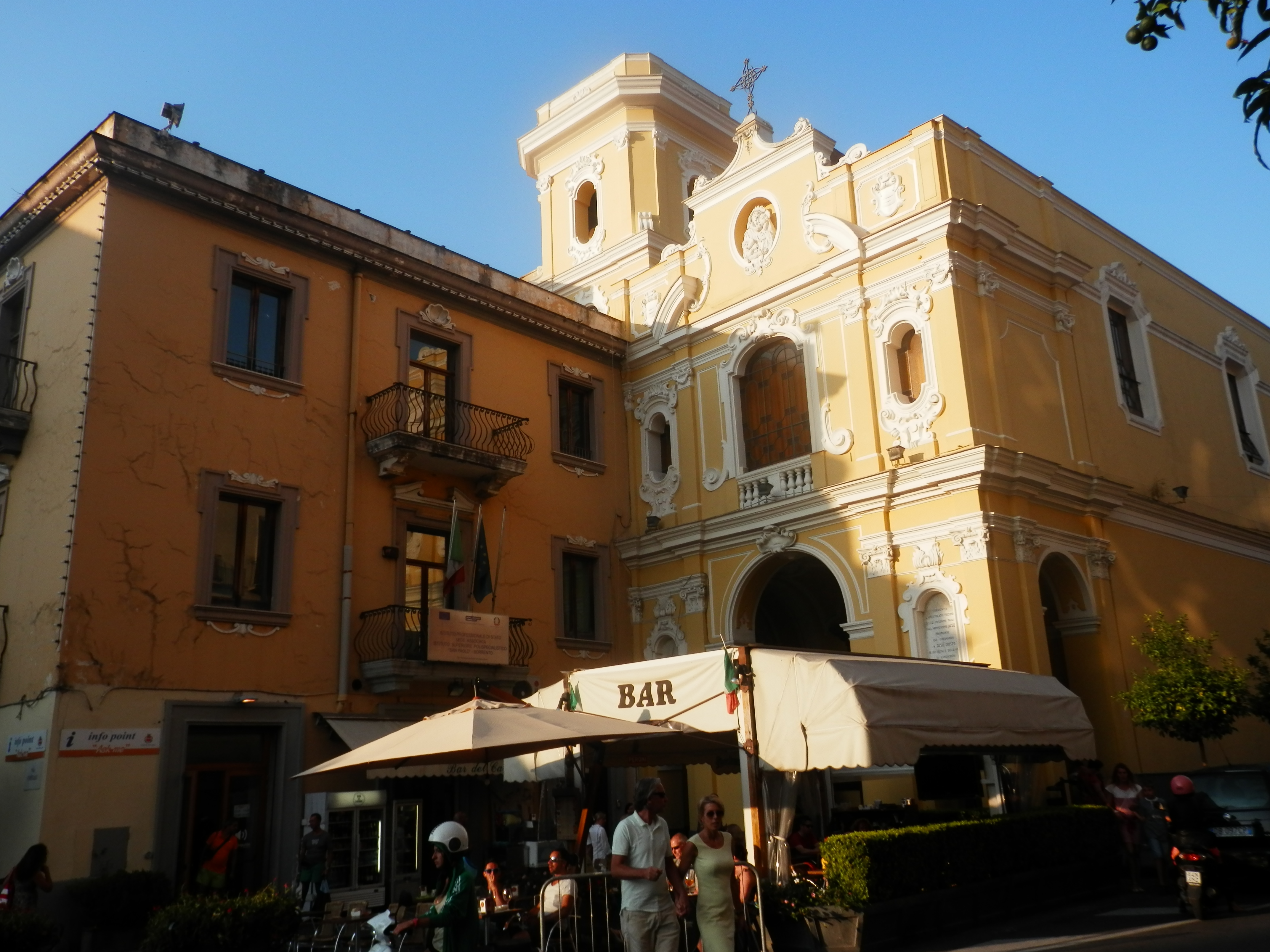
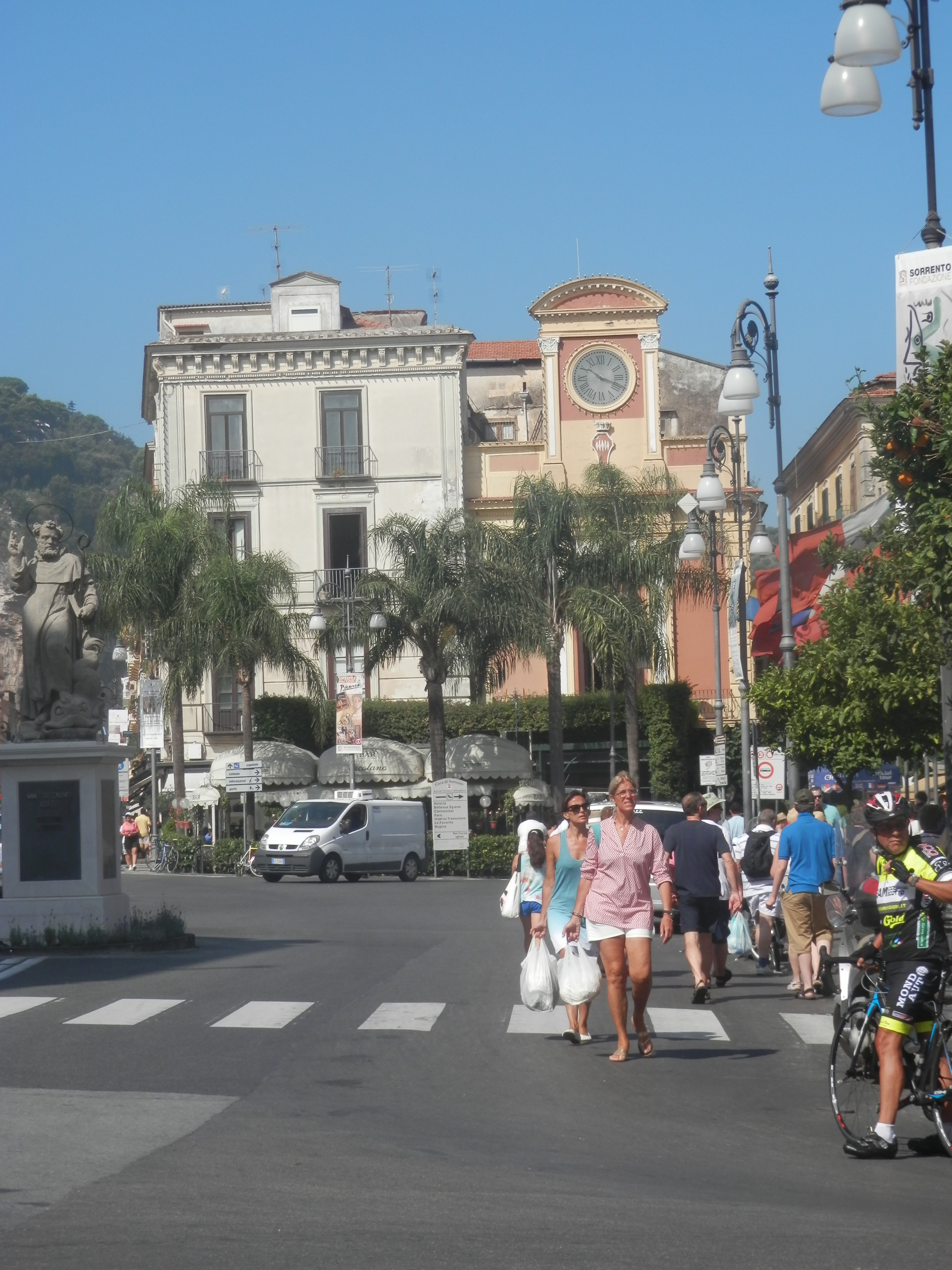
But it was Sorrento itself that I will concentrate on here. Toying initially with staying a little further afield, we decided to base ourselves in the centre, a few hundred metres from the bustling heart of the town in Piazza Tasso. The images below may not confirm that description, but that is due to the fact that most were taken early in the morning when the indigenous population were slugging their doppio espressos in their favourite tabaccheria, whilst the British were standing around in hotel dining rooms waiting for their bread to be toasted, a process that takes nearly as long as the arrival of a postcard back home.

OLYMPUS DIGITAL CAMERA OLYMPUS DIGITAL CAMERA

Framed by lively bars and restaurants, Piazza Tasso is invariably noisy and congested as humans, scooters, cars, coaches, bicycles, horses, miniature trains, those tiny pick up delivery trucks designed to squeeze down the narrowest of streets – oh, and did I mention scooters – all vie for space. But that is what we were seeking – – an authentic slice of Italian life, if inevitably infused with a heavy dose of Anglo-Saxon.

My countrymen and women were, of course, conspicuous by their pale skin, poor dress sense, refusal to even utter a single per favore or grazie and naive belief that cars and scooters were ever going to stop for them, even on the many crossings painted on the streets.

Sorrento is not a beach resort in the accepted sense – the coarse, dark sand at the foot of the mighty cliffs that front up Vesuvius across the Bay of Naples could not compete with Margate or Blackpool, let alone the Caribbean. But it does – admittedly at a price – provide a number of private beaches, primarily along the stretch of water between Marina Grande and Marina Piccola. There are also small patches of public beach scattered along this coastline which are packed by mid-morning with Italian families.

Our cabina (chalet, just about big enough for changing and storage), sunbeds and umbrellas at Leonelli’s Beach cost us a little under fifty euros, a price that would appear to have scared off most of the British visitors, judging by the preponderance of tanned and stylish Italians in our vicinity.

OLYMPUS DIGITAL CAMERAOLYMPUS DIGITAL CAMERA

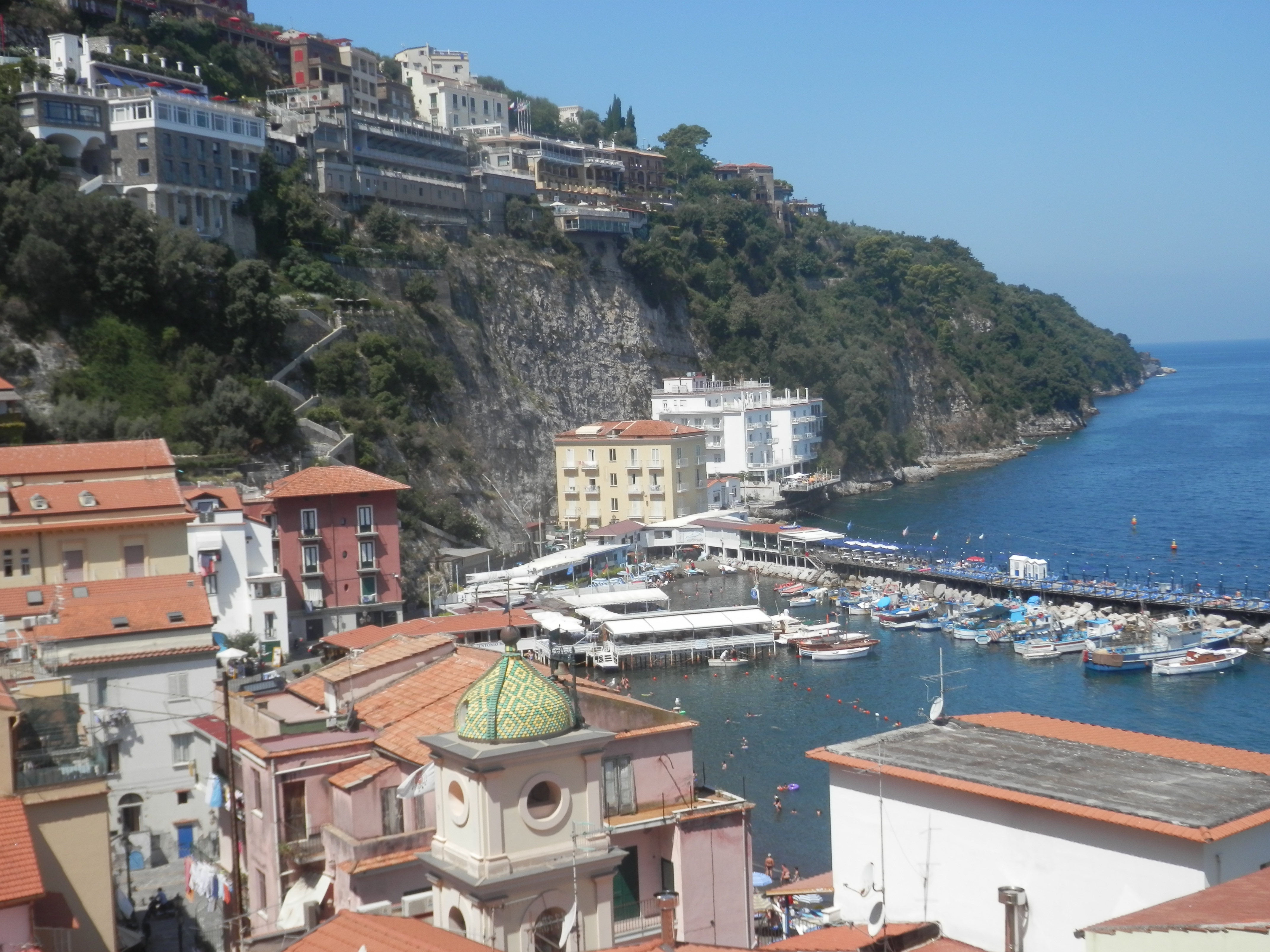
It is secluded Marina Grande, however, to which I gravitate as often as I can. It requires a fifteen minute downhill walk from the town centre and more demanding hike back up, but it is worth the effort (only the Englishmen walk it, the locals – and mad dogs – tend to take the bus).

OLYMPUS DIGITAL CAMERA

Traditionally, Sorrento’s fishing harbour, it has become distinctly more tourist-friendly since our last visit. Again, bars, restaurants and a modest beach dominate this small area overlooked by a number of imposing hotels.

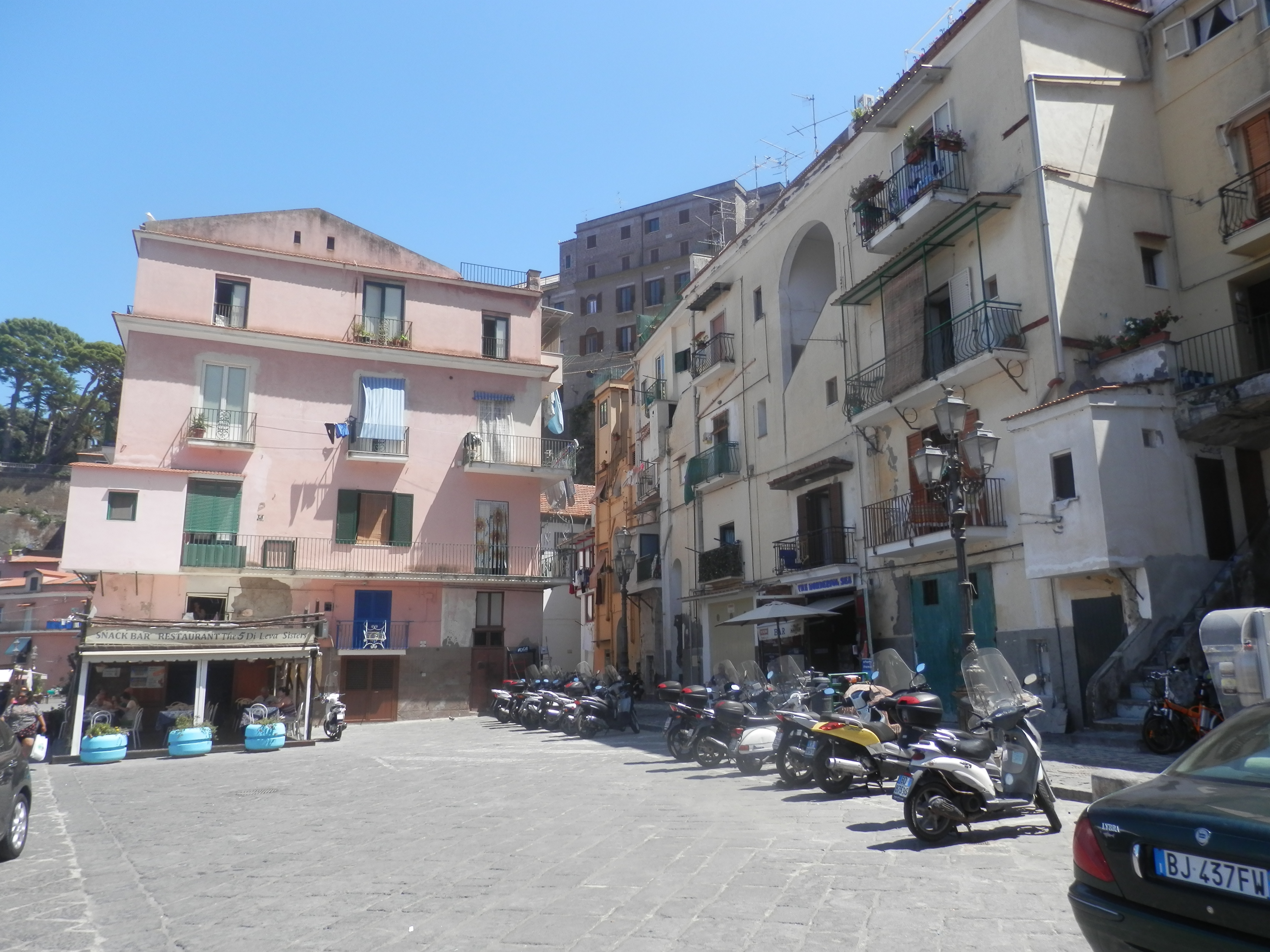
But it does still have an air of authenticity. People, mostly elderly, still live in the apartments that fringe the harbour, washing hangs from every window, shrines greet the pedestrian on every corner of the steep, cobbled steps, cats skulk for fishy remnants, and nonno and nonna still sit together in front of the lovely Chiesa di San Francesco and watch the foreigners ordering their calamari and lachryma christi.

OLYMPUS DIGITAL CAMERA

It was the appropriate place, therefore, for our last evening meal where we ate at the highly rated (#2 of 225 restaurants in Sorrento on TripAdvisor), Ristorante Bagni il Delfino, sat on the glassed-in pier on the water.

OLYMPUS DIGITAL CAMERA

Shopping along narrow Via San Cesareo with its bunting draped across the street and the aroma of fruit, especially lemon, and vegetables, is one of the most popular activities for visitors, especially during the evening passeggiata. Ceramics, inlaid-wood, leather and jewellery are particularly sought after. Corso Italia, which runs either side of Piazza Tasso, has a more modern feel and is home to a number of noted Italian fashion houses.

OLYMPUS DIGITAL CAMERA  OLYMPUS DIGITAL CAMERA OLYMPUS DIGITAL CAMERA   OLYMPUS DIGITAL CAMERA   OLYMPUS DIGITAL CAMERA OLYMPUS DIGITAL CAMERA OLYMPUS DIGITAL CAMERA

There is so much more to admire, including the restaurants and religious buildings, about Sorrento that I do not have time to cover because another port on another continent commands my attention. But I hope these photographs and short description have demonstrated why most of the people who visit the region are enchanted by it and vow to return.


I haven’t always been obsessed with San Francisco.

There was a time when I was obsessed with Italy.

My affection has never diminished for the land of olives, arias and elections. It’s just that since we first – belatedly – discovered the United States, and San Francisco in particular, the siren call from across the Atlantic has invariably proved too hard to resist.

But for a decade in the eighties and nineties, it was Italy that held us in its thrall.

Our first date, however, did not go well.

Midway through a twelve day cheese and wine driving tour of France, we made a short detour into Italy via the Mont Blanc Tunnel. That excursion might have lasted a little longer had it not been for the fact that, having realised we had the taken a wrong turn on the outskirts of Courmayeur, we reversed onto the newly laid tarmac driveway of the startled, and more worryingly, burly owner.

Fortunately, our hire car had sufficient power to outpace him, his even sturdier wife, three small children and fearsome German shepherd dog as they gesticulated in a manner that seems to be every Italian’s birthright.

Having lain low from Interpol for a couple of years,  diplomatic relations were restored when we snuck back on a ten day coach tour that included Rome, Florence, Pisa, Venice and Assisi (our earliest encounter with San Francisco?).

Over the next few years we took short breaks to Florence, Venice and Milan. Longer holidays followed to Sorrento (twice), Lakes Garda and Como and, loveliest of all, Taormina in Sicily. We even abandoned France one year to base ourselves in the Aosta Valley resort of La Thuile, from whence we could ski over the border to La Rosiere.

No matter that public life was mired in scandal and corruption, and that television was a boorish blend of babes, boobs and Berlusconi baloney. We were now besotted with the breathtaking natural beauty, history, sense of style and the ravenous appetite for life of the people. We enjoyed la dolce vita, worshipped la bella figura, and did our best to blend seamlessly into la passeggiata every evening. Puccini, Giotto and Michelangelo became my cultural icons. The whole country was one large show and we loved it.

Climbing up from Piazzetta Michelangelo to San Miniato al Monte in Florence, coming upon the Campo dei Miracoli in Pisa for the first time, getting lost among the remoter calle in Venice, gazing on Santa Lucia in Naples, walking the Circus Maximus……the list goes on.

In 1992 I began to learn the language (that, acording to Lord Byron, ” sounds as if it should be written on satin”) in earnest, and attained a Royal Society of Arts Level 1 diploma with distinction.

And then there was the calcio.

Serie A was at that time the most glamorous football (soccer) league in Europe. Real Madrid and Barcelona may still have attracted many of the bigger names, but La Liga was not televised on British television as it is now, or if it was, only to a miniscule satellite audience. And the Premier League in England was only in its infancy.

But Sunday afternoon on Channel 4 was one of the highlights of my week, when a top Italian league game was televised live. The Saturday morning magazine show, Gazzetta Football Italia, presented by the witty and well informed James Richardson (did he ever drink that cappuccino or eat that gelato that shimmered on the table in front of him?), showed highlights of all the previous week’s games and featured interviews with the top players, including Paul Gascoigne and Paul Ince, who took the rare route of moving from England to Europe.

It was bliss to an Italophile like me.

Roberto Baggio with his languid style, pony tail and hip Buddhist beliefs, and Franco Baresi, the epitome of the Italian hard man defender, became my footballing heroes. We even named our pet rabbits, Baggio and Schilacci after their namesakes’ exploits in Italia ’90. The spectacle and drama of that World Cup tournament only endeared me to the country more. I could not even get downhearted when the host country beat England 1-0 in the third place play-off.

And then, five years later, I realised an ambition and attended the San Siro where, in front of 83,000 fans, AC Milan “welcomed” eventual Scudetto winners, Juventus. I’d always thought that English football supporters were passionate, but the fervour and fanaticism in that stadium that evening was astonishing. One elderly gentleman next to me spent the entire game clutching his prayer beads and yelling at Milan’s mercurial Yugoslav playmaker, Dejan Savicevic, to produce a moment of magic for the hosts, but to no avail.

Discretion being the better part of valour, I kept my allegiance to La Vecchia Signora (Juventus) firmly under wraps as they strolled to a 2-0 victory with goals from Gianluca Vialli and Fabrizio Ravanelli, both later to star in the Premier League. The contrast with the last match I had been to, between Gillingham and Bury four nights previously in front of little over 3,000, could not have been more striking.

It was later in that year that we made our first fateful trip to the American West. We didn’t abandon Italy immediately as we visited Lake Como two years later. But it was another decade before we renewed acquaintance with La Serenissima as part of my wife’s fiftieth birthday celebrations.

And now, another seven years later, we are finally returning for a third time to Sorrento. We may only be there for a week, but that will be enough to enable us to go back to Capri, Pompeii, Naples and the Amalfi Coast (Positano, Amalfi and Ravello).

Torna a Surriento!