Feeds:
Posts
Comments

Our visit to Monument Valley Navajo Tribal Park had been the most eagerly anticipated part of our road trip, and a week after we had flown into Las Vegas, the day had arrived.

Although today’s drive from Page, Arizona was only 104 miles, we were understandably anxious to get an early start to maximise our time in the Navajo Nation. So the trip to Glen Canyon Dam in the cool morning air was a brief one. Janet’s smile in the photo above pre-dated her discovery, several miles down the road, that she had left her Team GB baseball cap in the hotel.

Our customary diet of country and classic rock on the car radio seemed inappropriate for today, and we replaced it with Sacred Spirit II, More Chants and Dances of the Native Americans, the CD we had bought expressly for this leg of the trip. It was to play on endless loop for the next couple of days, lending a haunting, rhythmic backdrop to our travels.

As we headed east we began to encounter a sight that would become very familiar over the next ten days – tables by the roadside containing native american jewelery and, on occasions, pottery and rugs made by local people. Some of it might have been tourist “tat” but there is no doubting that the business is a valuable, even essential, addition to the local economy. On some stretches of road, however, there were as many abandoned as thriving stalls, though most still flying ragged American and Indian flags. More upscale trading posts, notably at Shonto, provided a shinier, and more expensive, face.

Much of  US-98 through Kaibito and Shonto was scrub and desert with occasional homesteads and trailers dotting the landscape.

As we turned onto US-160 the amount of traffic increased, though as on this entire road trip, such statements are relative – it meant that we were joined by a handful of vehicles travelling in either direction. Congestion is almost an unknown concept in this land.

That said, a huge Lux Bux America bullied its way past several RVs ahead of us as we bypassed the Black Mesa mine and Navajo National Monument.

Our overnight stop, the Hampton Inn at Kayenta, was 24 miles south west of the tribal park and directly on the route. We reached it shortly after midday, and as it was three and a half hours before our booked tour, we called in to check whether our room might be ready. After a half hour wait, during which we availed ourselves of the complimentary tea and coffee, we placed our luggage in the room and set off for Monument Valley.

Careful to avoid the cattle and horses grazing by the roadside, we took US-163, one of dozens of ramrod straight roads on this trip, joining a steady procession of tourist buses and Cruise America RVs intent on witnessing the archetypal western landscape. Low rise homes of brick and wood mingled with churches, including the Living Word Assembly of God and Jehovah’s Witnesses, and health, recreation and animal care centres before the scenery took on the familiar look of desert, sagebrush and isolated, thrusting buttes.

The mood in the car of approaching awe and solemnity was briefly shattered as a sign proclaimed that the highway had been adopted by “the family of Jimmy Krank” (this reference will sadly be lost on my American readers).

We entered Tsi-Bii-Ndzisgali, the Navajo for Monument Valley Navajo Tribal Park meaning “the valley within the rock” ,with an hour and a half to spare. Although we were hungry we were more desperate for our first live view of that most iconic of movie locations. We may have seen it a hundred times on screen but nothing can prepare you for encountering it laid out before your eyes for the first time.
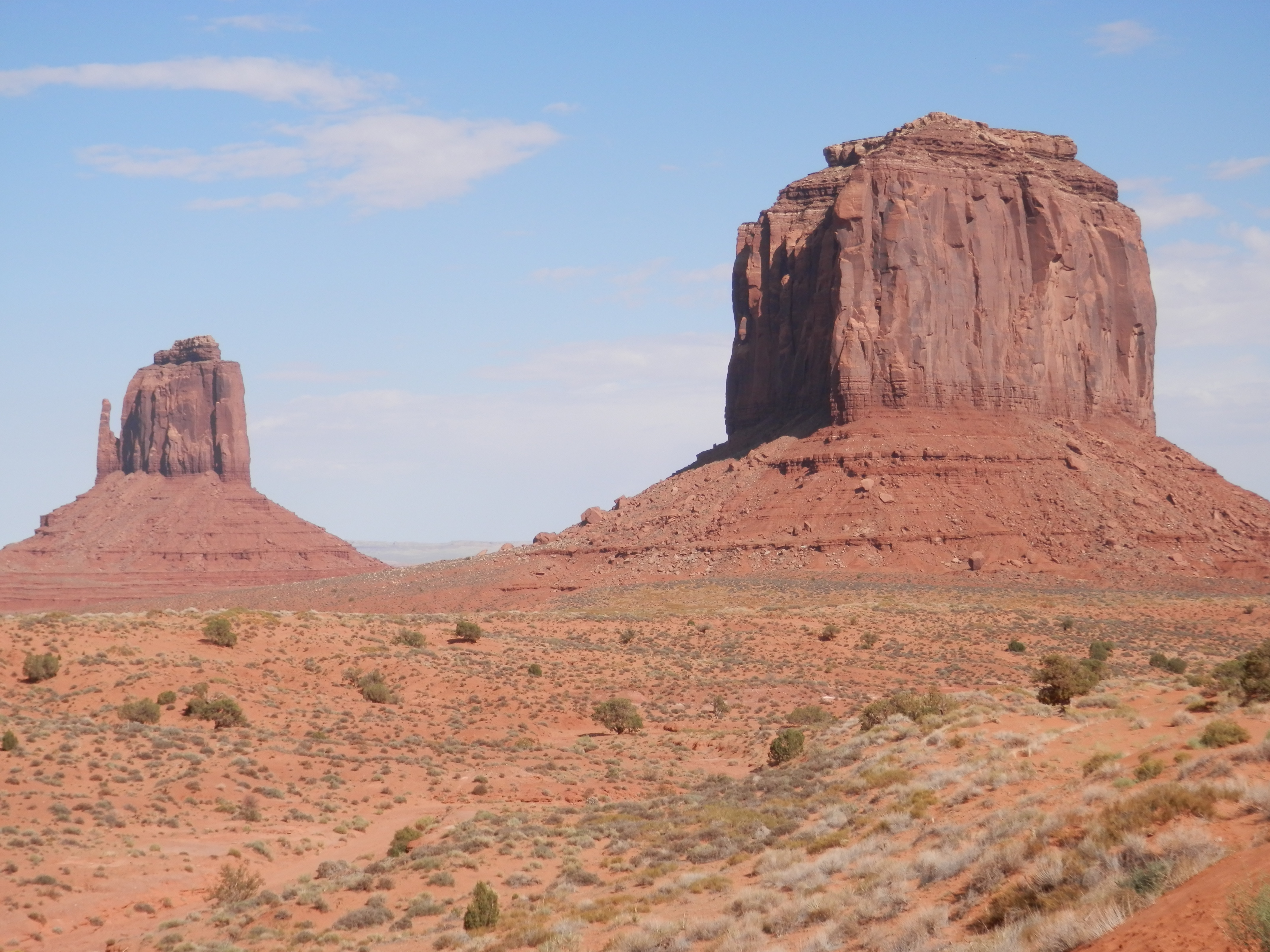
And there it was! The official leaflet proclaims it the “8th wonder of the world”. Those that have seen both compare it with the Pyramids at Giza, and the majority declare that it surpasses its Egyptian counterpart. I am content to take their word for that. Surely Wordsworth was stood here rather than gazing at Westminster Bridge when he declared “earth could not pass by a sight so touching in its majesty”.

Curiosity sated, our attention turned to lunch. Built less than four years ago in a style and colour sympathetic to its age old neighbours, the View Hotel provides luxury accommodation and stunning views. We found a table by the picture window overlooking the East and West Mittens and Merrick Butte, John Wayne’s favourite view, and ordered Navajo Tacos, fry bread with ground beef, pinto beans, onion and lashings of lettuce and cheese. Janet had the good sense to ask for the small plate whilst I succumbed to gluttony and had the large version, to the amusement I recall of the server, a decision I almost came to regret on the helter-skelter jeep ride in the backcountry later in the afternoon.

We assembled in the foyer of the hotel to await our guide. As the appointed time approached it appeared that we might be the only people on the tour. However, we were joined by another British couple and a mother and son from New York.  Larson, from Navajo Spirit Tours, appeared shortly afterwards to advise us that our guide, Miesha, was running a few minutes late and engage us in some ice breaking conversation.

Once Miesha had arrived and introduced herself, she drove us to the traditional hogan village, a group of sun-baked mud covered homes, built in harmony with the universe and all living creatures on earth. The large one in the picture, a female hogan, is used as a permanent home, and represents love, peace and kindness, whereas the smaller, conical version, the male hogan, is the location for ceremonies and for war plans to be drawn up (though not for some time I hope). Aside from their spiritual significance, they perform another valuable function in that they retain heat for long hours in the winter and can be 25% cooler than the outside temperature in the summer.

Our next stop gave us close up views, or as close up as visitors are, rightly, allowed to be, of the classic triumvirate of the East and West Mitten Buttes and Merrick Butte as well as satisfying any retail urge we might have retained with a dozen or more tables displaying Navajo rings, necklaces, earrings and bracelets.

With the notable exception of the aforementioned, the most famous viewing spot in the valley is John Ford’s Point, the place where the great movie director, whose catalogue includes Stagecoach, She Wore A Yellow Ribbon and The Searchers, would spend hours contemplating his life and work. More stalls and a caravan selling fry bread and cold drinks completed the scene. The lone cowboy in the photo above appears periodically to enable visitors to satisfy their fantasy still further.

The selling point for this particular tour had been the excursion into the restricted areas of the valley. The self-drive and basic tour options focused purely on the more familiar areas. We were heading into the back country! Shortly after leaving John Ford’s Point we turned off the well trodden road down a narrow path out into the area bounded by the Rain God, Thunderbird and Spearhead Mesas.

The journey was reminiscent of the previous day’s bone-breaking ride to Antelope Canyon as Miesha made the jeep lurch in and out of the dry, rutted terrain. But she delivered us into a quiet, magical expanse that seemed far removed, even from the vistas we had marveled at only a few minutes before.

Here we encountered wild horses, a small party on horseback on a day’s trail, spectacular rock formations and sporadic lush vegetation – and, above all, blissful peace.

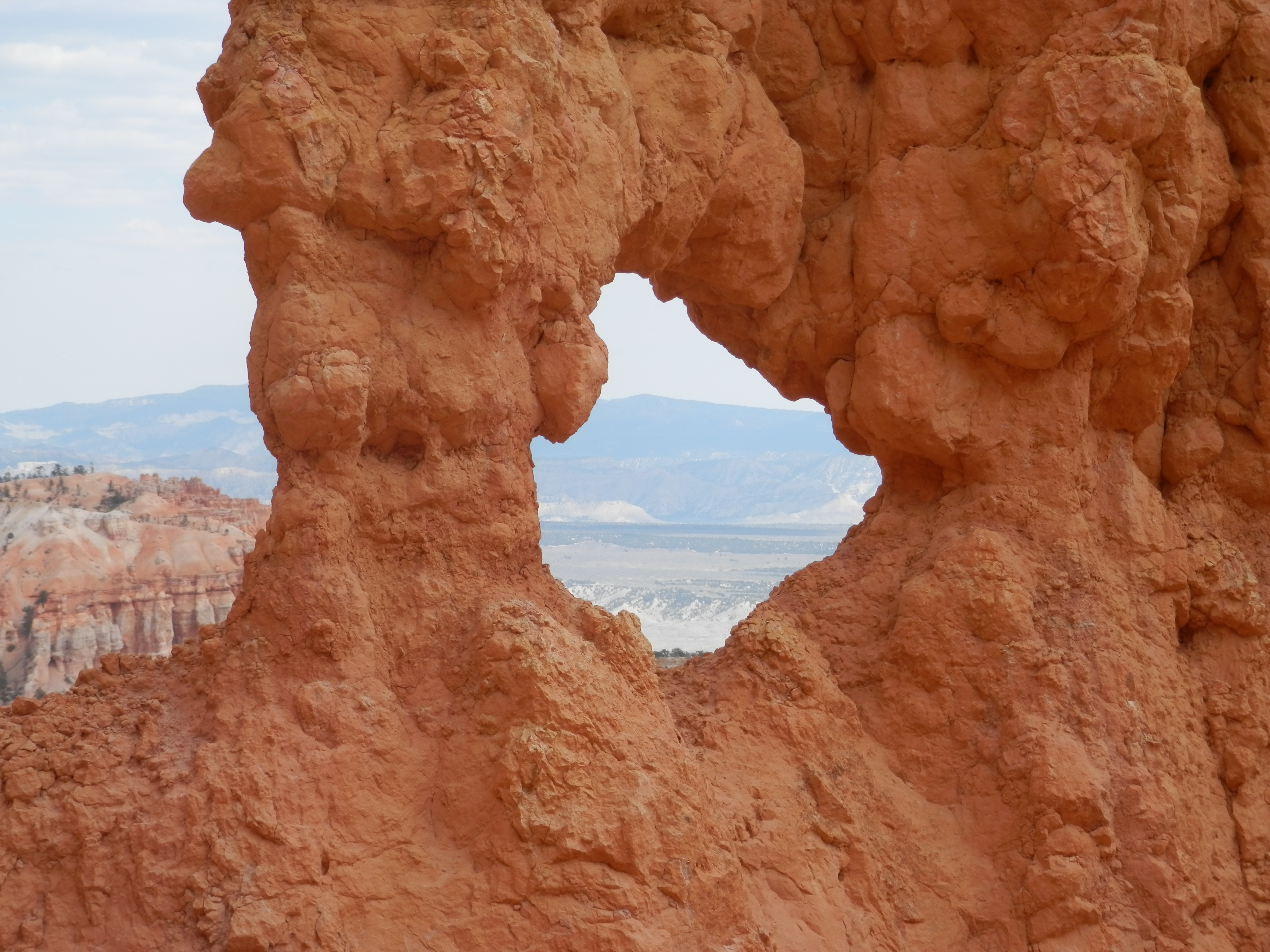
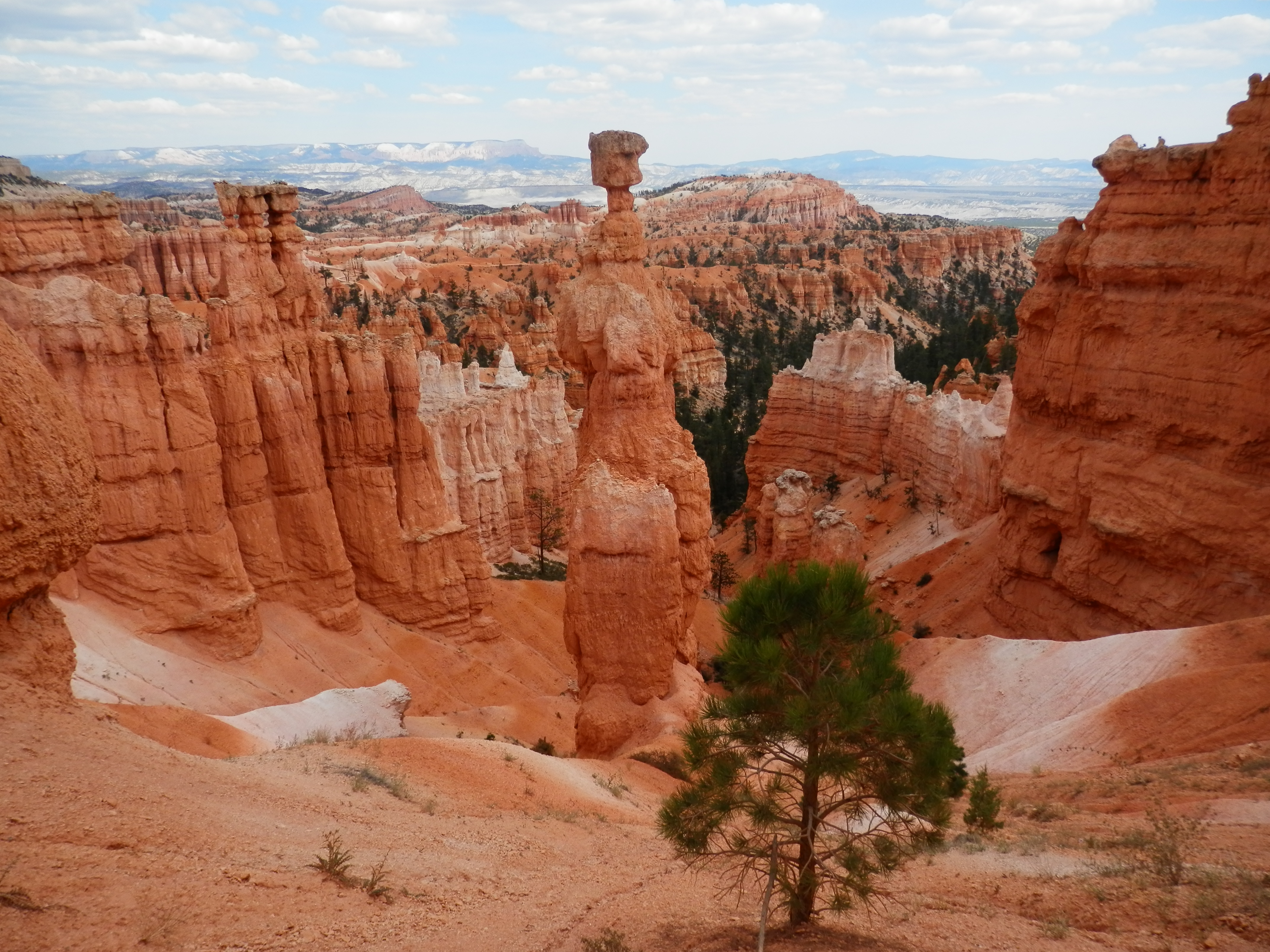
We were afforded the opportunity to see close up some of the most celebrated, but less often seen, sights of the valley, including the Totem Pole and Suns Eye (both pictured below).
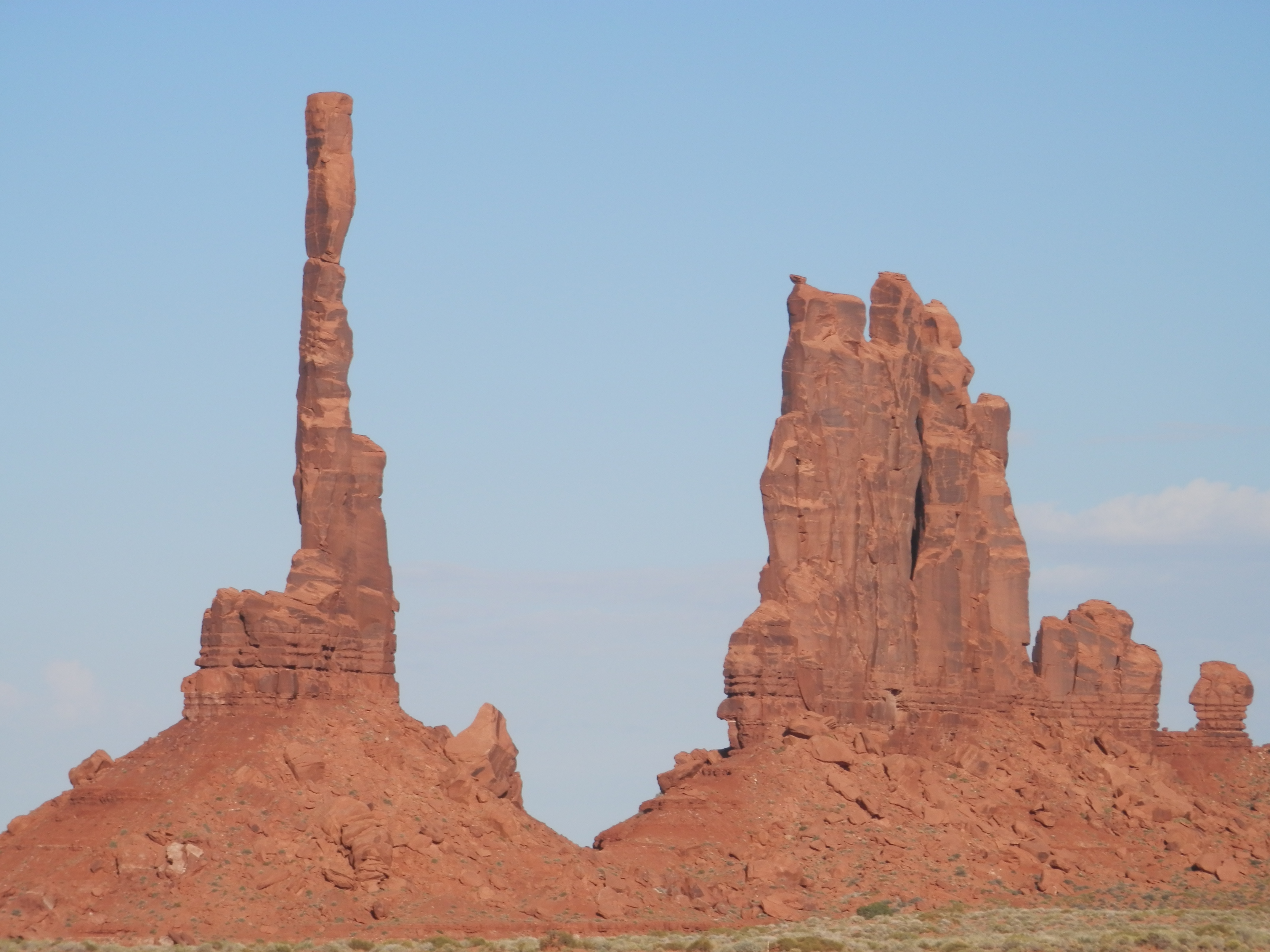
It is perhaps at this point that I should say a little more about the Navajo in general, and Miesha in particular.

Much of the appeal for me of this road trip had been the opportunity to witness both the landscape and culture of the native american, primarily Navajo, people first hand. But everything I had read in preparation cautioned the visitor on how to interact with them. I was a guest in their land, an impoverished one in many respects. My hosts held deep spiritual beliefs that were far from the mainstream of American life. Some individuals might be difficult, taciturn, even hostile.

It was essential, therefore, to interact with respect and humility – which I hoped I would have done without the friendly warning.

I can only say that I did not have a single conversation or transaction with a Navajo throughout the trip that was not friendly and respectful. Our guide in Antelope Canyon, Rosie, could not have been more helpful or informative. Every restaurant server, trading post or stall owner greeted us with a smile and showed an interest in where we came from and what we were doing in their country and were grateful that we were. Of course, they were aiming to part us from our money at the same time, but that never seemed the primary motivation.

Not only are their beliefs about nature and man’s duty towards it, highly attractive, and ones that western man had largely forgotten, but on an individual basis they were a joy to deal with, on this day and the coming days wherever we went.

Ah yes, Miesha.

When we first met her, and were about to board her jeep, she outlined the three hour tour we were about to embark upon. Ever smiling, quietly spoken, a little diffident perhaps with a girlish giggle at the end of most sentences, she was nonetheless authoritative and immediately gained my confidence.

Not only did she recount the history, myths and, of course, movie relevance, of each sight in the valley, but she regaled us too with stories about her life and that of her family, bringing out the basic principles of the Navajo way of life such as respect for nature, balance in all things, and one that struck me as so contrary to our British and American prejudices – reverence for the wisdom of old age (her grandmother was 99).

Everything she said reinforced her commitment to these principles. A modern 21 year old woman but one deeply rooted in the Navajo life. Hugely talented, she had traveled far with her flute playing and singing. Indeed, her rendition of two songs, one in Navajo and the other in English, whilst her small tour party lay on their backs looking up through Suns Eye, was the most affecting moment of the whole trip for me.

She even made a vain attempt to teach us some Navajo! I think Janet and I did get top marks as we did already know Diné (the people)!

A’he’hee Miesha!


After a heartier breakfast in a more spacious Bear Bites room (and patio!) than its sister motel in Hurricane, Utah, we made the short drive from the Travelodge in Page, Arizona to Wahweap Marina for our Lake Powell boat cruise.

We succeeded in getting on a two and a half hour cruise that enabled us to have a leisurely lunch before taking up our Antelope Canyon tour in the afternoon.

With 1,960 miles of shoreline, longer than the entire west coast of the continental U.S., man-made Lake Powell, with its clear, blue water, red rock canyon walls and sandy beaches, welcomes nearly three million visitors per year.

It was already warm and sunny, if a little breezy when we took our seats on the top deck of the boat.

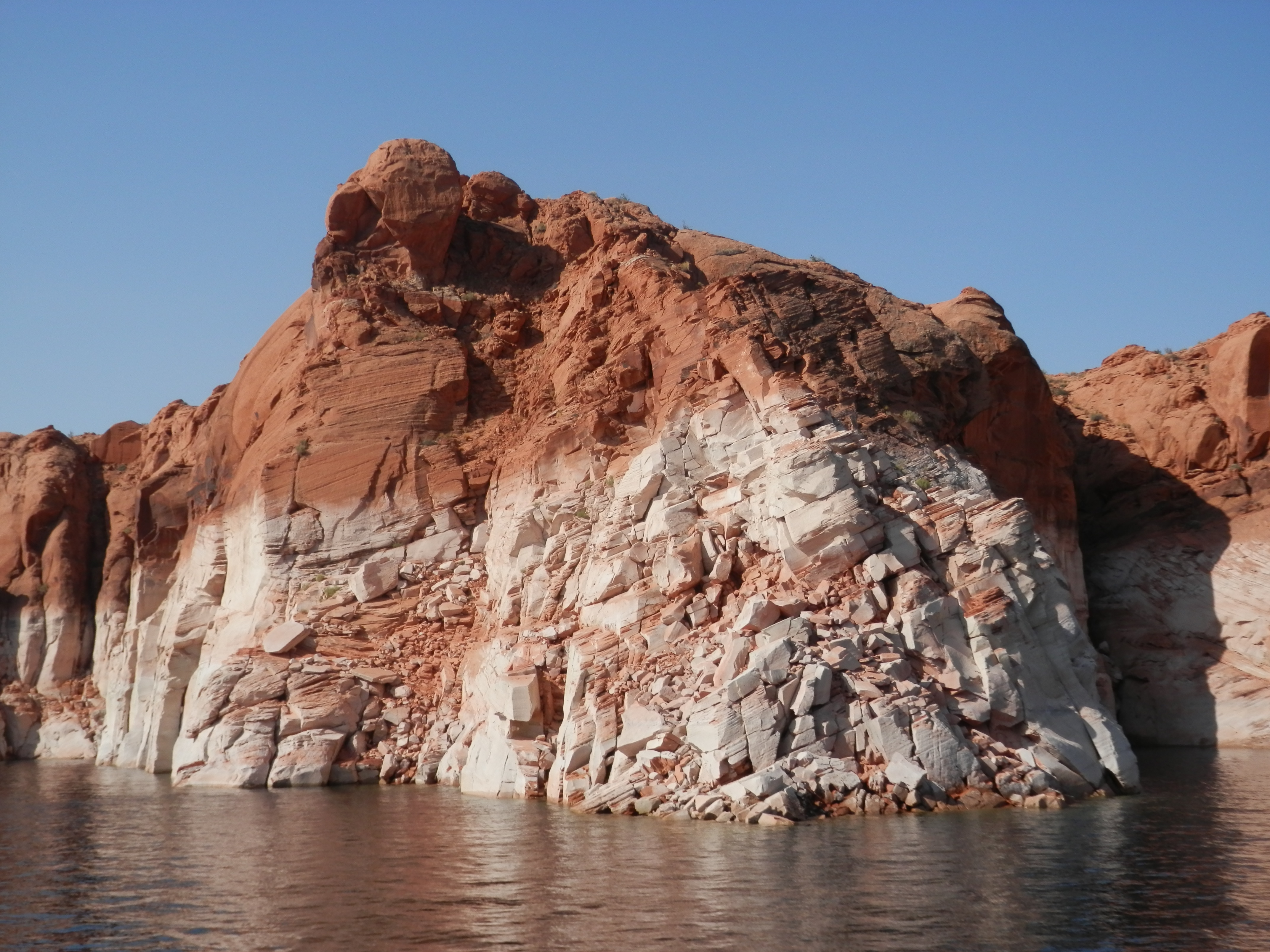
We had taken a similar cruise on Lake Mead, which is linked with the more celebrated Hoover Dam, the previous year, but enjoyed this tour more. The geology was more varied, and the descent into Antelope Canyon was spectacular. The final part of the tour took us in the direction of Glen Canyon Dam, the power from which serves 1.5 million people across five states.

We had a sandwich and coffee at the Marina before returning, briefly, to our motel to freshen up.  We then joined an excitable crowd at the Antelope Canyon Tours office for our 1.30pm tour.

The assembled throng was almost entirely Italian, a coach party of elderly tourists and half a dozen young couples. The former were accommodated first, and when our young Navajo driver / guide, Rosie, asked the rest of us to board her open-sided jeep for the journey to the canyon, there was an unbecoming scramble for seats, even though there were sufficient spaces (sixteen, eight on each side) available.

What followed was a jaw juddering, hair raising charge across desert and sand dunes to reach the opening to the canyon. Fortunately, we had neither had too much or too little lunch for the journey to discomfort us unduly.

What, however, added to the excitement, or alarm for those of a more sensitive disposition, was the fact that the 20 minute journey coincided with the first rain we had seen since we arrived in America.

We were drenched within minutes, and for a moment I was reminded of the eleven people who had been swept to their death in the canyon by a flash flood fifteen years before.

However, by the time we were helped, dazed, from the vehicle, the heat had dried our clothing completely and the threat of further rain had receded.

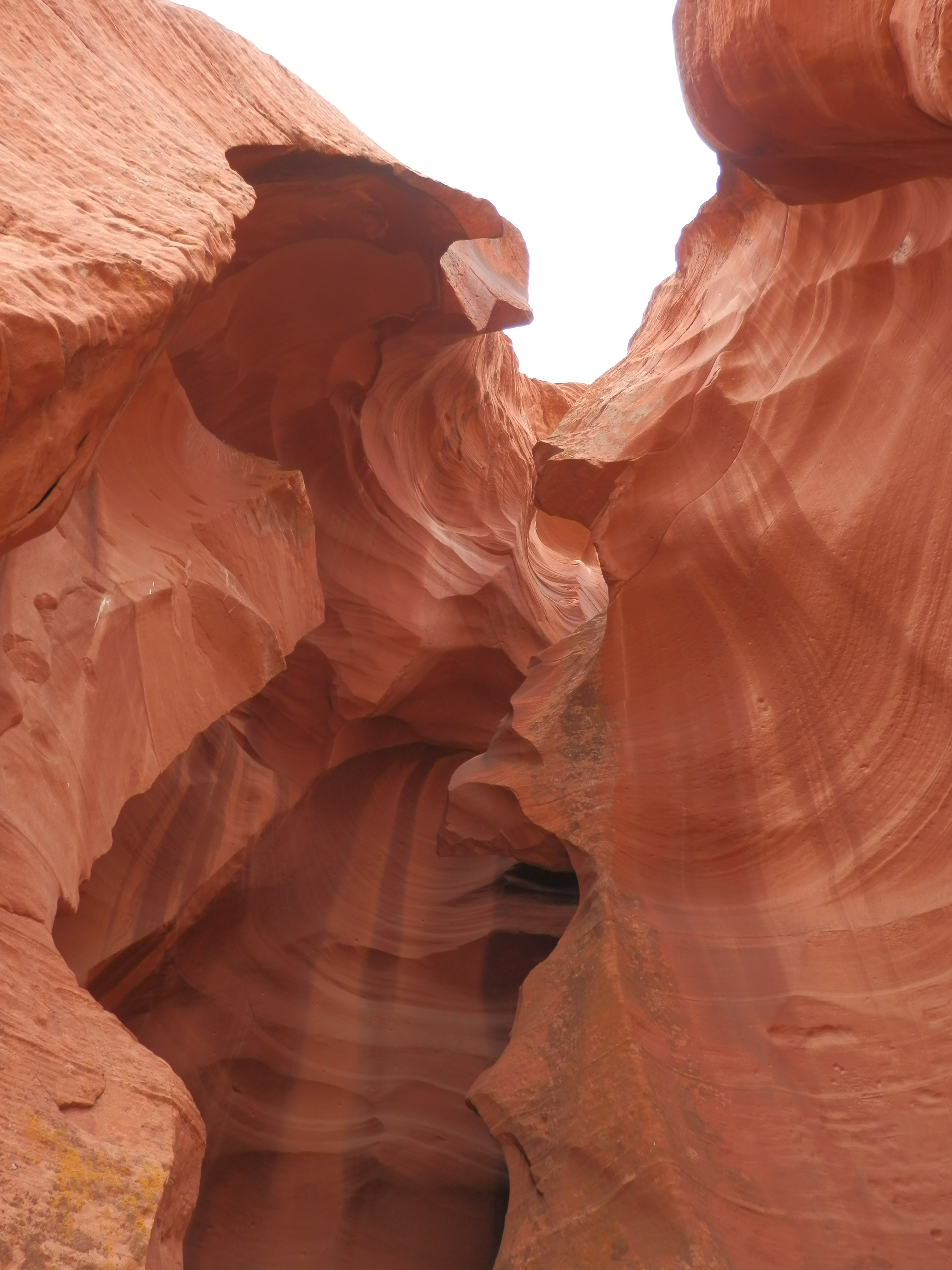
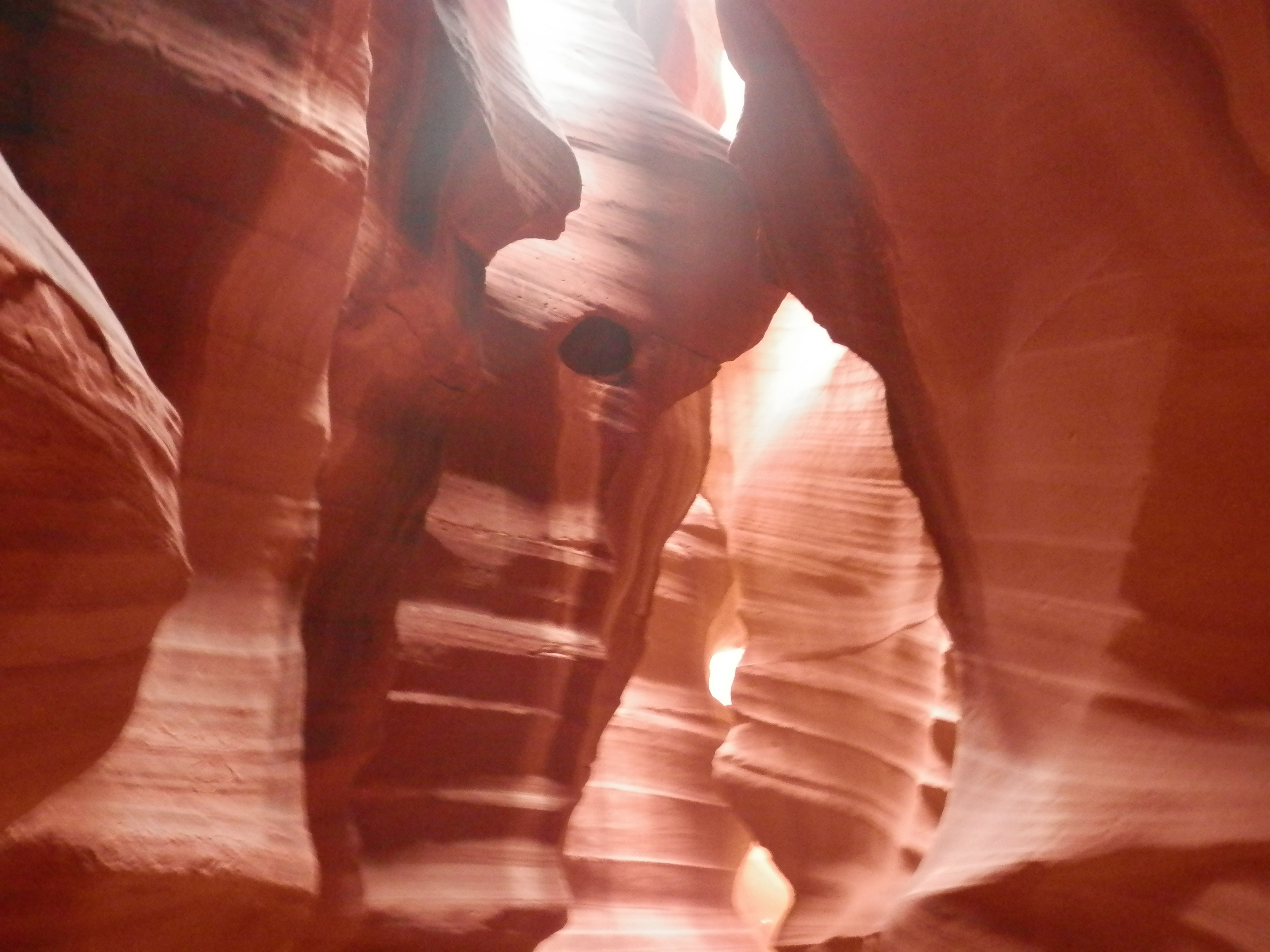
Antelope Canyon is a slot canyon, which means that thousands of years of wind, water and sand have ripped a narrow crevice in the mesa (a raised, flat stretch of land). It is a quarter of a mile long and 130 feet deep. Access is restricted by the Navajo tribe and visitors must be accompanied by a licensed tour guide.

The array of colours and shafts of light from above make it a real challenge for amateur photographers to capture the glorious images that dazzle the naked eye. The combination of a new digital camera and a modest appreciation of the snapper’s art, did not augur well for us. However, Rosie not only set our camera for the best effect, and then reset it at the end, but also took several of the photos herself! There appeared no end to her talents.

Indeed, as the young Italian couples in our group neither seemed to possess much English, nor appeared altogether interested, she spent most of the time directing her commentary to Janet and I. And yes, she is responsible for the picture below.

Dinner was taken at Bonkers, the number one rated restaurant in Page according to TripAdvisor. In fact, we liked Page and could have stayed a week without having to eat at the same place twice. A far cry from our earlier experience in Utah!

But before anybody reading this thinks that I have treated that state unfairly, we had two more nights there later (in Moab) where we enjoyed excellent meals, washed down with fine wine and hand crafted, home brewed beer.

For now, we were looking forward to our trip to Monument Valley the next day, the most eagerly anticipated leg of our trip.   


I have already written in this diary about our frustration at being unable to find a decent alcoholic drink, especially wine, in Utah.

Imagine our relief, therefore, when we left Panguitch in the “elevated” state for Page in Arizona, our base for Lake Powell and Glen Canyon Dam, safe in the knowledge that we would be able to enjoy a bottle with dinner that evening. Although, I suspect, for different reasons, our guidebook declared that the only reason for driving US 89S was to reach Arizona.

Curiously, the first song playing on  97.7 FM The Wolf this morning was the last broadcast as we pulled into the motel the previous evening – Picture to Burn by Taylor Swift. As the cliffs loomed high on either side of the road, reception was lost, though we succeeded in finding 95.9 FM Classic Rock in time for Led Zeppelin to pound out Whole Lotta Love. 

Cruise America and El Monte RVs sailed past in the opposite direction in equal numbers, and I wondered what it might be like to live on the road full time rather than stay in even the cheapest motels. But I think Janet and I enjoy our creature comforts too much to go to such lengths.

We passed a PT Cruiser wedged in a ditch with the local sheriff”s car on the scene. Fishing resorts and ranches peeked through forestry as we drove through Glendale and Orderville. A billboard in the former proclaimed the Buffalo Bistro where the “crazy sausage” was the house speciality.

After filling the car with gas we left the main road to fulfill another of our Lake Panguitch guide’s recommendations – visiting Coral Pink Sand Dunes State Park. Motorised buggies were hurtling over the distant sand hills and, eyeing the largest peak in the distance, from which youngsters were sliding down on a variety of contraptions, we set off in pursuit to do the same.

However, after twenty minutes barefoot yomping, and little appreciable distance travelled, we abandoned our plan. The exertions in Bryce Canyon the day before had taken their toll.

We rejoined the highway and continued our journey to our intended lunch time stop in Kanab, Utah, the self-styled “Greatest Earth on Show”, a town with a strong Mormon tendency but which had a distinct western feel to it.

As the photograph below indicates, the lack of wine was beginning to have an alarming effect on my looks.

Kanab’s justifiable claim to fame is that it was once “Utah’s Little Hollywood”, providing the backdrop to many prominent movies. Plaques extolling such Hollywood greats as Ava Gardner, Howard Keel and Maureen O’Hara were positioned along the main street.

We were also pleasantly surprised to find a funky, western oriented cafe and upstairs art gallery open where we had an excellent andouille sausage with cajun (or was it creole?) sauce and Greek salad respectively. Although wine was on the menu we were saving ourselves for Arizona. Isn’t that a film? No, it’s Raising Arizona, Nicolas Cage and Holly Hunter I think.

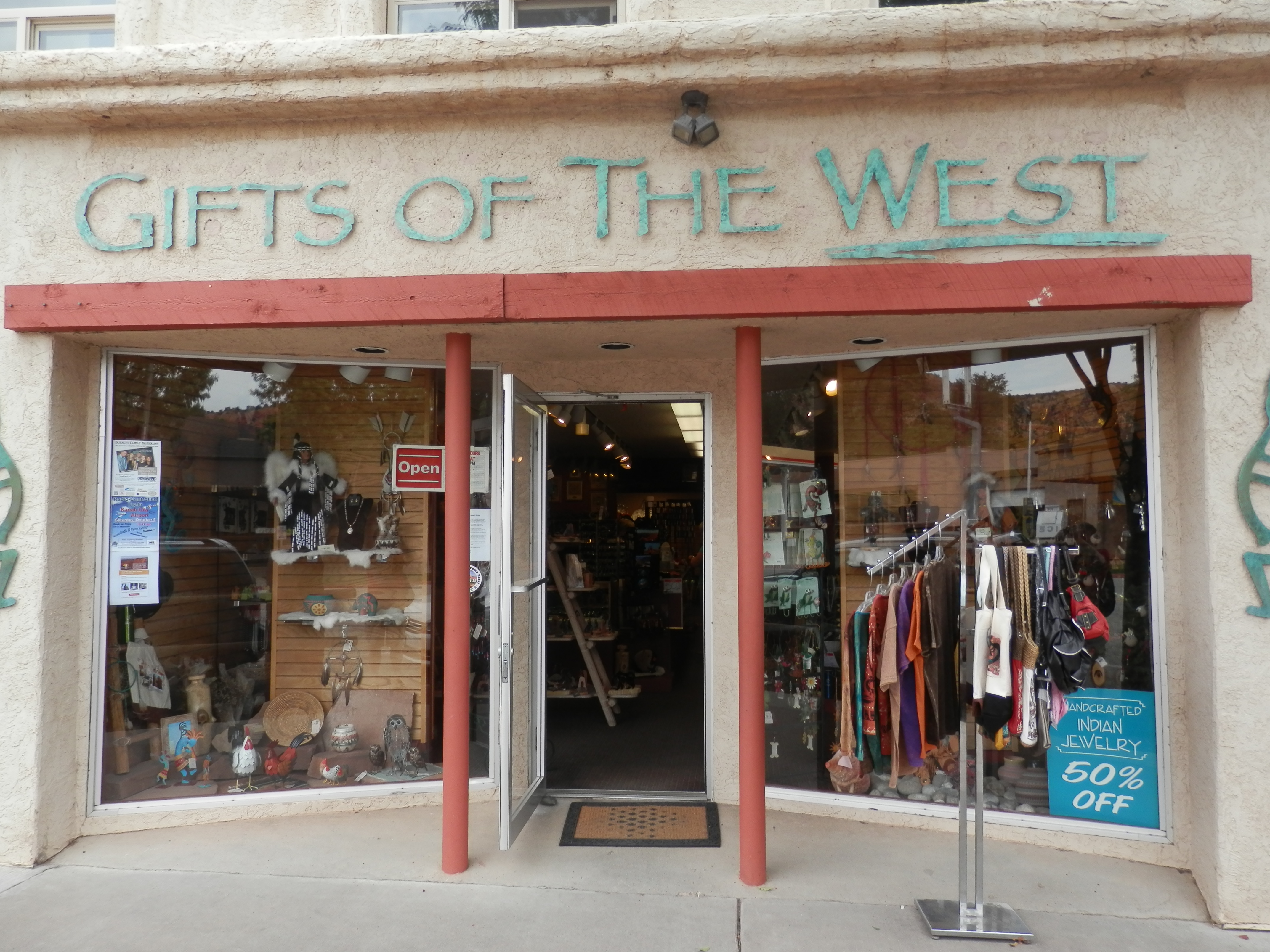
It may have been Sunday but we also found a couple of attractive cowboy / Western stores – Gifts of the West and Denny’s Wigwam Western Wear (Denny must have been a big shot in town because he also owned a restaurant and craft shop) – to browse, and spend money, in.

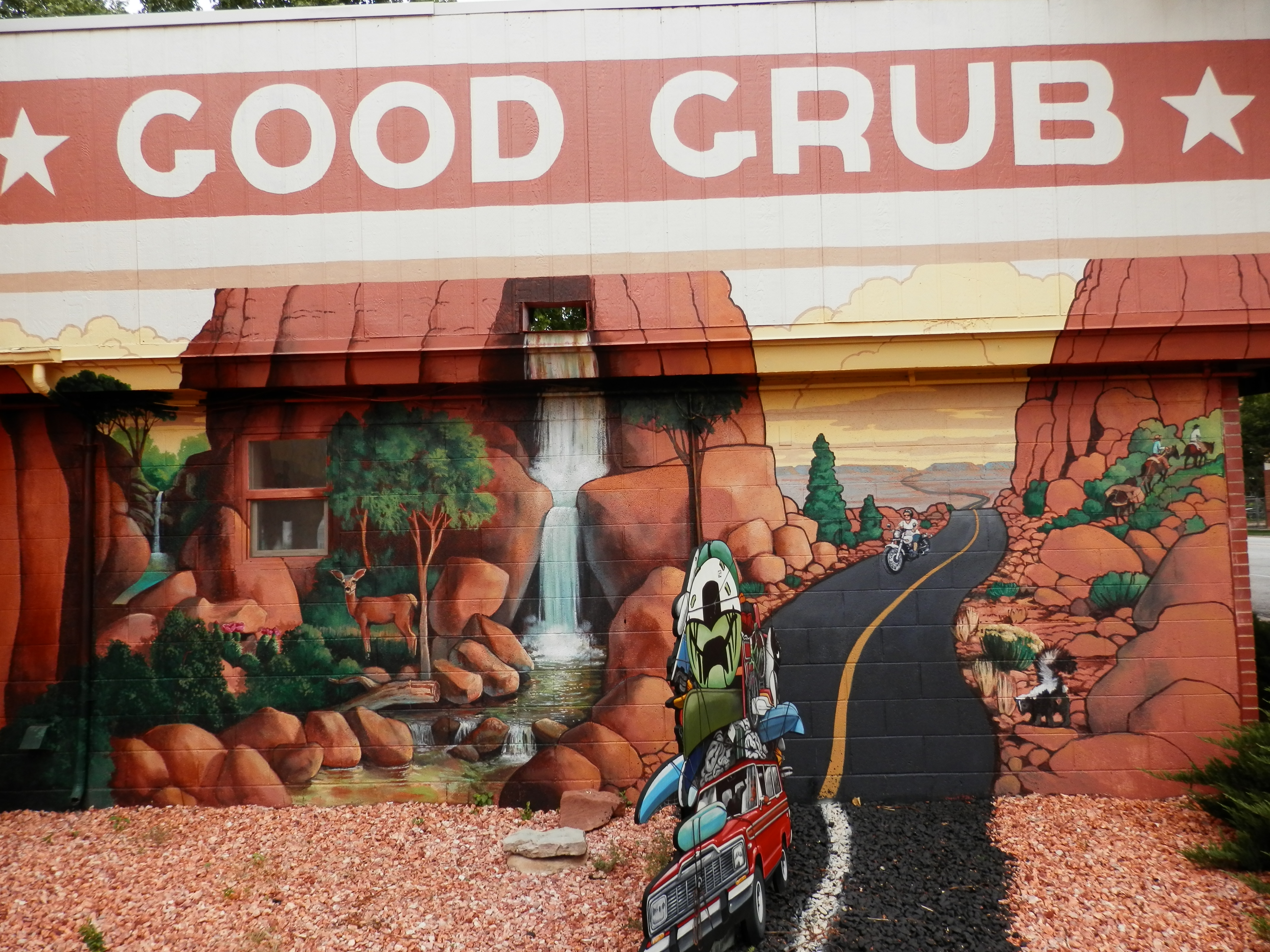
The most amazing building, however, in this surprising town was the Kane County tourist information office with its beautiful murals celebrating its history adorning the exterior.

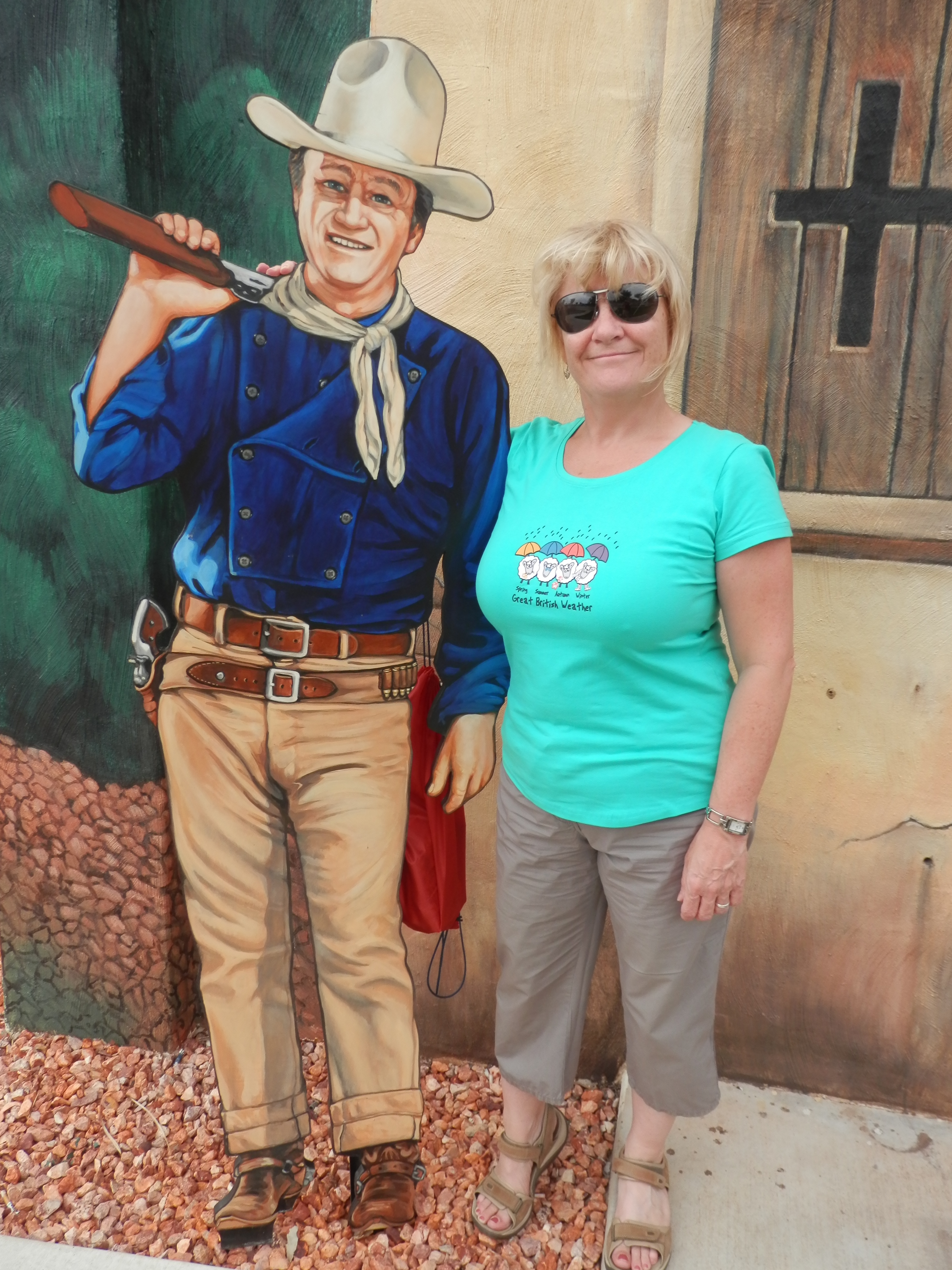
In view of my dishevelled state, it was understandable that Janet should find herself a cowboy.

Shortly after leaving Kanab a billboard screamed at us: “TARNATIONS! Did you visit Denny’s Wigwam and get your Levi’s from $29.95? NO? Turn round now”. We felt we had already invested enough of our money in the Kane County economy, so ignored the entreaty.

We skirted the vast Grand Staircase Escalante National Monument area where the jagged rocks resembled the longest bar of Toblerone in the world. Buttes and mesas abounded as we crossed into Arizona, celebrating its centennial as a US state, and arrived at the Travelodge in Page (another decent sized room for the price) where we were to spend the next two nights.

After I had booked a tour of Antelope Canyon for the following afternoon, and Janet had tested the pool, we had an excellent dinner in the Dam Bar and Grille –  with wine of course.


Bryce Canyon had been one of the expected highlights of our trip and it did not disappoint. As I stated in an earlier post, it is neither my intention, nor in my gift in the time available, to attempt to describe the wondrous sights we have been witnessing. I hope the photographs, with a modicum of accompanying comment, will convey something of the splendour of each place.

The day began unpromisingly when we turned right out of the motel and started to drive down the US-89N, only to discover, thankfully after just a couple of miles, that we should have taken the US-89S. So less than ten minutes after we first left the motel we were passing it again on the road to Bryce.

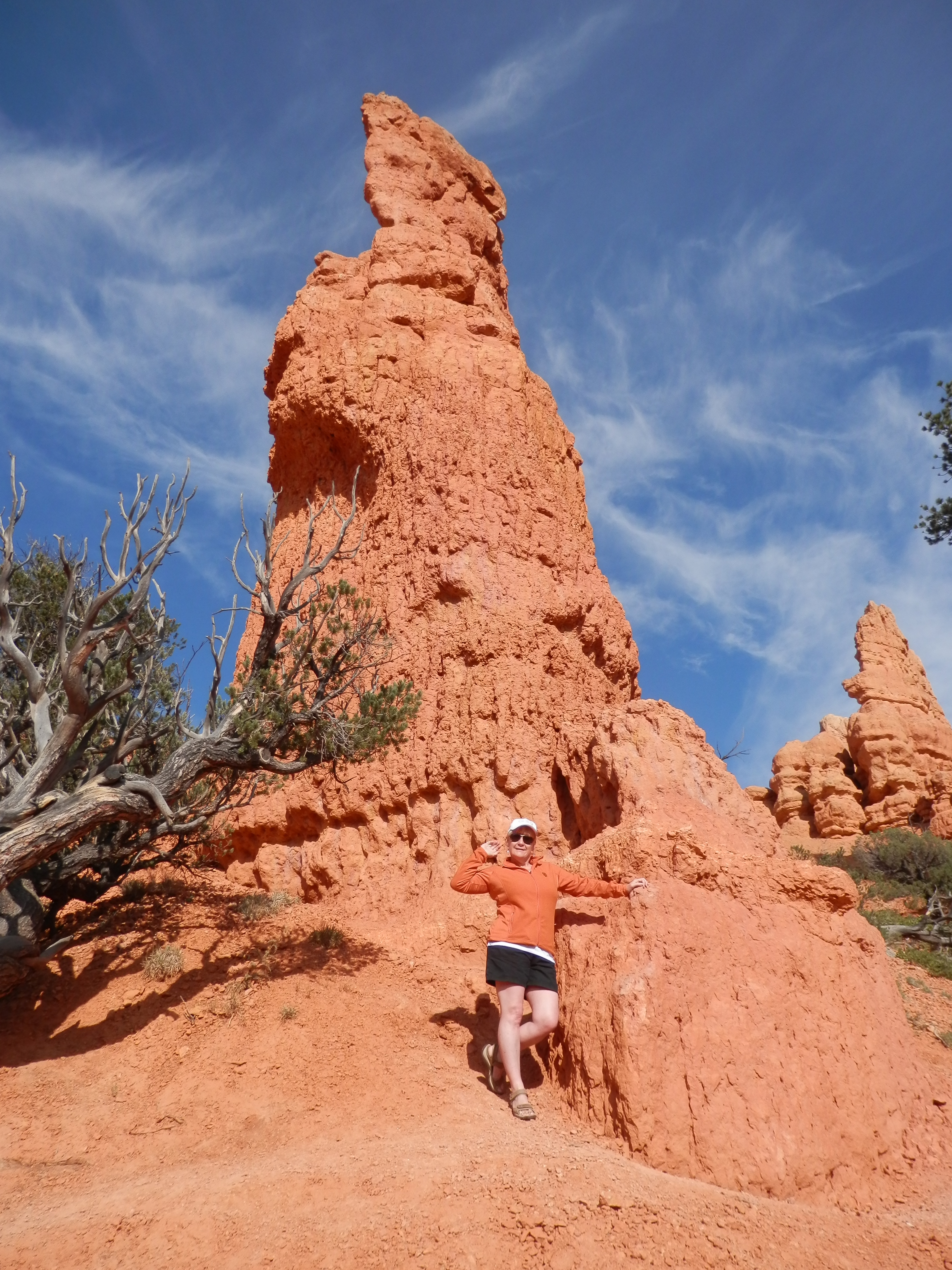
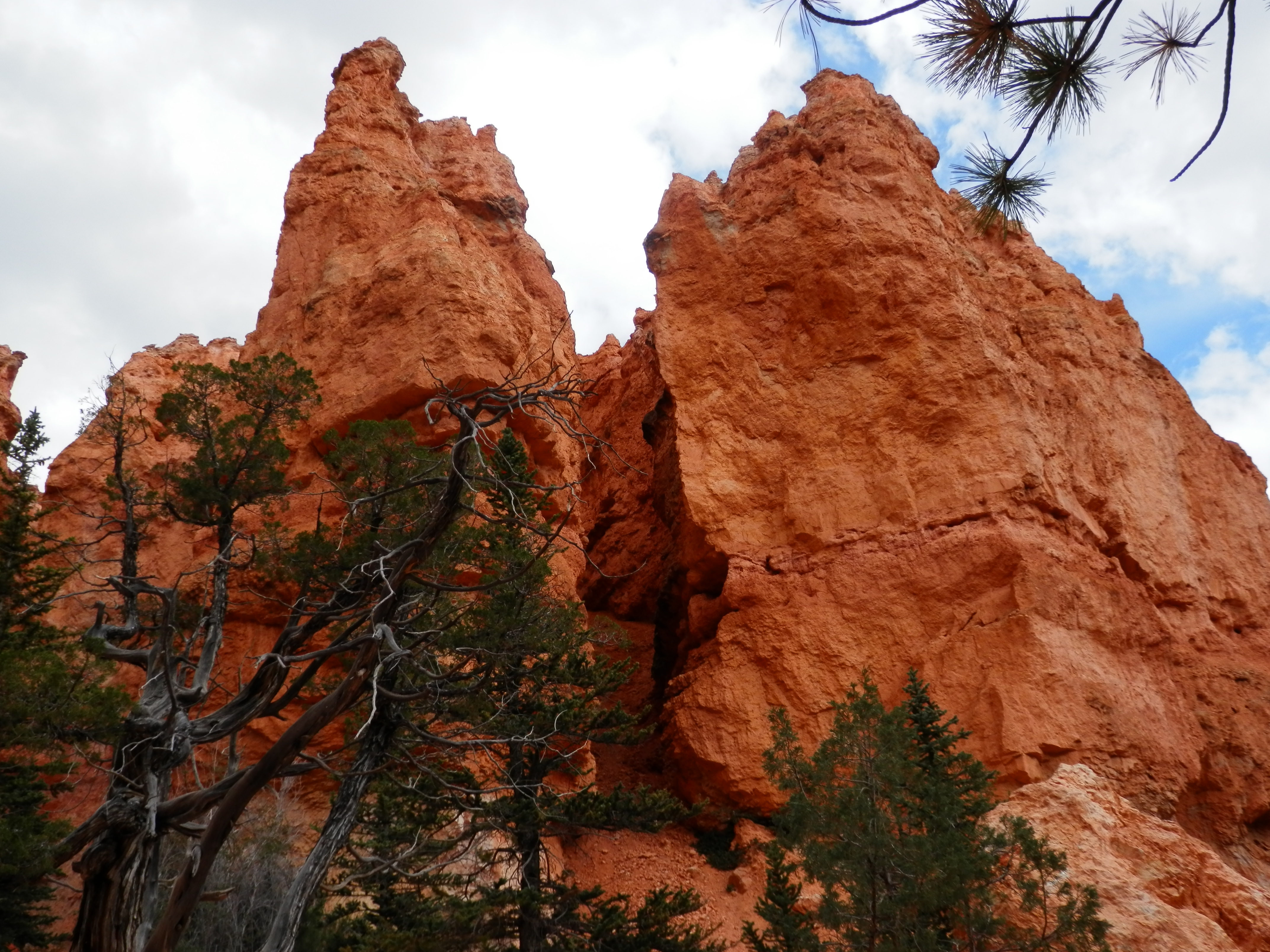
Our impromptu guide from the Bear’s Paw Fishing Resort on the previous day had advised us not to ignore the modest delights of Red Canyon en route. In fact, we spent nearly two hours there, hiking among the relatively gentle rock formations.

Having avoided the roadside deer, that were infinitely better behaved than the sheep had been the day before, we arrived at the Bryce Canyon Visitor Center in time for lunch. We collected our park guide and trail maps and drove to Bryce Canyon Lodge. Although we would have been content with a sandwich (honestly), our only option was to eat in the formal dining room (where they sold wine!).

With some strenuous walking ahead of us, we probably ate more than was good for us – although, in retrospect, the large lunch may have given us exactly the energy we needed for the work ahead. My tasty bison burger did lay heavy for a time but dealt no lasting damage.

After a short detour to Sheep Point we moved onto Bryce Point, the furthest viewing spot in the park. From there we drove back to Inspiration Point, where we took in the astonishing views from three different elevations, the highest being a short but crippling hike (but worth it).

We decided to take the Rim Trail from here to Sunset Point, the most popular viewing spot in the park, and the one that adorns millions of postcards and posters worldwide, a two and a half mile round trip on foot. This stretch of the rim was scheduled to take around thirty minutes, but could have taken many hours as, every few yards, we stopped to discuss the resemblance of single and groups of rocks to other, more familiar, objects – “there’s a castle and that one looks like a monkey, and that series over there looks like a row of houses”.

On arriving at Sunset Point we looked longingly at those people walking along the floor of the canyon amongst the weird, wonderful 200 million year old  rock formations, called hoodoos, and resolved that, despite having hiked around four miles already, and still suffering slightly from a heavy lunch, we could not leave the park without doing it also.

The Navajo Loop Trail” was only 1.3 miles long, and although half of that was descending into the bottom of the canyon, the other half was climbing back up again! A little over half a mile is a trifle, you might think, but given the steepness and the extreme heat, it was a monumental (no pun intended) challenge.

The route also enabled us to encounter some of the park’s most famous sights, notably “Wall Street”, “Two Bridges” and “Thor’s Hammer”.

We had taken the clockwise route as recommended at the top of the trail, and although it may not have felt like it as we struggled up the last gruelling incline, we had made the right choice.

As we “high-fived” at the top of the trail, I pondered whether I had ever done anything else for which I had been more thankful, or of which I had been more proud of myself. It was a deeply rewarding experience. And Bryce Canyon had eclipsed Zion National Park from the top of my favourite places.

But of course we still had the return leg of the Rim Trail to do to get back to the car parked at Inspiration Point, around 1.2 miles with some tough uphill sections. At the risk of cramping up, we wasted no time, other than to refill our water bottles, in setting off on our last hike of a long, arduous but enjoyable day. Before leaving the park we rewarded ourselves by buying the largest ice creams we had ever eaten.

Even the annoyance of having to go down to reception twice to collect the cups and coffee that the maid had omitted to replace in the morning, could not detract from our satisfaction.


After filling up with gas we hightailed outta Hurricane headin’ north to Cedar City on I-15. As we passed the small towns of Browse, Pintura, Snowfield, Kolobo Canyon and New Harmony signs warned “drowsy drivers” to “use next exit”. We  didn’t fit into that category at this point so politely ignored them.

We pulled off at exit 57 for Cedar City, self-styled “Festival City USA” (it does host an annual Shakespeare Festival as well as a music festival so I think it’s entitled), and spotted Starbuck’s where we had a breakfast of bagels and cream cheese and lattés. The incomparable Townes Van Zandt was singing “Pancho and Lefty” as we entered (though, sadly, not in person as he left us at a criminally young age fifteen years ago). On our exit Sting was crooning “every step you make I’ll be watching you”, which was a little more disconcerting.

We drove around Providence Plaza with its incongruous lighthouse (though I believe that there is a link with Rhode Island). I spied a smart looking bookstore entitled Deseret and immediately bounded in. However, it did not take long for me to decipher that this was not a bookstore in which I was likely to find any underground, or even secular, literature. The devotional muzak, clean cut, grinning staff and shelves of Mormon tracts hastened my exit and reminded me that we were still in the heart of Utah.

Turning off the I-15 we took the U-148 towards Panguitch. Despite the heat, the trees in the Dixie National Forest were beginning to show signs of Autumn’s approach.

We arrived at the Cedar Breaks National Monument, a kind of mini-Bryce Canyon, just in time to catch a talk by a park ranger from Akron, Ohio on what to do, or rather not to do, if we met a brown bear on one of the area’s trails. Essentially, it came down to the acronym SCRAP – we shouldn’t stare, call, run, approach or panic – now I think I could make a passable attempt at the first four but might just struggle with the last.

Anyway, should you come across a brown, or for that matter, grizzly bear on your morning commute or during your weekly shop, please bear in mind the advice I have kindly dispensed above. Hopefully, you’ll be as lucky as us and not meet any. But it’s as well to be prepared.

We decided to take the Chessman Ridge Trail, a two and a half mile loop at over 10,000 feet. The altitude caused us to catch our breath intermittently and my heart has never pounded so much – apart from that night with Jennifer Aniston in a motel room in Bakersfield.

Chipmunks nipped in and out of the bushes in front of us, though I was a little disappointed that we didn’t hear a single rendition of Ragtime Cowboy Joe. I’m referring here, of course, to the original band, not the modern team led by Alvin.

A party of local schoolchildren passed us in the opposite direction, and I couldn’t resist warning them to watch out for the bears. But kids are too streetwise these days to be freaked out by such news. I think they felt a little sorry for me. Ah well.

The most alarming moment, however, occurred with less than half of a mile of the trail left when both Janet and I realised that we couldn’t wait to get back to the visitor centre to take a leak. Whilst I resolved my particular issue in one of the many bushes on the side of the trail, Janet felt it necessary to pick a precarious spot on the side of a steep cliff upon which to relieve herself. For those readers of a delicate constitution I will not give any more details other than to say she somehow managed to maintain her balance and dignity (just). Nor do I have any photographic evidence.

Leaving Cedar Breaks we took U-143 towards Panguitch, a lovely road with cedars and pine trees turning yellow and orange almost before our eyes. However, before very long we encountered, as far as the eye could see, hundreds of sheep striding down the road in front of us.

They were clearly intent on crossing from a field on one side of the road to another, but not before they had gone for an afternoon stroll in the middle of the road first. There was no shepherd to be seen and they had little inclination to move out of the road other than in their own good time. Eventually, they dispersed, not least on account of a driver overtaking us and heading at speed for them. Perhaps he was a local and that this was the appropriate way to scatter them, but it seemed cruel and risky to us townies. At least we could now proceed slowly, avoiding the stragglers with ease.

As lunch had been no more than a granola bar at Cedar Breaks we were hungry by mid afternoon and grateful to come across a small restaurant at the Bear Paw Fishing Resort on the  man-made Panguitch Lake. If the hearty food was not welcome enough, the proprietor proceeded to slap a map of the region down on our table and point out a host of potential places to visit in addition to those we had already planned to see. The road trip was getting longer by the day.

What struck us most on approaching Panguitch were the wide roads and number of single storey houses and trailers. We found the New Western Motel easily enough and were pleased to discover that, rather than the single motel room we had expected, we had been placed in a newly refurbished suite with separate lounge and bedroom. Equally surprising was the fact that it was run by Indians – no, not the Navajo, Hopi or Zuni, so prevalent in the southwest, but Hindus.

A much anticipated visit to Bryce Canyon awaited us on the next day.


This road diary is primarily about just that – the road. Although, in one sense, the purpose of the road is merely to link one natural wonder after another, it is that act of movement, through time and space, and the sights, sounds and adventures that inhabit them, that is the focus of these articles.

So I will not be exclaiming at length about the extraordinary parks and canyons that we are visiting. In fact, I don’t really have the words, or at least the time to find the right words, to describe some of the most beautiful spots on earth, let alone the United States.

Moreover, I hope that the photographs that will increasingly feature in these pieces will speak more eloquently than ever I can.

Hurricane, Utah, whose culinary delights I have already commented upon, was our base for Zion National Park, which we visited on our second full day. It is not as close as funkier Springdale, effectively the gateway to the park, but still convenient and much cheaper.

Our trip to Zion was prefaced by a sumptuous breakfast in Bear Bites, actually room 116 in the Travelodge, one in which it might have been difficult to swing a kitten, let alone a fully grown cat. Here we banqueted on toast, juice and coffee – we hadn’t the confidence to negotiate the waffle machine – with an assortment of non-English speaking residents.

One mature German couple sat down next to us with four slices of toast. The woman then produced a carrier bag containing a whole cucumber and half a green pepper – complete with seeds – which she cut up and scraped onto the toast.  No accounting for taste.

As we were packing the car, two surprisingly beardless, but not bandana-less, bikers were lovingly tending to their Harleys before setting off on the next leg of their own road trip.

In the short drive to Zion we passed Doggy Dudes Pet Care. Oh to have had a pooch in tow at that point.

On arrival at the entrance to Zion we purchased an annual pass for all US national parks for the phenomenally low price of $80 (total), representing a huge saving even by the end of this trip. Had I been a few years older it would have been $10! British visitor attractions please take note.

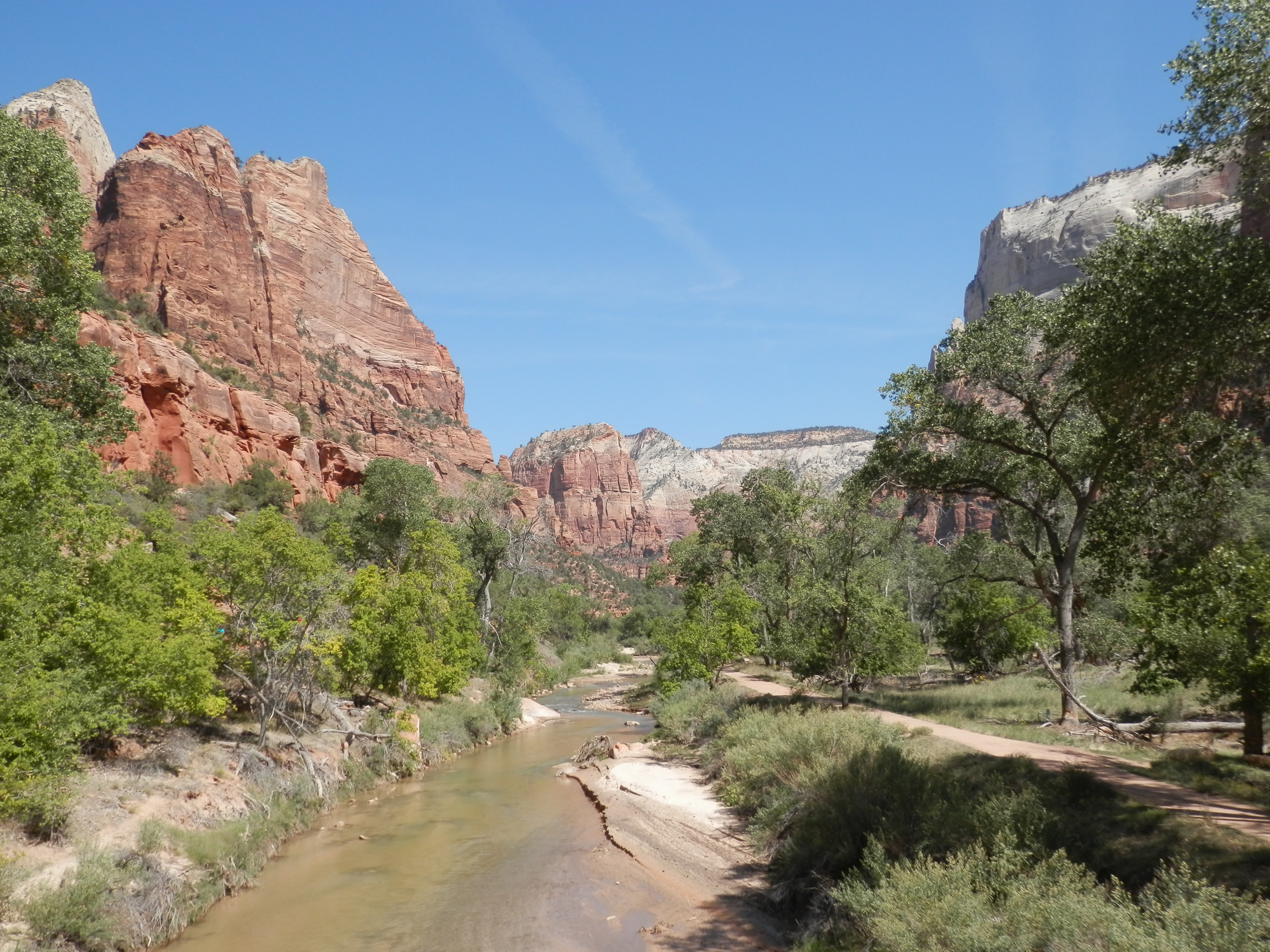
We parked at the visitor centre and took the shuttle to the furthermost point of the park, the Temple of Sinawava, and worked our way back, hiking several trails, including Riverside, Weeping Rock, the Lower Emerald Pool and the Pa’rus Trail in near hundred degree heat.

Zion is not dissimilar to Yosemite in that it contains awe inspiring cliffs and rocks, lush vegetation, and flowing rivers and waterfalls (though the latter were not much in evidence today). In fact, I preferred it to Yosemite, proclaiming it the loveliest place I had ever seen. I was to change that judgement more than once over the next week.

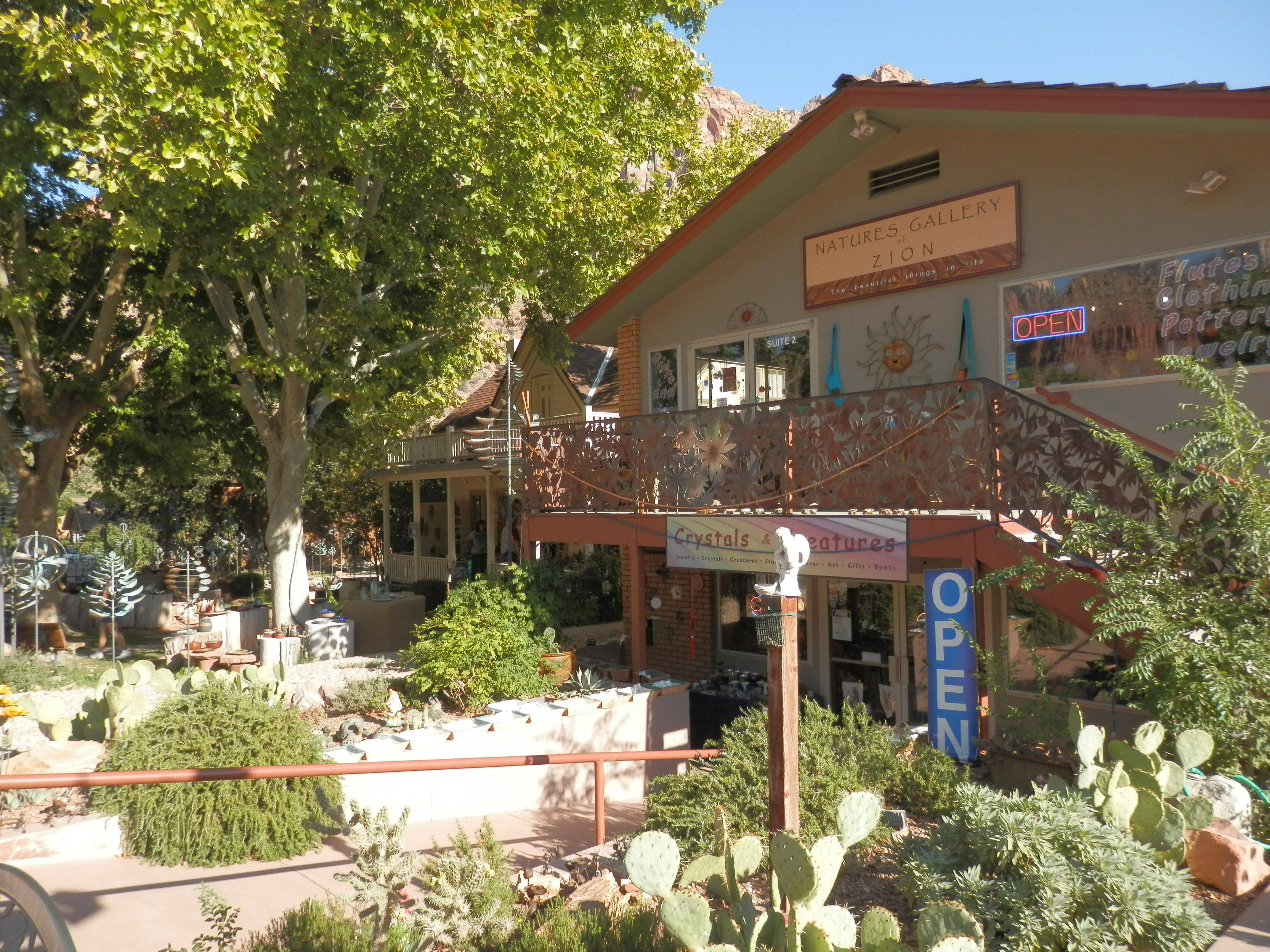
We called at Springdale on our return to the motel and found it an urbane and attractive town.  Were we to visit again this would be our base. We could not resist the Bumbleberry Inn where we rewarded ourselves for our strenuous walking all day with a slice of the “famous” (how is everything “famous” or even “world famous” in America?) bumbleberry pie. It might not truly be famous but it was delicious. Apparently, they grow on giggle bushes, which is pretty cute.

The gourmet evening was completed by a Domino’s pizza and wedges back in Hurricane – across the road from the infamous Barista’s – washed down by beer from the local gas station. Wine remained out of the question.

The road to Panguitch, Utah beckoned the next morning, where the story will continue.


We had been warned that high quality dining options were severely limited in Hurricane, Utah. Moreover, it was likely to prove difficult to obtain an alcoholic drink – beer possibly, but certainly not wine.

And those warnings were sadly endorsed over the next few evenings.

It all began when we went out to dinner on our first night. Having consulted TripAdvisor and selected its number one restaurant, a pizzeria in a cinema complex around a mile away, we were feeling optimistic. Armed with the respective street numbers we set off in our search for the cinema.

We found this easily enough – but no sign of any pizza restaurant. We walked a little further and then around the whole area, all to no avail. It was only when we returned to the motel and read the fulsome TripAdvisor reviews a little more carefully, that we discovered that it was only a mobile street wagon that set up stall during daylight hours (and even then not on a Wednesday)!

We headed off back in the direction of the motel, only mildly disappointed because we had spotted an attractive looking restaurant called Barista’s on the way down. And by the time we had been sat at our table and started to read the hundreds of  alleged customer testimonials claiming that the pizza and ice cream, along with many other items on the menu, were the best on the planet, we had struck lucky in adversity.

I like to think that I am reasonably streetwise, and do not often get hoodwinked by confidence tricks (I’ve conveniently forgotten the guy on Fisherman’s Wharf in San Francisco who screwed ten bucks out for me for “cleaning” my boots), but this proved to be one of my dumbest moves.

The teenage waitress in shorts who clearly wanted to be anywhere else took our drink order. Conscious already that wine was out of the question, we asked what beer they had. With a huge sigh the girl said “St. Pauli” in a “take it or leave it” manner, so St. Pauli it had to be. Now, although I didn’t articulate it immediately, I was familiar with this German brew and suspected that it might be non-alcoholic. After the girl had yanked the bottles out of the fridge and slapped them down on the table, and we had taken our first sips (it was too unpleasant to gulp), we knew it.

The food, whilst not inedible, also fell way short of the absurd praise scrawled over every inch of wall space (the staff must have had great fun fabricating that piece of fiction). My miniscule portion of fish and chips was delivered in a cereal bowl and Janet’s enchiladas came with no accompaniment whatsoever – not a hint of beans, rice or sour cream. The “service” remained surly and peremptory. Indeed, I think it might have been the first time I had eaten in America without being asked continually during the meal by the server whether the food was acceptable.

To add insult to injury, on reading both TripAdvisor and Yelp reviews back in the motel, we read a lengthy litany of furious, even vicious comments about the food, beer and staff attitude. And yet it had looked so appealing from outside. The words book, judge and cover sprung to mind.

We consoled ourselves by purchasing  a six pack of beer in the local gas station, though even this was of low strength (Bud Light, Coors Light and the like).

This was not, however, why I got to sleep so easily that night. I can thank the account of Joseph Smith’s revelation in the Book Of Mormon for that.

Having exhausted the full extent of Hurricane’s gourmet offerings on that first evening, we played safe on the following night by buying in a Domino’s pizza, washed down again by insipid beer.

We were no more successful in hunting down a bottle of wine to have with our evening meal on the following two nights in Panguitch. Raids on assorted supermarkets and gas stations proved equally futile. Only the dining room in the lodge at Bryce Canyon proffered a wine list, but, of course, that was at lunchtime and we were about to embark upon a prodigious hiking expedition that afternoon.

Whilst our stay in Utah was, in all other respects, wonderful, with visits to Zion and Bryce Canyon National Parks, Cedar Breaks National Monument, Red Canyon and Pink Coral Sand Dunes Park, our first swing into Arizona meant one thing above all other. No, not Lake Powell or the Grand Canyon but an opportunity to partake of one of the most civilised pursuits available to humankind – consuming a glass of wine.

Having got that off my chest, it is time to return to the true hero of this diary – the road.

And the journey between Hurricane and Panguitch had some interesting moments.


Firstly, apologies to Brigham Young for the deliberate misquote, but it seemed as apt a title as any for the drive from Las Vegas to Hurricane, Utah where we were to spend the first two nights of our road trip.

It got off to an electrifying start …………………….. with a lie-in and a spa bath. Making the most our deluxe room in Mandalay Bay, I was also able to complete the first post of my road trip blog.

We checked out at the latest possible time and collected the car from valet parking, when the guy who delivered it to us unaccountably disappeared before I was able to make his day by dispensing my customary $2 gratuity. Within a couple of minutes we were on the I-15 north in the direction of Salt Lake City (401 miles). It was already very warm and sunny, with temperatures forecast to tickle 100.

Locating a country music station on the car radio proved more difficult than anticipated, and after rejecting around 20 stations, spewing out everything from hip hop to power ballads, the comforting tones of Kenny Chesney took over. We had landed on 955 FM Vegas Country KWNR and life was good.

The landscape quickly gave the impression that a race of furious giants had ripped up and stamped upon it at some time in the distant past, leaving a jumble of cliffs, hillocks and mounds of varying sizes and colours.

We passed through the Moapa Indian Reservation and alongside the Valley of Fire State Park and Lake Mead National Recreation Area before arriving, 85 miles and 70 minutes after setting off, at the town of Mesquite, Nevada.

We cruised through the main street in search of a suitable lunchtime dining option. The signs were gloomy until we spotted Peggy Sue’s 50s Style Family Diner.  Dave Gorman, the English comedian, whose book Unchained America recounted his mission to cross the USA “from sea to shining sea” without paying even a cent to “the man”, would have been proud of us. This was the sort of place you should eat at on the classic road trip.

And Peggy Sue’s was indeed a classic. We were greeted with Laurel and Hardy on the TV at the end of the restaurant and Roy Orbison on the jukebox. The walls were liberally adorned with photographs of movie stars (Marilyn Monroe and James Dean amongst them) and Elvis (obviously), US flags (equally naturally), 45rpm discs, vintage Coca-Cola bottles and metal advertisement signs.

In addition to the customary condiment containers, and in the unlikely event that conversation should slacken in the few short minutes before your order arrived, each table had a series of books on it by Ben Goode, amongst which were  How to Cope when you are surrounded by IDIOTS…….Or if you are one, How to Share a Bad Attitude and The Fine Art of Worrying. They, and many others, could be purchased at the till for a measly $7.99 each.

The waitress was loud (in a good way), enthusiastic and attentive, which set me wondering, not for the first time, why her British counterpart invariably demonstrated the opposite characteristics. And then it occurred to me – why not sack all restaurant waiting staff in the UK and replace them with the London 2012 Games Makers? Moreover, they could work for free – there’s one you hadn’t thought of, Mr Cameron. In fact, the idea could be replicated in other industries.

Shortly after we resumed our journey, we were joined by the Virgin River which wended its muddy way through the steep cliffs on either side.

It is often said that beautiful American roads are too often scarred by huge, garish billboards, but, advertisements for fast food joints, motels and politicians aside,  the prize for the daftest sign today must have been the one that advised us to “Watch for Rocks” The entire landscape comprised rocks of various shades of red, orange and brown!

As we entered Utah where, according to the welcome sign on the state line, our life was about to be “elevated”, we lost an hour (moving from Pacific to Mountain time) but gained a degree (it was 99 now).

We stopped for coffee in St. George, an attractive and civilised town with two bookshops (always a good sign for me) and many public art works, including lovely bronze statues scattered around the main square where gleeful children  froliced through water features.

St. George is home to the dazzlingly white Mormon Temple , the only Latter Day Saints temple completed during Brigham Young’s lifetime, giving it a special place in the Mormon world. We decided not to visit, partly on the advice of our guidebook which advised that non-Mormons were not permitted to enter, but also that any caller to the adjoining visitor center was as likely to leave on a two year mission to Mozambique as be sold a guidebook.

Besides, this particular pasty-faced Brit would rather escape the heavy hundred degree heat for the comfort of the air conditioning in the car.

We left I-15 at junction 9 and took the road leading to Zion National Park. After nine miles we arrived at the Travelodge in Hurricane where we would be staying for the next two nights.

Our unusual dining experiences there will have to wait for the next article.


“Road Trip” – is there another phrase that better exemplifies the heart of the American experience? Apple pie perhaps? Have a nice day? Manifest destiny? No, none of those come close to capturing the same sense of freedom and adventure that is synonymous with the American Dream.

Well, dear reader, as you are a valued friend, I am inviting you to join my wife and I on our very own road trip of the American southwest over the next three weeks. Come with us as we criss-cross five states (Nevada, Utah, Colorado, Arizona and New Mexico) and three time zones.

We’ll hear the siren song  of the slots in Vegas casinos, listen to the mournful wail of country music radio as we glide the endless highways, and gasp at massive, multi-coloured incisions in the earth’s surface.

We’ll meet peoples from the rich diversity of American culture, including Mormons and Native Americans.

We’ll take juddering jeep trips with Indian guides into the heart of their reservation where we will purchase Navajo and Zuni jewellery.

We’ll stand at the only point on the North American continent where four states intersect, and have our photo taken like the dutiful tourists (I prefer the word travellers) we are.

We’ll eat at authentic cantinas and  tacquerias and sleep in beds where once slumbered the the Hollywood stars of yesteryear.

We’ll even find ourselves standing on a corner in Winslow, Arizona, waiting, or at least I will, for a girl in a flat bed Ford to slow down and take a look at me.

The itinerary?

I write this in our hotel (Mandalay Bay) room where we spent last night after a tortuous 15 hours on a Virgin Atlantic plane and equally frustrating wait in line for the car hire. But a fine meal and live swing band in The House of Blues, followed by a solid night’s sleep, has us ready for the road this morning.

Today we drive to Hurricane, Utah for two nights, the base for our exploration of Zion National Park. We then move on to Panguitch, Utah, close to Bryce Canyon for a further two nights. Staying at Page, Arizona for another two nights will enable us to visit Lake Powell and Glen and Antelope Canyons.

The highlight will be our trip to Monument Valley in the heart of the Navajo Nation, iconic location of so many westerns directed by John Ford and starring John Wayne.  A stay in Kayenta, Arizona that night will predate two nights in Moab, Utah, our base for Arches and Canyonlands national parks.

On the premise that we will be “red rocked out” by then, and that our hiking boots might have earned a rest, we will wind down a little at this roughly mid point. The sightseeing will become more leisurely as we move on to Durango, Colorado and then into New Mexico for stays in Santa Fe (two nights), Albuquerque and Gallup before driving Route 66 to Flagstaff, Arizona.

A two night stop there in which we will “pop over” to Sedona and the long drive back to Vegas, sixteen days after we left it, for the final four nights, the second of which will be my sixtieth birthday.

The rigours of the road will dictate whether we might take short detours to Los Alamos, New Mexico and the Mesa Verde National Monument.

Sounds fun?

So jump in the back seat of the car, tip your hat over your face, but not before grabbing a couple of Buds (or rather Sierra Nevada or Anchor Steam beers), kick off your cowboy boots, sing along to Hank Williams and Toby Keith, and enjoy the ride. It’ll be a blast!

Time to head out on the highway.


It was the longest of fortnights, it was the shortest of fortnights.

In witnessing the most exhilarating public event of my life, I, along with millions of others, was enraptured by, and became not a little knowledgeable about, previously obscure and disregarded sports like taekwondo, dressage, beach volleyball and BMX racing (I still draw the line at synchronised swimming), fuelled by the BBC’s all-embracing coverage.

But now they are over, gone as quickly as they arrived. What do I do now between the hours of 9am and midnight? Where are the rowing coxless pairs heats, 58kg weightlifting semi-finals and 50m rifle 3 position shooting final when you need them, and not just because they passed the time but because they inspired and enthralled us?

But let’s not dwell on my post-Games melancholia just yet.

Apologies in advance to my international readers – this is an unashamedly GB-centric piece, and merely passing reference to the prodigious feats of Usain Bolt, Michael Phelps, Missy Franklin, Oscar Pistorius, David Rudisha and many others does not diminish their extraordinary achievements.

It really all started on the first Wednesday (day 5) when my wife and I, intrigued but ticketless, decided to travel to Stratford and spend the evening at the Westfield shopping centre adjacent to the Olympic Park. As I had left the house, Helen Glover and Heather Stanning had just won Team GB’s first and, what seemed at the time, long overdue, gold medal in the women’s rowing pair.

Delivered in time by an efficient public transport system that belied the anxiety expressed by the IOC in the bidding process, I was able to marvel at the big screen with hundreds of others as the hugely popular Tour de France winner Bradley Wiggins doubled the tally in the men’s individual cycling time trial at Hampton Court.

The Olympic Stadium, home to the sometimes eccentric but always chest-swelling Opening Ceremony five days previously, was not to re-open for another 72 hours when the track and field athletics were scheduled to start. But the aquatics centre and other venues in the park were already providing thrilling action. The atmosphere in the adjoining mall was correspondingly electrifying.

The immediate impression on stepping off the high speed train at Stratford International was that there was a giant party going on, to which the whole world had been invited – after all, isn’t that what the Olympics is meant to be?

Athletes, coaches, officials, military personnel, volunteers, spectators and shoppers mingled in a festive, friendly atmosphere that would have disarmed the most hardened cynic.

Over there are two athletes dressed in Eritrean track suits with bulging carrier bags from River Island and John Lewis. Outside the Waitrose supermarket a soldier shares a joke with a couple of young Brazilian girls (beach volleyball competitors maybe?). And everywhere the “happy, shiny” Volunteers in their pink and purple outfits are directing pedestrian traffic and dispensing unlimited advice and bonhomie.

Everyone is smiling (the smile, along with the tears, becomes an abiding memory of the Games). There is not a hint of the stressed undercurrent that haunts busy shopping centres at any other time.

Is this Great Britain I ask myself? Is this the country that many of its own citizens said couldn’t be trusted to organise the biggest of all peacetime projects? Is this the city with the broken transport system? Are these the people notorious for being unwelcoming to visitors?

Not any more, at least for these two weeks.

And it just got better and better.

Yes, and I cried as much, nay probably more, than anybody at the swift procession of triumph and heartbreak assailing our TV screens, and not just those of the British participants. I will never forget the sight of Sarah Attar, the first Saudi Arabian woman ever to appear in the Games, lying crumpled on the track after pulling her hamstring immediately after springing from the blocks in her 100m hurdles heat.

Nor can I dismiss from my thoughts the sight of the exhausted and distressed Zac Purchase, virtually having to be carried out of the boat by his partner, Mark Hunter, after just missing out on the gold to Denmark in the lightweight men’s double sculls.

Most poignant of all were the interviews with competitors who, having put their lives on hold for the past four years for this “once in a lifetime opportunity” (the most frequently uttered quote of the Games), performed miserably when they arrived at the very moment that was meant to validate all that hard work and sacrifice.  Whilst British triple jumper Phillips Idowu may be the most high profile casualty, there were many others who failed to get out of their heats or, perhaps most criminally of all, did not achieve their personal best on the biggest stage.

Of the 65 GB medal winners, which were my favourites? A difficult choice but here, with apologies in particular to Sir Chris Hoy, the scary Ben Ainslie, the not so scary Jessica Ennis, the Brownlee brothers and, well, everybody else who captured gold, silver or bronze, are my top five:

1. Mo Farah, the Somali born Muslim who came to London at the age of eight, and through sheer hard work and sacrifice, was taken to the hearts of his adopted country and became on successive Saturday evenings, one of its greatest ever athletes;

2. Nicola Adams, the first ever Olympic woman’s boxing gold medallist, who said at the start of her campaign that she only wanted to make her mum proud, and having won, was going to celebrate with a trip to Nando’s;

3. Double gold cyclist, Laura Trott, whose infectious, post-race interviews (“I can’t believe this is happening….I’m just a 10 year old kid”) were as joyful as her performances were thrilling;

4. Jade Jones, our youngest gold medallist, in the women’s 57kg category of taekwondo who described her victory as “bonkers”- she could kick my head in any day; and

5. Bradley Wiggins – after his heroics in the Tour de France, striking of the Olympic bell in the Opening Ceremony and handsome time trial victory, “Sir Brad” became a bit of a forgotten man during the last ten days of the Games as new British heroes emerged. He probably preferred it that way as it would have allowed him to continue getting “blind drunk”. His feats can never be underestimated though, and he remains, for me, the brightest star of Britain’s glorious sporting summer.

TV moment of the Games? It has to be the interview with previously mild-mannered, even diffident British Finn class sailor Ben Ainslie. Aiming for his fourth Olympic Gold he lost to his Danish rival, Jonas Hagh-Christensen in the first six (of ten) races. In that sixth race the Dane, along with Dutchman, Pieter-Jan Postma, alleged that Ainslie had hit a mark whilst turning round it, thereby incurring a penalty. Ainslie felt obliged to repeat the manoeuvre, causing him to lose vaulable time, though he was unconvinced that he had committed the offense.

When interviewed about this afterwards, a clearly incensed Ainslie stated that he was “seriously unhappy” about this and that “they’ve made a big mistake, they’ve made me angry and you don’t want to make me angry”. I felt afeard even from the other side of the television screen. It reminded me of John McEnroe in his pomp when his public outbursts appeared to drive him to perform still better. Needless to say, Ainslie collected his fourth gold and the reward of carrying the GB flag at the Closing Ceremony.

One other hero – London.

Never was Samuel Johnson’s famous phrase that “when a man (or woman) is tired of London, he is tired of life; for there is in London all that life can afford” more apt. All that life could afford was present in this past fortnight.

Lord Coe recounted at the post-Games press conference that Jacques Rogge, President of the IOC, had advised him that if he exploited just 10% of London’s heritage in designing the venues, it would be spectacular. And spectacular it was.

I now offer a public apology to whoever took the decision to block off from the public a large chunk of Greenwich Park a year ago in order to prepare the site for the equestrian events. It was worth it. The most dramatic blend of action and backdrop was the sight of the show jumpers negotiating the “Moon” fence with the spendour of Greenwich’s maritime buildings in the immediate foreground and Canary Wharf and adjoining buildings in the background. Pure genius.

Only this could have beaten the volleyball arena in Horse Guard’s Parade, with the Whitehall rooftops and the London Eye enjoying birds eye views of the scantily attired athletes, into the silver medal position.

If there is a single word that defined these Games, and which my personal roll of honour above exemplifies, it is diversity or, if you prefer, inclusivity.

Tory MP Adam Burley called the opening ceremony “leftie multi-cultural crap”. As novelist Tony Parsons put it, “this was a rotten fortnight to be a bigot” as British athletes of black, white and mixed ethnic origin, of different religions, and from every corner of the nation, won medals. Burley’s angst will be intensified still further when the disabled Olympians take to the stage later this month.

I wrote this piece, not only as a counterpoint to the two articles published on the eve of the Games, but to provide some measure of catharsis or, in the modern vernacular, closure. But as I surround myself with commemorative brochures and newspaper reviews and look forward to the DVDs to come, I don’t want it to end, though I know it must.

The sceptic in me has re-entered the room, bragging that the spirit of generosity and celebration so overflowing in the past fortnight will soon be swept aside in arguments between politicians about the funding of sport in schools, surliness between strangers on the creaking tube, rail and bus network and a return to the national pastime of moaning.

Well, maybe, but we will always have London 2012.

I had intended to write also about that all-important issue of legacy, but I will leave it to others better qualified. Besides, I think I have occupied your time long enough.

All I will say is that I pray that these Games form not only the trigger to greater participation in the unifying and health-giving pursuit of sport in schools, clubs and throughout society (sustaining GB’s success in future Games), but that they act as a springboard to delivering the much-needed regeneration of eastern London that has been so trumpeted by politicians and adminstrators.

The true success of the Games, and its implications for the future of Britain, will be determined over a much longer timescale than a fortnight. And we face harsh economic times that might quickly remove the shine on those glorious medals.

But I will never forget the spectacle and the atmosphere, the way London 2012 made me feel good about my country, my fellow citizens, those inspirational athletes and the city I have lived and worked in for much of my life. Nothing will change that.

And let’s not forget – the Paralympics are returning home on 29th August and they are already scheduled to be the best supported in history. And I have two of the 600,000 tickets alone that have been purchased since the Opening Ceremony, enabling me to sample that extraordinary atmosphere in the Olympic Stadium!

Let’s replicate that feel-good atmosphere and celebrate a movement that, perhaps more than its big brother, exemplifies the Olympic ideals.

And finally, I’ll return to my previous article entitled Let the Games Begin when I concluded by stating that I would be “sparing a thought too for the friends and families of those who perished on 7 July 2005”.

I’d like now to finish with a quote from Dr Ian Harte who treated victims of the bombings that day:

I saw the worst of mankind that morning, and now I’m into this and I’ve seen the best.