Feeds:
Posts
Comments

If you have had the good fortune (sic) to read my previous article entitled “My Olympic Journey”, you will have gathered that my passion for the Games has waned over time. In fact, I didn’t watch a single minute of the XXIX Olympiad in Beijing in 2008, when Great Britain garnered its second highest medal tally – 47 – in the modern era.

Yet, three years earlier, at around a quarter to one on Wednesday 6 July 2005 to be exact, I had stood in the middle of Trafalgar Square with hundreds of office and shop workers, and a group of mildly bewildered Italian schoolgirls in matching pink and purple backpacks, and witnessed the fateful and surprising words of President Jacques Rogge, speaking from the organisation’s 117th session in Singapore: “The International Olympic Committee has the honour of announcing the games of the 30th Olympiad in 2012 are awarded to the city of……..London”.

The detonation of delight following that agonising, reality TV show-like pause was all the more exhilarating for the fact that it had been widely expected by that stage that Paris, in its third attempt at securing the ultimate gig, had snapped the winning tape in a photo finish ahead of London.

Of course, the elation of that afternoon was brutally crushed within a mere twenty hours when news started filtering through about explosions on underground trains between Liverpool Street and Aldgate, King’s Cross and Russell Square, at Edgware Road, Old Street and Moorgate, and at Tavistock Square on the number 30 bus travelling from Marble Arch to Hackney Wick.

My tube train was halted in the tunnel between Westminster and St. James’s Park for around twenty minutes, occasioning angry mutterings from fellow commuters accustomed to signal failures and emergency track repairs. It was only after we were released into an eerily quiet daylight that we discovered that the Aldgate blast had been on one of the trains directly in front of us.

As manager of the director of a government department human resources’ office, the remainder of my day was spent trying to account – to both statistically minded management and anxious friends and families – for the hundred or so staff expected in the office that day. Thankfully, nobody was lost.

However, others had not been so lucky. The prospect of the Olympic Games in this suddenly terrorised city, seven years and 52 lives away, vanished as quickly as it had been acclaimed.

And, irrespective of the tragic events of that day, that was always likely to be the case, at least for the ordinary citizen not involved in the planning and preparation. But it did not need such carnage to convince those of us living and working in London to realise that.

Beijing came and went and still my interest was not ignited. It was only in 2010 when I began research on a 2,200 word paper for my travel and tourism qualification on the state of preparedness of the public transport system, that I began to allow myself positive thoughts again about what the Games itself and, most importantly, their legacy might be for both the east end of London and the country as a whole.

From that date, I have kept a keener and better informed eye on developments. Moreover, I have been fortunate enough, living so close to the capital, to watch the Olympic Park and its stadia take shape and feel the sense of pride and excitement growing in the area around it.

Now, us Brits are a cynical lot, and we love to moan, which, given that one of our most familiar phrases is “mustn’t grumble”, is rather ironic (the capacity for which is also part of our national psyche). And I claim my share of that not particularly attractive character trait, but, in respect of the Olympics in the incomparable city of London, where I have been blessed to spend so much of my life, including living there for eight years, I feel it is time to celebrate rather than snipe.

That doesn’t stop me smirking, raising my eyebrows and shaking my head when I read the stories of the firm handed vast sums of money to ensure the Games were safe and secure, failing to recruit anywhere near enough staff and having to be bailed out by the armed forces, or of lengthy queues at immigration at Heathrow Airport and threats of strikes (thankfully now averted) by the very same staff operating those desks. Or of the closure of the vital M4 motorway route into the city, of taxi drivers protesting at the installation of Olympic road lanes and coach drivers getting lost en route from Heathrow Airport to Stratford.

All of these are ammunition for the soulless and negative people determined to see the Games fail. And yes, the cost has exceeded the original budget threefold, those we voted for (or rather didn’t) will make as much political capital as possible out of any successes – and watch for repeated attempts to “bury bad news”, and the dead hand of corporate sponsorship will be all pervasive. But these, sadly, are inevitable consequences of the staging of any modern global event.

And all this against a backdrop of one of the wettest summers on record.

However, what has struck me most in recent weeks – and I know this is a cliché – is the manner in which ordinary people, from all corners of the island, have embraced the spirit of the Olympics, as symbolised in the joyous and exhilarating torch relay. The sight of the torch adorning such iconic landmarks as the London Eye, Snowdonia, Forth Road Bridge and even scooting through the Hampton Court Maze, has been humbling and inspirational. I am even astonished that my teeth no longer grate when I hear the words “it is the opportunity of a lifetime”, because, after all, it is, isn’t it?

And whilst a good proportion of the screaming, mobile phone camera toting, followers (and runners) have been children, whipped, no doubt, into a frenzy by media, parents and teachers alike, that really doesn’t matter.

Anyway, isn’t that the point? If nothing else, the Games are about instilling a passion for sport, healthy living and pride in one’s community in the coming generations, and howsoever that has been generated, the genuine, not engineered, enthusiasm of thousands of young people throughout the nation that we have witnessed can only be heartening.

Moreover, I was struck by what rapper Dizzee Rascal, whose music is very popular amongst teenagers but leaves me cold, perhaps because I emigrated from teenagedom some while ago, had to say in an interview with the BBC last night. He hails from the area adjacent to the Olympic Park and many of his childhood friends still live in the vicinity. Although some still harboured mistrust towards the authorities, he declared that the reaction was generally a positive and optimistic one, and saw a new hope emerging in the community.

That is, of course, the huge challenge that now faces those responsible for delivering the Olympic legacy in that and other deprived parts of the capital in particular. This really must not fail.

The cynics will argue that the Games are a complete waste of money, a classic instance of bread and circuses, deflecting the brainwashed masses from the reality of a country in double-dip recession and a government devising social policies that would have made the Thatcher cabinet blush.

I don’t belittle those claims, and will not lose sight of the domestic political context within which the Games are being played out, but I believe that it is now time to get behind the event, the volunteers, the athletes, London, the country, and especially those young people whose futures are so dependent upon their success.

So will I go?

I had not applied for any tickets, and although there are still some available, primarily for the football (which I have always had difficulty accepting as an Olympic sport), I will need a lottery win this weekend to allow me to purchase any now.

But there are, of course, the Paralympic Games in a few weeks, with tickets still available both for the Olympic Park experience and some sports. Securing some is now a priority.

I will be sparing a thought too for the friends and families of those who perished on 7 July 2005.

Let the Games begin.


Now before you think that my Olympic medal winning exploits had passed you by, let me clarify at the outset that I haven’t even attended a Games, let alone competed in one, but cynically entitled this piece as I have to grab your hopefully more than fleeting attention. This is an account of my evolving connection with the Olympics over the past half century.

As I start this article the official website ( http://www.london2012.com ) informs me that it is one day, twelve hours and seventeen minutes to go to the Opening Ceremony of the XXX Olympiad in London, the precise details of which, including the identity of the individual lighting the Olympic cauldron, remain a surprisingly well guarded secret.

I leapt from the blocks at the Rome games of 1960, or rather sat on the living room floor with my legs, and, due to my proximity to the new but tiny black and white television, eyes, crossed, cheering on Great Britain’s two gold medallists, Anita Lonsbrough in the women’s 200 metres breaststroke and the diminutive Don Thompson, waddling hilariously for 50 kilometres in sunglasses and mum made white hat.

Great Britain doubled its gold medal tally in Tokyo in 1964 with victories for Ann Packer in the women’s 800 metres (whom of a certain age could forget David Coleman’s hysterical television commentary as she took the lead in the home straight and broke the world record?), Lynn Davies and Mary Rand in the men’s and women’s long jump respectively, and Ken Matthews in the shorter form (20 kilometres) waddle. The glory was accentuated by the fact that the television had grown a couple of inches in the intervening four years.

Don’t worry – this article is not a list of British gold medal winners over the last 50 years, but rather an account of how the Games have, or, on occasions, not, touched my life at various stages.

What is interesting about my childhood Games watching is that, bedtime regime permitting, I watched all of it, not just the glamorous events like the men’s 100 metres, pole vault and high jump (well ok, the 100 metres then), but everything – from fencing and water polo to weightlifting and graeco-roman wrestling.

And I loved it! There was never a chance that a British competitor would stalk the podium in the majority of sports, but it was the Olympics, the original “greatest show on earth” and it was on television! My only reservations at the time, as a prepubescent and then fully pubescent boy in the sixties, were that neither synchronised swimming nor  beach volleyball had been invented as Olympic sports for another 20 and 30 years respectively.

(one day, eleven hours and thiry six minutes).

It was the athletes from behind the iron curtain, particularly the Soviet Union, that fascinated me most. Perhaps it was their exotic names (the brilliant ice dance pairing of Lyudmila Belousova and Oleg Protopopov still raise a juvenile titter), or the fact that we knew so little about their society, or the allegations that most of their women were actually men, or the suggestion that they took performance-enhancing drugs, or that they received massive state sponsorship (there was still an expectation that competitors should be amateur) Or it may just have been because they were so bloody good.

The most notorious case was that of the Press sisters, Tamara (shot put gold in 1960 and 1964 and discus gold in 1964) and Irina (80 metres hurdles gold in 1960 and modern pentathlon gold in 1964), who were effectively hounded from the Games after Tokyo in the wake of persistent Western mockery and, more pertinently, the introduction of gender testing in 1966. They never took the test and their sudden disappearance was explained by Soviet officials as enforced retirement in the Ukraine to care for their ailing mother (or was that father?).

Before I move on, I must make it clear that, in the interests of political correctness and indeed accuracy, many of the most attractive women from that era bore the bibs of eastern European nations.

(one day, seven hours and fourteen minutes).

Leaving home and going to university in the Moscow Olympics year of 1972 put a virtual end to my slavish scrutiny of the Games, as I discovered other interests, or rather enjoyed the opportunity of exploiting those interests to the full. I will leave it to you to consider what they might have been.

As those interests, as well as responsibilities, expanded over the next thirty years, I became much more selective in what I watched, focusing largely on the track and field events.  The rivalry of Sebastian, now Lord, Coe and Steve Ovett over 800 and 1500 metres in the Moscow and Los Angeles Games of 1980 and 1984, probably stands out, not least because it sparked endless arguments between my mother, who adored the smarmy, former Loughborough University graduate Coe, and myself, who cheered on the Brighton bruiser, Ovett.

Memories of summer Games over that period centre on remarkable individual performances. The most notable for me included the four times gold medal winner at 200 metres (Atlanta 1996), 400 metres (Atlanta and Sydney 2000) and 4 x 400 metres relay (Barcelona 1992), Michael Johnson, pole vaulter Sergey Bubka, who, despite ten world championship golds, won just a single Olympic title in Seoul in 1988, Mark Spitz’s seven swimming golds in Munich in 1972 and Nadia Comaneci who, at the age of 14, won three gymnastic golds in Montreal in 1976 (and a further two in Moscow four years later). There are many others but these are my particular favourites.

(one day, three hours and twenty seven minutes).

But let’s not forget the Brits who have momentarily captured the imagination of this increasingly wearied Olympic follower –  (Sir) Steve Redgrave’s extraordinary five rowing gold medals, almost matched by (Sir) Matthew Pinsent’s four, Linford Christie becoming the oldest 100 metres champion in Barcelona in 1992, the hockey team that won gold at Seoul in 1988 and (my mother’s influence here), Torvill and Dean’s sublime ice dance routine to Ravel’s Bolero in Sarajevo in 1984. But, for me, the greatest achievement is that of Kent girl (Dame) Kelly Holmes who won double gold in Athens in 2004 (800m and 1500m) at the age of 34 and after years of injury heartache in major championships.

(one day, one hour and eighteen minutes).

With my discovery of skiing in the late eighties, I became more interested in the Winter Olympics over the next few years, modelling my own technique on that of Purmin Zurbriggen, downhill champion in Calgary in 1988, and Alberto Tomba, winner of slalom and giant slalom in both Calgary and, four years later, Albertville. If you’re wondering, the “modelling” extended no further than being able to stand upright on two skis.

They are my fondest memories of a truly global spectacle. My feelings about the only Olympics to be hosted in my country in my lifetime can be found in the following article entitled “Let the Games Begin”.

(eleven hours and forty two minutes).


San Francisco can claim more than its share of personalities who have changed the course of society and popular culture, and Carol Ann Doda ranks high on that list.

She was born on 29 August 1937 in Solano County, California, and grew up in Napa.  Her parents divorced when she was three. She dropped out of school and became a cocktail waitress and lounge entertainer at aged 14.

Described as a “lovely, busty and curvaceous blonde bombshell” she achieved fame, or notoriety depending upon your point of view, on 19 June 1964 at the Condor Club at the corner of Broadway and Columbus in North Beachby dancing in a topless swimsuit, the first recognised entertainer of the era to do so, and spawning similar exhibitionism across the country. In fact, within 48 hours, the neighbouring bars had also gone topless, and at one point, 28 clubs along the Broadway strip were advertising bare-breasted dancers.

Her act, which she performed twelve times nightly, “began with a grand piano lowered from the ceiling by hydraulic motors;  Doda would be atop the piano dancing.  She descended from a hole in the ceiling.  She go-go danced the Swim to a rock and roll combo headed by Bobby Freeman as her piano settled on the stage.  From the waist up Doda emulated aquatic movements like the Australian crawl.  She also performed the Twist, the Frug and the Watusi“, all dances familiar to those of us growing up in the sixties.

She later spent $20,000 on enhancing her bust size from 34B to 44DD through a total of 44 (“just a coincidence” she said) direct silicone injections (now illegal because the plastic tends to migrate), earning her breasts the nickname of “the new Twin Peaks of San Francisco”.  She had them insured for $1.5 million with Lloyd’s of London, but never had recourse to claim on it. In his 1968 book, The Pump House Gang, Tom Wolfe referred to them as “two incredible mammiform protrusions, no mere pliable mass of feminine tissues and fats there but living arterial sculpture – viscera spigot – great blown-up aureate morning glories”.

Such was her popularity that delegates from the 1964 Republican National Convention flocked to see her and, four years later, she was given a film role as Sally Silicone in Head, created by Jack Nicholson and Bob Rafelson, and featuring The Monkees.  She appeared in another six films. The U.S.S. Kittyhawk aircraft carrier named her Pinup Girl of the Year and she even received a Business Person of the Year award from Harvard.

Doda created a further seismic impact in the entertainment industry on 3 September 1969 by dancing completely naked at the Condor, though she was obliged to reinstate the bottom part of her costume in 1972 after the California alcoholic beverages commission prohibited nude dancing in establishments that served alcohol.

She explained that “even in liberal San Francisco, what I did was technically a crime. The cops raided. The owner and I ended up in the slammer. I was back slamming on stage in two shakes of a stripper’s tail”.

In an interview with the San Francisco Chronicle in October 2011 Doda stated that she only caused a scandal “about a year and a half after I started, because the cops came in and said no more bottomless unless  you move the tables back 5 feet. I had to explain to the people we can’t do bottomless and topless because the health department folks are afraid our pubic hairs will jump into your drinks”.

As a witness during the trial of two completely naked dancers at the pink pussy Kat in Orangevale, California, arrested for “indecent exposure and lewd and dissolute conduct”, she performed to live song and dance numbers and a 17 minute movie entitled Guru You, at the Chuck Landis Largo Club in Sunset Boulevard, Los Angeles, which was set up as a temporary courtroom. Cross-examined by a deputy district attorney, Carol, dressed in a red miniskirt with blue piping and beige boots, explained that her act, rather than being pornographic in itself, represented a a satire on it, “to show people the humourous side of sex”.

She also became a spokesperson for Channel 36, now known as KGSC-TV, in San Jose when, filmed from the waist up and wearing clothes, she’d intone “you’re watching the perfect 36” (there was no channel 44 at the time).

Doda returned to dancing at the Condor three times a night in 1982, at the age of 45, performing to blues, ragtime and rock ‘n’ roll, dressed “in a gold gown, traditional elbow-length gloves, and a diaphanous-wraparound.  Her clothing was removed until she wore only a G-string and the wraparound.  In the final portion she was attired in only the wraparound.  Her small body looked slimmer without clothes which was emphasised by the dwarfing effect of her breasts”.

Despite the notoriety she earned by being the first dancer to break the topless / bottomless taboos in the U.S., her act was rarely regarded as sleazy.  As she herself said: “I always just wanted to give people a good time, have fun.  Nothing really dirty – just fun”.

Larry Inla, who spent most of 1966 playing in a band called Stark Naked and the Car Thieves at the Galaxy, a couple of blocks from the Condor, reiterates this point, recalling that, thanks in no small part (sic) to Carol, “it was a fantastic place at an incredible time” and that the “ambience was more naughty-but-nice, in a sophisticated European city kind of way, not a sleazy, dirty kind of way”.

Retiring from stripping later in her mid forties (“you can’t go on stripping forever”), she formed her own rock band, the Lucky Stiffs, with whom she played for several years.

Doda now runs the highly respectable “Carol Doda’s Champagne and Lace Lingerie Boutique” in a pretty courtyard at 1850 Union Street in Cow Hollow, which she opened after San Francisco Chronicle columnist, Herb Caen, who was a clear fan, announced in the paper that she was going to do so. She specialises in “plus” sizes and waits on customers personally. She takes particular pride in being recommended by Macy’s, Nordstrom, Sacs, Neiman-Marcus and bridal stores who can’t cater for larger sizes.

Well into the new millennium, she has continued to put ten years of voice training to good effect by singing, whilst fully clothed, club standards like All of Me  at a variety of North Beach clubs, including Amante’s and Enrico’s Supper Club. In late 2011, at the age of 74, she was still performing at Gino and Carlo’s Bar on Green Street in North Beach, where she had been for around twelve years.

And finally, in a city with high foodie credentials, she has been truly immortalised in having a gourmet hamburger named after her at Bill’s Place at 2315 Clement at 24th in the Outer Richmond! Unsurprisingly, it consists of “two third of a pound plus hamburger patties served side by side on a sesame seed bun, each patty topped with an olive and full garnish on the side”.


One of several writing magazines to which I subscribe, Writer’s Forum, has a regular feature on the inside back cover entitled Where I Write, in which established authors describe the space in which they do most of their work. This month’s (August!) edition also contains a longer article headed Room to Write in which eight writers explain where they escape to write, and whether they regard such a place as a “necessity or a luxury”.

Amongst the “offices” cited by the respondents are specially designed, sound proofed studies, pergolas, sheds, beach huts, inglenook fireplaces and even the corner of the kitchen table. The accompaniment of dogs and music figure high in judgements of what aids creativity.

As I am never likely to be invited to contribute to such a feature, I thought I would take this opportunity to inflict my own preferences on you.

Firstly, there is no single place where I do all, or even the bulk of, my “writing”. The absence of a settled location in my house means I have to take my chances where I can.

Despite being from a generation reared on pen/pencil and paper, I tend to compose directly onto a computer, although I do, as the scribbling sages advise, have a notebook and pen (and now smartphone) with me at all times to capture those rare and precious moments of inspiration.

In no particular order here are my regular writing locations:

The front (second) bedroom before the purchase, three years ago, of my laptop, and last year, my netbook, the fact that our single desktop PC resided here meant that this was the most common venue for my work. The fact, however, that it overlooks the road at the front of the house, and that there is a TV in it (and, of course, a bed!), all play to my innate inattentiveness, so it was hardly ideal. And then, for some unaccountable reason, guests staying in the room started to complain when they found me hunched over the desk at three o’clock in the morning with one finger stuck to the “delete” button on the keyboard.

The kitchen / diner – plenty of space, the most suitable table in the house and my most prized books almost within touching distance, but the insidious presence of yet more TVs in both the conservatory and living room, and all that food intoning “eat me” from fridge, freezer and cupboards alike make this far too distracting, though less so towards the end of the week when I feel as if I am auditioning for the role of Old Mother Hubbard.

(Pause for the fifth cup of tea of the day).
The (south facing) garden – a nice idea in the summer (if and when it arrives), but the glare of the sun, my recently acquired susceptibility to hay fever, and the noise of the neighbours’ children (or rather their fishwife of a mother), render it inconducive to concentration.  There is a brick shed at the end of the garden, but I doubt that the mice, spiders and triffids would be too enthusiastic about sharing their home with me on a regular basis.

The train – despite having cashed in my chips at the commuter casino three years ago, I still make a number of train journeys, principally to London and back. At around an hour they are useful for planning writing exercises, and if the compartment is relatively quiet (no loud mouth Blackberry users confusing it for their office or shopping parties discussing last night’s soap story lines), I might just be able to write something worthwhile. The main drawback, however, is what I call the “Meopham triangle”, a 20 minute stretch of the journey when my broadband signal tends to wander off.

The library – all the local libraries provide a healthy number of computers for people to use, primarily, it would seem, for job search and social networking. This alone, for my part, demonstrates that they continue to add value to the community. Although time on the PCs is limited to an hour at a time and no more than two hours per day, the additional provision of quiet study areas enables me to use my netbook there too. Those with (cheap) coffee machines get an extra point – which leads me to what, in many respects, are my favourite places to compose……

Cafés and Coffee shops (is there a distinction?) – there is something about the environment that lends itself to both thinking and writing, and that is not just the smell of fresh coffee or the availability of free wifi and (not so free) cake. Perhaps it is the steady procession of customers, inadvertently, in their demeanour or conversation, offering up ideas for characters, situations or thought trails. Inconveniently, however, you are usually obliged to buy coffee, which can be expensive.  If it could stay hot for longer than 15 minutes this would be the ideal place – maximum time, minimum cost. The only solution is to buy a frappé, frappuccino or cooler (depending on your vendor of choice) – I can make a medium sized version last a couple of hours.

Having seen what I have written above it is interesting to note that I appear to prefer, and get more written, out of the house – in a library or café – than in it. I think that reinforces my belief that there is a clear need to separate home from writing, though as some writers have claimed, that can be achieved in the physical space that constitutes that home. In the final analysis, I suppose it is, as the article in Writer’s Forum concludes, a matter of “finding your own space, whatever and wherever it is, where you feel comfortable and are the most productive”.

The dream of a discreet study, either in the house itself or in its grounds, and surrounded by all my books, lives on.

For the record. I have written parts of this article in a variety of places, including the kitchen, conservatory (with the fishwife in fine voice next door), on the 16.52 train from London Victoria to Ramsgate and Dover Priory and in my hairdresser’s waiting area.


It is funny how it is only after I return from a visit to San Francisco that I start to ponder, even worry, about the prospect of a major earthquake hitting the city.

OLYMPUS DIGITAL CAMERA

I have recently been reading A Crack In the Edge of the World: America and the Great California Earthquake of 1906 by British born but recently naturalised American, Simon Winchester, a magnificent exploration of the origins, development and aftermath of the magnitude 8.25 Earthquake and ensuing Fire that hit the city on 18th April of that year, and it set me to thinking what is increasingly fascinating me from afar.

Aside from his narrative skill, Winchester, as befits a masters graduate in geology from Oxford, is perfectly placed to explain the scientific basis for earthquakes. Irrespective of how imperfectly I understand that science, his voice is authoritative, and this paragraph in particular sends a chilling message to all those living on the San Andreas Fault, and especially in the city by the bay:

It is not a question of whether a big earthquake will occur, nor even a question of precisely where it will hit. There will be a quake, it will be considerable, it will be somewhere in the vicinity of San Francisco, it will more than likely affect the San Andreas Fault or one of its cadet branches – and it will take place, most probably before 2032. The only true unknown is the precise year, month, day and time.

The U.S. Geological Society actually issued a formal forecast in 2003. Sometime before 2032 , along one of the seven fault systems that belong to the San Andreas cluster, and which cut their way through the Bay Area, there is a machine-computed probability of 62 per cent that an earthquake with a magnitude of 6.7 or greater will strike. There will be damage and casualties “on an impressive scale”.

All those communities, not least the major city in the area, have comprehensive plans for dealing with every type of disaster, as well as providing detailed guidelines for those “authorized to know what their duties and responsibilities are in the event of the most statistically likely major disaster that is anticipated in the region – and that is a very, very large earthquake”.

And, of course, since the Loma Prieta earthquake of 1989 that, amongst its other effects, caused part of the upper deck of the Bay Bridge to collapse onto the lower and much of the Marina district to be destroyed, many buildings have been checked and reinforced to enable them to stand a chance when the next “big one” arrives.

That is all reassuring I’m sure. But I wonder how far the citizens of San Francisco are truly geared up to cope when it comes. I suppose if the authorities kept hammering on about it it would instill a pervading sense of paranoia that would do nobody any good. But I have rarely seen or heard any references to the subject during my trips to the city. Having said that, it has not even crossed my mind whilst staying there – though I am becoming increasingly fascinated both by the historical context and the future potential for calamity.

So does it concern me that my beloved city could be seriously damaged any moment? Of course.

Does it deter me from visiting it often, and, hopefully, more than before, in the future? Not at all.

Is there just a small part of me that hopes I am there when it happens? I think there might be (many witnesses of the 1906 quake recorded their excitement at being part of a major historical catastrophe, and more still posed for photographs amid the ruins even as their homes disintegrated).

But do I wish it? Of course not.

I know that I have a number of readers who would be directly affected by an earthquake. Do they think about it at all? Do they worry about it? Are they confident that they would know what to do if such a disaster struck?

It would be interesting to know. Answers at the bottom of this post please.


One of the most distinctive landmarks on the San Franciscan horizon, visible from most of the eastern half of the city, is 210 foot high Coit Tower on top of Telegraph Hill.

This is the story of the eccentric woman whose lifelong dedication to the city’s firefighters culminated in bequeathing a third of her fortune for its construction.

Lillian Hitchcock was born on 23 August 1843 at West Point, New York, the only child of Martha and Dr Charles M Hitchcock, a distinguished army surgeon, who had operated on the leg of Colonel Jefferson Davis. She moved with her parents to San Francisco in 1851.

Two days before Christmas that year she was rescued from the upper floor of the hotel in which she and her father were staying. Thanks to the firefighters from Knickerbocker Engine Company No.5. she was unharmed, fuelling a lifetime’s devotion to the same crew in their red shirts and war-like helmets.

This was in an era when fire carriages were designed to be pulled by hand. Firefighters lined up along a rope and pulled, like tug-of-war teams, in order to haul their engine to the fire. They would often be in competition with other companies to get to the blaze first. Such was the case when “Lillie” first saw her opportunity to repay “her men” for saving her when she was only eight years old.

Seven years after that event, the pretty, tomboyish 15 year old was walking home from school when she spied an underhanded Knickerbocker Engine Company No. 5 falling behind the Manhattan No. 2 and Howard No. 3 companies in responding to a fire call on Telegraph Hill.

Intelligent and quick-witted, Lillie hurled her school books to the ground nd rushed to help, finding a vacant position on the rope and calling out to other bystanders to help get the engine up the hill.  Largely through her intervention, No.5 was the first to the fire.

Frederick J. Bowlen, Battalion Chief of the San Francisco Fire Department (SFFD), wrote that it “was the story of Jeanne d’Arc at Orleans, The Maid of Saragossa and the Molly Pitcher of Revolutionary fame all over again” as she “exerted her feeble strength and began to pull, at the same time turning her flushed face to the bystanders and calling “Come on you men! Everybody pull and we’ll beat ‘em!”

From then Lillie became the Knickerbocker Engine Company No.5 mascot and honorary firefighter, swinging into action at the sound of every bell. She was elected an honorary member of the company on 3 October 1863, making her the only woman in the US to belong to a volunteer fire station. Her energy and speed were the envy of even the fittest of firemen. She rode frequently with No. 5, especially in street parades and other celebrations, bedecked in flowers and flags.

She wore a diamond-studded fireman’s badge reading “No.5” for the remainder of her life, started signing her name with a 5 after it, and even had its emblem embroidered on her bedsheets (some have suggested her undergarments too!). If a fireman fell ill she would sit with him in his sickroom, and provide floral tributes for the families of those who died.

By the age of 18 she was the “undisputed belle” of San Francisco according to Chief Bowlen.

Stories abound about her eccentric lifestyle. She was believed to have been engaged at one point to two men, wearing their engagement rings on alternate days. But she had resolved to marry wealthy easterner Howard Coit, a caller at the San Francisco Stock and Bond Exchange. Even after they had tied the knot in 1868, she continued to attend firemen’s balls and played poker with the men who nicknamed her “Firebell Lil”? She smoked cigars and wore trousers long before it was socially acceptable for women to do so, gaining her access to men-only establishments in North Beach. She is reputed even to have shaved her head to make the wigs fit better.

Her position in polite society did not prevent her from following her heart and dashing from parties and weddings in her barouche at the call of the doleful clang of a fire engine. Embarassing though this was for her respectable husband, she was generally regarded as an amiable eccentric and ladies either ignored or humoured her.

She was an “accomplished singer, dancer and guitarist” and enjoyed fine food, dining often at the famous French restaurant The Poodle Dog. She also kept her own recipe book.

Like her North Carolina mother, she was a southern sympathiser during the Civil War, spending the early war years there before moving to Paris where she became a notable figure at the court of Napoleon III, on one occasion marching into a prestigious masked ball dressed head to toe as a firefighter. She also travelled extensively in the east, particularly India, where she befriended the Maharaj.

But the lure of her adopted city, and in particularly its firefighters, was too much and she always returned to it, often bringing with her gifts from her regal contacts, notably rare gems, objets d’art and souvenirs.

Her long-suffering husband died in 1885, leaving a $250,000 estate. This was the trigger for Lillie to return to her wilder days, accompanying five men on an overnight camping trip and disguising herself as a man in order to lurk around the grubbiest dives at the waterfront.

Anxious to witness a prize fight she arranged for a pair of boxers to perform for her in her suite in the grand and elegant Palace Hotel in which she spent much of her later years. After she had the room cleared of furniture and breakables, the two men stripped and begun to pummel each other. Lillie watched this perched on a plush chair atop a table. After several rounds, and as the men had hit each other to a virtual standstill, the referee pleaded that the match be declared a draw, to which Lille retorted they should continue until a “bloody knockout”. The Boston Globe hailed the event as “pioneering a new way of life for women” but the New York Globe was appalled, labelling it a “staggering shock”.

In 1904 a distant cousin, angered by her refusal to let him manage her financial affairs, broke into her room whilst she was entertaining a Major McClurry with the intention of killing her. McClurry stepped in and saved Lillie but was injured and died of his wounds. With the scandal still fresh, she left San Francisco and spent the last two decades of her life abroad.

She inherited a further $60,000 and property from her grandfather.

She died on 22 July 1929 at the Dante Sanatorium in San Francisco, bequeathing the city $118,000 (estimates vary from $100,000 to $125,000) to “be expended in an appropriate manner for the purpose of adding to the beauty of the city I have always loved”.

After lengthy deliberation, during which two of its members resigned on the grounds that Lillie had actually hated towers, the Coit Advisory Committee used the funds to build Coit Tower on the site of the first west coast telegraph 5 years later.  In addition, it also erected the statue of three firefighters, one carrying a woman in his arms, that Lillie had commissioned herself, in Washington Square Park.  It is this statue that she had intended should be the one to adorn Telegraph Hill.     

Because of the association with Lillie, the shape of the tower is generally, and not unreasonably, felt to resemble a fire nozzle.  However, Arthur Brown Jnr, who also designed City Hall, refuted this suggestion. Other theories, including one not unrelated to her affection for the men she rode with, have been postulated, but none of these are any more plausible.

She remains the unofficial patron saint of all firefighters in San Francisco to this day.


Today is my first day being a writer.

Huh? What d’ya mean, first day being a writer? You’ve had this blog for 17 months, posted 128 articles, written nearly 90,000 words and had 35,000 views!

I thought you’d put all that “am I / aren’t” I nonsense behind you when you posted the article http://www.tonyquarrington.wordpress.com/2011/12/16/yes-i-am-a-writer/ .

So did I, but I was wrong. I may be writing but I’m not living the life of a writer.

Yes, I’ve derived some personal satisfaction from doing it and thought some pieces were actually pretty good. And I’ve had a number of gratifying compliments along the way. But it just doesn’t feel right.

So what does this “living the life of a writer” that you’re so obviously failing at really mean?

It’s difficult to define but it’s to do with it being at the centre of my life – and it’s not. I have other commitments which, when push comes to shove, take priority and demand my time at the expense of writing.

Well, of course, we all do, and it’s only right and proper that they should on occasions. I think you’re being too hard on yourself.

Perhaps. I suppose, like everything in life, it’s a question of balance and something that I just have to keep working at.

Don’t get me wrong, I don’t begrudge a second of the other important things in my life. It’s the time in which I could write that I am not making the most of.

So what do you need to change?

I continue to be too easily prone to distractions – social, digital and psychological. I have always been so and probably will never change. But I need to eliminate, or at least manage, them better than I do, starting today.

So that’s all you have to do then is it?

Hardly, that’s only improving the environment in which I can operate – there’s much more to it than that. I knew from the outset that, in this ultra-competitive world of writing, I was not going to be “discovered” overnight and handed a multi-book deal or a prestige magazine column just by virtue of a few blog posts.

But in effect that’s what I have done – sat back and waited for someone with influence to say “hey Tony, we really like your work, can you write us an article on x, we’ll pay you for it”. Not going to happen.

It’s not only sisters that are doing it for themselves nowadays – I need to put myself out there, make things happen.

So what specifically do you need to do?

I have a significant body of work, some of which I know can be adapted into pieces for relevant magazines, competition entries and more substantial commissions, and, essentially, made better.

I need to be more disciplined, dynamic and determined. The compulsion to write is definitely there but indolence still reigns (thought I’d throw in a Diamond Jubilee reference there).

At the beginning of this year I set myself writing goals for the next 3 years and detailed plans for this year, but, after a satisfactory start, they are not being followed through at present. I could blame, as always, distractions such as the April holiday in San Francisco and subsequent long days spent at the cricket, both of which have spawned some writing pieces, but it is too easy to do that and I won’t do it anymore.

It’s time for proper planning, structure, organisation – and drive.

Time to contact those magazines that might find both my existing and future work interesting and worthy, just possibly, of publishing, however meagre the remuneration might be.

Time to enter those writing competitions (I have identified a couple today that have deadlines of the end of June/ beginning of July that look promising and require “only” a revision and adaptatation of articles that have appeared previously on the blog).

Time to eliminate the distractions – not have e mails, Facebook, Twitter and cricket forums open on my laptop when I’m meant to be writing, let the telephone go to voicemail, and stop flicking the television on to catch the Piers Morgan Tonight show on CNN or the latest jousting at the Leveson enquiry (which drone on interminably but are nonetheless fascinating).

Time to read much more.

Time to stop talking (and scribbling) about doing all of those things and get on and do them.

Time to get serious.

Well, I wish you luck.

Thanks, now where’s that e mail I must reply to?


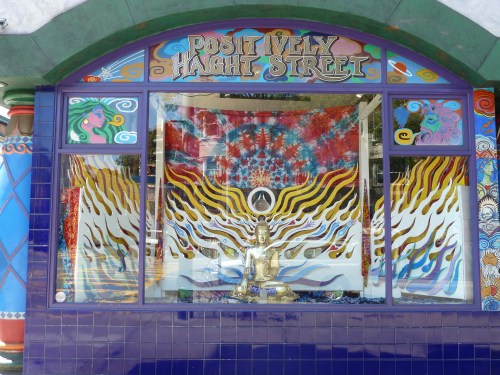
We were stood on the corner of Waller and Stanyan, alongside the McDonald’s parking lot and opposite the historic Stanyan Park Hotel. It was 10.20 on a sunny if cool Saturday morning in April. The shops in Haight Street a block away were drowsily coming to life, and a gaggle of skateboarders and assorted “heads” were making their way over to Hippie Hill in Golden Gate Park to hang out for the day.

After ten years of inexplicable resistance, we had finally decided to give the Haight-Ashbury Flower Power Walking Tour a try. Having read our e-mail confirmation carefully we were confident that we were at the appointed meeting place. But the time was beginning to concern us. Whilst both our e-mail and the official website had expressly stated that the tour began at 10.30am, we had collected a leaflet the previous day quoting 9.30am.

As 10.25, 10.30 and 10.35 passed without anyone joining us, we began to speculate on what might have happened. Was it really a 9.30 start and we were horribly late? Had the tour been cancelled because we were the only participants (and if so why hadn’t we been informed)? Or was the guide merely delayed? I rang the telephone number quoted on the e mail with no success.

As frustration turned to irritation at 10.40, a balding, middle-aged man approached us and enquired whether we were on the tour. He had received a telephone call to say that the guide was running late due to a burst water main near her flat.  A Kentuckian, he was accompanied by his 20 year old daughter, as well as his son and his girlfriend, both of whom were studying at San Francisco State University.

Five minutes later our ears were assailed by a cheery “good morning” emanating from behind us on Waller Street. On turning around we were greeted by a diminutive woman dressed from head to toe in black, apart from the psychedelic leggings flashing intermittently from beneath her huge coat, shuffling towards us. This was Izu, our guide for the next two and a half hours. My heart soared (I may have been alone in this reaction) – here was someone who had palpably lived and breathed the hippie dream in the sixties and, equally importantly, was still doing.  This was going to be fun – and I was not to be disappointed.

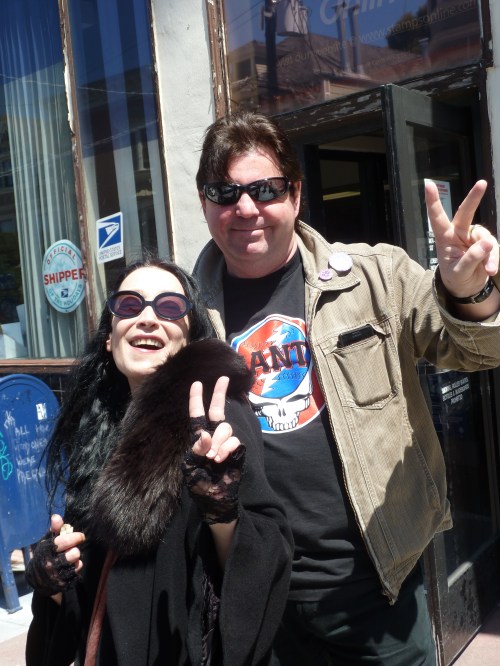
Having made her apologies, referring, not for the only time, to “hippie time”, she squealed with delight at the sight of my Grateful Dead “Steal Your Face” t-shirt. We were instant soul mates and, given my familiarity with the history and music of the era, she regularly sought my input, which, whilst being very gratifying personally, might have annoyed the remainder of the group who weren’t as well informed beforehand. The son’s girlfriend spent most of the morning hiding behind his back and when gently challenged on this by Izu, insisted that she was not feeling well. I’m not convinced she wasn’t just a tad intimidated by Izu’s earnest, energetic approach.

Izu’s credentials to conduct this tour were impeccable. She  had lived in the Haight for a month during the Summer of Love, and despite returning home to New York immediately thereafter, had been resident in the neighbourhood for many years.

One of her most endearing traits was that she had retained her broad New York accent which, incongruous though it might seem, gave an added charm and piquancy to her feast of anecdotes. I particularly delighted in her repeated pronounciation of Haight-Ashberry, proclaimed in a manner that could be heard from several blocks in any direction. 

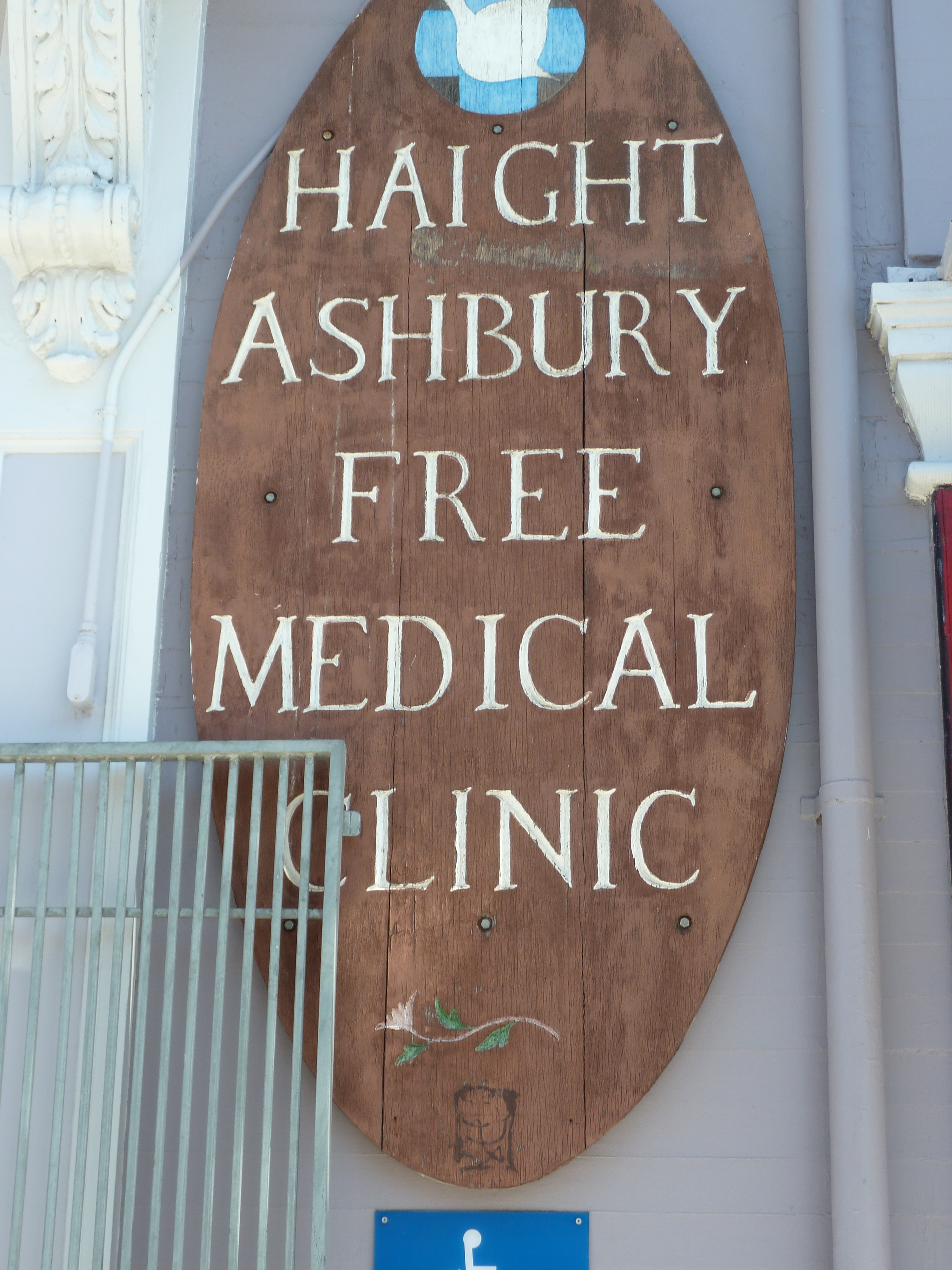
Armed with our free gift of a Haight-Ashbury Flower Power Walking Tour button badge we set off down Waller Street, pausing at the SFFD’s Fire Station 12 which, uniquely, carries the Grateful Dead “Steal Your Face” logo on its engines. We learned too about the Human Be-In, the influx of young people from all over the United States and the invaluable social service provided by both the Diggers and the Haight-Ashbury Free Medical Clinic.

Whilst we stopped at properties that had been lived in by such counterculture luminaries as Janis Joplin (several), Country Joe and the Fish and Jimi Hendrix, as well as Charles Manson, the highlight for me was the Grateful Dead house at 710 Ashbury. Now, I have stood outside this pad many times but, with Izu at my side, I didn’t feel as uncomfortable, as much of a stalker, as I had done before. It helped that Izu knew both the current tenants and their neighbours – well, actually, she appeared to know everybody in the vicinity! We barely passed a shop, café or homeless center without her stopping to hail its occupants.

Whilst I went along with every photo opportunity arranged by Izu, I did draw the line at taking one of the Haight-Ashbury sign – been there, done that, not cool. I think we fell out briefly at that point!

Many San Francisco walks are more like hikes, especially when they involve negotiating its unforbidding hills, but this one is leisurely and laid-back. We barely walked more than 100 yards before Izu asked us to gather round to listen to her stories, not only of the music scene but also the general history of the Haight. She was aided by a canvas shopping bag, from which she intermittently plucked vintage photographs.

The tour culminated in a visit to the recently opened Haight Ashbury Museum of Psychedelic Art and History, a center designed to showcase the arts, music and creativity of the era. Depending upon your point of view, it was either impossibly cluttered or incredibly comprehensive. Izu alerted us to historic posters, photographs and newspaper extracts from the hippie Haight.

The slogan of the museum is The Hippies Were Right!, a mantra repeated by Izu throughout the tour. As the (larger) badges extolling this theory illustrated, this relates to concern for the environment, emphasis on organic products, peace and love rather than war, sustainable housing and fuel efficiency, and, capping it all, “more fun and less unnecessary work”. I for one find it hard to argue with any of that.

The tour ended with heartfelt hugs outside the museum and clichéd, but utterly necessary, poses for the cameras.

In summary, this was a relaxing and thoroughly entertaining walk. In fact, the word “walk” doesn’t adequately describe it. It was a “show” in which Izu, in her inimitably animated, slightly wacky style, conveyed a vast amount of information and observation on both what was arguably the neighbourhood’s golden era and how those ideals are being implemented today.

Anyone who is deterred by the prospect of becoming preached at on the virtues of free love and rampant drug taking should really not be worried. Whilst Izu, inevitably, relates stories of excessive LSD, marijuana and heroin usage, she takes every opportunity to explain her vehement opposition to drugs. Nor does she gloss over the many unsavoury elements of the period.

So go with an open mind and you will be rewarded. But first listen to some live Grateful Dead or Jefferson Airplane whilst you are searching for that old kaftan, transfer a few flowers from your garden to your hair, throw on any piece of jewellery you can find, get on the bus and make your way up to the corner of Waller and Stanyan on a Tuesday or Saturday at 10.30am (yes, that’s 10.30am hippie time).

And remember…………….the Hippies Were Right!


Finally, after a pre-season match against the Oakland A’s in 2008 and a rain-curtailed “friendly” against the Seattle Mariners two years later, I made it to my first two Major League Baseball (MLB) games at AT & T Park for the opening weekend of 2012.

On Saturday evening the San Francisco Giants entertained the Pittsburgh Pirates in the second of a three game series, and then hosted the Philadelphia Phillies in the opening game of three on Monday evening.

This is not a match report on either game, though I will briefly outline  the action. It is more a series of impressions on the baseball experience.

So – the figures. On Saturday, the Giants squeezed out a 4-3 victory in the ninth after trailing both 2-0 and 3-2 earlier in the game. CRedit should go to much-maligned, and many believe, grossly overpaid, starting pitcher, Barry Zito’s second quality performance at the start of the season.

A disastrous first innings by star pitcher, Tim Lincecum, in which he gave up four runs, meant the Giants were always chasing the game against the Phillies’ Roy Halladay. Despite Buster Posey’s three hits and improved pitching by Lincecum and the bullpen, the deficit was too much for Giants to pull back, eventually losing 5-2.

One win and one defeat, not altogether unexpected, so I’ ll take that.

Although we had already printed our tickets at home back in the UK, we wanted to get to the ballpark well in advance of Saturday’s 6.05pm first pitch. We disembarked from a Muni Metro car at 3rd and King at around 4.30pm, just in time to be welcomed through the turnstiles with a large number of equally excited fans, most wearing the Giants’ orange and black colours.

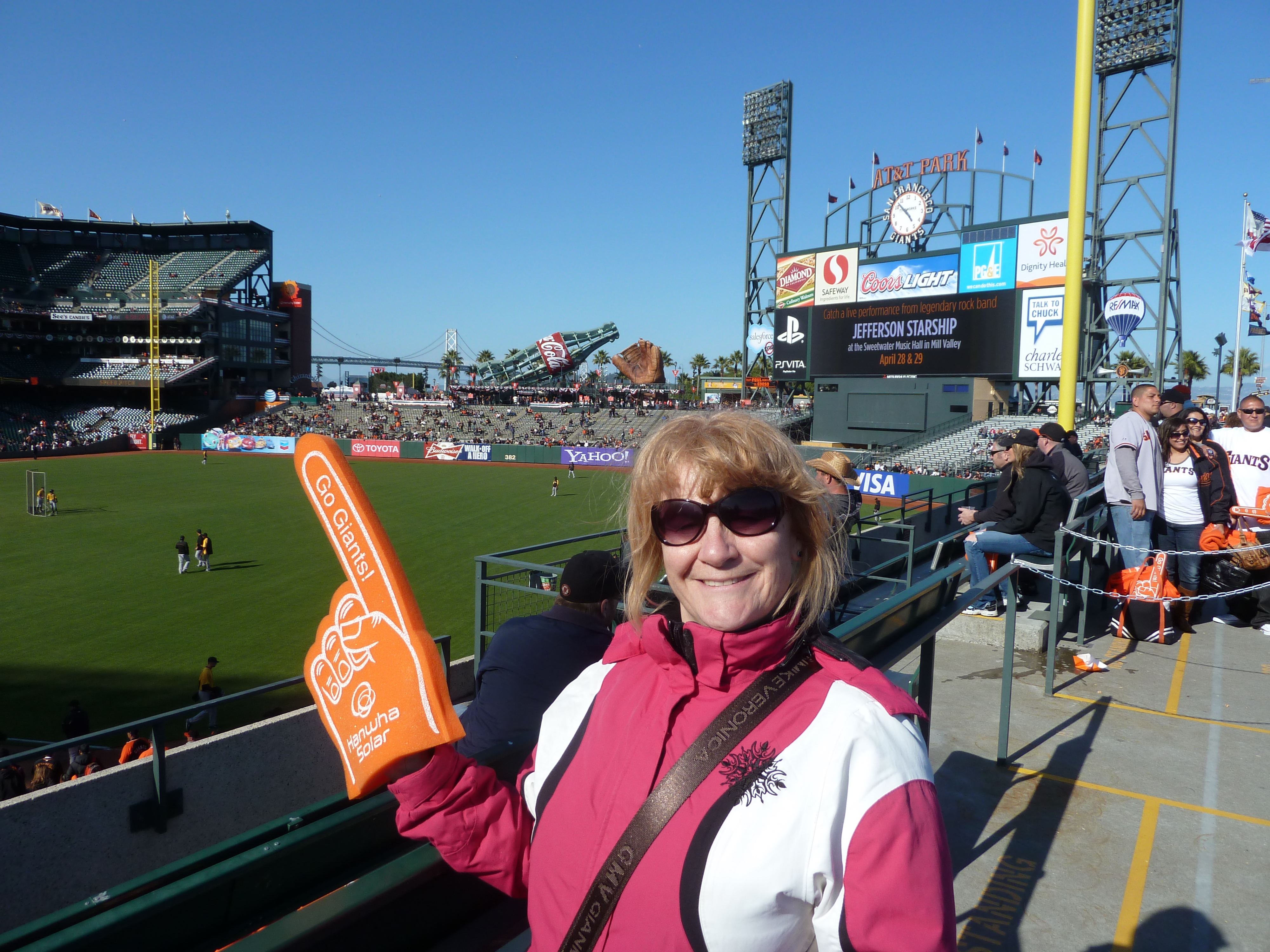
One of many reasons for wanting to get to the park early was that it would guarantee us securing the day’s free gift on entry. Although on Saturday this was a rather modest foam finger, the use for which is modelled in the photograph below, we received a far more elegant A5 size Giants 2012 schedule fridge magnet at the Phillies game. This was the first of a host of fan-oriented activities on both nights.

And it is this emphasis on ensuring that the spectators, especially families, have a memorable experience at the ballpark that is so impressive about American sports in general, and the San Francisco Giants organisation in particular, and which I want to concentrate on in this article.

Amongst the other gifts scheduled to be handed out at future home games during the season were bobbleheads of the most popular players, including Sergio Romo, Madison Bumgarner and Pablo Sandoval, a Brian Wilson gnome, a Matt Cain t-shirt, fedoras, knitted hats, texting gloves (sic), trading cards and caps. Some of these are limited to the first 20, 25 or 40 thousand fans through the turnstiles, one of many clever marketing ploys to get the spectators eating and drinking early inside the stadium rather than at the bars and restaurants around the “yard”.

For children aged 14 and under, they would be greeted at selected games with snap watches, rope necklaces, and Super Hero capes. Many of the above gifts were presented by companies such as Subway, See’s Candles, Comcast Sportsnet Bay Area and PG & E.

And then there would be the games that celebrated past glories such as the “Turn Back the Century Game – 1912” and the 2010 Giants World Series Team Reunion. On another day Virgin America would be providing two for one flight vouchers for all fans.

And it still doesn’t end there!

San Francisco is renowned for its commitment to diversity, demonstrated in a range of festivals and street fairs throughout the year that showcase its ethnic communities.

And the Giants play their part. Certain games are designated “heritage nights” where the culture and history of peoples that have played a key role in the history of the Bay Area is celebrated. The list includes Chinese, Japanese, Korean, Mexican (Cinco de Mayo), Irish, Jewish, Italian, Polynesian, African American, Filipinos, and, this being San Francisco, the lesbian, gay, bisexual and transgender (LGBT) community.

And then there are the games that are dedicated to firefighters, law enforcement officers, masons and even singles! And, again, it wouldn’t be San Francisco without a series of food festivals, including one where leading chefs from around the area set up stall and offer their wares at a fraction of the price that one would pay in their restaurants.

Once inside the stadium, the off-field entertainment, both before, during and, on occasions, after, the game, is excellent. In the lead up to the start of the Pirates game, the crowd was treated to Jefferson Starship ripping through their – or rather Jefferson Airplane’s – catalogue of classic songs, including Somebody to Love and White Rabbit. They returned to lead the traditional pre-match rendition of the American national anthem – not perhaps their finest hour, but I doubt the great majority of the crowd, wrapped in the emotion of the moment, were too concerned about that.

Although the breaks between innings in a ballgame are rarely more than a few minutes, the gaps are filled invariably with quizzes, competitions and interviews played out on the large screen / scoreboard, with yet more prizes and special offers available to the lucky fans. The middle of the seventh community singing of Take Me Out to the Ballpark is another tradition that raises the crowd’s spirits, even if the Giants are faltering.

Perhaps the most popular moments are when the camera scans round the crowd to hone in on unsuspecting couples whose duty it is then to kiss each other in front of 41,000 other people. These bring huge cheers, notably when a chaste peck turns into a more passionate clinch. On more than one occasion I wondered whether the “victims” had ever kissed before, might even be on their first date, such was the embarrassed on some faces. But most carry it off with good humour.

The antics of Lou Seal, the Giants’ larger than life (particularly around his midriff) mascot, contribute to the party atmosphere. A feisty character, his finest moment is when he strides and struts on the roof of the Giants dugout, leading the ninth innings rallying cry of Dont Stop Believin’ by Journey, which has become the team’s unofficial anthem since the World Series season of 2010. And it had the desired effect in the Pirates game in inspiring the team to pull round a 3-2 deficit to secure a walk-off win in the bottom of the ninth, adding a triumphant note to the spectacular fireworks display at the end.

Oh….and there’s always a baseball game going on if you get bored with all the ancillary entertainment!

I shall now turn to the other visible demonstration of the fan-friendly approach that epitomises the Giants organisation – the provision of refreshment.

For anyone unfamiliar with American sports, and, as a result, erroneously supposing that the food and beverages at venues barely extend beyond Coca-Cola, Budweiser, hot dogs and hamburgers, would be astonished to see the variety and quality on offer at AT & T Park.

Amongst the dozens of outlets at the stadium are California Cookout, Clam Chowder, Crazy Crab’z, Mission Creek Cantina, Cinnamon Roasted Nuts, First Base Carvery, McCovey’s 44 BBQ, Gourmet Sausages, Tres Mexican Kitchen, Long Taters Baked Potato, Doggie Diner, Haagen Dazs, Outta Here Cheesesteaks, Pier 44 Chowder House, Say Hey! Speciality Sausages, Port Walks Pizza, Ghiradelli, Mashi’s Sushi Bistro and Edsel Ford Fong’s. Some of these have multiple stands.

But the crowning glory, the signature dish, the product singularly responsible for the unmissable, pungent aroma of the ballpark, apart from on Grateful Dead Day when it is overpowered by the heady waft of dope, are Gilroy’s garlic fries, served up in generously filled trays at many of the aforementioned stands. These are the must eat” option, not only for the human visitors but also for the savvy seagulls that swoop and hover over proceedings in the latter stages of the game.

And yes, of course, soda and beer dominate the drinks scene, but this is San Francisco and elegant dining is available too, as witnessed by the Francis Ford Coppola wines my wife and I gravitated towards on both evenings.

My only quibble with all this eating and drinking – which clearly provides the Giants organisation with massive income – is that it is so enjoyable that a significant proportion of the sell-out crowds that flock to every game feel the need to keep going back for more – and more – and more – during the actual game, meaning that they miss a not inconsiderable part of the play. If you have the misfortune to sit behind someone who is constantly getting up out of their seat to stock up on yet more food and drink, it can be very annoying.

Now, I like a drink and something to eat when I watch football, cricket or baseball, but not at the expense of missing the play. I will get that out of the way before the game, or, occasionally, during a scheduled interval in play, such as half time in football. After all, I am there for the game, no more, no less.

But baseball, with its short breaks in play between innings, doesn’t allow one to do that. There is no lunch or tea interval as in cricket, where you may have between 20 and 40 minutes in which to satisfy your hunger or thirst.

So I do understand, not only the urge, but also the compulsion to eat constantly during the game, particularly when the fare is so tasty. And if you have children badgering you for a hot dog, coke or ice cream, during the play, it’s hard to resist.

But for some people, and not necessarily those with families, the actual game appears almost incidental – or rather that it is no more than a part of the overall experience or the excuse for attending a foodie extravaganza.

By the end of Saturday evening when we sat in section 324 View Reserve Infield, overlooking from the clouds (if there had been any) third base, I wondered whether I had been the only spectator in my block who could honestly claim that they had seen every single ball pitched during the game. Even my wife had had to make a call of nature (your fault Mr Coppola – who was at the Phillies game) during the seventh innings!

That said, I was one of the first in the extensive queue for the gentlemen’s restrooms at the end!

By way of contrast we sat in section 135 Lower Box Infield, immediately to the right of the bleachers on Monday evening and the “problem” was almost non-existent. The higher you sit in the stands the more likely you are to have people leaving their seats obscuring your view.

The situation would be worse – if that is the correct word, if it weren’t for the army of incredibly hard working vendors of hot dogs, cotton candy, ice cream and beer that flit amongst the crowd from beginning to end. Their energy, good humour and efficiency are a sight to behold.

Lessons to be learned for future visits?

1. If it’s a night game in spring or autumn (or summer for that matter) take a blanket. Although both evenings were clear and relatively still, it became decidedly chilly when the sun went down.

2.Choose seats at a lower level than section 324 – few fans struggled to make it back to their seats without pausing for breath. More chance of catching a ball there too.

3. Take more photos to supplement my report. This article  would certainly have benefited from that.


We hadn’t intended to ski this year.

And we didn’t.

But between those two statements lay a four month long gallimaufry of resolution, indecision, confusion, excitement, frustration, relief, misery, hope and resignation.

Following last year’s trip, our seventh, to Heavenly ski resort on the southern shore of Lake Tahoe, we decided to give skiing, at least in the USA, a miss this year, and perhaps even next.

But as the British summer shrugged its way into autumn, and our equal determination not to visit San Francisco this year,  dissipated, the prospect of not skiing at all became increasingly unpalatable.

With a major holiday planned for later in the year, we could not afford – in both senses of the word – more than two weeks away. We arranged, therefore, to spend a week in an apartment in San Francisco, drive up to Tahoe for four nights, skiing for three days, before returning to the city for the final weekend prior to flying home. Flights and accommodation were duly booked in the New Year, the lateness of which illustrated how we had prevaricated about going at all.

I have written elsewhere that my wife and I are “fair weather” skiers, liking nothing better than cruising perfectly manicured trails in warm spring sunshine. With that in mind, we booked to ski Heavenly between Wednesday 18th and Friday 20th April inclusive, providing us, we hoped, with a felicitous combination of good weather and a healthy accumulation of snow (2011 had been a record year).

So we were “sorted”, looking forward to what was fast becoming our annual American skiing fix.

Or so we thought, for that’s when it all started to unravel.

In deciding to ski late in the season, we’d given no thought to when the resort might be closing. After all, last year it had remained open until early May and only a few days prior to that the previous year. We were not only going to enjoy wonderful weather and spring conditions but would also get some great end of season bargains in the shops. 

I suppose we should have seen the warning signs earlier in the season as snowfall had been uncommonly sparse, weeks passing with barely a single natural flake bedding down with the undeniably impressive but limited layer of artificial snow provided by the resort’s convoy of groomers. Much of the skiing terrain remained closed.

But even at the end of February there appeared to be no cause for concern. Major storms were surely lining up out in the Pacific, ready to deposit the white stuff soon enough. And Heavenly would be prepared to stay open as long as possible to compensate for the relatively poor conditions of December through to March. Wouldn’t it?

How wrong we were.

Firstly, we discovered that Heavenly had planned all along to close on Sunday 15th April – nearly three weeks earlier than last year and, more alarmingly, THREE DAYS BEFORE we were due to arrive! A succession of frantic e-mails, Facebook and Twitter messages over the next 24 hours confirmed this to be the case.

At least we had not incurred great expense at this stage – just the first night’s accommodation, which could be cancelled up to 72 hours before arrival anyway. Unusually (we must have known), we had not booked our lift tickets and we would not obviously have hired equipment until we were in the resort.

But what were we going to do?

I devised eight alternative options for the middle leg of the vacation. These included remaining in San Francisco, driving down the coast and spending nights in San Luis Obispo, Carmel and Monterey, or in the opposite direction via Mendocino and Bodega Bay, even still travelling to South Lake Tahoe but amusing ourselves in other ways.

But the thought of not skiing at all, when the conditions were likely to be the best they had been all season, was too painful to contemplate. And, of course, you guessed it – by this time, those slothful storm systems had swung into town with a vengeance, depositing seven feet of snow in a week!

Having decided that we had, if we could, to ski somewhere, we found ourselves forced into doing what we had often spoken about but never got around to doing before – slide down some other slopes than Heavenly’s.

So perhaps it was all a blessing after all – provided we could find other resorts that were open whilst we were in the area.

The next few weeks were spent anxiously trawling the websites of, and sending e mails to, Sierra-at-Tahoe, Kirkwood, Homewood, Alpine Meadows, Sugarbowl and Squaw Valley to establish what their closure plans were.

Whilst, in one respect, we were now becoming increasingly excited at the prospect of skiing elsewhere, this threw up several practical issues. For example, if we were to ski near the north end of the lake, we would need to find alternative accommodation, and it was extremely limited in some resorts, particularly at such a late stage. We would also need to take a different route to the one we were accustomed to to get to the lake.

The fact that we would be skiing only a day, possibly two, at a new resort would also mean we would be unfamiliar with everything there – the terrain, transport, equipment hire and so on  – to the extent hat we might not derive much enjoyment from it.

But beggars can’t be choosers, and, after all, it meant we could ski.

And then……Heavenly decided to extend its season!

Great!

We could now avoid all the complications of staying and skiing elsewhere and return to our familiar, much loved Plan A of skiing in Heavenly for three days.

Or so we thought.

Rather than extending by a full perhaps two, to allow its customers to enjoy the fresh snow, the resort proposed to close as planned on 15th April and reopen for the next two weekends only (Friday to Sunday inclusive). The upshot of this would be that we would have ONE day in which to ski!

Again we considered different scenarios, including skiing only on the Friday, our last day. Better than nothing.

But we rather liked the idea now of skiing somewhere else too, and plumped for a day at nearby Sierra-at-Tahoe.

Now, neither of us had been fully fit in our last couple of days in San Francisco, suffering from sore throats, coughing, headaches and general tiredness. So we decided that two days skiing would be sufficient.

The final plan now went like this. As it was conveniently located just off the I-50, we would call into Sierra-at-Tahoe on our drive from San Francisco on Tuesday and familiarise ourselves with the resort. We would then take our first full day off and perhaps drive to Carson City, before skiing at Sierra on Thursday and Heavenly on Friday.

What could now go wrong? After the twists and turns, and mangled emotions, of the past three months, we were going to be skiing for two days, one of which was going to be at, for us, a new, exciting resort, and the forecast was for brilliant blue skies and warm temperatures.

Well, one three letter word ending in a vowel was about to be replaced by another and destroy those plans. 

Flu.

On the journey to South Lake Tahoe, we both started to deteriorate dramatically, to the extent not only that we abandoned the diversion via Sierra-at-Tahoe, but that we were only able to leave our room – reluctantly – in the next 48 hours to stock up on pharmaceutical supplies (and the occasional Starbuck’s). Dinner on our first evening consisted of a $1 packet of Dorito’s from the vending machine along the corridor.

It was only the last – fourth – night that we were both able to do any justice to an evening meal when we dragged ourselves to the Hard Rock Café in our hotel. Even then, we had had to cancel our reservation beforehand at the Riva Grill. We did manage, however, to drive around the lake during the day, as the last post testifies.

We had both been so debilitated during our stay that walking alone proved a challenge. As much as we wanted to, we could not have skiied. 

At least we saved on meals, ski hire and lift tickets  – although the colourful cocktail of pills, infusions and liquids – enough to have taken the weight of our baggage over the allowance had we been flying back to San Francisco – were not cheap!

We hadn’t intended to ski this year.

And we didn’t.