Feeds:
Posts
Comments

It was March 2002, a mere half year since that brilliant, terrible morning in New York City that changed our lives forever. The world, and especially the United States, remained in a state of anxiety and foreboding about the direction in which it was moving.

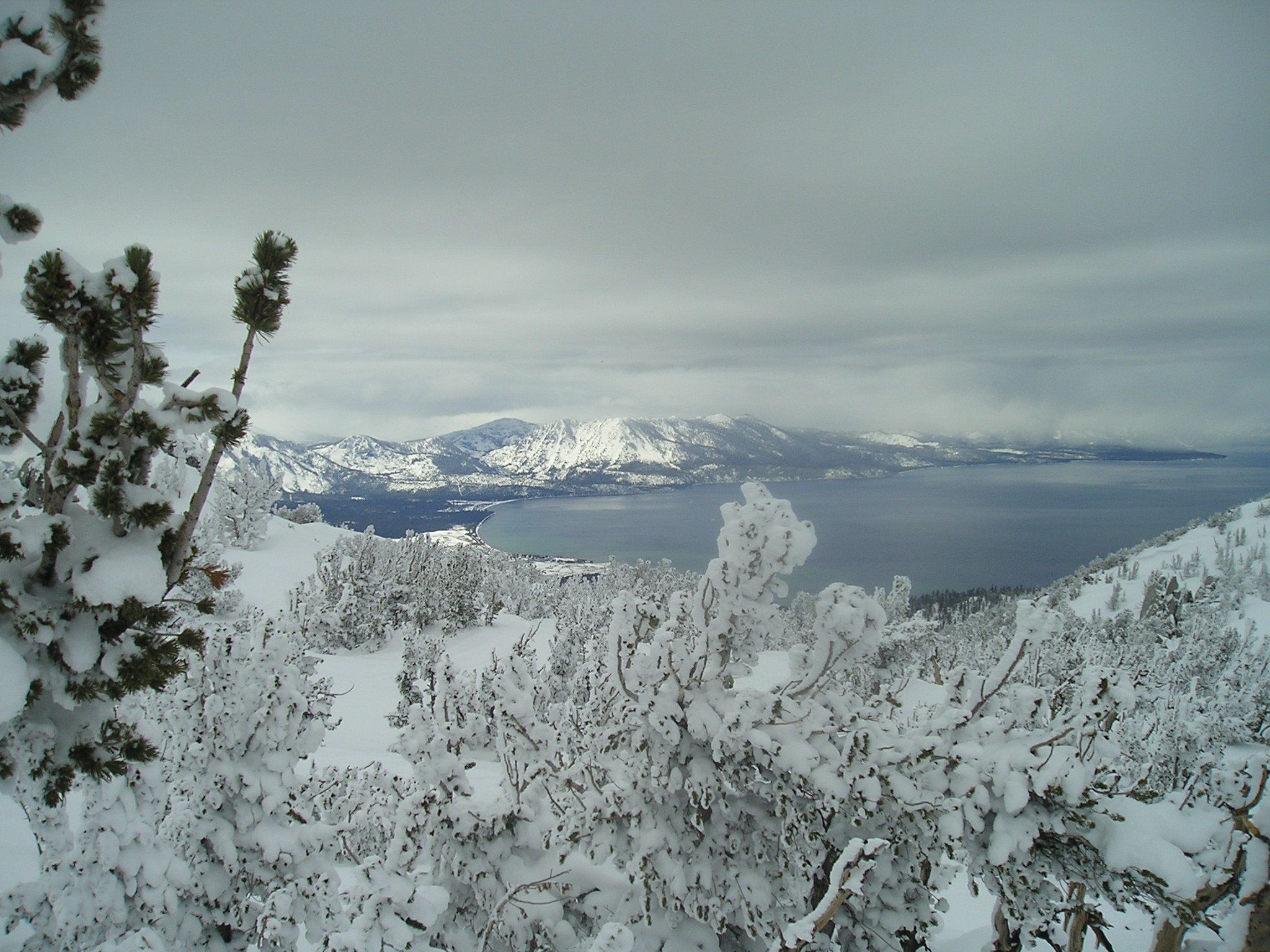
Security was tight, therefore, as we landed at San Francisco International Airport on a damp, dismal Tuesday afternoon.  With an eleven hour flight and early check-in, we had been travelling already for eighteen hours. We were already regretting the decision to drive the 180 miles direct to South Lake Tahoe that evening for our holiday in Heavenly ski resort.

After dragging our heavy luggage from the arrivals hall to the car hire centre at the far side of the airport, we were informed that a large storm was approaching Tahoe, and advised that we should seriously consider upgrading to a 4×4 vehicle.  Whilst subsequent experience has taught us that this is a regular ploy to extract a significant chunk out of our holiday spending budget before we have even left the terminal, this appeared a more plausible scenario on this occasion.  However, we declined the upgrade but collected our obligatory snow chains before searching for our car.

We drove away from the airport at around 4pm, the beginning of the evening commute, just as the rain that had been threatening since our arrival set in.  Experience had taught us that rain at this level meant snow at much higher elevations.  How would we be able to attach the snow chains to the car?  We had never done it before.  And when would we know it was the right time to do so? Fortunately, at a small price (this is America after all), these decisions were made for us later in the journey.

The run to the Bay Bridge was frenetic, and, as the rain got heavier, so did the traffic.  Our wipers were working overtime through the stretch of the I-80 from the Oakland end of the bridge past Emeryville, Albany, El Cerrito, Richmond, Vallejo, Bernicia, Fairfield, Vacaville, Dixon, Davis and all the way to Sacramento when we joined the US 50.  Between Folsom and Placerville the incessant rain turned to sleet and then full-blown snow, obscuring the intermittent views of the Sierra Nevada mountains that we would customarily enjoy.

The road narrowed from a relatively straight freeway to a constantly twisting single lane, and the tyres struggled to cope with the ever-thickening snow.  As quickly as they had created a groove it was covered over again, awaiting the next vehicle to attempt to carve through it.  We had only, in terms of distance, a sixth of our journey left, but we feared that this would be the most challenging and potentially frightening part of the journey.

OLYMPUS DIGITAL CAMERA

We passed a handful of “lookouts” with their signs warning of “snow removal equipment” and of snow chain installers at work. It was only, however, when we reached the distance marker denoting that South Lake Tahoe was twenty nine miles away, that we were brusquely hailed down by the abominable snowman who installed the chains efficiently if a little grumpily. We may have been another $20 light but a small measure of reassurance had been restored.

After all, it was “only” twenty nine miles wasn’t it?  How bad could it be?

We’d negotiated steep mountain passes in the Alps before, hadn’t we? Of course we had, piece of cake then.

Oh, but hold on a minute, we’d been sat on a coach whilst an experienced native of the region took the wheel. Not so simple then.

Yes, but, once this was over, we had a hot meal and a stiff drink awaiting us on our arrival in South Lake Tahoe. And just think how exciting it will be to ski on all this fresh powder tomorrow morning.

British stiff upper lips notwithstanding, we both silently fought our fears.

The snow was now pounding against the windscreen, at least that is what we assumed was accounting for the only sound assaulting the silence high in the mountains. The intermittent cracks in the white darkness, were the headlights of oncoming trucks hurtling past in the opposite direction. The drivers had seen it all before.
OLYMPUS DIGITAL CAMERA

Although we could hardly have been moving more slowly, no other vehicle passed us on the entire journey. There had been seven others at the lookout when our snow chains had been installed. Where could they have gone? There was no other road to take. Perhaps they had given up for the night – something we had not for one second contemplated, however bad it got, because that would have been even more dangerous.  We had to press on – we may have been doing barely ten miles an hour at this point, but every rotation of those snow chained gripping tyres got us a little closer.

We may not have been able either to rationalise or articulate it in such terms at the time, but we had both adopted an, at least outwardly, calm, practical demeanour – Janet maintaining a steady, straight course, building fresh, deep grooves in the snow whilst I, as much by intuition than calculation, assessed our proximity to the side of the road, instructing her to make slight adjustments to the car’s position as necessary. Hearts skipped a beat every time I recommended a small movement to the middle of the narrow road just as a truck sped past, or what seemed, directly at, us!

The alternative was worse. The slightest twitch to the right would have had us plunging into the Eldorado National Forest. The sporadic fencing would not only have failed to prevent our fall, but also it was not visible as a guide to our proximity to the edge.

Height markers were barely decipherable on the hairpin bends, though we managed to make out Strawberry at 5,800 and Camp Sacramento at 6,500 feet respectively, providing comfort that we were closing in on the highest point of Echo Summit at 7,377 feet.

But our journey was not over. The snow chains had done their job so far, but now we were beginning our steep descent towards South Lake Tahoe.  Would the brakes work?  Would the chains grip the road sufficiently to prevent us running away?  Again, these thoughts went simultaneously through our minds, though nothing was spoken other than the now customary “steer slightly towards the middle” and “keep straight” admonitions from the passenger seat.

Our unease was unwarranted.  The chains performed impeccably as we descended smoothly towards our destination, braking at regular intervals.  The final challenge was to negotiate the steep, twisting hill that drops down to the lake basin. Relief, even euphoria took hold as the “Y”, the intersection between South Lake Tahoe Boulevard and the continuation of I-50 up the western side of the lake came into view.  Never had we been so grateful to see the welcoming neon of McDonald’s and Starbucks.

OLYMPUS DIGITAL CAMERA

During the descent the snowfall had relented, and the home straight into Stateline was just wet.  That final twenty nine miles had taken four hours to negotiate which meant that, by the time we had checked into the Embassy Suites resort, there was no hot food available.  But after 25 hours travelling we were too weary to venture out, so decided to just have a drink before retiring.

Over a glass or two we spoke for the first time of our ordeal, and how composed and worried at the same time we had been. We resolved that we would make tomorrow our non-skiing day.  As it happened, that decision was academic as the four feet of snow and high winds closed the resort anyway, allowing us to spend the day recovering and re-acclimatising ourselves to the area.

This was not to be the only harrowing experience of this particular holiday, though the week’s skiing went relatively smoothly after that. We have made the same drive six times since that night, but, sensibly, only during the day after a night’s rest in San Francisco.  And the weather has, ironically, been fine on each occasion.

But there’s always the next time.


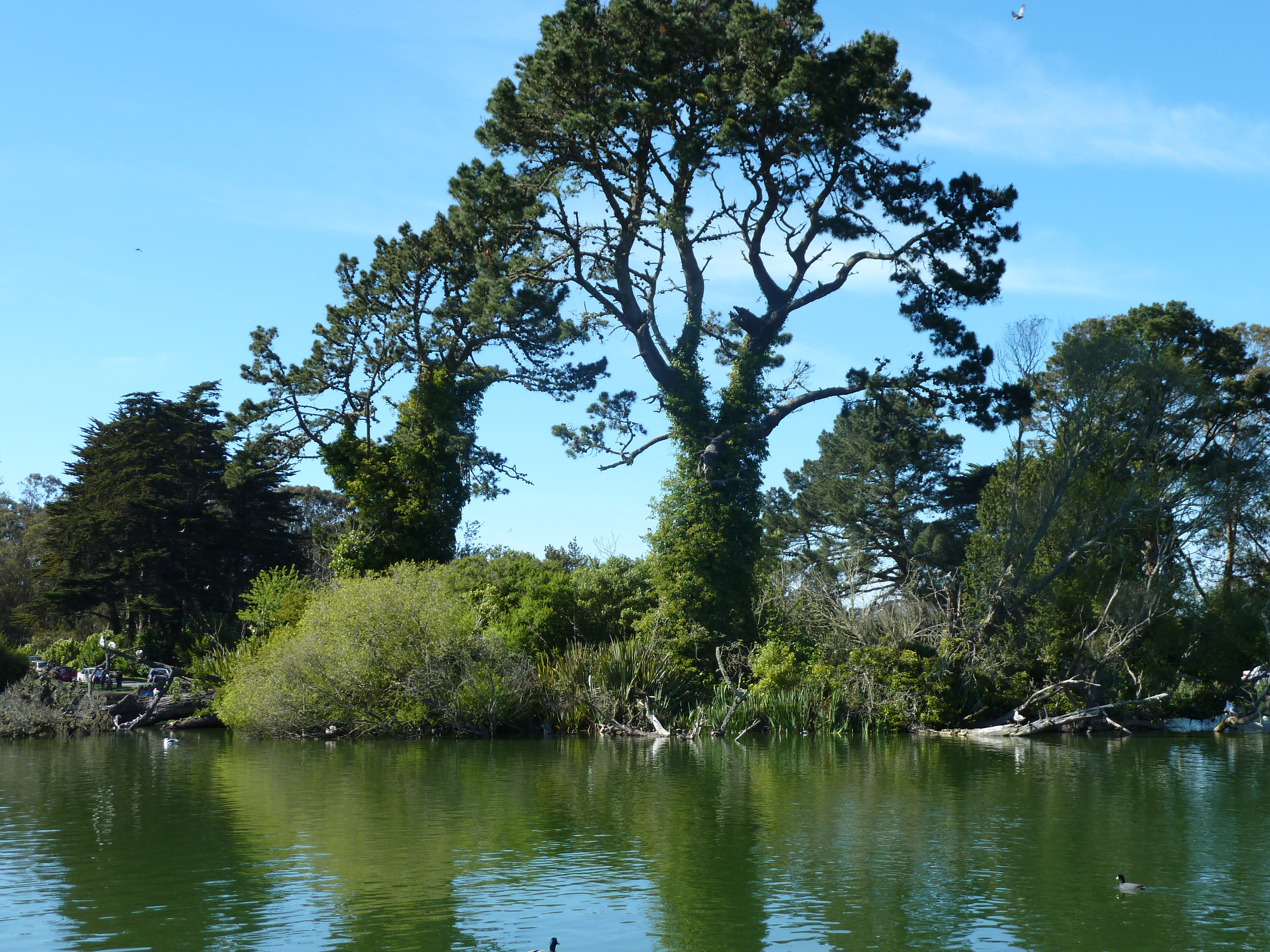
There are few more relaxing spots in which to while away an afternoon in San Francisco than the man-made Stow Lake in the centre of Golden Gate Park.

It’s frequented more by residents than tourists who are rather drawn to the heavily promoted, and undeniably impressive, adjacent attractions of the de Young Museum, California Academy of Sciences and Japanese Tea Garden. Yet it is only a few minutes walk away.

We stumbled upon it purely by accident on our second trip to the city thirteen years ago. Venturing west from those headliner venues, you quickly come across a pathway and stairs that lead to the south side of the lake. In the dense trees on the island opposite you soon encounter the charming Chinese Pavilion, a gift from the people of Taipei, shipped in 6,000 pieces and reassembled in 1981.

As you stroll along the path that encircles the lake you gain an immediate impression of both serenity and bustle. Young families, pushing strollers and trying to contain excited children, compete with joggers, dog walkers and cyclists for the narrow path. Ducks, gulls and other bird life glide along the placid surface, scanning for potential feeding stations wherever humans congregate by the water.

For now, pass the rustic stone bridge on your right and continue along the path  that leads to the boathouse where you will be able to rent paddle boats, row boats – new, I believe, this year – bicycles, and in-line skates. Restrooms, picnic tables and a surprisingly well stocked snack bar greet you here also. Indeed, it has the distinction of being the first place in the U.S. where I tasted a vegetarian hot dog (whilst Janet ate ice cream!).

On a bright day you may be lucky enough to observe a row of turtles sunbathing on the rocks and logs alongside the boathouse.

For the more adventurous there is the short but relatively steep hike up to Strawberry Hill, the 430 foot high artificial island in the middle of the lake, which rewards you with fine, slightly tree obscured views across the western part of the city, and even as far as the Farallone Islands 26 miles out to sea.

You can either retrace your steps from the boathouse and access the island across the stone bridge, or you can approach it by crossing the second “Roman” bridge which appears shortly in the opposite direction. Be sure not to miss Huntington Falls which cascade down into the lake close to the Chinese Pavilion.

Encircling the entire lake and climbing Strawberry Hill amounts to around two and a half miles.

So if you want a few hours respite from the frenetic environs of Fisherman’s Wharf, Chinatown or Union Square, take a bus out to Golden Gate Park and visit Stow Lake, grab an ice cream and paddle gently for an hour in the civilising company of ducks and turtles.


It’s four months now since I entered my sixtieth year on this blessed, blasted planet. In fact, 2012 is a rare year for major anniversaries – the Queen’s Diamond Jubilee, the bicentenary of the birth of Charles Dickens, the five hundreth anniversary of the death of Amerigo Vespucci, the centenary of the sinking of the Titanic and last, and definitely least, there’s lil’ ol’ me.

So how do you “celebrate” such a feat of stamina? Big family party? Trip of a lifetime? Crawl into a corner and curl up into a ball? Well, my 40th was spent in Amsterdam and my 50th in Paris, whilst my wife’s corresponding birthdays were played out in Paris and Venice respectively. Bit of a clue there then (though Janet also wangled a not inexpensive party for the latter in the boardroom of the local football league club)!

But I think you get the picture – we’ll be spending it somewhere other than home.

Janet has been “encouraging” me for months to decide where I wanted to spend the occasion. Unfortunately, I am no nearer making that decision than I was on my 59th birthday, though I have narrowed it down to a handful of candidates (feels a bit like I’m deciding on where the next but one Olympics or football World Cup will be held).

One trip that has been on my wish list for much of the past decade is what is known as the “Blues Highway”, effectively tracing the migration of blacks from the deep south to the north following the Civil War, and, in the process, reliving American musical history.

The tour starts in New Orleans, with extended stops at Nashville, Memphis, St Louis and eventually Chicago. Visits to such iconic venues as Graceland, Sun Studios and the Grand Ol’ Opry, would be essential, and we would also want to sample cajun and zydeco music in their locales.

A tour through blues history would not be complete without a pilgrimage to Moorhead, Mississippi where the Southern crosses the Yellow Dog or Dawg, the spot where the “father of the blues”, W.C. Handy, heard “the first blues song” in around 1903, or the crossroads (there is much dispute as to its location) at which the “king of the delta blues singers”, Robert Johnson, apocryphally, sold his soul to the devil. And an evening at the Ground Zero Blues Club, owned by Morgan Freeman, in Clarksdale, Mississippi would not go amiss.

But in August 2005 Hurricane Katrina put a temporary end to that dream.

The other front runner at present is the national parks and canyons of the American south west, notably Monument Valley, Bryce and Zion Canyons, the Arches and Canyonlands. Even this trip would have some musical resonance for me in the form of the great Jackson Browne / Glenn Frey song Take It Easy, popularised by The Eagles:

Well, I’m standing on a corner

In Winslow, Arizona

And such a fine sight to see

It’s a girl, my lord in a flatbed

Ford, slowin’ down to take a look at me

Come on baby, don’t say maybe

I gotta know if your sweet love

Is gonna save me

We may lose and we may win though

We will never be here again

So open up, I’m climbin’ in

So take it easy

When I first started to ponder this, our adopted second home of San Francisco figured strongly in my plans. The timing would have enabled us to attend a Giants ball game or two on their last homestand of the regular season against the Pittsburgh Pirates. But since then, in an increasingly common fit of weakness, we have succumbed to its allure and – for us – late booked a two week trip to the city in April. And we have succeeded in purchasing tickets for two of the first games of the season – against the Pirates and the Philadelphia Phillies.

This has had the added advantage of granting me a stay of execution on the fateful decision on the birthday break, though I know that I cannot hide behind that excuse much longer, hence this post.

The downside is that it may now necessarily be shorter than we had originally envisaged – two rather than three or four weeks. But we shall see.

I should also mention another U.S. option – that of staying at a friend’s condominium in Tampa, Florida – because I know he will be reading this!  He has very kindly offered to accommodate us at any time, and we will certainly take him up on that offer, though perhaps not this year. So, Melvyn, you have been spared – but only for now!

And finally, I have begun to pine again for Italy, our favourite holiday destination before the United States colonised our travelling consciousness. So I would not rule out Rome, Tuscany or Sicily at this stage, though they remain dark horses.

Or perhaps I should just take my lead from Ellen de Generes’ grandmother “who started walking five miles a day when she was sixty.  She’s ninety seven now and we don’t know where the hell she is”.

So what would you vote for?


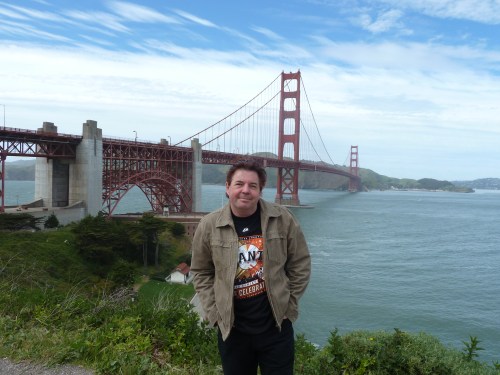
Anyone with the merest acquaintance with this blog will observe a strong bias towards the city of San Francisco in it. If the heading of “A Golden Gate State of Mind” and accompanying photograph did not immediately give it away, the preponderance of posts on the city certainly will.

So what, you ask, is the attraction of what San Francisco based Beat poet Lawrence Ferlinghetti called “this far-out city on the left side of the world” to a cricket loving, warm beer drinking Englishman?

Well, that is a very good question (I do wish you hadn’t asked it).  It’s not sufficient to say it is because I “love” it.  After all, there are many things that I love – my wife, my father, my football team, my favourite rock band, skiing, fish and chips, and the BBC Breakfast presenter, Susanna Reid (I’d be grateful if you didn’t tell my wife about that one) – the list goes on.

But “love” – like “great” – is an overused – or rather over abused – word today. In fact, I may have proved this conclusively in the preceding paragraph. Everyone will have places that they “love”, whether it be Paris, Rio de Janeiro, New York or even Leysdown-on-Sea. Few of us would deny “loving” their favourite holiday haunts, particularly if they return to them time and again.

So I think you deserve a more substantial explanation than that. After all, it took me nearly 43 years to finally feast my hungry eyes on the Golden Gate Bridge and Alcatraz, even though I had venerated the city from afar for nearly three decades before that. So what do I find so special about it now?

Before I answer it – and I’m not prevaricating, honest – I think it is worth considering what it is about a place that makes us become attached to it. After all, isn’t it nothing more nor less than a collection of natural features and man-made buildings?

I suppose that many of us, including myself, claim that we “love” the place in which we were born and / or raised. It is this emotional attachment, linked to childhood memories, that, I believe, is the crucial factor here. And the acknowledgement of that attachment may not manifest itself without the aid of age and distance.

“Absence makes the heart grow fonder” and “there’s no place like home” may be cliches but they still have a sturdy ring of truth. James Joyce – that incomparable chronicler of place – could not, as he himself admitted, have written so profoundly or entertainingly about Dublin had he stayed there instead of leaving it to work and live in Trieste, Zurich and Paris.

My last post (www.tonyquarrington.wordpress.com/2012/02/08/walking-with-our-mutual-friend/) conveys my affection for my own home town of Rochester in Kent, and an earlier one (www.tonyquarrington.wordpress.com/2011/10/03/to-my-home-county/) describes the pride I have in being a Man of Kent, a grateful product of its rich embrace of coast and countryside.

So our attachment to place begins, as with so many of our passions, with our childhood experiences.

But I digress. We’re not in Kent(as) anymore, Toto. You want to read about why I “love” San Francisco. Well, I presume you still do or you would have given up by now. So here goes.

I could cite the stunning beauty of the bay and its glittering “bracelet of bridges”, the gorgeous skies, the cute, clanking cable cars, the abundance of fresh seafood in its classy restaurants, the diversity of its music and theatre scene, the richness of its ethnic neighbourhoods, the thrilling exploits of the Giants and 49ers, and, of course, its renowned tolerance and reputation as a haven for the otherwise discarded and disaffected – all of these are part of it.

However, thousands of other visitors have been equally captivated by most, if not all, of these qualities. It is not for nothing that many leave their heart in San Francisco.  But their “love” is invariably on loan, perhaps until the next trip or another geographical gigolo snatches their affection. Mine is permanent, organic, forever.  

So what is it about this place that has lured this individual into spending what time he can’t reside in it dreaming and writing about it?  Why has this place gotten hold of my heart” where other cities I delight in visiting, such as Venice, Florence, Barcelona, Dublin and New York have not? And why, with relatively little time left, and  just as I am about to resolve to go somewhere else, does it sing its siren (or is that sea lion) songs to me, steering my boat back into the dock of the bay?

For much of my life it was a platonic, long distance affair.  It started with the Summer of Love (1967) when San Francisco snared the imagination of many people across the globe, including one 14 year old English schoolboy an entire continent and ocean away. Intrigued by the love and peace mantra, he was inspired by Scott McKenzie and the Flowerpot Men to commit fashion suicide by wearing paisley shirts and, on at least one occasion, flowers (almost certainly plastic) in his hair, to football matches that year – fortunately, it pre-dated the skinhead era or he may not have been given such an easy ride!

Three years later, the music of the Bay Area, in the form of the Grateful Dead, Jefferson Airplane and Quicksilver Messenger Service began to fill my head. “Everyone’s favourite city” had become the epicentre of my cultural universe. However, another two and a half decades passed before I set foot on San Francisco’s ever shifting soil.

And, for me, Haight-Ashbury, from whence that dazzling music came, still represents, more than any other location in the city, MY San Francisco, and where I gravitate to on every trip, however short. Free concerts by the Dead on flat bed trucks in the Panhandle and Golden Gate Park, tie-dye shirts and the pungent waft of marijuana smoke remain enduring images of that time.

And there is just enough of that atmosphere – at stores like Positively Haight Street, Haight-Ashbury T-shirts and Pipe Dreams, as well as Sami Sunchild’s Red Victorian (www.tonyquarrington.wordpress.com/2012/01/06/great-san-franciscan-characters-14-sami-sunchild/) – to keep me enthused as I saunter down Haight Street today.

That is not to say that other parts – the Tenderloin and Civic Center no less than the trendy neighbourhoods and tourist honeypots – are not equally “real” embodiments of the modern city, all too real some might say. Though I embrace them all, the Haight remains the heart of my San Franciscan experience. Its only failing is that it does not aford bay views!  Or does it? I really must check on my next trip!

Another earlier post (www.tonyquarrington.wordpress.com/2011/10/27/my-san-francisco-top-ten/) summarises those parts of the city that captivate me most, so I will not bore you by repeating them here.

It’s not just the physical sights and sounds that appeal, but the literature (Armistead Maupin, Jack Kerouac, Ferlinghetti, Dashiel Hammett, Jack London) and history (the Barbary Coast, the earthquake and Great Fire, the cultural movements of the fifties and sixties) that fascinate me too.  And has there been a better chronicler of a city anywhere than Herb Caen(www.tonyquarrington.wordpress.com/2011/02/07/great-san-franciscan-characters-6-herb-caen/), renowned columnist of the San Francisco Chronicle?

Indeed, it was Caen who wrote half a century ago in one of his many ruminations on what made a San Franciscan:

I don’t think that place of origin or number of years on the scene have anything to do with it really. There are newcomers who become San Franciscans overnight – delighted with and interested in the city’s traditions and history. They can see the Ferry Building for what it represents (not for what it is), they are fascinated with the sagas of Sharons, Ralstons, Floods and Crockers, they savor the uniqueness of cable car and foghorn. By the same token, I know natives who will never be San Franciscans if they outlive Methusalah. To them a cable car is a traffic obstruction, the fog is something that keeps them from getting a tan, and Los Angeles is where they really know how to Get Things Done.

I like to think that I fit into Caen’s San Francisco “newcomer” category, though I’ll settle for being the “sophisticated tourist” who is “charmed and fascinated” by the city.

I have used the word “home” in a number of features on San Francisco, and that, I think, is the key here. That is not to say that it replaces the town in which I was born and raised – though, equally, it might – but rather that the city engenders those same feelings, not just of comfort and security but also of confidence and pride that allows me to engage with it on all levels. Venice and New York do not. Nor even does “dear, dirty Dublin”, despite my Irish ancestry.

Back where we started then.

And my wife and I have deliberately fostered this feeling in recent years where, by staying in apartments in different neighbourhoods – Hayes Valley and North of the Panhandle, and for our upcoming (ninth) visit, Noe Valley – we aim to “live like locals”, whilst continuing to take in the traditional tourist sights too (our stays are still too short to omit them, even if we wanted to). It is another of San Francisco’s virtues that we can do both.

How many of us can say that anywhere, at least beyond the place in which we live, that we can call it “home”?

Do you have any place that exercises that same grip on you?

I’ll end with Herb Caen again:

thank God or Allah or whoever it was that blessed this small, special, annoying, irresistible place at the tip of a peninsula and the end of the world.


What better way to spend the 200th anniversary of the birth of Charles Dickens than to stroll the streets of the town in which he enjoyed both his formative years and the last 14 years of his life, and from which he drew the inspiration for many of his finest characters and works, including The Pickwick Papers, Great Expectations and The Mystery of Edwin Drood.

Rochester in Kent also happens to be the town in which I was born and educated, and remains no more than a 10 minute drive or train journey away. It is less than three days since the first snowfall of the winter, and whilst the relatively mild temperatures since have provoked a slow thaw, this morning had dawned bitterly cold and foggy.

But as I disembark from a London bound train at 7.50am, the sky is brightening and the sun is making a brave effort to combat the cold. Across the street the Medway Little Theatre’s production of The Inimitable Dickens all this week is the first indication of the connection between the area and our greatest novelist. But it was not always so.

When I attended Sir Joseph Williamson’s Mathematical School in what was then still a city (its status has subsequently been forfeited due to a shocking oversight by the local authority), the crucial impact of tourism on the local economy was not as well appreciated and, aside from the societies dedicated to celebrating his works, the relationship was little exploited.

Dickens based the fictional town of Cloisterham in his final, unfinished novel, The Mystery of Edwin Drood, on Rochester and, as I turn into the high street this morning, I am minded that he wrote “So silent are the streets of Cloisterham”, and remarked also on its “oppressive respectability”. But a steady procession of pedestrians – commuters heading for the station in one direction and King’s School pupils shuffling towards the Cathedral precincts in the other – creates an impression of bustle.

As the bitter chill takes hold, I am gratified to see that the Rochester Coffee Company, a fine, modern cafe with art and TVs on its walls and comfortable leather sofas and chairs, is open. It currently stands opposite  Eastgate House, ” a venerable brick edifice” built in the reign of the first Elizabeth. The owner explains to me that she is moving to larger premises opposite the War Memorial in the Cathedral precincts in a couple of weeks. It is heartening to learn that an independent coffee shop is doing so well.

I pass a municipal car park, skirted by a fragment of roman wall, the only remains of the school that was already over a century old when Dickens first walked this street with his father in 1817, and which had the pleasure of my company 150 years later. The presence of snow reminds me of my, depending on your point of view, most glorious, or nefarious, performance at school when I earned a Saturday morning detention, and instant hero status, for lobbing snowballs at the Latin teacher.

The Dickens influence is everywhere in the names of retail and refreshment outlets – Peggotty’s Parlour, Mrs Bumble’s Tea Rooms, Oliver’s Wine and Cocktail Bar, Topes Resturant, A Taste of Two Cities (Indian), Dickens House Wine Emporium, Copperfield’s (antiques), Pips of Rochester (greengrocers), Little Dorrit (retro clothing and accessories), Ebeneezers (gift shop) and Sweet Expectations. And I am sure I may have missed one or two.

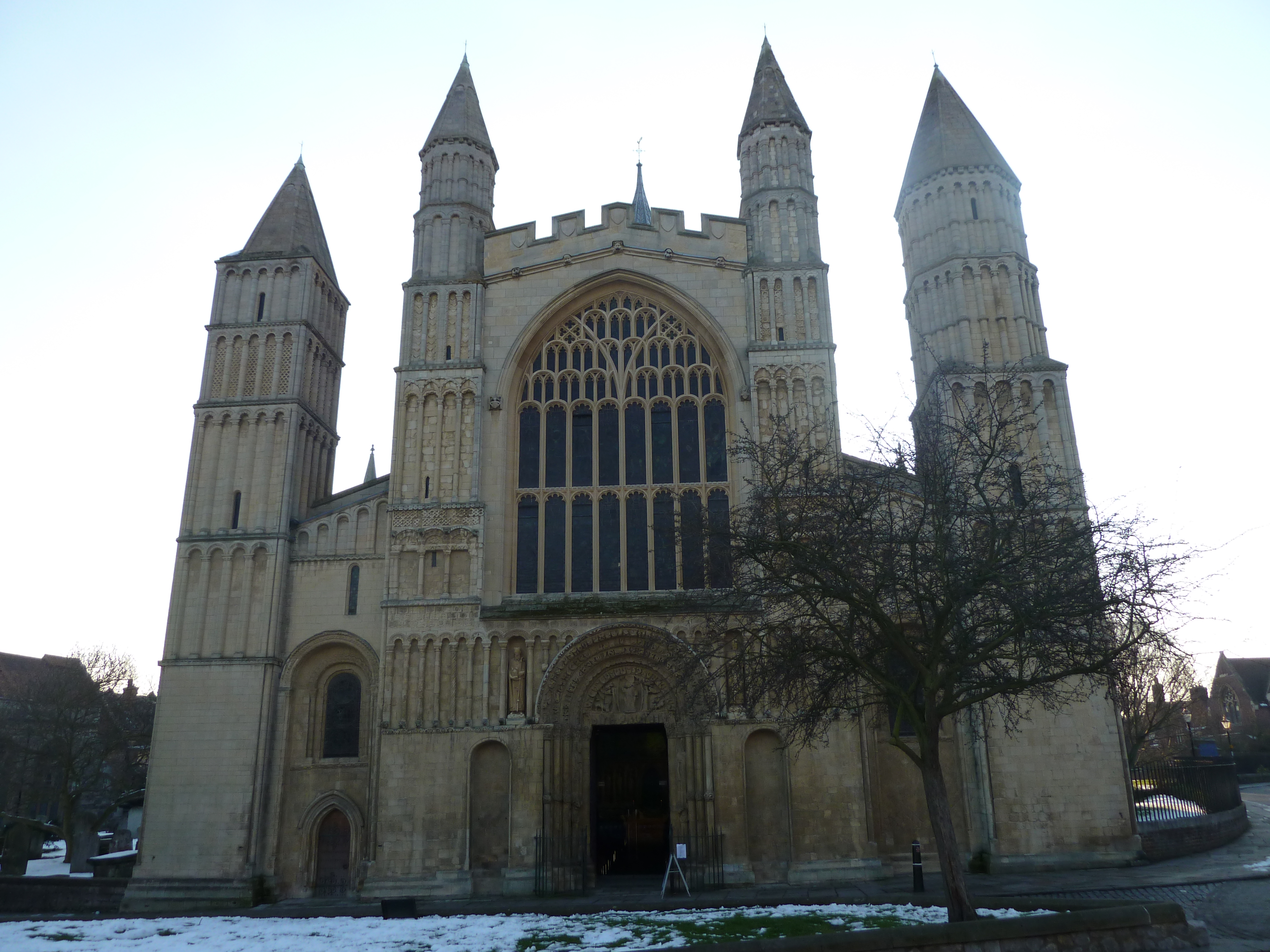
One of Rochester’s great servants and benefactors is the splendidly named Sir Cloudesley Shovell, Admiral of the Fleet and MP from 1695 until his death in 1707, but there is no reminder of that name as the dawn mist has now completely disappeared to reveal a brilliant, pale blue sky with a glaring if tepid sun. With so few people around this is the perfect time to wander around the environs of the Castle and Cathedral to take photographs.

It is difficult to take a bad picture of either of these magnificent buildings (though you may think differently). The Cathedral, second oldest in England (AD604), and the Norman keep have stared, sometimes smiled, at each other for more than a thousand years, and look at their loveliest in this light. King’s School preparatory boys, complete with matching grey blazers, shorts and boaters are being marched into the former for morning service, whilst their elder brethren amble into the array of school premises adjacent to it.

The Castle Gardens are deserted, apart from myself and a couple with a brown and white spaniel spraying snow everywhere in his excitement at being let loose. Walking back through The Vines I stop to admire Restoration House, inspiration for Miss Havisham’s Satis House in Great Expectations and the “finest pre-Civil War town house in England” according to Simon Jenkins.

A gloveless hour spent pointing the camera has removed virtually all feeling from my fingers, so it is time to warm up. A mid-morning pot of tea and toasted teacake are, therefore, taken in Peggoty’s Parlour, a traditional English tea rooms overlooking the High Street, with Dickens art on every wall. It doesn’t take long before I get into conversation with several other afficionados of the author on the benefits to the area of having such a famous son. I discover that one of them was the organiser of the inaugural Dickens Festival (when the town was still a city) in 1981.

The narrow high street is becoming busier as the morning wears on. My first sighting of a film crew occurs opposite the award-winning Visitor Centre where BBC South East Today is setting up. ITV Meridian is also here. Parties of animated French schoolchildren are being led around by guides in Dickensian costume. One is now standing outside the Six Poor Travellers’ House, the one with the “queer old door” that inspired one of Dickens’ shorter stories. Another group can be seen wriggling up Two Post Alley for a tour of the Cathedral and Castle Gardens.

A number of events are being held in the area to commemorate the bicentenary. Eastgate House is the venue for many of these, starting today at 11am with an exhibition on Dickens’ connections with Medway and a display of his autographs. In addition, merchandise – notebooks, pictures, keyrings and fridge magnets – can be purchased to pay for the restoration of the Swiss Chalet, where Dickens wrote his later novels. It was once domiciled in the grounds of Gad’s Hill, but now resides in the gardens of Eastgate House, though is in a state of disrepair. There is a raffle too for a lock of the writer’s hair and portrait.

After a short delay to accommodate BBC Radio Kent and other media groups, 50 of us are escorted up creaking stairs for a reading of the storming of the Bastille from A Tale of Two Cities. There are further readings during the week, including Wackford Squeers in full flow in Dotheboys Hall from Nicholas Nickleby, David’s journey to Dover to meet Aunt Betsey Trotwood in David Copperfield and Pip’s first meeting with the convict, Magwitch, in Great Expectations.

Shortly after lunch at Tony Lorenzo’s (a cafe, unusually in this Dickens obsessed place, named after the owner rather than one of the author’s characters), the fast sinking temperature deters me from venturing into Chatham for “readings, anecdotes and memorials and the laying of flowers to remember members of the Dickens family” in St Mary’s Church in Chatham. And, after all, as the birthday boy said: “Every traveller has a home of his own, and he learns to appreciate it from his wandering”.

In conclusion, an understandably low key but civilised celebration for the great author in his spiritual home. But there will be many more events later in the year, notably at the ever-popular Dickens Festival, commemorating its own 32nd anniversary in June, and Dickensian Christmas at the beginning of December.


If you’ve had the doubtful pleasure of reading my recent post about Heavenly ski resort (www.tonyquarrington.wordpress.com/2012/01/20/heavenly-thoughts-returning/), you ‘ll be aware of my love of skiing, particularly on the snow rich slopes of Lake Tahoe. But had circumstances been different a quarter of a century before on my first winter vacation, that may have been a pleasure forever denied me.

Encouraged by another couple, already experienced skiers, my girlfriend and I agreed to accompany them on a two week holiday to Austria in late February 1987. But before that, we had to locate our ski legs and take the first tentative, or in my case, petrified, steps on snow, or rather, artificial Dendix mesh.

The ordeal began with a course of evening lessons at the Crystal Palace Sports Centre dry ski slope in south London. Sadly, I recollect little of the first lesson other than it took me more than half of it before I was able to a) wedge my feet into the concrete boots, b) stand up and c) begin to tramp around in them in a manner reminiscent of Boris Karloff in the early Frankenstein movies.

The “slope”, if it could be dignified with such a noble word, was a terrifying 60 metres long and of a gradient that would barely have qualified it to be called a green run i.e. virtually flat, in any self-respecting European resort. But, for me, the distance from top to bottom resembled a pit of writhing, seething snakes.

Half way down, in the middle, stood a menacing, 8 foot high tree that called to me, like the Sirens luring sailors to shipwreck in Greek mythology, every time, and there weren’t many, I had managed to plod back to the top to make my next descent. Either side of this monster were run-outs to the bottom. It was not until the third lesson that I succeeded in routinely reaching the end without having had an intimate encounter with that tree along the way.

A couple of long, agonising months later the fateful hour arrived when we set foot – blessedly freed, for now, from those concrete blocks – on a flight to Munich, praying that the worst of the winter conditions were over and that we would catch some spring sunshine. Our destination was Auffach – notoriously difficult to pronounce after a couple of glasses of schnapps or jagertee (a potent mix of overproof rum and black tea) – in the Wildschonaü region of Austria, an area allegedly ideal for beginners.

My girlfriend and I spent the first week in ski school whilst our friends enjoyed themselves.  She was marginally, well much, better than me in the initial test, which amounted to nothing more than being able to stand up in the skis for more than 3 seconds, and was, consequently, placed in a higher standard class.

I was consigned to the lowest group which comprised one Austrian girl and half a dozen boisterous (is there any other type?) Dutch men. The instructor, who at least had the decency to be gorgeous, even in a pink Michelin (UK) or Stay Puft (US) Man outfit, spoke Dutch fluently and used it as the default language for the week. 

Unfortunately, the only Dutch I knew, other than the names of the national football team that came so close to winning both the 1974 and 1978 World Cups, was of the double variety, though I do profess to being quite fluent in that. At least I had found a ready made excuse for my ineptitude.

And that spring sunshine? Forgeddaboutit. Snowfall had been a stranger to the area since Christmas and it was conspicuous by its continued absence during our stay. Whilst the weather was generally bright it remained cold, rendering the surface thin and icy.

My “progress” was tortuously slow. When I wasn’t trying to step off the precarious button lifts prematurely, obliging me to climb the remainder, inevitably slipping back with every other step, I was sliding down an icy incline in a permanent and deeply uncomfortable “snowplough”. I did, however, become highly proficient at trudging down the side of the run with a ski tucked under each arm, having surrendered any belief in my capacity to achieve the same result with them strapped to my boots.

My girlfriend’s experience was equally disappointing and we agreed to forego the final day’s test run, and the life-changing opportunity to dribble down the hill in front of the entire ski school and any other sadists residing in the village, in the forlorn hope of earning a certificate (that was probably written in Dutch anyway). 

Exhausted from the miles, or rather metres, we had carved up in the previous 5 days, we decided to take a coach trip to Salzburg, city of Mozart, chocolate and The Sound of Music. An otherwise enjoyable day was marred by the news of the capsizing of the Herald of Free Enterprise ferry shortly after leaving the Belgian port of Zeebrugge en route to Dover, resulting in 193 deaths. Skiing seemed even less important on that day.

I was prepared to come home at that point. However, we had paid for a second week, and there was a limit to the number of sleigh rides, bowling alleys and “authentic” Tyrolean evenings a man with his pride still narrowly intact could take, so I resolved to give skiing another chance.

And it proved an altogether more enjoyable experience. Our friends were very patient and supportive, escorting us around the whole mountain (much of which we had only dreamed of seeing before), and providing us with one to one tuition – in English! Whilst conditions underfoot were little better, it was much more fun, and we improved accordingly – though my propensity for leaping off button lifts before reaching the top continued well into my third Alpine season.

By the end of that second week, we were hooked and did not want to leave! Had the vacation only been for a week we may never have skiied again – and our subsequent holidays – and life – may have taken a completely different course.


Having now posted the 16th article in the series, I think it is time to review the role of the “Great San Franciscan Characters” in my overall writing strategy. 

In my penultimate post of the last year (www.tonyquarrington.wordpress.com/2011/12/30/99-not-out) I stated that not only would I be reinforcing the San Francisco theme of the blog, but also “working on more substantial, long term projects”.  One of those projects relates to this series. It had always been my intention that the material it contains might ultimately, with a fair wind, develop into a firm book proposal.  

Now if I am to make that a reality, and preserve the integrity of the subject matter, I will have to curtail publication of any more “chapters”, or else the book will already be in the public domain and available for free! Moreover, having read through a number of the preceding articles, I feel there is a clear need for significant revision, both to improve the quality of the individual articles and to ensure a coherent style and approach to the whole.  

So apologies for anyone who was actually enjoying the series.  I hope I can replace it on the blog with (equally) interesting and entertaining pieces.

Now Lillie Hitchcock Coit and Joe Montana are calling.


Firstly, if you have landed on this site expecting subject matter a tad more racy or devotional than skiing, please leave now!

After spending our formative skiing years in Europe, we decided in 1999 to try America for our winter vacation. Lake Tahoe caught our imagination, not only because of its innate beauty and impressive snowfall record, but because it could comfortably be combined with a trip to San Francisco (and other parts of both California and Nevada).

We fell in love with Heavenly and the unique California / Nevada Stateline atmosphere instantly, and despite acknowledging that we should expand our skiing experience to the Rockies or Canada, we have remained loyal to it ever since.  We were even on the verge one year of booking Whistler or Banff and spending our “city time” in Vancouver, but when push came to shove, we hadn’t the heart to abandon Heavenly.

Nor, in the face of numerous recommendations from people on chairlifts, in restaurants and on the street, have we skiied a single day in any of the other Tahoe resorts. Lame excuse though it may seem, we have, in a sense, not wanted to “waste” one of our precious skiing days at Northstar, Squaw Valley or Sierra-at-Tahoe.  And where would we get a better breakfast than at the Driftwood Cafe in the village centre, or seafood dinner at the Riva Grill by the south shore of the lake? 


After our initial vacation we returned in 2002, followed by further trips in ’04, ’06, ’08 and ’10.  With a mountain that rises to over 10,000 feet and the largest snowmaking and grooming operation on Lake Tahoe if Mother Nature should fail to deliver, snow conditions have always been excellent. The weather during our stays has, however, been less predictable (for example, warm sunshine in ’04 and incessant snowfall in ’06, including 4 feet the night before we were heading for Vegas).

The biennial strategy collapsed last year when we went again just 12 months after our last trip. This appeared at first to be a smart move as a record season was already in full swing when we arrived in early March. Now, we confess to being fair weather skiers, always going relatively late in the season, initially in late February, more latterly in mid March (and now April!). The theory is that there will not only have been substantial accumulations of snow already, but that the weather will have warmed up. Spring in San Francisco can be very pleasant too.

So we scanned the web cams and drooled over the daily Another Heavenly Morning broadcast on the internet, watching the snowfall count escalating. Surely, this will have abated and Spring will have arrived with a swagger by the time we pitched up in the resort, allowing us to enjoy several days cruising on a deep snow base in balmy, sun-soaked weather?

No chance! As the travel diary on this blog demonstrated (links below) the only thing we saw was snow, and, in the words of A.A. Milne, it just “kept on snowing”, even after we had left for San Francisco towards the end of the month:

www.tonyquarrington.wordpress.com/2011/03/20/western-diary-day-3-janet-falls-over/

www.tonyquarrington.wordpress.com/2011/03/20/western-diary-day-4-Janet-falls-over-again-and-Tony-gets lost/

www.tonyquarrington.wordpress.com/2011/03/22/western-diary-day-5-the-more-it-snows-tiddley-pom/

www.tonyquarrington.wordpress.com/2011/03/22/western-diary-day-6-i-fall-over-and-Janet-loses-her-backpack/

The year did, indeed, turn out to be a record one with a total 0f 529 inches snowfall (the average is anywhere between 300 and 500). But, after such a disappointing experience, we vowed that we would now leave it a couple of years before returning to Heavenly, perhaps even going back in the interim to getting our skiing fix in Europe again.  

But here we are in mid January and the itch needs scratching again (problematic when you are plodding around with several layers of clothing on, including an esapecially fetching pair of tights). The lure of both Heavenly and San Francisco has become too much, causing us to alter our vacation plans for the year. The four weeks travelling around the canyons and National Parks of the West to celebrate my 60th birthday later in the year has now contracted to two.

We are undaunted by the uncharacteristically puny snowfall so far this year. Although the resort has been open every day since November 18th, the total snow for the season has only reached 13 inches (lower slopes) to 22 inches (upper elevations), and the base depth is just 18 to 24 inches. Only 215 acres out of a total of 4800, and 27 of the 97 runs (trails), are currently open.  

Limited terrain aside, the resort has still managed to provide high quality, if limited, snow in fine weather, with the army of “midnight riders” (groomers) putting in more than 1,200 snowmaking hours. And we have faith that the storms will come. In fact, as I pen this article, 3-6 feet is being forecast for the next week. 

It can snow now until early April as far as we are concerned. But please, let’s have a few days sunshine after that!


“But soft, what light through yonder window breaks? It is the east and Juliet is the sun”.

Even those with the most basic knowledge of, or interest in, Shakespeare, will be familiar with these words from Romeo and Juliet. Of course, they are uttered by Romeo in the famous balcony scene in Act 2.

However, the scene before us is no Royal Shakespeare Company production in Stratford-upon-Avon but a gambling palace turned melodeon or music hall called the Bella Union, located at Washington and Kearney Streets in late nineteenth century San Francisco. 

And our “star-cross’d” lovers are not Laurence Olivier and Vivien Leigh, or even Leonard Whiting and Olivia Hussey, but a baseball bat wielding wild man and a 20 stone woman of whom it could not have been said for at least 30 years that she was “not yet fourteen”.  The incongruity does not end there – because of her bulk she cannot be trusted not to demolish the balcony the moment that she steps on to it, so she is placed centre stage whilst Romeo growls his immortal words from the balcony instead.

Romeo is played by Oofty Goofty, whom we have met already in this series (www.tonyquarrington.wordpress.com/2011/05/17/great-san-franciscan-characters-12-oofty-goofty)   And his “all-seeing sun” was portrayed by Big Bertha, a wealthy woman with a dubious past.  Their performances are the talk of the town, although Oofty’s violent displays leave Bertha “covered with bruises from head to toe” every night, leading to her vowing never to play the part again.

Big Bertha, who is described by Herbert Asbury in his splendid The Barbary Coast as a “sprightly lass of 280 pounds”, had first appeared in the city in the mid 1880s claiming to be a wealthy Jewish widow in search of a man to help protect her fortune.  In order to test any suitor’s value and good faith, she required him to hand over to her a sum of money that she would then double and risk on an unnamed investment. 

This worked so successfully that she “collected several thousand dollars from a score of lovelorn males, not a penny of which was ever seen again by its rightful owner”. Although she was eventually arrested for a succession of such scams, none of her victims had the courage to charge her for fear of public humiliation. She was released on nominal bail and the case against her dropped.

She now decided to turn her attentions to a stage career, approaching Ned Foster and Jach Hallinan, managers of the Bella Union and Cremorne melodeons respectively. Recognising her potential they hired her immediately under joint management and put her on display in an empty storefront on Market Street. Dubbed the “Queen of the Confidence Women”, for ten cents she would, at regular intervals, rise from her reinforced chair and recount the list of dreadful crimes that she had committed in San Francisco and other cities, “embellishing her account with many vivid details”. 

She would then regale the assembled throng with horribly off key renditions of the only two songs she ever knew: A Flower from my Angel Mother’s Grave” and The Cabin Where the Old Folks Died. This proved so popular that, after a brief engagement at Bottle Koenig’s, where her erstwhile Romeo had also performed briefly, her act transferred to the Bella Union stage and converted into what became an equally celebrated song and dance revue in which she sang “sentimental ballads in a squeaky voice”.    

Aside from the Romeo and Juliet farce, Bertha was involved in one other crazy theatrical moment. She was cast in Byron’s Malzeppa as the eponymous hero strapped to a horse or, in her case, donkey as punishment for having an affair with a young countess. Her entrance always drew ecstatic applause, but one evening it all went horribly wrong.

Wilting under the nightly strain of carrying Bertha, the donkey lost its footing and crashed into the orchestra pit, taking the massively proportioned Bertha with it.  The musicians’ reaction has not been preserved for posterity but it is not unreasonable to speculate that their language was not equally as colourful as that bellowing from the lips of the hero / heroine’s. Neither can I report whether the hapless donkey sustained any lasting injury.

But it did herald the end of Bertha’s bizarre acting career, who confined herself to singing and, on occasions, dancing. This proved more successful, culminating in her wrestling ownership and management of the Bella Union in 1895. However, restrictions placed on the sale of liquor three years previously eventually forced her to sell up and leave.  And that is the last we hear of her.

“So please you, let me now be left alone”.  


I have never understood, or cared to understand, American football.  That is until last night.

Purely because of our affinity with the city of San Francisco, my wife and I had considered celebrating our first wedding anniversary at Wembley Stadium in October 2010 when the 49ers came to town with the Denver Broncos – until we saw the exorbitant prices. We went to Dublin for the weekend instead.

Last season, as dozens of others before, had completely passed me by but I have followed the upturn in their fortunes this year, if  only by casting a cursory glance at the final scores. I had also read a lot about the exploits of quarterback, Alex Smith, which reminded me of the only 49ers player from the past I could honestly claim I could remember – Joe Montana.

So as they had reached the playoffs and were live on TV last night at a manageable hour (9.30pm) – even if it meant missing The Football League Show on BBC – I decided to tune in to the final two quarters as they were leading 17-14 against the New Orleans Saints at the time. Having led 14-0 earlier in the game but the prospects for the remainder of the game did not appear promising to one unsuspecting football virgin.  However, the sight of a scarlet hued Candlestick Park convinced me to stay the course.

I can’t claim to have followed everything of what was going on, though touchdowns and field goals were at least comprehensible.  And I can appreciate a long, accurate pass and even a mighty hit (I have always enjoyed these on the ice rink).  Anyway, the third quarter passed without much incident, other than that San Francisco extended its lead to 20-14.

The margin was still 6 points (23-17) as those final 3 portentous minutes started. It appeared to me that the home side was defending with increasing desperation and, with a history of supporting sports teams who so often ripped defeat from the jaws of victory, I felt staying up until nearly 1.30am would prove ultimately futile. 

And when the Saints went 24-23 ahead, it looked all over. But then Alex Smith, who had hardly had a bad game beforehand, ran in a 28 yard touchdown (I believe that’s the correct expression).  So we’d (notice that?) won it 29-24 hadn’t we? Now, hold on a cotton picking minute (who was it used to say that, Deputy Dawg I think) – back come the Saints with a touchdown of their own to “win” it 32-29.

Glorious failure then – a not uncommon feeling for this sports fan. With 14 seconds left, and my thumb poised on the off button on the remote control, Smith calls what seems to me to be a pointless timeout.  Now this is where my ignorance of American sport kicks in. Of course I should have known that within 5 seconds he would plant the ball in the arms of the grateful, and soon to be sobbing uncontrollably, tight end, Vernon Davis, for the winning touchdown. 36-32! 

I was reminded in the midst of all this mayhem of the word “torture” that so eloquently described the San Francisco Giants march to the World Series 15 months before.

I don’t think that I will still ever develop the affiliation I now have with the city’s baseball team – you might like to read my earlier post about how I fell in love with the San Francisco Giants (www.tonyquarrington.wordpress.com/2011/05/12/bitten-by-the-giants-baseball-bug) – but I have acquired sufficient interest to prompt me to learn more about the rules and tactics, purchase some 49ers merchandise, and be there in front of the TV for the next playoff game and, of course, the Super Bowl. OK, I’m probably getting  a little ahead of myself now, but that’s what fans do don’t they?