Feeds:
Posts
Comments

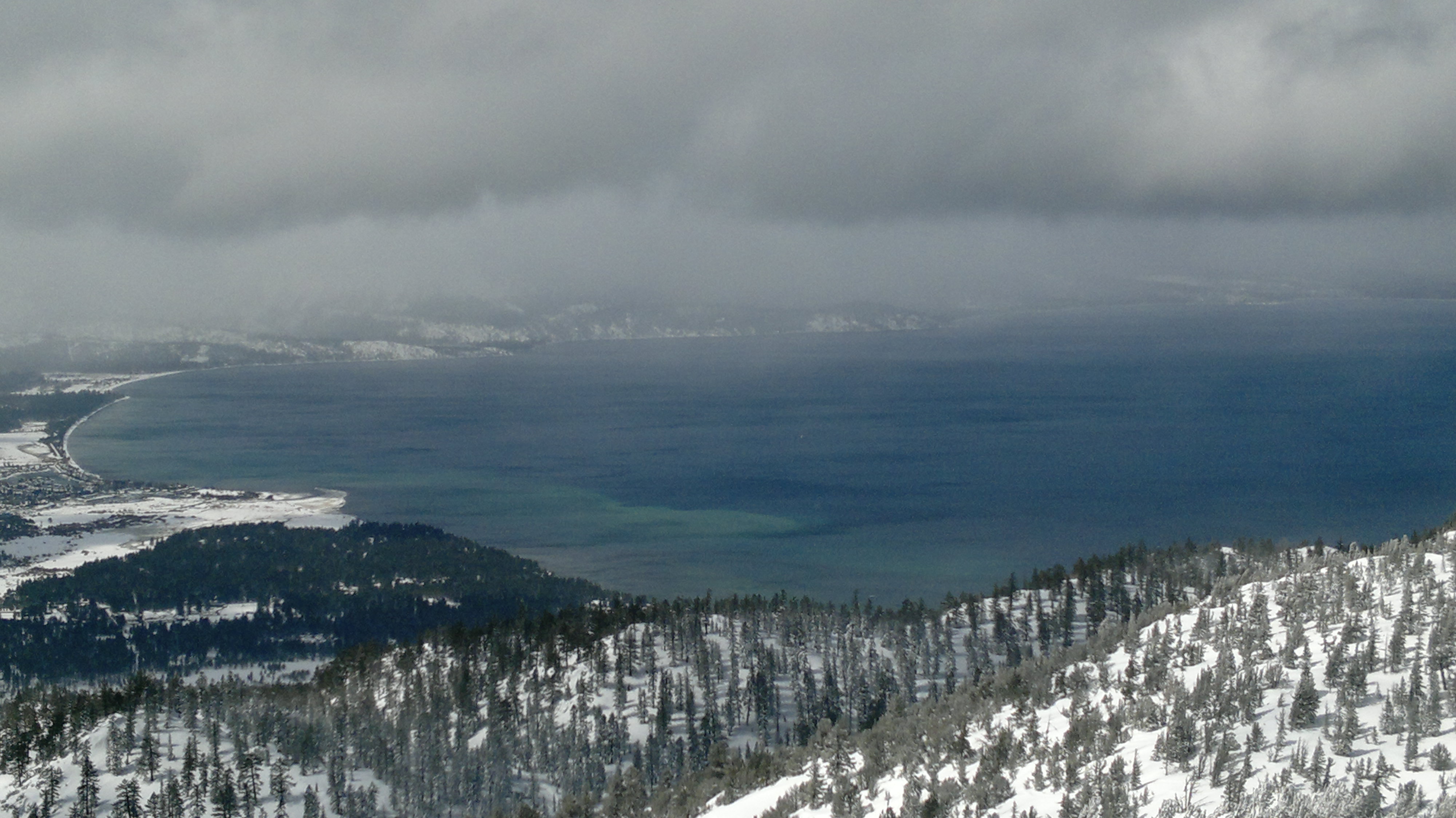
We woke to learn that the snow had left over a foot of fresh powder on the mountain (nearby Sugarbowl had had 32 inches overnight!), and that today would see a brief respite in the relentless wave of storm systems hitting the west of the country during March.

Although it was snowing and visibility was poor when we set out, leaving both the lake and mountain invisible, breaks in the clouds brought a surprising and prolonged spell of sunshine from late morning onwards. Occasional “wind holds” aside on lifts on the upper levels of the mountain, the majority of the ski terrain remained open, including the all-important gondola in the middle of the village.  The fresh, dry, soft snow which had fallen on the groomed surface meant that appreciable bumps developed on all trails as skiers and riders turned over it.  The term “powder day” was rarely more relevant in our experience.

That said, the day’s skiing was hardly uneventful.  Firstly, Janet contrived to fall twice whilst standing still  – that’s now three nil to me!  But I didn’t exactly cover myself with glory either.  Returning from the Nevada side of the mountain at 1pm we resolved to head down the run that led directly into the new Tamarack mountain restaurant for lunch.

However, if you miss the left fork leading to the restaurant, and the gondola alongside it, you find yourself hurtling towards the farther California side of the mountain, with no way back other than by negotiating a time-consuming and frustrating return via a series of long trails and lifts, taking you back into Nevada – and that’s if the latter are operational (which, at the time I needed them, was the case).    

And that is what this idiot did, leaving Janet waiting outside the restaurant wondering where I had disappeared to.  As I had perpetrated the same felony only last year, she soon worked out what had happened to me, and had the good sense to wait there whilst I reacquainted myself with most of the mountain before being reunited with her over an hour and a half later.  My legs had started to tire BEFORE I embarked upon the additional marathon journey, so I was mighty relieved to see her waving to me at the bottom of the run!

But that wasn’t the only indignity I suffered – staggering back to the gondola for the ride back to the village my saloppettes (ski pants to the unitiated) fell down, revealing the three layers (thermals, tights and underpants) beneath.  Fortunately, Janet may have been the only witness, and it certainly raised her spirits after the long, frustrating vigil at the restaurant.  At least it proved that I had lost weight from last year!

Lunch at Wolfgang Puck’s cafe in the village was highly welcome =- and very late, thanks to this author.  After the customary late afternoon siesta, we roamed the casino and village shops before having dinner at the Hard Rock Cafe in Harvey’s casino.  Good food, great music, delicious margaritas and  friendly service – it is not difficult to see how it long outlasted Planet Hollywood.

I’ll finish with a tip for those wanting to have fun and win each time they hit the casinos – play the penny slots!  Ok, it’ll take a few thousand years for you to become a millionaire, but you’re just about guaranteed to win every time.  Janet and I only discovered them at the Bellagio in Vegas last year when they paid for several rounds of drinks at the bar.  Tonight we walked away with $70 from a $30 stake – that’s 233% profit, pretty good odds huh?


Here are a handful of photos from our first couple of days’ skiing in Heavenly.

Me!

View of lake from top of Comet Express

Both of us!

View of lake (just!) from window of hotel room


I realise that yesterday’s blog was rather lengthy, so resolve to keep day 3 short and sweet.

After coffee and bagels in Starbuck’s in Harrah’s we set off to collect our valeted skis and poles.  The first half hour was taken up climbing into our boots – why is it that with all the advances in ski technology in the past twenty years that getting into – and out of – boots is as strenuous and stressful as it was when we first took up the sport in 1987?

The weather was cold and overcast, and strong winds at the upper levels of the mountain meant that the lifts and runs available were very limited.  We were compelled to take an overcrowded shuttle bus – along with a cacophanous bunch of brash Texans on their spring break – to the Stagecoach lodge in Nevada, which we reached shortly after 10am. The skiing was confined to just a handful of runs, though it was enjoyable nonetheless.  The highlight was Janet’s spectacular back flip from a standing position as she was about to push off on the Olympic Downhill.  One nil to me! 

With a heavy storm approaching in mid afternoon we finished skiing around 1pm and had lunch at Wolfgang Puck’s cafe in the village – even though it’s a fast food outlet that man still puts out great food! My four cheese pesto pizza matched the cajun shrimp pasta from the night before.

The snow set in as forceast around 3pm, and had covered the road at lake level within an hour.  It did not stop for the remainder of the day, dumping well over a foot on the mountain overnight.  Seeking escape in our room I wrote yesterday’s blog and watched a great profile of the Giants’ 2010 postseason heroics whilst Janet braved the hotel’s swimming pool.

We trudged through the roadside snow to Cecil’s Steak and Brew for their excellent Jack Daniel’s drenched half chicken before returning to the hotel for drinks and a modestly successful i.e. breaking even session on the penny slots.  We went to sleep wondering whether the incessant snowfall would jeopardise tomorrow’s skiing plans.


The first morning of our vacation maintained the traditional approach with a walk to the Eagle Cafe on Pier 39 for breakfast.  Two Eggs Benedict with fried potatoes, scallions, peppers, melon and orange slices, accompanied by orange juice and unlimited water and coffee, set us up for the impending trip to South Lake Tahoe.

We did not leave the city without an alarming revelation.  Having lamented the demise of the Border’s bookstore in Union Square only a few weeks before on this blog, I was horrified that the Fisherman’s Wharf Barnes and Noble bookstore had also gone since our last trip, soon to be replaced by an extension of the adjacent Costplus World Market store.  Barnes and Noble had again been a stopping point on our trip to Tahoe. where I invariably bought the books that I would be reading over the next few weeks.  I am a great fan of the independent bookstore but the loss of both of the large branches in the city that I enjoyed visiting is a lot to take.

We collected “The Beast”, set the radio to 95.7 The Wolf and left San Francisco at 11.30am, crossing the  Bay Bridge on a mild (58 degrees), bright morning.  Now, American readers might consider applying a Chevy Traverse with the nickname “The Beast” to be rather an exaggeration, but if you are accustomed to driving a Mazda 2 back home, believe me it’s a monster! Once we had passed Treasure Island we saw part of the new East span of the Bay Bridge which, once opened in another couple of years, will offer magnificent views towards Alcatraz and the Golden Gate Bridge.   

The 180 mile drive to South Lake Tahoe along Highways 80 and 50 was untroubled, traffic steady and the weather lovely, the in-car temperature guage going as high as 65 degrees around Sacramento (which has one of the least attractive American downtown skylines in my experience).  One of the most entertaining aspects of the journey was spotting the Adopt-A-Highway sponsors, two of the most intriguing being Friends of Obama (some might ask whether he still has enough to cough up the money to pay for the upkeep of a major road) and Jelly Belly.

The heavily snow-capped Sierra Nevada mountains first came into view as we approached Sacramento, though they hid themselves intermittently over the next fifty miles before dominating the final part of the drive.  We stopped for lunch at Starbuck’s in Hangtown Village Square in Placerville – note to self: remember to look up the derivation of that name. It was here that we experienced for the first time on this trip the classic, arguably over-effusive American customer service approach, exhibited by both the server and barista.  For now, it was welcome, but I wonder how soon it would be before it began to grate.

As Tahoe approached the side of the road became littered with signs such as “watch for snow removal equipment”, “chain installers work east of this point” and “slow traffic use turnouts” (laybys to UK readers). But in the benign weather today, they were irrelevant.

As the road climbed to more than 7000 feet the scenery of the Elderado National Forest and the gushing American River, became ever more spectacular.  And then…..the lake was teasingly laid out before us in all its beauty, only to disappear again as the twisting road plunged downhill.

We arrived in South Lake Tahoe at a little after 3.30pm, enabling us to fill “The Beast” up (it is so much cheaper than paying for a full tank of petrol at the outset) and return him to his Avis parents before the desk in the Embassy Suites closed.  Once checked in at Harrah’s we sought out Powder House ski and boot rental (the best deal in the resort) before dinner at Applebee’s (my cajun shrimp pasta was to die for), a brief , unsuccessful spell on the Harrah’s slots and bed (not our liveliest St Patrick’s Day I’ll acknowledge,but we were tired and wanted to hit the ski lifts early the next morning as a major snow system was scheduled to explode upon the area on Friday afternoon).


After a relaxing night at the Holiday Inn near Heathrow Airport our Virgin Atlantic flight to San Francisco ascended into the cloud cluttered skies thirty eight minutes late.   Most of the lost time was retrieved on a  flight enlivened by the repeated failure of the entertainment system, the noisy carousing of a handful of English rugger types in the galley area  and the malfunctioning of the pier doors on landing! 

We received an uncommonly affable welcome from the Federal Inspector on entering the U.S. and baggage reclaim and car hire went equally smoothly.  After the fork lift truck, brought in to haul  us into our seats in the red Chevy Traverse, was driven away, we set off for the City on the evening commute in hazy sunshine and 59 degrees, arriving at our customary first night stop, the Holiday Inn at Fisherman’s Wharf,  in little more than half an hour.     

Wireless connection, cappuccinos and baths – in that order – were the priorities of the next hour and a half.  Tradititon then took hold with dinner at Calzone’s in Columbus Avenue in North Beach followed by a couple of gin and tonics in Vesuvio’s, the famous bar frequented by the Beats and other counter culture luminaries in the fifties and sixties.  Our comfortable king size bed at the hotel was very welcome after a twenty four day.

That’s about as much as I can manage after such a hectic day,  Posts will be more comprehensive in future, starting with a report of today’s upcoming trip to South Lake Tahoe – the next big storm is in the offing (will it ever stop snowing this season)?


No less a San Franciscan institution than the Golden Gate Bridge or the cable cars is Val Diamond, the heartbeat for thirty years of the world’s longest running musical revue, Steve Silver’s Beach Blanket Babylon.

Valeria Adriana Maria Francesca Diamond was born, the daughter of a Jewish father and Italian immigrant mother, in Oakland in 1951 and raised in Castro Valley. Attracted to the theatre from a young age, she started her acting career in high school, playing the lead role in Medea and Anna in The King and I.   For the next eight years she was lead singer in a rock band called the Sounds of Joy that toured the country.

Becoming tired of life on the road she accepted an invitation to join the cast of Beach Blanket Babylon.  Despite initial reservations that a zany topical revue in which she had to wear increasingly gargantuan hats whilst attempting to hold a musical number, did not fit with her ambitions to be a serious actress and musician, she became one of  its most enduring and beloved icons.  Her first of around 11,500 performances came on 17th January 1979 when her roles included that of a singing waitress with a giant Coca-Cola bottle on her head and a singing envelope exhibiting just legs and face.

She made many other parts her own during her thirty year residence, including her favourite, a French whore, Jewish mother, cowgirl, Japanese maid, Marie Antoinette, the Singing Nun, the Queen and a tap dancing Yankee Doodle Ghandi.

But it should not be forgotten that the outlandish costumes and often surreal scenes were not able to mask a great voice too. Janet Lynn Roseman, in her book Beach Blanket Babylon – A Hats-Off Tribute to San Francisco’s Most Extraordinary Musical Revue, referred to  her as the “queen of the belters” and John F. Kennedy Jnr exclaimed “the one with husky voice, boy, can she sing”.  Amongst her show stealers were “There’s No Business Like Show Business”, “Lili Marlene”, “City Lights” and “Coroner Man”.The image, however, that audiences will most readily conjure up of  Diamond, is of, as Miss San Francisco, her gliding serenely onto the stage at the end of the show in her magnificent, three hundred pound San Francisco landmarks hat to lead them in joyous renditions of Happy Trails to You and San Francisco.

Perhaps her most treasured night was a seventeen minute Beach Blanket Babylon performance for Queen Elizabeth II at the Davies Symphony Hall in 1983.  At the end she appeared wearing an enormous London hat, containing replicas of Buckingham Palace (complete with marching guards), the Tower of London and Big Ben which opened to reveal photographs of the Royal Family.  The Duke of Edinburgh is reputed to have been particularly entranced by this moment, and the Queen claimed that visiting San Francisco was the highlight of her trip to the United States.

She also played before the Prince of Wales, Rock Hudson, Rudolph Nuryev and Mikhail Baryshnikov as well as countless American public figures and celebrities, and was invariably in the show’s welcome party for visiting dignitaries.  When the 1989 World Series resumed at Candlestick Park following the Loma Prieta earthquake, she led a singalong of San Francisco, wearing a giant (no pun intended) baseball themed hat.  More recently, she sang the national anthem at the Giant’s new home of Pacific Bell Park (now AT & T Park) (below).

Mindful that the huge hats she wore might have diverted the audience’s attention from the skill in her performance, she derived immense satisfaction as she explained in Roseman’s book: “when you really feel fine is when you’ve sung some touching ballad wearing something crazy on her head, and you’ve gotten the audience to stop laughing and listen to you sing, and then they give you an ovation.  That’s when it feels great!”.

Even when surgery in 2001 to treat nodes on her vocal chord nerves threatened her career, she was back onstage within five months.

Diamond’s departure from Beach Blanket Babylon has never been adequately explained and provoked much anger and bewilderment among fans Her final performance was on 23rd September 2009 when she knew was leaving, although it was not announced to the public for more than a week afterwards.

Nonetheless, producer Jo Schuman Silver, widow of the show’s creator Steve Silver, paid tribute to her by saying that she was “one of the most versatile and professional performers to ever grace the stage at Club Fugazi”, and that Beach Blanket’s long running success was “in part, due to Val’s immeasurable contributions”.

She married the company’s trumpet player, Steve Salgo, in 1987 and still lives in Sonoma.


Charming, charismatic, successful businessman and whorehouse owner, “Sunny Jim” Rolph was the longest serving mayor in San Francisco history.

He was born to British parents in the city on 23rd August 1869 and educated in the Mission District where he  also lived in adult life in a large mansion at the corner of San Jose and 25th Streets.  After jobs as a newsboy, clerk and messenger he entered the shipping business in 1900, forming a partnership with George Hind.  For the next ten years he served as President of two banks, one of which he established, as well as founding the Rolph Shipping Company and James Rolph Company.  He also directed the Ship Owners and Merchants Tugboat Company and the San Francisco Chamber of Commerce.

Prior to his country’s entry into the First World War he supplied coal and ships to the Allied Countries.  With an estimated wealth of $5 million he bought a ranch west of Stanford University.  It is reported that the Department of Public Works made all the improvements to the ranch at the taxpayers’ expense, not the last time his appropriation of public funds for his own personal gain was mooted.

In 1911 Rolph was encouraged to run for Mayor against the incumbent P.H. McCarthy who had failed to curb the corruption that was rife in the city.  Following a six week campaign categorised by egg throwing, fist fights and police riots, he won comfortably.

His first major project was the construction of the 1915 Panama-Pacific International Exposition, designed not only to celebrate the opening of the Panama Canal but, equally importantly, to showcase the remarkable renaissance of San Francisco after the 1906 earthquake.  It was  during the latter that he he had earned the gratitude of the city by, as head of a relief committee, delivering water and supplies with his horse and wagon.

Image:rulclas1$governor-jim-rolph-1931.jpg

He opened the Exposition by, pied piper style, leading 150,000  followers down Van Ness Avenue and Lombard Street to the Fairgrounds, now the Marina District.  The profits from the highly successful event were used to build the Civic Auditorium.

As Mayor, he personally oversaw the construction of City Hall, and on the day it was dedicated in 1915, climbed the golden dome, “beamed at the astonished faces below”, and ran up the American flag.

His nickname derived from his relentlessly cheerful, gregarious disposition.  With a theme song entitled “There Are Smiles That Make You Happy” he paraded about town in, alternately a stovepipe silk or derby hat, dapper black suit with a flower, usually a carnation, in the buttonhole, smiling and “pressing the flesh” of the city’s residents as if he were on a continuous election campaign trail. He would often pick up pedestrians on his way to City Hall and drive them to their destination.  He was known as the “Mayor of All the People”, relating to people of all races, religions and political parties.  He even invited Communist protestors into his office for a chat.

He had time for everyone as he “popped up” at just about every public event, seeing it as a photo opportunity to promote himself.  His role was primarily as the charming figurehead for city government, leaving the day to day running of his administration (which bored him), including several major public works projects such as the Bay Bridge, Hetch Hetchy water system, which supplies most of the city’s water,  and San Francisco Airport, to trusted colleagues.

Rolph’s affable manner and the spectacular but costly festivities he arranged to celebrate major political events may have endeared him to the man in the street, but he presided over a “lawless, debauched city”in which “gambling and prostituion thrived”.  Moreover, he contributed personally towards this by owning the Pleasure Palace, an “entertainment hideout”at 21st Street and Sanchez on Liberty Hill.  It is hardly surprising, therefore, that he made only half-hearted attempts to clean up the city.  This, along with his lax stance on enforcing Prohibition, may have partly accounted for his four re-elections and nineteen years in office.

His flamboyant image extended to appearances in several films, notably the 1915 documentary Mabel and Fatty Viewing the World’s Fair at San Francisco, directed by Fatty Arbuckle and the short, Hello Frisco.

Rolph’s drinking and alleged affair with movie star, Anita Page, however, scarred his final term in office.  He missed meetings at City Hall and drivers would be despatched to find him. When he did turn up he appeared drunk and patently unwell.

He was elected the 27th Governor of California from 6th January 1931 when he resigned as San Francisco Mayor.  However, the advent of the Great Depression and the budgetary constraints that that inevitably imposed upon the State, had serious personal and political consequences.  Moreover, laregly as a result of his shenanigans over a previous gubernatorial campaign, his contract to build three new ships for the Federal Government was cancelled and he was banned from selling ships to foreign governments, accelerating his financial ruin.

His political inadequacies were also regularly exposed, provoking a recall movement against him within two years of taking office.  His tenure was dogged by controversy, not least when he publicly praised the citizens of San Jose, whilst promising to pardon anyone involved, following the November 1933 lynching of the confessed murderers of Brooke Hart, the son of a wealthy local merchant.  He was thereafter known as “Governor Lynch”.

As he fell into serious debt his health failed, although he continued to make personal appearances against medical advice.  Following a number of heart attacks he died on 2nd June 1934 at Riverside Farm, Santa Clara County.  He was brought home to lie in state in the City Hall rotunda.

Notwithstanding his many flaws, Rolph’s popularity in his home town was unquestioned. and illustrated in the decision to name the San Francisco-Oakland Bay Bridge, that had begun to be built under his stewardship, the “James “Sunny Jim” Rolph Bridge”.

Finally, I am particularly indebted for much of the detail in this article to the historical essay on Rolph written by Daniel Steven Crofts.


One of the most controversial and radical religious and social leaders of his time, the Rev. Cecil Williams has been an influential figure in San Francisco public life for the past half century.  Combining spirituality, left-wing politics and unstinting social activism he has been a inspirational spokesperson for the poor and margininalized in the city and across the country.  

He was born on 22nd September 1929 in San Angelo, Texas, one of six children.  After graduating from Huston-Tillotson University in 1952, he was one of the first five African American graduates of the Perkins School of Theology at Southern Methodist University three years later.

He bacame the pastor of the GLIDE Memorial United Methodist Church at Ellis and Taylor in San Francisco in 1963.  Its mission has been to “create a radically inclusive, just and loving community mobilized to alleviate suffering and break the cycles of poverty and marginalization”. 

Diversity and compassion have been at the heart of Williams’s work.  People of all races, ethnic backgrounds, social classes, cultures, ages, faiths and sexual orientations are welcome to join in the Celebrations held every Sunday at 9am and 11am to “experience the energy of spiritual liberation coupled with the fusion of jazz, blues and gospel performed by the renowned GLIDE Ensemble choir and the Change Band”.  An example of this is contained in the following video:

http://www.youtube.com/watch?v=Wg7jmgnwAds

It is the practical demonstration of his belief in diversity that has earned him both veneration and notoriety.  In 1965 he became the first minister to perform  same sex marriages long before the battles of the past decade and he was also instrumental in forming the Council on Religion and Homosexuality in 1964.  The church provided healing and comfort for the LGBTQ community in 1978 in the aftermath of Harvey Milk’s assassination, and it was the first  in the US to offer HIV testing after Sunday services during the AIDS epidemic of the eighties.

In 1967 Williams courted further controversy by ordering the cross removed from the church’s sanctuary, stating that it was a symbol of death and that his congregation should celebrate life and living instead.

Rev. Cecil Williams Mike Kepka / The Chronicle

His contribution to the struggle for civil and human rights is unquestioned and prompted him to host political rallies in which Angela Davis and the Black Panthers spoke in the seventies.  He has also arranged lectures by Bill Cosby and Billy Graham.  Other prominent public figures that have frequented and supported the church’s work include Bill Clinton, Oprah Winfrey, Robin Williams, Maya Angelou and Warren Buffett.

Under his leadership, GLIDE Memorial became one of the most prominent liberal churches in the US, and now boasts a diverse congregation of over 11,000 members.  It is the largest provider of social services in the city, serving over 3,000 meals a day, providing AIDS / HIV screenings, innovative adult education programs, creative arts and mentoring for youth,  computer and job skills training, drug and alcohol recovery programs and giving assistance to women dealing with domestic violence, homelessness, substance abuse and mental health issues.  GLIDE Health Services was hailed by House of Representatives Speaker Nancy Pelosi as a model for national healthcare in March 2008.

Williams retired as pastor in 2000 in accordance with United Methodist Church rules.  However, the local congregation and affiliated non-profit foundation hired him in the newly created role of Minister of Liberation, thus enabling him to continue officially serving the community and church.

He was married to school teacher Evelyn Robinson from 1956 until their divorce in 1976.  They had two children, Albert and Kim.

He has been married to Janice Mirikitani, who co-founded the GLIDE Memorial Church with him and who has worked with him on many social programs, since 1982. 


The church is credited with helping Will Smith and his son get back on their feet in the 2006 film, the Pursuit of Happyness.  His autobiography I’m Alive was published in 1980.

In recent years he has received numerous honors and awards, including Southern Methodist University’s Most Distinguished Alumni, the National Caring Award and an appointment as Chairman for the Northern California Dr Martin Luther King Jnr Birthday Observance Commitee at the personal request of Dr King’s widow.

The challenges for Williams and his church are no less demanding than they were when he became pastor neary fifty years ago, and are best expressed, along with a restatement of his original vision, by the GLIDE website:

“a suffering economy, poverty, drug abuse, violence, and despair continue to persist in San Francisco as they do across the country. By working to combat these problems, GLIDE serves as an oasis in a desert of hopelessness, marching to the edge where victories for social justice are won. GLIDE is a place where old, destructive ways of being are thrown out and new ones created. Where names are named and love is celebrated and a simple call goes out to all races, classes, genders, ages, and sexual orientations: It’s recovery time. It’s time to love unconditionally”.

I trust we can all say “Amen” to that.


Snow at sea level? It could happen this weekend.

For all the picture postcard scenes that San Francisco has to offer, rarely, very rarely, are they draped in the white stuff.  But this weekend, according to the above article in the San Francisco Chronicle, there is a distinct possibility that, for the first time in 35 years and only the twelfth time since 1856, snow will fall in Chinatown and Union Square.

In one sense I am glad that this may come – and go – more than a fortnight before I visit the city, but I am equally disappointed that I will not be able to witness this extraordinary meteorological sight at first hand.  I’ve no doubt, however, that cameras will be a-clicking in all parts and I will have to content myself with seeing the photographs.

I hope this phenomenon, along with the seven feet that have fallen in Tahoe over the past ten days, heralds a mild, sun-drenched March and April!


Jerry Seinfeld once said that a “bookstore is one of the only pieces of evidence that people are still thinking”.  If that is true, and I rather incline to the view that it is, then ignorance has claimed another modern victim. I learnt this morning by e mail that the giant Border’s bookstore in Union Square, San Francisco is about to close.  I’m not sure what date it will finally shut its doors, but I do hope the sale that began yesterday will still be in full swing when I visit towards the end of next month.

An oasis of culture in my least favourite part of the city, I have always looked forward to spending an hour, and a few dollars, there when on vacation.  It was one of the first bookstores in my experience that appeared to actively encourage customers to stay awhile and browse through the books and magazines before purchase.  Equally, it possessed a (Seattle’s Best) cafe that was always packed, even in the minutes leading up to its midnight closure. Thankfully, that has become a model for the diminishing number of bookstores in the UK in recent years.

In one sense I am hardly surprised – the Border’s bookstore in Oxford Street in London closed a couple of years ago, replaced by yet another tacky youth “fashion” emporium.  And another San Francisco branch – in South Beach – went out of business in October. Both were victims of the economic downturn in general and the rise of internet based competition.

Now, I can’t abdicate responsibility for my own part in the demise of the bookstore.  I can never pass one without going in – after all they are increasingly rare sights -but it is as often these days to check the price of books I want before rushing home, going online and buying them at massively discounted cost at Amazon.  I have resisted the allure of a Kindle or similar e-reader up till now, although the convenience might prove too much of a temptation before long.  What I will never lose the love for, however, is the feel and look of books and the generally civilised atmosphere of bookstores. 

At least I can still comfort myself with visits to the City Lights Bookstore in North Beach, Barnes and Noble in Fisherman’s Wharf and the Booksmith in Haight-Ashbury on my forthcoming trip.  I just hope I’m not lamenting their demise too before the next time I take that eleven hour flight west.