Feeds:
Posts
Comments

Following the unexpected boost provided by the popular final tour of the preceding year, and the business award from Folkestone Town Council, 2020 always promised to be an exciting year. And within days of the commencement of the New Year, the season’s prospects looked even brighter. An approach from the leader of the Sandgate Parish Council resulted in an agreement to deliver ten walking tours of the village, linked to the dates of the Farmer’s Markets in Chichester Hall on the first and third Saturday of each month from May to September.

And, for the first time, I was given funding to research and design the programme, and to compensate for any slow take up in interest.

In addition, the Folkestone Channel Rotary Club asked me to deliver a day long tour and introductory presentation to their members, including colleagues from Belgium and the Netherlands, as part of their fortieth anniversary celebrations. A date had also been agreed with the Friends of Folkestone Museum to conduct a talk, followed by a walk around the Creative Quarter. 

Finally, there was the added enticement of the fifth Folkestone Triennial, scheduled from 5 September to 8 November, during which I had undertaken to provide a series of artworks tours to complement the official programme.

But within three weeks of the launch event, all had “changed, changed utterly” in the prophetic words of W.B. Yeats a hundred years before.

And yet 2020 still became the most successful season in the four year life of Folkestone Walking Tours.

How could that have been?

As March begat April, which turned into May and then June, all the major events in town, including the Triennial, were postponed or cancelled. The only walking I was permitted to do fell into the category of daily “exercise”. I began to joke to anyone who would listen that, if and when lockdown restrictions were lifted, I might find myself the “only gig in town”.

And so it proved. 

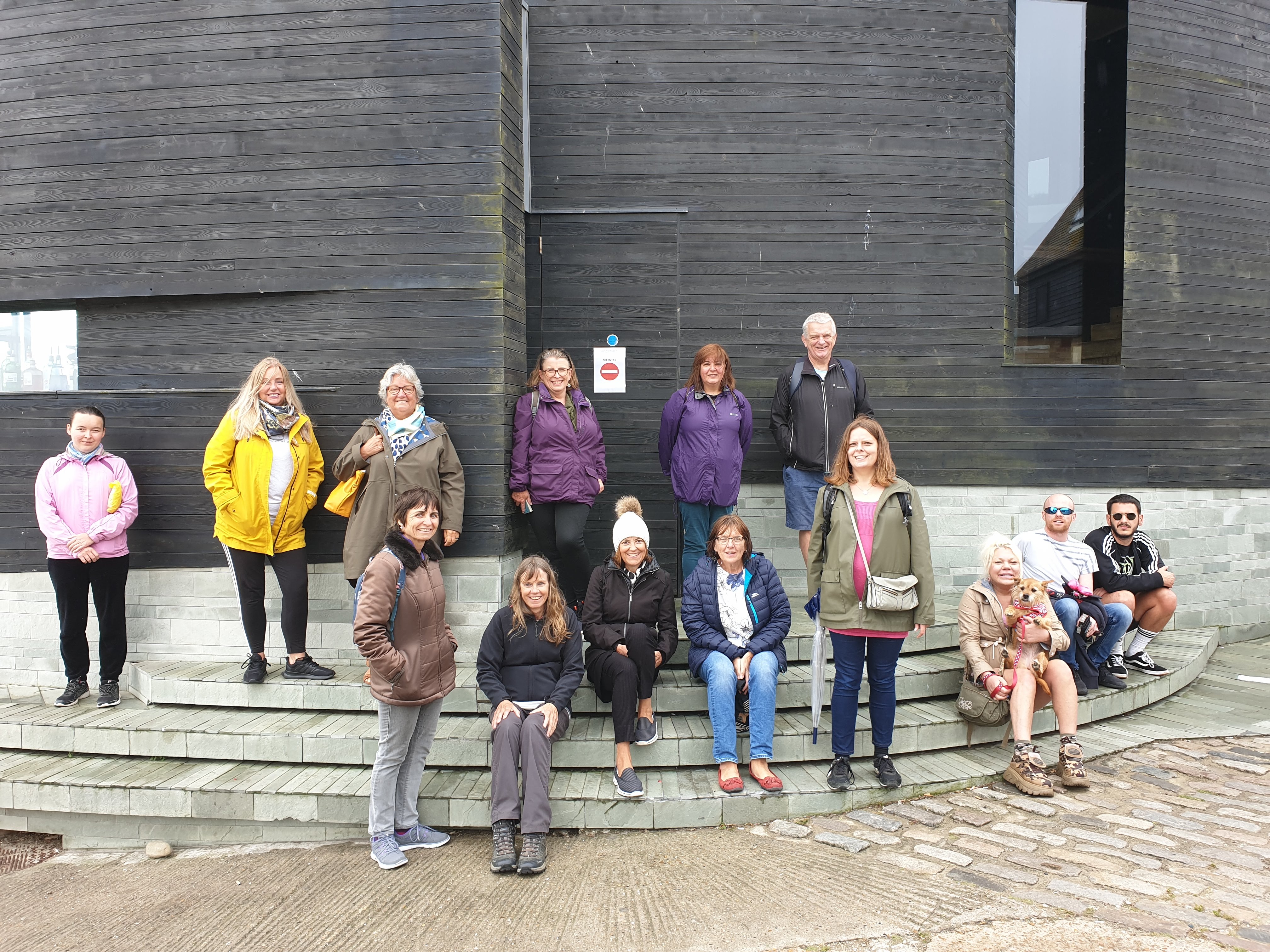
On a cool, wet morning on Saturday 4 July I was joined on the steps of Rocksalt by fourteen human guests and a dog for a three hour stroll around the harbour and seafront. Despite persistent drizzle and intermittent dives for cover to avoid the seagulls seduced into joining the group by one of our number with large handfuls of food, it had been a enjoyable and liberating event. My prior concerns about the legality of the size of the group, and the potential inability to maintain the appropriate distance between each other, proved unfounded too as the police in evidence allowed us to move around unchallenged. 

The Sandgate tours got underway two weeks later, and I was eventually able to deliver the entire programme, with a further tour thrown in for good measure. 

But a remarkable thing happened to confirm my earlier prediction.

As society reopened, and many felt comfortable in leaving their homes again, I began to receive requests for tours from leaders of groups such as the U3A (University of the Third Age) and other “Meetup” parties. Starved of their customary range of activities, they were determined to enjoy the great outdoors again. With so little else on offer, walking tours became an even more attractive proposition than they might otherwise have been.

I even found time to offer “new” literary and artworks walks – and a special birthday tour for the family of the former Prima Pottery shop owners on the Old High Street.

With holidays cancelled, there needed to be no end date to the season, other than if further restrictions were imposed, which duly returned in November. But in the intervening period, I was able to deliver twenty six tours for a total of two hundred guests. That figure would have been even greater had the “rule of six” not been in force during part of the period, which left a number of prospective guests disappointed. 

In the space of eight months, 2020 had promised much, threatened to disappoint but ultimately delivered in unexpected but satisfying ways.

And then 2021 proved equally interesting. 

But that is for another day.

I sit in coffee shops, 

That’s what I do,

Sometimes outside, 

To take in the view.

There I write poems 

Or post updates online,

To let my friends know 

That I’m doing fine.

I might have a big breakfast

Or occasionally brunch,

And if I stay long enough,

It might stretch to lunch.

Cappuccino, no chocolate,

Is my customary drink,

But after two or three,

I can’t hear myself think.

So I revert to a pot

Of refreshing Earl Grey,

Instead of just leaving,

It allows me to stay.

I quite like the quiet,

But am up for a natter,

With anybody else

There for that matter.

If I’m using my laptop

Which is not that robust,

To keep it performing

A wall socket’s a must.

Django’s and Steep Street

Are my regular haunts,

Eleto and the Hideaway,

And Brown’s on my jaunts.

I love Bobbies too

In the old harbour station,

And the literate Lift Cafe

By the regeneration. 

There are a few others

I sometimes frequent,

But not conducive to writing,

So my time’s not well spent.

I sit in coffee shops, 

That’s what I do,

Sometimes outside, 

To take in the view.

,


Seagull, seagull sitting on a roof,

Seagull, seagull, resting and aloof.

No care in the world, so it would seem,

Silent and still, as if in a dream.

Meanwhile, in the cafe down below,

A full English breakfast is on show.

In fifteen minutes, the meal is done,

Save for some toast and piece of bacon.

The customer pays and walks away

While the seagull contemplates his prey.

Before the server can clear the table first ,

The seagull has swiftly done his worst.

Cutlery and crockery deafeningly clattered,

Adjoining seats and tables ketchup splattered. 

Bacon and slice of toast gripped in his beak,

The gull retreats with triumphant shriek.

Soon peace and quiet return to the scene,

An Eggs Royale is ordered, all is serene.

But………….

Seagull, seagull sitting on a roof,

Seagull, seagull, resting and aloof.


From Danton Farm to harbour sluice gate,

The watercourse winds down towards the sea;

Now largely hidden from the public gaze,

It still has power to harm you and me.

Beside the metal footbridge at Broadmead,

It surfaces in Lower Radnor Park,

Where it glides and ambles beneath tall trees 

That screen the glinting sun and pierce the dark.

Empty crisp packets and chocolate wrappers

Lie wedged among the stream washed rocks,

Ivy draped grotto screams neglect, 

Moss stained stones and stagnant water mock.

But, vouchsafed by Victorian forebears,

It remains a quiet refuge from the race;

Where scurrying squirrels pursue their tails

And jackdaw and magpie compete for space.

Dog walkers trudge along the muddy track

That leads to paved Pavilion Road,

And one last glimpse of curving rivulet,

By fence at foot of Red Cow garden flowed.

No more the source of fresh water for the town,

No more the driving force for Foord Road mill,  

No more the home on planks for fishing folk,

Shoved underground a shopping need to fill.

From Tontine Street via Hatch coffee house

It meets returning tide by harbour wall;

A quiet end perhaps, but still pent up threat

In times of storm and flood that may yet fall.

Sweet Mill flow softly.


Concrete and cranes now bestride the beach

Beneath Decimus Burton’s gracious Leas;

The shrieks of gulls and lapping waves,

Reassuring melodies of the seafront scene,

Are now drowned by the discordant notes 

Of drill and digger, hammer and pick.

Switchback and swimming pools,

Pier, putting green and amusement rides,

Once the joyous heart of local life,

All now just bittersweet memories,

Mourned on social media sites.

In their place, behind the boardwalk,

Another emblem of an earlier time,

A new, brighter world is taking shape 

On shell and shifting shingle ground.  

The red and white cars of the lift

Lie almost side by side, stalled 

And halfway up the dormant track,

Impatient for the flats to rise

And hasten their own resurrection. 

I loiter outside the waiting room,

Now popular pitstop on the promenade,

With a vegan sausage roll in my hand

And dust in my cappuccino.


Life was never better

Than in Nineteen Sixty Three

Between the end of the snowbound winter

And Freddie’s You Were Made For Me.

On a cool August morning in Foord Road

A blue Vauxhall Victor groans to a stop,

Disgorging two pairs of flustered parents 

And three kids chock full of crisps and pop.

No sooner the guest book’s been signed

The kids clamour to go to East Cliff Sands;

With the tide far out the beach is ripe 

For making castles and handstands.

But it’s for cricket the boy yearns the most,

Pitching stumps and bails he scans the beach

For willing, smaller boys to do the fielding 

While he smashed the ball out of their reach.

As sand recedes beneath insistent waves,

Cricket gives way to crazy golf with slides,

To amusement arcade and boating lake,  

Rollercoasters and Rotunda rides. 

He plays for plastic racing cars

And pinball machine high scores,

While parents play bingo for household goods 

They could buy much cheaper in the stores. 

And then there’s that first trip abroad 

On a ferry bound for Boulogne-Sur-Mer,

The boy spends his time bent overboard,

In bitter tears and silent prayer.

But he brightens at promise of fish and chips, 

White bread and butter, mugs of tea;

And climbing the crooked, sloping street

To Rock Shop’s window wide and free.

Life was never better

Than in Nineteen Sixty Three

Between the end of the snowbound winter

And Freddie’s You Were Made For Me.


The situation as it stands
Is stay at home and wash your hands;
Shop only for essential needs
And exercise with dogs on leads;
Keep your distance, at least six feet,
And make no plans with friends to meet;
Do those jobs you have left for long,
Practice new skills or write a song;
Home school the children, if you can,
Sit in the garden, get a tan;
Spend more time in your living room,
Watch a film or connect on Zoom;
Do what works for you all the while,
But through this anxious time, still smile.


With resident white mallard
On a seasonal sabbatical,
A newly arrived black cormorant
Struts and preens on the central island
Of Radnor Park’s fishing lake,
While ravenous pigeons wrestle
Over scarce, illicit bread stocks.

No more anglers cast silent floats
On the teeming duck infested waters;
No rods and bait filled baskets
Bestrew the narrow concrete path,
Forcing me to trudge through
The muddied grassy verge
As a pair of greedy gulls stamp
Feet to tantalise tender worms.

A limpid sun shines apologetically
Above the mock Tudor tea rooms;
Nurses from near minor injury unit
Snatch fag breaks on the corner
Where discarded dog ends,
And twigs from overhanging trees,
Entice the ducks into mistaking
Them for a flavoursome breakfast,
(The fags and twigs, not the nurses).

After a day when few people pass
To witness the birdlife bedlam,
Dusk descends on a noiseless scene,
And a serene moon declines
Over Cheriton Road rooftops;
And in the littered concrete shelter,
Where youths habitually congregate
To drink and smoke and lark about,
There is neither light nor sound,
No need here for an enforced curfew.


As the dread death toll still rises,
The public debate turns to when
We can come out of this crisis,
Be granted to walk free again.

Experts speak of apex and curve,
Reaching one, flattening the other,
Before we even have the nerve
To our former world uncover.

If we relax restrictive rules
Of business law and social life,
Is it a recipe for fools
To circulate more viral strife?

Might social distance still be right
To minimise exchange of breath?
Will my plain croissant and flat white
Be worth the price of pain and death?

We must think carefully what’s best,
Heed the need for work and wealth,
Saunter in the summer sun blessed,
Only hand in hand with good health.


When this is over,
Will we still display humility,
And value the simple things
We have, rather than strive
Aimlessly, shamelessly for more?

We can,
But will we?

When this is over,
Will we still show the respect,
Gratitude and appreciation
For those once unregarded folk
Who keep us safe and healthy?

We can,
But will we?

When this is over,
Will we still show empathy,
Tolerance and compassion,
Qualities mislaid in recent years,
For those less fortunate?

We can,
But will we?

When this is over,
Will we still relish nature’s gifts?
Listen to the thrilling birdsong,
Smell the spring blossom,
And nurture our fragile planet?

We can,
But will we?

When this is over,
Will we still view the world afresh,
And accept our true place in it,
As mutual partners, not masters,
And, by doing so, secure our future?

We can,
But will we?