Feeds:
Posts
Comments

A fearless chick loiters with intent
By Bob’s whitewashed seafood stall,
Affecting to ignore the cartons of
Whelks and cockles and lobster tails
Dispensed a few short steps away,
But pouncing on any edible debris
Unwittingly or deliberately dropped
By thoughtless human passers by.

By Pent’s red brick sluice gate
They luxuriate in a bracing shower
In muddy, minute puddles left behind
By gone, at least for now, high water;
With half an eye in the direction
Of Chummy’s charitable staff who
Discard empty shells on stony ground.

Teetering on bare, oarless rowing boats,
Or perched on piles of greying wood
Wedged deep into the hardening mud,
They pass the interminable time
Till the small crafts stir and sway again
And the sun glints on the wind blown water.

A fretful throng starts to assemble
At the end of sloping Rocksalt jetty,
Squabbling over the best viewing spot
To wait in line for the painfully slow
Incoming tide to reappear;
In the meantime, scavenging for scraps
On the Stade’s concrete harbour floor,
Disdainfully dropping bottle tops,
Dog ends and paper coffee cups.

Shrieks and cries rise in intensity
As the prodigal, once truant waves
Flood through Folkestone’s golden gate,
Between the now closed off East Head
And war ravaged remnants of South Quay.

A frantic chick chases after its mother,
Letting out a constant stream of whistles,
Pleading for a morsel of fresh fish
Now washing over its grateful feet;
But the peevish parent pecks its bobbing head
And bids it bide its time a little longer.


The Four Umbrella Sketch
(with thanks /apologies to Monty Python)

Behind the clean, efficient counter of the lost property department at Euston Station lurks a dense jungle of paraphenalia left by passengers, including mobile phones, sunglasses and purses.

And a vast and assorted collection of umbrellas.

The office has been closed for hours, and the last train has long left the station.

All is quiet – until four of the department’s, hopefully temporary, residents break away to the furthest corner and engage in earnest conversation.

The first umbrella, a Liberty print ladies version, opened the debate by stating that “you won’t believe how I ended up here. My owner brought me from North Wales on a shopping trip. By early afternoon she had accumulated designer bags from Harrod’s, John Lewis, Harvey Nichols and many other high end stores. She turned down the offer of a bag to put me in, as it was raining steadily outside at the time, and I was called into immediate action.

I had a premonition even then that, in the panic and confusion that was bound to accompany the train’s arrival at Crewe for her connection, I might be left behind. And so I was, though I did get an extra trip back to London.

I suspect the half bottle of Prosecco she drank on the journey didn’t help”.

A foldable child’s Peppa Pig design replied “mine was a young mother with two kids, both with their own umbrellas. I “belonged” to her five year old daughter, and the six year old boy carried one in the shape of a particularly ugly frog. Their mum had brought them to London for the day from Hemel Hempstead to visit the Natural History and Science Museums.

The day was going well until it was time to catch the train home. As they gathered their belongings for the return journey, mum discovered that one of the umbrellas was missing and harangued her daughter for leaving it somewhere, the precise location and timing being a total mystery at the time.

Well, I can exclusively reveal now that I was left in the ladies’ loo opposite Platforms 1 and 2.

Oh, and by the way, that blasted frog survived the ordeal”.

At that point, a multi-coloured beach brolly interrupted, insisting that “they’re both conventional ways of being left behind. My abandonment was much more interesting. They brought me, along with their two teenage boys, from Watford Junction on a day trip to the seaside. I spent five hours on Viking Bay Beach at Broadstairs, shielding them from the whistling wind and intermittent drizzle, I blew inside out at least twenty times (fortunately my spokes are strong and I didn’t suffer any lasting damage), and how did they repay me?

Left me to go round the entire Circle Line three times, being pushed from seat to seat (I nearly gone thrown onto the platform at Shepherd’s Bush Market), before a kind commuter picked me up and brought me here”.

A large, black, Ministry of Defence affair with hand carved ash handle had been listening to these laments with increasing irritation. He could not restrain himself any longer and haughtily exclaimed “that’s all very interesting but incredibly boring. My owner is a senior civil servant currently employed on top secret government business. It is as highly stressful as it is well remunerated, and requires high intelligence and discretion. He needs to relieve himself – literally – on occasions or it would all become too much.

So, his Tuesday afternoons are set aside for visits to a professional lady along the road from here at King’s Cross. To cover his tracks he always walks from his office in Whitehall and, due to today’s inclement weather, I was recruited to join him. We arrived at the appointed time and he promptly disappeared to carry out his business. At least he had the good grace to prop me by the door to the flat rather than condemn me to witness the proceedings from the inner sanctum.

At the customary time of four in the afternoon, the door opened and, as immaculately attired as he had been when he arrived, he took his leave. However, with the sun strenuously trying to penetrate the tattered curtain in the lady’s bedroom, thus restricting his vision, he omitted to collect me on his way out.

So how did I get here, I hear you ask?

It transpired that, rather than, as I would have expected, she resided in the hovel that hosted the afternoon’s divertissement, the lady in question actually commuted to her place of work on a daily basis, just like the office workers and retail staff that frequent the concourse here from the early morning until midnight.

After attending to three more gentleman callers, she duly took the 18:57 to Birmingham New Street, but not without making a short detour to this establishment to place me in its safe custody.

I must say I was surprised, but equally gratified, to learn that the entertainment industry is as subject to gentrification as any other these days.

It makes one proud to be British”.


When the day trippers leave

When the tattoos are covered up
And unsightly bellies are put away

When the swearing stops outside the pubs
And childrens’ squeals at the fountains
Turn to grumpy ingratitude

When the car parks empty
And the trails of traffic cease

When weary families trudge back
Up the crooked Old High Street

When I can get a seat again at Steep Street.

When I don’t stumble over
Discarded chip boxes and plastic beer glasses

When the angry squawk of the gulls
Is reduced to a plaintive mew

When Harbour Arm food stalls are locked
And music and laughter have faded into silence

When the ghosts of Hengist and Horsa
And the Orient Express caress my memory

When the sun disappears and clouds return
And waves lash against the Copt Point rocks

When the day trippers leave

That is my time

That is my Folkestone.


This is an adaptation, and considerable shortening, of a piece I wrote a couple of years ago.


Mermaid Beach at Dusk

On a night like this, the Cote d’Opale
Might as well be a thousand miles away.

It is a calm, quiet, otherworldly evening
After a dank, dreary December day;
Sky and sea present an ashen canvas.
Tonight it is impossible to tell
Where one ends and the other starts.

Despite slimy conditions underfoot,
I elect to descend from
The well-lit comfort of the Leas
To the chilly Channel seashore.

Barely a whisper from the surf tonight.
I cannot even hear Matthew Arnold’s
“Grating roar of pebbles
Which the waves draw back”,
So faint is nature’s melody this evening.

Across town, an artwork springs to mind,
Above Tontine Street’s old post office
Proclaims that heaven is a place
Where nothing ever happens.

Because nothing is happening tonight
In this desolate speck of paradise.

But then, everything is happening.

To the east, the lighthouse blinks
Through the thick, enfolding gloom;
A tuneless, abandoned church bell
Hangs silently suspended above
Where once stood rotunda, swimming pool,
Boating lake and fairground rides.

A dalmatian puppy snuffles among
The seaweed encrusted pebbles
On the dark shoreline, while its
Fretful owner punctures the peace
With impassioned and fruitless pleas
To follow her back across the beach,
To the refuge of her Range Rover.

A lone fisherman sets out his stall
For what appears a long night ahead,
Reminding me of all night sessions
With my teddy boy uncle fifty years ago,
On the shingle beach at Dungeness.

I wonder now why I ever went,
I was never interested in fishing!

Pastel hued beach chalets are now
Padlocked up for the winter,
Along with the Mermaids Cafe Bar,
Welcome pit stop on the promenade
From Folkestone to its upstart neighbours,
Sandgate, Seabrook and “posh” Hythe.

I defy anyone to assert that they
Do not like to be “beside the seaside”;
And I look forward to a first full summer
Season in my coastal home next year.

However, it is at moments like this,
With the cold, dark sea alone for company,
When enjoyment is such a feeble word
To evoke the effect of this magical place;
I can only equate it to a profound love,
Both infatuation and long term comfort.


One of the iconic images of the great British seaside holiday of the fifties and sixties is of happy families playing beach cricket.  Everyone joined in, playing with children’s bats, balls and stumps that reduced fathers who fancied themselves as Dexter or Sobers to the same level of competence as their seven year old sons, non-sporting wives and even the family dog (when they were still allowed on the beach between May and September). Truly, we had “never had it so good”.

Sadly, the advent of the foreign package holiday, breakdown in traditional family structures and expansion of alternative leisure pursuits, all contrived to render such a scene virtually obsolete.  Over the past weekend, therefore, I embarked upon a one man (at least for now) campaign to revive this venerable but floundering tradition, pitching up on Ramsgate Main Sands with my wife at 2pm on Sunday for an impromptu game.

I say impromptu because my planning had left something to be desired – a brief glance at the tide times beforehand would have revealed that this was the worst time of the day to start.  Nevertheless, after twenty minutes inspecting the fast diminishing slither of sand along the bay, I found a strip that was marginally more playable than the Rose Bowl.  It quickly became clear, however, that if the game was to be remotely watchable, or attract other participants, it was pointless bowling anything other than full tosses because once the ball had pitched, it was firmly plugged into the sand.

“Sticky dog” wicket aside, it proved a batsman’s paradise as the leg side boundary shortened sharply with the onrushing scum brown tide, ensuring that the merest of flicks resulted in a boundary.  That said, the smacking of  my extra cover drives against the sea wall was more satisfying.  Frank Keating once wrote that Ian Botham played a net “as if he is on Weston-super-Mare beach and the tide is coming in fast”.  I’d like to think that if you substituted Broadstairs for Weston, that might accurately describe my batting on this day.

Public interest was negligible, evidenced by a succession of families, oblivious of the sacred nature of my work, plodding across the wicket at regular intervals.  It reminded me of my primary school football pitch which had a concrete public footpath running diagonally across it, constantly trodden by young mothers with prams during vital matches against our bitter rivals from the adjoining parishes of Luton, Delce and Arden.  Understandably, dribbling was a skill particularly valued at Glencoe Road.

But back to the summer game.

Human indifference was not mirrored in the reaction of the indigenous bird population. An improbable infield of gulls occupyied short square leg, silly mid on and extra cover loitered, more, I suspect, in anticipation of the next tasty titbit thrown up by the thrashing waves than hovering in hope of a bat pad.  Their noisy sledging would have done justice to any Australian test team in history. Eventually, with the wicket completely submerged, the players were forced to dash from the square to the nearest ice cream van.

Undaunted, I resumed my missionary work two days later with a game on the much larger and more suitable Viking Bay beach in Broadstairs.  Low tide was scheduled for 2.04pm but, conscious that the tide came in a lot quicker than it went out, I decided that play should get underway an hour earlier.

An early inspection of prospective wickets revealed not only a soft, dune-like sand texture inconducive to a meaningful contest, but also an unmanageable abundance of people, deckchairs, windbreaks and bouncy castles, along with the ubiquitous volleyball court, populated by hordes of young Latino youths, led me to cancel plans to play there.  However, we rounded the bend at the end of the beach to enter Louisa Bay which, a full hour before the scheduled start of play,  sported a vast expanse of dark, compacted sand. Only sporadic handfuls of spectators scattered around what would serve as the boundary.

My excitement was heightened by the sight of  TWO sets of wickets already pitched further along the beach.  This was promising.  Our game got underway and soon acted as a magnet for every bored child on the beach.  Questions such as “can I play?” and “can my brother / sister join in?” (only the absence of the suffix “mister” reminded me I had not been transported back to 1960) were music to my ears as I suddenly found I was setting fields for TEN kids of assorted ages and having to remember in what order they all batted and bowled to avert tantrums.

The majority displayed more willing than competence, all wanting to field at mid wicket for some unaccountable reason (maybe the proximity of the tea hut and toilets had something to do with that), but uncomplainingly hared after every ball, regardless of how far and in what direction it had been despatched.  Falling into a rock pool or getting entangled in the profusion of seaweed were no barriers to their enthusiasm.

On a more serious note, it was heartening to learn that you could still play an innocent game in public with a group of children that you had never met before, without being accused of wanting to take salacious photographs of or, worse still, interfere with, them.  In fact, the parents seemed content to allow them to play, even the mother who was called upon to console her ten year old when he retired hurt after being struck on the left thigh by one of my rising eighty mile per hour inswingers.

The most poignant moment arose when one small boy advised me, with evident pride, and in hushed tones, that the reason his brother was scoring so freely with quasi-classical strokeplay and bowling off a run up that appeared to start just to the left of the Goodwin Sands, was because “he PLAYS cricket”.

The game lasted nearly three hours, interrupted only by obligatory lunch and tea intervals, dictated more by my need for regular rest than by the tyranny of the clock.  Each succeeding resumption of play appeared to draw even more players until the relentless waves washed the wicket away completely.

So beach cricket is alive and flourishing in the cradle of the game, not quite the High Weald, but still in God’s own county.  It can be no coincidence that shortly after this pilgrimage, I moved to Folkestone which boasts one of the firmest wickets on the coast at Sunny Sands.


Life was never better
Than in Nineteen Sixty Three
Between the end of the snowbound winter
And Freddie’s You Were Made For Me.

On a cool August morning in Foord Road
A blue Vauxhall Victor groans to a stop,
Disgorging two pairs of flustered parents
And three kids chock full of crisps and pop.

No sooner the guest book’s been signed
The kids clamour to go to East Cliff Sands;
With the tide far out the beach is ripe
For making castles and handstands.

But it’s for cricket the boy yearns the most,
Pitching stumps and bails he scans the beach
For willing, smaller boys to do the fielding
While he smashed the ball out of their reach.

As sand recedes beneath insistent waves,
Cricket gives way to crazy golf with slides,
To amusement arcade and boating lake,
Rollercoasters and Rotunda rides.

He plays for plastic racing cars
And pinball machine high scores,
While parents play bingo for household goods
They could buy much cheaper in the stores.

And then there’s that first trip abroad
On a ferry bound for Boulogne-Sur-Mer,
The boy spends his time bent overboard,
In bitter tears and silent prayer.

But he brightens at promise of fish and chips,
White bread and butter, mugs of tea;
And climbing the crooked, sloping street
To Rock Shop’s window wide and free.

Life was never better
Than in Nineteen Sixty Three
Between the end of the snowbound winter
And Freddie’s You Were Made For Me.


Perambulators and parasols parade
On new mown and manicured lawn
Designed by Decimus Burton,
From polo field and pasture hewn.

“Finest marine promenade in the world”,
The guidebook effusively lays claim;
Hard to argue on this glorious morn
When sea and sky look just the same.

The guests arrive by lift and carriage,
Depending on their wealth and style
To acclaim a marvel of the modern age,
A red brick vision to make them smile.

Crowds congregate on Madeira Walk,
Path forged from latest cliff slide,
While builder Baker, spurned by Metropole
Admires his handiwork with rightful pride.

The band plays a medley of popular tunes,
From jazz, music hall and ragtime,
Like When We Were Two Little Boys,
And In the Good Old Summertime.

Albert Burvill, in new blue uniform,
Sends packing gatecrashers from the town,
Craving a peek at the rich folk’s party,
Now turned away by copper’s frown.

But they will get their chance another day
To press their noses to the Monkey Cage,
And watch their King among his court
Feast and roar on this most public stage.

Metropole management looks on
At the rival Radnor vowed not to build,
Contemplating legal action
Against violation of its private field.

Pavilion, Burlington, Majestic,
Metropole and now the Grand,
Fashionable Folkestone is all the rage
At harbour and on cliff top land.


From centuries of slog and slime,
From Pent and Channel battered,
A sleepy, careworn fishing village
Today becomes a town that matters.

Herring, mackerel, crabs and sole
Now make their way to Billingsgate,
And fetch a price not seen before
The railway raised flat Folkestone’s fate.

Sun, with constant bedfellow, breeze,
Smiles on the arrival of the first class fares,
While locals rush to harbour viewing points
From auction sheds that plied their wares.

The first wave of “down from Londoners”
Steps from gleaming horse drawn coach
That brought them from a makeshift station
In lieu of soon to be rail track approach.

A boisterous band blares out the latest hits
Of Wagner, Chopin, Strauss and Liszt,
As crinolined ladies, with handbags and fans,
Tease gentlemen whose advances they resist.

Steam powered Water Witch, focal point
Of this auspicious day, adjoins the quay,
And nervous passengers clamber aboard
In clothes unsuited for a swelling sea.

But the water’s calm and the crossing smooth
As guns and flags bid travellers adieu,
In three hours, on Boulogne’s teeming dock,
An even louder band greets guests and crew.

Now, La Marsellaise and God save the Queen
Salute the excited but exhausted crowd,
A necessary triumph for entente cordiale,
Two towns so far, but now so near, made proud.

In Folkestone, normal service is resumed,
Men mend nets and women cook and clean,
Habitual chores for o’er a thousand years,
Yet a smaller, faster, world can now be seen.


I was born with cricket in my blood. My father was an enthusiastic if modest club performer who played for a team that, where once it had consisted largely of doctors from the local hospital from which it derived its name, and had been one of the strongest in the Medway area, had declined by the early sixties into a dad’s army of clerks, TV repair men and shipwrights (not to denigrate those trades but rather to demonstrate the disconnection over time from the medical profession).

My father’s skills were confined to a stubborn resistance to giving his wicket away easily (though, despite himself, he invariably did), and an aptitude for both pocketing slip catches himself, and occasionally by redirecting the ball from his commodious stomach into the hands of more agile teammates in the vicinity.

The team was my extended family – every player was an “uncle”, though not in the biological sense of the word, and I revered them, despite their limitations on the field. At the age of ten I graduated from mascot and scoreboard operator to become its official scorer. I fulfilled this role for the next five years, spending summer afternoons in cramped, rotting wooden sheds, invariably sat alongside grizzled, gap-toothed septuagenarians with a life long chain smoking habit.

But I loved it.

It wasn’t just the game that captured my young heart, but the environment surrounding it – the rickety double decker bus journeys through the Kent countryside, the team being forced to change on the bus if it was behind time, the sing-songs on the journey back (my party piece for some reason was Wouldn’t It Be Loverly from My Fair Lady) and the regular stops at pubs such as the Chequers at Loose and the Five Bells in Snodland. “Home” games at the Civil Service Sports Ground and Langton Playing Fields in Gillingham did not generate the same romance but were, nonetheless, events to be savoured. And then there was Tuesday night net practice, when I spent two hours building up a fearful sweat scurrying to retrieve balls that had been clubbed hither and thither (funny how they never managed it at weekends), was bliss.

At fifteen I made my own “first class” debut at Blue House Marden, a short walk from the Stile Bridge Inn and, “batting” at number eleven, notched a magisterial 0 not out in the customary crushing defeat. My other memory of that game was landing in a jungle of nettles, vainly chasing an edge down to third man. I could not sit down at school for the next three days.

And then there was the county side, on the cusp of its glory years of the seventies. Club commitments limited our outings to the Nevill, Garrison, Mote, Crabble, St Lawrence and Bat and Ball grounds, but my father and I managed a handful of days each season, courtesy of his Association of Kent Cricket Clubs pass.

OLYMPUS DIGITAL CAMERA

My greatest thrill came when our annual holiday to Folkestone in August coincided with the traditional Cricket Week. My parents would deposit me at the Cheriton Ground around ten o’clock in the morning and went off for a day of beach, bingo and Bobby’s shopping, allowing me to indulge in my busman’s holiday of scoring every ball of both matches and haring after Cowdrey, Knott and Underwood for their autographs as they left the field at lunch, tea and close. It was an era when, aside from newspaper photographs and occasionally black and white television coverage, we only saw our sporting idols “in the flesh” – yet they were more accessible for that.

Of course, I was playing cricket too at school, on both playground concrete and playing field grass. At Glencoe Road primary school I was the proud custodian of the chalk required to repaint the wicket on the wall at each break, lunchtime and long after the bell sounded to send us home. The only spectator sport that could compare were the regular fights outside the school gates at home time.

Although, unlike football, we did not play against other schools, I opened the batting in games at the Maidstone Road recreation ground in Chatham. My finest cricketing hour in those pre-eleven plus days was, however, imbued with tragedy when having, like Hutton at the Oval in 1948, carried my bat in a pathetically low team total, I arrived home to be informed by my mother that my pet dog, Patch, had been put down. I suppose the events of that afternoon taught me the value of treating those “twin imposters” of triumph and disaster equally.

Moving to Sir Joseph Williamson’s Mathematical School I was converted in my first year from an opening bat into a medium quick (for a twelve year old) bowler with a capacity for late swing – an pubescent Jimmy Anderson if you like. After flirting with the styles of Fred Trueman, Wes Hall and the mercurial Alan Brown, I began to model both my bowling action and fielding demeanour, if not my batting, which suffered in the process, on the mighty John Shepherd (though there was still the occasional Wes Hall whirl of the arms for variety).

My school had always been strong at cricket, competing successfully with teams from the Judd School, Skinner’s, King’s School Rochester and Dartford and Maidstone Grammar Schools to name but a few. At under twelve, thirteen, fourteen and fifteen levels I was a prolific wicket taker, with regular six and seven wicket hauls. My proudest moment, and I suspect my father’s too, was when he slipped away from work early in London one evening to watch me play for the under fourteens against Chatham South Technical School. I took eight wickets for three runs in eight overs and we won by ten wickets. I don’t recall him coming again – perhaps he just wanted to cherish that moment always.

The most publicly acclaimed performance was seven for fifteen against Faversham Grammar School. The school headmaster, a fine club cricketer himself for, I believe, Linton Park, who umpired a number of the age group games, announced at the school assembly on the following Monday morning that my spell had been the finest he had ever witnessed by a schoolboy of my age.

My exploits caught the eye of the Kent under fifteen selectors and I played in a handful of trial games, including the final eliminator for the county team. Playing for East against West Kent, I chose that match, however, to misplace my customary accuracy and spray the ball continually down the leg side of Graham Clinton who, when he managed to reach it, clipped it to fine leg for four. He made the Kent team, and forged a strong county career – I did not.

But I didn’t fade into cricketing obscurity – yet. In the second of three years in the First XI at “the Math” I took forty nine wickets, falling just three short of the all-time record. I followed this with a couple of highly successful seasons at university, and subsequently – albeit briefly – played at a decent level in both Yorkshire club cricket and around south east London in the late seventies and early eighties, where, oddly, I reverted to being a middle order batsman who bowled a little.

OLYMPUS DIGITAL CAMERA

My playing is now limited to fielding the occasional ball on the boundary at the St Lawrence or Nevill Ground, and the beach (I recommend Sunny Sands in Folkestone and Viking Bay at Broadstairs). I wonder too if I’m alone in strolling around the ground in the breaks between innings or along the seashore in the hope of being called upon to pouch a skier or pounce on a straight drive from one of the ever diminishing number of impromptu games.


In 1999, after a decade skiing in Austria, Italy and France, my wife and I decided to switch from Europe to the United States for our winter sports “fix”. We chose the beautiful resort of Heavenly on the south shore of Lake Tahoe – and had skied there ever since.
20190405_141234

Aside from the size of the skiing area (it is the fifth largest on the North American continent), it had the added bonus of being only a three hour drive to San Francisco. Our skiing holidays therefore became a twin break affair – up to a week in Tahoe, followed by a week or more in the City by the Bay.  On some occasions we even threw in Las Vegas, San Diego or Los Angeles.
20190407_103337

Over the course of those two decades we had discussed the possibility of skiing elsewhere. We had always wanted to visit Vancouver in British Columbia, which again could be combined with a trip to San Francisco, so Banff and Whistler became strong candidates. We also researched Vail and Breckenridge in Colorado.

20190407_103344

But every time it came to the final decision, we stuck with Heavenly for a number of reasons – the scenic beauty, snowfall records, size and accessibility of skiing area and the proximity to the Californian coast. We usually stayed on or very close to Stateline, the physical border between California and Nevada, where playing in the casinos (admittedly only the penny slots) became an integral part of our apres-ski experience.

20190407_102952

But this year we finally took the plunge and abandoned Heavenly for Whistler, not least because it had become prohibitive to stay for any length of time in San Francisco (which we would still visit in the autumn). The decision had been made easier by the recent relocation of English friends, who had originally emigrated from North Kent in 2007, from Ontario to British Columbia. If we were to visit them, which we were keen to do, it made sense to find a ski resort in the “neighbourhood”.

20190409_111323

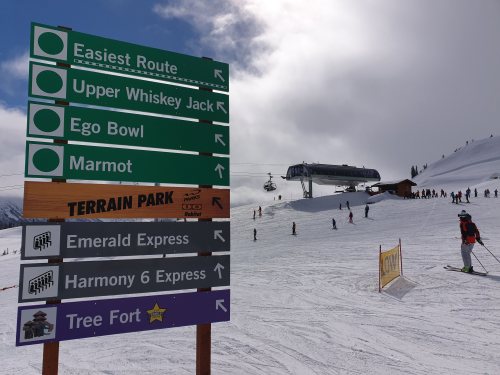
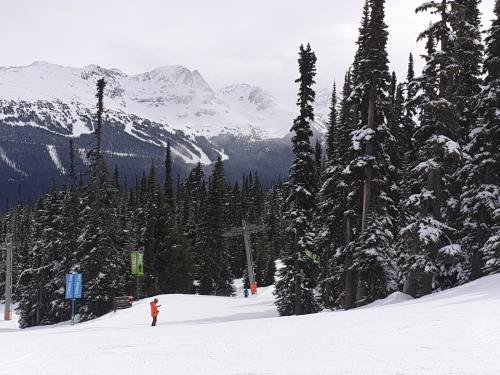
We didn’t make this decision lightly. We knew virtually every inch of the Heavenly ski area and were very comfortable with the environment, whereas Whistler, the largest resort on the continent by some margin, was an unknown quantity. Both the village and terrain were completely unfamiliar to us. Furthermore, the weather forecast for our week’s stay was discouraging, including a fair amount of rain, our least favourite skiing conditions.

20190408_103554

So it was with a degree of trepidation that we stepped off the Skylinx shuttle bus after an overnight stop in Vancouver on the third day of April and settled in our Airbnb on the edge of the village centre.  We had already determined that we would use the first day to acclimatise ourselves with the place, collect our pre-ordered lift passes, skis and boots and stock our apartment with provisions from the local grocery.
20190408_103559

We had purchased a four day lift pass to span the six days we were staying in the resort. So it was the second of those days before we queued up at the base of the Whistler Village Gondola shortly before 10 o’clock on Friday morning.
20190408_132830

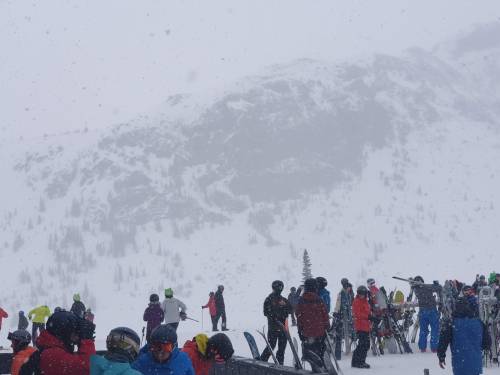
Unfortunately, the weather lived up to the forecast – cloudy and misty with alternate rain and snow showers. As a result, we did not venture too far from the area at the top of the mountain on that first day. Poor visibility, unfamiliarity with the terrain and first day nerves contributed to my falling twice on the first run, though after an early morning tantrum, things improved before the persistent wet snow drove us back down the mountain.

20190408_134903

The day took a turn for the better when we wandered into the araxi restaurant for ten Reid Island oysters, prepared by Nigel, and a cool glass of Okanagan Pinos Gris. Technically, this was a happy Hour deal, though the resulting bill argued otherwise.

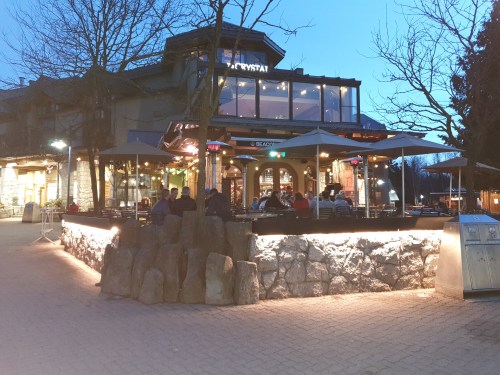
As much as we loved eating out, the cost of doing so had increasingly forced us to eat in our apartment on recent trips. But on this occasion, we had an excellent meal at the Beacon Pub and Eatery in the village square.
20190404_201553

With three days left on our lift pass, we had to make a decision as to which days to ski. Our final two days in Whistler had consistently promised the best weather, so we were committed to those. The forecast for both Saturday and Sunday was horrible, with the latter day marginally better. Our original plan of two days on, one off and then two days on needed revision, leaving us skiing for the final three days straight.

20190408_103554

Our judgement was vindicated as, even in the village, it rained all day. It did not, however,  deter us strolling around all afternoon, hopping in and out of the attractive coffee houses and gift shops.

20190406_135445

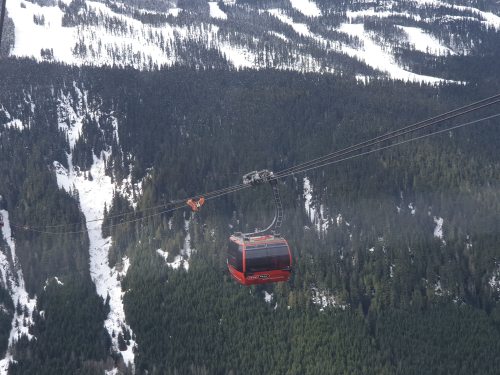
Although, in part due to the inclement weather, we had been unadventurous on our first two days on the mountain, we did not want to leave Whistler without taking the awesome and, some might claim, frightening, PEAK 2 PEAK gondola, which had been invisible on our first few days, over to the Blackcomb skiing area.

20190408_105628

After a few runs around the top of Whistler, we took the tram on our outward journey between the two largest lift terminals in the world. Although we were not deterred by the prospect of travelling in one of the glass-bottomed cabins, we eschewed the wait and took the first available one.

20190408_105902

At this point, I could bore you with lengthy statistics about the PEAK  2 PEAK Gondola, but I will confine it to a few:

  • the “longest unsupported span between two cable car towers” 3.024 kilometres (1.88 miles);
  • the “highest cable car above ground” 436 metres (1430.45 feet); and
  • completes the longest continuous lift system in the world.

Inspired by the ski lifts in Switzerland, at its highest point, it soars 5,280 vertical feet from the valley bottom.
20190408_110101

After lunch in the Roundhouse Lodge at the top of the Whistler Village Gondola on the first two days, we ate at the Rendezvous restaurant alongside the top of the Blackcomb Gondola on the last two, whilst exploring several trails around the peak.

20190408_110802

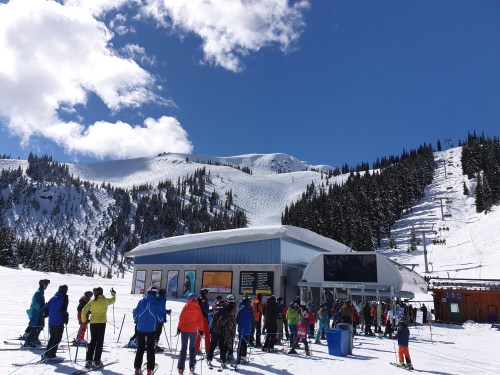
Once more, the weather forecast had lived up to expectations, and the conditions on Monday and Tuesday, especially Tuesday, were benign with sunshine replacing the periodic precipitation that had blighted our first couple of days. My skiing improved proportionately, though I still wasn’t wholly comfortable with the unfamiliar surroundings.
20190409_113926

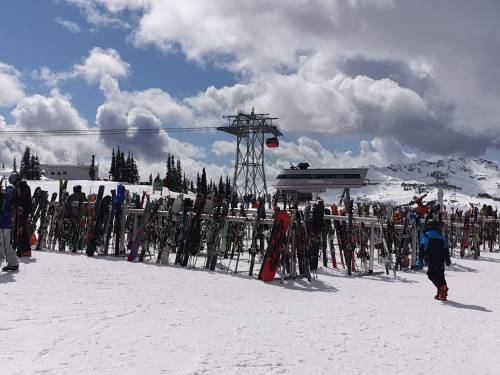
Skiing is an expensive pursuit, and I think it is not unreasonable to claim that we might not have had the full value for our outlay, certainly during the first two days when we were still acclimatising ourselves to the vast terrain under wet, gloomy skies. But by Tuesday afternoon, with a deep blue sky and warm sun beaming down upon us, life was good.

20190409_121013

20190409_132229

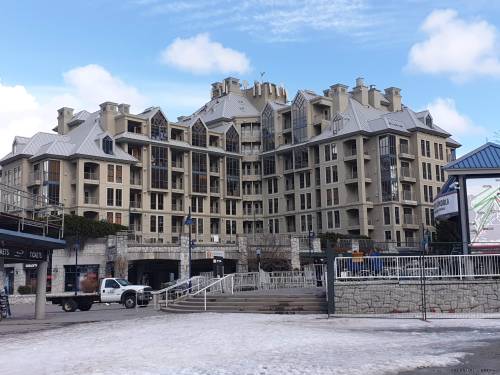
So what was our overall verdict? We liked the village of Whistler – it had a lively, friendly atmosphere and boasted some good bars and restaurants. It was likely to be even more boisterous over the coming weekend as preparations were underway for the hosting of the World Ski and Snowboard Festival. We were a little disappointed, however, that its relatively low elevation meant that it rarely saw snow on the ground.

20190406_140932

20190404_124844

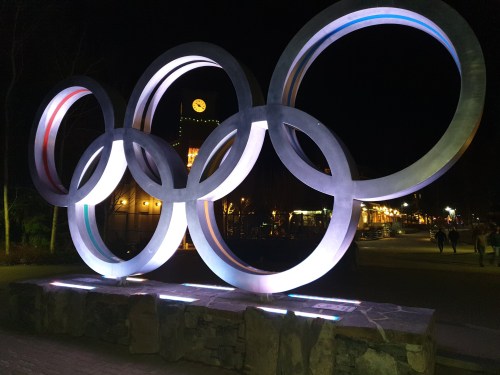
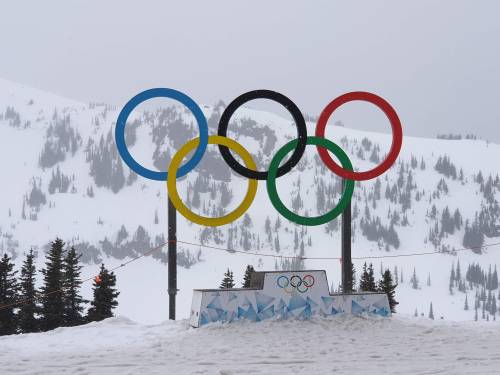
It was clear too that the village was extremely proud of its performance as host to the 2010 Winter Olympics and Paralympics Games, with impressive monuments dotted around town and on the mountain.

20190404_162320

20190408_160011

20190409_211931

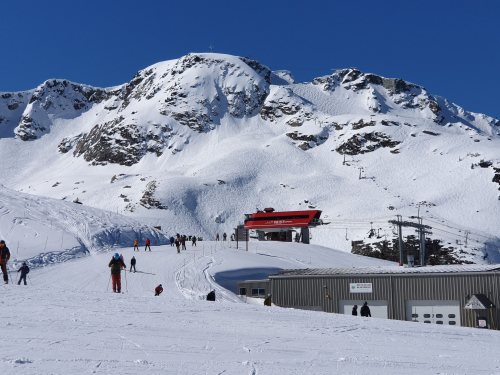
And we would certainly ski there again – there are still large parts of the terrain we have still to explore – provided the weather plays ball!

But we missed Heavenly – the lake views, the familiar trails, the mountain restaurants, even the casino bars and the drive up from San Francisco.
20190409_110853

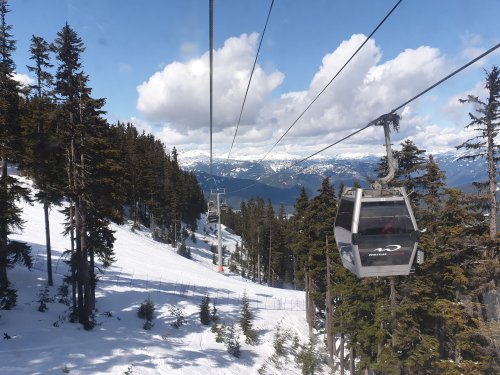
The major lesson we learnt, however, from this adventure was that we had to get fit before skiing in future – irrespective of whether we were in Heavenly, Whistler or Avoriaz or La Thuile in Europe. Although we never caught our breath as we had often done in the much higher resort of Heavenly, we ached more each morning and found it generally more tiring than it had been before. Age may have been a factor, but weight was a greater one. In the past, we had always spent the first couple of months of a new year aiming to lose weight and get relatively fit. We hadn’t this year – and it showed.
20190409_143038

Ageing and aching are an unavoidable fact of life, but at least we can do our best to minimise their impact if we shed a stone or two and exercise more in those crucial months before we set foot on the slopes again.