Feeds:
Posts
Comments

Posts Tagged ‘Earthquakes’

A First Time Visitor’s Guide to San Francisco


I am regularly asked by friends, personally and on social media sites, for advice on what are the best things to see and do on their upcoming,  and invariably first, trip to San Francisco. Rather than continue to respond on a one to one basis, I have listed below my current recommendations so that anyone can refer to them when they need to.

I should stress that the selections below reflect my personal views, though I have still included other celebrated attractions that would not necessarily be on my list if I only had a few days in the city. But the focus is on the first time visitor.

I must put my prejudices aside for this exercise! They are arranged in  no particular order.

1. Golden Gate Bridge

  • Drive it and take in the views from Vista Point, but much more spectacularly, the Marin Headlands (below), which you access by going under the road just after the end of the bridge;

OLYMPUS DIGITAL CAMERA

  • Note that you have to register in advance for the toll (credit card is charged when you return to city);
  • While you’re there, pop into Sausalito only a few miles away for lunch or coffee and fine views of the city;
  • Walk it or bike it too for more wonderful photo opportunities;
  • If you can, approach it by walking along the Marina, past Fort Mason, from Fisherman’s Wharf – it’s quite a trek and usually very bracing, but it affords great views of the bridge and Alcatraz.

2.  Golden Gate Park

  • Two splendid museums: the California Academy of Sciences and the modern art de Young Museum;
  • Japanese Tea Garden (it may be twee but it is set in lovely grounds and provides tasty oriental teas and snacks in the café);

OLYMPUS DIGITAL CAMERA

  • Stow Lake (lovely to walk round, grab a hot dog at the boat house or book a pedal boat);

P1020096

  • Visit the moving National AIDS Memorial Grove and the steamy Conservatory of Flowers;
  • The buffalo paddock (the creatures are rather shy) and the Dutch Windmill are also worth exploring at the other end of the park.

3. Ferry Building

  • Fantastic selection of indoor food and gift stores, and the sixth best Farmers’ Market in the world (according to a recent survey) outside on certain days;

OLYMPUS DIGITAL CAMERA

  • Nice bookshop and great wine bar.

4. Cliff House

  • Drive or take the 38 bus from downtown to cean Beach for two fine restaurants with stunning views over the Pacific;
  • Stroll along the beach for miles;
  • explore the remains of Adolph Sutro’s great public baths and watch the sea birds on Seal Rock;

OLYMPUS DIGITAL CAMERA

  • Take the short walk to the western end of Golden Gate Park.

5. Chinatown

  • Witness the largest Chinese community outside Asia going about their daily business;
  • Grant Avenue is best for gifts whilst Stockton contains the markets at which the Chinese women shop for produce not seen anywhere else!;

P1000148

  • You must eat here at least once during your stay – I recommend the Great Eastern, after all the Obamas eat there, and the R & G Lounge;
  • Don’t forget the side streets too with their views of the Bay Bridge and Financial District – and the Golden Gate Fortune Cookie Factory!

6. North Beach

  • Traditionally the Italian quarter adjacent to Chinatown;
  • Plenty of excellent cafés and restaurants – Trieste the most famous but Tosca, Greco and Puccini are really good too;
  • We have enjoyed meals at the North Beach restaurant, Calzone, Sotto Mare, Firenze at Night and others;
  • Rest awhile at Washington Square Park watching the dogs and their humans at play under the shadow of the Church of Saints Peter and Paul;

P1000138

  • Have a glass or two at the Vesuvio Café, our favourite bar – historic haunt of the Beats, e.g. Jack Kerouac and Allen Ginsberg, in the fifties and sixties;
  • Peruse the unique shelves of the City Lights Bookstore, one of the most famous in the world, opposite Vesuvio;

OLYMPUS DIGITAL CAMERA

  • On the opposite corner on Columbus, Broadway is the home to many of San Francisco’s more famous fleshpots;
  • Reserve seats in advance for Beach Blanket Babylon, another thing you really should do – but best to book in advance

7. Palace of Fine Arts

  • The only remaining building from the 1915 Panama-Pacific International Exposition celebrating the resurrection of San Francisco from the Earthquake and Fire of nine years before;
  • Beautiful classical structure with a tranquil swan-filed lagoon attached;

277

8. Haight-Ashbury

  • Whether you’re an old hippie (like me) or not, it’s a fascinating place with lots of “head” shops, stores selling retro clothes, good cafés, a massive record shop (Amoeba) and not a few “characters”;
  • Close to Golden Gate Park, it is possible to visit both on the same day.

P1000643

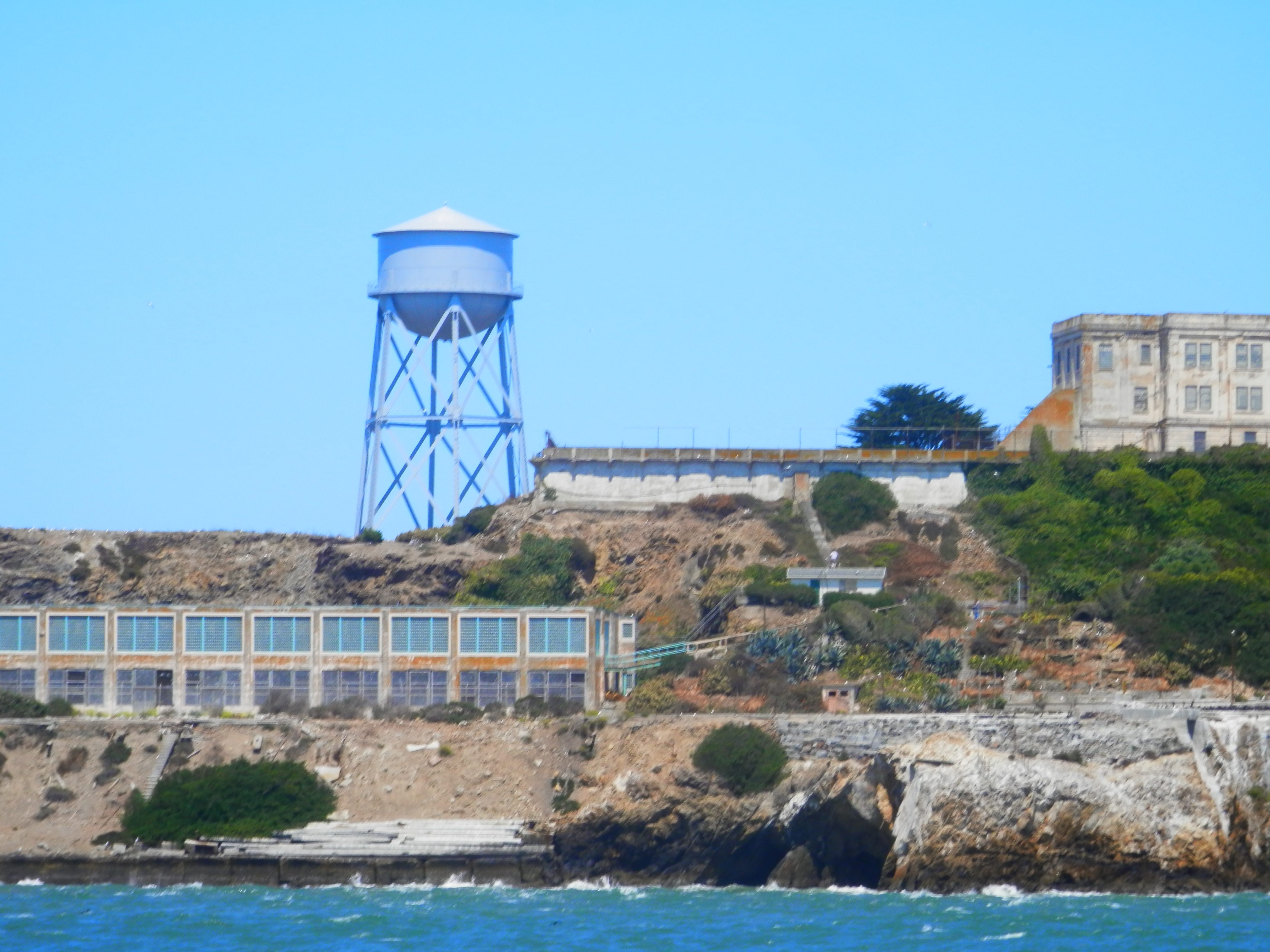
9. Alcatraz

  • It may be touristy but no visit to the city is complete without a visit to the most feared federal penitentiary of them all;
  • It is very popular so you should book in advance, preferably before you travel;
  • The day tour is good but the evening (sunset) one is even better!
OLYMPUS DIGITAL CAMERA

10. Bay Cruise

  • Enjoy an hour or two on the bay, remembering to take suncream, as much for the wind as the sun;
  • Stop off at Sausalito for a drink and a promenade, or even go on to Angel Island and Tuburon;
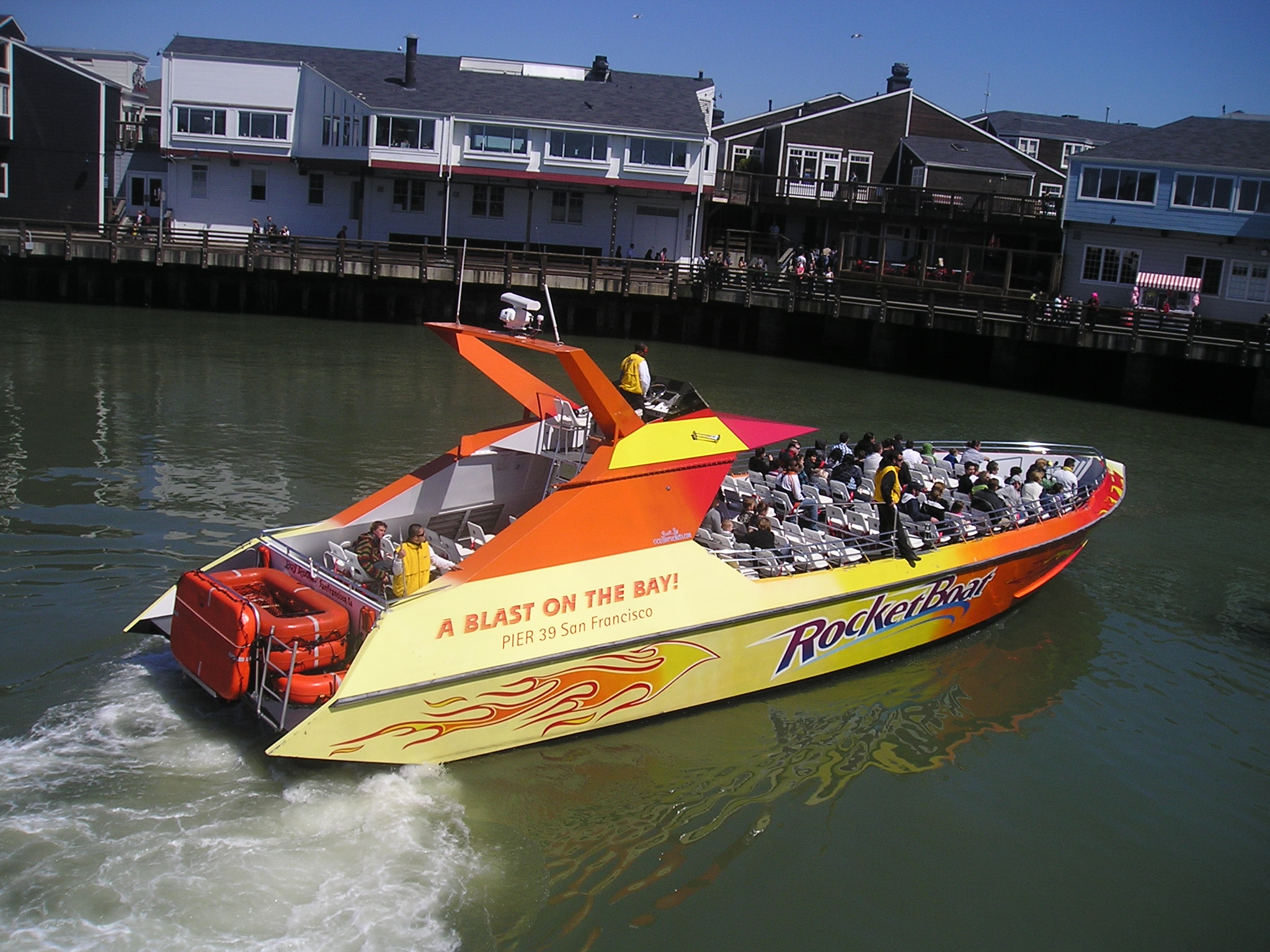
  • The Rocket Boat is tremendous fun, though not for the faint- hearted!
OLYMPUS DIGITAL CAMERA

11. Castro

  • Ground zero for San Francisco’s large gay and lesbian community, rainbow flags are fluttering everywhere;
  • Good shops and bars;

OLYMPUS DIGITAL CAMERA

  • It boasts a great movie house, the Castro Theatre, with its own wurlitzer;  if you can, book tickets for a film. You might even get lucky and be able to participate in a sing-a-long version of either The Sound of Music, Grease or The Wizard of Oz.

12. Alamo Square

  • Position yourself to take the perfect picture of the famous Painted Ladies Victorian houses with the modern city looming behind.

OLYMPUS DIGITAL CAMERA

13.  Mission

  • Boisterous, funky, and, at night, edgy Latino and Hispanic neighbourhood;
  • Great for cheap clothing and inexpensive Central and South American food;
  • Take the pilgrimage to the original Mission Dolores church where it all started;
  • But a picnic for Dolores Park and savour the great views, not only of the city but also of your fellow humans (some of which may be naked – you have been warned!).

P1020123

14. Coit Tower

  • Fire nozzle shaped monument provided for the city by Lillian Hitchcock Coit in honour of the brave firefighters of the Earthquake and Fire of 1906;
  • Take in the wonderful views over the bay, including Alcatraz;
  • See and hear the wild parrots of Telegraph Hill (though they do frequent other parts of the city too now);

P1000444

  • Climb up at least one set of steps – there are several to choose from, including those that run past beautiful urban gardens.

15.  Twin Peaks

  • The most visited spot for panoramic views of the city, though there are others e.g. Bernal Heights just as good in my opinion.

P1000111

16. Civic Center

  • Home to magnificent City Hall and several other public buildings, including the symphony/opera and library;
  • Good, cheap farmer’s market on Wednesdays.

OLYMPUS DIGITAL CAMERA

17. Fisherman’s Wharf and Pier 39

  • The most popular tourist spots on the bay, not my favourite but you cannot deny that it is a place of fun and energy;
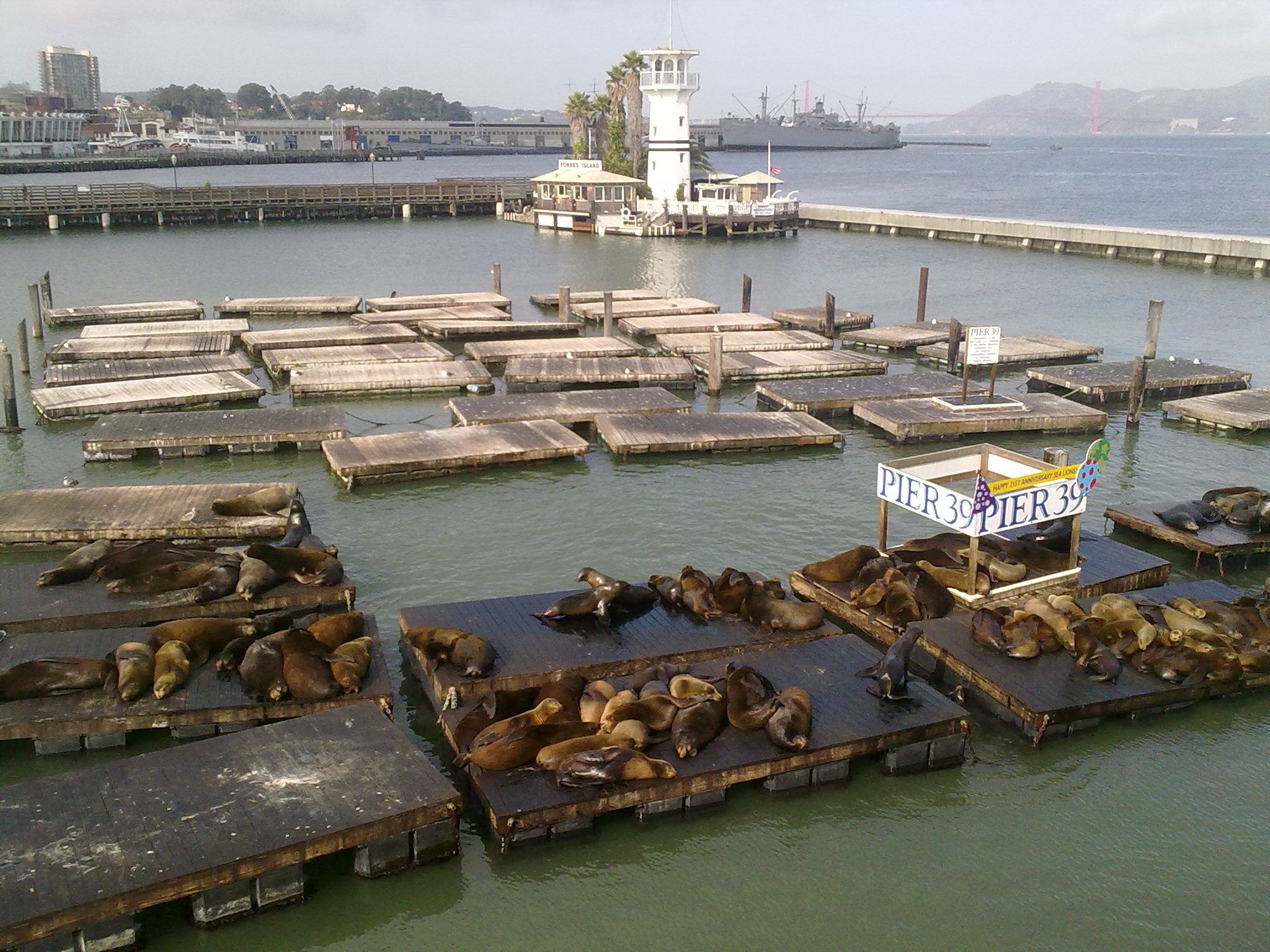
  • See,  listen and laugh at the crazy sea lions on Pier 39;
013

  • Wander round the myriad of gift shops for presents for those back home;
  • Sample seafood at the many restaurants and wharfside stalls – we have eaten well at the Franciscan, Neptune’s Palace and McKormick & Kuleto’s;    
  • The Hard Rock is here too if that is more your scene;
  • The Gold Dust Lounge, relocated from Union Square, is a good watering hole with live music;
  • The Musée Mecanique (vintage amusement arcade) and Hyde Street Pier (collection of classic ships), are two of the best deals, not only on the waterfront, but in the whole of the city; 

OLYMPUS DIGITAL CAMERA

  • Beware the World Famous Bushman!

18. Union Square

  • San Francisco’s “modern” shopping heart is very popular with tourists and locals alike, though I use it more as a thoroughfare from Market to Chinatown and North Beach;

OLYMPUS DIGITAL CAMERA

  • There are a number of good diners and grills in the vicinity, including John’s Grill, Tadich Grill and Daily Grill;
  • It borders both the Tenderloin and Civic Center, so don’t be surprised by the number of homeless people, some of which may approach you for money.

19. Bay Bridge

  • Many, including my wife, prefer this to the Golden Gate Bridge and love driving on both its upper and lower decks;

OLYMPUS DIGITAL CAMERA

  • The new span that replaced the old one destroyed by 1989 Loma Prieta earthquake has recently opened and is stunning;
  • It is spectacularly lit up at night.

20. MUNI

  • San Francisco’s public transit system is loved and hated at the same time by both locals and visitors;
  • The cable cars are not merely tourist toys, many locals use them too, and you must ride them;

P1010970

  • The lines may be long but it’s well worth the wait – hurtling down Nob or Russian Hill is a thrilling experience;
  • The historic F Streetcar that runs along Market and the Embarcadero from the Castro is charming if uncomfortable. Don’t expect, however, to get anywhere quickly;

OLYMPUS DIGITAL CAMERA

  • All human life is there on the buses!

21. Sports

  • Candlestick Park, home of the 49ers, is one of the most famous football stadia in America, and the 49ers won’t be there much longer, so get there quick!
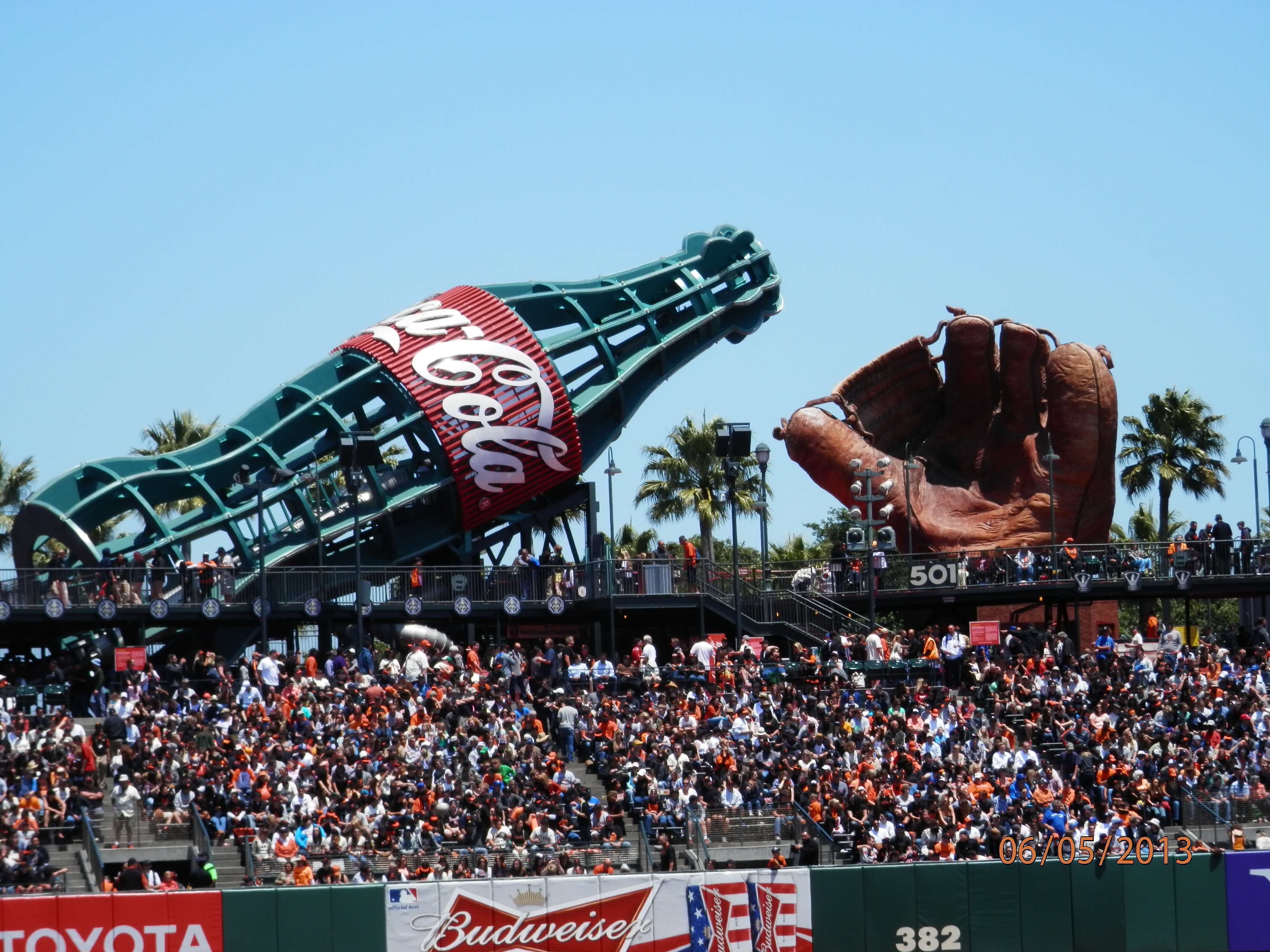
  • Even if it is baseball close season, take the tour of the Giant’s home, AT & T Park, dubbed the most beautiful sports stadium in America with wonderful views over the bay;
OLYMPUS DIGITAL CAMERA

  • You can get your (ice) hockey fix too by taking the train from the Caltrain station at 4th and King to San Jose where the Sharks will be waiting to entertain you.

This is not an exhaustive list and I have not even mentioned the many day trips out of the city that can be made, for example to Napa, Muir Woods, Berkeley, Monterey and Carmel. But I think what I have included will keep any first time visitor occupied for a couple of weeks at least!

I would be happy to answer any questions arising from this post.
Read Full Post »


Ask any visitor to San Francisco what was the most distinctive local foodstuff they tasted during their stay and they are likely to reply “sourdough bread”.  They may not have liked it because it is an acquired taste, but they will  certainly have tried it, if only in the form of a bowl containing clam chowder or, for the more adventurous, the Bread Bowl Scrambler of eggs, bacon, cheddar, onions and bell peppers.

Isidore Boudin (pronounced “boo-Deen), member of a French immigrant family of master bakers from Burgundy, founded the bakery, making the “Original San Francisco Sourdough Bread” in 1849 at the height of the Gold Rush.  It remains one of the oldest businesses in the city and still bears his name, despite having been, for much of the last 70 years, in the ownership of the Giraudo family.

P1000391

The original bakery, a tiny olde world affair, stood at 319 Dupont Street (now Grant Avenuein what was a raucous North Beach district during the Gold Rush.  Its unique flavour comes from a wild yeast that is found only in  San Francisco’s foggy climate, making it a truly local product.  Indeed, in 1970, a Federal study isolated a previously unidentified microorganism named “Lactobacillus Sanfrancisco”, proving, as Jay Hansen claimed in his book, The Other Guide to San Francisco, that “you can take the sourdough out of San Francisco, but you can’t take the San Francisco out of the sourdough”. This would account for the fact that, although sourdough is becoming increasingly accessible in Farmer’s Markets in the UK, it tastes nothing like the “real thing”.

Boudin perfected his recipe by combining his family’s traditional French baking methods with the “sour” or tangy dough taste beloved of the gold miners, to produce, in the company’s words, the “signature dark-gold, crunchy crust, soft chewy center and distinctive flavor”.

His secret lay in using the “mother dough” as a natural starter and allowing the bread to rise and “sour” at its own speed.  Even when caked yeast became the industry norm, he continued to use his slow method of leavening the bread with the mother dough.

When he died in 1887, his wife of 14 years, Louise, with the support of their four children, especially daughter Lucie, ran the business successfully for 23 years, moving twice, in 1890 to 815 Broadway and then in 1906 to its present 10th Avenue and Geary Boulevard location in the Inner Richmond district.

Louise’s greatest triumph was in rescuing the mother dough during the 1906 Earthquake and Fire by mobilising the family to carry it in buckets of ice to Golden Gate Park where they baked bread over open fires.  This ensured that they always kept a portion of the mother dough to mix for the next day’s bread. A formidable woman, she earned the title of the “social leader of the French colony”.e starter-yeast-bacteria culture that Isidore developed back in the 1840s.  At the start of the mixing process, a piece of the mother dough is combined with flour, water and salt, divided into batches and shaped into loaves, which are refrigerated for 24 hours.  The loaves are placed in a proof – or steam – box to rise.  They are then scored, or slit, and baked in a 400 degree oven.

Despite the advent of mechanisation and modern baking methods, the company has steadfastly refused to use fats, sugars, preservatives, or dough conditioners, insisting that only natural ingredients be used.

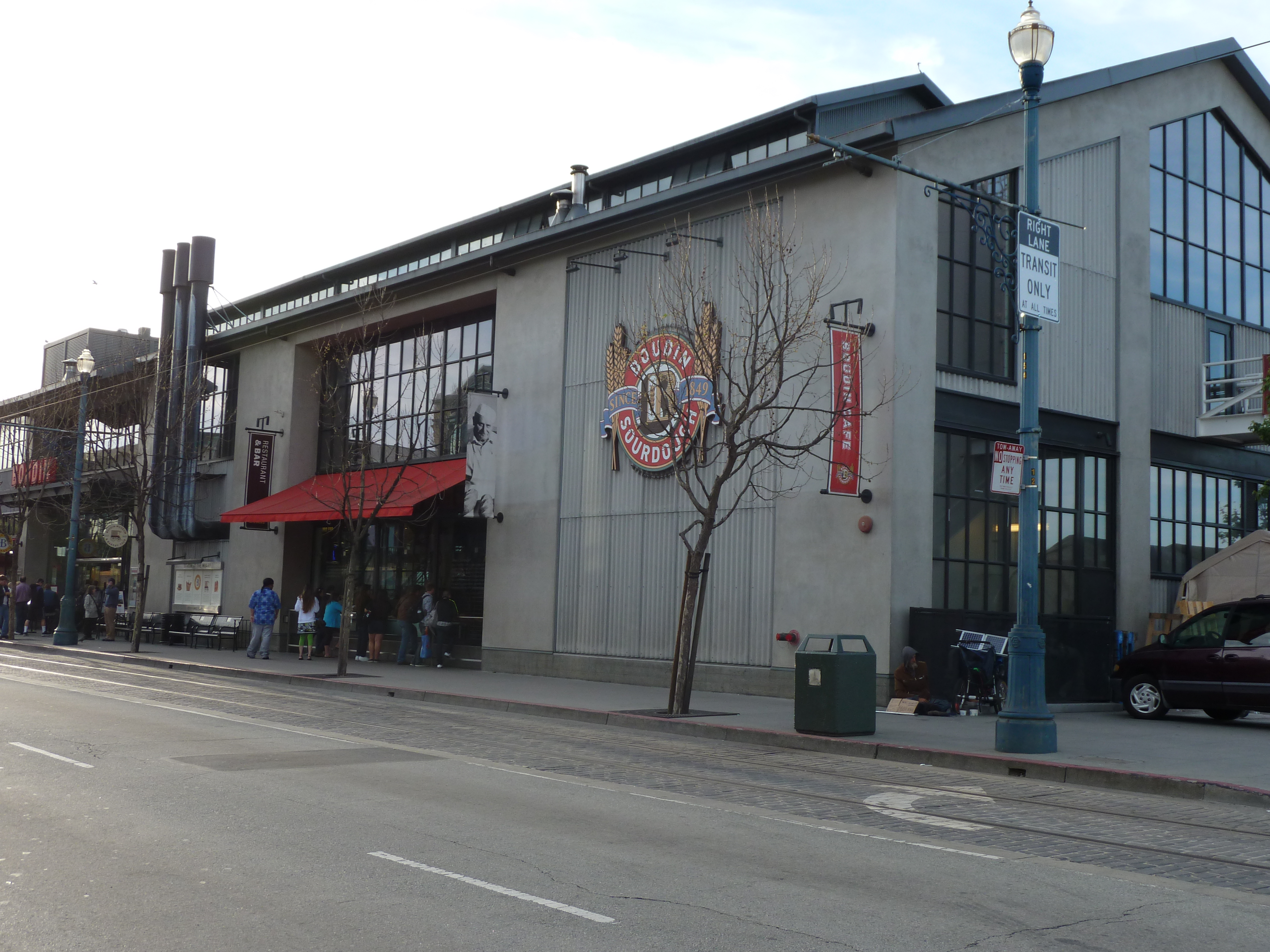
Recent visitors will be familiar with the half  block long flagship store on Jefferson Street on Fisherman’s Wharf  which opened in 2005.  Within its  26,000 square feet of space are an espresso bar, bistro, full service restaurant and private dining room, Bakers Hall market, museum and 5,000 foot demonstration bakery where the dough is mixed on a platform 20 feet above the ground floor, then tossed to the bakers below.   Passers-by are able to watch this spectacle through the 30 foot observation window fronting the bakery or, more excitingly, from a catwalk suspended directly over the bakery. Nearly 3,000 loaves are produced daily for sale in the adjoining café and shop.

P1000390

The museum upstairs chronicles the history of sourdough bread on a 28 foot timelinefocusing on the history of San Francisco through the eyes of bakers. Numerous artefacts associated with the baking process are also on display, including an antique baking wagon used to deliver bread, a replica of Louise’s desk and a carving of the founder himself.

In total, around 20,000 loaves are sold every day in the San Francisco area.  In addition to the 20 different flavours used, loaves are sculpted into numerous exotic shapes on request, including crabs, turtles, alligators, turkeys, pumpkins, shamrocks, snowmen and cable cars.  Boudin now has around 30 other bakeries in California, including one at  at Disney’s California Adventure Park which includes the hour long attraction The Bakery Tour.

I intimated at the beginning of this piece that the “Original San Francisco Sourdough Bread” is an acquired taste.  In 1990 city residents voted Boudin their favourite San Francisco bread.  Herb Caen claimed in the San Francisco Chronicle that “Fresh cracked crab with Boudin’s round “dark bake” sourdough and a well-chilled bottle of California Chardonnay is still the quintessential S.F. meal”.

Well, I’d like to raise a glass to that and say both “Merci” and “Santé” to Monsieur  Boudin!

Read Full Post »


It is funny how it is only after I return from a visit to San Francisco that I start to ponder, even worry, about the prospect of a major earthquake hitting the city.

OLYMPUS DIGITAL CAMERA

I have recently been reading A Crack In the Edge of the World: America and the Great California Earthquake of 1906 by British born but recently naturalised American, Simon Winchester, a magnificent exploration of the origins, development and aftermath of the magnitude 8.25 Earthquake and ensuing Fire that hit the city on 18th April of that year, and it set me to thinking what is increasingly fascinating me from afar.

Aside from his narrative skill, Winchester, as befits a masters graduate in geology from Oxford, is perfectly placed to explain the scientific basis for earthquakes. Irrespective of how imperfectly I understand that science, his voice is authoritative, and this paragraph in particular sends a chilling message to all those living on the San Andreas Fault, and especially in the city by the bay:

It is not a question of whether a big earthquake will occur, nor even a question of precisely where it will hit. There will be a quake, it will be considerable, it will be somewhere in the vicinity of San Francisco, it will more than likely affect the San Andreas Fault or one of its cadet branches – and it will take place, most probably before 2032. The only true unknown is the precise year, month, day and time.

The U.S. Geological Society actually issued a formal forecast in 2003. Sometime before 2032 , along one of the seven fault systems that belong to the San Andreas cluster, and which cut their way through the Bay Area, there is a machine-computed probability of 62 per cent that an earthquake with a magnitude of 6.7 or greater will strike. There will be damage and casualties “on an impressive scale”.

All those communities, not least the major city in the area, have comprehensive plans for dealing with every type of disaster, as well as providing detailed guidelines for those “authorized to know what their duties and responsibilities are in the event of the most statistically likely major disaster that is anticipated in the region – and that is a very, very large earthquake”.

And, of course, since the Loma Prieta earthquake of 1989 that, amongst its other effects, caused part of the upper deck of the Bay Bridge to collapse onto the lower and much of the Marina district to be destroyed, many buildings have been checked and reinforced to enable them to stand a chance when the next “big one” arrives.

That is all reassuring I’m sure. But I wonder how far the citizens of San Francisco are truly geared up to cope when it comes. I suppose if the authorities kept hammering on about it it would instill a pervading sense of paranoia that would do nobody any good. But I have rarely seen or heard any references to the subject during my trips to the city. Having said that, it has not even crossed my mind whilst staying there – though I am becoming increasingly fascinated both by the historical context and the future potential for calamity.

So does it concern me that my beloved city could be seriously damaged any moment? Of course.

Does it deter me from visiting it often, and, hopefully, more than before, in the future? Not at all.

Is there just a small part of me that hopes I am there when it happens? I think there might be (many witnesses of the 1906 quake recorded their excitement at being part of a major historical catastrophe, and more still posed for photographs amid the ruins even as their homes disintegrated).

But do I wish it? Of course not.

I know that I have a number of readers who would be directly affected by an earthquake. Do they think about it at all? Do they worry about it? Are they confident that they would know what to do if such a disaster struck?

It would be interesting to know. Answers at the bottom of this post please.

Read Full Post »


As this series develops I hope to be able, where the events of the day allow, to present a “main feature” i.e. a story in some detail supported by a list of “lesser” happenings that are worthy of note.  But I am at the mercy of history and this may not always be possible.  

The following events occurred on this day in history:

1848: Gold is discovered by James W. Marshall, a foreman working at Sutter’s Mill on the American River in Coloma, 130 miles to the north east of San Francisco, triggering the influx of 300,000 prospectors seeking their fortune and transforming the city from a small town into a booming, bawdy metropolis. 

Doubts persisted for some time whether the small, golden nugget that had made Marshall’s “heart thump” as it was more the colour of brass than the customary reddish-tinged gold found elsewhere.  A few tests revived his confidence that he had struck gold, though it was not until March before the rumours were confirmed for all in San Francisco to hear.  That story will be  be recounted on the relevant day.

1980: Just before 11am a powerful, rolling earthquake centred ten miles to the north west of Livermore and measuring 5.8 on the Richter scale, hit, destroying the Lawrence Livermore Laboratory, a major storage depot for nuclear materials.  Forty four people were injured and the estimated property damage was $11.5 million. 

It was felt over a large area of central California and parts of western Nevada and was followed by 59 aftershocks in the next six days and a second principal earthquake on 27th of the month.  

1982: The San Francisco 49ers won Superbowl XVI by defeating the Cincinnati  Bengals 26-21 in cold, snowy conditions at the Pontiac Silverdome in Pontiac, Michigan.  The treacherous roads leading to the stadium caused the 49ers motorcade to be delayed, though the team arrived in time for the kick off. 

Joe Montana, in only his third season, was named the Super Bowl MVP, completing 14 of 22 passes for 157 yards and one touchdown, and also rushing for 18 yards and a touchdown on the ground.  The Bengals were the first team in Super Bowl history to lose the game whilst accumulating the most yards and touchdowns.

Nearly thirty years on the game remains one of the most watched broadcasts in American TV history, pulling in 85 million viewers.

Read Full Post »