Feeds:
Posts
Comments

Posts Tagged ‘fishing’


A biting breeze and thin drizzle denote December’s inevitable but uninvited return. Twilight descends on the ancient churchyard.

Never has the phrase “quiet as the grave” seemed more apt. 

As I pause to tie my bootlaces by the Town Cross, venue for the making of mayors for many centuries, my body shudders as a young woman brushes past me, the hem of her blue dress grazing the grass border, and her white headpiece fluttering in the wind. She carries provisions – bread, leeks and a small flagon of beer – for the poor in a round wicker basket, forswearing another potentially lucrative tryst with a Northumbrian nobleman, orchestrated by her frustrated father.

Her head bowed, she whispers “Good evening, sir, God be with you”. Before I can frame an intelligible response, she disappears behind the west window.  

Composing myself as best I can in the circumstances, I shamble on past the crumbling tombs, narrowly avoiding a collision with a rat, scurrying across my path to the sanctuary of the lopsided lychgate leading into Church Street. The Pullman pub is empty, save for a few flickering candles and a lone member of bar staff deep in conversation with his mobile phone. 

The lanterns of Rendezvous Street are unusually dim, and the restaurants are sparsely populated. 

The stillness is unnerving, but strangely thrilling.

I turn into the narrow, twisting, rain drenched street that slides down towards the harbour.

Many months have elapsed since chaotic, cacophonous Charivari had snaked up that old thoroughfare, all drums and whistles and cymbals, and other less conventional instruments. More recently, the ground had groaned beneath the burden of polished, red-laced “Doc” Martens, worn by follicly challenged pilgrims lumbering towards Gillespie’s and The Ship for an afternoon of Special Brew, and worship at the altars of Prince Buster and The Specials.

I am alone.

But am I?

The fog in my brain mirrors the slowly enveloping mist approaching from the bottom of the hill. Images of times past in this salty, saintly town start to consume my thoughts. 

Nothing is quite what it seems.

My longing for one last lingering look at the dazzling, daily alchemy conjured up in the rock shop near the top of the street Dickens christened a “crippled ladder” is soon answered. The heady, fashionable aromas of craft beer and Nicaraguan coffee cannot compete with the memory of the sickly sweet perfume radiating from that beloved spot, where, nose squashed against the glass, a small boy gasped in awe at the thick, long sticks of heaven being rolled.

“Let me in at the front, Michael, you’ve been stood there for ages”, pleads his tearful younger sister, Anna, her view obscured by the taller girl stood in front of her.

“Have they started giving out the bags of broken bits yet?”, another boy bellows from further back in the crowd.

A sudden, excited scrum confirms his suspicion as I catch an intoxicating whiff of granulated sugar.

It was often claimed that if Rowlands were to shut its doors for good, Folkestone would die; a prediction, thankfully, since proven dramatically wrong, 

I stumble into Steep Street Coffee House for cake and cappuccino, a combination that never fails to comfort. I am their last customer of the day and the staff, without being obtrusive, are cleaning up around me. The self-styled Folkestone Poet has vacated his customary sales pitch across the cobbles at Big Boys Burger, his heavy overcoat and leather balaclava no longer a match for the diminishing temperatures. 

I pass by Marley’s – or what I thought was Marley’s. From a dark upstairs room, redolent of patchouli and cigarette smoke, a loud, piercing jukebox exhorts me to “go to San Francisco” a seductive reminder of the original Summer of Love on such a bleak winter’s evening.

Two young men in afghan coats, and a messy profusion of facial hair, are huddled at the foot of the crippling, crumbling Bayle Steps. 

“Hey man, how’s it going?”

“Far out, whatcha doing’ tonight?”

“Going’ to Archies. The Lonely Ones are playing”.

Nice. I hear there’s some hot Swedish chicks in town too”.

“That’s settled then, Archie’s it is”. 

“Yeah, and I could kill for one of his salami rolls right now”.

I start to follow them through the door, only to find that the closer I get, the scene dissolves in the moist air, and I am left once more outside Marley’s rather than the Acropolis

The piercing cold slices through my flimsy denim jacket and hastens my progress to the bottom of the street. Everything is still again as I try to rationalise the scenes I have encountered in the past half an hour. 

I cross a deserted Tram Road car park and pass under the arch by Ovenden’s old forge into the empty fish market, tiptoeing around the grimy puddles that tend to settle there, whether it has rained or not. 

A solitary gull plods apologetically past, pining for Spring and the reopening of Chummy’s and Bob’s seafood stalls, when it will again be afforded means, motive and opportunity to ambush tourists for their fish and chips and tubs of whelks.

Pausing outside The Shell Shop, I appear to have stepped into an earlier time again. Men in cloth caps and heavy, seaweed encrusted boots trudge up the slipway opposite, lobster pots and herring nets half empty after an exhausting and disheartening shift. They slap their meagre catch on the floor of Fish Shed One, light cigarettes and congregate in whispered conversation.

‘Darkie” Fagg, “Cottage” Featherbe and “Lobby” Spearpoint are leaning on the railing and reminiscing about better days, while Old Ned Saunders, retired these ten years, is mending the sprat nets for a “free” pint or two in The Oddfellows Arms later this evening. 

On The Stade, wives and daughters juggle the demanding tasks of cleaning fish and supervising the smaller, and not so clean, children. 

Observing this picture, it is difficult to gauge which gender had the tougher life.

Meanwhile, grubby, barefoot young boys, oblivious to the dedication and drudgery of their elders all around them, chalk stumps on the wall of Clouts Alley.

“I’ll be Jack “Obbs, you can be Clarrie Grimmett. I’ll ‘it you into the “arbour, every time, just you see” brags nine year old Harry Sharp.

But with his first delivery, Clarrie, better known about these parts as Edmund, and, later years, “La La”, Taylor, traps Jack in front of his wicket and appeals for leg before.

“Owzat! Got you with me flipper, pom”.

A heated dispute follows, culminating in the great English batsman hurling his bat against the wall and storming off in the direction of Redman’s boat builders.

His mother, ankle deep in half gutted dogfish and three scruffy toddlers, calls: 

“Harry, your tea is ready. And find your brother before you come in”.

“Five more minutes, mum. I’ve got to bowl Don Bradman out first. it won’t take long”.

“Five more minutes, my arse – you’ve got thirty seconds. This tea won’t wait. If you don’t get to the table soon, the other kids will have your share”

A case of bad mum stopped play.

As this scene of family harmony evaporates, I hear, from across the harbour, a sergeant major’s earsplitting admonition to “Step Short”  to a long procession of uniformed men stomping down the slope from the Leas above.

The rhythmic sound of boots on concrete is accompanied by raucous renditions of Pack up Your Troubles in Your Old Kit Bag and It’s a Long Way to Tipperary, as the soldiers march to the waiting ships that will take them to the Western Front.

But there is one last treat before their sombre adventure begins.

Inside the harbour station waiting room, two formidable middle aged women adjust their pinafores and rearrange any curls that have slipped beneath their flower bestrewn boaters. They inspect the massive urns containing the last hot, strong tea most of these men will ever drink.

“Come on boys, form a straight line, you don’t have long, you know”, Flora Jeffrey cries out with a tinge of regret in her voice, while her sister Margaret cuts thin slices of trench cake and bread pudding to complete what, for many of these condemned men, will be their last meal.  

“And don’t forget to sign the visitors’ book before you do”.

“All right, all right, you sound like me muvver – nag, nag, nag”, one private who claims to be twenty one but looks barely sixteen, retorts, as he lurches towards Margaret and slurs:

“Give us a kiss”.

But before he can perfect this unwise manouevre, a grizzled veteran of Mafeking and Ladysmith yanks him back by his collar and barks:

“Show the ladies some respect, young ’un’. You ain’t in the playground now, y’know”.

“Sorry, old timer, I didn’t mean nuffin’ by it, it was just a bit of fun”.

Flora chuckles: “You got off lightly there, my boy, that’s nothing to what Margaret would have done to you if you’d got any nearer!”.

An outpouring of communal hilarity is unleashed, and the embarrassed teenager slinks back into the anonymity of the crowd.

I separate from the excited, but fearful, throng with the final strains of Keep the Home Fires Burning ringing in my ears, and join the boardwalk that connects the station with the base of the thirty year old water lift along the beach to the west. 

But I have hardly stepped foot on the old railway sleepers before finding myself in the midst of a large conglomeration of buildings, including a swimming pool, boating lake and fairground rides.

As I try to take all this in, a crew cut kid in knitted cardigan and khaki shorts can be seen rushing into a huge, dimpled dome that is destined to be his whole world for the next two weeks. He will never tire of rolling a penny for plastic motor cars or shooting a steel ball into a hole for packets of mints.

His father and mother, the latter clutching a wad of what appear to be tickets, frown as they dismount from the blue plastic seats they have occupied for the past two hours, where they had been subjected to an increasingly annoying loop of “legs eleven”, “two little ducks, twenty two” and “two fat ladies’ eighty eight”. 

The boy drags himself from the penny pusher slot machine and scampers towards them in a frenzy of excitement.

“How many wins did you get, mum?”.

“Eight”.

His heart sinks. “Oh no, that big cuddly monkey on the bottom shelf is nine wins. Can you play some more games and win it for me?”.

“We don’t have time, darling; besides dad and I want that nice set of tea trays that are eight wins. They will be just perfect for our TV dinners when we get home”.

“Boring”. 

Feeling betrayed and despondent, the boy skulks off in the direction of the Runaway Coaster.

But he is soon appeased by a promise to go to his favourite fish and chip restaurant in Tontine Street for tea.

Intermittent drizzle and mist has given way to steady rain and a thickening gloom. Hungry and shivering, I resolve to return home. 

Christmas lights bestride the street across the ragged rooftops, and retailers and restaurateurs contend for the accolade of best dressed window, though tonight there is nobody about to judge them. 

Apart from the echo of my boots upon the sodden cobbles, silence is restored.

Until I reach Archie’s.

From that same gloomy upstairs window from whence the Flowerpot Men had serenaded me two hours – and a hundred and fifty years – earlier, the Small Faces remind me that:

“It’s all too beautiful”. 

After the battering my senses have taken this evening, I remain to be convinced of the veracity of this hypothesis.

So I try, for the second time, to gain access to the old haunt of hippies and radicals.

As I take my first hesitant steps in its direction, fully expecting to find myself in Marley’s again, the doors open of their own accord and I am permitted to enter.

And there, waiting to greet me, is the original owner, Mickey Argegrou, who is anxious to introduce me to his special guests for the night. 

To my astonishment, St Eanswythe is here. The modest blue and white garments she had been wearing during our perfunctory encounter in the churchyard earlier have been replaced by brightly coloured, patterned flower dress and matching peaked hat. She is sampling her first ever cup of coffee and, judging by the uncharacteristic grimace that quickly follows, she is unlikely to order a second. Water from her own spring and the occasional small goblet of mead will remain her preferred tipples. 

With the final troop ship of the day, Engadine, set sail for Boulogne, and the Mole Cafe consequently closed, the indomitable Jeffrey sisters have swapped their pinafores for elegant three quarter length dresses. They appear to be conducting a taste test of Mickey’s famed rum babas, comparing them in the process with their revered fruit cake.   

John Brickell, still in his overalls and safety cap, is here too. He has disappointed his vast army of young fans by holding back the remnants of today’s rock rolling, handing the broken bits around to the grateful regulars, who find them a perfect accompaniment to their cocktails. 

And Harry Sharp, grown in the past hour into a handsome young man, but still smarting from his first ball duck at the Clouts Alley Oval, is feeding the jukebox, while Old Ned Saunders, released from his net repairing duties, though not separated from his favourite fisherman’s jumper, for the evening, is leading a communal sing along to the latest tune selected by Harry:

“Those were the days, my friend”.

After the scenes I have witnessed this evening, I am inclined to agree. 

Read Full Post »


My upcoming poetry book, “Dust in my Cappuccino” is a collection of thirty two poems inspired by the coastal town of Folkestone in the south east corner of England. In order to provide some context to the poems for those readers unfamiliar with the town, I have written a short history of the town. This will feature as the introduction to the collection when it is published next month.

Located on the south east coast of England, a handful of miles from the famed White Cliffs, and only twenty two miles from continental Europe, Folkestone has had a long, varied history, boasting both Bronze and Iron Age settlements and a prominent Roman Villa, sadly now perilously close to the cliff erosion that has always afflicted this coastline.

Descended from the the Anglo-Saxon Kings of Kent, Eanswythe, a devout young princess, founded a nunnery in the town in the seventh century AD, and was subsequently made a saint. Her bones, discovered in the parish church by workmen in 1885, were radiocarbon tested and confirmed in 2020, and the church is now becoming a growing site of pilgrimage.

For a thousand years, Folkestone was a modest fishing village and, for most of that time, as a limb of the Cinque Port of Dover, also a busy trading port. Smuggling was a not insignificant business from the eighteenth century too. But it was the coming of the railway and associated cross-channel ferry industry from 1843, and the construction in later decades of grand hotels and white stuccoed family homes, notably in the West End, that contributed to its rise as a fashionable resort that attracted royalty, artists and writers in addition to the Victorian and Edwardian middle class. Much of this development was conceived, funded and overseen by the Earl of Radnor, who still owns land in the town and surrounding area.

The “golden age” that began around 1880 arguably came to a sudden halt with the outbreak of the Great War, which had a profound effect on Folkestone. It became a major port of embarkation for the Western Front, and the final sight of England for millions of troops, many of whom will have marched from the neighbouring Shorncliffe army camp. The bombing of Tontine Street in 1917 brought about the highest number of British civilian dead as a result of an air raid during the war up until that point.

The inter war years saw a revival, with Folkestone exploiting its natural beauty – the Channel views, rolling hills, delightful parks and gardens – by marketing itself as “Fashionable” and “Spacious and Gracious”. Moreover, its popularity as a resort was enhanced by the Earl of Radnor’s “foreshore development” that included the building of the Rotunda, the largest unsupported concrete dome in Europe, swimming pool and boating lake, supplementing the existing Victoria Pier, switchback railway and the 1885 Leas water lift.

The town suffered heavy bombardment during the Second World War, destroying much of the harbour, but recovered as a seaside destination during the fifties and early sixties, which is when my Folkestone story began. The Rotunda, quaint, steep Old High Street with the revered Rock and Joke shops and the popular ferry route to Boulogne-sur-mer, kept the visitors coming and the locals entertained.

But, like so many other UK coastal resorts, it suffered a deep decline as the advent of cheap air fares, duty free and longer annual leave allowance, led to an escape to resorts where the sun was twenty degrees warmer and the beer ten degrees colder. Many of the much loved attractions and hotels closed, were demolished and converted into flats, and trade in the town slumped. Although the cross-channel ferry industry stopped at the turn of the century, Folkestone has retained its role as a point of departure to the continent with the opening of the Channel Tunnel in 1994.

The new Millennium brought a revival, aided by the philanthropy of former Saga owner, Sir Roger De Haan, who renovated and refurbished many of the buildings in the old town, offering the properties to creatives, provided education and sporting facilities (the latest of which the world’s first multi-storey skatepark), and restored and remodelled the derelict harbour area. The construction of up to a thousand apartments along the shoreline between the Leas Lift (currently closed) and the Harbour Arm is also now underway.

Since 2008, the Folkestone Triennial has showcased new works from established British and International artists, around half of each remain in the town once the exhibition is over. There are now around ninety such pieces placed outdoors around town.  

De Haan’s influence and the arrival of the high speed rail link (only fifty four minutes from London) in 2007, has proved a happy marriage in rendering Folkestone more accessible. Comparatively cheap (but rising) house prices, the advantages of living by the sea, a vibrant dining scene and improving facilities, not least for children, have all led to a growing relocation of people, many of them young families, predominantly from London.

My love affair with Folkestone began at the age of ten when I was brought by my parents from my hometown of Rochester, forty-five miles away on the North Kent coast, on the first of a succession of summer holidays to the town. It was my mother’s admitted but modest pretensions to social mobility which led to the choice of Folkestone rather than the traditional “bucket and spade” resorts such as Herne Bay, Margate or Broadstairs.

Once I left home and moved around the country for study or work, visits became much less frequent, though I always retained my affection for the town. In fact, my parents long harboured the desire of retiring to Folkestone (on their last holiday together they had stayed in the Grand Burstin Hotel at the harbour), but with my mother’s relatively early passing, it never materialised. But their groundwork was not done in vain, as when the opportunity arose in 2016, my wife and I had no hesitation in moving here.

I have gathered together thirty two of my poems inspired by Folkestone, in which many of the themes and events I have outlined above are referenced and explored. One particular challenge has been whether to present them in a systematic way, for example, chronology, geography or subject matter, but ultimately, they are laid before you in an essentially random form, at least superficially.

Read Full Post »


Even the gulls are taking a morning off
As I drift around the deserted harbour;
The tide is out, the sky deep blue,
And the beach warm and yielding
Under my inappropriate footwear.

Amidst this light brown desert,
Brief rivulets of muddy water
Command me to take a run
And leap to reach the
Next patch of firm dry sand.

The railway viaduct now fenced off,
The Grand Burstin and Rocksalt
Both dark and sad and empty;
And the metal gates to the Harbour Arm,
Anticipated host to thousands
Over this warm Easter weekend,
Are firmly closed.

On a morning as delicious as this,
It would have been perfect
To stroll its two concrete tiers;
But the only tears today
Are for the sick and fearful
Imprisoned in homes and hospitals
Across an anxious but resolute land.

Bob’s seafood stall and Folkestone Trawlers
Plough lone furrows on the deserted Stade,
While a pair of deep wrinkled fishermen
Lean against the chain railing and reminisce
When fish was plentiful and the ferries full.

I bound another murky stream
And lean against the pink house;
Planted in self-isolation,
Its former lustre lost too,
With peeling paintwork and ponder the fate
Of the next Triennial, triumphantly announced
Barely a month, but another lifetime, ago.

I turn the corner of the East Head
Under the rock perched orange house,
That, unlike its pink neighbour,
Has had a reviving lick of paint;
Two young girls lift their skirts,
And paddle in the gentle, shallow waves
On the incessant, incoming tide;
I cannot avoid the uncharitable suspicion –
A sign of these strange and fretful times –
That, as they giggle and jostle each other,
They may not be from the same household.

I could stay here for hours yet,
Till the water washes over my shoes,
But an insistent call of nature,
Prosaic and not infrequent visitor
To this man of a certain age,
Summons me to return swiftly
To my home by the park.

Read Full Post »


This is an adaptation, and considerable shortening, of a piece I wrote a couple of years ago.


Mermaid Beach at Dusk

On a night like this, the Cote d’Opale
Might as well be a thousand miles away.

It is a calm, quiet, otherworldly evening
After a dank, dreary December day;
Sky and sea present an ashen canvas.
Tonight it is impossible to tell
Where one ends and the other starts.

Despite slimy conditions underfoot,
I elect to descend from
The well-lit comfort of the Leas
To the chilly Channel seashore.

Barely a whisper from the surf tonight.
I cannot even hear Matthew Arnold’s
“Grating roar of pebbles
Which the waves draw back”,
So faint is nature’s melody this evening.

Across town, an artwork springs to mind,
Above Tontine Street’s old post office
Proclaims that heaven is a place
Where nothing ever happens.

Because nothing is happening tonight
In this desolate speck of paradise.

But then, everything is happening.

To the east, the lighthouse blinks
Through the thick, enfolding gloom;
A tuneless, abandoned church bell
Hangs silently suspended above
Where once stood rotunda, swimming pool,
Boating lake and fairground rides.

A dalmatian puppy snuffles among
The seaweed encrusted pebbles
On the dark shoreline, while its
Fretful owner punctures the peace
With impassioned and fruitless pleas
To follow her back across the beach,
To the refuge of her Range Rover.

A lone fisherman sets out his stall
For what appears a long night ahead,
Reminding me of all night sessions
With my teddy boy uncle fifty years ago,
On the shingle beach at Dungeness.

I wonder now why I ever went,
I was never interested in fishing!

Pastel hued beach chalets are now
Padlocked up for the winter,
Along with the Mermaids Cafe Bar,
Welcome pit stop on the promenade
From Folkestone to its upstart neighbours,
Sandgate, Seabrook and “posh” Hythe.

I defy anyone to assert that they
Do not like to be “beside the seaside”;
And I look forward to a first full summer
Season in my coastal home next year.

However, it is at moments like this,
With the cold, dark sea alone for company,
When enjoyment is such a feeble word
To evoke the effect of this magical place;
I can only equate it to a profound love,
Both infatuation and long term comfort.

Read Full Post »


From centuries of slog and slime,
From Pent and Channel battered,
A sleepy, careworn fishing village
Today becomes a town that matters.

Herring, mackerel, crabs and sole
Now make their way to Billingsgate,
And fetch a price not seen before
The railway raised flat Folkestone’s fate.

Sun, with constant bedfellow, breeze,
Smiles on the arrival of the first class fares,
While locals rush to harbour viewing points
From auction sheds that plied their wares.

The first wave of “down from Londoners”
Steps from gleaming horse drawn coach
That brought them from a makeshift station
In lieu of soon to be rail track approach.

A boisterous band blares out the latest hits
Of Wagner, Chopin, Strauss and Liszt,
As crinolined ladies, with handbags and fans,
Tease gentlemen whose advances they resist.

Steam powered Water Witch, focal point
Of this auspicious day, adjoins the quay,
And nervous passengers clamber aboard
In clothes unsuited for a swelling sea.

But the water’s calm and the crossing smooth
As guns and flags bid travellers adieu,
In three hours, on Boulogne’s teeming dock,
An even louder band greets guests and crew.

Now, La Marsellaise and God save the Queen
Salute the excited but exhausted crowd,
A necessary triumph for entente cordiale,
Two towns so far, but now so near, made proud.

In Folkestone, normal service is resumed,
Men mend nets and women cook and clean,
Habitual chores for o’er a thousand years,
Yet a smaller, faster, world can now be seen.


Read Full Post »


This is where east meets west,
Dover Road and Augusta Gardens;
Where DFLs mix with Folky born and breds,
Cold war adjourned for one warm afternoon.

Tram Road traffic crawls and curls
Around a heaving Harbour Street,
Affording passengers an extended view
Of much loved, yet loathed, Grand Burstin.

A brisk breeze, cooling the searing sun,
Sweeps champagne flutes to a watery end
In the chastening Channel spray
That laps the lighthouse;
Proof that, sometimes, weather
Can be a first to place and time.

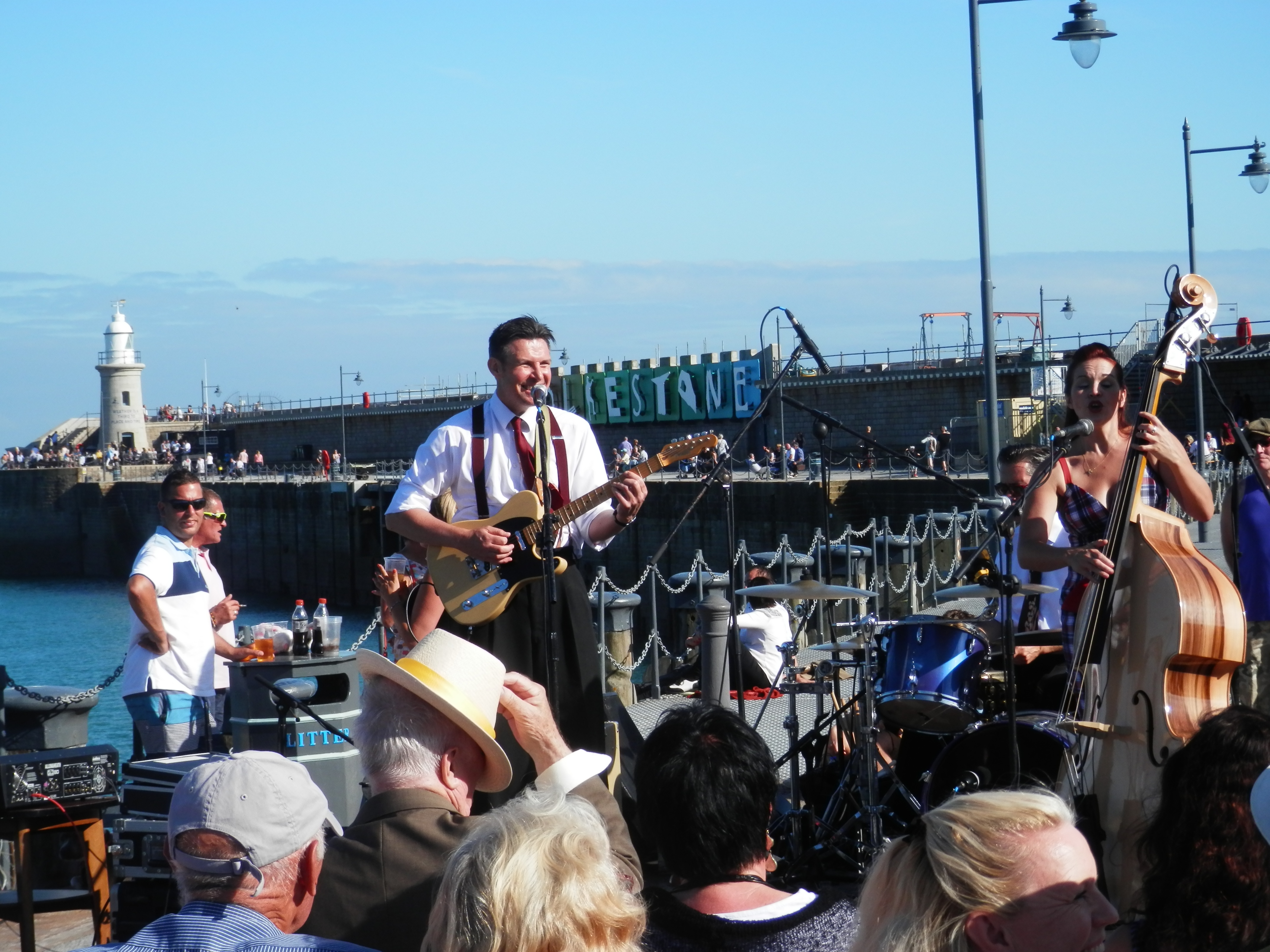
Sinatra’s call to Come Fly with Me
Gives way to the eclectic sounds
That entertain the growing queues
For Sole Kitchen and Hog and Hop.
While the Native Oyster Band
Has the crowds singing and swaying,
Kadialy Kouyate’s kora mesmerises,
Bringing the authentic sounds of
New Orleans and Senegal to
This English coastal paradise.

Children build bricks to knock them down,
Dash between Baba Ji and Pick Up Pintxos
Or search for the iron man in the water,
(Don’t worry, kids, he will be back!).


But if the heat and tumult are too much
And it is peace you pine for,
Retire inside to the Mole Cafe
For a mug of strong, hot tea
And a chocolate swiss roll,
Reminders of a quieter,
Yet more violent, time.

Tomorrow, normal service will be resumed;
DFLs will become RTLs
(Work it out!);
The Arm will be handed back
To anglers, cormorants and
A few unsuspecting souls,
Drenched by crashing waves
Cascading over the Folkestone sign.

But is this the lull before the storm?
Eden before the Fall?
Will those blissful views across
To ancient East Cliff and to Sunny Sands
Be there to inspire us still
In three, or five, or ten, years?

Or will the thunder of pick and drill
Drown out those of bass and drum?

Read Full Post »


The Cote d’Opale might as well be a thousand miles away on a night like this.

It is a calm, quiet evening after a dank, dreary December day. The sky and sea present an ashen canvass. It is difficult to tell where one ends and the other starts. Spencer Finch’s The Colour of Water, the artwork that requires people, by looking through a narrow aperture, to match the colour of the sea with one of a hundred variants of shade placed around the perimeter of a large wheel, is set firmly in the grey quadrant.

Despite the slimy conditions underfoot, I choose to descend from the well-lit comfort of the Leas to the bleak seashore via the Metropole Steps rather than the Zigzag Path, deducing that the strain on my knees and calves will be less that way.

There is barely a whisper from the waves tonight. The overwhelming flatness of the scene has deterred the customary photographic shooting party from assembling to capture the final, ferocious blaze of orange and gold of the sun over Sandgate shore. Anyone hoping to catch tonight’s projected meteor shower will be sadly disappointed. Even the moon, a mere twenty four hours from full term, doesn’t appear bothered to turn up.

Neither do I hear Matthew Arnold’s “grating roar of pebbles which the waves draw back”,  so imperceptible is nature’s refrain this evening. Aleppo, Trump, Yemen, Brexit all drift from my consciousness, at least for a short hour. I am at peace, and am reminded of  Nathan Coley’s Talking Heads inspired sign on Tontine Street that “ heaven is a place where nothing ever happens”.

Because nothing is happening tonight in this little speck of paradise.

But then everything is happening.

Across the bay, the lighthouse on the Harbour Arm blinks through the gloom. The sixteenth century Out of Tune bell, rescued from a church in Leicestershire, hangs suspended above the area where once the rotunda, boating lake, swimming pool and fairground rides, thrilled generations of children.

A dalmatian puppy snuffles among the seaweed encrusted pebbles on the shoreline, while its impatient owner punctures the peace with impassioned and fruitless entreaties to it to accompany her back to the refuge of her Range Rover parked at the foot of the Leas Lift.

A discarded, empty tuna mayonnaise sandwich pack flutters in the breathless breeze in the midst of Folkestone’s own modest version of Stonehenge or Avebury. If, as seems likely, the stillness of tonight’s air fails to dislodge it, I am reassured that a town sprucer will probably complete the job in the morning.

A lone fisherman has set out his stall for what appears to be a long night ahead. It reminds me of all night sessions on the Dungeness shingle with my uncle half a century ago. I wonder now why I ever went. I was never interested in fishing. I don’t even recall experiencing the elation of catching much either. Perhaps it was the thrill of spending a night away from home on a beach with a nuclear power station looming over me that lured me.

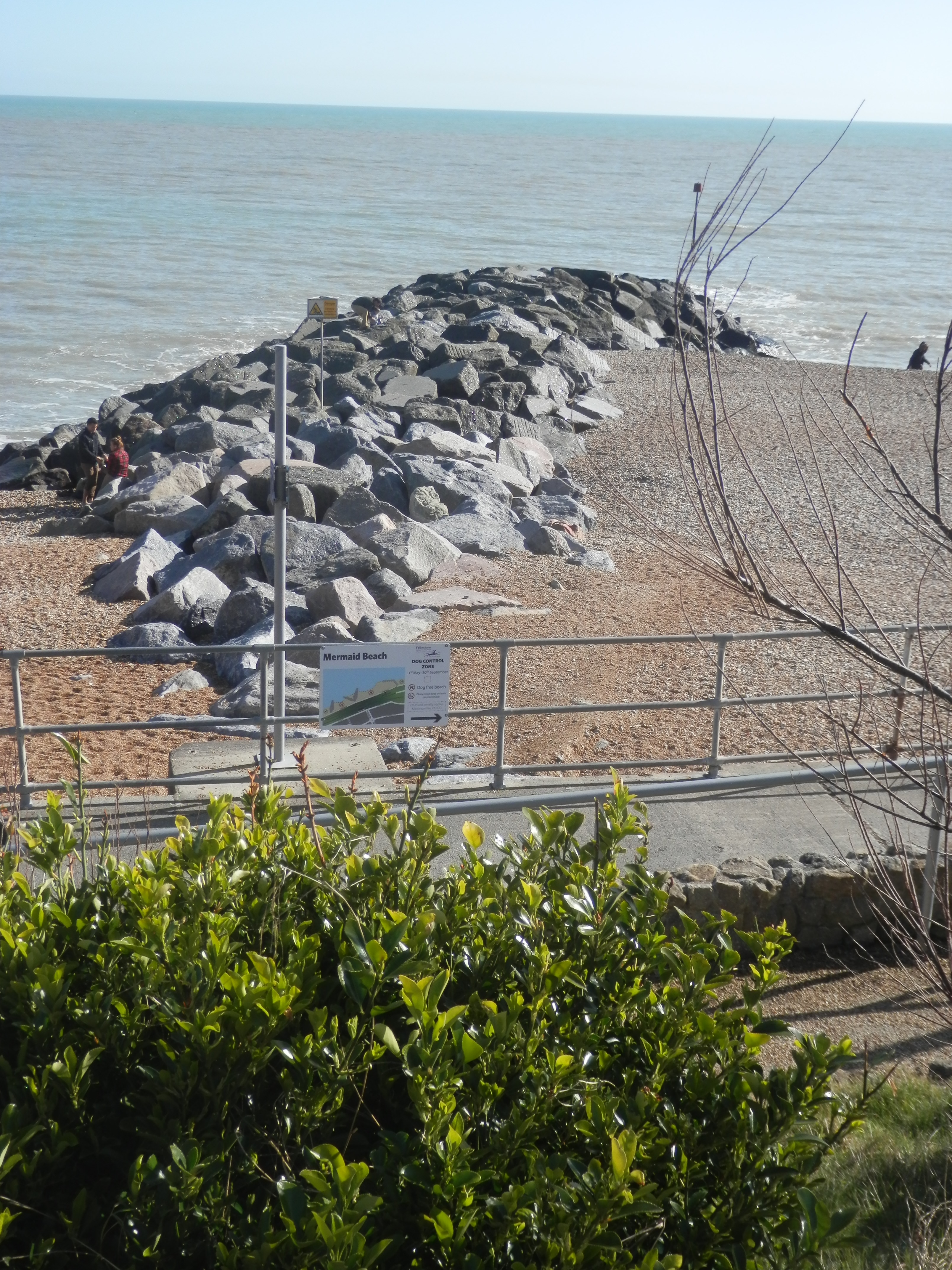
I stroll along the curved seawall that separates the two main parts of the beach, squinting at the six wooden, weirdly shaped seats donated by the Dutch government, and reach the imposing rock groyne. It would be foolhardy this evening to venture out onto this mini-Giants Causeway as some do during the daylight in low tide.

Debate rages on social media as to whether the shape of the groynes that branch out in opposite directions from the beach represent a mermaid, gull, whale or even the Royal Air Force crest. I will not fuel the dispute here, other than to offer the diplomatic suggestion that there is a case to be made for all of them. Whichever it might be, it is a fine sight by day when viewed from the Leas.

Pastel hued beach chalets are now padlocked up for the winter and the Mermaids Cafe Bar, welcome pit stop on the long promenade between Folkestone and its western coastal neighbours of Sandgate, Seabrook and Hythe, is now open on fine weekends only. Tonight, it is dark in contrast to the newly renovated View Hotel beaming benignly down upon it. The hotel’s Cliffe Restaurant, which, in only a few months, has earned a deserved reputation for fine dining and excellent service, will, in contrast, already be busy with office Christmas parties.

I return to the Leas via the lovely Zigzag Path, a walk rendered all the more atmospheric as I weave through its alcoves and tunnels, by its resemblance to those of a Greek island. All that is missing, thankfully, are the maltreated donkeys.

I defy anyone to deny that they enjoy a warm summer’s day by the sea. After all, as the popular expression goes, life’s a beach. And I look forward to the first full summer in my coastal home next year.

However, it is moments like this when enjoyment is a hopelessly inadequate word to describe the impact of this magical place on me. I think I will attempt to define that more fully on another occasion, but, for now, I can only equate it to love in all its manifestations.

Once in a while you get shown the light in the strangest of places if you look at it right is one of my favourite quotes, and is never more relevant than in relation to my feelings for Folkestone. Who would have thought that fifty three years ago, when four adults and three children aged between eight and ten years plus luggage, miraculously emerged from my mother’s Ford Anglia, to cram into that bed and breakfast in Foord Road, that not only would I make this my home all these years later but would instantly become enraptured by the place all over again?

Read Full Post »