Feeds:
Posts
Comments

Posts Tagged ‘Kent cricket’


Below is my report of the first day’s play in the LV County Championship game between Kent and Middlesex at the St Lawrence Ground, Canterbury on Wednesday 17th August 2011.

Rob Key, returning to the Kent side after sitting out the two recent CB40 matches nursing his troublesome wrist injury, won the toss on a bright morning at the St Lawrence Ground and elected to bat. Azhar Mahmood, fresh from his all-round heroics the night before in the thrilling CB40 win over the same opponents, replacing the injured Simon Cook, was the only change in the Kent team that had beaten Surrey equally impressively in the Championship game of Canterbury Week.

Openers Key and Joe Denly played watchfully against the accurate opening attack of Murtagh and Collymore, both of whom extracted some bounce and a little movement.  The opening 11 overs brought just 13 runs, with the only boundary coming from an edge by Denly between third slip and gully. Only when Crook replaced Collymore did Denly open up with two expansive back foot drives through the off side for successive boundaries.

Despite his excellent recent form in the four day game, Key struggled in particular, playing and missing on several occasions. When he did play his first shot in anger – a handsome cover drive – it was brilliantly fielded. 

The predominantly blue skies gave way to an off white cloud cover that began to provide more assistance for the Middlesex seamers.  Crook was unlucky when he induced Denly to snick two deliveries past third slip for four, though the opener followed this with two further boundaries with sumptuous straight and off drives off Collymore. The introduction of the Middlesex captain, Neil Dexter, into the attack was greeted by Denly with two more powerful drives through extra cover and mid off.

Key continued to struggle, particularly against Collymore, finally edging an outswinger to Malan at first slip for 17 with the score at 61. Sam Northeast, fresh from his mature fifty in the previous evening’s match, started in confident mood, but was caught behind by Simpson off Crook shortly before lunch for 3, leaving Kent 71 for 2. Denly responded with a cover drive off the same bowler to bring up a fine half century, and Kent went to lunch at 77 for 2.

A highly entertaining afternoon session brought 165 runs and 8 wickets.  Martin van Jaarsveld, who had failed to score in the CB40 match, made just two before being caught behind off Crook with the score at 83.  Denly followed just four runs later when he was given out, perhaps a little unluckily again, leg before to Tim Murtagh for a fine 55.

Darren Stevens and Geraint Jones steadied the ship with a stand of 45, mostly by virtue of expansive drives, before the latter was adjudged leg before to Collymore for 26.  The hero of the previous evening, Mahmood, joined Stevens but anxious to get off the mark off his first ball, he failed to get back in his crease in time to beat the bowler Collymore’s javelin-like throw. 

Kent were now 132 for 6, which soon became 155 for 8 as, firstly, Stevens played tamely onto his stumps off Dexter for 27 and Ball edged Collymore to Dalrymple at second slip for 8. James Tredwell and Matt Coles added a breezy 57 for the ninth wicket with a series of thumping drives and judicious sweeps befpre Tredwell became the second player to chop onto his stumps off Collymore for 31.

Wahab Riaz’s arrival at the wicket placed Coles in the unfamiliar role of senior batsman, and he appeared to take that responsibility seriously by advising the Pakistani international that he should curb his natural game whilst he was left to play his shots.  In fact, Riaz acquitted himself well, even contributing equally to a final wicket stand of 30.  He was left 17 not out when Coles, much to his and the crowd’s disappointment, pulled Murtagh to the mid wicket boundary nine short of what would have been a deserved fifty, a fitting achievement for what was probably his most mature innings in the Championship side. 

Kent were all out for 242, falling eight short of a second batting point.  Collymore was the pick of the Middlesex bowlers, taking 4 for 69 whilst Murtagh and Crook both took two wickets.  Tea was taken at this point.

Middlesex began their innings with 31 overs remaining in the day, and a very late finish on the cards. However, increased cloud cover and slight drizzle called a halt to their innings after just 13 overs at a relatively untroubled 55 for no wicket, 187 behind the home side.  Robson, who had been the main aggressor, was 37 not out and his partner, Newman, 16 not out at the close.

The state of play at the end of the first day is almost identical to the previous week’s match against Surrey when Kent made 266 and their adversaries proceeded comfortably to 50 for no wicket.   Largely by virtue of Darren Stevens’s career best bowling figures of 7-21, Kent skittled Surrey out for 127 the next morning and went on to win by a massive 265 runs following a second collapse by the visitors on the third afternoon in very poor light.

Away from the action on the field, the  day’s highlight was undoubtedly the continuing, and largely unwitting, entertainment provided by the Club’s new tannoy announcer.  Having jettisoned the bizarre “bowled lbw” form of dismissal, he still delights by telling us about changes in the bowling AFTER they have taken place, often prefacing it “as you may have already noticed”!  And it would appear that Middlesex now have three members of the Murtagh family in their side, as today their bowling attack included Tim, Timothy and even James!

Footnote: Despite the unpromising position that Kent found themselves at the end of this first day, they went on to secure another impressive win over promotion-chasing Middlesex by 65 runs on the last evening.

Read Full Post »


On a baking early August day I took in my first day’s play of Kent second XI cricket for many years against Glamorgan at Mote Park in Maidstone.  It was an equally belated return to “the Mote” which, since 2005 when the county was, unjustly, deducted eight points by the England and Wales Cricket Board (ECB) for a sub-standard pitch, had not hosted first class cricket.  My sense of anticipation was twofold – an opportunity to see a number of highly regarded young Kent players in action for the first time, and to reacquaint myself with the ground that has always been second only to the Nevill at Tunbridge Wells in my affections.

As I walked up Mote Road, with my right shoulder creaking under the weight of my new holdall bulging with laptop, notebooks, Kent CCC annuals and food, but rendered even heavier by the purchase of three cricket books in the Oxfam bookshop in town, I was saddened, if not altogether surprised, to see that The Cricketers pub was up for sale, a shame as it had often been a handy retreat during the lunch intervals in the past.

My initial impression on entering the ground was that it seemed in remarkably good health (it is still the home to cricket, rugby and squash clubs). The lovely two-storey pavilion, a recent centenarian, looked resplendant with its tiled roof and handsome black and white gable, hanging baskets and recent paint job.  On closer inspection, however, the facilities inside clearly needed substantial upgrading to meet the demands of the modern professional game. 

Alongside the pavilion stands “the Tabernacle”, described by George Plumptre in his book, Homes of Cricket – the First-Class Cricket Grounds of England and Wales as “one of the most delightful curiosities to be found on any county ground”. 

It had been built by the Mote’s most prominent patron, (Sir) Marcus Samuel in the style of “an ornamental cottage with herringbone pattern brickwork and a covered verandah in front”.  Originally Marcus’s private pavilion in which to entertain his well connected friends, it had latterly become a temporary office for the county club during the traditional week, as well as a suitably imposing structure from which “the brethren” the Band of Brothers Cricket Club could sit and watch the game.

Today, it was a dusty shell, though it was heartening to note from the contractors’ awning that a significant makeover was imminent, perhaps a further indication that the local authority and club were making necessary ground improvements in preparation for the resumption of county cricket in the next few years, a “consummation devoutly to be wished” by this supporter.  

The mature trees, primarily oaks, encircling the ground were magnificent as always and the new fence at the bottom end, whilst plain and rustic, gave it a neat appearance.

Entering the pavilion in pursuit of a scorecard, I saw a sight I wasn’t expecting – Daniel Bell-Drummond helping himself to a fruit juice.  A dashing opening batsman, the 17 year old from Millfield School is being touted as a star of the future, and had already been scoring attractive runs in the England Under 19 team.  It had not been expected that he would be released from an international boot camp to play today, so this was a pleasant surprise.

Salivating at the prospect of watching him and 18 year old Fabian Cowdrey, the latest in the distinguished Kentish cricketing dynasty, open the innings and rattle up 150 before lunch, the news from Daniel that Glamorgan had won the toss and elected to bat was deflating – my hopes raised and ruthlessly dashed in the space of thirty seconds! 

Although Kent sported an experienced attack,  it already felt like it would be a day of toil for Kent players and spectators alike, which it subsequently proved (Glamorgan were 287 for 5 at tea when the combination of heat and desultory action persuaded me to leave).

The outstanding moment from the Kent perspective was a stunning leg side stumping by 20 year old Sam Billings off Simon Cook. Billings is yet another prospect in what might (everything is crossed) develop into a “golden generation” for the county.  Already being “billed” as Kent’s best wicketkeeper since the mercurial Alan Knott, he also proved the chief cheerleader in a side that was vocally encouraging of each other all day, impressive given the humd conditions and very different from the deathly hush that falls over the first team for long intervals in the field.

The size of the crowd, a number of whom appeared to follow the second XI to the exclusion of the full county side, probably did not reach 100, with smatterings in the pavilion, alongside the tabernacle, under the great oak tree and on the top of the ground, many sitting in their parked cars in chairs bought from the local garden centre. 

I had not known what to expect when I arrived, particularly as far as catering was concerned.  Whilst I had bought my own food I was worried whether I would be able to get a drink at all, hence my delight, half an hour after play had commenced, to see the bar open and the Shepherd Neame Whitstable Bay handpump hove into view.  A couple of gorgeous pints of that helped to counteract the stifling heat.

There was a quaintness about proceedings that belied the intense endeavour of young men striving in stifling heat to use their undoubted talent to forge a career in the game.  This was epitomised by the hilarious sight, every half an hour or so when the umpires called for a drinks break, of two small boys, the sons of the former Kent player and now part-time coach, Mark Ealham, with a combined age of no more than the number on the back of Kent captain Alex Blake’s shirt (10), bounding onto the field carrying hefty trays of cold concoctions that must have weighed at least as much as their bearers.  Priceless!

It is a pity that there are now no more home second XI games this season because I think I’m hooked!  Oh, and I do hope that the club and the local council can get their act together and bring first team county cricket to this beautiful ground that was, after all, Colin Cowdrey’s favourite.

Read Full Post »


“You must be mad”.
“The game could be over in a couple of minutes”.
“They’re sure to lose”.
“And you’re going to pay a £16 rail fare and possible £10 admission price for that?”
 
The sort of comments to be expected from the sensible and soulless.
 
After three days in which they have been also rans in the game, Kent need 52 runs to win with just two wickets left.  But one of the undefeated batsmen is captain Rob Key who has already made 144, over half the team’s score of 270 for 8, chasing 322 for a victory that seemed remote when they had been 87 for 6 in their first innings in response to the home side Surrey’s 387 all out.
 
So why am I going? The match could be lost in just two deliveries, and it will seem pointless and anticlimatic.  Key and his tail end partners, Robbie Joseph and Ashley Shaw, will be facing a formidable attack comprising England’s premier fast bowler and two other promising right arm seamers with a new ball in helpful conditions.
 
Would anyone in their right mind make a nearly two hour journey by public transport to catch the last five minutes of a football (soccer) match in which their team are already losing 2-0?  Or the final innings of a baseball game when their favourites are 4-0 behind in the bottom of the ninth with no runners on base and two out?
 
Probably not………but.  There is a chance, an admittedly slim one, that Key, with doughty support from his numbers 10 and 11. might just pull off an unlikely and famous victory.  And I would be able to say “I was there!”.  Very few people who follow sports with any fervour would deny the exhilarating feeling that that engenders –  such events live in the memory long after dozens of dreary defeats have been forgotten.
 
And perhaps that feeling is no more acute than in cricket when, however uninspiring the preceding 18 hours of play might have been (this has, however, been an absorbing game throughout), everything comes down to a matter of minutes, perhaps as much as an hour, where every ball leaving the bowler’s hand has the potential to destroy and every run scrambled stokes up the tension.
 
Or as J.M. Kilburn memorably put it: “cricket never was and never can be a game of continuous excitement or of great achievement every day.  The quiet hours, the simple strivings, are as much a part of the attraction as the unforgettable moments of high drama”.  The quiet hours and simple strivings are now done with in this match – it is high drama from now on.
 
Despite Key’s five and a half hour heroics, Surrey remain strong favourites to complete the win.  And were I at home listening to the inevitable denouement I would shrug my shoulders, accept that the result had been on the cards and be thankful that I hadn’t wasted considerable time and money trekking to South London to witness it.  The emotional impact would be minimal.
 
But if Kent won and I hadn’t been there!  Any sports fan will know that, thrilling though that might be, their response would be tempered with a certain frustration and disappointment that they had not shown sufficient faith to have witnessed it.  A part of them will have rather craved a glorious failure in order to vindicate your judgement.
 
As I approach Bromley South on my inbound train journey from Gillingham to London Victoria, an elderly, greying, gap toothed woman lovingly folds sprigs of purple heather in aluminium foil.  I’m almost inclined to ask her for one there and then in the hope that it might bring Kent luck!  But I resist as she is clearly intent on wrapping as many as she can in the remaining twenty minutes of the journey before foisting her wares on unsuspecting tourists.
 
It is standing room only after Bromley South and a three year old girl chuckles to her “granny” that this must be the “wobbliest train I ever saw……….I keep bumping into everyone”.  Even the commuters hypnotised by their laptops and Blackberries cannot avoid a smirk.
 
After a short underground journey I reach the Oval tube station forty minutes before play, pleased to see that admission is free, though membership cards are still required to enter the pavilion (the “disgusted of Tunbridge Wells” streak in me is glad to see standards are being maintained even with such a sparse crowd).  It is more February than July – the glowering skies and brisk wind make the choice between cold beer and hot tea an easy one.
 
The players vigorously going through their paces in the net area on the Harleyford Road side of the ground almost outnumber the spectators.  As if conscious that the game will be over soon the dozen pigeons that would usually set up their encampment on the edge of the square at around tea time are already circling the playing area.  The talk amongst the members, Surrey and Kent alike, in the middle tier of the pavilion, is of Key’s “magnificent” innings and the prospect of the Surrey pace attack of Tremlett, Linley and Meaker rolling over the last two visitors’ wickets quickly.
 
And the outcome? Predictable valiant failure on the behalf of the Kent batsmen. For forty minutes  Key and Joseph looked comfortable – the former thumping 4/5 balls an over at the dispersed field before taking a single on the 5th or last ball, and his partner  judiciously leaving or solidly playing the remaining deliveries.  As the score mounted towards 300 the sense of unease in the Surrey camp became palpable, provoking lengthy discussions between Rory Hamilton-Brown, the  captain, and his senior players. Shredded nerves induced a wayward shy at the stumps that went for four overthrows and a wild delivery from Linley that flew for four byes. But to his credit, with only 29 needed, the Surrey captain turned to his spinners, Batty and Ansari, both of whom promptly took a wicket, including Key’s for 162, to complete a 21 run win for the home side.
 
Scars of sweet paradise indeed or as Sir Neville Cardus said: “Dear, lovely game of cricket that can stir so profoundly, that can lift up our hearts and break them, and in the end fill them with pride and joy”.  Being there, the overwhelming feeling as I returned to the tube station was one of pride.
 
But I could not help also feeling regret that I had not purchased that sprig of lucky purple heather when I had had the chance.


Read Full Post »


My first recollection of going to a county cricket match was a trip to the Nevill Ground in Tunbridge Wells on Saturday 15th June 1963 when I was ten.  Although the cricket I witnessed was characteristically utilitarian for that era, the game evolved, in the words of Wisden, into one “without parallel in the history of first class cricket”.  On Monday morning (there was no play on a Sunday then), the Middlesex first innings of 121 for 3, in reply to Kent’s paltry 150 all out, was declared closed by the umpires because nine members of the visiting team, allowed home for the weekend rather than staying in a local hotel as they had done the night before, were delayed in a massive traffic jam, and did not reach the ground in time for the start of play.  There is little else to commend the game, however, as rain on the final day condemned it to a draw.

In those days my father and I travelled to the traditional festival weeks at “the Wells”, Maidstone, Gravesend and Canterbury on the special double decker buses laid on by the Maidstone and District Motor Services Ltd.  With virtually no one day cricket – the Gillette Cup competition was in its first year and only test matches were televised – championship games represented the only opportunity a young boy had of seeing his cricketing heroes, in my case the Kent captain, Colin Cowdrey, play live.

The bus journey was uncomfortable, a combination of sitting upstairs, poor suspension and unforgiving road surfaces.  Nonetheless, it was exciting, not least because of the animated, sometimes, coarse, banter engaged in by the adult male company, speculating on how many runs Cowdrey might score today or, equally pertinently, how much weight he had put on since they last saw him, a fact belied by his graceful batting and nimble slip fielding (the manner in which he pocketed a catch and then looked behind him to see if the ball had reached the boundary always deceived and delighted this marvelling supplicant).

Sadly, he made just 8 runs on this fateful day, caught and bowled by medium pace bowler Ron Hooker.  And ten days later his season was over when his left arm, just above the wrist, was broken by a delivery from the fearsome fast bowler, Wes Hall, on the final afternoon of the second test match against the West Indies at Lord’s.  However, with England needing six runs to win with two balls left, he returned to the wicket with his arm in plaster.  Fortunately, he did not need to face a ball and the game was saved. 

In his autobiography he stated that he “felt confident that even if I had to face a couple of overs I could keep the ball out of my wicket one-handed”.  Now, that’s a true hero!

Already a cricket fanatic and no mean schoolboy player either, I was forever hooked on the three, now four, day format of the game.  Equally captivating was the arena itself, set in a shallow, tree-lined bowl, with rich splashes of pink and mauve rhodedendron bushes in full bloom.  At the lower end of the ground a group of marquees curving gently from the ladies’ stand to the Cumberland Walk entrance.  The large, decorated tents were home for the week to dignitaries such as the Mayor of Tunbridge Wells, the Band of Brothers and the Men of Kent and Kentish Men.  Their elaborate lunches stretched long into the afternoon session of play, providing a raucous if refined aural backdrop to the almost incidental action on the field.

Furthest from the pavilion were smaller tents populated, amongst others, by the less privileged, but no less respectable, denizens of the Association of Kent Cricket Clubs (my father and I often sat here) and the Civil Service Sports Council, where beer and sandwiches were more likely to be the luncheon of choice, but where attention was firmly directed on the cricket.

The open seating area opposite was shared by the middle and lower orders, the former in their own deckchairs, parked, along with picnic tables and baskets, behind the boundary ropes where the family dog snoozed contentedly, dreaming of its next walk during the lunch or tea interval, but intermittently jolted from its slumbers by the polite applause that greeted a well struck boundary or the fall of a wicket.

The “free seats” were where you were most likely to find those hardy souls who had endured the bumpy bus rides from around the county.  Dressed in jacket, collar and tie (this was “Royal” Tunbridge Wells after all and the “sixties” had still not quite announced themselves), they dined on pork pies and cheese and pickle sandwiches wedged into tupperware containers, whilst drinking tea from flasks prepared by their wives earlier that morning.  As a special treat, they might visit the public beer tent to fortify themsleves for delivering fruity retorts to the gentry laughing and clinking their wine glasses across the other side of the wicket. 

It is hard to argue in one sense with Philip Larkin’s assertion that “life was never better than in nineteen sixty-three…..between the end of the Chatterley ban and the Beatles first LP”.  It may have been an eventful year, with the Profumo scandal, the assassination of John F. Kennedy and the explosion of the British pop scene, but it was cricket, county cricket, Kent County Cricket Club and the Nevill Ground in particular that stirred the soul of at least one ten year old boy that day.

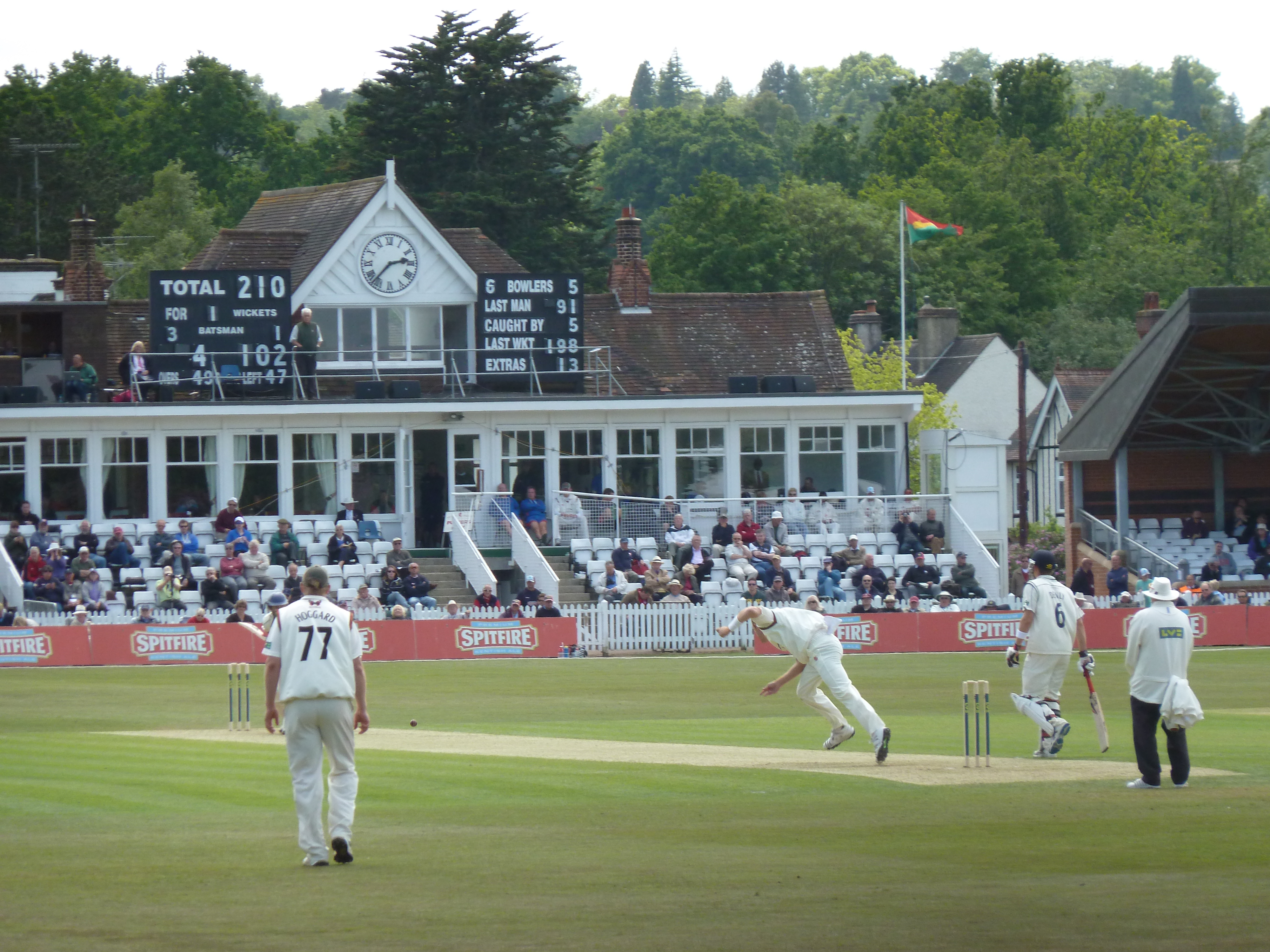
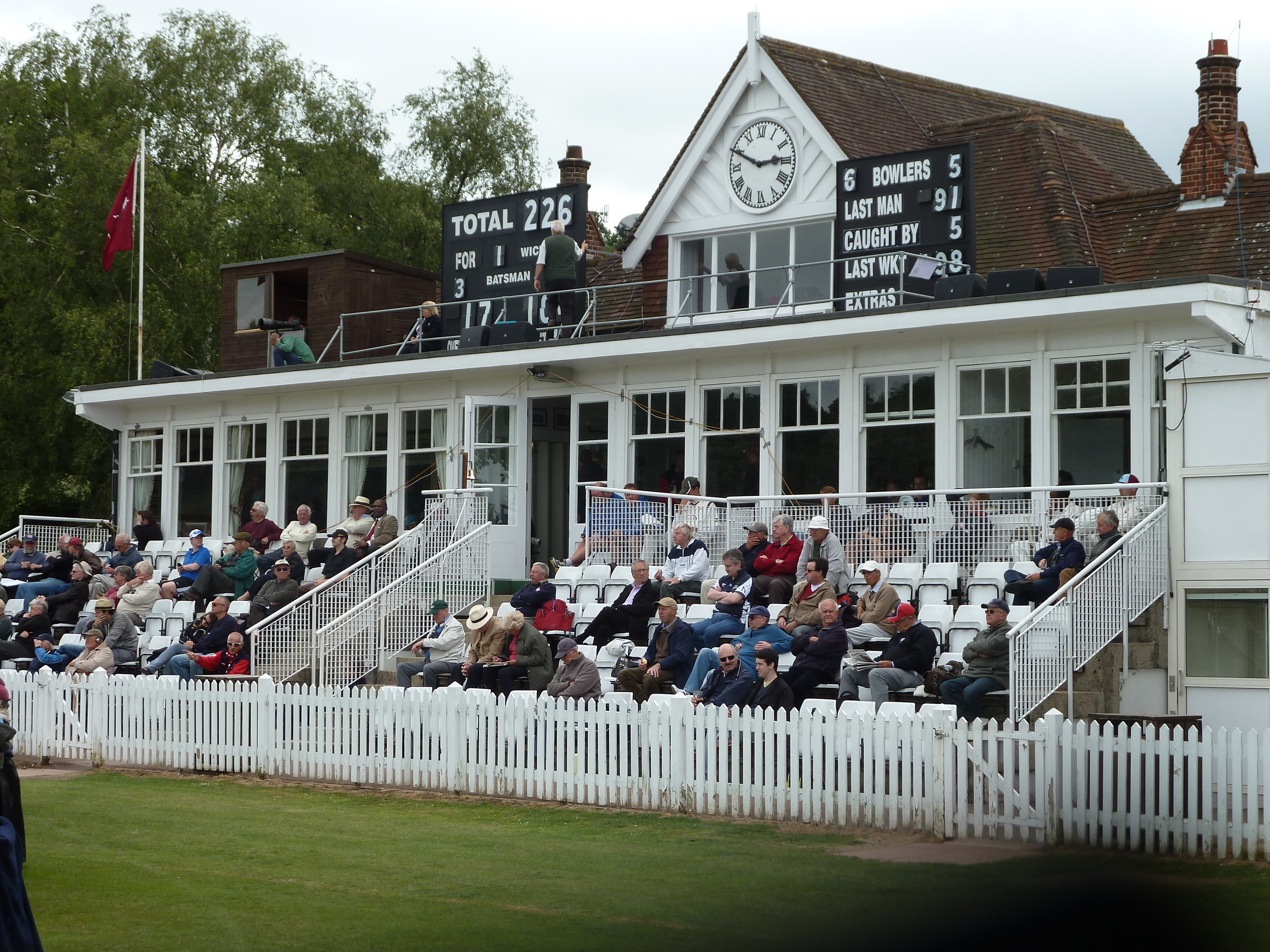
The ground had, and still has, a timeless quality.  If you didn’t look too closely, the photographs I have taken in the past two years that accompany this article, could almost have been taken back in 1963, were it not for the fact that there are now new stands either side of the pavilion, spectators, other than those in the grander marquees, are more casually attired and the rhodedendrons are now less abundant and colourful (or has lady nostalgia seduced me too well on this sensitive subject?).  The absence of houses from any vantage point completes the idyll.

There were many more such  “outgrounds” on the county circuit fifty years ago, including those at Blackheath, Dartford, Dover, Folkestone, Gillingham, Gravesend and Maidstone, but none were, or remain, lovelier, or more eagerly anticipated, than the Nevill.  But then, as a Man of Kent, born a few hundred years from the east bank of the River Medway, I’ll freely admit to being biased.

The ground had hosted county cricket since 1901 and held its inagural cricket week a year later.  Like its venerable counterpart at the club’s headquarters in Canterbury, the town embraced the event with a series of social gatherings, music and plays throughout the week.  Anyone arriving in the town would be greeted by bunting and flags flapping gently above the main streets of the old High Street and the elegant Pantiles.

The cricket week remained a highlight of my summers (though I could only attend on the Saturday due to the annoying necessity of attending school on the other five days of play), until I left home for university in the rough, upstart cricketing county of Essex in 1972.  I saw little county cricket during the rest of the decade, preferring to play, mainly in the serious, competitive world of the Yorkshire club game.

The love affair with the Nevill was resumed in the early eighties when my wife and I took the festival week off work each year and stayed in one of the town’s hotels (the Royal Wells, Russell and Beacon all had the dubious pleasure of our patronage).  Kent victories were rare during those years in seamer friendly conditions, and my most vivid – and sad – memory is of Bob Woolmer being carried from the field against Sussex, never to play again.  I had been less often in recent years, though since I escaped the clinging clutches of the home civil service a little over two years ago, I have returned to more frequent hours of worship.

The nearly sixty year old man still experiences the same thrill entering the ground as the ten year old boy.  And any visit would not be complete without performing certain rituals beforehand.  Whether arriving by car or train the first stops are the secondhand bookshops of Hall’s and the Pantiles, both of which, as befitting the rich Kentish heritage, maintain excellent stocks of cricket books.  A hearty breakfast is a prerequisite for a day at the cricket and there are several good options in the old High Street, Chapel Place and the Pantiles.  Finally, there is only one way in which to approach the Nevill, and that is by taking the ten minute amble up delightful Cumberland Walk, an alleyway that separates townhouses on the left from the more spacious properties and expansive gardens of Warwick Park.

Much as I want my county side to do well, watching well contested cricket in pretty surroundings under a cloudless June sky, has always been more important than seeing Kent win.  It does not invest me with the same measure of partisanship that following my local football club has done.  And that is no more the case than at Tunbridge Wells, where the setting and serenity are paramount – though it was gratifying to be present on the final day of the championship game against Leicestershire this year to witness their first home victory of the season!

The traditional week has assumed a different shape in recent years, with the ground now hosting a single championship game and two one day matches.  Relatively large crowds have placed pressure on the county club to commit to playing at the Nevill even when facilities  at Canterbury are being upgraded and the T20 programme is to be curtailed next year.

Many in the membership, including myself, would welcome more, rather than less, county cricket at Tunbridge Wells but, financial considerations aside, would it retain its lustre later in the season when those famed rhodedendrons have long faded?  I know my answer.

Read Full Post »

« Newer Posts