Feeds:
Posts
Comments

Posts Tagged ‘North Beach San Francisco’


Ask any visitor to San Francisco what was the most distinctive local foodstuff they tasted during their stay and they are likely to reply “sourdough bread”.  They may not have liked it because it is an acquired taste, but they will  certainly have tried it, if only in the form of a bowl containing clam chowder or, for the more adventurous, the Bread Bowl Scrambler of eggs, bacon, cheddar, onions and bell peppers.

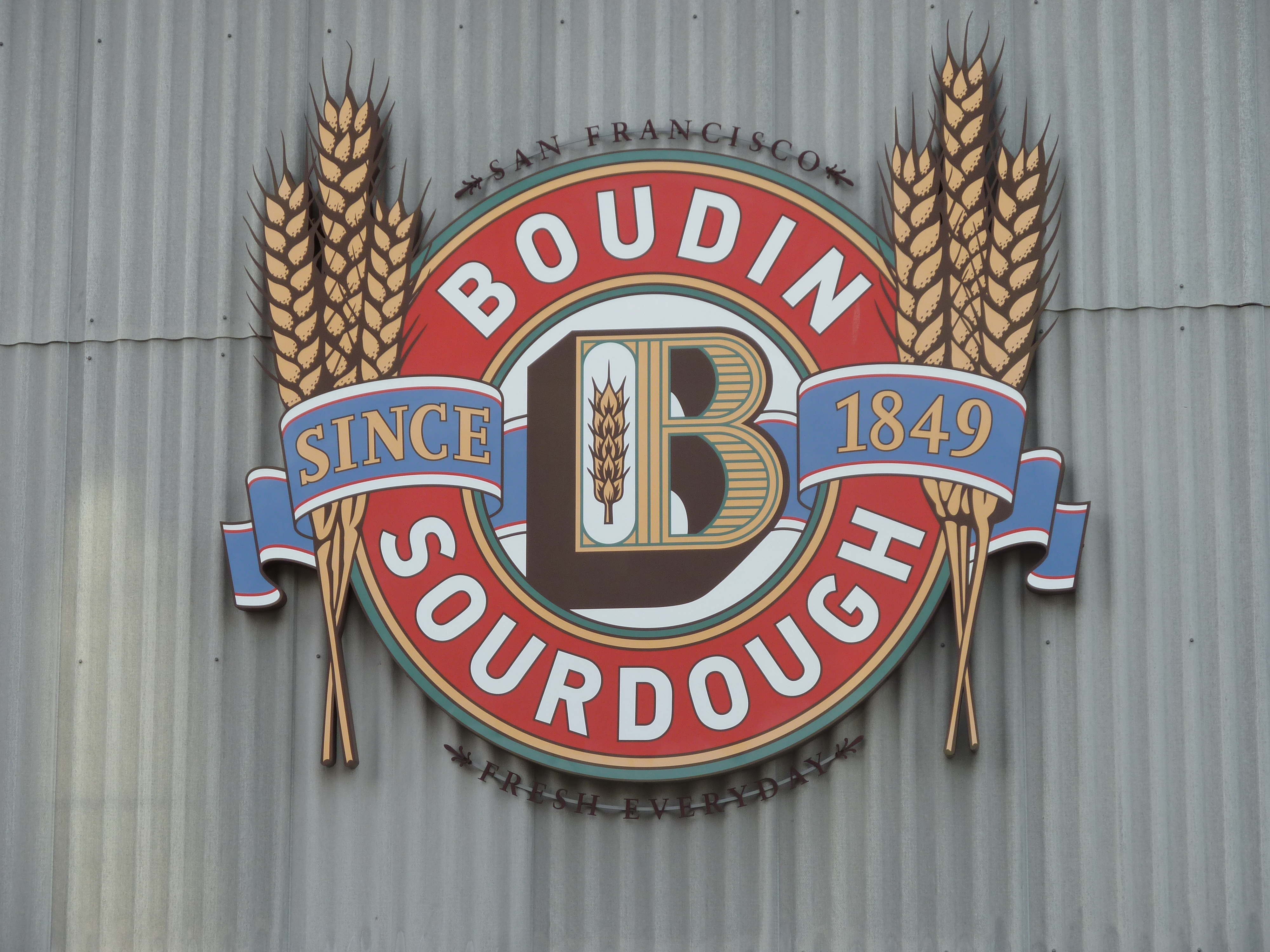
Isidore Boudin (pronounced “boo-Deen), member of a French immigrant family of master bakers from Burgundy, founded the bakery, making the “Original San Francisco Sourdough Bread” in 1849 at the height of the Gold Rush.  It remains one of the oldest businesses in the city and still bears his name, despite having been, for much of the last 70 years, in the ownership of the Giraudo family.
P1000391

The original bakery, a tiny olde world affair, stood at 319 Dupont Street (now Grant Avenuein what was a raucous North Beach district during the Gold Rush.  Its unique flavour comes from a wild yeast that is found only in  San Francisco’s foggy climate, making it a truly local product.  Indeed, in 1970, a Federal study isolated a previously unidentified microorganism named “Lactobacillus Sanfrancisco”, proving, as Jay Hansen claimed in his book, The Other Guide to San Francisco, that “you can take the sourdough out of San Francisco, but you can’t take the San Francisco out of the sourdough”. This would account for the fact that, although sourdough is becoming increasingly accessible in Farmer’s Markets in the UK, it tastes nothing like the “real thing”.

Boudin perfected his recipe by combining his family’s traditional French baking methods with the “sour” or tangy dough taste beloved of the gold miners, to produce, in the company’s words, the “signature dark-gold, crunchy crust, soft chewy center and distinctive flavor”.

His secret lay in using the “mother dough” as a natural starter and allowing the bread to rise and “sour” at its own speed.  Even when caked yeast became the industry norm, he continued to use his slow method of leavening the bread with the mother dough.

When he died in 1887, his wife of 14 years, Louise, with the support of their four children, especially daughter Lucie, ran the business successfully for 23 years, moving twice, in 1890 to 815 Broadway and then in 1906 to its present 10th Avenue and Geary Boulevard location in the Inner Richmond district.

Louise’s greatest triumph was in rescuing the mother dough during the 1906 Earthquake and Fire by mobilising the family to carry it in buckets of ice to Golden Gate Park where they baked bread over open fires.  This ensured that they always kept a portion of the mother dough to mix for the next day’s bread. A formidable woman, she earned the title of the “social leader of the French colony”.e starter-yeast-bacteria culture that Isidore developed back in the 1840s.  At the start of the mixing process, a piece of the mother dough is combined with flour, water and salt, divided into batches and shaped into loaves, which are refrigerated for 24 hours.  The loaves are placed in a proof – or steam – box to rise.  They are then scored, or slit, and baked in a 400 degree oven.

Despite the advent of mechanisation and modern baking methods, the company has steadfastly refused to use fats, sugars, preservatives, or dough conditioners, insisting that only natural ingredients be used.

Recent visitors will be familiar with the half  block long flagship store on Jefferson Street on Fisherman’s Wharf  which opened in 2005.  Within its  26,000 square feet of space are an espresso bar, bistro, full service restaurant and private dining room, Bakers Hall market, museum and 5,000 foot demonstration bakery where the dough is mixed on a platform 20 feet above the ground floor, then tossed to the bakers below.   Passers-by are able to watch this spectacle through the 30 foot observation window fronting the bakery or, more excitingly, from a catwalk suspended directly over the bakery. Nearly 3,000 loaves are produced daily for sale in the adjoining café and shop.
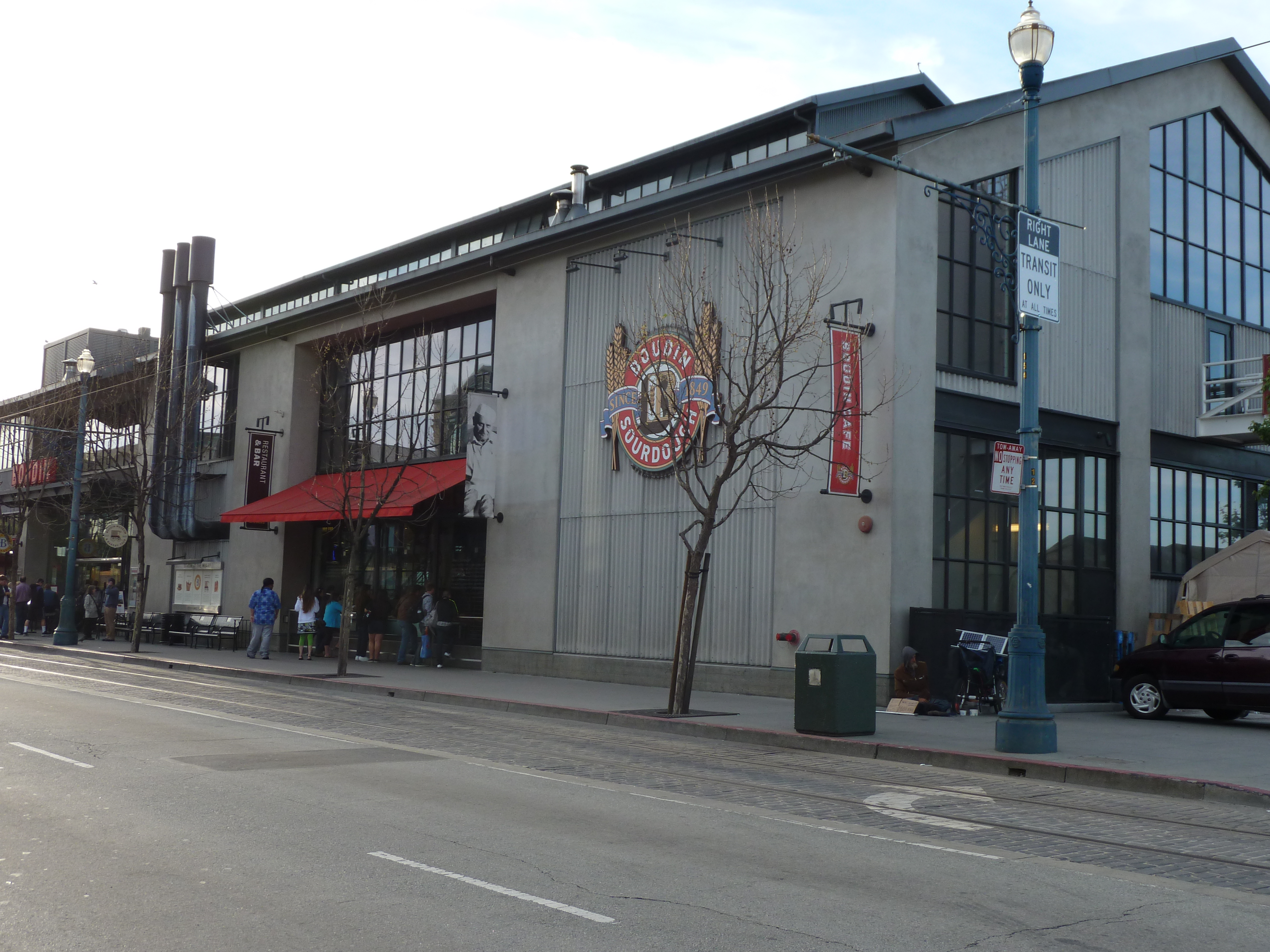
P1000390

The museum upstairs chronicles the history of sourdough bread on a 28 foot timelinefocusing on the history of San Francisco through the eyes of bakers. Numerous artefacts associated with the baking process are also on display, including an antique baking wagon used to deliver bread, a replica of Louise’s desk and a carving of the founder himself.

In total, around 20,000 loaves are sold every day in the San Francisco area.  In addition to the 20 different flavours used, loaves are sculpted into numerous exotic shapes on request, including crabs, turtles, alligators, turkeys, pumpkins, shamrocks, snowmen and cable cars.  Boudin now has around 30 other bakeries in California, including one at  at Disney’s California Adventure Park which includes the hour long attraction The Bakery Tour.

I intimated at the beginning of this piece that the “Original San Francisco Sourdough Bread” is an acquired taste.  In 1990 city residents voted Boudin their favourite San Francisco bread.  Herb Caen claimed in the San Francisco Chronicle that “Fresh cracked crab with Boudin’s round “dark bake” sourdough and a well-chilled bottle of California Chardonnay is still the quintessential S.F. meal”.

Well, I’d like to raise a glass to that and say both “Merci” and “Santé” to Monsieur  Boudin!

Read Full Post »


Our first full day in San Francisco and there was much to look forward to, including brunch at the Cliff House and our fifth trip to Steve Silver’s Beach Blanket Babylon in the evening, he timing of both dictated by tradition and designed to orientate us quickly back into life in the city.

After a comfortable night’s sleep in our new apartment in the North of the Panhandle, we woke to gentle but steady March rain that left large pools at the bottom of the wooden steps leading down from the kitchen to the shared back garden.  The forecast, however, was for it to clear later in the morning to leave a cloudy but dry afternoon and evening.

The Cliff House at Ocean Beach was just a straight ten to fifteen minute drive along Fulton Street to the Pacific Ocean. We passed a verdant Golden Gate Park on our left, whilst on our right, we caught tantalising glimpses of the towers of the glorious Golden Gate Bridge looming over the dense foliage of the Presidio.

We parked several hundred yards short of the Cliff House to enable us to take in the bracing appetite-inducing air for a few minutes before we entered the bistro.  The ocean presented a turbulent picture with a swift succession of high rolling waves chasing away anyone brave or foolhardy enough to venture too close to it.

The scene was, however, still a busy one – joggers passing in either direction at varying speeds;  people , like us, strolling contentedly in a wind ravaged state of dishevelment; but most of all, dogs everywhere bathing in the freedom and exhilaration of exploring the endless expanse of beach.  We must have seen a dozen different species, from caped miniature poodles and chihuahuas and enigmatic huskies to slavering rottweilers. It is claimed that there are more dogs than babies in San Francisco, and on a morning like this, you would not doubt it.

We felt as if we were committing an act of animal cruelty by not having one of our own to exercise.  Momentarily, I contemplated hiring one for the week because, after all, this is San Francisco and anything is possible.  But pets are not allowed in the apartment – probably just as well.

We had a twenty minute wait for our table, allowing us the opportunity to check on upcoming events such as the Wednesday prix fixe dinner and jazz evenings, and look in the gift shop.  As ever we both ordered Eggs San Francisco (two poached eggs and crab on toasted sourdough bread with roasted potatoes and fruit), accompanied by the establishment’s signature warm rolls – delicious.

Feeling replete we took another longer walk in the adolescent sunshine along the beach towards the south, inspecting the periodic bonfire pits on the beach.  Crossing the Great Highway for the return to our car, we called in at the Beach Chalet to marvel at the fabulous Lucien Labaudt frescoes depicting everyday life in the thirties in the city. The brewery and restaurant on the first floor apparently have outstanding views of the ocean, a fact we need to verify before much longer.

We abandoned our planned food shopping trip as we needed time to get ready for the evening (and for me to finish my previous blog post).  The mild, partly cloudy late afternoon weather encouraged us to take the long walk to Club Fugazi in North Beach for the early evening performance of Beach Blanket Babylon.  The near hour and a half  journey took in some of the less salubrious parts of the city (Fillmore and Civic Center) before turning off Market Street to snake through Grant in the heart of Chinatown.

Sadly and inevitably, there was no shortage of vagrants around the Civic Center vicinity, though we experienced no intimidating panhandling.  I did purchase a copy of Street Sheet from a man who bore an uncanny resemblance to the queen in Snow White and the Seven Dwarfs when she dresses as a witch and tempts Snow White with a poisoned apple.  He even sported the hunch back and hood.  But he was very friendly and appreciative of my $2 donation.

For the uninitiated, the Street Sheet is a magazine that has been published by the Coalition on Homelessness since 1989, and is designed to provide information and support programmes for homeless people in the city.  The philosophy is not dissimilar to that of The Big Issue in the UK, in providing its vendors with the opportunity to earn money for food, shelter and other necessities.

We joined an already lengthy line outside Club Fugazi around fifty minutes before showtime.  I collected our tickets from will call (box office) and joined Janet in the queue.  We were surrounded by a dozen boisterous ladies of a certain age in varying states of drunkenness attending the show as part of a bachelorette party.  Whilst we didn’t begrudge them their fun, we couldn’t help but hope that their seats were in a different part of the auditorium.

Our prayers were answered as they lurched off to the area close to the stage on the ground floor whilst we were escorted to our seats in the center balcony – our preferred area to watch the show.  Arming ourselves with a bottle of Woodbridge White Zinfandel and a large packet of pretzels we were ready to support  Snow White in her worldwide search for a prince. No sign of the queen this time – which is just as well as Snow White had a hard enough (or not as the case may be) time without her.

Once again, Beach Blanket Babylon delivered.  Although we had only been twelve months before, there was still a lot of new content along with the familiar staples.  The highlight for me was when San Francisco Giants baseball stars Buster Posey, Tim Lincecum and Brian Wilson (no, not the real ones) burst onto the stage holding the World Series trophy and singing We Are the Champions. Her Majesty the Queen’s appalled put down of the upcoming wedding of Prince William and Kate Middleton was hilarious and a typical Beach Blanket Babylon satirical slant on a subject often treated too reverently, no more so than in the States.

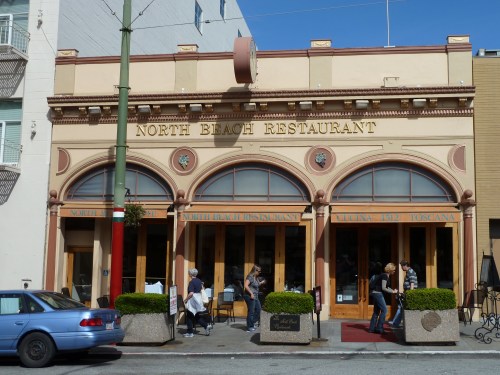
We had decided that we would try the North Beach Restaurant for dinner for the first time, provided we could gain entry (we hadn’t booked).  The restaurant looked very busy, but on presenting ourselves at the front desk, we were whisked to the only free table for two, adjacent to the kitchen.  That may not sound the most appealing location, and it was rather cramped, but Janet found it fascinating, catching regular momentary glimpses of the frenzy behind the scenes action as the front of house staff crashed through the doors leading in and out of the kitchen.

But what of the food and service?  This was traditional Italian fine dining at its best.  My linguine with porcini mushrooms and scallops was outstanding, as was Janet’s seafood risotto – even surpassing the excellent meals we had enjoyed at the Riva Grill in South Lake Tahoe a few days before.  And our waiter was suave, attentive and witty – well, Italian.

I had wanted to visit The Beat Museum on Broadway for some time, so as the night was still young (10pm), we called in.  The museum itself had already closed for the day, but we spent some time perusing the bookshelves and other fascinating memorabilia, and I bought a couple of books I had not seen before, one the 700 page Hippie Dictionary –  A Cultural Encyclopedia of the 1960s and 1970s by John Bassett McCleary and The Beats – A Graphic History.

After a canter past the fleshpots of Broadway, we sought refuge in Vesuvio’s bar on Jack Kerouac Boulevard – yes, another first night tradition.  Once more we succeeded in claiming the only two seats available, at the bar.  After a couple of drinks we walked down Montgomery through the Financial District before boarding a number 5 MUNI bus at Market to transport us back to the apartment.

It had been a long day but a satisfying one. We were truly “at home” again in our favourite city.

Read Full Post »

« Newer Posts