Feeds:
Posts
Comments

Posts Tagged ‘railways’


My upcoming poetry book, “Dust in my Cappuccino” is a collection of thirty two poems inspired by the coastal town of Folkestone in the south east corner of England. In order to provide some context to the poems for those readers unfamiliar with the town, I have written a short history of the town. This will feature as the introduction to the collection when it is published next month.

Located on the south east coast of England, a handful of miles from the famed White Cliffs, and only twenty two miles from continental Europe, Folkestone has had a long, varied history, boasting both Bronze and Iron Age settlements and a prominent Roman Villa, sadly now perilously close to the cliff erosion that has always afflicted this coastline.

Descended from the the Anglo-Saxon Kings of Kent, Eanswythe, a devout young princess, founded a nunnery in the town in the seventh century AD, and was subsequently made a saint. Her bones, discovered in the parish church by workmen in 1885, were radiocarbon tested and confirmed in 2020, and the church is now becoming a growing site of pilgrimage.

For a thousand years, Folkestone was a modest fishing village and, for most of that time, as a limb of the Cinque Port of Dover, also a busy trading port. Smuggling was a not insignificant business from the eighteenth century too. But it was the coming of the railway and associated cross-channel ferry industry from 1843, and the construction in later decades of grand hotels and white stuccoed family homes, notably in the West End, that contributed to its rise as a fashionable resort that attracted royalty, artists and writers in addition to the Victorian and Edwardian middle class. Much of this development was conceived, funded and overseen by the Earl of Radnor, who still owns land in the town and surrounding area.

The “golden age” that began around 1880 arguably came to a sudden halt with the outbreak of the Great War, which had a profound effect on Folkestone. It became a major port of embarkation for the Western Front, and the final sight of England for millions of troops, many of whom will have marched from the neighbouring Shorncliffe army camp. The bombing of Tontine Street in 1917 brought about the highest number of British civilian dead as a result of an air raid during the war up until that point.

The inter war years saw a revival, with Folkestone exploiting its natural beauty – the Channel views, rolling hills, delightful parks and gardens – by marketing itself as “Fashionable” and “Spacious and Gracious”. Moreover, its popularity as a resort was enhanced by the Earl of Radnor’s “foreshore development” that included the building of the Rotunda, the largest unsupported concrete dome in Europe, swimming pool and boating lake, supplementing the existing Victoria Pier, switchback railway and the 1885 Leas water lift.

The town suffered heavy bombardment during the Second World War, destroying much of the harbour, but recovered as a seaside destination during the fifties and early sixties, which is when my Folkestone story began. The Rotunda, quaint, steep Old High Street with the revered Rock and Joke shops and the popular ferry route to Boulogne-sur-mer, kept the visitors coming and the locals entertained.

But, like so many other UK coastal resorts, it suffered a deep decline as the advent of cheap air fares, duty free and longer annual leave allowance, led to an escape to resorts where the sun was twenty degrees warmer and the beer ten degrees colder. Many of the much loved attractions and hotels closed, were demolished and converted into flats, and trade in the town slumped. Although the cross-channel ferry industry stopped at the turn of the century, Folkestone has retained its role as a point of departure to the continent with the opening of the Channel Tunnel in 1994.

The new Millennium brought a revival, aided by the philanthropy of former Saga owner, Sir Roger De Haan, who renovated and refurbished many of the buildings in the old town, offering the properties to creatives, provided education and sporting facilities (the latest of which the world’s first multi-storey skatepark), and restored and remodelled the derelict harbour area. The construction of up to a thousand apartments along the shoreline between the Leas Lift (currently closed) and the Harbour Arm is also now underway.

Since 2008, the Folkestone Triennial has showcased new works from established British and International artists, around half of each remain in the town once the exhibition is over. There are now around ninety such pieces placed outdoors around town.  

De Haan’s influence and the arrival of the high speed rail link (only fifty four minutes from London) in 2007, has proved a happy marriage in rendering Folkestone more accessible. Comparatively cheap (but rising) house prices, the advantages of living by the sea, a vibrant dining scene and improving facilities, not least for children, have all led to a growing relocation of people, many of them young families, predominantly from London.

My love affair with Folkestone began at the age of ten when I was brought by my parents from my hometown of Rochester, forty-five miles away on the North Kent coast, on the first of a succession of summer holidays to the town. It was my mother’s admitted but modest pretensions to social mobility which led to the choice of Folkestone rather than the traditional “bucket and spade” resorts such as Herne Bay, Margate or Broadstairs.

Once I left home and moved around the country for study or work, visits became much less frequent, though I always retained my affection for the town. In fact, my parents long harboured the desire of retiring to Folkestone (on their last holiday together they had stayed in the Grand Burstin Hotel at the harbour), but with my mother’s relatively early passing, it never materialised. But their groundwork was not done in vain, as when the opportunity arose in 2016, my wife and I had no hesitation in moving here.

I have gathered together thirty two of my poems inspired by Folkestone, in which many of the themes and events I have outlined above are referenced and explored. One particular challenge has been whether to present them in a systematic way, for example, chronology, geography or subject matter, but ultimately, they are laid before you in an essentially random form, at least superficially.

Read Full Post »


Margate, on the north eastern tip of the Isle of Thanet in Kent, sixty four miles east of London, epitomises the rise and fall of the English coastal resort.  A booming seaside town in its Victorian heyday, and still hugely popular as recently as the nineteen sixties, it declined into decay and dilapidation in the past quarter of a century. But now it is slowly emerging from the ashes with an ambitious regeneration programme designed to re-position the resort as an artistic and heritage destination.

OLYMPUS DIGITAL CAMERA

Turner Contemporary

It was the association, during the eighteenth century, of seawater with good health due to its spa qualities that sparked an interest in the coastal resorts around Britain. Initially a fishing town, and a haven for smugglers, Margate capitalised on the growing passion for “taking the cure” in the sea by constructing, as early as 1805, bathing machines that allowed ladies to enter the water from its beautiful sandy beaches with the utmost modesty.

OLYMPUS DIGITAL CAMERA

The Main Sands (during Quad Bike show)

Growth, however, was slow in the early decades because it took several hours to travel from London to the town and the cost was prohibitive for the average worker   Moreover, accommodation provision was negligible. This all changed in the nineteenth century.  Firstly, steamboat services reduced the cost and time of travel from London, with a discrete service operating to Margate by 1820.  Grain hoys unloading their cargo at London docks would return to the town “laden with passengers”.  Piers were built, initially to provide landing stages, but they soon became the places to be seen.

OLYMPUS DIGITAL CAMERA

The Harbour Arm

The expansion of the railway network, along with the enactment of the Bank Holiday Act in 1871, put the resort within the reach of working class Londoners.  For those who could afford a longer stay than the customary day trip, guest houses began to emerge, often in impressive Georgian and Victorian houses.  Margate was invariably in the forefront of innovation and convenience for the holidaymaker, not least in being the first resort to provide deckchairs on its attractive, sandy beaches in 1898.

OLYMPUS DIGITAL CAMERA

Fine, sandy beaches abound

With improved transport links, fine sandy beaches and a carefree atmosphere, Margate was a highly popular holiday destination during Victorian times, welcoming, by 1879, between 16,000 and 24,000 people every day during the summer.  Its popularity endured beyond the two world wars and well into the third quarter of the next century.  Day trippers, often on works or club outings, would stream off the trains and coaches from the capital for a “day on the sands, donkey rides, cockle and whelk stalls, fish and chips, Punch and Judy and amusement arcades”.

OLYMPUS DIGITAL CAMERA

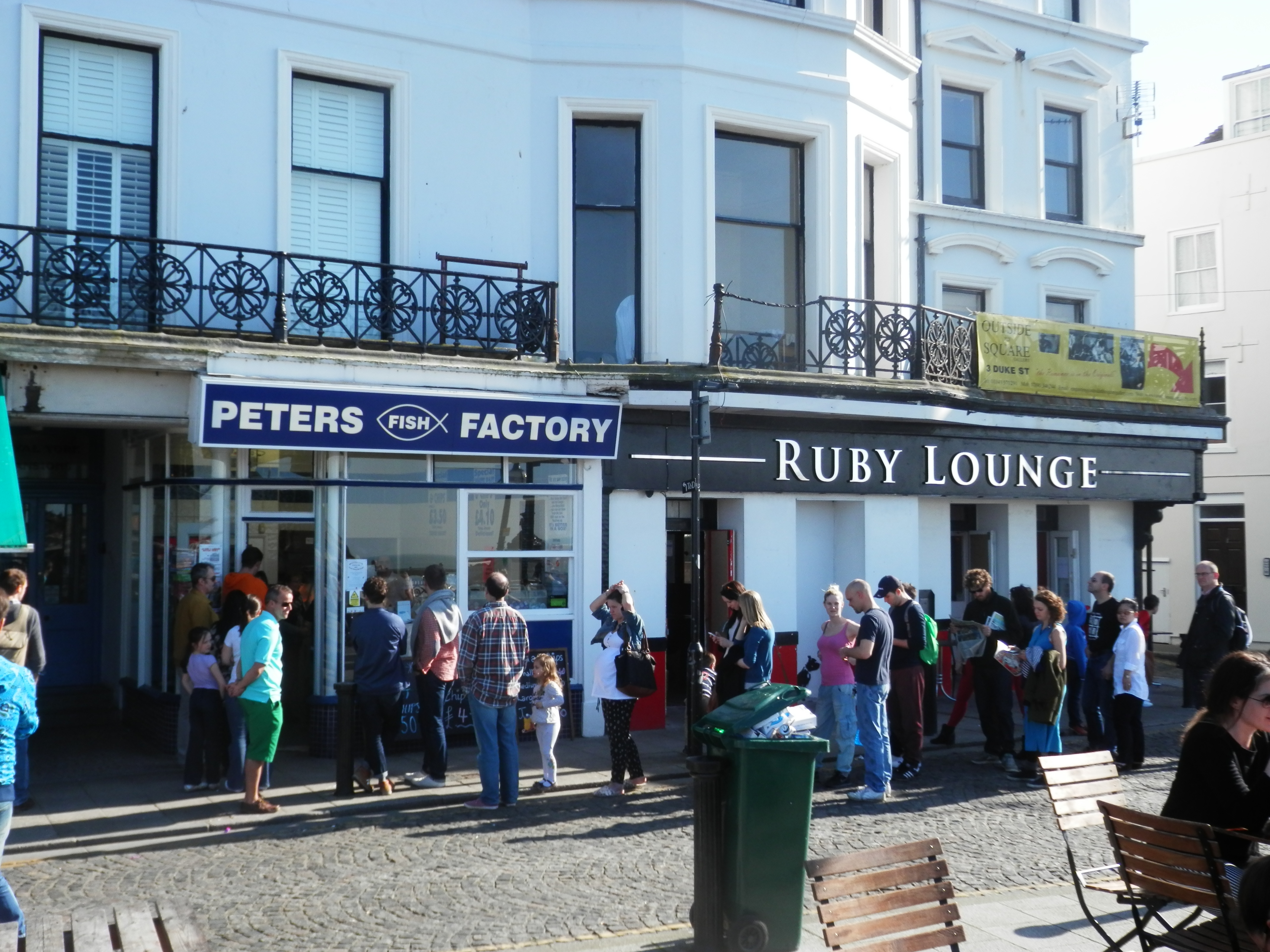
Queues for fish and chips are long all day

Tracey Emin, a Margate native and impassioned champion of the resort, speaks lovingly of her upbringing in the town, and recalls, in the late sixties and seventies, visiting the “Lido – a giant art deco half-moon pool with an array of diving boards”, and listening to Tony Savage playing the organ while “old ladies dance together to Tea for Two”.  Thousands of striped deckchairs adorned the golden sands and the “Golden Mile would be a siege of people walking eight-deep with candyfloss and kiss-me-quick hats”.

Every day from May to September was “full of golden sunshine and beautiful emerald green seas”.  Carnivals, talent shows, bathing beauty contests, puppet theatres thrived and the Winter Gardens and Theatre Royal welcomed the major music hall and, more latterly, TV stars of the day.

The jewel in the crown  was the fifteen acre Dreamland Amusement Park.  The site was formally opened in 1920 when, inspired by Coney Island, the mile long Scenic Railway wooden rollercoaster was unveiled, carrying half a million passengers in its first year alone.  Other rides followed and the site was augmented, partly with investment from Butlins, by the construction of a huge ballroom, cinema, pleasure gardens, ice rink, zoo and Big Wheel.

OLYMPUS DIGITAL CAMERA

Improving refreshment facilities

Purchased in 1981 it became Bembom Brothers White Knuckle Theme Park, reverting to the Dreamland name in 1990, and, with the addition of a number of “high tech” rides, it was one of the top ten most visited tourist attractions in the UK.

OLYMPUS DIGITAL CAMERA

Once it lived up to its name………maybe again?

But a lethal combination of longer paid holidays, inexpensive package tours to Spain and, more latterly, the rise of low cost airlines, spelt the end of the halcyon days of the domestic seaside resort.  British tourists could now afford to travel abroad where sunshine was guaranteed and the cost of living was often cheaper.

Margate was especially badly hit by the dash to the Med. As fewer visitors stepped off the trains, much of the Victorian infrastructure – piers, sundecks and Grade II listed buildings – were blown up or left to rack and ruin. Natural disasters also put paid to much loved icons, with the 123 year old pier perishing during a violent storm in 1978.

OLYMPUS DIGITAL CAMERA

Sunday lunchtime outside one of its many pubs

Many of the large guesthouses, of which the town was once proud, were split up into bedsits, others became care homes or social housing, inhabited by asylum seekers, refugees and the elderly, placed there by local authorities from as far afield as London.

As the number of visitors dried up, local industry declined, resulting in abnormally high levels of unemployment and social deprivation for the region with the accompanying increase in crime.

OLYMPUS DIGITAL CAMERA

Only the sign remains

The sale of Dreamland in 1996 led to many of the rides, including the Big Wheel, being removed to other parks or sold off.  In 2003 the new owners announced that the park would close and the land sold for retail and commercial use.  Its closure came two years later, sold for a fraction of its real value. Around a third of the Scenic Railway, now Grade II listed and the second oldest in the world, was severely damaged in an arson attack in April 2008.  Despite having its Listed building status upgraded to Grade II* (buildings of special architectural or historic interest) the Dreamland Cinema also closed in 2007, replaced, inevitably, by an out of town multiplex cinema.

Even the famed Main Sands progressively lost their glamour.  The only remaining donkey ride licence holder in the resort gave up his licence in 2008, signalling the end of a service that had thrilled small children for more than two centuries. And as recently as June 2010 year businesses complained that the “stench of rotting seaweed” on the seafront “driving away tourists”.

OLYMPUS DIGITAL CAMERA

Looking back towards town from the harbour arm

To compound the frustration for Margate, its neighbours Broadstairs and Whitstable , have both enjoyed a renaissance in recent years, trading primarily on their respective Victorian and “foodie” identities.  That said, the typical visitor to those resorts was always a little more sophisticated than the traditional working class visitor to Margate.

In order to remain a viable tourist destination, the challenge for Margate is to enhance and, where necessary, revamp the unique and appealing parts of its product to meet changing tastes.  If it can develop new attractions and facilities that satisfy the modern holidaymaker, as well as entice customers craving a lost past, then even better, especially in a period of austerity.

OLYMPUS DIGITAL CAMERA

Heaven for every child from ages 2 to 102

And despite its recent troubles Margate still has outstanding natural features that ought to be marketed to the hilt.  The beaches are excellent, in particular the lovely sweeping curve of the Main Sands, which has consistently achieved Blue Flag status, though controversially and, it is anticipated, temporarily, it was removed in August 2010.

Moreover, despite their current shabbiness, many of the remaining Georgian and Victorian houses along the seafront have an air of gentility that, with careful renovation, could light up the promenade again.  And the Old Town, with its narrow lanes and streets, also exudes a charm that could be better promoted to attract the missing tourists, though the preponderance of boarded up shop fronts makes it hard for the visitor to look beyond the current down at heel atmosphere.

OLYMPUS DIGITAL CAMERA OLYMPUS DIGITAL CAMERA OLYMPUS DIGITAL CAMERA

Scenes from the  burgeoning artistic quarter

There are two major developments, part of a wider regeneration project, which might just put the town back among those premier seaside resorts such as Blackpool and Bournemouth that have successfully ridden the storm. Dreamland is Margate’s core, talismanic built attraction.

There is now hope for its future.  Rejecting the previous owners’ desire for it to become a retail and commercial site, local people and Government have secured its continued use as a leisure facility. The aim is to redevelop it as the world’s first amusement park of historic rides and attractions, the centrepiece of which will be a renovated and restored Scenic Railway.

OLYMPUS DIGITAL CAMERA

Another of the lovely beaches

Some vintage rides have already been donated, including many of the unique rides from the defunct Pleasureland Southport amusement park such as the 1940s Catapillar Ride, King Solomons Mines rollercoaster, workings from the Ghost Train and River Caves and Hall of Mirrors. The Junior Whip from Blackpool Pleasure Beach and the now-demolished water chute at Rhyl are also destined for new homes on the North Kent coast. The success of Dreamland’s new incarnation when it opens will be fundamental to the town’s financial and spiritual well being.

OLYMPUS DIGITAL CAMERA

Main Sands with artistic quarter in background

Art and culture stand alongside heritage at the heart of Margate’s regeneration plans.  Conceived as a new twist on its tourist offer the £17.4 million Turner Contemporary art gallery is located in a plot of land adjacent to the harbour.  It is already having the same positive impact as the Tate Gallery in St Ives in Cornwall has had.

OLYMPUS DIGITAL CAMERA

Turner Contemporary watches over the fishing boats

J.M.W. Turner said that Margate had the “loveliest skies in Europe”, and painted more than  a hundred  scenes to prove his point.  The controversial gallery named in his honour plans to exhibit work from a variety of artists, including that of Tracey Emin.  The gallery is designed not only to attract high paying visitors but also to reduce the town’s reliance on the summer season by providing year round exhibitions.

OLYMPUS DIGITAL CAMERA

The evidence for Turner’s claim

Margate has endured spectacular growth, maturity and depressing decline over the past two hundred years.  Restoring it to its former glory will be a daunting task but, through the planned marriage of art and heritage, spiced with nostalgia and allied to its wonderful natural assets, it deserves to succeed.

And on a glittering March afternoon like that on which I wrote this piece, there are fewer finer places to be.

Read Full Post »