Feeds:
Posts
Comments

Posts Tagged ‘San Francisco Chronicle’


Ask any visitor to San Francisco what was the most distinctive local foodstuff they tasted during their stay and they are likely to reply “sourdough bread”.  They may not have liked it because it is an acquired taste, but they will  certainly have tried it, if only in the form of a bowl containing clam chowder or, for the more adventurous, the Bread Bowl Scrambler of eggs, bacon, cheddar, onions and bell peppers.

Isidore Boudin (pronounced “boo-Deen), member of a French immigrant family of master bakers from Burgundy, founded the bakery, making the “Original San Francisco Sourdough Bread” in 1849 at the height of the Gold Rush.  It remains one of the oldest businesses in the city and still bears his name, despite having been, for much of the last 70 years, in the ownership of the Giraudo family.
P1000391

The original bakery, a tiny olde world affair, stood at 319 Dupont Street (now Grant Avenuein what was a raucous North Beach district during the Gold Rush.  Its unique flavour comes from a wild yeast that is found only in  San Francisco’s foggy climate, making it a truly local product.  Indeed, in 1970, a Federal study isolated a previously unidentified microorganism named “Lactobacillus Sanfrancisco”, proving, as Jay Hansen claimed in his book, The Other Guide to San Francisco, that “you can take the sourdough out of San Francisco, but you can’t take the San Francisco out of the sourdough”. This would account for the fact that, although sourdough is becoming increasingly accessible in Farmer’s Markets in the UK, it tastes nothing like the “real thing”.

Boudin perfected his recipe by combining his family’s traditional French baking methods with the “sour” or tangy dough taste beloved of the gold miners, to produce, in the company’s words, the “signature dark-gold, crunchy crust, soft chewy center and distinctive flavor”.

His secret lay in using the “mother dough” as a natural starter and allowing the bread to rise and “sour” at its own speed.  Even when caked yeast became the industry norm, he continued to use his slow method of leavening the bread with the mother dough.

When he died in 1887, his wife of 14 years, Louise, with the support of their four children, especially daughter Lucie, ran the business successfully for 23 years, moving twice, in 1890 to 815 Broadway and then in 1906 to its present 10th Avenue and Geary Boulevard location in the Inner Richmond district.

Louise’s greatest triumph was in rescuing the mother dough during the 1906 Earthquake and Fire by mobilising the family to carry it in buckets of ice to Golden Gate Park where they baked bread over open fires.  This ensured that they always kept a portion of the mother dough to mix for the next day’s bread. A formidable woman, she earned the title of the “social leader of the French colony”.e starter-yeast-bacteria culture that Isidore developed back in the 1840s.  At the start of the mixing process, a piece of the mother dough is combined with flour, water and salt, divided into batches and shaped into loaves, which are refrigerated for 24 hours.  The loaves are placed in a proof – or steam – box to rise.  They are then scored, or slit, and baked in a 400 degree oven.

Despite the advent of mechanisation and modern baking methods, the company has steadfastly refused to use fats, sugars, preservatives, or dough conditioners, insisting that only natural ingredients be used.

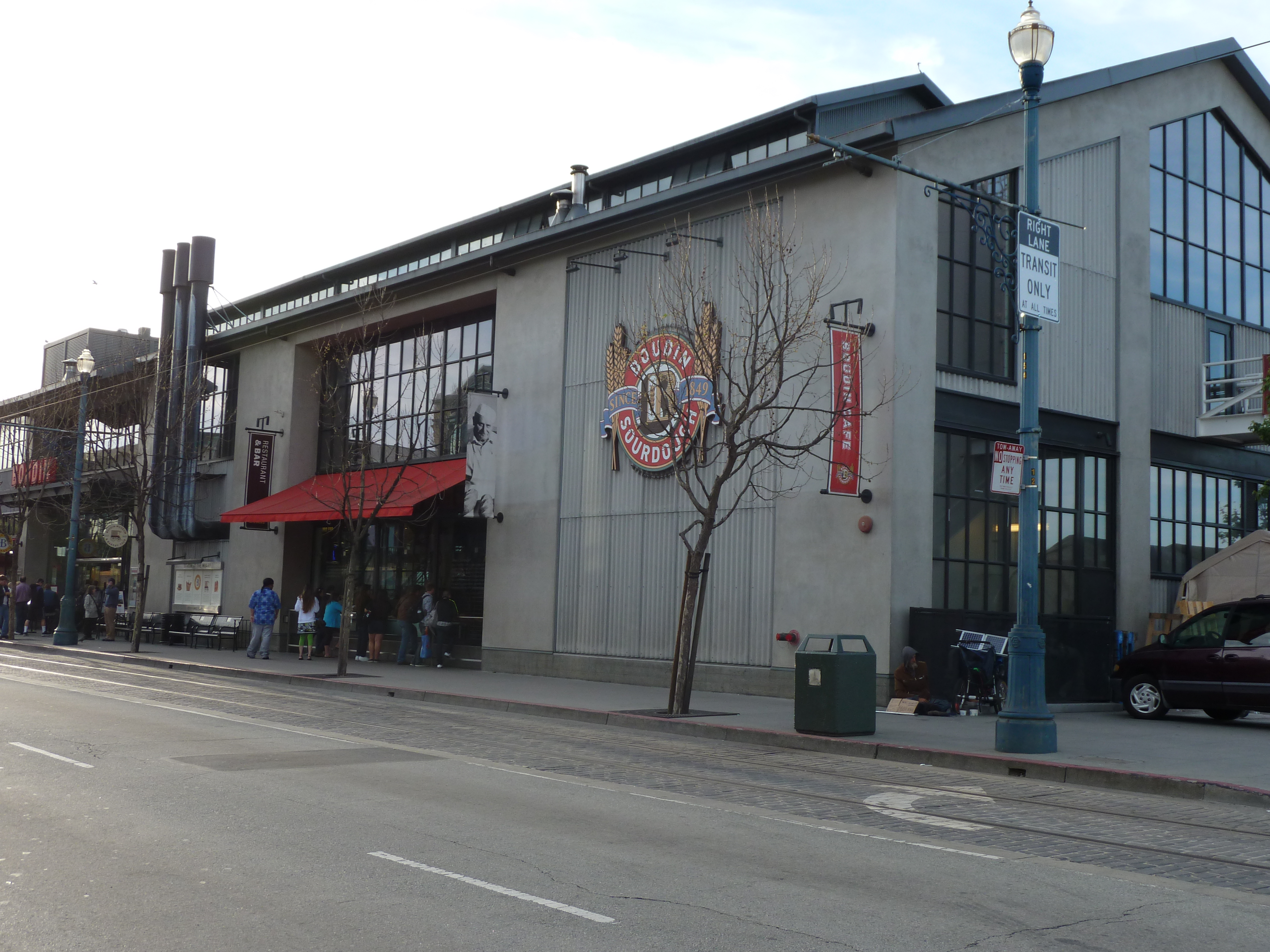
Recent visitors will be familiar with the half  block long flagship store on Jefferson Street on Fisherman’s Wharf  which opened in 2005.  Within its  26,000 square feet of space are an espresso bar, bistro, full service restaurant and private dining room, Bakers Hall market, museum and 5,000 foot demonstration bakery where the dough is mixed on a platform 20 feet above the ground floor, then tossed to the bakers below.   Passers-by are able to watch this spectacle through the 30 foot observation window fronting the bakery or, more excitingly, from a catwalk suspended directly over the bakery. Nearly 3,000 loaves are produced daily for sale in the adjoining café and shop.
P1000390

The museum upstairs chronicles the history of sourdough bread on a 28 foot timelinefocusing on the history of San Francisco through the eyes of bakers. Numerous artefacts associated with the baking process are also on display, including an antique baking wagon used to deliver bread, a replica of Louise’s desk and a carving of the founder himself.

In total, around 20,000 loaves are sold every day in the San Francisco area.  In addition to the 20 different flavours used, loaves are sculpted into numerous exotic shapes on request, including crabs, turtles, alligators, turkeys, pumpkins, shamrocks, snowmen and cable cars.  Boudin now has around 30 other bakeries in California, including one at  at Disney’s California Adventure Park which includes the hour long attraction The Bakery Tour.

I intimated at the beginning of this piece that the “Original San Francisco Sourdough Bread” is an acquired taste.  In 1990 city residents voted Boudin their favourite San Francisco bread.  Herb Caen claimed in the San Francisco Chronicle that “Fresh cracked crab with Boudin’s round “dark bake” sourdough and a well-chilled bottle of California Chardonnay is still the quintessential S.F. meal”.

Well, I’d like to raise a glass to that and say both “Merci” and “Santé” to Monsieur  Boudin!

Read Full Post »


Those “little cable cars” climbing “halfway to the stars” are one of the best loved and most iconic experiences for any visitor to San Francisco.  But few tourists hanging onto that lead rail as the Powell-Hyde car plunges down to the bay, or commuters perched atop Nob Hill on a California Street car about to sweep past the swanky hotels en route to the Financial District, will be aware that there was a time, shortly after the Second World War, when they became an endangered species.  Or even less so of the fact that they were saved for future generations through the foresight and resilience of a genteel, middle-aged lady from the eastern slopes of Telegraph Hill.

P1000416

The devastating earthquake and fire of 1906 destroyed much of the cable car system and triggered the rapid expansion in construction of electric streetcars with overhead wires, the first of which had been built in 1892.  And once it had been shown that the latest municipal buses, unlike the streetcars, could negotiate the steep hills, the continued viability of Andrew Hallidie’s invention was called into sharp focus.

By 1944 there were only five lines left in operation – the three independently owned by the California  Street Cable Railroad (Cal Cable) and the Powell-Mason and Washington-Jackson lines owned by the San Francisco Municipal Railway (Muni).

On 27th January 1947, in his annual message to the Board of Supervisors, Mayor Roger Lapham, a New York businessman who had been elected with a mandate to streamline the city’s finances, announced that the “city should get rid of its cable cars as soon as possible”, claiming that they were losing $200,000 a year.

Lapham’s vision of “super buses” replacing the cable cars met with little public favour, and the San Francisco Chronicle encapsulated the opposition’s argument in its editorial of 3rd February when it wrote that: “bus lines would be a good deal less expensive. But against this saving should be weighted………the market value of an institution which helps make the city stand out among cities of the world”.

Klussmann

But the strongest advocate for their retention came in the unlikely form of prominent socialite, Mrs Friedel Klussmann, who, outraged by this pronouncement, immediately began to mobilise opposition through the equally improbable auspices of the California Spring Blossom and Wildflowers Association and the San Francisco Federation of the Arts.

On 4th March, within sight of the Mayor’s office, she held a joint meeting attended by leaders of 27 women’s civic groups and formed a Citizen’s Committee to Save the Cable Cars, collecting more than 1,000 signatures in the first four hours of its campaign for an initiative charter amendment, a figure that was to rise to 50,000 by the end of the battle with City Hall. Despite the increasingly desperate arguments emanating from the Mayor’s office, the Board of Supervisors voted 7 to 4 to place Measure 10 on the November ballot.

Neither Mrs Klussmann nor her Committee were mere soft-hearted sentimentalists, and they put forth a robust rebuttal of the economic argument for closure in a detailed press release that spoke about the “$34,630,522 of new money” generated by tourism in the previous year, adding that San Francisco “is constantly striving to interest the rest of the world in its historical and colorful background, of which the cable cars are the No.1 attraction”.  The loss of the Powell and Market turnaround would be a blow to the city’s identity that “cannot be measured”.

P1000407

As Life Magazine put in in its 24th February edition: “It was as though Venice had proposed ridding itself of its gondolas”.  Visiting celebrities, including Elenor Roosevelt, publicly endorsed Mrs Klussmann’s campaign.  Newspapers were inundated with letters of support for the cable cars and accounts from passengers of their grim experiences waiting for and riding buses.

Measure 10 compelling the City to maintain and operate the existing cable car system was passed overwhelmingly by 166,989 votes to 51,457.  In her victory statement Mrs Klussmann said: “It is wonderful to know that San Franciscans appreciate their famous, efficient and safe cable cars”.  The Committee was galvanised again in 1950, 1951, 1954 and 1971 to fight further cost-cutting measures, with modest success.

OLYMPUS DIGITAL CAMERA

In the same year Mrs Klussmann also founded San Francisco Beautiful (www.sfbeautiful.org), the “only organisation in San Francisco whose sole purpose is to protect and enhance the city’s urban environment”, working to “improve the quality of daily life, strengthen communities and empower citizens to maintain the character of the city’s parks, neighbourhoods and streets”.  It continues to do excellent work today, not least through its Friedel Klussmann grants made to organisations that “seek to maintain or enhance San Francisco’s unique beauty and livability”.

When she died at the age of 90 in 1986 the cable cars were decorated in black in her memory.  On 4th March 1997, the fiftieth anniversary of the Committee’s initial meeting outside City Hall, the Friends of the Cable Car Museum dedicated a mural to Mrs Klussmann at the cable car barn.  The turntable at the outer terminal of the Powell-Hyde line was also dedicated to her.

So next time, dear visitor, when you skirt the ridge of Russian Hill on a clanking, rumbling Powell-Hyde cable car and catch your breath at the bay vista spread out before you, spare a thought for the prosperous, middle-aged lady, whose vision and courage sixty years ago ensured that you can have those unforgettable experiences today.

P1010990

I am particularly indebted to Walter Rice and Val Lupiz’s excellent article The Cable Car and the Mayor (www.cable-car-guy.com/html/cclm.html#top) for much of the detail provided above.

Read Full Post »


With a little over two months to my tenth trip to San Francisco, I am revisiting, and where appropriate, updating a handful of my articles on the city I fell in love with from afar in 1967 and in person 28 years later.

If I were forced to name the place I would most like to spend a couple of rainy hours, the Ferry Building would appear very close to the top of the list.

It was on 13th July 1898 that the first ferryboat and its passengers pulled into what was then called “The Union Depot and Ferry House”. At the height of its glory in the nineteen thirties, more than 50 million passengers passed through it each year.

Despite two major earthquakes and the construction of both the San Francisco – Oakland Bay and Golden Gate Bridges, not forgetting a hideous double-decker freeway along the Embarcadero, the latter thankfully demolished after the second of those earthquakes, the building with its 235 foot high clock tower inspired by the moorish belltower in Seville, has not only survived but become one of the most popular attractions in the City.

Once the City’s principal transportation hub and beautifully restored between 2003 and 2007, it is now home not only to two storeys of premium office space, but also a permanent gallery of stalls selling locally produced fresh fruit and vegetables, cheeses, wines, meats, flowers, chocolate and pastries, as well as one of a kind gift items, many related to the kitchen and garden.

An outstanding farmer’s market takes over the plaza on Tuesdays, Thursdays, and especially Saturdays, when celebrated chefs from around the City demonstrate their skills to locals and tourists alike. Several appealing restaurants and cafés complete the scene.

Located along the Embarcadero at the foot of Market Street, it is now one of only a handful of landmarks that I make a point of visiting on every trip to the City, however short. Ten days in April didn’t yield a single cable car ride or journey over the Golden Gate Bridge, but it did include two trips to the Ferry Building, one on the way back from a spending spree at the ballpark (in fact, it is a perfect resting spot if you are making the bracing but arduous hike on a blustery day from AT & T Park to Fisherman’s Wharf, or vice versa).

Its role as a ferry port may have diminished (it now caters only for a handful of local services), and cruise ships may soon be getting their own spanking new terminal, but the building remains at the heart of the City’s transportation system with MUNI (Metro) and BART lines criss-crossing here, and the cranky, lovable F Streetcars rattling by.

Whilst there might be other excellent, if admittedly less expensive, farmer’s markets and wholefood stores around town, the Ferry Building might just be the best. Where else can you pick up those last minute snapper fillets, fresh vegetables, rustic loaves, Californian wines and cheeses, and even pig’s cheeks, to take back to your apartment in Noe Valley or the Sunset? And the visit alone, especially if you tarry awhile and experience everything it has to offer, is worth the journey alone.

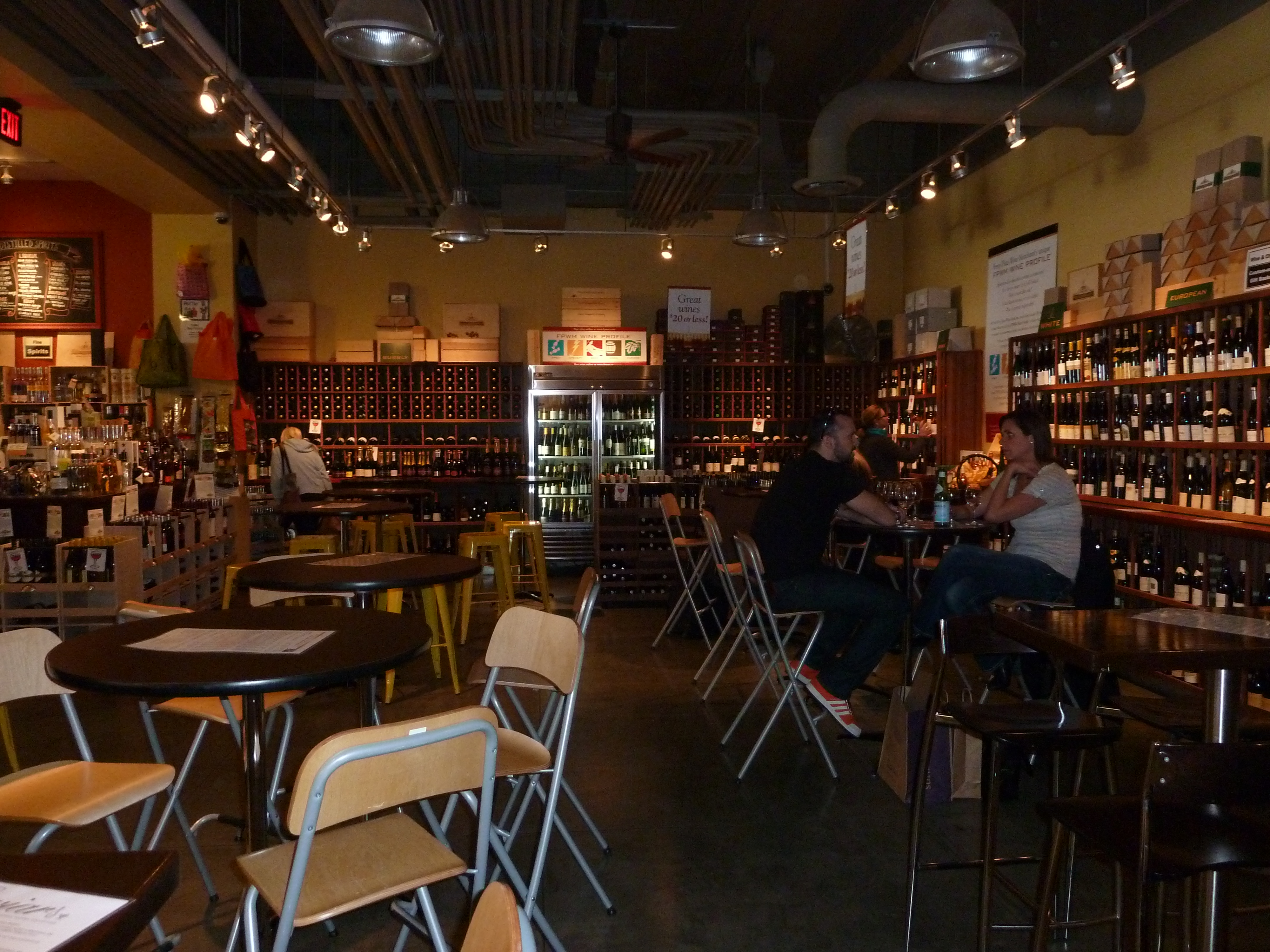
Slip into the Ferry Plaza Wine Merchants , share a carafe or two of Napa or Sonoma wine, or indulge in one of the special tasting “flights” where you can sample half a dozen wines at once (I would caution, however, that if you are of a nervous disposition, it comes with a lot of (different shaped) glasses, and whilst it looks pretty, the potential for disaster is considerable). What better to accompany it than a tasty cheese board? And you may stumble upon one of the regular lectures on wine or even meet the individual who made the wine you are drinking, as has happened to me!

If the Giants happen to be playing on the live televisions, so much the better, just order another carafe. And don’t forget to pick up a couple of bottles before you leave.

With the closure of the large Border’s and Barnes and Noble bookstores at Union Square and Fisherman’s Wharf respectively in recent years, it is heartening also to find the excellent Book Passage in the building. It may be small but it stocks an impressive selection of books on San Francisco and the Bay Area in particular. Pick up a book and a cup of Peet’s (coffee) from the adjoining cafe, grab a seat outside and “waste” an hour enjoying the bay views.

San Francisco Chronicle columnist Herb Caen called it “a famous city’s most famous landmark”, adding that the “waterfront without the Ferry Tower would be like a birthday cake without a candle”.

It is hard to disagree.

Read Full Post »


At 1.48pm on Thursday 14th January 1954 in City Hall, Municipal Judge Charles S. Perry proclaimed Joseph Paul “Joe” DiMaggio, son of an immigrant Sicilian born fisherman, and Norma Jean Dougherty, better known by her screen name of Marilyn Monroe, man and wife. 

It was dubbed “The Wedding of the Century” by the American media.  He was the recently retired “Yankee Clipper” who had led the New York Yankees to nine World Series Championships in his thirteen years as a major league baseball slugger and centre fielder.  She was the beautiful screen actress whose career had taken off over the previous twelve months with the release of the films How to Marry a Millionaire, Gentlemen Prefer Blondes and Niagara

Although the couple had tried to keep the time and place a secret, a telephone call by Monroe that morning to her studio in Los Angeles announcing that she was to be married at 1pm, started a media feeding frenzy in San Francisco.  In the event 500 people turned up, delaying the ceremony for over half an hour.

Monroe wore a dark brown, figure hugging, broadcloth suit with a white ermine collar and matching bouquet, whilst DiMaggio was equally smart in a blue suit and blue and white checked tie. They looked and said that they were very happy as press men clamoured for quotes and photographs.

http://www.youtube.com/watch?v=LGmOD_cqxN4

Once he had cleared his courtroom Judge Perry was able to conduct the ceremony which lasted only two minutes, the end of which unleashed mayhem amongst the waiting press corps.  The challenge now for the newly married couple was to effect a getaway!  Attempts at escape via different floors only came up against a different crowd each time, and on one occasion they ended up in a cul de sac!

Eventually, they reached diMaggio’s blue Cadillac parked on McAllister Street and drove off to North Beach where, in front of the Church of the Saints Peter and Paul in Washington Square, they posed for photographs before proceeding to their honeymoon in Paso Robles.  As divorcees they had been barred from marrying at what is known locally as the “Fishermen’s Church”.

Sadly, the marriage lasted only 254 days after Monroe filed for divorce for mental cruelty.  However, they remained close, Monroe often turning to him in her darker moments and DiMaggio having six red roses delivered to her crypt three times a week for more than twenty years. There were even rumours circulating when she died in 1962 that they had been thinking of getting married again.

There is a further melancholy footnote to that wedding day.  In the post-ceremony chaos Judge Perry, to his eternal misery, had forgotten to kiss the bride!

My gratitude in particular to the later Arte Hoppe who reported on the wedding for the San Francisco Chronicle.

Read Full Post »

« Newer Posts