Feeds:
Posts
Comments

Posts Tagged ‘Tony Quarrington author’


From Menlo Park and Mountain View

They stalk the streets where strollers go,

Forbidding beasts with blacked out eyes

Bound for Sunset, Haight and Castro.

As dusk falls over Salesforce Tower,

And Transamerica’s tip fades,

They blend in with the growing gloom

Yet still stand out on their parades.   

Beside a bougainvillea bush

Between wide Dolores and Church,

Silently these modern Molochs

Pull up to of their cargo purge.

They vomit forth a dozen men,
Each unaccompanied and young,

Not a word spoken between them

Nor glance of recognition sprung.

Their only friends matching backpacks

From which hang heavy hydro flasks,

Courtesy of the company  

That pays them for their key tech tasks.

This quiet yet purposeful dance

Will recommence next morn at eight,

When partners jog to coffee shops,

Before their nail and yoga dates.

Read Full Post »


A bright, brisk morning

In a small English town,

I order an extra shot americano

In the one coffee house

That does not reek of grease,

And take a seat outside.

From the doubtful comfort of my

Three and a half legged plastic chair

I scan the temptations around me:

“Nails Palace – Professional Nail Care for Ladies”,

“Cash Generator – the Buy, Sell and Loan Store”,

“Tanning Heaven”,

And the Salvation Army’s “Community Store”,

Promising “Heart to God, Hand to Man”.

“Eel Pie Island”, specialists in all day breakfasts,

Proudly proclaims in yellow, peeling letters,

It is a “Caf’e”, an apostrophe planted

Between the “f” and “e”.

The “Hot 4 U Pizza, Chicken and Kebab” house

Has closed, victim of too much competition

In the fast food field,

Proof that you CAN have

Too much of a good thing.

Unless it’s burgers and jumbo sausage rolls.

Obesity is a badge of honour here.

In frayed makeshift marquees

And spread along the pavement,

Traders display their wares –

Leather jackets, shell suits,

Batteries, watches, mobile phones, 

Toys, rugs, carpets, curtains,

Handbags, purses and luggage –

Each screaming the critical selling point of

Affordability.

Relatively.

The saucy entreaties of the meat wagon guy

To “come on girls, don’t be shy,

Give my lovely meat a try”

Trigger giggles but no takers;

A further invitation to pinch his pork loins

Is similarly snubbed.

Granville’s traditional barber’s shop

Has closed after fifty years;

Its red and white striped pole

No longer rotates, confirming

There’s nothing for the weekend here.

Supplanted by a succession

Of glitzy Turkish emporia

Offering an eye watering array

Of treatments for every part

Of the modern male head and face.

The Lord Raglan pub is also boarded up,

A ragged, handwritten paper sign

Flaps in the vape drenched breeze;

Some wag has inserted an “i”

Between the words “to” and “let”.

Country crooners from the fifties

Trill through the babble

Of Bengali, Romanian, Arabic

And English

That assail my ears.

The RAC canvasses for new recruits

But most people here do not drive,

Unless you count the cavalcade of

Motorised scooters and wheelchairs

Wreathed with union jacks and teddy bears

Parked outside the padlocked toilets.

Bald middle aged white men, 

Their relationship with teeth

Over,

Flaunt their body art

Of indecipherable oriental slogans,

Football team allegiances

And the obligatory catalogue

Of proud progeny,

Many of whom they have

Not seen for years.

Japanese tosas and pit bull terriers,

Acquired more for their menace

Than their questionable cuteness,

Slowly encircle each other,

Doing nothing more threatening

Than exploring each other’s private parts.

Teenage mums congregate outside Gregg’s 

To share a cigarette and debate

Last night’s episode of Love Island,

To compare frilly pram accessories,

And to show off the clothes just bought

For Noah and Amelia in Primark.

Occasionally they turn around to bark

At their same bored and testy toddlers

Committing the heinous crime of

Being children.

An Albert Steptoe tribute act

Stutters along the street,

Peering professionally

Into every bin and doorway

For bottles, fag ends

And unfinished food scraps,

Leaving the council street cleaner

To deal with the discarded needles.

The midday sun glints through

The single, leafless tree,

Where neither Vladimir nor Estragon wait,

As I drain my second americano

And head for home. 

And yet, it is I who feels observed,

A figure of curiosity,

Even suspicion,

With my fancy coffee,

Collection of Eliot’s poetry

And notebook and pen,

Observing and trying to capture

Life.

Read Full Post »


On what would have been his 106th birthday, a poem from the great Lawrence Ferlinghetti, founder and owner of the City Lights bookstore in San Francisco. Never have its sentiments been more pertinent.

Pity the nation whose people are sheep
And whose shepherds mislead them
Pity the nation whose leaders are liars
Whose sages are silenced
and whose bigots haunt the airways
Pity the nation that raises not its voice
but aims to rule the world
by force and by torture
And knows
No other language but its own
Pity the nation whose breath is money
and sleeps the sleep of the too well fed
Pity the nation Oh pity the people of my country
My country, tears of thee
Sweet land of liberty!

Read Full Post »


I dreamt long last night of San Francisco,
As I have done so many nights before;
I left my heart there thirty years ago,
No more was I waiting outside her door.

Sitting upon summer brown Bernal Hill,
Watching the golden city laid before me   
Like a lover spread ‘cross a crumpled bed,
In no sweeter place would I rather be.

Standing astride the stunning Sunset steps

As the cool fog weaves its wild, wondrous spell,
Slicing Sutro Tower in half before,
In a heartbeat, it returns and all’s well.

Hanging for dear life from the cable car
I crest the hill on Hyde at dawn of day,
Siren song from all the foghorns moaning
As we hurtle down to the glistening bay.

Eating popovers by Pacific shore
Among the tourists and locals well dressed,
Humming along to O Sole Mio
While wrestling a ristretto at Trieste.

Hailing Josh Norton and his doting flock,
As they follow him on the Barbary Coast,
Waiting two hours in Zazie’s lengthening line
For bacon, eggs benedict and French toast.

Hunting for tie-dye tees in Hippie Haight,
Paying Harvey homage on Castro Street,
Reading a novel on the F Streetcar
As it clanks along to a Market beat.

Drinking a cool, tall glass of Anchor Steam
With ghosts of Ginsberg, Neal and Kerouac,
In North Beach’s beloved beat retreat
With Joyce’s peering portrait at my back.

Gorging on Gilroy’s garlic fries at the yard
As gulls circle above to claim what’s left,
Pablo slams a mighty walk off splash hit
To leave downhearted Dodgers fans bereft.

Sharing tales of shows at the Fillmore West
In Martha and Brothers at breakfast break,
The Blackpool boat tram slithers past and waves
To Lovejoy’s ladies taking tea and cake.

The scent of jasmine on our Noe porch,
Sea lions cavorting on the wharfside pier,
Sourdough with Coppola Sauvignon blanc,
And that “bracelet of bridges” held so dear.

These and other images flood my mind –
Painted houses, murals and gleaming bay,
Bowls of cioppino and Irish coffees,
I curse the undue advent of the day.

Read Full Post »


Nimble nuns scurry across the square

Heading for their next service fix,

Neatly sidestepping Vespa riders

Who twist and jerk and shudder

Between the imperceptible lanes

That mean as little to them

As pedestrians and traffic lights.

Perched in the middle of the piazza,

A poliziotta municipale

In pristine white helmet and gloves,

In a whirl of her arms

And ear-splitting whistle,

Valiantly struggles to

Manage the morning mayhem.

Every Fiat Panda or Lancia Ypsilon,

Oblivious to battle scars

Of bumps and scrapes,

Jostles for precious –

And inconceivable –

Parking spaces.

Across the red, rutted rooftops

Dogs howl in unison

With the wail of ambulances

And hubbub of honking,

While disoriented tourists

Are pursued and seduced

By waiters with winning smiles

Into perusing the menu turistico.

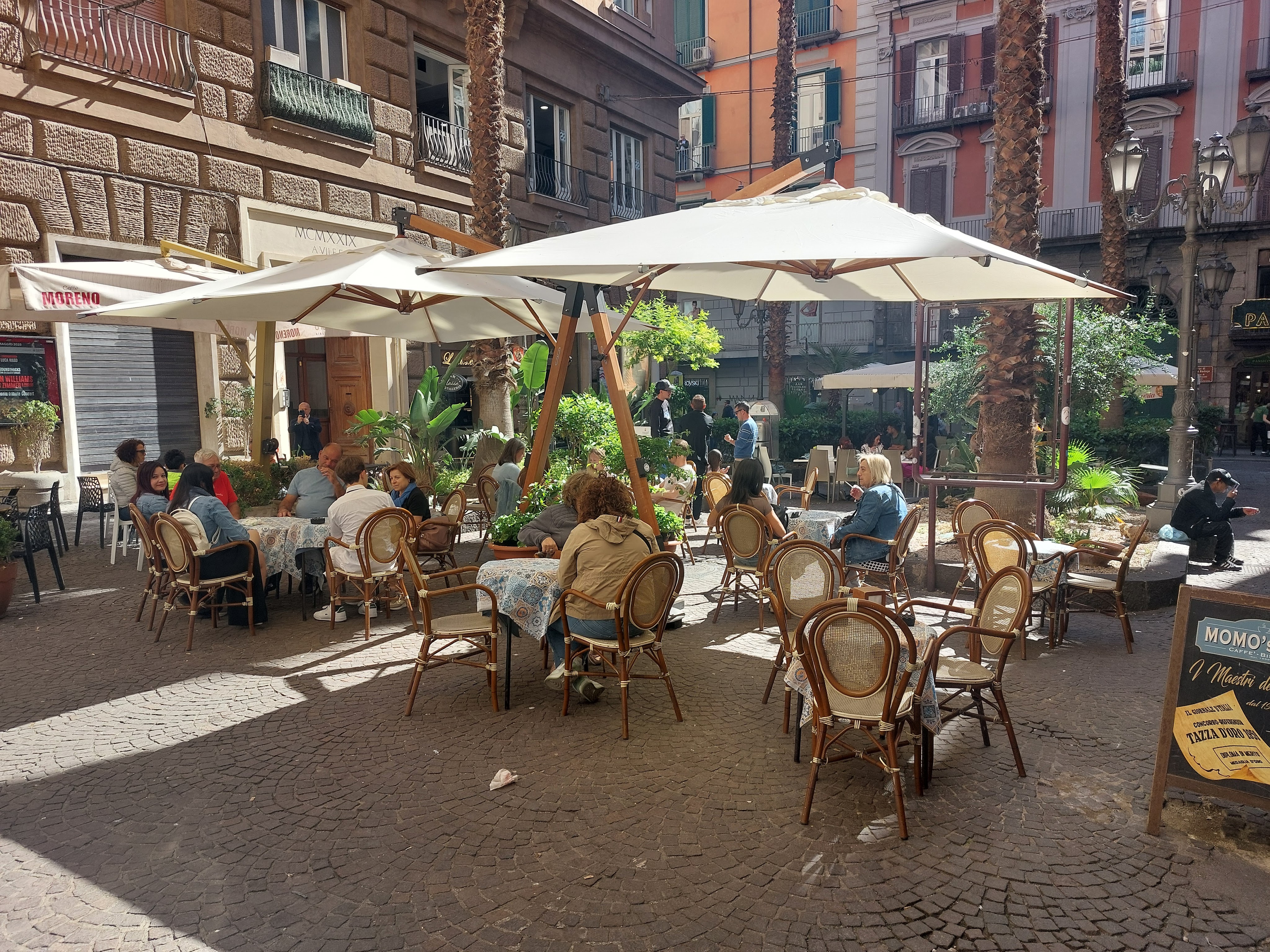
Outside a small coffee house

Beside a deconsecrated church,

A middle aged woman

Dripping in Gucci and Armani,

Caresses her cappuccino

(It is not quite mezzogiorno yet),

And takes a slow, sultry draw on

Her third Muratti Chiaro cigarette.

Read Full Post »


No more the need to force the pace

While others a back seat will take,

But bide my time and choose my theme

And there my contribution make.

No more to crow of what I’ve done

In lieu of praise from others’ cries,

But show humility and calm

For that is where contentment lies.

No more to crave the company

Of those whose sly promises I scorn

But reciprocate their silence

And their absence no longer mourn.

Find a comfortable corner

Of a welcoming coffee house,

To while away wild winter days

And those elusive words to rouse.

I know too well the time will come

When from the world I’ll no more hide,

To speak again and play my part

But for now I am satisfied

Being quiet.

Read Full Post »


I pass through the door

Where they check

IQ instead of ID

Subjected to neither

By the affable doorman

In tweed jacket

And corduroy pants

Lounging on a stool

That looks as if it might

Cave in under him

At any moment.

I take a seat upstairs

At a glass topped table

Resisting insistent requests

From the genial female server  

To have another lethal shot

Of gin and tonic

But I eventually reason

At only seven bucks

Why not?

Twelve feet beneath me

Across the ornamented alley

An ageing Chinese guy

Sells vintage magazines

Punk as well as Beat related,

From a wonky trestle table

Outside City Lights

And chats to a tour guide

Whose Vietnamese party

Scatters to take photographs.

Over my shoulder, James Joyce

Squints at a bottle of Jameson’s

Behind the well stocked bar

And from a yellowing poster

William Burroughs bemoans

The day he killed his wife.

The fleet is in town,

Fresh-faced, well scrubbed

Serious young men

From Jackson, Mississippi

And Greenville, South Carolina

Stare open-mouthed at

Cartoons of bare buttocks

And unpatriotic sentiments

Posted on the walls around them.

“In this far out city

Yet

Even here

On the left side of the world”

Guests line up to

Thank them for their service

And pester them for selfies.

The 8 Bayshore Muni

Meanders up Columbus

And catches the lights

On Broadway before

The Condor sign

Where Carol Doda

Once titillated guests

With her

Twin Peaks.

As my third drink is delivered

At the next table an elderly man

With white beard and pigtail

Tells tales of Gregory and Jack

Hoping to impress

Switched on young women

From Berkeley and Stanford.

While at the end of the bar

Clutching bottles of Boston lager

The best minds of their generation

Prattle of apps and analytics.

Read Full Post »


I was recently asked by a local magazine a series of questions about my poetry, its provenance and future plans. This is a transcript of the “interview”.

Can you remember your earliest interaction with poetry?

I suppose, like most children, nursery rhymes would have been the first poems that I engaged with. And then, as I progressed through primary and grammar school, I was exposed to Shakespeare, Wordsworth and the “classic” English poets. 

When did you realise that you not only had the talent and skill to be a successful poet but that you wanted to pursue a career in poetry?

That is making a big assumption! But, like most adolescent boys, I wrote soppy “love” poetry that, fortunately, has not survived! 

To readers who may not have heard you before, how would you describe your poetry?

I subscribe to Leonardo da Vinci’s claim that “simplicty is the greatest sophistication”, so don’t try to over cook the imagery or make the poems too wordy and obscure. I still, on occasions, like to use rhyme and traditional metre, whereas so much of modern poetry is now free verse (which I also do). If there is one goal I try to obtain in an individual poem, it is the creation of a mood, at atmosphere – show not tell I suppose. 

If you could pick the three most memorable moments in your career, what would they be and why?

I did write a three volume “novel” at the age of seven based upon the Tommy Steele song, “Little White Bull”. I am equally proud of the book on Kent cricket I co-wrote ten years ago which was very well received. But, aside from the adolescent stuff, it is only really since I retired from work and moved to Folkestone that I was inspired to write poetry regularly. There was a significant increase in my output during the first Covid-19 lockdown when I was producing a poem a day for several months. Some of those verses feature in my collection, Tickled by the Turning Tide: The Folkestone Poems, which was published only a week ago on 7th April. 

You are both stranded on a desert island and can only take one book with you, what book are you choosing and why?

As with the radio programme, I am assuming that I can take a complete works of Shakespeare as well? That is an almost impossible question to answer, and my view might change, dependent upon my mood on a particular day. But I will say – today – Ulysses by James Joyce for its radical approach to the novel but especially its humour and evocation of a place (as my Folkestone poetry testifies, it is a sense of place that often appeals to me).

What do you enjoy most about living in Folkestone and do you have any particular favourite go-to spots in the town?

How long is this piece meant to be?! Being by the sea, with all its benefits, has to be the most important factor, though Folkestone’s creative vibe has helped inspire my own work. And then there is the dining scene – one of my poems is entitled I Sit in Coffee Shops, and that pretty much sums up my everyday life! I could recommend so many places, but Marley’s, Django’s, Folklore (where I had my recent book launch) and Steep Street Coffee House are probably my top four, though there are several others that meet different needs at different times.

Has living in Folkestone and being by to the sea helped inspire any of your poems?

Clearly!

Given the past 36 months and the evolving digital world, what are your thoughts on the current status of poetry, will it still have a future in say 40, 50 years’ time and will it need to adapt to survive?

Judging by the growing attendances at the local Poets’ Corner, Folkestone group, the town’s poetry scene seems to be thriving. Whilst I found that Covid gave my poetry a significant boost, providing me with a mechanism by which I could come to terms with what was happening, I know that others were completely floored and could, or wanted, not to write anything. I believe we have now moved out of that depression and many, maybe even more, people are writing again. Poetry has been with us for thousands of years, and I expect it to continue to have a role in attempting to make sense of the world and articulating it in a thought-provoking and – important for these days – manageable way. 

Do you have any upcoming books that readers should look out for?

I have already mentioned the Folkestone poetry book, which is available online through all the major retailers and also being sold on my behalf in a several outlets throughout the town.  The best way at present to get your hands on a copy – and a signed one at that – is direct from me by messaging me on my Facebook pages or email at tonyquarrington@msn.com.

Do you have a future vision of what you would like to achieve over the next 5-10 years?

Absolutely – I have several projects on the go. For the past twelve years I have been putting together a book about my love for San Francisco, and with the immediate Folkestone project completed now, I can return to that. Since I moved to the town I have been keen to produce a modern tourist guide, based upon my walking tours that I have been delivering for the past six years. And with an Italian holiday on the horizon, I am hoping to write a travel diary, hopefully in poetic form. And possibly a second volume of poetry!

Read Full Post »


I am pleased to announce that my first collection of poetry, Tickled by the Turning Tide: The Folkestone Poems will be published on 6th April 2023.

When I was first taken on holiday by my parents to Folkestone at the age of ten, I could never have thought that, more than half a century later, I would not only return to the town to live but be publishing a book of poetry inspired by it.

All thirty three verses reflect my adopted coastal home, covering key moments in the town’s history, from its fishing heritage to its role as a port of embarkation for war, and from its period as a fashionable seaside resort, which welcomed royalty and writers, to its decline and subsequent regeneration as an art and dining destination.

I also explore aspects of modern living in a town that is changing rapidly.

Since I moved here with my wife in 2016, I have not only written and performed my poetry in a variety of locations, including coffee houses, bars and even on the steep, cobbled Old High Street, but also created and run a successful series of literary evenings, initially as a lockdown solution but still going strong after three years, and delivered award winning walking tours of the local area.

The official launch will take place at Folklore on Tuesday 11th April 2023 at 7pm, at which I will be signing copies and reading a handful of the poems.

I will also be delivering more readings at the Steep Street Coffee House on Thursday 4th May in the coming weeks in addition to running walking tours on 22nd and 26th April to promote the collection.

The book will retail at £10.99 in the UK (USA £12.99) but, for the first two months, I will be offering it at the discount price of £8. For those living in and around Folkestone, I will be happy to deliver or arrange collection. I will also be delighted to sign the book (for those wanting its value to diminish immediately!).

It will also be available for sale from 1st May  at the Folkestone Bookshop, Town Hall/Musuem, Steep Street Coffee House and The Great British Shop on the Old High Street. I am currently negotiating with other outlets to do the same. If you have any questions in the meantime or wish to purchase a copy once it is available, please either message me on one of my social media platforms or email me at tonyquarrington@msn.com.

Read Full Post »


Part One: The Wage Slave

“And what do you do?”.

For nearly thirty years I had to contend with this question at parties, in the pub or in the street when meeting somebody for the first time.  And I never managed to formulate an answer that did not make me feel uncomfortable and embarrassed.  The conversation usually went something like this:

“And what do you do”?

(Please don’t ask that question).

“I work for the Government” or “I’m a civil servant”.

“Oh, what department do you work in?” or “you work for the council then do you?”

(Please don’t ask that question either).

“I work in social security”.

(Here we go – I’ve never claimed a penny in my life / they are all scroungers / all you do is drink tea all day waiting to pick up your fat pension / my granny is not getting all her benefits, can you help me if I give you her details – or some permutation of the foregoing).

(Now what do I say?  Express an opinion, provoking a heated debate, change the subject or walk away?).

Sometimes, a sympathetic shrug and weak smile would dull the interest.  And I could often dredge up the hardy excuse that that was not my particular area of expertise.  Either way, the conversation would always dribble to an unsatisfactory conclusion.

The irony is, of course, that I did perform a valuable function on behalf of the British taxpayer, whatever the tabloid press might wish to feed the electorate.  And, working in welfare, I did contribute, probably in a smaller way than I would have liked, to reducing unemployment, alleviating child poverty or making the lives of the elderly and infirm more dignified and comfortable.

But I could rarely make that leap from modest self-gratification to public pride when confronted by someone who did a job that was, or was perceived to be, more productive. 

I’m sure there are many other jobs that incite similar reactions, but welfare is one area where everyone has a stake – after all, most pay taxes and national insurance, and know people either who are claiming or who should not, in their view, be claiming.  More to the point, they believe that that entitles them to have an opinion, irrespective of its value, that they own a piece of you and that you are fair game, even when off duty, for a favour or an argument.  

Part Two: Gentleman of Leisure

Yesterday, a taxi driver shipping me and two weighty bags full of Sainsbury’s ready meals to my octogenarian father asked me whether it was my day off and what did I do (to earn a living).   Here we go – confidence and pride be my companions now.  Frying pan and fire spring immediately to mind as, for the first time since announcing to myself that I am now a writer, someone has tested that new resolve and self-confidence.

“I’m actually retired from the civil service – I know I don’t look old enough (why must I always add that, one day it won’t be true), but ……. (deep breath) I’m doing some writing now (phew, got that out, move on quickly), and I need to keep a regular eye on my father, doing all his shopping, washing,  ironing and so on. 

(Think I got the mention of writing in ok but he’ll have forgotten that bit by now).

“Oh, going to write your memoirs now about working for the Government?” What was it exactly that you did?”

But all of that is nothing to the reaction I now get when informing people that I am a writer (there I said it).

For several years after leaving the service, and even after having had a book published, and managing a blog, I could never get beyond saying I was unemployed  – in fact I don’t think I’ve ever said that (such a snob), though, technically, it could have been argued that, as I was then still below pensionable age, that might be true.  

But as I had a regular source of income, namely my occupational pension, which, by the way could not be termed “fat” by any stretch, I tended to fall back on the word “retired”. Even then, and now for that matter, when my income has been supplemented by what my parents’ generation, more appropriately for the time, termed the “old age pension”, I certainly don’t recognise that word in relation to my current lifestyle. I am fortunate that I am relatively healthy for my age, which allows me to be active, both physically and mentally.

What I wanted to scream out every time is that I was “a writer”. When I did manage to blurt it out, it was usually only after I have already said “retired” – my vanity prompting me to provoke envious or admiring noises about the fact that I didn’t look it! (I should add that such comments are less often forthcoming as time passes)!

But it’s not only myself who struggled with the word, however strongly I felt that it defined what I now was and did. People to this day don’t know what to say beyond “what have you written” (as if they’re likely to have heard about, let alone read or been interested in, anything you’d penned) or “have you had anything published”. 

Many will profess to be impressed and claim that they too “have a book in them” or “have always wanted to write”.  But they have no understanding of what it means to be a writer, to look at and think about the world through a writer’s eyes.

In fact, the declaration intimidates, and immediately labels you as odd (“different” might be a more charitable word), or – worse still – an intellectual, an accusation, for that is what it is, my underdeveloped capacity for reasoned thought disqualifies me from pleading guilty to.

The idea that I could spend my time writing, or not even writing, but planning and thinking about it, is incomprehensible.  It’s not a serious pursuit, especially if it doesn’t pay.

It was difficult enough in those years immediately after I left the service, when I was working towards my travel and tourism qualification, when I would (always) have to raise the subject myself in conversation.  But at least that was a worthy, tangible product, enabling friends to ask “have you completed any more of your assignments” or “what grade did you get for the assignment on preparations for the 2012 Olympics”?

I’ve always regarded myself as somewhat of an outsider – some might attest that it stems, in part at least, from being an only child. My circle of friends was always a small one, and I never had the need, or indeed desire, to join groups, other than sporting teams – Sunday school and the Cub Scouts were my parents’ idea, and I did not survive either very long. 

So I learnt to be broadly satisfied with my own company (crucial for a writer), whilst not repudiating altogether my Libran credentials for sociability.  In engaging with others though, both in the personal and work spheres, I’ll confess that it has invariably been on my own terms, whereby I have tended to “take charge”,  to be the one to plan and organise activities.

Part Three: Revelation

Well, now, rather like the ugly duckling in the Danny Kaye song, I have finally come to accept that my feathers are no longer “stubby and brown”, but rather that I am, if not a “very fine” one, at least a swan.

The particular flock of swans that opened my eyes to this fact did not, perhaps surprisingly, come in the form of my first published book in 2013, but rather from reading the books of Kristen Lamb, namely Not Alone  – the Writer’s Guide to Social Media and Are You There Blog – I’m a Writer.

As the titles suggest, the focus of the books is on the need of writers today to manage social media and adjust to the fact that traditional publishing often has a less important part to play.

Kristen goes straight to the heart of my ongoing dilemma:

When people ask you what you do, you need to tell them, “I’m an author” 

or “I am a writer”…………As long as you introduce yourself via your day 

job (other than writer), then you are telling your subconscious that 

you want to be that day job FOREVER. Don’t even try to cheat with 

“I am an aspiring writer”. Again, this is a subconscious cue, 

and twenty years later, you will still be “aspiring”.

Of course, since I first read this, writing has effectively become one of my “day jobs”. But the argument is no less powerful.

Kristen also addresses, with customary humour, the embarrassment factor that accompanies that brave declaration with:

If you want others to shut up and stop mocking you, just tell them 

they had better knock it off because there is a part for a nose-picking circus 

midget with mommy issues in your novel. Then they might agree to play nice.

And finally:

Screw aspiring. Aspiring is for pansies. Takes guts to be a writer. Yes, other 

people will titter and roll their eyes, but you won’t care. In the meantime, 

toughen up. You will need the skin of a rhino in this business. Do not look 

for outside approval. This is about as productive as looking

 for unicorns or Sasquatch.

So, I have no hesitation today in proclaiming that that is exactly what I “am” – a writer.

After all, what do I spend much of my time doing – yes, writing.  Poems, blog, Facebook, Twitter, e mails, forums – all writing. This is what I do.

In fact, when asked today what I do, in addition to my walking tours business, proudly and unhesitatingly I reply by saying I am, not just a writer but a poet, 

Read Full Post »

« Newer Posts - Older Posts »