1 It Was Always Folkestone (January 2016)
Most of my summer holidays between the ages of ten and eighteen (when I became too cool to trail behind my parents) were spent in the once fashionable seaside resort of Folkestone, a gull’s glide along the coast from the fabled White Cliffs of Dover.
Although there was only one small, inevitably packed, patch of sandy beach along its largely pebble and shingle seafront, the magnificent Rotunda amusement arcade, fringed by fairground rides, putting green, boating lake and swimming pool, kept a young boy handsomely entertained for two weeks in August.
Just occasionally, the vacation coincided with cricket at the Cheriton Ground where the county team hosted opponents from what appeared then to be exotic, faraway places such as Derbyshire and Northamptonshire. My parents would install me in the stand around 10 o’clock in the morning and head for the shops, bars and arcades. Equipped with sandwiches, suncream and scorebook, I drooled over the godlike exploits of Cowdrey, Knott and Underwood. The sun always seemed to shine and Kent always seemed to win, though I’m not convinced that the history books corroborate either assertion.
But I didn’t care.
I was in Heaven.
In the absence of “the summer game” in town, I could be found being blown around the pitch and putt course on the windswept cliffs overlooking the small but bustling harbour, where saucers of fresh cockles and whelks were in abundant supply. If the cliff top links seemed too challenging, a round of crazy golf could be had on The Stade, the narrow strip of land between the harbour and the East Cliff (now Sunny) Sands. The family, who went by what, to a ten year old in 1963, was the hysterically funny name of Clutterbuck, not only ran our bed and breakfast on Foord Road, but also the kiosk selling buckets, spades and fishing nets at the beach end.
Finally, there was a daily ferry service to Boulogne-sur-Mer in Northern France, where I spent my first few hours on foreign soil. Unfortunately, my recollections of a youthful life on the ocean wave have more to do with leaning over the side of the boat depositing what I hadn’t eaten, than tucking into a full English breakfast in the café below deck. It was several more years before I could indulge in what became lifelong passions for croissants, Roquefort cheese and Burgundy wine.
Folkestone may not have enjoyed the cheeky, “kiss me quick” ambience of Margate or Southend, but I loved its quieter, more refined atmosphere. My parents even spoke on occasion of retiring to the resort but, sadly, it never happened – and with my father’s recent death, never will. I’m comforted, however, by the thought that the last break they shared together was in their favourite location (where they thoroughly enjoyed their stay in the much maligned Grand Burstin).
And now my wife and I have means, motive and opportunity to live that dream ourselves. We have been frequent visitors to Folkestone and the other Kentish seaside towns of Herne Bay, Margate, Ramsgate, Broadstairs, Deal and Whitstable in recent years, and loved each for its particular attractions and atmosphere.
But when it became apparent that my father’s life was approaching its end, I asked her which resort she would like to make her home should circumstances one day permit. To my surprise and delight she replied, without hesitation, “Folkestone”.
So now we are presented with the small task of selling two homes in Medway and buying a property on our favoured part of the coast. It is a daunting, but undeniably exciting prospect. At the moment of that fateful decision six months ago, I announced that I hoped we would be able to take up residence by mid to late summer of 2016.
And it isn’t going to be for want of trying – even our customary lengthy foreign holidays might need to take a back seat this year.
So, apart from the obvious charms that the recollection of childhood still wove, what is it that has lured me to Folkestone?
After all, the past forty years have seen the town, in common with many other resorts around the British coastline, decline dramatically as a holiday destination as people took advantage of extended leisure time and the resources to travel abroad. The rotunda and surrounding attractions have long been demolished, the lively, cobbled Old High Street that winds up to the modern town centre fallen into disrepair and many of the businesses dependent upon holidaymakers closed. Even the Sunday market on the rotunda site lost its appeal for the hordes that had once descended upon it from all parts of the county.
Gone were many of the shops selling postcards, beach balls and buckets and spades. Gone were the traditional tea rooms and fish and chip restaurants. Gone were the abundant amusement arcades where I might while away hours on the Roll a Penny, Skee Ball and Coin Pusher games. And gone was the shop with the big picture window at the top of the Old High Street, through which generations of children and adults alike had gaped in awe at luscious sticks of Folkestone rock being mgically brought to life.
But, with extensive investment, much of it courtesy of a notable sugar daddy in Sir Roger de Haan, there have been signs in recent years that the resort is beginning to stir again. The Old High Street has undergone a makeover. One of a kind gift shops, artisanal food stores, and trendy restaurants are emerging, along with a burgeoning artistic community focused on the Creative Quarter.
There may no longer be any cross-channel services, and the former harbour railway station remains overgrown with weeds, but the town’s accessibility from London and the rest of the county has been enhanced by the arrival of a high speed rail service, reducing the journey to the capital to under an hour. And, of course, it is home to the Channel Tunnel and the swiftest escape to the continent.
The East Cliff beach has been re-branded Sunny Sands and is as rammed as it ever was with humanity on a warm day. And there are few better places to play beach cricket when the tide is out.
And, during the summer of 2015, the Harbour Arm, after years of abandonment, re-opened for several weekends with live music and eclectic food and drink outlets decorating its bracing promenade, providing “new” thrilling vistas back across the harbour. Closed for the winter, it is scheduled to resurface on a larger scale in May 2016.
So our permanent residence could not be better timed.
For me, however, the jewel in Folkestone’s crown (only just ahead of the harbour) remains the Leas, once described as “indisputably the finest marine promenade in the world”, a wide clifftop walk with lovingly tended flower beds and glorious views across the channel.
Imposing old hotels speak of the resort’s former glory, none more so than the Grand and Metropole, though now they provide private apartment living. The Leas Cliff Hall is a popular stopping off point for musicians and comedians on tour. I will never forget a hilarious and seemingly never-ending night in the company of Frankie Howerd there during one of those wonderful sixties’ holidays.
On a clear day, you can almost pick out individual buildings on the French coast as you walk past Mermaid Beach en route to the charming neighbouring resorts of Sandgate and Hythe with its access to the world class attractions of Port Lympne Reserve and the Romney, Hythe and Dymchurch Railway, still the smallest regular light rail system in the world, and as thrilling a ride more than a half a century after the first.
At the end of the line, you arrive at Dungeness on the tip of Romney Marsh with its remote beauty (and venue for all night fishing trips with my uncle fifty years ago), and where the abundant birdlife share the shingle with two nuclear power stations and an elegant lighthouse. Dover Castle, Canterbury and Ashford Designer Outlet are all a short drive away.
Despite the loss of the ferry service and crazy golf course, as well as the diminution in the fishing trade, the pretty little harbour and adjoining Stade with its seafood stalls still retain some of the atmosphere that first captivated me fifty years ago.The Guardian newspaper recognised the efforts being made to enhance Folkestone’s appeal by rating it among the world’s best holiday destinations to visit in 2014. Many, especially those who had not visited in recent years, might snigger at the idea, but the town is showing signs that it has a future.
Now, if they could only rebuild the Rotunda and resume playing first class county cricket there ………….
2 So Glad We Made It (August 2016)
Twelve months, two house sales, one flat purchase and much frustration and spasmodic heartache later, we took up permanent residence in Folkestone in early August, on schedule with my wishful prediction when the decision to move here was made. And every night over the dinner table we have interrogated each other as to why we hadn’t done this many years before.
But, of course, there were a number of viable reasons (or were they excuses?) – proximity to ageing parents, financial constraints borne of a meaty mortgage and a bank-busting propensity for expensive, primarily American, holidays, or maybe it was just unwarranted caution.
But there is no value in dwelling on those now.
It is the future that matters.
And the future is Folkestone.
We might have settled into our new apartment a month or so earlier had our sellers – now, let’s put this kindly – not taken a more relaxed approach to moving than us. Firstly, they refused to let the estate agents have a set of keys, insisting that they show prospective buyers around their property themselves. Their prerogative, of course, and they did afford us nearly an hour of their time on two separate occasions, making us tea and establishing a strong personal rapport (or so we thought).
However, the fact that they engineered a seven week gap between those two viewings and prevented the surveyor from examining the apartment for a further month thereafter, explained by a combination of work commitments and regular retreats to their French holiday home, proved immensely frustrating and stressful, by contrast, as progress on the sale of our house in Gillingham proceeded smoothly.
Moreover, half way through the process, and completely out of the blue, their solicitor delivered an ultimatum to us to the effect that we pay a non-refundable deposit of 1% within 24 hours or they would pull out and place the property back on the market. Disaster was averted by the estate agent persuading them that fairness dictated that they put up a similar deposit. An open-ended exclusivity agreement sealed the deal, barring subsequent major catastrophe.
We had viewed eight other properties in the West End of town, none of which remotely matched up in terms of visual appeal, character or size. Once we had seen the property on Radnor Park and submitted an offer at the asking price within five minutes of leaving the viewing it, we were determined that it would be ours. We even took a significant financial hit following the survey on our own house to secure it.
And the physical move was not without its difficulties either. Firstly, despite valiant and agonising attempts to reduce my book collection before the move, enriching the minds of the populace of the Medway Towns into the bargain, there were still a huge number of heavy boxes of books for the removal men, not only to load onto their van at our former house, but to carry up forty one steps to our apartment in the sky at the other end. We may not have taken much in the way of furniture and white goods, planning to buy long overdue new items on arrival, but this was still a challenging task for them in addition to the ninety mile round trip.
They were brilliant by the way.
We have already bought a new washing machine (to replace the one that had served us so well for twenty years) and our first king size bed, incurring the wrath, in the process, of two teams of delivery men doomed to lug them up those aforementioned stairs. I know it’s their job, but we felt a little guilty as we witnessed the grunts and groans that accompanied the manipulation of the items round and over the bannister at each level.
I dread what expletives might reverberate around the building when a new oven, fridge/freezer and wardrobe are delivered in the coming weeks!
But – let’s be fair – they have it easy.
Because, at least in the case of furniture, they don’t have to assemble the blighters!
The manufacturer’s instructions for the bed stated that it would take two people an hour and a half to accomplish.
Yeah right!
Now, I’m arguably the least competent do-it-yourself person on the planet, though my wife, having been brought up by a handyman father and two equally proficient brothers, has some aptitude (and, miraculously, managed to translate the nineteen pages of obtuse drawings into a workable plan).
I may never have been more impressed by her than on that day.
My contribution, such as it was, was to supply the occasional burst of brute strength (again an attribute not commonly associated with me).
So how long did it take us?
Only the seven hours!
Usain Bolt could have run the hundred metres 2,520 times in the time it took us to put that together!
But it was worth it, even if there is still a niggling worry as we lay our heads down at night that it’s going to collapse beneath us.
The washing machine is working well. It even seems to know when the clothes haven’t quite dried and takes it upon itself to add a few minutes to the cycle. Modern technology eh?
Well, at least we were able to slump in front of the television after our mammoth Saturday morning/afternoon ordeal.
Wrong!
Despite assertions before the move that our Virgin Media services would be installed within a few days of our arriving in Folkestone, we were then informed that we would have had to wait three weeks before we have an operational landline, broadband or TV in the apartment.
Consequently, we did not see a single minute of the Olympics or the start of the Premier League season – oh, and I must not forget the soaps (my wife instructed me to include that). That said, we did catch up with a lot of movies and television series on DVD that we have not seen for years, or, in some cases, not even taken the outer sleeve off!
Telephone access is not a problem as we have mobile phones, but obtaining meaningful Wifi access (other than on said devices) has necessitated expensive daily trips to the coffee shops of Folkestone (I’m on my second flat white of the morning in Costa Coffee as I write this).
I would not wish any of the above to give you the impression that we are regretting the decision to move.
Far from it.
The glorious skies, near constant sunshine (so far), even the noisy but necessary birdlife have all been a joy, and Bob’s and Chummy’s at the harbour, Rocksalt, Copper and Spices, Django’s, the Lighthouse Champagne Bar at the end of the Harbour Arm, the Grand, Steep Street coffee house and others have all benefited from our custom over the past fortnight.
A significant added and unexpected bonus has been my wife’s transfer from Chatham to Folkestone, converting a round trip drive of more than two hours into a ten minute walk to her new office.
We had planned to head out west in late September for a few weeks. This was diluted to a week in Italy as the exchange rate plummeted following the EU referendum (I refuse to use THAT word).
Now, we have decided to stay at “home” and acclimatise ourselves to our new surroundings. After all, there is a sense that we are still on holiday and staying in somebody else’s apartment, but I’m sure that will recede as autumn and winter approach (or will it?).
But when I can gaze upon views like those below every day I feel blessed, and any temporary and trivial hardships, before, during and after the move, simply fade away (unlike love).
3 Calling Folkestone Home (September 2016)
Now that another month has passed, and with the climate gods continuing to shine upon us, we are beginning to feel that this is now our permanent home.
The frustrating saga of our landline, cable and broadband installation is finally over after forty two tortuous days.
Hold on, the more discerning among you will exclaim, you said it was being completed after three weeks. And you would be right.
The engineer duly arrived (very late) on the appointed date and immediately announced that he was unable to carry out the job because he would need a longer ladder (you couldn’t make it up), and he had not been informed that we lived on the second floor (the company was fully aware of this).
This resulted in a further three week delay before our services would be installed. No amount of pleading, complaining or threatening on our part could bring the appointment date forward.
The more observant reader would also have wondered why, in the absence of cable television coverage, we did not invest in an indoor aerial and take advantage of the Freeview channels installed in any modern appliance.
We did.
But only after four weeks!
And, again, that was my wife’s idea.
But the saga is now well and truly over.
We have now, in addition to the aforementioned bed and washing machine, purchased a new fridge/freezer and oven, perpetrating an epidemic of hernia repairs among local delivery men in the process.
My wife has settled into her new office in town.
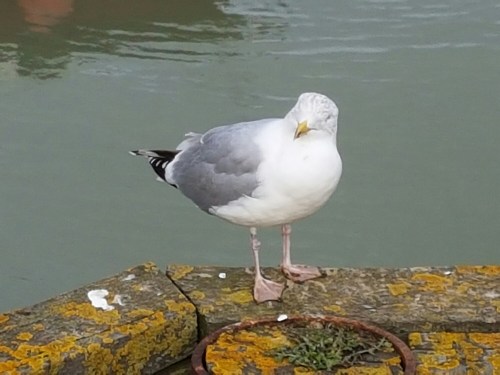
We are on first name terms with two pair of crows that have taken up residence in our beech tree. They love nothing more than to join the ducks in the fishing lake and the gulls on the roof in a chaotic (pre-) dawn chorus.
Our collection of eateries and watering holes continues to rise, with the Cliffe Restaurant in the View Hotel quickly becoming a favourite.
And we have entertained guests from Norwich and Philadelphia.
For now then, it is fair to say that the fabulous Folkestone fairytale continues.
Cynics will sneer at what they perceive to be an overly positive initial impression, and I acknowledge that the rose-tinted spectacles haven’t been discarded yet. However, I offer the following:
1 The people of Folkestone, especially in the retail and hospitality sectors, have largely been friendly and cheerful. And I have been particularly impressed by the courtesy of drivers towards pedestrians around town; and
2 Folkestonians appear to care for their physical surroundings too – flower displays and other open spaces are lovingly tended, littering is less visible than in many other places I have lived in and visited and there is extensive renovation and redecoration of buildings going on, especially near the seafront.
I am very conscious, however, that Folkestone is no more immune from the contagion of drunkenness and lawlessness that infects town centres across the country. The recent attack on a group of innocent bystanders in the early hours of the morning in Sandgate Road is not the only such incident since we have been here. I will not shy away in future from highlighting negative as well as positive features.
As the council gardening staff begin to dig up the flower beds along the Leas under another limpid blue sky that belies the reality of today’s Autumn Equinox, my thoughts turn to the next six months. Most of the time I have spent in Folkestone, as child and man, until now has been during the summer or in the late spring. But whilst I might mourn the imminent passing of hot, sunny days, I am excited at the prospect of witnessing winter storms crashing (but not damaging further) Coronation Parade and walking from Mermaid Beach into Sandgate and Hythe on cold, crisp February mornings.
The next phase of our Folkestone story awaits!






 Tony Quarrington