A clear, crisp November morning in Northern France has given way to a chill pall of fog and drizzle. A young, slim French mother guides her three, maybe four, year old daughter around a muddy field full of stone and flowers. They hold hands, but, occasionally, the small girl cannot contain her curiosity and runs to a rosebush that catches her eye.
This is no family Sunday morning stroll, however. It is Remembrance Day and they are walking among the 2,681 burials of the men from the UK and Commonwealth, slain during the Great War of nearly a century ago. A large white memorial, which forms the entrance point for the cemetery, commemorates on its walls 34,785 forces of the UK, South Africa and New Zealand, with no known grave, who died in the Arras sector between the spring of 1916 and August 1918, many of whom killed in the Battle of Arras during April and May 1917.
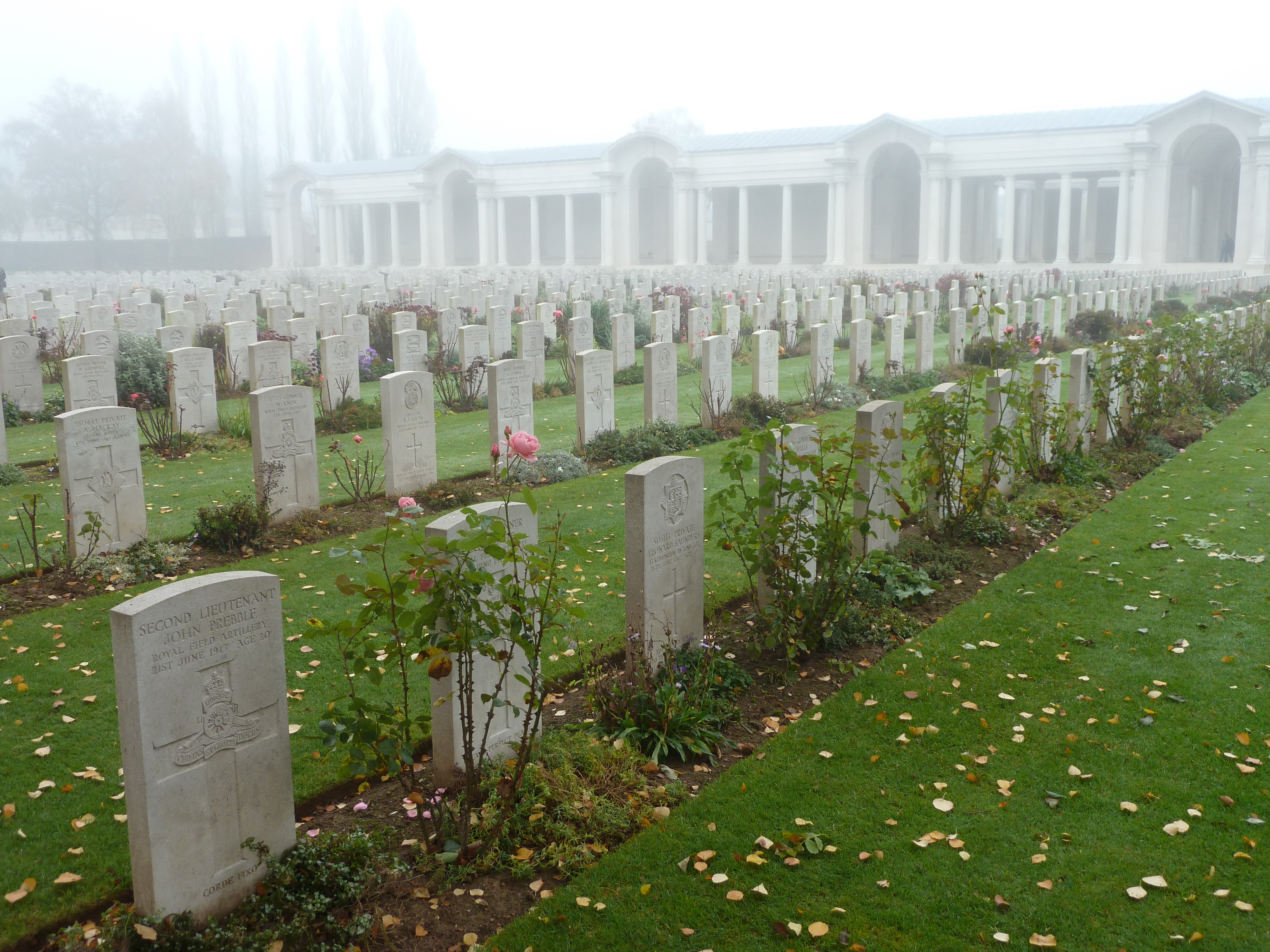
The Arras Memorial and Faubourg d’Amiens Cemetery is the first world war battlefield that I have visited, despite passing dozens over the years and, each time, blithely proclaiming that “we must visit” some one day. Well, that day has arrived. But, even then, this two mile pilgrimage from the centre of Arras on a morning more suited to the month of November than any others have been so far this year, was not planned. The weekend away with friends had been booked four months ago and the timing determined purely on our respective availabilities. It is only in recent days that I have felt drawn towards the location at which Siegfried Sassoon placed Harry and Jack in his poem called The General, of which more later.

Aside from the nationalities I have already referred to, there is a separate plot for 17 Germans. That might be understandable, but then there is one, Max Klemt, who died on 15th February 1917 (his age is not known), who is placed in the middle of row upon row of the British fallen. There are so many unanswered questions and forgotten stories in this place.
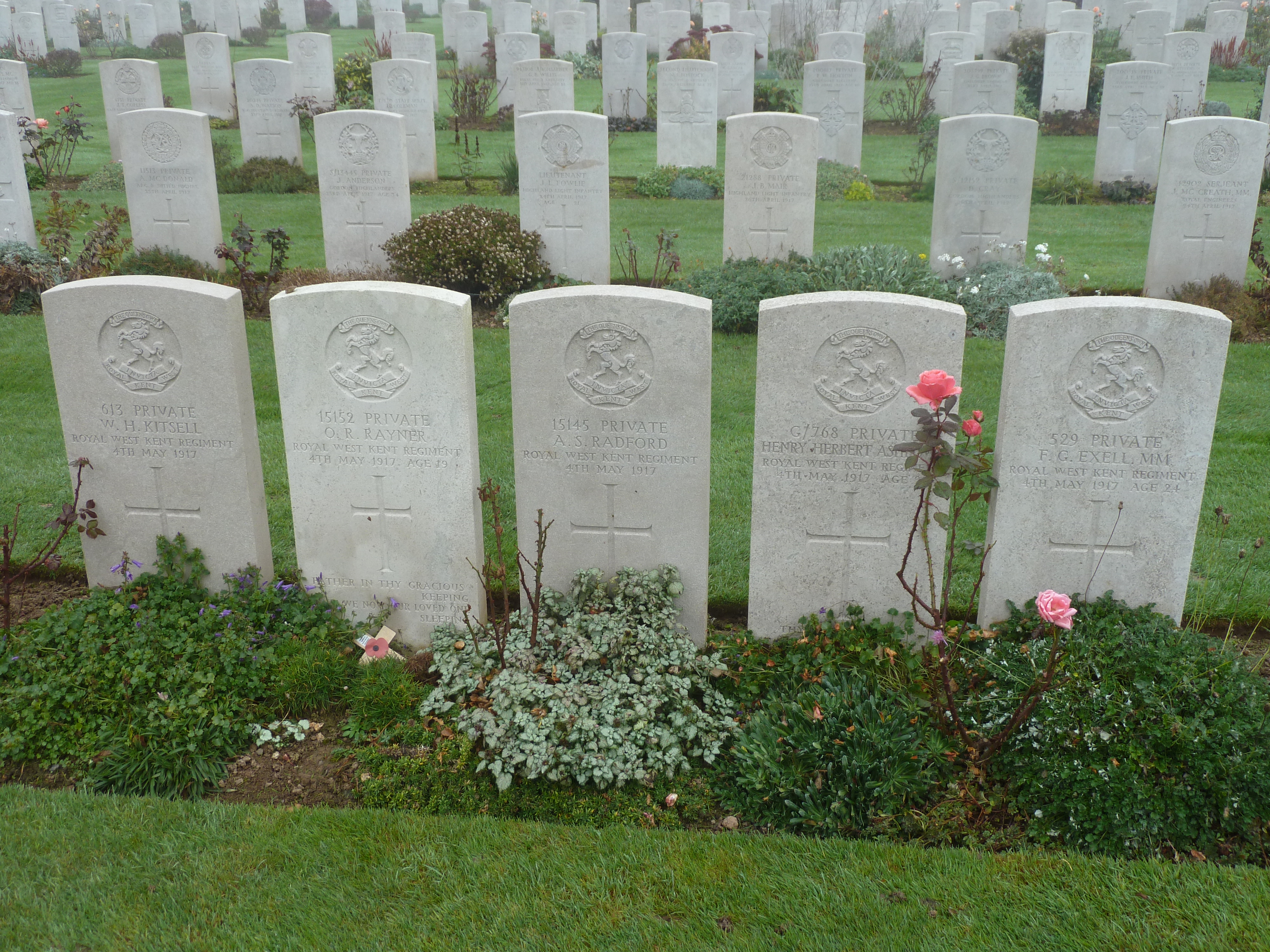
Each stone provides the information, where known, about the name, rank, regiment and date of death of the individual. The most telling fact, however, is age. Whilst there are a number of men who died in their thirties, even forties, the large majority were untimely ripped from the world between the ages of 18 and 25. I am moved especially by one group of stones, placed closer together than any others in the cemetery, that hold the graves of five privates in the Queen’s Own Royal West Kent Regiment, none of whom lived past 24. Another comrade, equally mysteriously, stands a little apart from the others. They must have been as close friends in life as they are physically close in death.
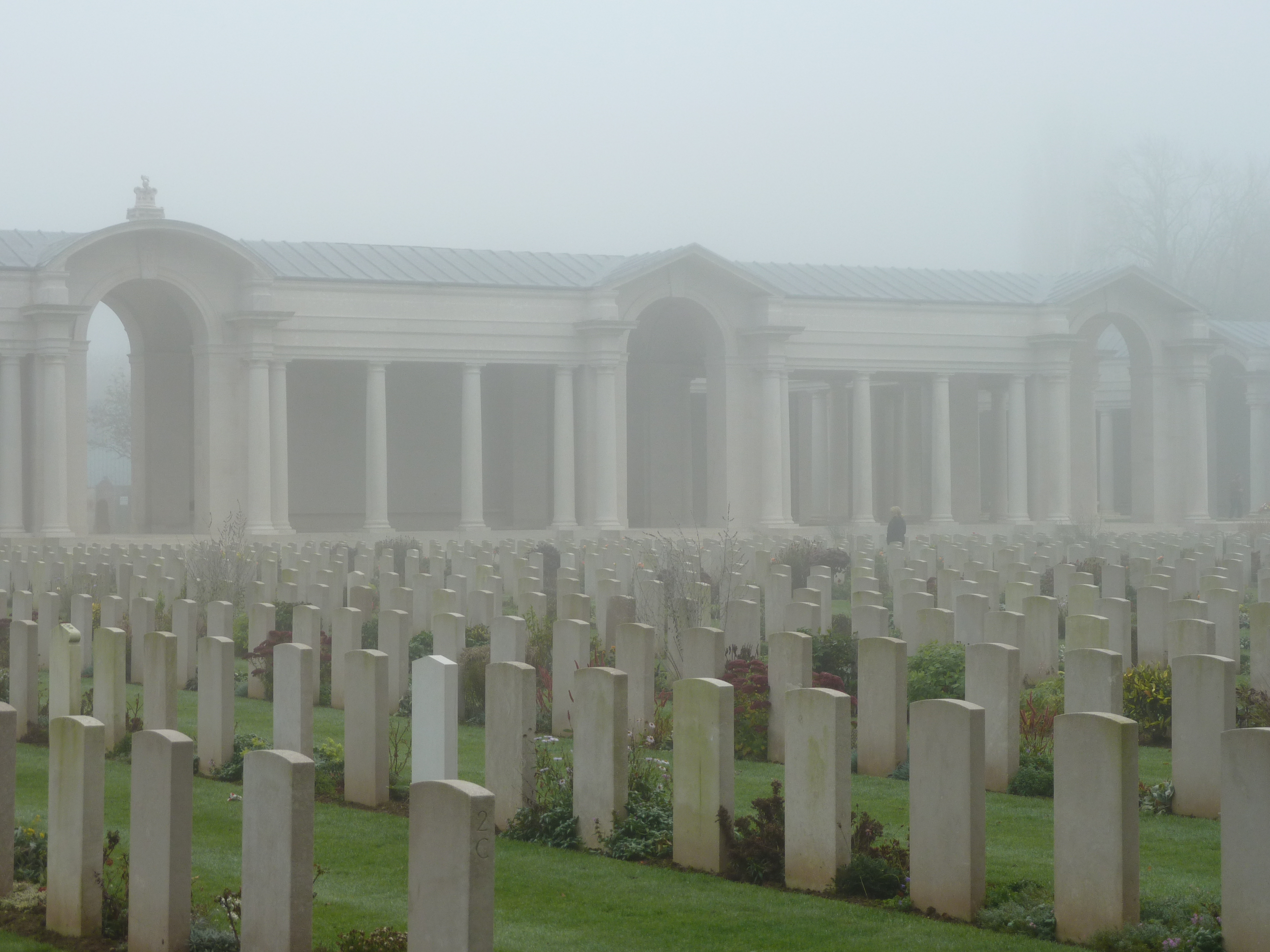
I scour the walls of the memorial for sight of my family name in vain. I have no reason to believe that I would have come across it, and am thankful in a sense that I have not – I would hope to have prepared myself first. But then again I am desperately disappointed. This place plays havoc with your emotions.
Although I am haunted by the names and especially ages of those laid out before me in neat rows in this sodden field that tests the impermeability of my new boots, Harry and Jack in that Sassoon poem seem more real, and their fate captures my overriding emotion, not of worthless grief, though that is strong enough, but of anger and contempt for the politicians and officers that bullied and hoodwinked such men to their early deaths:
“Good morning, good morning” the General said
when we met last week on our way to the line.
Now the soldiers he smiled at are most of ‘em dead,
and we’re cursing his staff for incompetent swine.
“He’s a cheery old card,” grunted Harry to Jack
as they slogged up to Arras with rifle and pack.
But he did for them both by his plan of attack.
I suddenly remember the mother and daughter and look around for them. But they have slipped away. I ponder what their story might have been. Were they, perhaps, the descendants of a teenage “tommy” and a local girl? I cannot think what other reason might have brought them to this grim, dank scene this morning. I hope that they have returned to a warm, welcoming home, an ordinary, everyday event that we take for granted but which was snatched from those young men with whom we have shared this space over the past hour.
But I have stayed here, at least for today, long enough. Having had no breakfast, the call of lunch is insistent. And we have a 70 mile drive back to the shuttle terminal this afternoon before returning to our lives of comfort and plenty.
Already, my thoughts turn to my next visit to one of the battlefields of Northern France and Belgium. We will certainly not pass one by so casually in the future.


 Tony Quarrington
The colder weather and mist seem appropriate for a visit to the cemetery, Tony. We have visited Arras, Albert, Paschendale, Thiepval, Ypres & Verdun over the years and always found the experience chilling. We were even invited to stay the night at the Ulster Tower, in the Somme, by the friendly Irish custodian of the memorial. A kind gesture but it would have led to nightmares, I’m sure. Particularly chilling were visits to villages that no longer exist due to the pounding they took. We have been lucky that we were never called upon to fight. It is difficult to believe we have learned so little with politicians continuing to wage wars in order to extend their empires or curry favour with the USA. Is Iran next on the list?
The place that plucked at my heart more than any of the few war graves I have visited was the Pinkas Synagogue in Prague. No longer used as a synagogue, its bare white walls list the 80,000 jews from that area alone who died in the holocoaust. The letters are only and inch high but the walls are full. The impression is overwhelming yet each one you read feels somehow like an individual. And the knife is twisted even more when you realise that your family name is there on that endless list.
Tony. This was, in my opinion, one of your most moving and evocative posts which I have read. In spite of my involvement each year – the arrangements for the Queen are planned at the FCO, when she goes out of a door which is opened only once a year – the more I watch the annual commemoration at the Cenotaph, the more I feel the importance of the need that we must remember them. Continually.
Like you, I wonder who that lady and the daughter could have been. But, whatever the reason, it is vital that we maintain cemetaries like those at Arras, and elsewhere, so that future generations are never allowed to foret about the futility of war.
Richard and Malvin above, in their separate ways, have wriitem much of what I would have done. As Richard says, our generation missed National Service. Even more reason why we should impress upon future generations the sacrifices made on their behalf by young men, many of whom were nameless and unknown. Lions led by donkeys.
And Malvyn rightly brings home the horrors of the Holocoaust. The persecution of the Jewish people has been perpertrated for far too long, and was shown in all its horrors during WW2. And, sadly today, we still have a limited number of people who try to deny that the holocoaust actually happened. Sad. So very sad.
In summary, thank you for your words and pictures. They were both poignant and relevant.
Thank you Graham, I really appreciate and value your comments.
Thanks, Tony…as always a fine read. As to the identity of the young mother and daughter I have two thoughts. I watched a news story once on the American cemeteries in France and how locals adopt graves. These fine people clean and decorate the plots. Or perhaps, like her mother before her, the woman wanted her daughter to start to understand the importance of this place and others like it. Military cemeteries are a reminder of the price of imperialism, nationalism, bigotry and intolerance. Maybe those who rattle the saber incessantly should be required to walk this hallowed ground. Not to leave off a wreath before being whisked away by a motorcade, but to really interact with the place. Before sending the next generation off on the next Children’s Crusade the politicians should read the names and imagine the lives that were not lived…Michael Eastman died 1917 (Never properly kissed a girl), Jack O’Hara died 1918 (never played ball with his child in the yard), Harry Kensington died 1914 (His bowling skills were sorely missed by the Kent side). Sometimes war must be fought, and the best we can do for the fallen is to keep their resting places beautiful and then to work for peace.
Thank you Dan, and I echo every word you say