Feeds:
Posts
Comments

Archive for the ‘Personal’ Category


“Care for a glass of ginger wine, Eddie?”, my grandfather would ask his son-in-law on our pre-Christmas visit to his house.

This was the cue for all the colour in my father’s face to be drained from it whilst he summoned up a festive smile and accepted the heartfelt, annual offer.  Whereas his family “liked a drink”, my mother’s side were teetotal (she virtually gave up alcohol herself after my christening party – that must either have been a great night, or it had suddenly dawned upon her that she would need to keep a clear head in bringing me up).  Apart from enjoying the traditional Christmas Day meal, on the table at 12 noon sharp just like any other day, my grandparents honoured Christmas in their customary restrained and homely manner.

My dad was essentially a beer drinker, but could be persuaded to partake of a gin and tonic or a glass of wine, (or, frankly, anything) if it was offered to him. Ginger wine, however, was not a  drink worthy to celebrate the Yuletide with in his mind. His misery was compounded by the fact that only he and his brother-in-law were ever afforded the doubtful privilege of being permitted to let the stuff pass their lips.  Consequently, the same bottle must have lasted a decade or more.  In fact, I don’t recall it ever being replaced (they were small measures).  Perhaps it was grandad’s pointed annual reminder to his son-in-laws to treat his daughters well, or else they would be answerable to him by being forced to endure a second glass.

My grandparents’ sobriety was all the more remarkable given that, for the last forty years of their lives, they lived next door to the neighbourhood pub.  It had both a public and saloon bar, as well as a “jug and bottle” (off-licence to anyone under the age of forty in this country and, for my continental and transatlantic readers, a separate room where people could buy drinks to take home without having to enter the pub). It was a raucous but friendly establishment.

I often wondered how they managed to sleep in the bedroom adjacent to it, especially at closing time when revellers spilled out onto the street, lingering long and loud before shambling home.  I suppose it helped that my “(Big) Nan”, as opposed to my father’s mother who was, you guessed it, “Little Nan” (the distinction was immediately evident on meeting), was stone deaf, though she always refuted the accusation (after her doting husband had both pulled faces and shouted at her for five minutes).

My grandfather – funny how I never called him “Big Grandad” when he was around eight inches taller than my father’s father – had worked and brought his family of two daughters and one son up in a London fire station during the Blitz and, as a result, I was in awe of him.  Chain smoking filterless “Senior Service” cigarettes, warming his backside against an open fire, pouring tea from his cup into the saucer before drinking it and constantly smoothing back his full head of bristling black hair, even at the age of eighty, he appeared even cooler in my young eyes (“old” people were cool then).

The manner in which he cherished his wife of sixty years (and fianceé of another seven) bespoke a deep love, although it made conversation with visitors redundant as the volume on the tiny black and white television set had to be turned up to maximum, especially when Double Your Money, Take Your Pick or Sunday Night at the London Palladium were on.

But back to the ginger wine, Stone’s Original Green Ginger Wine to be precise. Made to the original (1740) secret recipe that includes raisins and pure Australian ground ginger, it was an especially popular drink in the sixties when this story is set.  But I think it is best drunk with something else, preferably with a spirit or in a cocktail. Whisky Mac, a blend of whisky and Stone’s, was an order I heard many times whilst hovering on the shadowy doorsteps of pubs and clubs at that time. Given that it is a fortified wine and, therefore, quite alcoholic, it is a powerful and acquired taste when drunk neat – which is how it was served to my father.

Though it must have taken him at least forty eight hours to recover from such a chore, he did only have to endure it once a year. And there was always the pub next door to escape to.

Read Full Post »


It is November 21st and the preparations for Christmas are in full swing. Supermarket special offers vie with insurance companies for predominance in TV commercials.  Small children walking to nursery with their mothers can be heard singing “Jingle Bells” or “We Wish You a Merry Christmas” under their breath, though just loud enough to act, they think, as a subtle reminder to Mum.  The cable TV channel Movies 24, renamed Christmas 24 for the duration, is showing festive films throughout the day and night – with a two hour break between 6am and 8am for………….teleshopping! Christmas trees are also beginning to peer from behind curtains.

Much as I enjoy Christmas I have always tried to keep it at arms’ length, at least until the second week in December.  But the date upon which I am sucked into its tentacles has got earlier and earlier. I suppose Halloween now acts as the catalyst for a full scale assault on the holiday season, though the retail world, more desperate than ever to eke every penny out of customers grudgingly trying to resist such attempts, has been playing Christmas carols, Dean Martin, The Pogues and Kirsty McColl, not to mention that infernal Slade song, since mid-October.

So here I am – still a week of November to go and I am already wrapped up in Christmas (unlike the presents I haven’t even started to buy).

Unless we are devout Christians, and I certainly do not claim to be one, I suspect that our perceptions of the occasion vary over our lives.

My childhood Christmas mornings were spent opening the bulging sack of presents that my father, whom, out of loyalty, I had never exposed until now for his obvious mugging and impersonation of Santa, had lain at the bottom of my bed at between 1.30 and 2.00am (how do I know that when I was so obviously asleep at the time?).  At least I had the decency not to disturb my parents before 5am with the revelation of its contents.

After visiting several friends for drinks, we would walk to my paternal grandparents’ house for the traditional Christmas dinner, surrounded by assorted cousins, aunts and uncles, followed by party games, a “good old sing-song” and an elaborate tea comprising such Dickensian delicacies as pork pie and piccalilli.  Once the organisation of such a large event had become too much for them, their children rotated responsibility for accommodating fifteen, sometimes more, celebrants for three nights.  The women and children slept in the beds upstairs and the men sank onto any available floor space downstairs, where the evening’s drinking would be rounded off by the annual world farting championship (which a certain uncle won every year).  Joining the menfolk in this charming ritual became a rite of passage for the boys in the family.

Since leaving University thirty five years ago, the holiday season has, with the exceptions of one New Year in New York and a couple of years where bad weather grounded us, entailed a near six hundred mile round trip between the two events to ensure that both my and my girlfriend’s / wife’s parents were neither offended nor disappointed.  Inevitably, therefore, Christmases and New Years have taken on a familiar and staid pattern.  “Christmas is really for the kids” may be a cliché, but the presence of each succeeding generation of children does enliven the occasion and bring back warm memories of one’s own childhood.

But, in recent years, I have developed a growing affection for Christmas.  For a long time it was an enjoyable if routine experience, which the travelling did little to mollify.  Especially since my disenchantment with football, around which my Christmas diary had revolved, took hold, the lead up to the holiday season has become one long round of social events.

This year alone, I have already booked to see Cinderella, the first pantomime in the new Marlowe Theatre in Canterbury and English folk singer, Kate Rusby’s Christmas Concert at the Barbican Centre in London.  Both of these have become essential annual events.  In addition, we are attending the Christmas Evening Special at Hever Castle and Rochester’s annual Dickensian Christmas and linked German style Christmas market.  We may also be part of the congregation at the Rochester Cathedral Carol Service.  Several Christmas meals are also planned, and there will be the inevitable procession of  shopping excursions, including a visit to the new Westfield Shopping Centre in Stratford, close to the Olympic Stadium.

And then there’s the Christmas CDs which have been stuffed away in my wardrobe for the past eleven months.  They will need a dusting before my favourite songs are reloaded once again on my iPod to enable me to create the playlists that act as the soundtrack to the “big day”.

The DVD collection will also get an airing with assorted versions of A Christmas Carol and Miracle on 34th Street being essential viewing.  Purporting to have a literary disposition, it might be expected that I would cite It’s A Wonderful Life as the ultimate Christmas movie, but I’m sorry to disappoint you – Bad Santa and Elf take pride of place in my collection!

Which brings me to a question that preoccupies me a lot these days – whether my shifting interests and attitudes on this subject, or any other for that matter, are, in any respect, attributable to the ageing process or not.  I have no idea what the answer is. My political views, musical tastes and sporting allegiances remain broadly the same as when I was younger, although they have been subject to some fine shading with the passage of time.  I dare say this phenomenon has attracted scientists who will have theories for it.  Perhaps it will, one day, be the subject of another blog post.

The connection to the Christian dimension of Christmas is a particularly interesting one.  Although I was brought up as a Church of England Christian, and was presented with a bible for 100% attendance at Sunday School when I was nine, any faith that my parents might have gently encouraged me to adopt, has long disappeared.  And I have never been one, unlike my father, to bellow out a carol or hymn – in fact I was only selected for the school choir and placed in the front row because I was a champion mimer.  But, long after those days in primary school when I would sit cross-legged singing (my talent for miming had not been discovered yet) Away in a Manger and Rocking, I remain genuinely touched by the music in particular.  It has the same emotional impact upon me as listening to a reading of the 400 year old King James version of the Bible. I am sure that I am far from alone in harbouring such contradictions.  

So I’m looking forward to Christmas – the social and theatrical events, my father round for dinner and, yes, the travelling to the in-laws for New Year.

But I will not be able to suppress an irritated groan when I hear that damned Slade record for the first time.

Read Full Post »
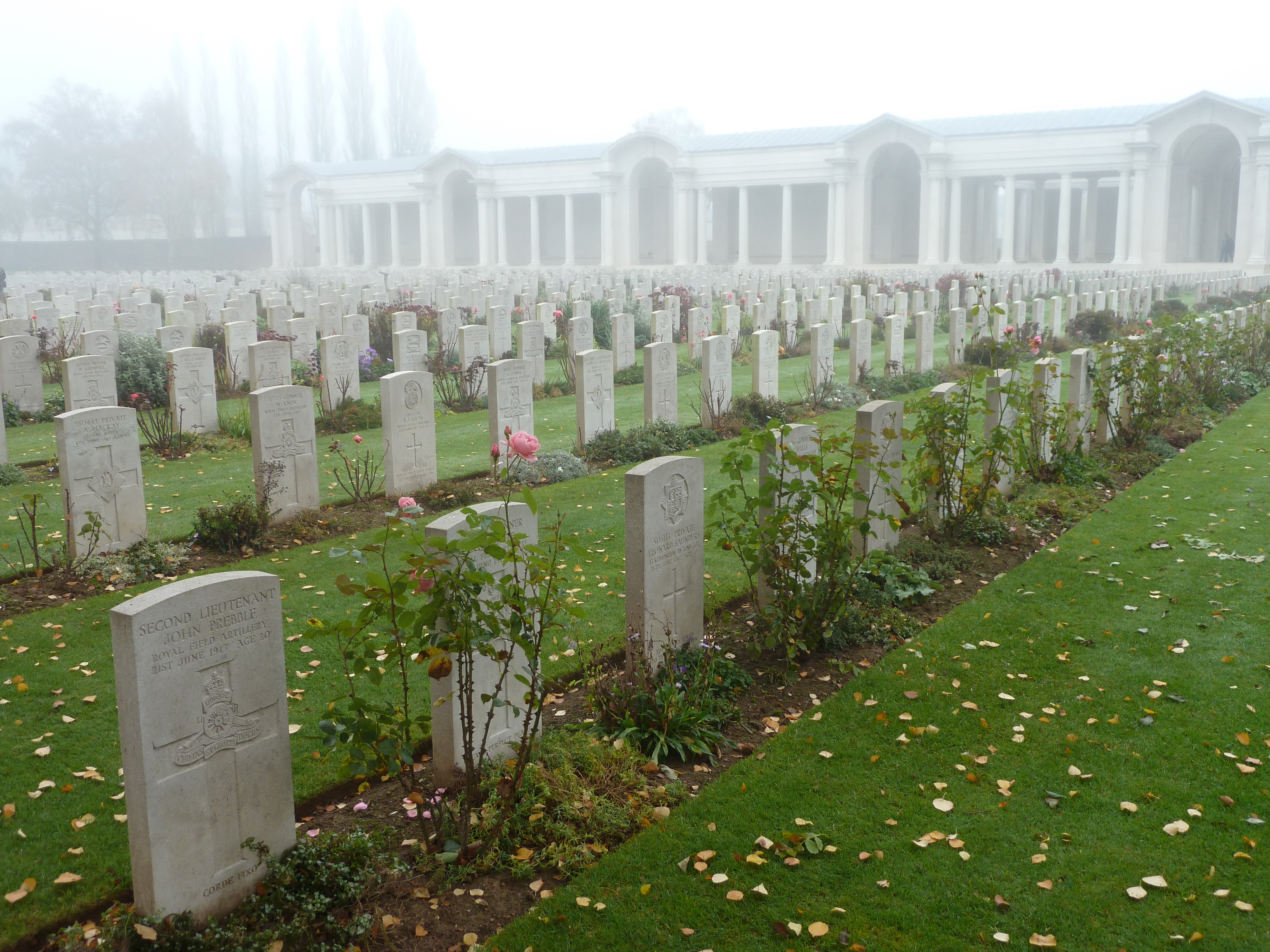

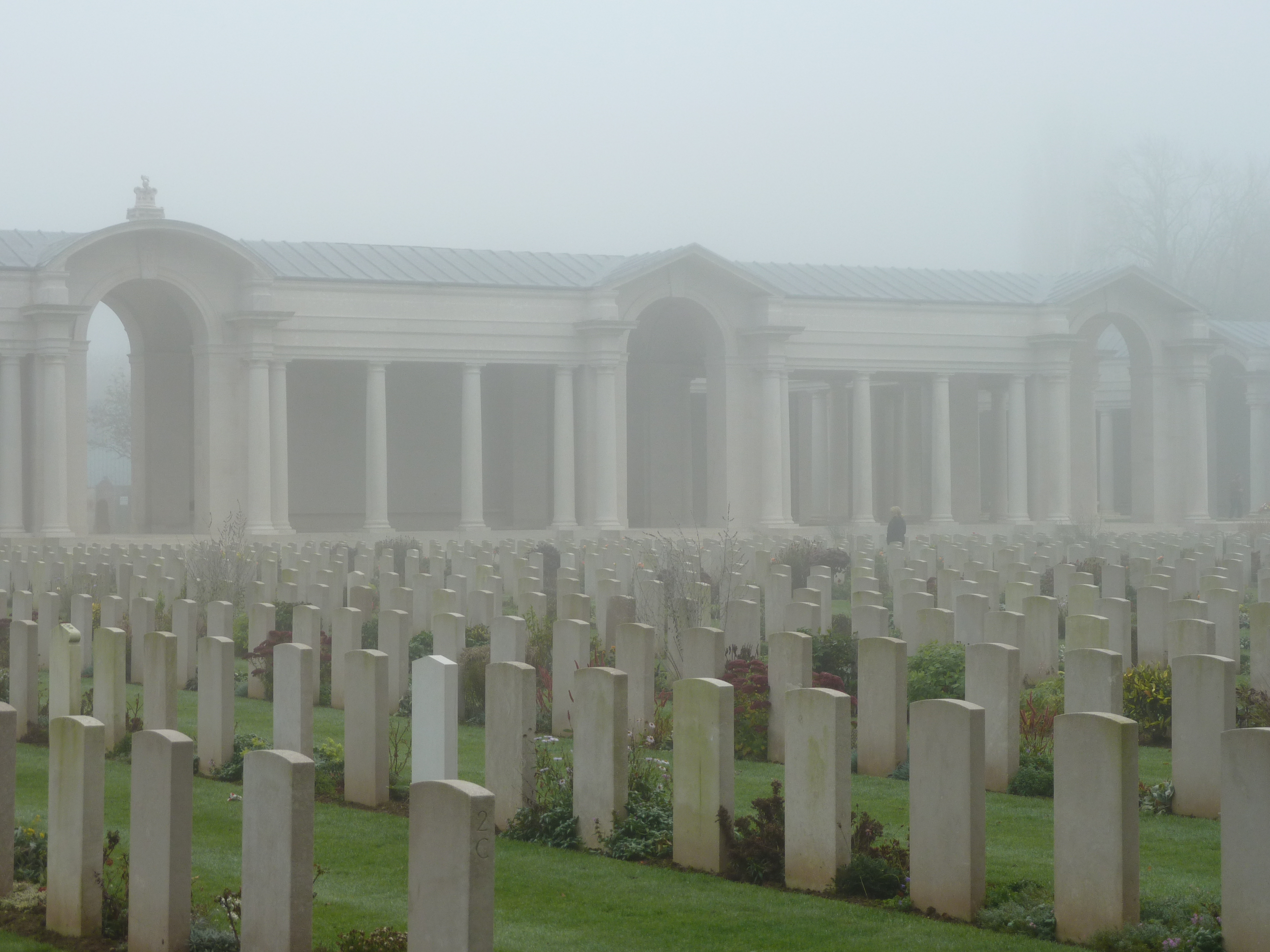
A clear, crisp November morning in Northern France has given way to a chill pall of fog and drizzle.  A young, slim French mother guides her three, maybe four, year old daughter around a muddy field full of stone and flowers.  They hold hands, but, occasionally, the small girl cannot contain her curiosity and runs to a rosebush that catches her eye.

This is no family Sunday morning stroll, however.  It is Remembrance Day and they are walking among the 2,681 burials of the men from the UK and Commonwealth, slain during the Great War of nearly a century ago.  A large white memorial, which forms the entrance point for the cemetery, commemorates on its walls 34,785 forces of the UK, South Africa and New Zealand, with no known grave, who died in the Arras sector between the spring of 1916 and August 1918, many of whom killed in the Battle of Arras during April and May 1917.

The Arras Memorial and Faubourg d’Amiens Cemetery is the first world war battlefield that I have visited, despite passing dozens over the years and, each time, blithely proclaiming that “we must visit” some one day.  Well, that day has arrived.  But, even then, this two mile pilgrimage from the centre of Arras on a morning more suited to the month of November than any others have been so far this year, was not planned.  The weekend away with friends had been booked four months ago and the timing determined purely on our respective availabilities.  It is only in recent days that I have felt drawn towards the location at which Siegfried Sassoon placed Harry and Jack in his poem called The General, of which more later.

Aside from the nationalities I have already referred to, there is a separate plot for 17 Germans. That might be understandable, but then there is one, Max Klemt, who died on 15th February 1917 (his age is not known), who is placed in the middle of row upon row of the British fallen.  There are so many unanswered questions and forgotten stories in this place.

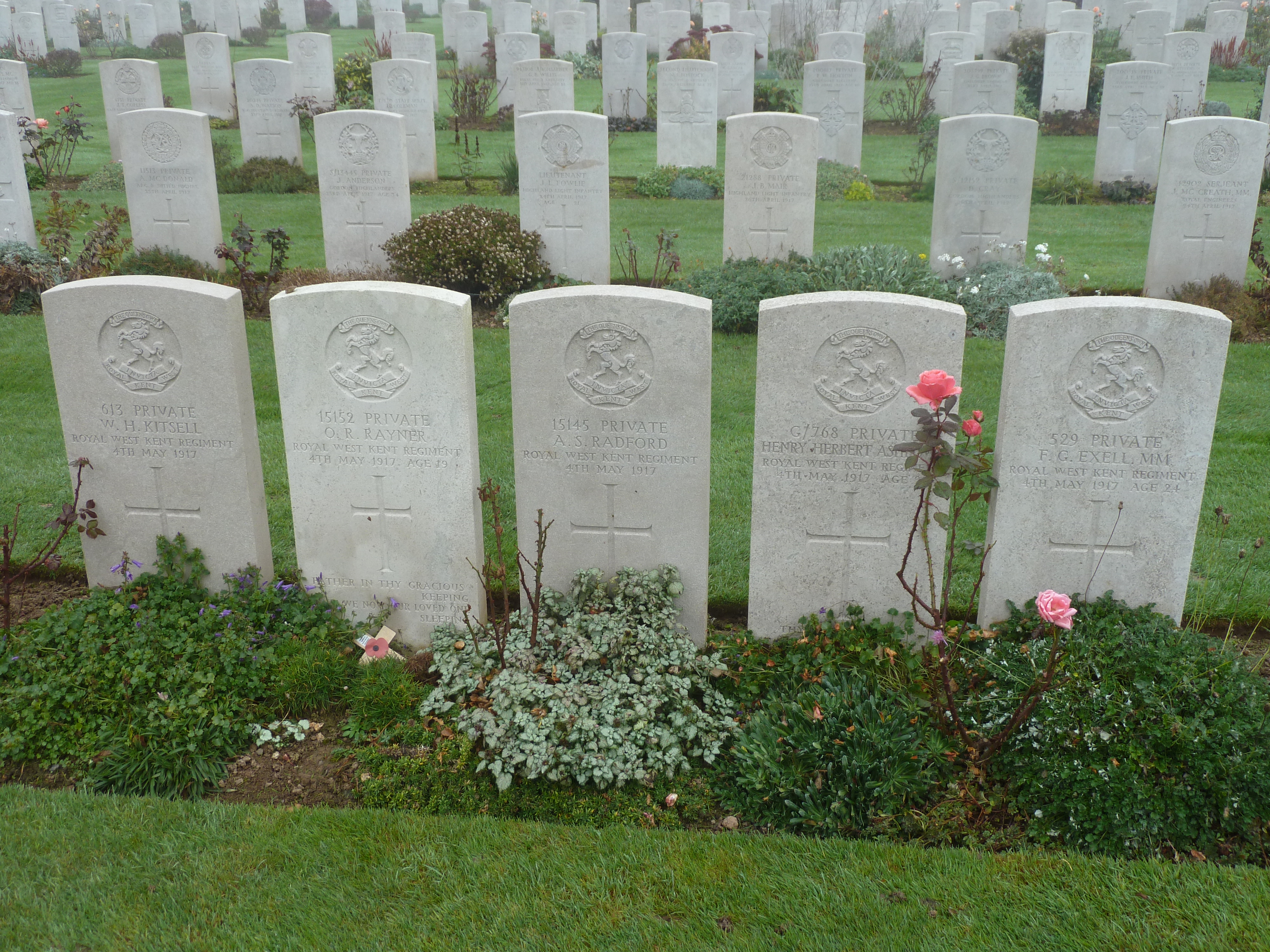
Each stone provides the information, where known, about the name, rank, regiment and date of death of the individual.  The most telling fact, however, is age.  Whilst there are a number of men who died in their thirties, even forties, the large majority were untimely ripped from the world between the ages of 18 and 25.  I am moved especially by one group of stones, placed closer together than any others in the cemetery, that hold the graves of five privates in the Queen’s Own Royal West Kent Regiment, none of whom lived past 24.  Another comrade, equally mysteriously, stands a little apart from the others. They must have been as close friends in life as they are physically close in death.

I scour the walls of the memorial for sight of my family name in vain.  I have no reason to believe that I would have come across it, and am thankful in a sense that I have not – I would hope to have prepared myself first.  But then again I am desperately disappointed.  This place plays havoc with your emotions.

Although I am haunted by the names and especially ages of those laid out before me in neat rows in this sodden field that tests the impermeability of my new boots, Harry and Jack in that Sassoon poem seem more real, and their fate captures my overriding emotion, not of worthless grief, though that is strong enough, but of anger and contempt for the politicians and officers that bullied and hoodwinked such men to their early deaths:

“Good morning, good morning” the General said

when we met last week on our way to the line.

Now the soldiers he smiled at are most of ‘em dead,

and we’re cursing his staff for incompetent swine.

“He’s a cheery old card,” grunted Harry to Jack

as they slogged up to Arras with rifle and pack.

But he did for them both by his plan of attack.

I suddenly remember the mother and daughter and look around for them.  But they have slipped away.  I ponder what their story might have been.  Were they, perhaps, the descendants of a teenage “tommy” and a local girl? I cannot think what other reason might have brought them to this grim, dank scene this morning. I hope that they have returned to a warm, welcoming home, an ordinary, everyday event that we take for granted but which was snatched from those young men with whom we have shared this space over the past hour.

But I have stayed here, at least for today, long enough.  Having had no breakfast, the call of lunch is insistent.  And we have a 70 mile drive back to the shuttle terminal this afternoon before returning to our lives of comfort and plenty.

Already, my thoughts turn to my next visit to one of the battlefields of Northern France and Belgium. We will certainly not pass one by so casually in the future.

Read Full Post »


Chester is a pretty city, along with Bath, York and Edinburgh, one of my favourite UK destinations. It has a rich history (it was the Roman city of Deva), fine architecture, especially the unique and magnificent Rows, many cultural attractions and excellent shopping.  It is all the more remarkable, therefore, that our trip last August Bank Holiday was our first to the city for fifteen years.

We had stayed overnight in Sutton Coldfield en route to my wife’s parents in Lancaster for the weekend – just as well as a combination of traffic congestion at the Dartford Crossing and on the M25, major, long standing roadworks on the M1 and intermittent driving rain throughout meant it took us nearly five hours from Maidstone in Kent.  We decided to stop somewhere for lunch on the Friday and plumped for Chester as we had not been there for so long.

Janet stated that she would like a jacket potato.  So we embarked upon the hunt for a decent, independent cafe where we could sit outside in the bright if lukewarm sun and watch the good citizens of Chester go about their Friday lunchtime business. This ought not to have been a difficult quest, though the city centre was understandably very busy.  Eventually, we found an establishment that appeared to fit the bill perfectly with a one available table outside, ideal for both serious people watching and modest sun bathing.

I ordered a prawn salad baguette and Janet asked for a tuna mayonnaise jacket potato, both to be washed down with coffee.  The proprietor taking the order was extremely pleasant and efficient (yes, we are still in the UK at this point), and our order was promptly taken.  I returned to join Janet in our prime position outside only to find her gathering up her bags and hurrying back into the cafe itself.  Possessing higher than the average level of acuity, I promptly deduced that the sudden swarm of wasps and flies encircling our evacuated erstwhile table may have been a contributory factor in her flight.

So we settled at a table towards the back of the cafe, conveniently adjacent for gentlemen (I use the word advisedly) of a certain age, to the washrooms.  After around ten minutes our sumptuous repast was delivered to our table.  Being very hungry at this point I was not overly disappointed at either the size or texture of my baguette.  However, it was a different story for Janet.  She had been granted custody of probably the smallest jacket potato either of us had ever seen.  She likened it instantly and accurately to a new potato, one that would not have looked out of place peeking coyly from a rocket salad.

Ordinarily, this would have been the cue for me to bestride my white charger and rush to the damsel’s distress – in other words assume the role of a militant consumer and take the matter up with the proprietor, citing my thirty years of experience in customer service.  However, Janet was too hungry to wait any longer for a (more substantial) substitute and decided, on this occasion, to let it pass.  By the way, my prawn baguette was delicious, but please don’t tell Janet as it will only reopen old wounds for her.

This may, however, and forgive me for perpetrating a gross gender stereotype, if one borne of no little experience, have been partly because any additional minute spent in the cafe would have been a minute less in looking for shoes and jewellery (we did, after all, only have two hours on the parking meter).

Before we were able to do so, Janet’s humour was not assuaged as we left the cafe only to discover that the outlet next door was a branch of the decidedly downmarket Spud-U-Like chain, and their jacket potatoes were enormous.  And half the price.

Read Full Post »


Today is my birthday, the 59th to be precise.

Cause for celebration? Perhaps, but more a sense of satisfaction and gratitude for being granted the last year.  And a sense of expectation for what lay ahead.

But, for the past seven years, any joy has been tinged with sorrow as my mother died just two days before it.  Her last whispered words as I wished her a good night in hospital were “happy birthday, I love you so much”, as if she knew she wouldn’t get the chance to say it again. Thinking no such thing myself, I admonished her, reminding her that my birthday was still a couple of days away and that she could extend her love and best wishes then. But, as always, she knew best.

Yesterday, two fine talents who have also influenced me, though not in as profound a way as my mother, were snatched from us before their time.  Graham Dilley, Kent, Worcestershire and England cricketer, passed away after a short illness at the criminally young age of 52, whilst one of the greatest guitarists of the past half century, Bert Jansch, died at the age of 67 after a long battle with cancer.

I will never forget my first sight of “Picca” Dilley on a Kent ground. Aside from his shock of blond hair, and beaming smile, here, at last, was the type of player that the county club had rarely been blessed with – a genuinely quick bowler who could spreadeagle rather than tickle a batsman’s stumps. On his day he was also a glorious stroke player, earning comparison, on one occasion, with the great Frank Woolley.  Were it not for injury he would surely have led England’s attack for more than 41 tests.

Jansch was a musician’s musician, who influenced and inspired guitarists who became household names such as Jimmy Page, Paul Simon and Neil Young.  I first encountered him playing with the outstanding British folk group, Pentangle, whom he helped to found and collaborated with for many years.

I hadn’t seen Dilley for nearly 20 years, during which time he had become a successful and much loved coach.  Nor had I seen Jansch live in that same period, though his music lives on in recorded form.  But their passing, whilst diminishing my life now, enriches it too because it reminds me how important to me they have been at times in my life, and that they have played a positive part in making me who I am today.  In that sense, they join some distinguished company.

It is against this even sadder than usual backdrop that another birthday has dawned (on a morning that I also hear of the death of Steve Jobs, the founder of Apple).  Or perhaps birth weekend would be a more appropriate term. Tonight my wife and I will have a meal and stay in Tunbridge Wells, and on Saturday evening we will pay homage to David Crosby and Graham Nash at the Royal Albert Hall, again with a hotel stay in the capital.

My mother would not have wanted it any other way.

Read Full Post »


You may be familiar with Mr Jingle’s assessment of Kent in The Pickwick Papers: “Kent, sir – everybody knows Kent – apples, cherries, hops and women”. Although the abundance of the first three may have been diminished in recent times (being a happily married man I could not possibly comment on the fourth), this still holds true to a great extent.

An alternative definition that I would subscribe to might be “coast, countryside and cricket”.  It is certainly a triumvirate of glories that make me a proud product of its soil. That pride has been rather dented over the summer months with the dismal displays, both on and off the pitch, of the county cricket club. The cradle of the game, home to some of its greatest ever players and with a tradition of playing cavalier cricket in front of large festival crowds in beautiful surroundings, now reduced to a laughing stock in the cricketing world.

Rising debts, the result of a succession of poor financial decisions, a stalled ground redevelopment programme at its Canterbury headquarters, poor communications with its members and supporters and woeful performances on the field leaving the team second bottom in the county championship, all combined to make the season one of the worst in the modern Club’s distinguished 141 year history.

And in the past few days, the coach and two of the senior batsmen have all departed, leaving the team desperately short of both numbers and experience. With doubts remaining too over whether the player of the season will get the new contract that he deserves, that situation is likely to get worse before it gets better.

But in the past week, I have sought solace in some of the county’s many other delights – country walks through the full to bursting apple orchards of haunted Pluckley and the beechwoods and meadows of handsome Harrietsham, a stroll among the bookshops in civilised Tunbridge Wells, and Kentish beer and seafood at the Broadstairs Food Festival, overlooking the packed beach of Viking Bay, basking in the baking October heat and looking like a scene out of the nineteen fifities.

Though I currently live in the “compost heap” of the “Garden of England”, I am no more than an hour and a half, by car, bus or train, from any of its attractions – the castles of Hever, Scotney, Leeds and Rochester, the gardens of Sissinghurst and Emmetts, splendid houses like Groombridge Place, Finchcocks and Knole and what J.M.W Turner called the “loveliest skies in Europe” along the Thanet coast. Throw in two world class animal parks dedicated to conservation, the White Cliffs of Dover, otherworldly Romney Marsh, the rolling North Downs and atmospheric Wealden woodland – the list goes on (my apologies to any favourites of yours that I have missed out).

I count myself lucky in having been born, educated and, after a brief but largely loveless affair with other parts of England, lived in this wonderful county. I’ve been equally fortunate to have grown up hearing and reading  of the exploits of Woolley, Ames and Freeman and watching Cowdrey, Knott and Underwood in their pomp.

But whilst the experience of the cricket, at least at the professional level, has sunk in the past couple of years, there are still those other two features, and much more, to fall back on in the coming months.

Read Full Post »


With the cricket season finally over, perversely heralding the return of summer, my wife and I decided to resurrect our walking regime on Sunday.

Five miles west of Ashford, on the edge of the Greensand Ridge, lies the village of Pluckley which, despite a population of little more than a thousand, lays claim to two impressive titles – “the most haunted village in Britain”, home to between 12 and 14 ghosts, and the location for The Pop Larkin Chronicles written by H.E. Bates, who lived in a converted tithe barn in neighbouring Little Chart Forstal.  Set in the “never had it so good” nineteen fifties, the best known of those novels is The Darling Buds of May, which inspired a popular Sunday evening TV series in the nineties.  Pop Larkin’s sunny, optimistic disposition was never better characterised than in his catchword, “perfick”, a rural version of Del Boy’s “lovely jubbly” in Only Fools and Horses, fittingly both TV roles played memorably by David Jason.

The majority of this particular walk winds through apple orchards with pleasant views across the Weald.  It has been a vintage year for Kentish apples, and this is evident in the bulging crop tugging at the upper branches of the trees, urging them to kiss the ground which is equally well populated with “drops” of different varieties.  Our taste test reveals that they range from succulent to woody.  The overriding impression, however, is of their immense size.  Stacked boxes and short step ladders signify the advent of harvest.

Setting off from the car park of the 540 year old Black Horse pub, where furniture is said to rearrange itself from time to time, we head towards the adjoining villages of Little Chart and Little Chart Forstal.  The latter boasts a lovely and surprisingly large village green, and is bordered intermittently by neat and handsome  houses.

Now “it is a truth universally acknowledged” that any good walk culminates in well deserved refreshment at a hostelry.  The true glory of this particular walk is not, as might be imagined, the abundance of apples, but the fact that not only does it end at one pub, but another is thrown in for good measure at the half way point too!

So, on a warm late September morning, we rest our legs with “a half” (appropriately) and a coffee respectively in the garden of the friendly Swan at Little Chart, accompanied only by birdsong and the rustling of trees.  The food menu is eye-catchingly unpretentious (sausage, egg and chips rather than Sunday roast – Pop Larkin would have loved it), but, having already stocked up with a large breakfast at home, it is too soon to eat (so I’m told).

The stated length of the walk is 4 miles, but as we are out of practice and get lost periodically (beautiful though they might be, apple orchards do all tend to look the same), our legs insist that we have covered more like 6 miles.

Two and a half hours after we set off, we return to the village as the groundsman tends lovingly to the now redundant cricket square.  Seeking sustenance at the Black Horse, my rustiness in walk management is exposed when we discover to our disappointment that, despite the mouth-watering array of meals displayed on the blackboards, the pub only serves roast dinners on a Sunday.  Whilst the gargantuan yorkshire puddings scream “eat me”, we are only looking for a snack (so I’m told).

However, taking the country rather than motorway route home, salvation awaits at the delightful Village Tea Rooms in Headcorn, which doubles up as an attractive gift shop.  Here I am able to indulge my weakness for smoked salmon, which arrives in a toasted baguette whilst Janet, having initially dismissed the idea, tucks into a large and, to her mind, uncharacteristically moist and delicious, carrot cupcake.

Nothing left to say but……….perfick!

Read Full Post »


It’s been a few weeks now since I paid my first visit as an adult to my local hospital accident and emergency (A & E) department, and I thought I would share the occasion with you.

In a rare fit of enthusiasm for moderately hard physical work I decided to clear out the brick shed at the bottom of our garden.  Having swept up the remnants of recycled paper, stray leaves and miscellaneous detritus, and deposited it in a dustpan, I stood up and involuntarily headbutted the wire tray hanging from the wall a few inches below the ceiling.  Given the violence of the blow I immediately put my right hand to the offending spot, only to collect a massive smear of blood.  Had it not been the wrong time of year I would have sworn that it gave a passable impression of a spillage of beaujolais nouveau.

In a state of mild panic I rushed past the pond, careful not to disturb our one remaining and increasingly obese goldfish, into the bathroom, issuing blood in all directions, coating the bath, sink, toilet seat and floor, grabbed the previously cream coloured hand towel and pressed it to my head.  After a couple of minutes I had succeeded in staunching the blood.  Heart rate slowly subsiding, I considered what I should do next, other than mopping up the blood spattered bathroom.  Given the apparent depth of the wound (I wasn’t brave enough to look at it), I determined to get myself to A & E as quickly as possible as it might require stitches.  Insufficiently injured to call for an ambulance, but groggy and anxious enough not to risk the fifteen minute walk, I rang for a taxi.  But not before…………….

Although time was pressing I had not lost the sense of self-respect inculcated in me by my late mother which prompted me to change into clean clothes, shave and clean my teeth before greeting my public.  My head might look a mess but I was going to look presentable in all other respects.  I did not, however, go so far as to adjust my make-up as mum would have done.   Beautification complete, I was able to call the taxi to whisk me to Medway Maritime Hospital.

On arrival I joined a queue (naturally), but was greeted almost simultaneously by a young nurse requesting basic details (name, date of birth and nature of injury) before presenting me with a pink slip to hand over to reception when called, which further transaction took place five minutes later.  As I had not been to hospital since I trod on a football in the school gym in 1972, there was no record of me on the computer system, a fact that was soon rectified.  As ever, I had the excrutiating dilemma of describing my employment status – courage failed me and I answered “retired”, though I did add under my breath that I was also “doing some writing”, which provoked the customary smile of pity.

I was then asked to sit down and wait to be called by a nurse in the “minor ailments” area.  Despite a dull ache above the bridge of my nose I felt fine, in fact perfectly able to read my book without strain for the hour that it took before I was hailed.  The nurse started by asking me the same questions that the receptionist had asked – had I lost consciousness?  Was I suffering with a headache or nausea? What medication, if any, was I taking?  In addition, if a little apologetically, she enquired whether I knew where I was, what her name was and what was her role – all of which I answered correctly!  Had I been a few decades younger I’m sure that would have entitled me to some reward, but all I got was a “well done”.

The nurse also took my blood pressure, which proved significantly higher than it had been of late, attributable, as I suggested, to my current mild anxiety state.  She advised me that the wound was only superficial and could be repaired by the application of medicinal glue rather than stitches.

This took a matter of seconds.  Before I left, armed with advice cards on head injuries and wound care, it was my turn to ask a “silly” question as the nurse referred to it – would I be able to wash my hair, which I would normally do every day?  The nurse’s frightening reply was that I could not touch the wound for five days, putting thoughts in my mind of rampant nit infestation by the Wednesday (this was Monday by the way).  Vanity had supplanted anxiety as uppermost in my thoughts.  But it could have been worse – she might have had to cut my hair!

Impressed by the efficiency and care with which I had been treated, I walked home for a much needed and overdue lunch, a tentative tidying of the shed and an afternoon on the sofa.

Read Full Post »


In the past two years, I have re-established contact with a series of people from my past whom I had not seen for a total of more than 130 years – a schoolfriend from 38 years ago, a good friend from university (36 years), a group of work colleagues (nearly 30 years), a couple with whom my wife and I had previously enjoyed a great relationship  (18 years) and an ex-boss (12 years).  And I suspect that many other people have similar tales to tell about rediscovering, if not recapturing (which I doubt is ever possible), some of the more enjoyable periods in our lives.

So, what are the motives for doing this?  Is it because I need to recapture a past that was much better than the present? (it was certainly simpler, but today’s comforts – including the ability to communicate my thoughts in the way I’m doing now – make it difficult to counter that argument).  Or is it just safer to “live in the past” in order to escape from a present that is complicated, stressful, even frightening?  Short of becoming a hermit I just don’t see how such an escape could be effected. Or is it because in most instances I was considerably younger, healthier and fitter then?    Well, that is undeniable, but life on a personal level is “all good” as my Californian friends would say.

Or, maybe, for me at least, it is purely because I have more time (far too much, some might say) on my hands now that I am no longer a wage slave.  There may be something in that, but these matters had concerned me before that, but I did not, or chose not, to articulate them in this public fashion.  And, finally, and on a shallower level, is it mere vanity, a means whereby I can induce more people to say how well I have aged and how young I look?  I would hope not, though I can’t deny, nor could you I suspect, that it is nice to told that from time to time!

It may, at least in part, be an intimation of mortality, an understandable symptom of the ageing process, even possibly a need to “make my peace” with those people; to confirm that, when we do part again, as we will surely do, we do so on unequivocally good terms.  But that presupposes that the people I am back in touch with, I had fallen out with in the first place – which is palpably untrue.   It is a fact that the pace and demands of modern living can, sometimes unaccountably, disconnect us  from people we have long regarded as good friends, leaving the embers of Christmas cards and the occasional e mail – and, perhaps, your displacement by other people from their past!

Whilst there is some truth in all of the above, I suppose the simple answer to the question is “because I can” – four  of the five reunions have been triggered or facilitated by social networking, with the other the result of the reporting of a major life event.  In none of these cases have I pursued or sought out those people because I needed to – in fact, in the majority of instances, it has been the other party that has contacted me, though the experience of resuming contact, once the approach had been made, has been a wholly positive one.

Indeed, regardless of either the route taken to the reunion or the current state of play between the parties, the relationship has enriched my life now, as it had done in the past when we took it more for granted.  And not just because it’s “nice” to see “so and so” again.  I believe that  revisiting some of the good times in our past with people we still value, though we had been long separated, prompts us to think about how we behaved and reacted to experiences then, and how we might learn lessons from that that would enable us to lead more caring, inclusive and uncomplicated lives now in what is unquestionably a more sophisticated and dangerous world.

Psychobabble?  Old hippie drivel?  Perhaps, but if you find that you too are investing an increasing amount of your time in re-engaging with the scenes and characters in your past, consider how that has affected how you live your life now, and whether it has reacquainted you with values that you may have, on occasion, lost sight of.     

Read Full Post »


I have never been a great fan of Starbucks on the grounds, pun absolutely intended, that I don’t find their coffee strong enough (perhaps I should order something other than latté in future).  I prefer the more astringent taste found in Caffe Nero or Costa Coffee or, even better, a traditional, independent Italian coffee house, though they are becoming, along with corner bookshops and record stores, increasingly hard to find.

That said, I think Starbucks has more to commend it than its core product.  Firstly, it plays the best music, with a lot of classic jazz and blues and a smattering of folk rock.  As I write this in the large branch in Bluewater (Kent), Bob Marley, is singing Three Little Birds, and we’ve just had Joni Mitchell’s Big Yellow Taxi and Ella Fitzgerald’s Paper Moon – a fine playlist in my books.

The company also has a history of selling CDs exclusively from its outlets.  I was lucky enough to stumble across the live One Man Band by James Taylor whilst on a long, lonely road in California a few years back, but sadly missed out on the live Gaslight recording of Dylan because the offer was only available in the US (a long, expensive way to travel for a $10 album, even for Bob).

Then there is the ambience, which is particularly appealing in this branch – massive picture window opening out onto a sparsely populated mall, a casual mix of comfortable armchairs and stiff backed seating, and wooden framed photographs celebrating the coffee making process and posters advertising the latest special offers.

Shelves of packets of tea and coffee, assorted cups and other merchandise are arranged in the corner by a long perspex fronted counter that displays a tantalising array of things to eat, including tuna melt and mature cheddar panini, skinny lemon and poppyseed muffin and roasted chicken with herb mayonnaise sandwich.

I’ll confess that the food in Starbucks is another selling point for me.  My favourite delicacy is the toasted cheese and marmite panini, whilst my wife, who has a decent claim to being a connoisseur on the subject, asserts that the carrot cake is the best anywhere.  This reminds me that, although I usually eschew the (hot) coffee, I cannot resist a coffee flavoured frappuccino, which may actually be the best frozen / cold concoction available in any coffee chain.

With the busy lunch period past, the branch is now half empty.  The muted lighting generated by small, widely dispersed clusters of yellow and blue lamps, the gentle hum of conversation and the unobtrusive yet satisfying music all contribute to a civilised atmosphere.

Opposite me, two new mothers compare breastfeeding strategies, in word rather than deed, which acts as the perfect sleeping pill for their previously irritable daughters.   In the far corner, a gaggle of young shop girls from Zara, Gap and Hollister meet up in their mid afternoon break to slurp strawberries and crème and caramel frappuccinos and relay tales of annoying customers and bossy supervisors, whilst simultaneously maintaining text conversations with their boyfriends.

An elderly couple on an organised coach trip, nibbling at blueberry muffins and sipping “traditional” tea, suspicious of the exoticism of coffee that isn’t instant, bemoan their blistered feet and the cost of everything.  A bald, middle aged man with paunch protruding through ill fitting suit leers over his espresso macchiato at a female employee, and potential lover, young enough to be his daughter yet flattered by his worldly patter (not an entirely civilised scene then).

As my wife approaches (is that solitary slice of carrot cake still available?) I suddenly reflect – I like the ambience, the food, the fairtrade commitment, the music and some of the drinks  – should I not consider rewriting that first sentence?

Read Full Post »

« Newer Posts - Older Posts »