A biting breeze and thin drizzle denote December’s inevitable but uninvited return. Twilight descends on the ancient churchyard.
Never has the phrase “quiet as the grave” seemed more apt.
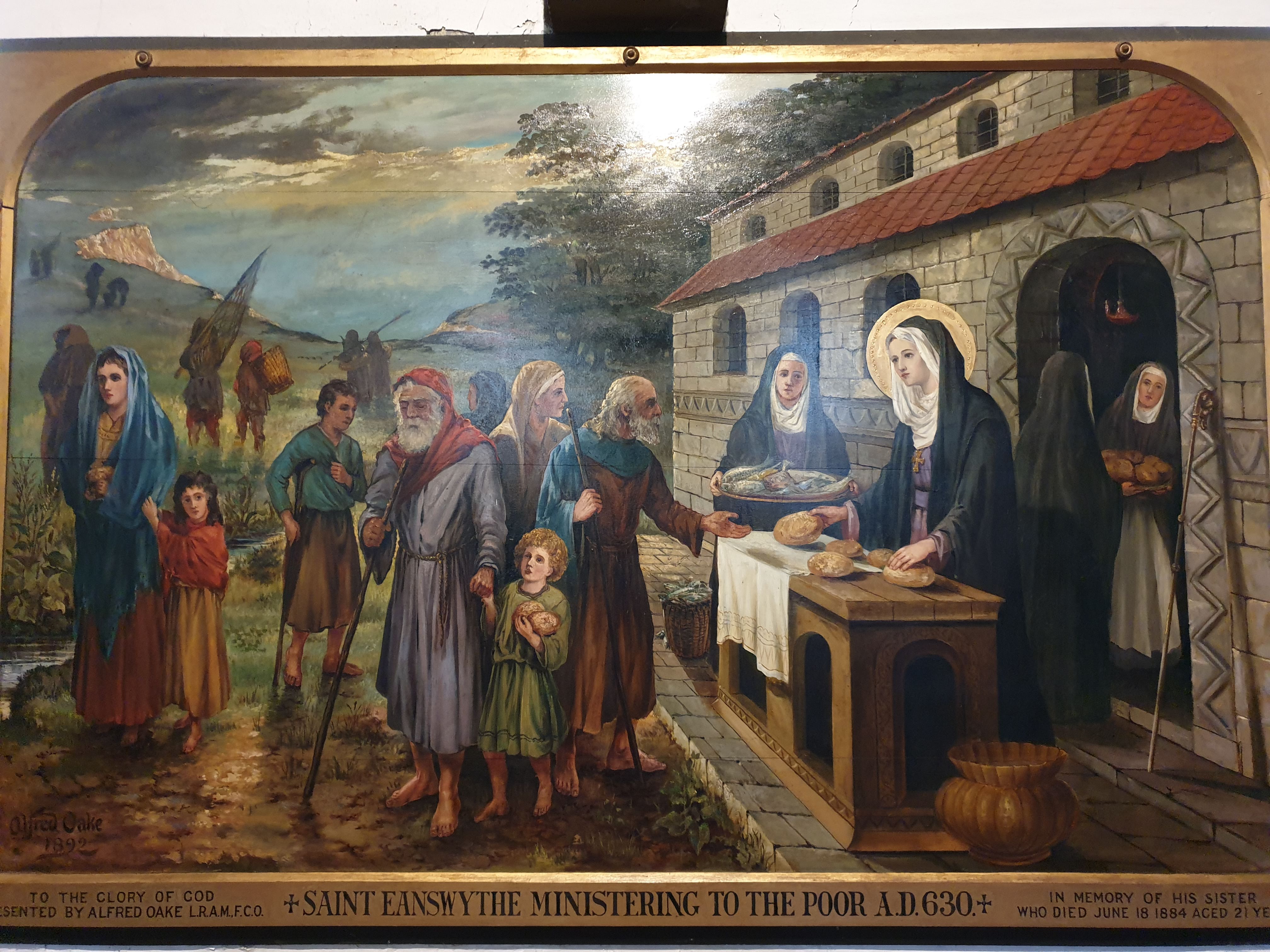
As I pause to tie my bootlaces by the Town Cross, venue for the making of mayors for many centuries, my body shudders as a young woman brushes past me, the hem of her blue dress grazing the grass border, and her white headpiece fluttering in the wind. She carries provisions – bread, leeks and a small flagon of beer – for the poor in a round wicker basket, forswearing another potentially lucrative tryst with a Northumbrian nobleman, orchestrated by her frustrated father.
Her head bowed, she whispers “Good evening, sir, God be with you”. Before I can frame an intelligible response, she disappears behind the west window.
Composing myself as best I can in the circumstances, I shamble on past the crumbling tombs, narrowly avoiding a collision with a rat, scurrying across my path to the sanctuary of the lopsided lychgate leading into Church Street. The Pullman pub is empty, save for a few flickering candles and a lone member of bar staff deep in conversation with his mobile phone.
The lanterns of Rendezvous Street are unusually dim, and the restaurants are sparsely populated.
The stillness is unnerving, but strangely thrilling.
I turn into the narrow, twisting, rain drenched street that slides down towards the harbour.
Many months have elapsed since chaotic, cacophonous Charivari had snaked up that old thoroughfare, all drums and whistles and cymbals, and other less conventional instruments. More recently, the ground had groaned beneath the burden of polished, red-laced “Doc” Martens, worn by follicly challenged pilgrims lumbering towards Gillespie’s and The Ship for an afternoon of Special Brew, and worship at the altars of Prince Buster and The Specials.
I am alone.
But am I?
The fog in my brain mirrors the slowly enveloping mist approaching from the bottom of the hill. Images of times past in this salty, saintly town start to consume my thoughts.
Nothing is quite what it seems.
My longing for one last lingering look at the dazzling, daily alchemy conjured up in the rock shop near the top of the street Dickens christened a “crippled ladder” is soon answered. The heady, fashionable aromas of craft beer and Nicaraguan coffee cannot compete with the memory of the sickly sweet perfume radiating from that beloved spot, where, nose squashed against the glass, a small boy gasped in awe at the thick, long sticks of heaven being rolled.
“Let me in at the front, Michael, you’ve been stood there for ages”, pleads his tearful younger sister, Anna, her view obscured by the taller girl stood in front of her.
“Have they started giving out the bags of broken bits yet?”, another boy bellows from further back in the crowd.
A sudden, excited scrum confirms his suspicion as I catch an intoxicating whiff of granulated sugar.
It was often claimed that if Rowlands were to shut its doors for good, Folkestone would die; a prediction, thankfully, since proven dramatically wrong,
I stumble into Steep Street Coffee House for cake and cappuccino, a combination that never fails to comfort. I am their last customer of the day and the staff, without being obtrusive, are cleaning up around me. The self-styled Folkestone Poet has vacated his customary sales pitch across the cobbles at Big Boys Burger, his heavy overcoat and leather balaclava no longer a match for the diminishing temperatures.
I pass by Marley’s – or what I thought was Marley’s. From a dark upstairs room, redolent of patchouli and cigarette smoke, a loud, piercing jukebox exhorts me to “go to San Francisco” – a seductive reminder of the original Summer of Love on such a bleak winter’s evening.
Two young men in afghan coats, and a messy profusion of facial hair, are huddled at the foot of the crippling, crumbling Bayle Steps.
“Hey man, how’s it going?”
“Far out, whatcha doing’ tonight?”
“Going’ to Archies. The Lonely Ones are playing”.
Nice. I hear there’s some hot Swedish chicks in town too”.
“That’s settled then, Archie’s it is”.
“Yeah, and I could kill for one of his salami rolls right now”.
I start to follow them through the door, only to find that the closer I get, the scene dissolves in the moist air, and I am left once more outside Marley’s rather than the Acropolis.
The piercing cold slices through my flimsy denim jacket and hastens my progress to the bottom of the street. Everything is still again as I try to rationalise the scenes I have encountered in the past half an hour.
I cross a deserted Tram Road car park and pass under the arch by Ovenden’s old forge into the empty fish market, tiptoeing around the grimy puddles that tend to settle there, whether it has rained or not.
A solitary gull plods apologetically past, pining for Spring and the reopening of Chummy’s and Bob’s seafood stalls, when it will again be afforded means, motive and opportunity to ambush tourists for their fish and chips and tubs of whelks.
Pausing outside The Shell Shop, I appear to have stepped into an earlier time again. Men in cloth caps and heavy, seaweed encrusted boots trudge up the slipway opposite, lobster pots and herring nets half empty after an exhausting and disheartening shift. They slap their meagre catch on the floor of Fish Shed One, light cigarettes and congregate in whispered conversation.
‘Darkie” Fagg, “Cottage” Featherbe and “Lobby” Spearpoint are leaning on the railing and reminiscing about better days, while Old Ned Saunders, retired these ten years, is mending the sprat nets for a “free” pint or two in The Oddfellows Arms later this evening.
On The Stade, wives and daughters juggle the demanding tasks of cleaning fish and supervising the smaller, and not so clean, children.
Observing this picture, it is difficult to gauge which gender had the tougher life.
Meanwhile, grubby, barefoot young boys, oblivious to the dedication and drudgery of their elders all around them, chalk stumps on the wall of Clouts Alley.
“I’ll be Jack “Obbs, you can be Clarrie Grimmett. I’ll ‘it you into the “arbour, every time, just you see” brags nine year old Harry Sharp.
But with his first delivery, Clarrie, better known about these parts as Edmund, and, later years, “La La”, Taylor, traps Jack in front of his wicket and appeals for leg before.
“Owzat! Got you with me flipper, pom”.
A heated dispute follows, culminating in the great English batsman hurling his bat against the wall and storming off in the direction of Redman’s boat builders.
His mother, ankle deep in half gutted dogfish and three scruffy toddlers, calls:
“Harry, your tea is ready. And find your brother before you come in”.
“Five more minutes, mum. I’ve got to bowl Don Bradman out first. it won’t take long”.
“Five more minutes, my arse – you’ve got thirty seconds. This tea won’t wait. If you don’t get to the table soon, the other kids will have your share”.
A case of bad mum stopped play.
As this scene of family harmony evaporates, I hear, from across the harbour, a sergeant major’s earsplitting admonition to “Step Short” to a long procession of uniformed men stomping down the slope from the Leas above.
The rhythmic sound of boots on concrete is accompanied by raucous renditions of Pack up Your Troubles in Your Old Kit Bag and It’s a Long Way to Tipperary, as the soldiers march to the waiting ships that will take them to the Western Front.
But there is one last treat before their sombre adventure begins.
Inside the harbour station waiting room, two formidable middle aged women adjust their pinafores and rearrange any curls that have slipped beneath their flower bestrewn boaters. They inspect the massive urns containing the last hot, strong tea most of these men will ever drink.
“Come on boys, form a straight line, you don’t have long, you know”, Flora Jeffrey cries out with a tinge of regret in her voice, while her sister Margaret cuts thin slices of trench cake and bread pudding to complete what, for many of these condemned men, will be their last meal.
“And don’t forget to sign the visitors’ book before you do”.
“All right, all right, you sound like me muvver – nag, nag, nag”, one private who claims to be twenty one but looks barely sixteen, retorts, as he lurches towards Margaret and slurs:
“Give us a kiss”.
But before he can perfect this unwise manouevre, a grizzled veteran of Mafeking and Ladysmith yanks him back by his collar and barks:
“Show the ladies some respect, young ’un’. You ain’t in the playground now, y’know”.
“Sorry, old timer, I didn’t mean nuffin’ by it, it was just a bit of fun”.
Flora chuckles: “You got off lightly there, my boy, that’s nothing to what Margaret would have done to you if you’d got any nearer!”.
An outpouring of communal hilarity is unleashed, and the embarrassed teenager slinks back into the anonymity of the crowd.
I separate from the excited, but fearful, throng with the final strains of Keep the Home Fires Burning ringing in my ears, and join the boardwalk that connects the station with the base of the thirty year old water lift along the beach to the west.
But I have hardly stepped foot on the old railway sleepers before finding myself in the midst of a large conglomeration of buildings, including a swimming pool, boating lake and fairground rides.
As I try to take all this in, a crew cut kid in knitted cardigan and khaki shorts can be seen rushing into a huge, dimpled dome that is destined to be his whole world for the next two weeks. He will never tire of rolling a penny for plastic motor cars or shooting a steel ball into a hole for packets of mints.
His father and mother, the latter clutching a wad of what appear to be tickets, frown as they dismount from the blue plastic seats they have occupied for the past two hours, where they had been subjected to an increasingly annoying loop of “legs eleven”, “two little ducks, twenty two” and “two fat ladies’ eighty eight”.
The boy drags himself from the penny pusher slot machine and scampers towards them in a frenzy of excitement.
“How many wins did you get, mum?”.
“Eight”.
His heart sinks. “Oh no, that big cuddly monkey on the bottom shelf is nine wins. Can you play some more games and win it for me?”.
“We don’t have time, darling; besides dad and I want that nice set of tea trays that are eight wins. They will be just perfect for our TV dinners when we get home”.
“Boring”.
Feeling betrayed and despondent, the boy skulks off in the direction of the Runaway Coaster.
But he is soon appeased by a promise to go to his favourite fish and chip restaurant in Tontine Street for tea.
Intermittent drizzle and mist has given way to steady rain and a thickening gloom. Hungry and shivering, I resolve to return home.
Christmas lights bestride the street across the ragged rooftops, and retailers and restaurateurs contend for the accolade of best dressed window, though tonight there is nobody about to judge them.
Apart from the echo of my boots upon the sodden cobbles, silence is restored.
Until I reach Archie’s.
From that same gloomy upstairs window from whence the Flowerpot Men had serenaded me two hours – and a hundred and fifty years – earlier, the Small Faces remind me that:
“It’s all too beautiful”.
After the battering my senses have taken this evening, I remain to be convinced of the veracity of this hypothesis.
So I try, for the second time, to gain access to the old haunt of hippies and radicals.
As I take my first hesitant steps in its direction, fully expecting to find myself in Marley’s again, the doors open of their own accord and I am permitted to enter.
And there, waiting to greet me, is the original owner, Mickey Argegrou, who is anxious to introduce me to his special guests for the night.
To my astonishment, St Eanswythe is here. The modest blue and white garments she had been wearing during our perfunctory encounter in the churchyard earlier have been replaced by brightly coloured, patterned flower dress and matching peaked hat. She is sampling her first ever cup of coffee and, judging by the uncharacteristic grimace that quickly follows, she is unlikely to order a second. Water from her own spring and the occasional small goblet of mead will remain her preferred tipples.
With the final troop ship of the day, Engadine, set sail for Boulogne, and the Mole Cafe consequently closed, the indomitable Jeffrey sisters have swapped their pinafores for elegant three quarter length dresses. They appear to be conducting a taste test of Mickey’s famed rum babas, comparing them in the process with their revered fruit cake.
John Brickell, still in his overalls and safety cap, is here too. He has disappointed his vast army of young fans by holding back the remnants of today’s rock rolling, handing the broken bits around to the grateful regulars, who find them a perfect accompaniment to their cocktails.
And Harry Sharp, grown in the past hour into a handsome young man, but still smarting from his first ball duck at the Clouts Alley Oval, is feeding the jukebox, while Old Ned Saunders, released from his net repairing duties, though not separated from his favourite fisherman’s jumper, for the evening, is leading a communal sing along to the latest tune selected by Harry:
“Those were the days, my friend”.
After the scenes I have witnessed this evening, I am inclined to agree.
Read Full Post »
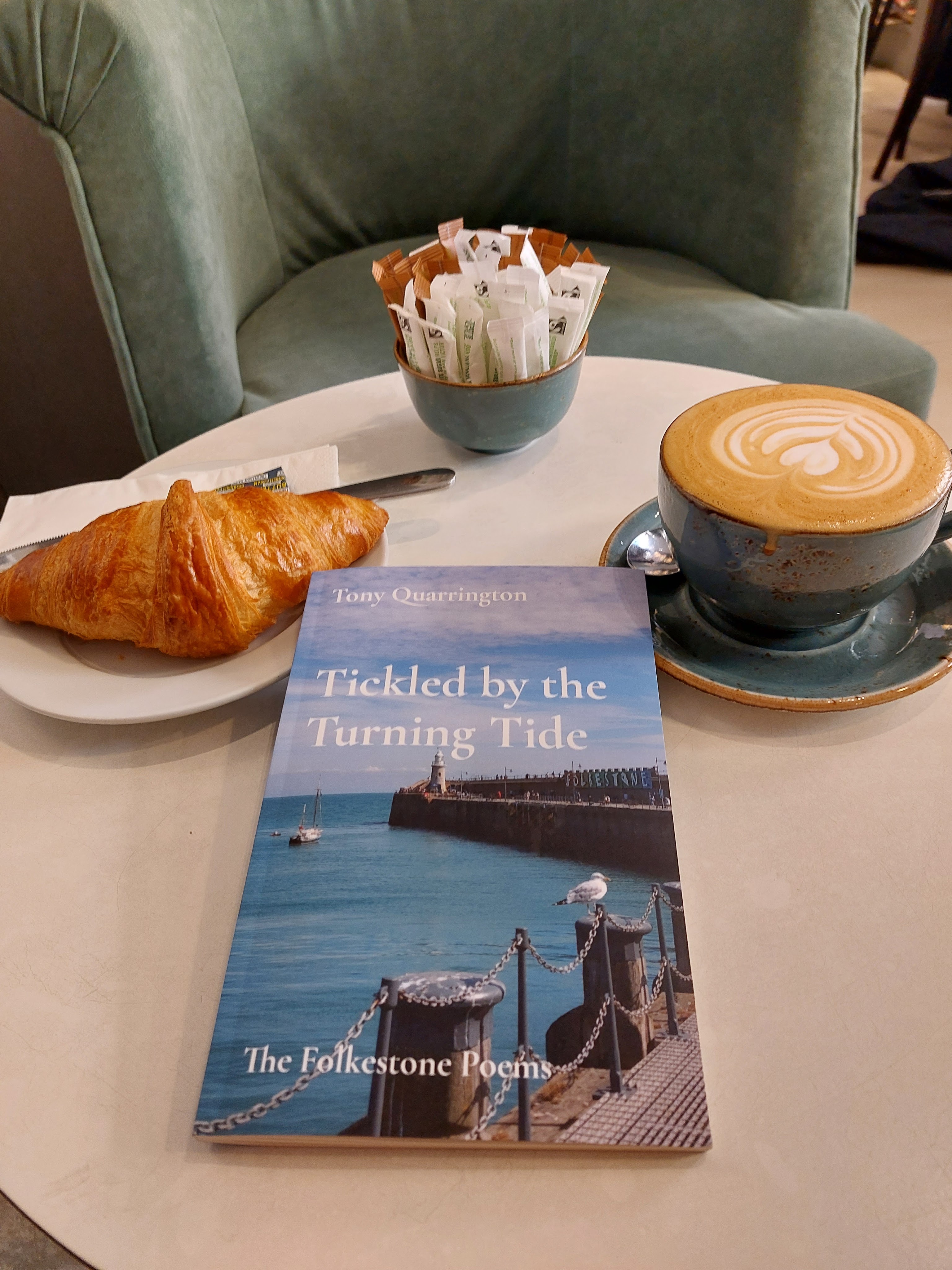


 Tony Quarrington