Feeds:
Posts
Comments

Posts Tagged ‘Grand Burstin Hotel’


Waves sweep through railway arches

And Rip Tide and Isabella,

Sea Warrior and Connemara,

Long time inner basin residents,

Swing and sway

To a soaring seagull symphony.

Folkestone’s Marmite building too

Comes to life once more;

Buses from Runcorn, Rhyl and Redcar

Offload oversized congregations,

Suitcases outnumbered by

Disability impedimenta.

The quayside is converted

From pedestrian thoroughfare

To geriatric racetrack

As mobility scooters

Scatter unwary walkers,

While rickety zimmer frames

Clog up the wide, windowed doorway.

An elderly couple from Cleckheaton,

Weary and windswept from seafront stroll,

Stagger from harbour fish bar

To plant their tired torsos

On the refuge of roadside benches.

Weekend specials are back on the menu,

With almost every still standing Sixties star

Scheduled to perform in the coming months.

Inside, there’s not a spare seat

In the suffocating heat of the lounge bar;

Tables are laden with leftover sandwiches

And half empty glasses of gassy beer;

Debate lurches from Covid controls

To rabid rants about refugees,

Inflamed by hate-filled headlines

In the crumpled copies of the

Daily Mail and Daily Express

Left lying on abandoned chairs.

Another bus, bound for Margate,

Sandwich, Canterbury or Chatham,

Parks outside to await the sedentary rush

From couch to coach in thirty seconds;

Its passengers forsaking Folkestone

No sooner than they have arrived,

Only to return to eat and sleep tonight

Before escaping again to towns

No more deserving of their patronage.

Dover Docks and Cap Gris-Nez

Lurk somewhere beyond the growing gloom;

What catastrophes might be unfolding

On that slim, unstable stretch of water?

A headless chicken on Rocksalt’s roof

Reddens and revolves in sudden frenzy,

While in the ballroom along the road

A bingo caller hollers “two fat ladies”

To a sparse but satisfied audience.

As the sun punctually dips down

Beyond the Jelly Mould Pavilion,

The receding tide meanders 

Through the East Head gateway,

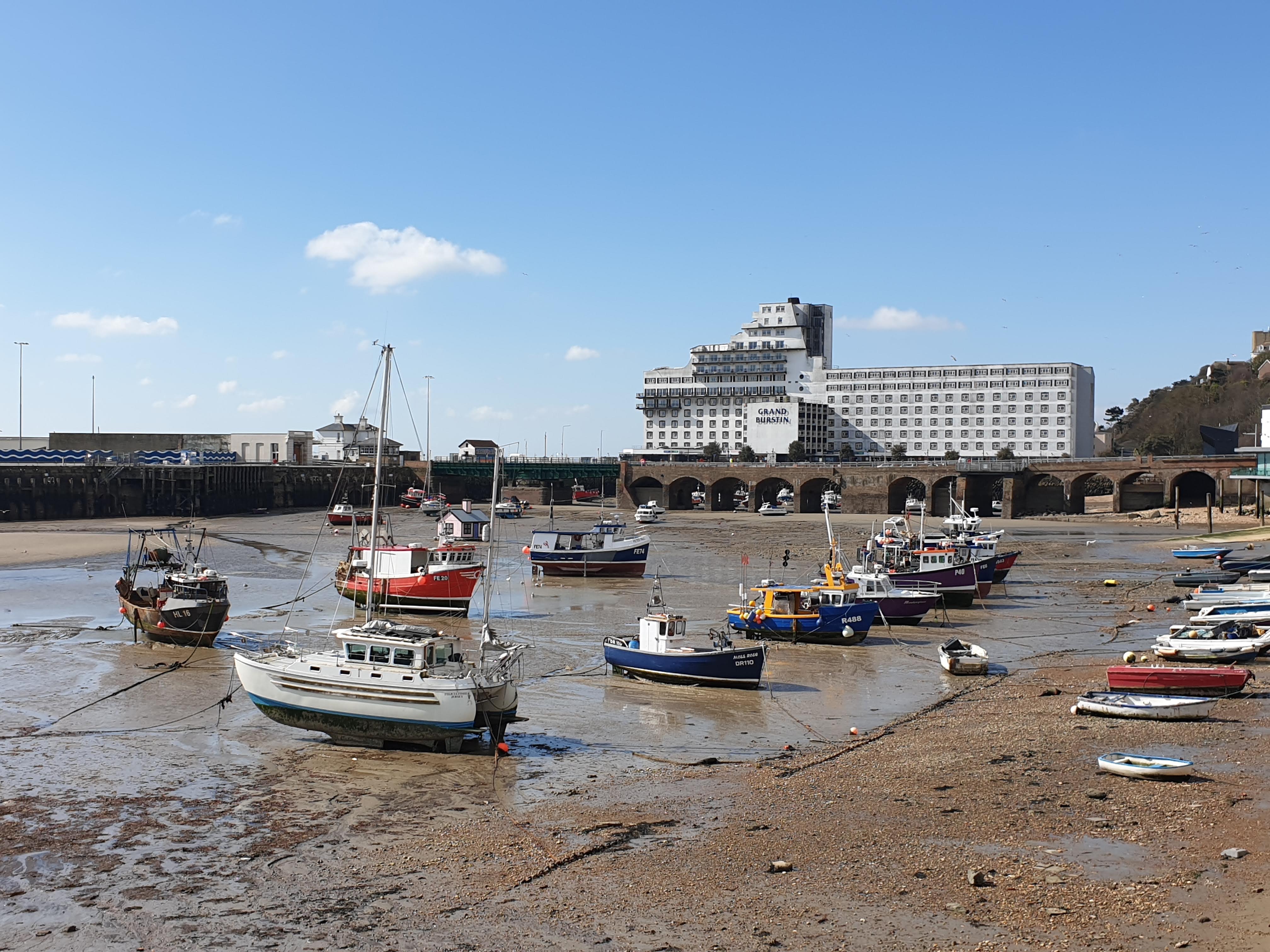
And the inner harbour boats

Collapse back on their sides.

Read Full Post »


My upcoming poetry book, “Dust in my Cappuccino” is a collection of thirty two poems inspired by the coastal town of Folkestone in the south east corner of England. In order to provide some context to the poems for those readers unfamiliar with the town, I have written a short history of the town. This will feature as the introduction to the collection when it is published next month.

Located on the south east coast of England, a handful of miles from the famed White Cliffs, and only twenty two miles from continental Europe, Folkestone has had a long, varied history, boasting both Bronze and Iron Age settlements and a prominent Roman Villa, sadly now perilously close to the cliff erosion that has always afflicted this coastline.

Descended from the the Anglo-Saxon Kings of Kent, Eanswythe, a devout young princess, founded a nunnery in the town in the seventh century AD, and was subsequently made a saint. Her bones, discovered in the parish church by workmen in 1885, were radiocarbon tested and confirmed in 2020, and the church is now becoming a growing site of pilgrimage.

For a thousand years, Folkestone was a modest fishing village and, for most of that time, as a limb of the Cinque Port of Dover, also a busy trading port. Smuggling was a not insignificant business from the eighteenth century too. But it was the coming of the railway and associated cross-channel ferry industry from 1843, and the construction in later decades of grand hotels and white stuccoed family homes, notably in the West End, that contributed to its rise as a fashionable resort that attracted royalty, artists and writers in addition to the Victorian and Edwardian middle class. Much of this development was conceived, funded and overseen by the Earl of Radnor, who still owns land in the town and surrounding area.

The “golden age” that began around 1880 arguably came to a sudden halt with the outbreak of the Great War, which had a profound effect on Folkestone. It became a major port of embarkation for the Western Front, and the final sight of England for millions of troops, many of whom will have marched from the neighbouring Shorncliffe army camp. The bombing of Tontine Street in 1917 brought about the highest number of British civilian dead as a result of an air raid during the war up until that point.

The inter war years saw a revival, with Folkestone exploiting its natural beauty – the Channel views, rolling hills, delightful parks and gardens – by marketing itself as “Fashionable” and “Spacious and Gracious”. Moreover, its popularity as a resort was enhanced by the Earl of Radnor’s “foreshore development” that included the building of the Rotunda, the largest unsupported concrete dome in Europe, swimming pool and boating lake, supplementing the existing Victoria Pier, switchback railway and the 1885 Leas water lift.

The town suffered heavy bombardment during the Second World War, destroying much of the harbour, but recovered as a seaside destination during the fifties and early sixties, which is when my Folkestone story began. The Rotunda, quaint, steep Old High Street with the revered Rock and Joke shops and the popular ferry route to Boulogne-sur-mer, kept the visitors coming and the locals entertained.

But, like so many other UK coastal resorts, it suffered a deep decline as the advent of cheap air fares, duty free and longer annual leave allowance, led to an escape to resorts where the sun was twenty degrees warmer and the beer ten degrees colder. Many of the much loved attractions and hotels closed, were demolished and converted into flats, and trade in the town slumped. Although the cross-channel ferry industry stopped at the turn of the century, Folkestone has retained its role as a point of departure to the continent with the opening of the Channel Tunnel in 1994.

The new Millennium brought a revival, aided by the philanthropy of former Saga owner, Sir Roger De Haan, who renovated and refurbished many of the buildings in the old town, offering the properties to creatives, provided education and sporting facilities (the latest of which the world’s first multi-storey skatepark), and restored and remodelled the derelict harbour area. The construction of up to a thousand apartments along the shoreline between the Leas Lift (currently closed) and the Harbour Arm is also now underway.

Since 2008, the Folkestone Triennial has showcased new works from established British and International artists, around half of each remain in the town once the exhibition is over. There are now around ninety such pieces placed outdoors around town.  

De Haan’s influence and the arrival of the high speed rail link (only fifty four minutes from London) in 2007, has proved a happy marriage in rendering Folkestone more accessible. Comparatively cheap (but rising) house prices, the advantages of living by the sea, a vibrant dining scene and improving facilities, not least for children, have all led to a growing relocation of people, many of them young families, predominantly from London.

My love affair with Folkestone began at the age of ten when I was brought by my parents from my hometown of Rochester, forty-five miles away on the North Kent coast, on the first of a succession of summer holidays to the town. It was my mother’s admitted but modest pretensions to social mobility which led to the choice of Folkestone rather than the traditional “bucket and spade” resorts such as Herne Bay, Margate or Broadstairs.

Once I left home and moved around the country for study or work, visits became much less frequent, though I always retained my affection for the town. In fact, my parents long harboured the desire of retiring to Folkestone (on their last holiday together they had stayed in the Grand Burstin Hotel at the harbour), but with my mother’s relatively early passing, it never materialised. But their groundwork was not done in vain, as when the opportunity arose in 2016, my wife and I had no hesitation in moving here.

I have gathered together thirty two of my poems inspired by Folkestone, in which many of the themes and events I have outlined above are referenced and explored. One particular challenge has been whether to present them in a systematic way, for example, chronology, geography or subject matter, but ultimately, they are laid before you in an essentially random form, at least superficially.

Read Full Post »


In every tuft of dew-drenched grass

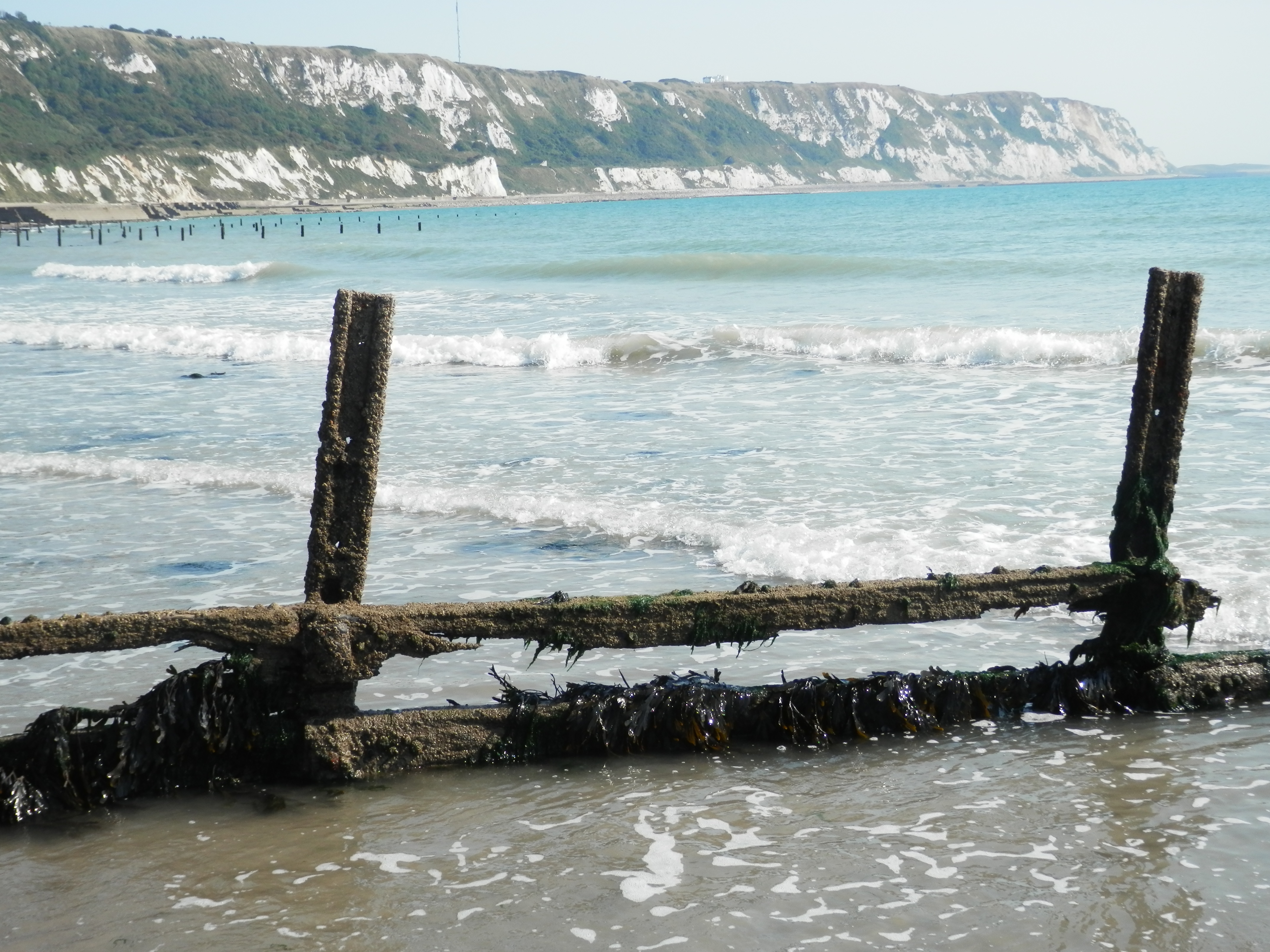
And every slice of crumbling chalk,

The howl of history is heard

Across this patch of green I walk.

Ferries no longer line the pier,

Nor steam from up trains fill the air,

The view replaced by Folkestone sign

And Burstin’s monumental glare. 

Mouldering Martello tower, 

Former lookout for all that floats, 

Stares out today at pitch and putt, 

And bowling club instead of boats.

Above sharp pointed St. Peter’s spire

The roar of spitfires still turns heads

Of tourists, swimmers, fishermen,

And foragers on fossil beds.

The Chinese Elvis lives here now,

From Old Kent Road to East Wear Bay,

No ghetto or jailhouse in sight,

But bungalows and children’s play. 

On ten thousand year old Jock’s Pitch,

Where breathless dogs now chase balls,

A caldarium bubbles underneath

And another chunk of cliff top falls.

Read Full Post »


Even the gulls are taking a morning off
As I drift around the deserted harbour;
The tide is out, the sky deep blue,
And the beach warm and yielding
Under my inappropriate footwear.

Amidst this light brown desert,
Brief rivulets of muddy water
Command me to take a run
And leap to reach the
Next patch of firm dry sand.

The railway viaduct now fenced off,
The Grand Burstin and Rocksalt
Both dark and sad and empty;
And the metal gates to the Harbour Arm,
Anticipated host to thousands
Over this warm Easter weekend,
Are firmly closed.

On a morning as delicious as this,
It would have been perfect
To stroll its two concrete tiers;
But the only tears today
Are for the sick and fearful
Imprisoned in homes and hospitals
Across an anxious but resolute land.

Bob’s seafood stall and Folkestone Trawlers
Plough lone furrows on the deserted Stade,
While a pair of deep wrinkled fishermen
Lean against the chain railing and reminisce
When fish was plentiful and the ferries full.

I bound another murky stream
And lean against the pink house;
Planted in self-isolation,
Its former lustre lost too,
With peeling paintwork and ponder the fate
Of the next Triennial, triumphantly announced
Barely a month, but another lifetime, ago.

I turn the corner of the East Head
Under the rock perched orange house,
That, unlike its pink neighbour,
Has had a reviving lick of paint;
Two young girls lift their skirts,
And paddle in the gentle, shallow waves
On the incessant, incoming tide;
I cannot avoid the uncharitable suspicion –
A sign of these strange and fretful times –
That, as they giggle and jostle each other,
They may not be from the same household.

I could stay here for hours yet,
Till the water washes over my shoes,
But an insistent call of nature,
Prosaic and not infrequent visitor
To this man of a certain age,
Summons me to return swiftly
To my home by the park.

Read Full Post »


This is where east meets west,
Dover Road and Augusta Gardens;
Where DFLs mix with Folky born and breds,
Cold war adjourned for one warm afternoon.

Tram Road traffic crawls and curls
Around a heaving Harbour Street,
Affording passengers an extended view
Of much loved, yet loathed, Grand Burstin.

A brisk breeze, cooling the searing sun,
Sweeps champagne flutes to a watery end
In the chastening Channel spray
That laps the lighthouse;
Proof that, sometimes, weather
Can be a first to place and time.

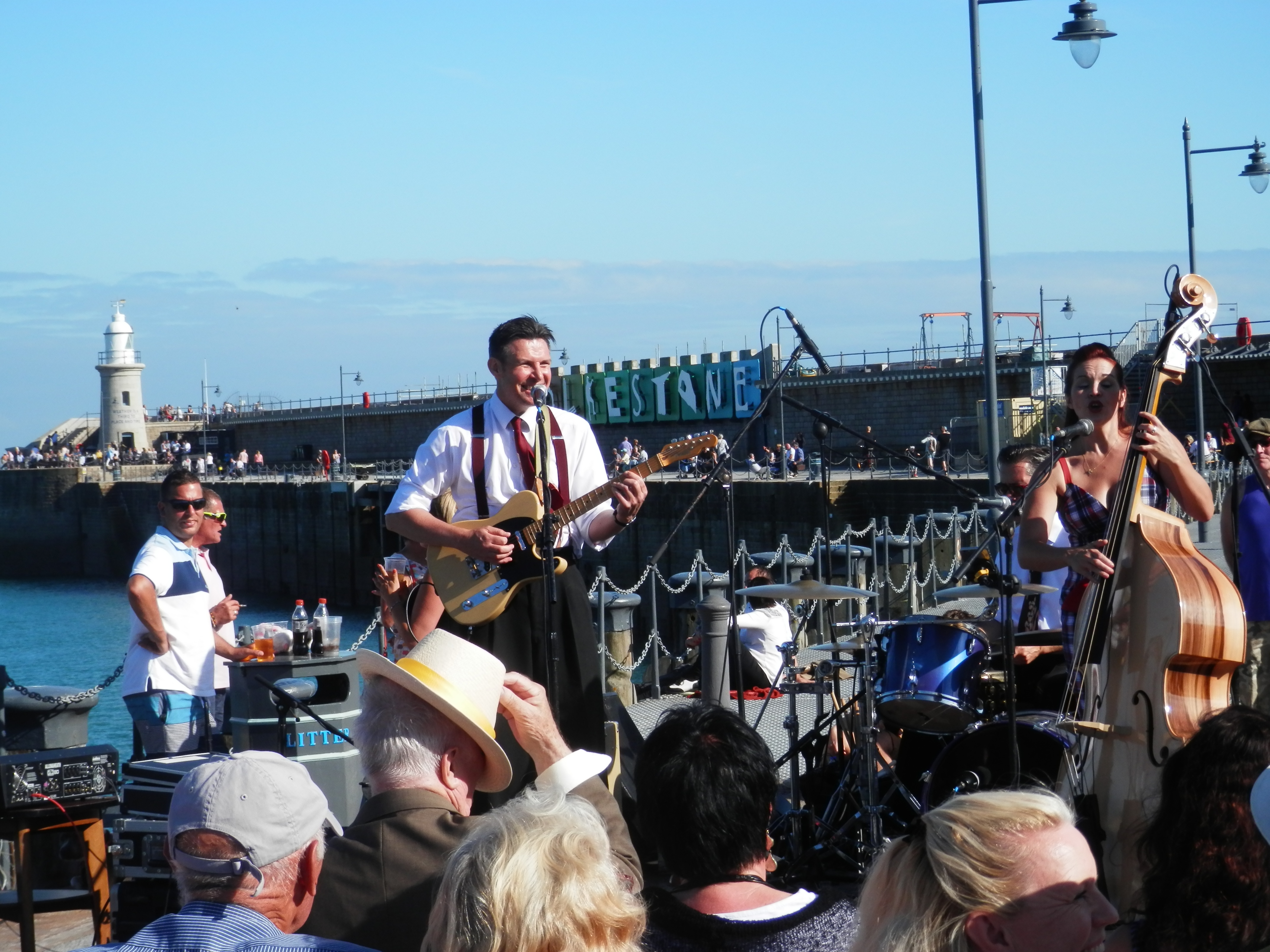
Sinatra’s call to Come Fly with Me
Gives way to the eclectic sounds
That entertain the growing queues
For Sole Kitchen and Hog and Hop.
While the Native Oyster Band
Has the crowds singing and swaying,
Kadialy Kouyate’s kora mesmerises,
Bringing the authentic sounds of
New Orleans and Senegal to
This English coastal paradise.

Children build bricks to knock them down,
Dash between Baba Ji and Pick Up Pintxos
Or search for the iron man in the water,
(Don’t worry, kids, he will be back!).


But if the heat and tumult are too much
And it is peace you pine for,
Retire inside to the Mole Cafe
For a mug of strong, hot tea
And a chocolate swiss roll,
Reminders of a quieter,
Yet more violent, time.

Tomorrow, normal service will be resumed;
DFLs will become RTLs
(Work it out!);
The Arm will be handed back
To anglers, cormorants and
A few unsuspecting souls,
Drenched by crashing waves
Cascading over the Folkestone sign.

But is this the lull before the storm?
Eden before the Fall?
Will those blissful views across
To ancient East Cliff and to Sunny Sands
Be there to inspire us still
In three, or five, or ten, years?

Or will the thunder of pick and drill
Drown out those of bass and drum?

Read Full Post »


A biting breeze and thin drizzle
Denote December’s arrival,
As twilight descends on the
Twisting, narrow street
Once one of Dickens’s daily haunts.

Many months have passed since
Crazy, cacophonous Charivari
Had snaked up that old thoroughfare;
And the ground had groaned
Beneath the weight of red-laced “Doc” Martens,
Worn by pilgrims strutting towards the
Grand Burstin or Gillespie’s
For an afternoon of Special Brew
To the sounds of The Selecter,
Prince Buster and The Specials.


I turn into that quiet, twinkling lane
And long for one last lingering look
At the dazzling, daily alchemy
Conjured up in Rowland’s Rock Shop.

The aroma of craft beer
Wafting from Kipps’ Alehouse
Cannot compete with the memory
Of the sickly sweet perfume
Pervading Rowland’s, where
Once I gaped in awe at the
Thick, long sticks of heaven being rolled,
A bag of broken bits
A highlight of my annual holiday.

It was often claimed that if it
Were to shut its doors for good,
Folkestone would die.
A prediction, thankfully,

Since proven dramatically wrong,


OLYMPUS DIGITAL CAMERA


I stumble into Steep Street Coffee House
For flat white, cake, warmth and inspiration.
The self-styled Folkestone Poet
Has vacated his customary sales pitch
Across the way at Big Boys Burger,
His heavy overcoat and leather balaclava
No more a match for declining temperatures.

The bitter cold slices through my flimsy jacket
And hastens my progress down the hill,
But not without momentary glances
On either side at steepling steps
To ancient Bayle and modern Tontine Street.


wp-image-1747716960jpg.jpg


I cross into the empty fish market,
Tiptoeing around the grimy puddles
That appear to assemble here
Whether it has rained or not.

A solitary gull plods apologetically past,
Pining for Spring and the reopening
Of Chummy’s, Bob’s and La’s,
When it can return to terrorising tourists
For fish and chips and tubs of whelks.

Back at the foot of the winding street,
Christmas lights flutter into action
As children huddle excitedly
Outside Blooms for tonight’s instalment
Of the Living Advent Calendar,
Jewel in the crown of
Folkestone’s festive year.

Apart from the echo of my boots
Upon the cobbles,
Silence is restored
As I drag my freezing bones
Back up the hill.

But………..
As I turn the corner
At the top
I stop.

Was that really
A childlike squeal I heard?
And did I just catch
A whiff of granulated sugar?

Read Full Post »


This is the final part in a trilogy of posts centred on our recent relocation to Folkestone. The first outlined the historical and emotional reasons for making the move in the first place, whilst the second described the sometimes rocky road of searching for, buying and moving into our coastal retreat.

At the end of the last piece, written a fortnight after our arrival, I concluded that, not least because of the excellent weather we had enjoyed, it still felt as if we were on an extended summer vacation.

But now that another month has passed, and although the climate gods continue to shine upon us, we are beginning to feel that this is now our permanent home.

The frustrating saga of our landline, cable and broadband installation is finally over after forty two tortuous days.

We have purchased a number of new household appliances (and perpetrated an epidemic of hernia repairs among the delivery men into the bargain).

My wife has settled into her new office in town.

We are on first name terms with a pair of crows that have taken up residence in our beech tree. They love nothing more than to join the ducks in the lake across the road and the seagulls on the roof in a chaotic (pre-) dawn chorus.

And we have entertained guests from Norwich and Philadelphia.

For now then, it is fair to say that the fabulous Folkestone fairytale continues – as the images below demonstrate.

wp-image-853740679jpg.jpg

Folkestone must have more outdoor benches per square metre than anywhere else on the coast!


OLYMPUS DIGITAL CAMERA

One of the many attractive features of the award winning, child friendly Lower Leas Coastal Park – it can’t be claimed that this seaside town is the preserve of the elderly!

OLYMPUS DIGITAL CAMERA

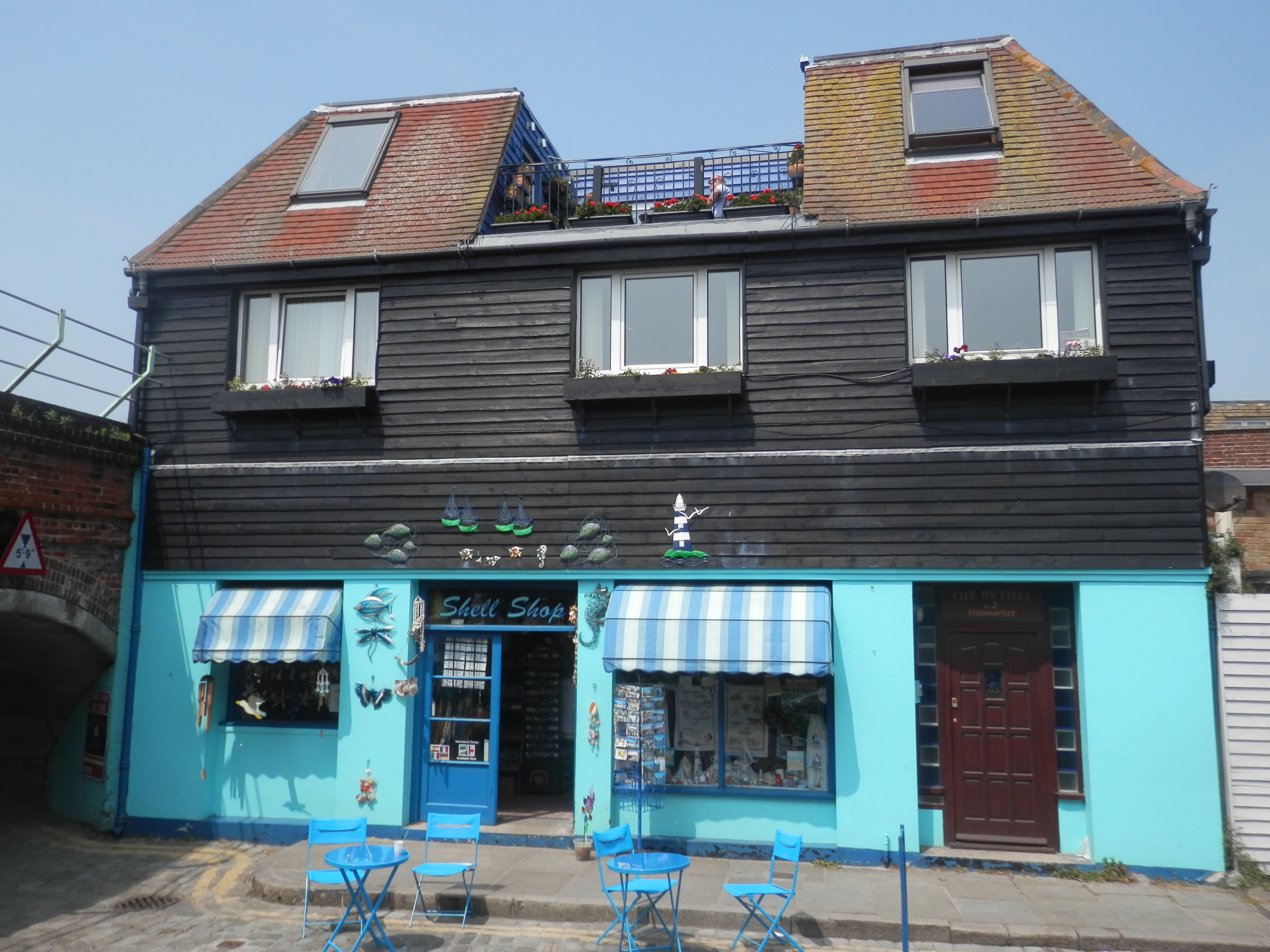
This shop in the harbour thrilled me as a child, and it is no different now as we’ve already adorned our apartment with artefacts from its shelves


OLYMPUS DIGITAL CAMERA

The Grade II Leas Lift, a much loved icon, was restored to full operation this summer

OLYMPUS DIGITAL CAMERA

“Ok, I get it that you won’t let me have any of your fish and chips, and you’re only looking after my own welfare by not feeding me, but just remember who runs this town”

OLYMPUS DIGITAL CAMERA

Folkestone’s own Little Mermaid, modelled on local mother of two, Georgina Baker, gazes on our “chums” on the Cote D’opale from the rocks of Sunny Sands

OLYMPUS DIGITAL CAMERA

My fetish (I prefer to call it passion) for directional signs is amply satisfied around town

OLYMPUS DIGITAL CAMERA

The wild, weird, wonderful Warren is a secret jealously guarded by (us!) locals 

OLYMPUS DIGITAL CAMERA

Cafe culture at its best at Steep Street – welcoming smiles, potent coffee, delicious pastries, stacks of books, literary competitions and seats for great people watching – a killer combination

In conclusion, a couple of general observations. Cynics might sneer at what they perceive to be an overly positive initial impression, and I acknowledge that the rose-tinted spectacles haven’t been discarded yet. However, I offer the following:

  1. The people of Folkestone, especially in the retail and hospitality sectors, have been friendly and cheerful. And I have been particularly impressed by the courtesy of drivers towards pedestrians around town; and
  2. Folkestonians appear to care for their physical surroundings too – flower displays and other open spaces are lovingly tended, littering is less visible than in many other places I have lived in and visited and there is extensive renovation and redecoration of buildings going on, especially near the seafront.

I am very conscious, however,  that Folkestone is no more immune from the contagion of drunkenness and lawlessness that infects town centres across the country. Only last weekend, for example, a group of innocent bystanders was attacked in the early hours of the morning in Sandgate Road. I will not shy away in future from highlighting negative as well as positive features.

As the council gardening staff begin to dig up the flower beds along the Leas under another limpid blue sky that belies the reality of today’s Autumn Equinox, my thoughts turn to the next six months. Most of the time I have spent in Folkestone, as child and man, until now has been during the summer or in the late spring. But whilst I might mourn the imminent passing of hot, sunny days, I am excited at the prospect of witnessing winter storms crashing (but not damaging further) Coronation Parade and walking from Mermaid Beach into Sandgate and Hythe on cold, crisp February mornings.

The next phase of our Folkestone story awaits!


The first two posts in this series can be found at:

http://www.tonyquarrington.wordpress.com/2016/01/11/it-was-always-folkestone/

http://www.tonyquarrington.wordpress.com/2016/08/18/so-glad-we-made-it/

Read Full Post »