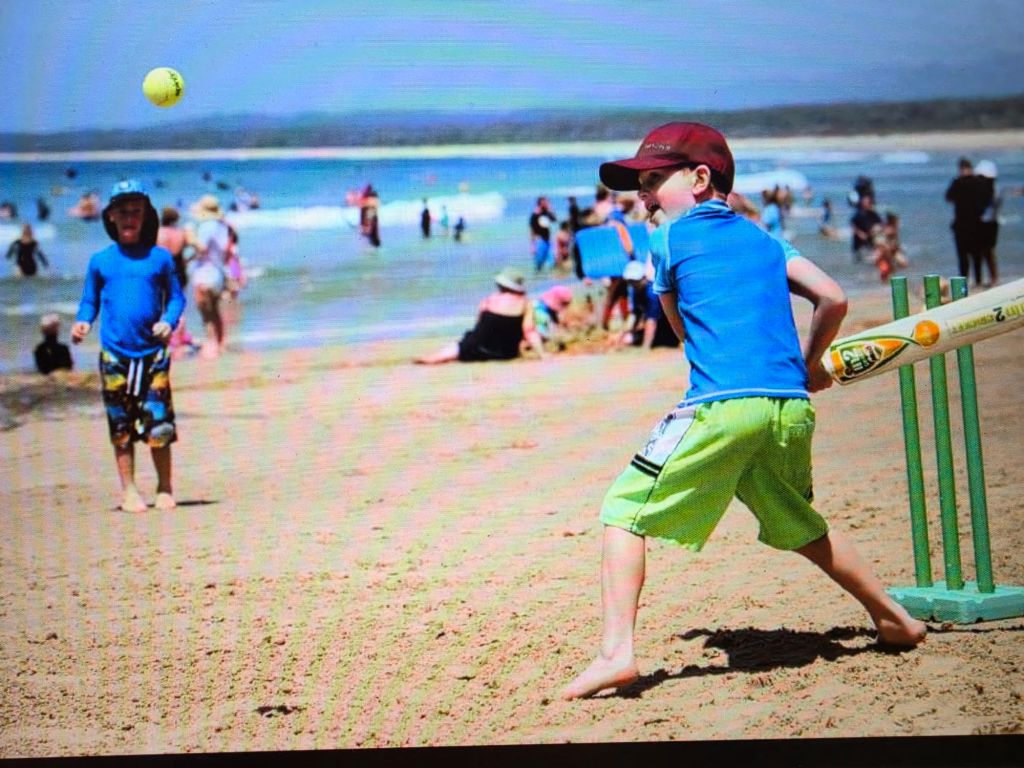
One of the iconic images of the great British seaside holiday of the fifties and sixties is of happy families playing beach cricket. Everyone joined in, playing with children’s bats, balls and stumps that reduced fathers who fancied themselves as Dexter or Sobers (Kohli or Archer to younger readers) to the same level of competence as their seven year old sons, non-sporting wives, grandfathers with knee replacements and even the family dog (when they were still allowed on the beach between May and September).
Sadly, the advent of the foreign package holiday, breakdown in traditional family structures and expansion of alternative leisure pursuits, all contrived to render such a scene virtually obsolete. Nearly fifteen years ago now, I embarked upon a one man campaign to revive this venerable but floundering tradition, pitching up on Ramsgate Main Sands with my wife at 2pm on a Sunday for an impromptu game.
I say impromptu because my planning had left something to be desired – a brief glance at the tide times beforehand would have revealed that this was the worst time of the day to start. Nevertheless, after twenty minutes inspecting the rapidly diminishing slither of sand along the bay, I found a strip that was marginally more playable than a Brisbane “sticky wicket” (one for the Boomers). It quickly became apparent, however, that if the game was to be remotely watchable, or attract other participants, it was pointless bowling anything other than full tosses because once the ball had pitched, it was firmly plugged into the sand.
Pudding-like wicket aside, it proved a batsman’s paradise as the leg side boundary shortened sharply with the onrushing scum brown tide, ensuring that the merest of flicks resulted in a boundary. That said, the smacking of my extra cover drives against the sea wall was more satisfying. Frank Keating once wrote that Ian Botham played a net “as if he is on Weston-super-Mare beach and the tide is coming in fast”. I’d like to think that if you substituted Ramsgate for its west country counterpart, that might accurately describe my batting on that day.
Public interest was initially negligible, evidenced by a succession of families, oblivious of the sacred nature of my work, plodding across the wicket at regular intervals, occasioning annoying and unaffordable interruptions in play. It reminded me of my primary school football pitch which had a concrete public footpath running diagonally across it, constantly trodden by young mothers with prams during vital matches against our bitter rivals from the adjoining parishes of Luton, Delce and Arden.
Understandably, dribbling was a skill particularly valued at Glencoe Road.
But back to the summer game.
Human indifference was not mirrored in the reaction of the indigenous avian population. An improbable infield of gulls occupied first slip, backward square leg and silly mid on, loitered, more, I suspect, in anticipation of the next tasty titbit thrown up by the thrashing waves than hovering in hope of a bat pad. Their noisy sledging would have done justice to any Australian test team in history. Eventually, with the wicket completely submerged, the players were forced to dash from the square to the nearest ice cream van.
Undaunted, I resumed my missionary work two days later with a game on the much larger and more suitable Viking Bay beach in Broadstairs. Low tide was scheduled for 2.04pm but, conscious that the tide came in a lot quicker than it went out, I decided that play should get underway an hour earlier.
A prompt inspection of prospective wickets revealed not only a soft, dune-like sand texture inconducive to a meaningful contest, but also an unmanageable abundance of people, deckchairs, windbreaks and bouncy castles, along with the ubiquitous volleyball court, populated by hordes of young Latino youths, compelling me to cancel plans to play there.
However, we rounded the bend at the end of the beach to enter Louisa Bay which, a full hour before the scheduled start of play, sported a vast expanse of dark, compacted sand. It was also devoid of spectators.
My excitement was intensified by the sight of TWO sets of wickets already pitched further along the beach. This was promising. Our game got underway and soon acted as a magnet for every bored child (this was before social media got its insidious claws into them) within three hundred metres. I was assailed with questions such as “can I play?” and “can my brother / sister join in?” (only the absence of the suffix “mister” reminded me I had not been transported back to 1959) – music to my ears as I suddenly found I was setting fields for TEN kids of assorted ages and having to remember in what order they all batted and bowled to avert tears.
The majority exuded more willing than competence, all wanting to field at mid wicket for some unaccountable reason (maybe the proximity of the tea hut and toilets had something to do with that), but uncomplainingly scurrying after every ball, regardless of how far and in what direction it had been despatched. Falling into a rock pool or getting entangled in the profusion of seaweed were no barriers to their enthusiasm.
On a more serious note, it was heartening to discover that you could still play an innocent game in public with a group of children that you had never met before, without being accused of wanting to take salacious photographs of or, worse still, interfere with, them. In fact, the parents seemed content to allow them to play, even the mother who was called upon to console her ten year old when he retired hurt after being struck on the left thigh by one of my rising eighty mile per hour inswingers.
The most poignant moment arose when one small boy advised me, with evident pride, and in hushed tones, that the reason his brother was scoring so freely with quasi-classical strokeplay and bowling off a run up that appeared to start just to the left of the Goodwin Sands, was because “he PLAYS cricket”, as if it were an arcane and ancient pastime.
The game lasted nearly three hours, interrupted only by obligatory lunch and tea intervals, dictated more by my need for regular rest than by the tyranny of the clock. Each succeeding resumption of play appeared to draw even more players until the relentless waves washed the wicket away completely.
So beach cricket is alive and flourishing in the cradle of the game, not quite the High Weald, but still in God’s own county. It can be no coincidence that shortly after this pilgrimage, I moved to Folkestone which boasts one of the firmest wickets on the coast at Sunny Sands.


 Tony Quarrington