Feeds:
Posts
Comments

Posts Tagged ‘Kent’


I am proposing to run twice, possibly thrice, weekly walking tours of Folkestone next summer (May to September 2017).

There are many practical considerations, including health and safety, marketing and potential licensing, that need to be addressed in the opening weeks of the New Year, but the crucial issue is the integrity of the tour itinerary itself.

Below are my initial thoughts on what route to take, and the issues to highlight at each stop and during the walk itself.

Currently, I envisage the tour lasting no longer than two hours.

These are still early thoughts and are subject to change. Being still a relative newbie, there is a distinct possibility that I may have missed something. This is where long term residents of Folkestone and others who have, like myself, come to love the town, can help me in fine tuning the details. I would be extremely grateful for their input and support.

I intend to finalise this by the end of February, allowing two months to work up the detailed commentary and supporting material.

I am extremely grateful for your assistance in this. Don’t feel you need to be gentle with me!

P8160014.JPG

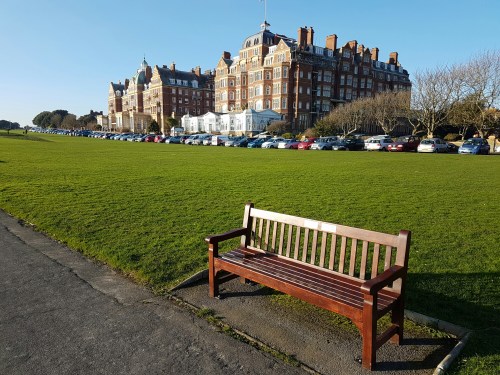
Start: By the Earth Peace sign in front of The Grand Hotel on The Leas

Stop 1: The Grand Hotel
a. outline of tour – duration – route – stops – toilets – refreshments – approach to questions
b. history of The Leas and Folkestone as a holiday destination – English & French coast highlights
c. history of The Grand, including rivalry with The Metropole & links to royalty

d. introduction to Folkestone Triennial & Folkestone Artworks, specifically Earth Peace (Yoko Ono)

Walk 1: Along The Leas, passing the View Hotel, Ruth Ewan (clock) and Mark Ballinger’s (Folk Stones) artworks & talking benches

————————————————————————–

Stop 2: Leas Cliff Hall 
a. history – construction – programme
b. William Harvey statue

Walk 2: Along The Leas passing the Leas Pavilion Theatre and the Leas Lift

————————————————————————–

Stop 3: Step Short Arch
a. Folkestone’s role in war
b. construction
c. War Memorial
d. poppies

Walk 3: Down the Road of Remembrance

PA190104.JPG

Stop 4: Harbour Station / Harbour Arm entrance
a. role of trains bringing soldiers/holidaymakers
b. history of ferry / hovercraft services
c. Hamish Fulton’s metal sign
d. Grand Burstin Hotel
e. regeneration plans

Walk 4: Along the Harbour Arm, taking in views of the Harbour 

————————————————————————–

Stop 5: Lighthouse on Harbour Arm

a. history
b. Weather is a Third to Place and Time artwork
c. Champagne Bar

Walk 5: Back along Harbour Arm and towards Harbour

————————————————————————–

Stop 6: Harbour
a. fish market
b. history of fishing c/f activity today
c. seafood stalls
d. Rocksalt

Walk 6: Along The Stade to Sunny Sands

————————————————————————–

Stop 7: Sunny Sands
a. beach & Coronation Parade
b. views to France, Harbour Arm, East Cliff, Dover Strait, the Warren & Samphire Hoe
c. Folkestone Mermaid (Cornelia Parker)

Walk 7: Back along The Stade and across to Creative Quarter entrance


Stop 8: The Old High Street
a. history
b. role of Creative Quarter
c. Quarterhouse

Walk 8: Up the Old High Street and onto The Bayle, highlighting galleries, restaurants and coffee shops

OLYMPUS DIGITAL CAMERA


Stop 9: The Bayle
a. history
b. Parade Steps
c. Shangri-La
d. British Lion
e. pond – child’s mitten (Tracey Emin)

Walk 9: Around The Bayle into Church Street

————————————————————————–

Stop 10: Church of St Mary and St Eanswythe
a. history of christianity in Folkestone
b. life & sainthood of St Eanswythe

Walk 10: Through churchyard and along The Leas towards the Leas Lift

————————————————————————–

Stop 11: Leas Lift
a. history – construction – importance
b. take lift down to Marine Parade

Walk 11: Along Marine Parade to entrance of Lower Leas Coastal Park


Stop 12: Lower Leas Coastal Park
a. background, construction & awards
b. Fun Zone
c. Amphitheatre
d. Adam Chodzko’s Pyramid

Walk 12: Through Lower Leas Coastal Park to beginning of Zigzag Path

P3250033.JPG

Stop 13: Zigzag Path
a. history

Walk 13: Up the Zigzag Path and along The Leas to The Grand Hotel

————————————————————————–

Stop 14: The Grand Hotel
Finish by the Earth Peace sign in front of The Grand Hotel on The Leas

————————————————————————–

Read Full Post »


If ever I need a respite from the hubbub of Folkestone town centre, there is no better area to take cover in than The Bayle. Bordering the Harbour via the Parade Steps, the Creative Quarter by Bayle Street and Sandgate Road at the end of pretty Church Street, it provides a welcome haven of peace and quiet.

Just off the beaten track, it is largely undiscovered by all but locals.

Today, I am accessing it from the recently refurbished Parade Steps that run from Harbour Street, alongside Gillespies bar at the True Briton.

Folkestone has more than its share of crippling paths and stairways, not least the Metropole Steps and Zigzag Path that link the main beach from The Leas, but the hundred or more steps that need to be negotiated here match the most difficult. Their saving grace is that they do afford the intrepid climber fantastic views of the harbour and the Channel beyond when, as is essential, they pause for a breather at each level.

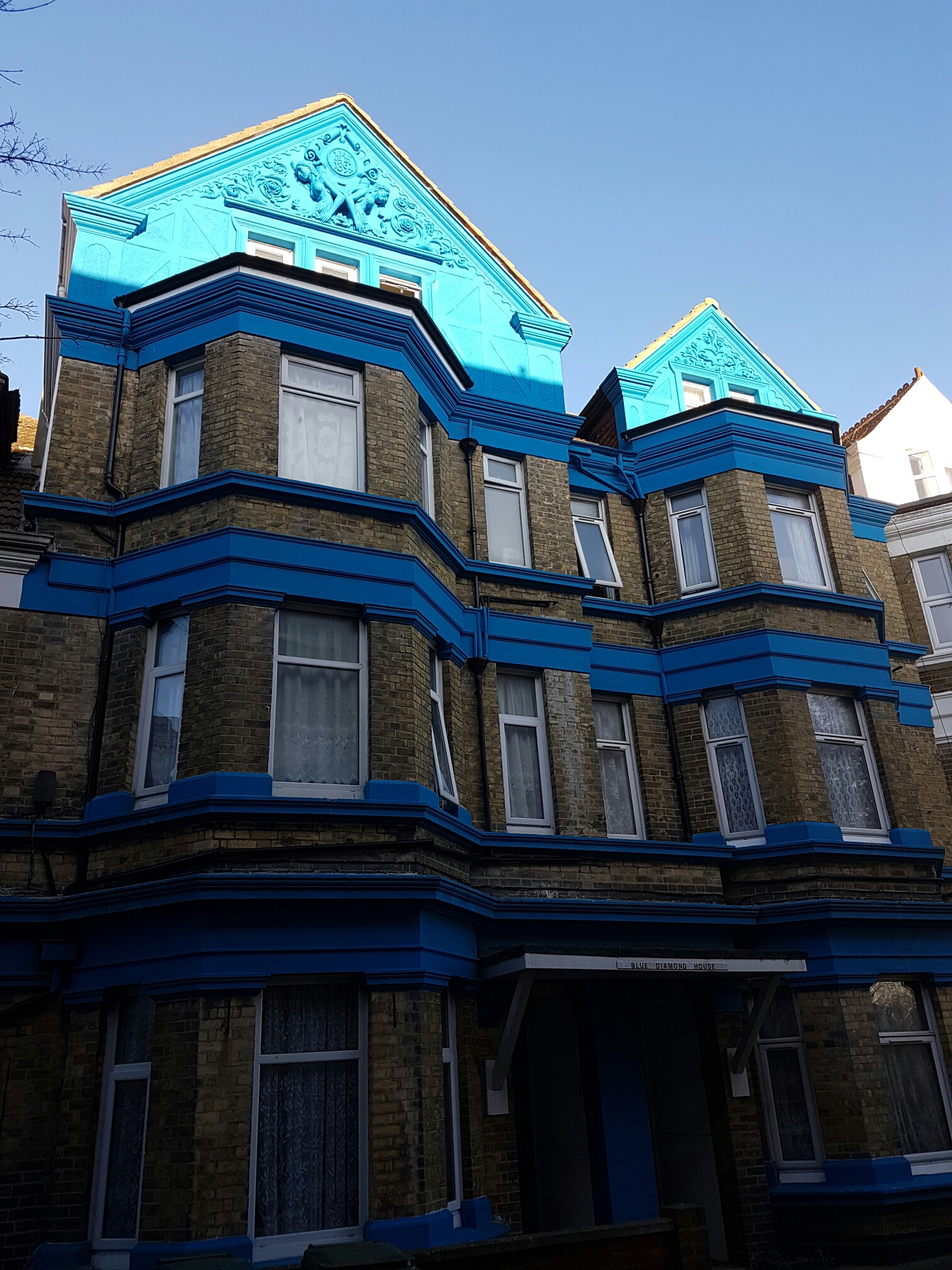
At the top you encounter not only Shangri-La, now discredited as a wartime German spy centre, but also fine multi-occupancy buildings like Blue Diamond House on Bayle Street.

Eschewing the Bail Steps, that lead back down to the Old High Street, I turn left at the friendly Guildhall pub onto The Bayle itself.  Within a hundred yards I come across the Bayle Pond Gardens, lovingly maintained by the residents’ association.

The pond is home to another of the Folkestone Artworks found scattered around the town. One of Tracey Emin’s collection of “baby things”, a bedraggled, brightly coloured mitten, is attached to the railings that encase the pond.

Properties, a mix of attractive brick and weatherboarded cottages and modern apartment blocks, are sought after and, as this recent house hunter can attest, relatively expensive.

Moreover, the significance of this part of town was recognised when number 5 Bayle Street was chosen to launch the fabulous Folkestone Living Advent Calendar programme on 1st December last and, fifteen days later, the Dance Easy / Folkestone Yoga studio at number 19 took its turn in the festivities.

In addition to the already mentioned Guildhall pub, this compact area also boasts Folkestone’s oldest watering hole, the British Lion, reputedly built no later than 1500, and Charles Dickens’s local when he stayed at nearby 3, Albion Villas.

Recovered remains from archaeological digs have revealed that the area was occupied in the late Iron Age and Roman periods, but it was not until the seventh century AD that Folkestone gained its most celebrated citizen.

The daughter of King Eadbald, St. Eanswythe, an intelligent, wilful and devout young woman, rejected numerous Anglo-Saxon suitors and opted for the religious life by establishing a small nunnery and dedicating herself and other women to prayer and service of the poor. On her death in 640, her tomb became the object of prayer and pilgrimage and her relics were sought after and venerated. She was made a saint almost immediately.

Standing between bare winter trees and amidst battered headstones, the current Church of St Mary and St Eanswythe, built upon a twelfth century original, is a lovely, tranquil space.

There are several routes in and out of the churchyard. My personal favourite is to walk through the internal gate, along the path (which starts on Priory Gardens) back to the War Memorial, taking in glorious views of the Channel above the rooftops of Marine Parade.

I’ll leave my favourite rock band (again) to encapsulate how I feel about The Bayle:

Don’t tell me this town ain’t got no heart

You just gotta poke around.

Read Full Post »


The Cote d’Opale might as well be a thousand miles away on a night like this.

It is a calm, quiet evening after a dank, dreary December day. The sky and sea present an ashen canvass. It is difficult to tell where one ends and the other starts. Spencer Finch’s The Colour of Water, the artwork that requires people, by looking through a narrow aperture, to match the colour of the sea with one of a hundred variants of shade placed around the perimeter of a large wheel, is set firmly in the grey quadrant.

Despite the slimy conditions underfoot, I choose to descend from the well-lit comfort of the Leas to the bleak seashore via the Metropole Steps rather than the Zigzag Path, deducing that the strain on my knees and calves will be less that way.

There is barely a whisper from the waves tonight. The overwhelming flatness of the scene has deterred the customary photographic shooting party from assembling to capture the final, ferocious blaze of orange and gold of the sun over Sandgate shore. Anyone hoping to catch tonight’s projected meteor shower will be sadly disappointed. Even the moon, a mere twenty four hours from full term, doesn’t appear bothered to turn up.

Neither do I hear Matthew Arnold’s “grating roar of pebbles which the waves draw back”,  so imperceptible is nature’s refrain this evening. Aleppo, Trump, Yemen, Brexit all drift from my consciousness, at least for a short hour. I am at peace, and am reminded of  Nathan Coley’s Talking Heads inspired sign on Tontine Street that “ heaven is a place where nothing ever happens”.

Because nothing is happening tonight in this little speck of paradise.

But then everything is happening.

Across the bay, the lighthouse on the Harbour Arm blinks through the gloom. The sixteenth century Out of Tune bell, rescued from a church in Leicestershire, hangs suspended above the area where once the rotunda, boating lake, swimming pool and fairground rides, thrilled generations of children.

A dalmatian puppy snuffles among the seaweed encrusted pebbles on the shoreline, while its impatient owner punctures the peace with impassioned and fruitless entreaties to it to accompany her back to the refuge of her Range Rover parked at the foot of the Leas Lift.

A discarded, empty tuna mayonnaise sandwich pack flutters in the breathless breeze in the midst of Folkestone’s own modest version of Stonehenge or Avebury. If, as seems likely, the stillness of tonight’s air fails to dislodge it, I am reassured that a town sprucer will probably complete the job in the morning.

A lone fisherman has set out his stall for what appears to be a long night ahead. It reminds me of all night sessions on the Dungeness shingle with my uncle half a century ago. I wonder now why I ever went. I was never interested in fishing. I don’t even recall experiencing the elation of catching much either. Perhaps it was the thrill of spending a night away from home on a beach with a nuclear power station looming over me that lured me.

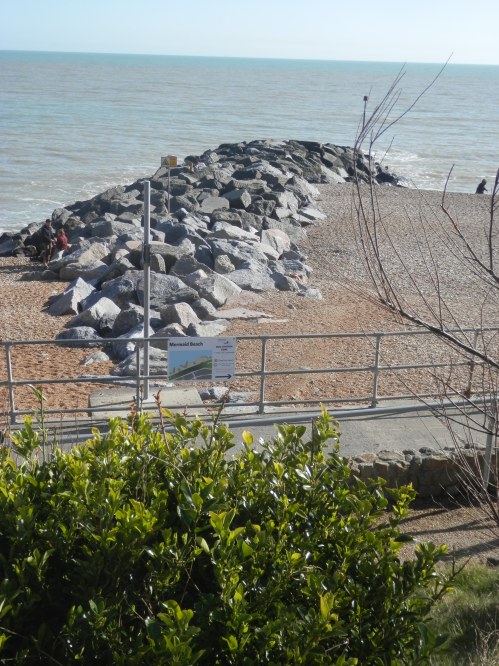
I stroll along the curved seawall that separates the two main parts of the beach, squinting at the six wooden, weirdly shaped seats donated by the Dutch government, and reach the imposing rock groyne. It would be foolhardy this evening to venture out onto this mini-Giants Causeway as some do during the daylight in low tide.

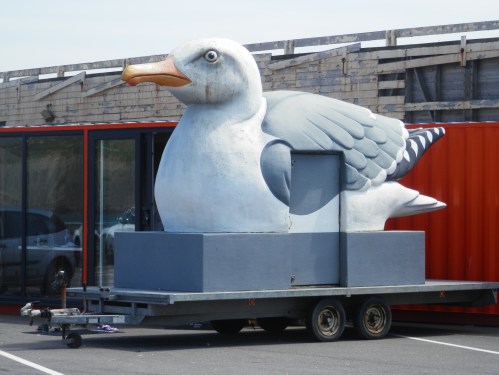
Debate rages on social media as to whether the shape of the groynes that branch out in opposite directions from the beach represent a mermaid, gull, whale or even the Royal Air Force crest. I will not fuel the dispute here, other than to offer the diplomatic suggestion that there is a case to be made for all of them. Whichever it might be, it is a fine sight by day when viewed from the Leas.

Pastel hued beach chalets are now padlocked up for the winter and the Mermaids Cafe Bar, welcome pit stop on the long promenade between Folkestone and its western coastal neighbours of Sandgate, Seabrook and Hythe, is now open on fine weekends only. Tonight, it is dark in contrast to the newly renovated View Hotel beaming benignly down upon it. The hotel’s Cliffe Restaurant, which, in only a few months, has earned a deserved reputation for fine dining and excellent service, will, in contrast, already be busy with office Christmas parties.

I return to the Leas via the lovely Zigzag Path, a walk rendered all the more atmospheric as I weave through its alcoves and tunnels, by its resemblance to those of a Greek island. All that is missing, thankfully, are the maltreated donkeys.

I defy anyone to deny that they enjoy a warm summer’s day by the sea. After all, as the popular expression goes, life’s a beach. And I look forward to the first full summer in my coastal home next year.

However, it is moments like this when enjoyment is a hopelessly inadequate word to describe the impact of this magical place on me. I think I will attempt to define that more fully on another occasion, but, for now, I can only equate it to love in all its manifestations.

Once in a while you get shown the light in the strangest of places if you look at it right is one of my favourite quotes, and is never more relevant than in relation to my feelings for Folkestone. Who would have thought that fifty three years ago, when four adults and three children aged between eight and ten years plus luggage, miraculously emerged from my mother’s Ford Anglia, to cram into that bed and breakfast in Foord Road, that not only would I make this my home all these years later but would instantly become enraptured by the place all over again?

Read Full Post »


1 It Was Always Folkestone (January 2016)

Most of my summer holidays between the ages of ten and eighteen (when I became too cool to trail behind my parents) were spent in the once fashionable seaside resort of Folkestone, a gull’s glide along the coast from the fabled White Cliffs of Dover.

Although there was only one small, inevitably packed, patch of sandy beach along its largely pebble and shingle seafront, the magnificent Rotunda amusement arcade, fringed by fairground rides, putting green, boating lake and swimming pool, kept a young boy handsomely entertained for two weeks in August.

Just occasionally, the vacation coincided with cricket at the Cheriton Ground where the county team hosted opponents from what appeared then to be exotic, faraway places such as Derbyshire and Northamptonshire.  My parents would install me in the stand around 10 o’clock in the morning and head for the shops, bars and arcades. Equipped with sandwiches, suncream and scorebook, I drooled over the godlike exploits of Cowdrey, Knott and Underwood. The sun always seemed to shine and Kent always seemed to win, though I’m not convinced that the history books corroborate either assertion.

But I didn’t care.

I was in Heaven.

In the absence of “the summer game” in town, I could be found being blown around the pitch and putt course on the windswept cliffs overlooking the small but bustling harbour, where saucers of fresh cockles and whelks were in abundant supply. If the cliff top links seemed too challenging, a round of crazy golf could be had on The Stade, the narrow strip of land between the harbour and the East Cliff (now Sunny) Sands. The family, who went by what, to a ten year old in 1963, was the hysterically funny name of Clutterbuck, not only ran our bed and breakfast on Foord Road, but also the kiosk selling buckets, spades and fishing nets at the beach end.

Finally, there was a daily ferry service to Boulogne-sur-Mer in Northern France, where I spent my first few hours on foreign soil. Unfortunately, my recollections of a youthful life on the ocean wave have more to do with leaning over the side of the boat depositing what I hadn’t eaten, than tucking into a full English breakfast in the café below deck. It was several more years before I could indulge in what became lifelong passions for croissants, Roquefort cheese and Burgundy wine.

Folkestone may not have enjoyed the cheeky, “kiss me quick” ambience of Margate or Southend, but I loved its quieter, more refined atmosphere. My parents even spoke on occasion of retiring to the resort but, sadly, it never happened – and with my father’s recent death, never will. I’m comforted, however, by the thought that the last break they shared together was in their favourite location (where they thoroughly enjoyed their stay in the much maligned Grand Burstin).
And now my wife and I have means, motive and opportunity to live that dream ourselves. We have been frequent visitors to Folkestone and the other Kentish seaside towns of Herne Bay, Margate, Ramsgate, Broadstairs, Deal and Whitstable in recent years, and loved each for its particular attractions and atmosphere.

But when it became apparent that my father’s life was approaching its end, I asked her which resort she would like to make her home should circumstances one day permit. To my surprise and delight she replied, without hesitation, “Folkestone”.

So now we are presented with the small task of selling two homes in Medway and buying a property on our favoured part of the coast. It is a daunting, but undeniably exciting prospect. At the moment of that fateful decision six months ago, I announced that I hoped we would be able to take up residence by mid to late summer of 2016.

And it isn’t going to be for want of trying – even our customary lengthy foreign holidays might need to take a back seat this year.

So, apart from the obvious charms that the recollection of childhood still wove, what is it that has lured me to Folkestone?

After all, the past forty years have seen the town, in common with many other resorts around the British coastline, decline dramatically as a holiday destination as people took advantage of extended leisure time and the resources to travel abroad. The rotunda and surrounding attractions have long been demolished, the lively, cobbled Old High Street that winds up to the modern town centre fallen into disrepair and many of the businesses dependent upon holidaymakers closed. Even the Sunday market on the rotunda site lost its appeal for the hordes that had once descended upon it from all parts of the county.

Gone were many of the shops selling postcards, beach balls and buckets and spades. Gone were the traditional tea rooms and fish and chip restaurants. Gone were the abundant amusement arcades where I might while away hours on the Roll a Penny, Skee Ball and Coin Pusher games. And gone was the shop with the big picture window at the top of the Old High Street, through which generations of children and adults alike had gaped in awe at luscious sticks of Folkestone rock being mgically brought to life.

But, with extensive investment, much of it courtesy of a notable sugar daddy in Sir Roger de Haan, there have been signs in recent years that the resort is beginning to stir again. The Old High Street has undergone a makeover. One of a kind gift shops, artisanal food stores, and trendy restaurants are emerging, along with a burgeoning artistic community focused on the Creative Quarter.

There may no longer be any cross-channel services, and the former harbour railway station remains overgrown with weeds, but the town’s accessibility from London and the rest of the county has been enhanced by the arrival of a high speed rail service, reducing the journey to the capital to under an hour. And, of course, it is home to the Channel Tunnel and the swiftest escape to the continent.
The East Cliff beach has been re-branded Sunny Sands and is as rammed as it ever was with humanity on a warm day. And there are few better places to play beach cricket when the tide is out.

And, during the summer of 2015, the Harbour Arm, after years of abandonment, re-opened for several weekends with live music and eclectic food and drink outlets decorating its bracing promenade, providing “new” thrilling vistas back across the harbour. Closed for the winter, it is scheduled to resurface on a larger scale in May 2016.

So our permanent residence could not be better timed.

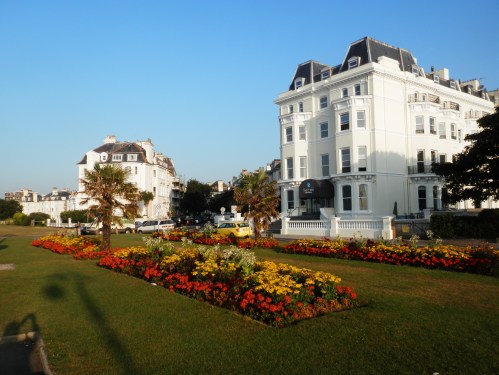
For me, however, the jewel in Folkestone’s crown (only just ahead of the harbour) remains the Leas, once described as “indisputably the finest marine promenade in the world”, a wide clifftop walk with lovingly tended flower beds and glorious views across the channel.

Imposing old hotels speak of the resort’s former glory, none more so than the Grand and Metropole, though now they provide private apartment living. The Leas Cliff Hall is a popular stopping off point for musicians and comedians on tour. I will never forget a hilarious and seemingly never-ending night in the company of Frankie Howerd there during one of those wonderful sixties’ holidays.

On a clear day, you can almost pick out individual buildings on the French coast as you walk past Mermaid Beach en route to the charming neighbouring resorts of Sandgate and Hythe with its access to the world class attractions of Port Lympne Reserve and the Romney, Hythe and Dymchurch Railway, still the smallest regular light rail system in the world, and as thrilling a ride more than a half a century after the first.

At the end of the line, you arrive at Dungeness on the tip of Romney Marsh with its remote beauty (and venue for all night fishing trips with my uncle fifty years ago), and where the abundant birdlife share the shingle with two nuclear power stations and an elegant lighthouse. Dover Castle, Canterbury and Ashford Designer Outlet are all a short drive away.

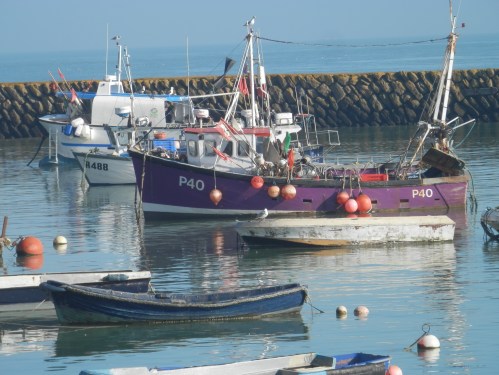
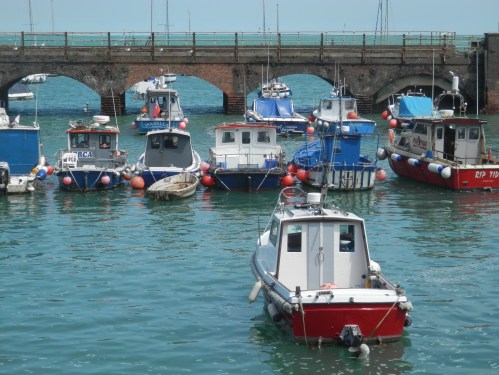
Despite the loss of the ferry service and crazy golf course, as well as the diminution in the fishing trade, the pretty little harbour and adjoining Stade with its seafood stalls still retain some of the atmosphere that first captivated me fifty years ago.The Guardian newspaper recognised the efforts being made to enhance Folkestone’s appeal by rating it among the world’s best holiday destinations to visit in 2014. Many, especially those who had not visited in recent years, might snigger at the idea, but the town is showing signs that it has a future.

Now, if they could only rebuild the Rotunda and resume playing first class county cricket there ………….

2 So Glad We Made It (August 2016)

Twelve months, two house sales, one flat purchase and much frustration and spasmodic heartache later, we took up permanent residence in Folkestone in early August, on schedule with my wishful prediction when the decision to move here was made. And every night over the dinner table we have interrogated each other as to why we hadn’t done this many years before.

But, of course, there were a number of viable reasons (or were they excuses?) – proximity to ageing parents, financial constraints borne of a meaty mortgage and a bank-busting propensity for expensive, primarily American, holidays, or maybe it was just unwarranted caution.

But there is no value in dwelling on those now.

It is the future that matters.

And the future is Folkestone.

We might have settled into our new apartment a month or so earlier had our sellers – now, let’s put this kindly – not taken a more relaxed approach to moving than us. Firstly, they refused to let the estate agents have a set of keys, insisting that they show prospective buyers around their property themselves. Their prerogative, of course, and they did afford us nearly an hour of their time on two separate occasions, making us tea and establishing a strong personal rapport (or so we thought).

However, the fact that they engineered a seven week gap between those two viewings and prevented the surveyor from examining the apartment for a further month thereafter, explained by a combination of work commitments and regular retreats to their French holiday home, proved immensely frustrating and stressful, by contrast, as progress on the sale of our house in Gillingham proceeded smoothly.

Moreover, half way through the process, and completely out of the blue, their solicitor delivered an ultimatum to us to the effect that we pay a non-refundable deposit of 1% within 24 hours or they would pull out and place the property back on the market. Disaster was averted by the estate agent persuading them that fairness dictated that they put up a similar deposit. An open-ended exclusivity agreement sealed the deal, barring subsequent major catastrophe.

We had viewed eight other properties in the West End of town, none of which remotely matched up in terms of visual appeal, character or size. Once we had seen the property on Radnor Park and submitted an offer at the asking price within five minutes of leaving the viewing it, we were determined that it would be ours. We even took a significant financial hit following the survey on our own house to secure it.
And the physical move was not without its difficulties either. Firstly, despite valiant and agonising attempts to reduce my book collection before the move, enriching the minds of the populace of the Medway Towns into the bargain, there were still a huge number of heavy boxes of books for the removal men, not only to load onto their van at our former house, but to carry up forty one steps to our apartment in the sky at the other end. We may not have taken much in the way of furniture and white goods, planning to buy long overdue new items on arrival, but this was still a challenging task for them in addition to the ninety mile round trip.

They were brilliant by the way.

We have already bought a new washing machine (to replace the one that had served us so well for twenty years) and our first king size bed, incurring the wrath, in the process, of two teams of delivery men doomed to lug them up those aforementioned stairs. I know it’s their job, but we felt a little guilty as we witnessed the grunts and groans that accompanied the manipulation of the items round and over the bannister at each level.

I dread what expletives might reverberate around the building when a new oven, fridge/freezer and wardrobe are delivered in the coming weeks!

But – let’s be fair – they have it easy.

Because, at least in the case of furniture, they don’t have to assemble the blighters!

The manufacturer’s instructions for the bed stated that it would take two people an hour and a half to accomplish.

Yeah right!

Now, I’m arguably the least competent do-it-yourself person on the planet, though my wife, having been brought up by a handyman father and two equally proficient brothers, has some aptitude (and, miraculously, managed to translate the nineteen pages of obtuse drawings into a workable plan).

I may never have been more impressed by her than on that day.

My contribution, such as it was, was to supply the occasional burst of brute strength (again an attribute not commonly associated with me).

So how long did it take us?

Only the seven hours!

Usain Bolt could have run the hundred metres 2,520 times in the time it took us to put that  together!

But it was worth it, even if there is still a niggling worry as we lay our heads down at night that it’s going to collapse beneath us.

The washing machine is working well. It even seems to know when the clothes haven’t quite dried and takes it upon itself to add a few minutes to the cycle. Modern technology eh?

Well, at least we were able to slump in front of the television after our mammoth Saturday morning/afternoon ordeal.

Wrong!

Despite assertions before the move that our Virgin Media services would be installed within a few days of our arriving in Folkestone, we were then informed that we would have had to wait three weeks before we have an operational landline, broadband or TV in the apartment.

Consequently, we did not see a single minute of the Olympics or the start of the Premier League season – oh, and I must not forget the soaps (my wife instructed me to include that). That said, we did catch up with a lot of movies and television series on DVD that we have not seen for years, or, in some cases, not even taken the outer sleeve off!

Telephone access is not a problem as we have mobile phones, but obtaining meaningful Wifi access (other than on said devices) has necessitated expensive daily trips to the coffee shops of Folkestone (I’m on my second flat white of the morning in Costa Coffee as I write this).

I would not wish any of the above to give you the impression that we are regretting the decision to move.

Far from it.

The glorious skies, near constant sunshine (so far), even the noisy but necessary birdlife have all been a joy, and Bob’s and Chummy’s at the harbour, Rocksalt, Copper and Spices, Django’s, the Lighthouse Champagne Bar at the end of the Harbour Arm, the Grand, Steep Street coffee house and others have all benefited from our custom over the past fortnight.

A significant added and unexpected bonus has been my wife’s transfer from Chatham to Folkestone, converting a round trip drive of more than two hours into a ten minute walk to her new office.

We had planned to head out west in late September for a few weeks. This was diluted to a week in Italy as the exchange rate plummeted following the EU referendum (I refuse to use THAT word).

Now, we have decided to stay at “home” and acclimatise ourselves to our new surroundings. After all, there is a sense that we are still on holiday and staying in somebody else’s apartment, but I’m sure that will recede as autumn and winter approach (or will it?).

But when I can gaze upon views like those below every day I feel blessed, and any temporary and trivial hardships, before, during and after the move, simply fade away (unlike love).

3 Calling Folkestone Home (September 2016)

Now that another month has passed, and with the climate gods continuing to shine upon us, we are beginning to feel that this is now our permanent home.

The frustrating saga of our landline, cable and broadband installation is finally over after forty two tortuous days.

Hold on, the more discerning among you will exclaim, you said it was being completed after three weeks. And you would be right.

The engineer duly arrived (very late) on the appointed date and immediately announced that he was unable to carry out the job because he would need a longer ladder (you couldn’t make it up), and he had not been informed that we lived on the second floor (the company was fully aware of this).

This resulted in a further three week delay before our services would be installed. No amount of pleading, complaining or threatening on our part could bring the appointment date forward.

The more observant reader would also have wondered why, in the absence of cable television coverage, we did not invest in an indoor aerial and take advantage of the Freeview channels installed in any modern appliance.

We did.

But only after four weeks!

And, again, that was my wife’s idea.

But the saga is now well and truly over.

We have now, in addition to the aforementioned bed and washing machine, purchased a new fridge/freezer and oven, perpetrating an epidemic of hernia repairs among local delivery men in the process.

My wife has settled into her new office in town.

We are on first name terms with two pair of crows that have taken up residence in our beech tree. They love nothing more than to join the ducks in the fishing lake and the gulls on the roof in a chaotic (pre-) dawn chorus.

Our collection of eateries and watering holes continues to rise, with the Cliffe Restaurant in the View Hotel quickly becoming a favourite.

And we have entertained guests from Norwich and Philadelphia.

For now then, it is fair to say that the fabulous Folkestone fairytale continues.

Cynics will sneer at what they perceive to be an overly positive initial impression, and I acknowledge that the rose-tinted spectacles haven’t been discarded yet. However, I offer the following:

1 The people of Folkestone, especially in the retail and hospitality sectors, have largely been friendly and cheerful. And I have been particularly impressed by the courtesy of drivers towards pedestrians around town; and

2 Folkestonians appear to care for their physical surroundings too – flower displays and other open spaces are lovingly tended, littering is less visible than in many other places I have lived in and visited and there is extensive renovation and redecoration of buildings going on, especially near the seafront.

I am very conscious, however,  that Folkestone is no more immune from the contagion of drunkenness and lawlessness that infects town centres across the country. The recent attack on a group of innocent bystanders in the early hours of the morning in Sandgate Road is not the only such incident since we have been here. I will not shy away in future from highlighting negative as well as positive features.

As the council gardening staff begin to dig up the flower beds along the Leas under another limpid blue sky that belies the reality of today’s Autumn Equinox, my thoughts turn to the next six months. Most of the time I have spent in Folkestone, as child and man, until now has been during the summer or in the late spring. But whilst I might mourn the imminent passing of hot, sunny days, I am excited at the prospect of witnessing winter storms crashing (but not damaging further) Coronation Parade and walking from Mermaid Beach into Sandgate and Hythe on cold, crisp February mornings.

The next phase of our Folkestone story awaits!
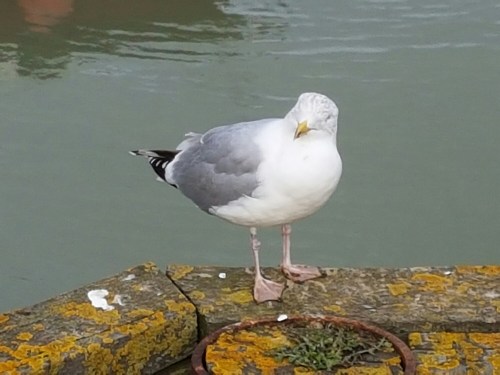
wp-image-437107990jpg.jpg

Read Full Post »


This is the final part in a trilogy of posts centred on our recent relocation to Folkestone. The first outlined the historical and emotional reasons for making the move in the first place, whilst the second described the sometimes rocky road of searching for, buying and moving into our coastal retreat.

At the end of the last piece, written a fortnight after our arrival, I concluded that, not least because of the excellent weather we had enjoyed, it still felt as if we were on an extended summer vacation.

But now that another month has passed, and although the climate gods continue to shine upon us, we are beginning to feel that this is now our permanent home.

The frustrating saga of our landline, cable and broadband installation is finally over after forty two tortuous days.

We have purchased a number of new household appliances (and perpetrated an epidemic of hernia repairs among the delivery men into the bargain).

My wife has settled into her new office in town.

We are on first name terms with a pair of crows that have taken up residence in our beech tree. They love nothing more than to join the ducks in the lake across the road and the seagulls on the roof in a chaotic (pre-) dawn chorus.

And we have entertained guests from Norwich and Philadelphia.

For now then, it is fair to say that the fabulous Folkestone fairytale continues – as the images below demonstrate.

wp-image-853740679jpg.jpg

Folkestone must have more outdoor benches per square metre than anywhere else on the coast!


OLYMPUS DIGITAL CAMERA

One of the many attractive features of the award winning, child friendly Lower Leas Coastal Park – it can’t be claimed that this seaside town is the preserve of the elderly!

OLYMPUS DIGITAL CAMERA

This shop in the harbour thrilled me as a child, and it is no different now as we’ve already adorned our apartment with artefacts from its shelves


OLYMPUS DIGITAL CAMERA

The Grade II Leas Lift, a much loved icon, was restored to full operation this summer

OLYMPUS DIGITAL CAMERA

“Ok, I get it that you won’t let me have any of your fish and chips, and you’re only looking after my own welfare by not feeding me, but just remember who runs this town”

OLYMPUS DIGITAL CAMERA

Folkestone’s own Little Mermaid, modelled on local mother of two, Georgina Baker, gazes on our “chums” on the Cote D’opale from the rocks of Sunny Sands

OLYMPUS DIGITAL CAMERA

My fetish (I prefer to call it passion) for directional signs is amply satisfied around town

OLYMPUS DIGITAL CAMERA

The wild, weird, wonderful Warren is a secret jealously guarded by (us!) locals 

OLYMPUS DIGITAL CAMERA

Cafe culture at its best at Steep Street – welcoming smiles, potent coffee, delicious pastries, stacks of books, literary competitions and seats for great people watching – a killer combination

In conclusion, a couple of general observations. Cynics might sneer at what they perceive to be an overly positive initial impression, and I acknowledge that the rose-tinted spectacles haven’t been discarded yet. However, I offer the following:

  1. The people of Folkestone, especially in the retail and hospitality sectors, have been friendly and cheerful. And I have been particularly impressed by the courtesy of drivers towards pedestrians around town; and
  2. Folkestonians appear to care for their physical surroundings too – flower displays and other open spaces are lovingly tended, littering is less visible than in many other places I have lived in and visited and there is extensive renovation and redecoration of buildings going on, especially near the seafront.

I am very conscious, however,  that Folkestone is no more immune from the contagion of drunkenness and lawlessness that infects town centres across the country. Only last weekend, for example, a group of innocent bystanders was attacked in the early hours of the morning in Sandgate Road. I will not shy away in future from highlighting negative as well as positive features.

As the council gardening staff begin to dig up the flower beds along the Leas under another limpid blue sky that belies the reality of today’s Autumn Equinox, my thoughts turn to the next six months. Most of the time I have spent in Folkestone, as child and man, until now has been during the summer or in the late spring. But whilst I might mourn the imminent passing of hot, sunny days, I am excited at the prospect of witnessing winter storms crashing (but not damaging further) Coronation Parade and walking from Mermaid Beach into Sandgate and Hythe on cold, crisp February mornings.

The next phase of our Folkestone story awaits!


The first two posts in this series can be found at:

http://www.tonyquarrington.wordpress.com/2016/01/11/it-was-always-folkestone/

http://www.tonyquarrington.wordpress.com/2016/08/18/so-glad-we-made-it/

Read Full Post »


I explained in my last post (in what appears now to have been a different archaeological period) why my wife and I had decided to move to the Kent coast, specifically my childhood summer playground of Folkestone.

( http://www.tonyquarrington.wordpress.com/2016/01/11/it-was-always-folkestone/ ) .

Well, two house sales, one flat purchase and much frustration and spasmodic heartache later, we descended upon the town a fortnight ago. And every night over the dinner table we interrogate each other as to why we hadn’t done this many years before.

But, of course, there were a number of viable reasons (or were they excuses?) – proximity to ageing parents, financial constraints borne of a meaty mortgage and an almost bank-busting propensity to go on expensive holidays, particularly to the west coast of the U.S.A, or maybe it was just unwarranted caution.

But there is no value in dwelling on those now.

It is the future that matters.

And the future is Folkestone.

OLYMPUS DIGITAL CAMERA

We might have settled into our new apartment a month or so earlier had our sellers – now, let’s put this kindly – not taken a more relaxed approach to moving than us. Firstly, they refused to let the estate agents have a set of keys, insisting that they show prospective buyers around their property. Their prerogative, of course, and they did afford us nearly an hour of their time on two occasions, making us tea and establishing a strong personal rapport (we thought).

However, the fact that they engineered a seven week gap between those two viewings and prevented the surveyor from examining the apartment for a further month, explained by a combination of work commitments and regular retreats to their holiday home in France, proved immensely frustrating and stressful as progress on the sale of our house in Gillingham proceeded smoothly.

OLYMPUS DIGITAL CAMERA

Moreover, half way through the process, and completely out of the blue, their solicitor delivered an ultimatum to us, insisting that we pay a non-refundable deposit of 1% within 24 hours or they would pull out and place the property back on the market. Disaster was only averted through by the estate agent persuading them that fairness dictated that they put up a similar deposit. An open-ended exclusivity agreement sealed the deal, barring subsequent major catastrophe.

We had viewed eight other properties in the West End of town, none of which remotely matched up in terms of visual appeal, character or size. Once we had seen the property and submitted an offer at the asking price within five minutes of leaving it, we were determined that it would be ours. We even took a significant financial hit following the survey on our own house to secure it.

And the physical move was not without its difficulties either. Firstly, despite valiant and agonising attempts to reduce my book collection before the move, enriching the minds of the populace of the Medway Towns into the bargain, there were still a huge number of heavy boxes of books for the removal men, not only to load onto their van at our former house, but to carry up forty one steps to our apartment in the sky at the other end. We may not have taken much in the way of furniture and white goods, planning to buy long overdue new items on arrival, but this was still a challenging task for them in addition to the ninety mile round trip.

They were brilliant by the way.

OLYMPUS DIGITAL CAMERA

We have already bought a new washing machine (to replace the one that had served us so well for twenty years) and our first king size bed, incurring the wrath, in the process, of two teams of delivery men doomed to lug them up those aforementioned stairs. I know it’s their job, but I felt a little guilty as I witnessed the grunts and groans that accompanied the manipulation of the items round and over the bannister at each level.

I dread what expletives might reverberate around the building when a new oven, fridge/freezer and wardrobe are delivered in the coming weeks!

But – let’s be fair – they have it easy.

Because, at least in the case of furniture, they don’t have to assemble the blighters!

The manufacturer’s instructions for the bed stated that it would take two people an hour and a half to accomplish.

Yeah right!

Now, I’m arguably the least competent do-it-yourself person  on the planet, though my wife, having been brought up by a handyman father and two equally proficient brothers, has some aptitude (and, miraculously, managed to translate the nineteen pages of obtuse drawings into a workable plan).

I may never have been more impressed by her than on that day.

My contribution, such as it was, was to supply the occasional burst of brute strength.

So how long did it take us?

Only the seven hours!

Usain Bolt could have run the hundred metres 2,520 times in the time it took us to put that  together!

But it was worth it, even if there is still a niggling worry as we lay our heads down at night that it’s going to collapse beneath us.

By the way, the washing machine is working well. It even seems to know when the clothes haven’t quite dried and takes it upon itself to add a few minutes to the cycle. Modern technology eh?

OLYMPUS DIGITAL CAMERA

Well, at least we were able to slump in front of the television after our mammoth Saturday morning/afternoon ordeal.

Wrong!

Despite assertions before the move that our Virgin Media services would be installed within a few days of our landing in Folkestone, we will have had to wait three weeks before we have an operational landline, broadband or TV in the apartment. Consequently, we have not seen a single minute of the Olympics or the start of the Premier League season – oh, and I must not forget the soaps (my wife instructed me to include that). That said, we have caught up with a lot of movies and television series on DVD that we have not seen for years, or, in some cases, not even taken the outer sleeve off!

Telephone access is not a problem as we have mobile phones, but obtaining meaningful Wifi access (other than on said devices) has necessitated expensive daily trips to the coffee shops of Folkestone (I’m on my second flat white of the morning in Costa Coffee as I write this).

I would not wish any of the above to give you the impression that we are regretting the decision to move.

Far from it.

The glorious skies, near constant sunshine (so far), even the noisy but necessary birdlife have all been a joy, and Bob’s and Chummy’s at the harbour, Rocksalt, Copper and Spices, Django’s, the Lighthouse Champagne Bar at the end of the Harbour Arm, the GrandSteep Street coffee house and others have all benefited from our custom over the past fortnight.

A significant added and unexpected bonus has been my wife’s transfer from Chatham to Folkestone, converting a round trip drive of more than two hours into a ten minute walk to her new office.

We had planned to head out west in late September for a few weeks. This was diluted to a week in Italy as the exchange rate plummeted following the EU referendum (I refuse to use THAT word). Now, we have decided to stay at “home” and acclimatise ourselves to our new surroundings. After all, there is a sense that we are still on holiday and staying in somebody else’s apartment, but I’m sure that will recede as autumn and winter approach (or will it?).

But when I can gaze upon views like those below every day I feel blessed, and any temporary and trivial hardships, before, during and after the move, simply fade away (unlike love).

OLYMPUS DIGITAL CAMERA


OLYMPUS DIGITAL CAMERA

OLYMPUS DIGITAL CAMERA

OLYMPUS DIGITAL CAMERA


OLYMPUS DIGITAL CAMERA


Read Full Post »


That may not strictly be true.

But it’s how it should work out.

The majority of my summer holidays between the ages of ten and eighteen (when I became too cool to hang on to my parents’ swimsuit tails) were spent in the once fashionable seaside resort of Folkestone in Kent, a seagull’s glide along the coast from the fabled White Cliffs of Dover.

Although there was only one small, inevitably packed, patch of sandy beach along its largely pebble and shingle seafront, the magnificent Rotunda amusement arcade, fringed by fairground rides, putting green,  boating lake and swimming pool, kept a young boy and his cousins handsomely entertained for two weeks every August.

OLYMPUS DIGITAL CAMERA

Just occasionally, the vacation coincided with cricket at the Cheriton Ground where the county team hosted opponents from what appeared then to be exotic, distant places named Derbyshire and Northamptonshire.  My parents would install me in the stand around 10am and go off to do whatever it was they did while, equipped with sandwiches, suncream and scorebook, I drooled over the godlike exploits of Cowdrey, Knott and Underwood. The sun always seemed to shine and Kent always seemed to win, though I’m not convinced that the history books would corroborate either assertion.

But I don’t care – I was in Heaven.

In the absence of cricket I could be found staggering around the bracing pitch and putt golf course on the windswept cliffs overlooking the small but bustling harbour, where saucers of fresh cockles and whelks were in abundant supply. If the cliff top links seemed too challenging, a round of crazy golf could be had on The Stade, the narrow strip of land between harbour and sandy beach. The family that ran our bed and breakfast, who went by what, to a ten year old in 1963 (and probably one in 2016 too), was the hysterically funny name of Clutterbuck, owned the shop at the beach end.

OLYMPUS DIGITAL CAMERA

Finally, there was a daily ferry service to Boulogne-sur-Mer in Northern France, where I spent my first day abroad. Unfortunately, my recollections of a youthful life on the ocean wave have more to do with leaning over the side of the boat than tucking into a full English breakfast in the café. It was a few more years, therefore, before I could indulge in what became lifelong passions for Brie and Roquefort cheese and French wine.

Folkestone may not have enjoyed the cheeky, “kiss me quick” ambience of Margate or Southend, but I loved its quieter, more refined atmosphere. My parents even spoke on occasion of retiring to the resort but, sadly, it never happened – and with my father’s recent death, never will. I’m comforted, however, by the thought that the last break they shared together was in their favourite location.

And now my wife and I have, or will soon have, means, motive and opportunity to live that dream ourselves. We have been frequent visitors to Folkestone and the neighbouring Kentish seaside towns of Margate, Ramsgate, Broadstairs, Deal and Whitstable in recent years, and enjoy each one for its particular attractions and atmosphere.

OLYMPUS DIGITAL CAMERA

When it became apparent that my father’s life might be approaching its end, I asked her which resort she would like to make her home should circumstances one day permit. To my surprise and delight she replied, without hesitation, “Folkestone”.

So now we have the small task of selling two homes in Medway and buying a property on the coast. It is a slightly daunting, but undeniably, exciting prospect. It might be fanciful to think that, by mid to late summer, we will be opening our curtains and shouting “bonjour” to our French neighbours across the English channel every morning.

But it won’t be for want of trying – even foreign holidays this year might need to take a back seat.

So, apart from the obvious charms that childhood still weaves, what is it that lures us to Folkestone?

OLYMPUS DIGITAL CAMERA

After all, the past forty years have seen the town, in common with many other resorts around the British coastline, decline dramatically as a holiday destination as people took advantage of greater leisure time and resources to travel further afield. The rotunda and surrounding attractions were demolished, the lively, cobbled Old High Street that winds up to the modern town centre fell into disrepair and many of the businesses dependent upon holidaymakers closed.

image

Gone were many of the shops selling postcards, beach balls and buckets and spades. Gone were the traditional tea rooms and fish and chip restaurants. And gone was the shop with the big picture window at the top of the Old High Street through which children and adults alike gaped in awe at sticks of Folkestone rock being made.

But, with extensive investment, there have been signs in recent years that Folkestone is beginning to stir again. The Old High Street has undergone a makeover. One of a kind gift shops, artisanal food stores and galleries, and attractive restaurants have emerged, along with a burgeoning artistic community.

OLYMPUS DIGITAL CAMERA

There may no longer be any cross-channel services, and the former harbour railway station may, for now, remains overgrown with weeds, but the town’s accessibility from London and the rest of the county has been enhanced by the arrival of a high speed rail service. And, of course, it is home to the Channel Tunnel and the swiftest escape to the continent.

OLYMPUS DIGITAL CAMERA

The East Cliff beach has been re-branded Sunny Sands and is as rammed with humanity as ever on a warm day. There are few better places to play beach cricket when the tide is out.

OLYMPUS DIGITAL CAMERA

And, last summer, the Harbour Arm, after years of abandonment, re-opened for several weekends with music, food and drink decorating its bracing promenade, providing “new” thrilling vistas back across the harbour. Currently closed for the winter, it is scheduled to resurface full time in May 2016.

OLYMPUS DIGITAL CAMERA

OLYMPUS DIGITAL CAMERA

Our permanent residence could not have been better timed.

The jewel in Folkestone’s crown remains the Leas, once described as “indisputably the finest marine promenade in the world”, a wide clifftop walk with well tended flower beds and glorious views across the channel. Imposing old hotels speak of the resort’s former glory, no more so than the Grand and Metropole, though some are now holiday apartments. The Leas Cliff Hall is a popular stopping off point for musicians and comedians on tour. I will never forget a long and hilarious night with Frankie Howerd there back in the late sixties.

image

On a clear day, you can almost pick out individual buildings on the French coast as you head towards the charming neighbouring resorts of Sandgate and Hythe with its access to the world class attractions of Port Lympne Wild Animal Park and the Romney, Hythe and Dymchurch Railway, still the smallest regular light rail system in the world and as thrilling a ride more than a half a century later than the first. At the end of the line, you arrive at Dungeness on the tip of Romney Marsh with its end of the world atmosphere, where the abundant birdlife shares the shingle with two nuclear power stations .

OLYMPUS DIGITAL CAMERA

Despite the loss of the ferry service and crazy golf course, as well as the diminution in the fishing trade, the pretty little harbour and adjoining Stade with its seafood stalls still retain some of the atmosphere that first captivated me fifty years ago.

OLYMPUS DIGITAL CAMERA

The Guardian newspaper recognised the efforts being made to enhance Folkestone’s appeal by rating it among the world’s best holiday destinations to visit in 2014. Many, especially those who have not visited in recent years, will snigger or even guffaw at the idea, but the town is showing signs that it has a future.

We might even put you up while you visit!

Now, if they could only rebuild the Rotunda and resume playing first class county cricket there ………….

OLYMPUS DIGITAL CAMERA


(more…)

Read Full Post »


I first met Martin at the T20 Quarter-Final between Leicestershire and Kent at Grace Road in 2011. This was to be the venue for the inaugural meeting of the Kent Reform Group whose stated aims were to bring greater transparency and accountability to the county club than was felt to be evident at the time.

I arrived first and parked myself at an empty table in the corner of the bar. I was shortly followed by Graham Holland, senior civil servant, former Mayor and prospective Kent County Cricket Club committee member. Graham and I exchanged pleasantries over a glass of sauvignon blanc while we awaited the arrival of the other two core members of the group.

After a quarter of an hour, the double doors swung open to reveal a tall, imposing figure dressed in a green and blue striped blazer with matching tie on a salmon coloured shirt, red slacks, scrubbed brown brogues and a boater sporting the black and Kentish grey colours of the Band of Brothers Cricket Club. He carried over his shoulder a faded brown leather satchel that looked at any moment about to spill its hefty contents. A crumpled packet of cigarettes protruded from the top pocket of the blazer. The only thing that would have completed this curiously Western scene (the meagre population of the bar to a man and woman had turned in his direction), would have been for the stranger to brandish a brace of six shooters from his hip.

Martin Moseling was in the building!

Graham introduced us and we got down to business, though not before Martin had dropped the satchel to the floor and sent the first of what seemed dozens of text messages to the fourth member of the group who had decided at the last minute to remain in Kent.

Throughout that ultimately depressing afternoon, in which Kent contrived to throw away a winning position in intermittent drizzle, he paced up and down replaying every boundary and dismissal by text with the absent colleague watching the game on TV back in his Wealden retreat.

OLYMPUS DIGITAL CAMERA

OLYMPUS DIGITAL CAMERA

We met occasionally at cricket over the next twelve months, standing and chatting aimlessly on the Old Dover Road banking or in the Chiesman pavilion for hours on end, only partly conscious of the performance of the “flannelled fools” out in the middle. With that heavy, faded satchel still hanging from one shoulder, Martin would hold court, offering a wealth of historical and technical insights on the game while a growing audience of his peers nodded sagely in response.

It became clear that, despite our political and social differences – he revered Margaret Thatcher and was at home at hunt balls, whereas my political hero was Dennis Skinner and I was more comfortable in tie-dye at a Grateful Dead concert – we still had a lot in common, notably a mutual affection for Kent cricketing history and the “Golden Age” immediately before the Great War in particular. But there was something else we shared, an ambition that had been unfulfilled for more than half a century – that of writing at least one book and getting it published.

But the 2012 season ended and we went our separate ways.

Until, on one dank, dismal December morning, he rang me to ask whether I was interested in writing a book with him on Kent’s 1913 County Championship winning side to commemorate the upcoming centenary. My response – something along the lines of “yeah, why not” – was hardly enthusiastic, but enough for us to spend the next hour scoping out structure, style and themes. We were off and running before my customary eleven o’clock coffee break.

P1020307

What had we let ourselves in for? It is difficult enough to write a book on one’s own, but to do it with someone else whom they still barely knew and who lived a hundred and twenty miles away, and had, as we soon discovered, a different writing style, would surely be impossible. But, having agreed a workable division of labour at the outset, we spent the next six months working separately on different chapters and sending drafts to each other before picking up the telephone and painstakingly working through every letter and punctuation mark. We didn’t always see eye to eye, of course – he was over fond of words like “rather” and “somewhat” and I drove him to distraction with my obsession with punctuation – but the system worked.

We spoke many times a day. Martin invariably initiated the discussions, telephoning to urge me to peruse a new draft chapter or an alteration in the design that he had been working on during the night while I was asleep! In fact, he often rang at the most inconvenient times, either just before I was leaving the house or about to cook my wife’s dinner. It became a standing joke between us, rather like the one my wife and I shared when we listened to our daily answerphone messages and heard the immortal phrase “hello Tony, it’s Martin, give me a call”.

We met only three times over that period, twice when I travelled down to the Cotswolds for a couple of days each time and when we made a joint visit to the MCC library at Lord’s from which we witnessed a spectacular snow blizzard envelopping the hallowed ground. I also visited the principal libraries around the county to research the newspapers of the day. This provided us with a great deal of reportage to supplement the official scorecards for each game that were available on the Cricinfo website. But the feature of the published book that received the most plaudits were the contemporary photographs, many of which had not seen the light of day since that fateful final full season before the Great War, that he had sourced from both his own impressive collection and other publications. His contacts in the game, not least in his adopted county of Gloucestershire, provided many priceless images too.  

OLYMPUS DIGITAL CAMERA

OLYMPUS DIGITAL CAMERA

Had he not been so persistent, we may never have finished the book. I am eternally grateful to him for not only coming up with the idea but motivating me along the way when my natural indolence took hold (and I like to think I did the same for him).

With the demise of the Kent Reform Group in early 2012, it was clear that the county club was not going to trust offers of assistance or criticism from individuals or members’ groups for the foreseeable future. However, by quiet diplomacy and patient relationship building, Martin was able to extract a number of concessions over the next three years, for example in overturning a ban on fans bringing even a modest amount of alcohol into the grounds for forty over games.

His legacy, however, will be the pivotal role he played in the establishment of the Kent Cricket Heritage Trust. Firstly, virtually single-handedly, he persuaded the Club of the value of creating a trust to protect and promote its proud heritage, and then drove through the implementation. His stunning timeline of the Great War which was displayed in the Chiesman Pavilion during the 2014 Canterbury Week, and the photographic montages of two historic run chases against Gloucestershire and Lancashire, were praised widely. Both were produced at his own expense. He also gave of his own time in keeping a watching eye on cricket auctions around the country, identifying items that the Club might be interested in purchasing.

P1020276

The fact that the Kent Cricket Heritage Trust is now established, and there are visible signs around the ground of its work, notably the new display cases in the Chiesman Pavilion, is largely attributable to Martin.

Any doubts that the Club might not have fully appreciated his contribution were quickly dispelled when they flew the official flag (white horse on red background) at half mast at the St Lawrence Ground on the day following his death. I cannot recall this being done for someone who neither played in the first XI (and oh how he wished he could have), nor served on the committee before. Martin would have been humbled and hugely proud of such a gesture.

As testimonials since his untimely passing have illustrated, he was admired and respected for his detailed knowledge of cricketing history, especially during the era covered by A-Half Forgotten Triumph. 

He had a patrician but nonetheless kindly demeanour which gave his utterances on the game an almost Swanton-like character, an impression reinforced by a build that resembled in later years that of the former journalist and president of the county club.

P1000936

As “Kentish Exile” he was prolific and authoritative. It was his opinion that many of his fellow posters looked for first on all cricketing issues for a combination of insider understanding and common sense. His style was measured, urbane and often sprayed with references and quotes from history, literature and music. It was this that led one wag from Chatham on the Old Dover Road seating at Canterbury one afternoon to declaim:

That Kentish Exile, ‘e’s a bit upmarket ‘e is.

Martin’s reaction to this statement when I relayed it to him that evening was a customary chuckle. I think he was rather flattered.

Despite his achievements – he was a fine horseman, golfer and guitar player, amongst other talents I may not have discovered in the short time I knew him, in addition to being a good enough cricketer to play not only for the MCC for many years, but also the Band of Brothers, Cross Arrows and a variety of teams in Gloucestershire – he was essentially a modest man. Few of his cricketing acquaintances will be aware that he maintained a blog – entitled A Cricket Sort of Chap: A sideways look at all kinds of cricket but especially the cricket of Kent – in which he brought his wit, wisdom and experience to bear on cricketing issues as diverse as being taken to the Bat and Ball Ground in Gravesend as a small boy by his father, the history of round arm bowling and a series of articles on Kevin Pieterson. I urged him constantly to notify his fellow Kent followers when he had published a new piece, but he preferred to manage it for his own amusement.

I’m afraid I’ve now let the cat out of the bag, but I’m sure he would forgive me as the articles are as good examples of cricket writing as you would find anywhere today,  and cry out to be be read by a wider audience.

OLYMPUS DIGITAL CAMERA

OLYMPUS DIGITAL CAMERA

We had spoken of collaborating again in the future and mulled over the worth of writing reappraisals of the life and career of three of the most influential figures of Kent cricket – Frank Woolley, Les Ames and Lord Harris. But I wanted to take a break from cricket writing, not sharing his all-consuming passion for the sport. Before his illness cruelly began to affect his capacity to concentrate, he was working on a book about James Seymour, one of the powerful top order in Kent’s first period of glory. During the writing of our book he had met with the Seymour family who had kindly made a voluminous scrapbook of cuttings, photographs and scorecards available to him. He spoke enthusiastically too of writing a book about the seasons in which Kent finished second in the County Championship (of which there are too many).

On the all too rare days that we watched Kent play together (Martin tended, understandably, to visit the Midlands away grounds more than Kent), he was invariably accompanied by his beloved flat coated retriever, Bear, who he had had for nearly nine years (“the best friend I could ever want”). Bear sadly died in February of last year when Martin wrote “I do not know what I will do without him”. Shortly after, however, he acquired Bear’s nephew, Alfie, and was still in the process of breaking him in and preparing to introduce him to the world of cricket in the near future.

He was immensely proud of his son and daughter, and the successful careers they had carved out for each other, and despite the rapid deterioration in his health, it must have been a joyous occasion to have Emma and Mark and his grandchildren all together at his home.

It is difficult to know how to finish this piece other than to say that I accounted him a friend, not only for his rich well of cricketing anecdotes and knowledge, but also for his wise counsel (something others commented upon in the days following his death). He was not just “a cricket sort of chap”, but someone whose intelligence, humour and understanding ranged across every imaginable subject. He even helped me to make (some) sense of the San Francisco rental market!

But I’ll leave the final words to the man himself:

I have become resigned to the fact that Kent cricket was always in my blood. Although the past few years have been endlessly frustrating, they have also been rewarding. Friendships made within cricket are necessarily transitory but they are enduring. I have re-established contact with people I played with and against 30/40 years ago and I have made new friends. The really great thing about it is that those friends share my love of the greatest game of all – cricket and, in particular, the love of the cricket of the county of Kent.

OLYMPUS DIGITAL CAMERA

OLYMPUS DIGITAL CAMERA

Read Full Post »
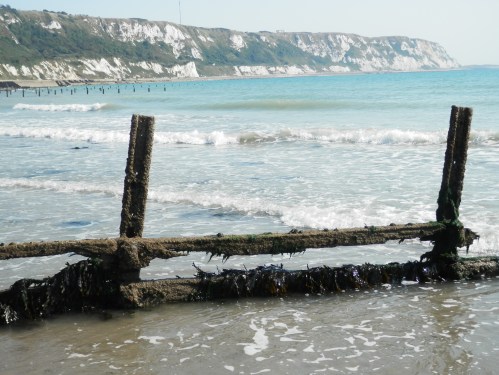

There are many reasons why I am grateful to have been born and educated in Rochester, notably the imposing castle keep, atmospheric cathedral and the close association with Charles Dickens.

The town also hosts a series of festivals and concerts throughout the year within its ancient high street and environs. Whilst the Dickens Festival, held on the weekend after the late May holiday is the oldest and biggest, it is the Sweeps Festival over the May Day weekend that I look forward to the most.

OLYMPUS DIGITAL CAMERA

For three days the town reverberates to the sound of accordions, bells, fiddles, clattering clogs and crunching sticks in one of the largest May Day celebrations in the UK.

But why sweeps?

Well, Dickens is again the inspiration for this extravaganza of music, dance and street theatre.  May Day was the one day’s holiday a year for chimney sweeps  or “boys” in Victorian England, and the novelist highlighted their plight.

The festivities actually begin earlier – at 5.32am on 1st May to be precise.  At the picnic site near Bluebell Hill, the principal road between Chatham / Rochester and Maidstone, the slumbering Jack-in-the-Green is brought back to life by sweeps, Morris Men and anyone else dedicated or foolhardy enough to rise at such an early hour.

OLYMPUS DIGITAL CAMERA

Back in Rochester, the narrow and sleepy high street stirs at around 11 o’clock each morning as shops and stall holders prepare their pitches against a backdrop of  Morris sides jingling into position for their first dance. Many of the pubs host live folk acts too. As you walk from one end of the street to the other you will hear snatches from every strand of the folk tradition.

OLYMPUS DIGITAL CAMERA

Already impassable to vehicular traffic, the street soon becomes clogged (pun intended) with human onlookers, some regular devotees but many others, local residents making their annual pilgrimage to gawp at the strange people from eight to eighty dressed in waistcoats adorned with badges, hats, handkerchiefs, bells and carrying the obligatory personalised beer mug (usually pewter).

OLYMPUS DIGITAL CAMERA

The 2014 Festival, blessed with the fine weather that can make or break such an outdoors event in spring in England, was the 35th since the tradition was revived. More than sixty “sides” from as far afield as Nottingham and Warwickshire performed the full gamut of Morris dances – Cotswold, Border, North West Clog and Black Face.

Kent was understandably well represented with, among others, festival favourites such as Bishop Gundulfs, Kits Coty and the Loose Women. Less traditional forms of dance, notably Gothic (the Screeming Banshees) and Sand (the Fabulous Fezheads), provided added spice.

OLYMPUS DIGITAL CAMERA

The entertainment was not confined to the crowded high street. The War Memorial was home to “Busker’s Corner” and stages behind the City Wall bar and on Boley Hill leading up to the Castle allowed further opportunities for singers. The car park adjacent to the castle moat was abuzz with enthusiasts trawling through the treasures in the record and musical instrument tents.

OLYMPUS DIGITAL CAMERA

The main stage in front of the Castle was permanently in use with a succession of folk acts, and the gardens contained a food, drink and lifestyle fair, children’s fun fair and a number of other craft marquees.

OLYMPUS DIGITAL CAMERA

OLYMPUS DIGITAL CAMERA

OLYMPUS DIGITAL CAMERA

Back in the high street again, the music – and the drinking – never stopped.

OLYMPUS DIGITAL CAMERA

And the dances – and fashion  – got weirder.

OLYMPUS DIGITAL CAMERA

OLYMPUS DIGITAL CAMERA

It had barely been a fortnight since, empty and depressed, I’d left San Francisco. But there can have been few better tonics than a day at the Rochester Sweeps Festival, which was rounded off by a fine concert from the original English folk-rock band, Fairport Convention that evening at Chatham’s Central Theatre.

Moreover, it heralded the start of the English summer – light evenings, more festivals, cricket, seaside trips.

And even the prospect of some warm sunshine.

Now that’s not something San Francisco can guarantee is it?

Read Full Post »


My home county of Kent has long worn the accolade of the “Garden of England” lightly but it also boasts an enviable heritage, including many fine castles. Below are photographs and brief descriptions of some of the most celebrated.

There is only place to start – with the great twelfth century Norman keep in my home town of Rochester, beloved of Charles Dickens. Standing on the east bank of the River Medway, it was besieged four times during its first three hundred years, but has survived, if much changed and as a magnificent ruin, ever since. Open to the public all year round, its pigeon poop encrusted turrets offer outstanding views of the river and beyond.

OLYMPUS DIGITAL CAMERA

OLYMPUS DIGITAL CAMERA

P1010811

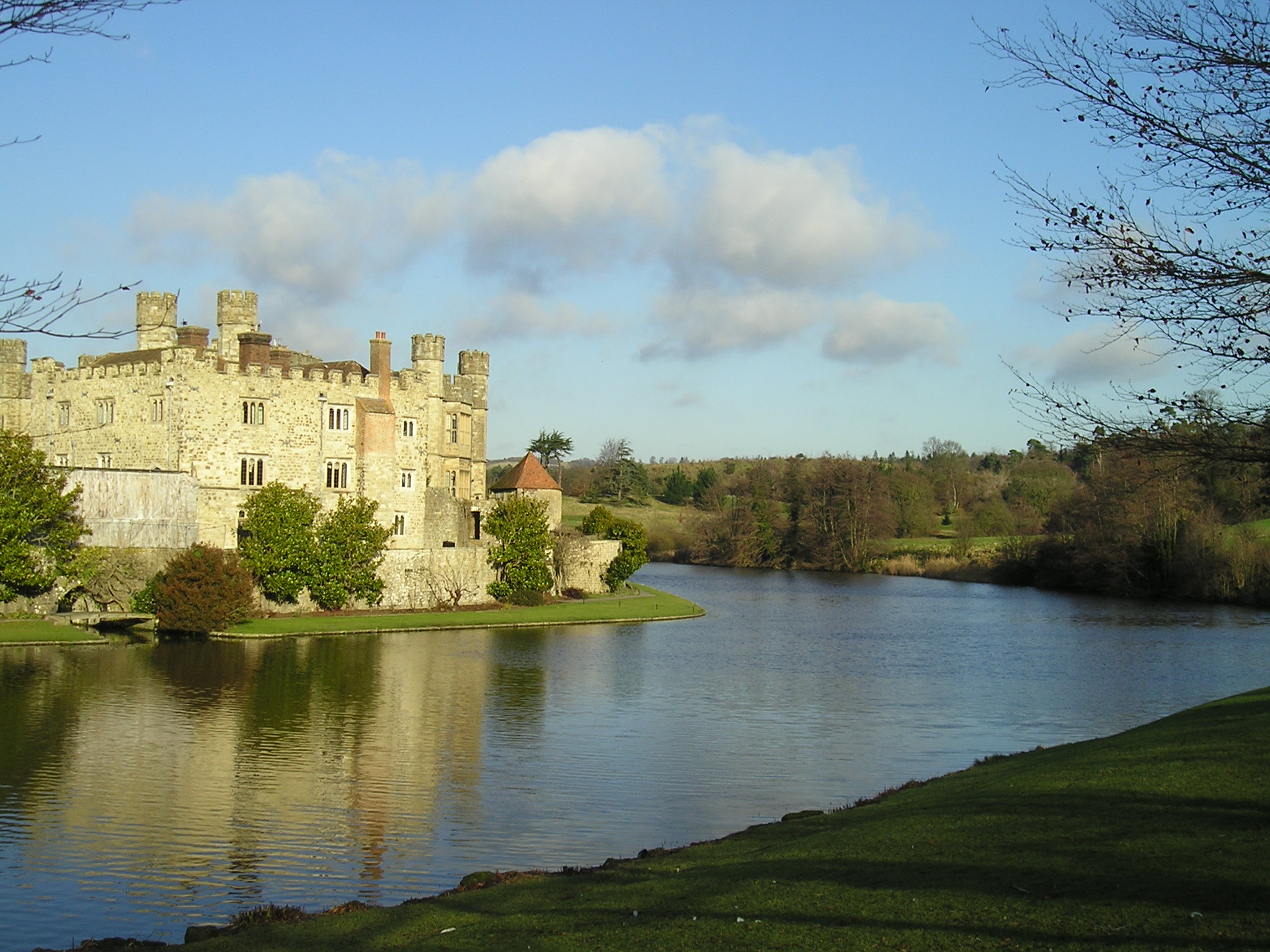
Romantic Leeds Castle, described by the historian Lord Conway as the “loveliest castle in the world”, is approaching its nine hundreth anniversary, though the modern structure dates largely from the nineteenth century. More than half a million people visited the castle and its maze, aviary, grotto and golf course in 2010. As the third picture illustrates, all the public rooms are beautifully decorated for Christmas.

OLYMPUS DIGITAL CAMERA

OLYMPUS DIGITAL CAMERA

OLYMPUS DIGITAL CAMERA

Tonbridge Castle, with its magnificent twin towered gatehouse, is another product of the Norman invasion, and whilst it might not attract the volume of visitors enjoyed by Leeds, it occupies a prominent position alongside the River Medway towards the northern end of the high street, and locals and tourists alike enjoy the attached public park .

OLYMPUS DIGITAL CAMERA

The principal attractions of Sissinghurst  Castle are the stunning gardens created by novelist Vita Sackville-West and her husband, Harold Nicolson, in the nineteen thirties.  The adjoining buildings may not resemble everyone’s idea of the traditional castle (it was originally a mansion set within a working farm), but, along with the imposing prospect tower, the beautiful brickwork and hanging foliage are  a delight. 

OLYMPUS DIGITAL CAMERA

OLYMPUS DIGITAL CAMERA

My personal favourite is achingly beautiful Scotney Old Castle, whose ruins are the very essence of the dreamy fairytale English castle. Technically, Scotney Castle is the name of the “modern” house at the top of the gardens, but it is the older, smaller version,   complete with lily pad decorated moat, that entrances visitors.

OLYMPUS DIGITAL CAMERA

OLYMPUS DIGITAL CAMERA

These are but a few of the beautiful castles and manor houses that are dotted around the Kent countryside. I am conscious that, on this occasion, I have omitted the mighty “Gateway to England” at Dover, Anne Boleyn’s home at Hever and the neighbour on the coast at Deal and Walmer. And I haven’t started on Knole, Chartwell, Groombridge Place and Ightham Mote.

I can see this becoming a series in its own right.

Read Full Post »

« Newer Posts - Older Posts »