Feeds:
Posts
Comments

Posts Tagged ‘Tony Quarrington’


Day two of three in the Big Easy was going to involve a lot of water. Firstly, we had booked a four hour swamp and bayou sightseeing tour.  And in the evening, we had made a reservation on the three hour dinner jazz cruise on the Creole Queen paddlewheel steamboat, a staple on the Mississippi since 1983.

Although we were unlikely to get wet during either event, the weather gods had lived up to the previous evening’s predictions by unleashing torrential rain upon us as we embarked upon the ten minute walk from the hotel. With characteristic British stiff upper lip we had made a conscious (and doubtful) decision not to purchase an umbrella, relying on our waterproof jackets.

With near ninety degree temperatures dictating that the rest of our attire need not consist of more than t-shirts, shorts and sandals, it was inevitable that we would still get drenched, standing for nearly half an hour waiting for the feeder bus under the wholly inadequate cover afforded by the ticket booth.

The Cajun Pride launch point from where we were to take our boat was a thirty five minute ride away. By the time we pulled in alongside the lush Manchac Swamp in Laplace among the South Louisiana bayous for our 12.45am start, the rain had abated and was to stop altogether once we were on the water.

As we stepped onto our boat we were greeted by one of the locals with some timely advice.

Within minutes the senior residents of the swamp introduced themselves. These were American Alligators, whom it transpired, were particularly partial to marshmallows.

Or not.

I think it might just be a droll way to entertain the gullible tourists.

The moment our boat captain, Danny, rustled in his bag of marshmallows and hurled them overboard, the alligators tucked in.

“Captain Danny” proved the most knowledgable, amusing and skilled tour guide imaginable. His deadpan southern drawl only added to the appeal. And he never drew breath throughout the tour, except to answer questions.


The most fascinating story involved the legendary voodoo queen, Julia Brown, who would sit by the bayou frightening anyone who passed. On the day of her funeral in 1915, she could be heard wailing over and over again “One day, I’m gonna die, and I’m gonna take all of you with me”.

Shortly afterwards, a devastating hurricane wreaked havoc in the area, completely destroying three villages and killing hundreds of people. There were reminders of the event on the swamp.

20180927_123026

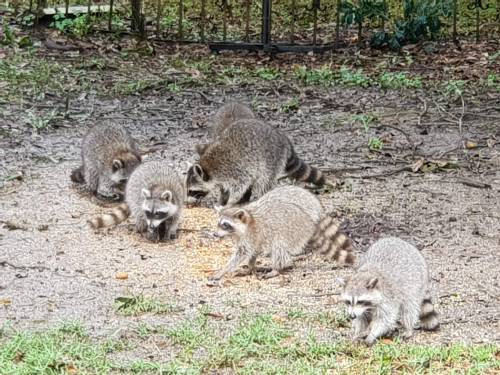
Whilst the alligators were the stars of the show, we saw other wildlife, notably a colony of raccoons, who wandered down to the bayou’s edge as we passed. Soft shelled turtles, egrets and squirrels also made periodic appearances.

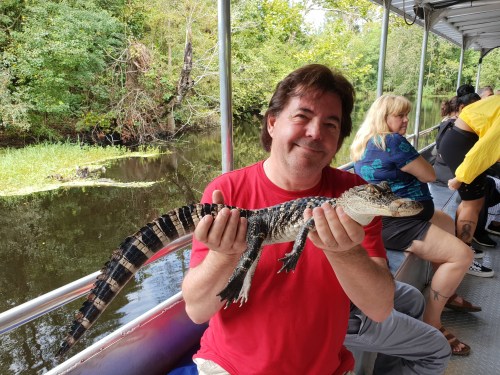
But the highlight of the ride was the opportunity to handle Bruce, a baby alligator whom Danny plucked from a large cool box towards the end of the tour. Although Bruce was still young and remarkably well behaved, his gnashers were still sufficiently sharp to inflict damage on a human, hence the muzzle.

The tour was one of our most enjoyable, informative and entertaining. Even the sun eventually made an appearance.

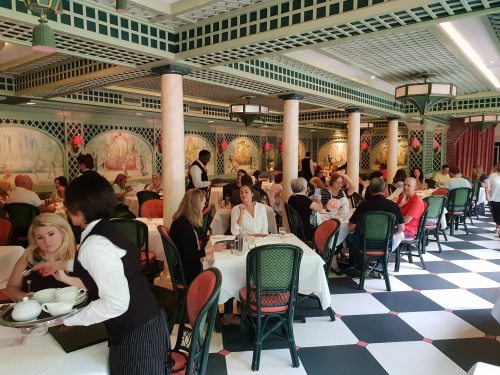
But light rain had returned by the time we were required to check in on the Creole Queen at 6pm for our dinner jazz cruise, scheduled to commence an hour later. However, probably because of the inclement weather, we were welcomed on to the boat and into the elegant dining room early. We were already demolishing the first plate of our Creole buffet when the majority of diners were ushered in.

Jambalaya, gumbo, red beans and rice, seafood pasta, meats and cornbread all featured on the menu. I cannot report what the dessert might have been as we never got past the main course. On reflection, it was the least satisfying of the four evening meals we consumed in New Orleans, but that is not intended as a criticism. Whilst I can’t claim I lose my appetite at buffets, I do wish I was able to take more advantage of the unlimited food available and get full value for money.

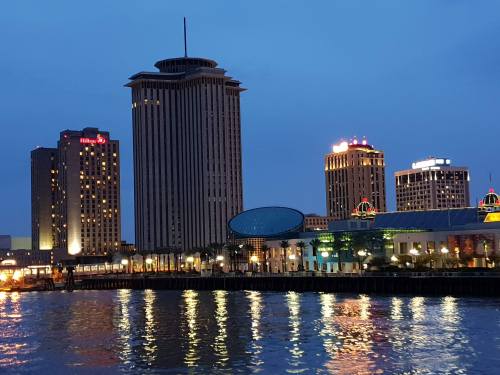
The boat moved away from the dock promptly as dusk, unveiling fine views of the Mississippi riverfront.

As the dining room filled up, and we became surrounded on all sides, we retired to the upper deck with our wine to enjoy the local Dixieland jazz band in the balmy evening air. Every song you would associate with the city was played, and the drummer and lead singer was also an engaging raconteur.

As we approached the dock at the end of the cruise we went in search of our server as we hadn’t yet paid for our food and drink! Moreover, once we had tracked him down, he seemed unconcerned, even surprised that we had sought him out after everybody else was a-pushin’ and a-shovin’ to disembark.

It had been a long day surrounded by water – from above and below – but a satisfying taste of Louisiana history and culture. With another busy day planned for tomorrow, we returned to our hotel for a gin and tonic at the bar.

Read Full Post »


We had three full days in New Orleans, one of which would be largely given over to organised sightseeing tours, so we had to make the most of the remaining time.

Having ticked Pat O’Brien’s off our “must indulge” list, it was time on our first morning to sample the revered breakfast dish of beignets, deep fried doughnuts sprayed with powdered sugar. This would not have been my first choice – eggs, bacon, sausage and toast will always lay claim to that title – but we acknowledged that it was incumbent upon any new visitor to the city to try them at least once.

Mindful of the long lines that accumulate outside Cafe du Monde in the morning, combined with fact that, following the previous night’s drinking, we had not risen early, we decided to tuck into them at the first opportunity, which turned out to be Cafe Beignet on Decatur Street. Ironically, by the time we had reached the flagship branch later, there was no line at all, though a healthy crowd were being entertained by a lively jazz band.

20180926_112756

At Jackson Square, former military drill field, “Place d’Armes”, we explored both the magnificent St Louis Cathedral and the statue of Andrew Jackson, seventh President of the United States and previously military leader responsible for defeating the British in the Battle of New Orleans in 1815.

One thing that struck me – though it really shouldn’t have – was the number of walking tours being delivered in the area, some well supported, others less so. There were several underway of the French Quarter, but this only scratched the surface as, amongst others, there were tours available to cover the New Orleans’s history, ghosts, voodoo, cemeteries, food and drink as well as for other parts of the city, for example the Garden District, home to the Lafayette Cemetery and dozens of monumental antebellum mansions.

There were several conspicuous reminders around the area that the city was celebrating its 300th anniversary.

20180926_112052

I called into the visitor centre and was greeted with that genuine, warm southern hospitality that we were already becoming accustomed to. Two delightful ladies of undoubted pensionable age directed me to the impressive, free official visitors guides to the city and state. As I turned to leave, they exclaimed in unison, “y’all have a nice day, now”.

After such a cheerful salutation, how could I not?

We wanted to make the most of the improvement in the weather (the sun had even made an occasional appearance), so decided against visiting any museums, much as we may have wanted to. These will have to wait for our return (for return we shall) on a later date.

And we were getting peckish again.

20180926_114257

One and a half beignets each was hardly going to fill us up, so we were, or rather I was, delighted shortly afterwards to spot the Central Grocery, home to the equally legendary muffuletta, a massive layered olive salad, meats and cheese sandwich drizzled with olive oil. We sat in the store and devoured one half of the half sized muffuletta (not cheap at $11.50) before moving on.

20180926_114728

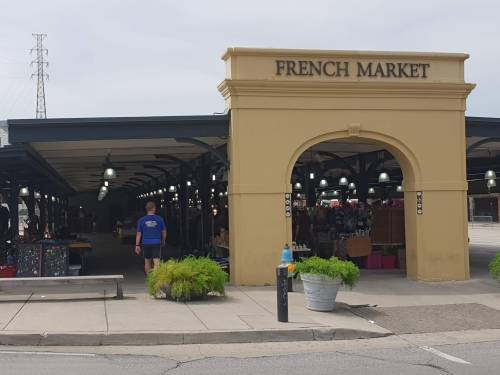
We continued to stroll along Decatur Street until it met Esplanade Avenue, the boundary between the French Quarter and the Faubourg Marigny district. With light rain falling again, it was reassuring to discover the indoor French Market which ran alongside the riverfront.

20180926_122612

Given the number of jewellery, as well as craft, stalls available, it was only a matter of time before Janet purchased her first earrings of the trip.

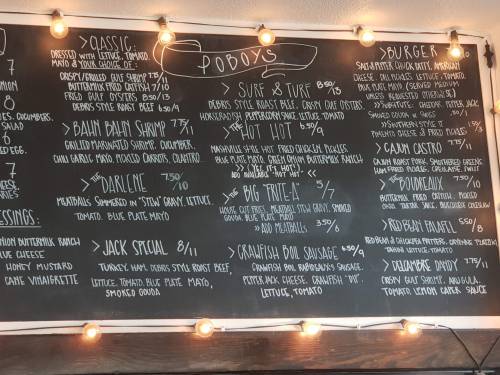
Although there is no substitute to eating the fabulous food that New Orleans has to offer, just reading the menu boards, as at this stall in the French Market can be almost as satisfying – I repeat almost.


It certainly served to remind us that we still had half a muffuletta left, which we devoured in triangular shaped Latrobe Park after first having had cocktails at the Gazebo Cafe (we had fully sobered up by now), whilst being thoroughly entertained by another accomplished band playing a number of New Orleans classics.

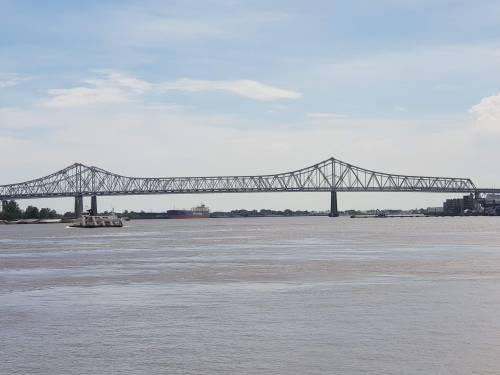
Our intention all along today had been to saunter back along the riverfront, or “Moon Walk”, from the furthest reaches of the French Quarter, and we were not going to allow the steady drizzle to deter us. Our first glimpse of the Mississippi River, which is to feature so prominently on this trip, was framed by the Greater New Orleans Bridge.

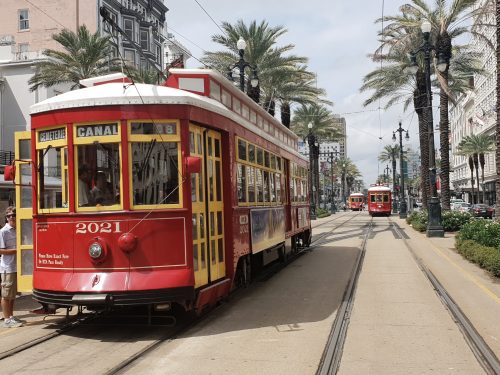
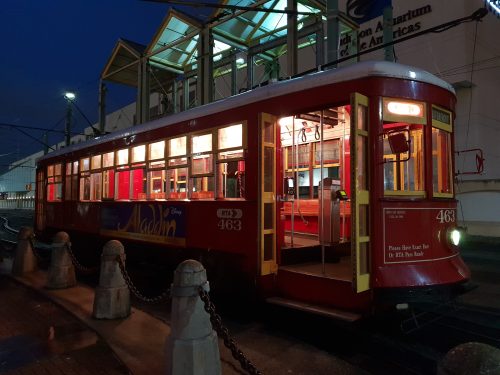
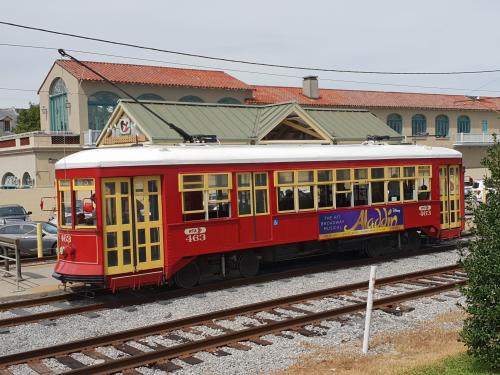
The pretty red Riverfront streetcar pulled into Toulouse Station, evoking memories of those rattling, cranky vehicles in San Francisco that we had ridden so many times before (and sometimes seemed we had spent half our lives on). We planned to travel the three main lines here on our final day.

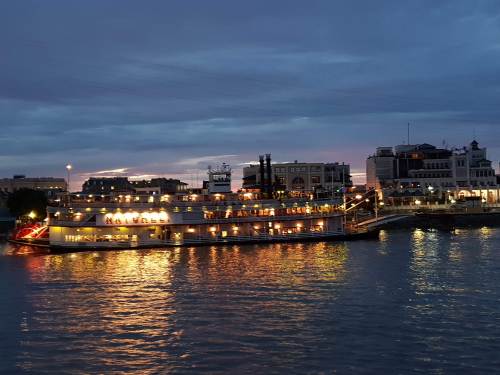
The riverfront amble also gave us the opportunity to compare the two paddlewheel steamboats that we had considered for our dinner jazz cruise on the next evening. As we approached, the Natchez, images of which, including a giant mural, we had already witnessed around the city was herding its latest group of passengers off the boat. It looked a little chaotic to be honest.

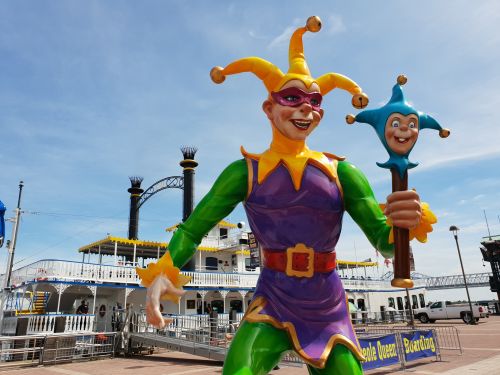
We had already booked the Creole Queen for the following evening, a decision that already looked vindicated. It appeared smaller and more intimate. The Mardi Gras character pictured below seemed to be promoting it too.

20180926_134713

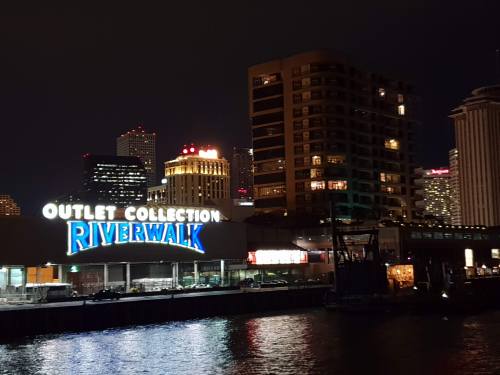
A brief exploration of the Outlet Collection at Riverfront, including a coffee at another branch of Cafe du Monde, prefaced a return to the hotel, negotiating the noisy and substantial building works that were upgrading the area still further.

We returned to the French Quarter in the evening, enjoying another outstanding seafood meal at Oceana on Conti Street, a few yards from the intersection with Bourbon Street. Bypassing the growing drunkenness and debauchery infecting the whole area, we returned to the Red Fish Grill where we had eaten the previous night, for a nightcap in their quiet, civilised bar.

Tomorrow would be a different day with water having the starring role. We had booked a swamp and bayou sightseeing tour for the morning/afternoon and the aforementioned jazz dinner cruise in the evening.

And the weather forecast was for heavy rain and thunderstorms!

Read Full Post »


We arrived in New Orleans in mid-afternoon after a smooth internal flight on United Airlines from Newark, New Jersey.

On crossing the threshold of the Cambria Hotel on Tchoupitoulas Street in the increasingly upmarket Warehouse District, I was thrilled to discover in the entrance corridor a series of fifteen wooden slatted artworks celebrating many of the great bluesmen and jazz musicians of the Delta and beyond. I will confine the photographs to three of my particular favourites.

20180925_154742

They are the work of Connie Kittok, a Louisiana contemporary folk artist inspired by her Southern roots. Coincidentally, or perhaps serendipitously, the entire collection is entitled Road Tripping: a journey to discover the heart of the blues. The thirteen year wait between our original plan to take this trip and actually making it suddenly seemed worth it.

An incredible collage of immaculately polished jazz instruments also adorned another wall adjacent to reception.

20180925_153510

We decided to unpack and get dressed to ignore the rain and have dinner early.

We were staying less than fifteen minutes walk from the French Quarter, and wanted to experience Bourbon Street at first hand. After forgetting momentarily that I was not in San Francisco when I bought a Grateful Dead bandanna at the Hippie Gypsy store on Canal Street, and then elegantly dodging a streetcar after looking the wrong way, we ventured into the fabled thoroughfare.

Even though it was still early in the evening, there was a boozy and boisterous buzz about the street.

We walked as much as possible beneath the balconies, from which there was a distinct lack of falling bead necklaces (Mardi Gras was, of course, still months away). There was a considerable amount of noisy and unsightly construction underway. At regular intervals, young children were sitting on the kerb drumming on upturned buckets with astonishing rhythm and dexterity. We were confronted on several occasions by drunks attempting to foist beads on us before demanding money, but we managed to deflect their tiresome attentions.

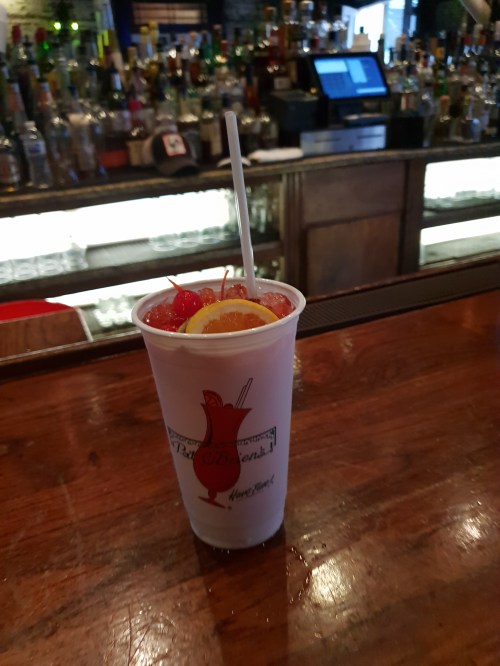
As this was our first visit to the Big Easy, we were determined to try as many of the  essential NOLA dining experiences as possible. Given that we were in the heart of the French Quarter, it was incumbent upon us to begin our exploration with a Hurricane cocktail (rum, passion fruit syrup and lime juice with an orange slice and cherry garnish) at its original home, Pat O’Brien’s.

20180925_182607

We had drunk many in the past at various Margaritaville and Hard Rock locations, but this was where it was first served. It was no less powerful than what we had become accustomed to, even though we declined the signature glass option. We sat at the bar and chatted with the big bearded barman before stepping out to select our dinner venue.

20180926_193412

We had already been struck from the outside by the appearance and enticing menu of the award winning Red Fish Grill, and decided to eat there. We were not disappointed. A handsome and attractive dining room and pleasant staff complemented superb seafood. My Cajun Jambalaya Risotto in particular was divine.

20180926_210904

The persistent drizzle failed to dampen the spirits of the early evening revellers. Live music spilled out of most of the bars – a cacophony of jazz, blues, hard rock and even country as an inevitable accompaniment to bull riding. With an abundance of choice available, we plumped for the Famous Door, a legendary live music venue where the excellent band ran the gamut of seventies and eighties American rock music – from Jackson Browne and Carole King to Foreigner and Guns ‘n’ Roses.

By this time the potency of the Hurricane, upon which by now we had piled cocktails and double gin and tonics, was beginning to take its advertised and insidious effect. I am convinced, however, that the periodic movement, as if across a ouija board, of our (plastic) glasses was not solely attributable to our mushrooming inebriation. After all, we were in the home of voodoo with many haunted locations close by, so it should be no real surprise that glasses should be sashaying around the table. In an even spookier twist, they stopped abruptly at the table’s edge, thankfully, saving us from having to order another, ultimately lethal, round.

Two flights, of eight and three hours duration respectively in the space of twenty four hours, combined with the alcohol, were beginning to take their toll and we returned, a little unsteadily, to our hotel.


Read Full Post »


The idea for this trip came thirteen years ago when I bought the book entitled The Blues Highway: A Travel and Music Book by Richard Knight.

But then, as we were on the point of booking the trip, Hurricane Katrina battered New Orleans, the planned starting point for the trip. We resolved then that we would wait to do it when life in the city had returned to some semblance of normality.

In 2012, we did finally embark on a road trip, but in a very different part of the country – the National Parks of the South West, covering the states of Utah, Colorado, Arizona and New Mexico.

Setting off from Las Vegas, our expedition took in Zion National Park, Bryce Canyon, Lake Powell, Monument Valley, Arches National Park and the Grand Canyon, followed by a sizeable detour through New Mexico, visiting Santa Fe, Albuquerque and iconic locations on Route 66 such as Winslow, Arizona (“Standin’ on a Corner”) and Gallup, New Mexico before returning to Vegas.

Numerous trips to San Francisco, Tahoe, Vegas as well as the North East (of the U.S, not England!) followed, as the Southern states, other than Florida, failed to seduce us sufficiently into venturing in their direction. Maybe their racist past (and present), Christian fundamentalism and gun culture all have had something to do with it. Moreover, the scene from Easy Rider where the main protagonists get short shrift in a southern diner still haunts me, and the song by Folkestone band, the Transients, entitled They Don’t Like Hippies in Baton Rouge, only serves to exacerbate the anxiety.

But now, with mid-term elections looming and the divisions in America widening, we have chosen this moment to plunge ourselves into the belly of Trumpsylvania, though a Californian friend’s recent assertion that we were essentially visiting “blue cities in red states” is a comforting and far from innacurate one.

So what is the attraction of this particular itinerary that has stubbornly refused to disappear from our vacation radar?

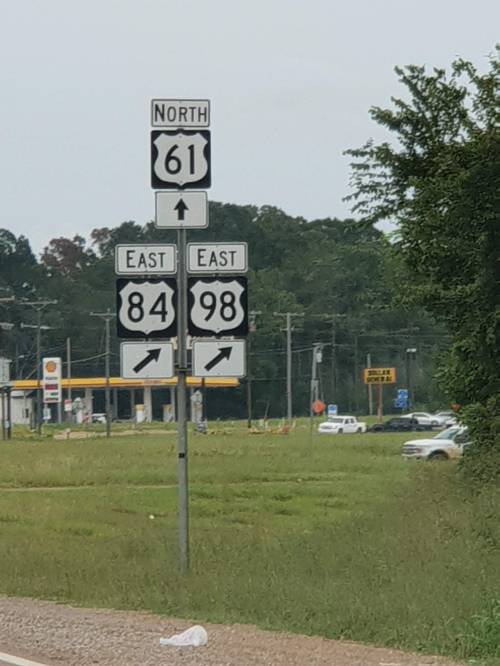
The Blues Highway, essentially Highway 61, runs, for the most part alongside the mighty Mississippi, from New Orleans  to Chicago and traces the migration of many African Americans from the Deep South to the Northern cities following the Civil War and Reconstruction.

Equally, it charts (sic) the development of the major music genres for which we are so much indebted to the United States for, principally the blues and gospel (Mississippi delta, Memphis, St Louis and Chicago), but also jazz (New Orleans), cajun and zydeco (Lafayette), country (Nashville) and soul (Memphis again, and not forgetting Elvis!).

After an initial overnight stay in Newark, New Jersey (flights from the UK being so much cheaper), we fly to the “Big Easy” for four nights before hitting the road with single overnight stays in Lafayette, Vicksburg and Clarksdale. A three night residence in Memphis follows before we head east to Nashville for four nights, arriving on the eve of my birthday.

From “Music City” we cross country back to the main road for three nights in St Louis, followed by a night in Peoria before arriving in the “Windy City” for another four nights, when we are hoping to be joined for a couple of nights by friends from San Francisco. Two nights in New York City conclude the trip before we catch our return flight from Newark.

The trip has the added bonus of introducing us to seven new states – Louisiana, Mississippi, Tennessee, Missouri and Illinois with brief detours through Kentucky and Arkansas. The prospect of experiencing new cultures, historic tours and spectacular scenery is, of course, exciting, but it is the music that is the driving force of the trip. Clubs, bars, museums and street musicians will, therefore, be the major focus of the next three weeks.

And we must not forget the other star of the show – the road itself.

Little thrills the blood more than the thought of exploring this amazing country by car with the radio blaring out the music style that reflects the landscape you are travelling through at the time. I am sure it will reveal some entertaining adventures as this blog grows over the coming weeks.

So let’s get on with the show!

See y’all later!


Read Full Post »


This is where east meets west,
Dover Road and Augusta Gardens;
Where DFLs mix with Folky born and breds,
Cold war adjourned for one warm afternoon.

Tram Road traffic crawls and curls
Around a heaving Harbour Street,
Affording passengers an extended view
Of much loved, yet loathed, Grand Burstin.

A brisk breeze, cooling the searing sun,
Sweeps champagne flutes to a watery end
In the chastening Channel spray
That laps the lighthouse;
Proof that, sometimes, weather
Can be a first to place and time.

Sinatra’s call to Come Fly with Me
Gives way to the eclectic sounds
That entertain the growing queues
For Sole Kitchen and Hog and Hop.
While the Native Oyster Band
Has the crowds singing and swaying,
Kadialy Kouyate’s kora mesmerises,
Bringing the authentic sounds of
New Orleans and Senegal to
This English coastal paradise.

Children build bricks to knock them down,
Dash between Baba Ji and Pick Up Pintxos
Or search for the iron man in the water,
(Don’t worry, kids, he will be back!).


But if the heat and tumult are too much
And it is peace you pine for,
Retire inside to the Mole Cafe
For a mug of strong, hot tea
And a chocolate swiss roll,
Reminders of a quieter,
Yet more violent, time.

Tomorrow, normal service will be resumed;
DFLs will become RTLs
(Work it out!);
The Arm will be handed back
To anglers, cormorants and
A few unsuspecting souls,
Drenched by crashing waves
Cascading over the Folkestone sign.

But is this the lull before the storm?
Eden before the Fall?
Will those blissful views across
To ancient East Cliff and to Sunny Sands
Be there to inspire us still
In three, or five, or ten, years?

Or will the thunder of pick and drill
Drown out those of bass and drum?

Read Full Post »


That staple of coastal living,
The pre-dawn chorus
Of ducks and gulls,
Of pigeons and crows,
And a single menacing magpie,
Echoes across a misty Radnor Park.

Untimely ripped from a fractured slumber,
I prepare for my morning ritual
Of checking if the sea is still there
And that this is not all a dream.

Caught in a leaf storm along Castle Hill Avenue
Joni in my ears telling me
She doesn’t know where she stands,
And there it is, that ever, never changing view!
Dunkirk and Dungeness
Wink from across the water.

The Leas is rife with life this morning
Walkers, joggers, mobility scooters,
Teenagers with learning difficulties
On escorted pilgrimages around town,
From each and every one
A “good morning” or “isn’t it beautiful?”.

This is such a friendly town.

Vacant, whispering benches
Call out across the century,
Remembrance of courage and sacrifice
That allow me to wallow
In this stunning spectacle today.

As the sun begins to burn,
Parched dogs yank at leads
And stop to lap at the cool water
Filling the empty margarine boxes
Left outside the Leas Cliff Hall.

Below, on windswept Mermaid Beach,
Young children sprint into the sea,
Mindless of the pebble and shingle
That scrape and bruise their fragile feet;
But soon they head for the refuge of towels,
New victims of the unforgiving Channel chill.

Across town, on the old, cobbled street,
Where art and cake have usurped rock,
A triumvirate of weary sprucers,
Unheralded heroes of this dirty old town,
Trudge past the The Quarter Masters store
Trailing bags of indeterminate bulk.

Young men, slaves to their primal needs,
Cajole reluctant wives and girlfriends
Into lunch at Big Boys Burger;
Buggies resignedly hauled over the threshhold
Wake the sleeping child within,
Soon to shatter the peace of other diners

At the foot of the winding hill,
Gleeful children squeal with ecstasy
As the newly repaired fountains,
Wedged between pub and seafood stall,
Erupt in thrilling power shower.

Gulls squawk and squabble
Over the crab and seafood remnants
Lobbed periodically from Chummy’s staff,
Before resuming their ablutions
In inner harbour pools
Left by the receding tide.

A single gull plants itself on a table behind Bob’s
And pleads silently for a bite of my crab sandwich,
Or the family’s chips on the next bench;
A staring contest ensues as I begin to eat,
Not daring to avert my eyes for one second.

I try to rationalise with my insistent guest,
Explaining that feeding it would be cruel
But it seems unconvinced
And resumes its glare.

As I finish the last mouthful and fold the wrapping
It flaps its wings and screeches its disappointment,
Before scooting perilously past my left ear
In pursuit of more sympathetic diners.

On Sunny Sands, oblivious of mermaid stare
Dogs scamper breathlessly after balls
Hurled by owners, equally relieved
At their release from summer banishment.

I head for Steep Street,
Swiftly become my second home,
To capture this all in print;
Renewed self-confidence, even nerve
To write this down and share with you,
Another thing to thank Folkestone for,
Or is that blame?

Read Full Post »


The pace and commotion of modern life renders it all the more crucial that we grasp those increasingly infrequent opportunities to draw breath and rest awhile.

Where I would take issue with the Welsh poet, W.H. Davies, who asked what is this life if full of care / we have no time to stand and stare is that sitting works just as well.

And where better to do it than on a bench in the fresh air?

We are so accustomed to lounging on a sofa, whether it be at home, watching mindless television, or in a coffee shop, spending money we haven’t got and aggravating our caffeine levels. Why not do the same in the great outdoors?

One answer might be that the provision of facilities to do that is not always plentiful.

But we cannot claim that excuse in Folkestone.

The town is blessed with more than its fair share, especially on the lovely Leas, once dubbed indisputably the finest marine promenade in the world,  where there are exactly one hundred wooden benches between the Step Short Arch and the Metropole Steps (seventy three alone between the Bandstand and the further of the large hotels (now apartments)). I would be surprised to learn if any other coastal resort had as many.

So, what has sitting on a bench ever done for us?

Let me count the ways.

OLYMPUS DIGITAL CAMERA

To “rest our legs”.

To pause and just breathe.

To think or meditate.

To be quiet and let time pass.

To eat lunch.

To read a book or newspaper (ok, or a tablet/phone).

wp-image-853740679jpg.jpg

To admire the view (and what a view!).

To watch the world go by.

To “people watch”.

To “sun bathe”.

To escape from conflict (at work or at home).

To grieve over disappointment or heartache.

To explore first love (within “reason” of course!).

Or a combination of any of the above.

And then there are less conventional reasons:

To drink or take drugs.

To “hide” with a lover.

To beg from passers by.

I am sure you can think of others (conventional or otherwise).

The value placed on the view afforded by benches is no better illustrated than on the plaques that grieving families have had affixed to commemorate the lives of loved ones who have passed away.

Arguably, these benches are a more life-affirming tribute than a concrete slab in a crematorium, though they have their place too, of course.

Benches are a visible and practical demonstration of a bygone age in a hectic world. Celebratory and consolatory in equal measure.

OLYMPUS DIGITAL CAMERA

And, as we have seen above, they can serve so many purposes that nothing else can quite deliver.

Whilst this post has focused on the wooden benches that festoon the Leas, especially at the West End, there are others at the eastern end that sit beneath the Step Short Arch and speak movingly of Folkestone’s critical role in war.

OLYMPUS DIGITAL CAMERA

I may not have picked the best weather (at least in Folkestone) in which to urge readers who live within reasonable travelling distance of The Leas to rush outside and “take a pew” in the outdoors.

But wherever you may be, try to take whatever opportunity you can to “sit and stare”. Aside from improving your mental wellbeing, you might just finish that book.

Or at least your lunch.

Read Full Post »


I am proposing to run twice, possibly thrice, weekly walking tours of Folkestone next summer (May to September 2017).

There are many practical considerations, including health and safety, marketing and potential licensing, that need to be addressed in the opening weeks of the New Year, but the crucial issue is the integrity of the tour itinerary itself.

Below are my initial thoughts on what route to take, and the issues to highlight at each stop and during the walk itself.

Currently, I envisage the tour lasting no longer than two hours.

These are still early thoughts and are subject to change. Being still a relative newbie, there is a distinct possibility that I may have missed something. This is where long term residents of Folkestone and others who have, like myself, come to love the town, can help me in fine tuning the details. I would be extremely grateful for their input and support.

I intend to finalise this by the end of February, allowing two months to work up the detailed commentary and supporting material.

I am extremely grateful for your assistance in this. Don’t feel you need to be gentle with me!

P8160014.JPG

Start: By the Earth Peace sign in front of The Grand Hotel on The Leas

Stop 1: The Grand Hotel
a. outline of tour – duration – route – stops – toilets – refreshments – approach to questions
b. history of The Leas and Folkestone as a holiday destination – English & French coast highlights
c. history of The Grand, including rivalry with The Metropole & links to royalty

d. introduction to Folkestone Triennial & Folkestone Artworks, specifically Earth Peace (Yoko Ono)

Walk 1: Along The Leas, passing the View Hotel, Ruth Ewan (clock) and Mark Ballinger’s (Folk Stones) artworks & talking benches

————————————————————————–

Stop 2: Leas Cliff Hall 
a. history – construction – programme
b. William Harvey statue

Walk 2: Along The Leas passing the Leas Pavilion Theatre and the Leas Lift

————————————————————————–

Stop 3: Step Short Arch
a. Folkestone’s role in war
b. construction
c. War Memorial
d. poppies

Walk 3: Down the Road of Remembrance

PA190104.JPG

Stop 4: Harbour Station / Harbour Arm entrance
a. role of trains bringing soldiers/holidaymakers
b. history of ferry / hovercraft services
c. Hamish Fulton’s metal sign
d. Grand Burstin Hotel
e. regeneration plans

Walk 4: Along the Harbour Arm, taking in views of the Harbour 

————————————————————————–

Stop 5: Lighthouse on Harbour Arm

a. history
b. Weather is a Third to Place and Time artwork
c. Champagne Bar

Walk 5: Back along Harbour Arm and towards Harbour

————————————————————————–

Stop 6: Harbour
a. fish market
b. history of fishing c/f activity today
c. seafood stalls
d. Rocksalt

Walk 6: Along The Stade to Sunny Sands

————————————————————————–

Stop 7: Sunny Sands
a. beach & Coronation Parade
b. views to France, Harbour Arm, East Cliff, Dover Strait, the Warren & Samphire Hoe
c. Folkestone Mermaid (Cornelia Parker)

Walk 7: Back along The Stade and across to Creative Quarter entrance


Stop 8: The Old High Street
a. history
b. role of Creative Quarter
c. Quarterhouse

Walk 8: Up the Old High Street and onto The Bayle, highlighting galleries, restaurants and coffee shops

OLYMPUS DIGITAL CAMERA


Stop 9: The Bayle
a. history
b. Parade Steps
c. Shangri-La
d. British Lion
e. pond – child’s mitten (Tracey Emin)

Walk 9: Around The Bayle into Church Street

————————————————————————–

Stop 10: Church of St Mary and St Eanswythe
a. history of christianity in Folkestone
b. life & sainthood of St Eanswythe

Walk 10: Through churchyard and along The Leas towards the Leas Lift

————————————————————————–

Stop 11: Leas Lift
a. history – construction – importance
b. take lift down to Marine Parade

Walk 11: Along Marine Parade to entrance of Lower Leas Coastal Park


Stop 12: Lower Leas Coastal Park
a. background, construction & awards
b. Fun Zone
c. Amphitheatre
d. Adam Chodzko’s Pyramid

Walk 12: Through Lower Leas Coastal Park to beginning of Zigzag Path

P3250033.JPG

Stop 13: Zigzag Path
a. history

Walk 13: Up the Zigzag Path and along The Leas to The Grand Hotel

————————————————————————–

Stop 14: The Grand Hotel
Finish by the Earth Peace sign in front of The Grand Hotel on The Leas

————————————————————————–

Read Full Post »


If ever I need a respite from the hubbub of Folkestone town centre, there is no better area to take cover in than The Bayle. Bordering the Harbour via the Parade Steps, the Creative Quarter by Bayle Street and Sandgate Road at the end of pretty Church Street, it provides a welcome haven of peace and quiet.

Just off the beaten track, it is largely undiscovered by all but locals.

Today, I am accessing it from the recently refurbished Parade Steps that run from Harbour Street, alongside Gillespies bar at the True Briton.

Folkestone has more than its share of crippling paths and stairways, not least the Metropole Steps and Zigzag Path that link the main beach from The Leas, but the hundred or more steps that need to be negotiated here match the most difficult. Their saving grace is that they do afford the intrepid climber fantastic views of the harbour and the Channel beyond when, as is essential, they pause for a breather at each level.

At the top you encounter not only Shangri-La, now discredited as a wartime German spy centre, but also fine multi-occupancy buildings like Blue Diamond House on Bayle Street.

Eschewing the Bail Steps, that lead back down to the Old High Street, I turn left at the friendly Guildhall pub onto The Bayle itself.  Within a hundred yards I come across the Bayle Pond Gardens, lovingly maintained by the residents’ association.

The pond is home to another of the Folkestone Artworks found scattered around the town. One of Tracey Emin’s collection of “baby things”, a bedraggled, brightly coloured mitten, is attached to the railings that encase the pond.

Properties, a mix of attractive brick and weatherboarded cottages and modern apartment blocks, are sought after and, as this recent house hunter can attest, relatively expensive.

Moreover, the significance of this part of town was recognised when number 5 Bayle Street was chosen to launch the fabulous Folkestone Living Advent Calendar programme on 1st December last and, fifteen days later, the Dance Easy / Folkestone Yoga studio at number 19 took its turn in the festivities.

In addition to the already mentioned Guildhall pub, this compact area also boasts Folkestone’s oldest watering hole, the British Lion, reputedly built no later than 1500, and Charles Dickens’s local when he stayed at nearby 3, Albion Villas.

Recovered remains from archaeological digs have revealed that the area was occupied in the late Iron Age and Roman periods, but it was not until the seventh century AD that Folkestone gained its most celebrated citizen.

The daughter of King Eadbald, St. Eanswythe, an intelligent, wilful and devout young woman, rejected numerous Anglo-Saxon suitors and opted for the religious life by establishing a small nunnery and dedicating herself and other women to prayer and service of the poor. On her death in 640, her tomb became the object of prayer and pilgrimage and her relics were sought after and venerated. She was made a saint almost immediately.

Standing between bare winter trees and amidst battered headstones, the current Church of St Mary and St Eanswythe, built upon a twelfth century original, is a lovely, tranquil space.

There are several routes in and out of the churchyard. My personal favourite is to walk through the internal gate, along the path (which starts on Priory Gardens) back to the War Memorial, taking in glorious views of the Channel above the rooftops of Marine Parade.

I’ll leave my favourite rock band (again) to encapsulate how I feel about The Bayle:

Don’t tell me this town ain’t got no heart

You just gotta poke around.

Read Full Post »


The Cote d’Opale might as well be a thousand miles away on a night like this.

It is a calm, quiet evening after a dank, dreary December day. The sky and sea present an ashen canvass. It is difficult to tell where one ends and the other starts. Spencer Finch’s The Colour of Water, the artwork that requires people, by looking through a narrow aperture, to match the colour of the sea with one of a hundred variants of shade placed around the perimeter of a large wheel, is set firmly in the grey quadrant.

Despite the slimy conditions underfoot, I choose to descend from the well-lit comfort of the Leas to the bleak seashore via the Metropole Steps rather than the Zigzag Path, deducing that the strain on my knees and calves will be less that way.

There is barely a whisper from the waves tonight. The overwhelming flatness of the scene has deterred the customary photographic shooting party from assembling to capture the final, ferocious blaze of orange and gold of the sun over Sandgate shore. Anyone hoping to catch tonight’s projected meteor shower will be sadly disappointed. Even the moon, a mere twenty four hours from full term, doesn’t appear bothered to turn up.

Neither do I hear Matthew Arnold’s “grating roar of pebbles which the waves draw back”,  so imperceptible is nature’s refrain this evening. Aleppo, Trump, Yemen, Brexit all drift from my consciousness, at least for a short hour. I am at peace, and am reminded of  Nathan Coley’s Talking Heads inspired sign on Tontine Street that “ heaven is a place where nothing ever happens”.

Because nothing is happening tonight in this little speck of paradise.

But then everything is happening.

Across the bay, the lighthouse on the Harbour Arm blinks through the gloom. The sixteenth century Out of Tune bell, rescued from a church in Leicestershire, hangs suspended above the area where once the rotunda, boating lake, swimming pool and fairground rides, thrilled generations of children.

A dalmatian puppy snuffles among the seaweed encrusted pebbles on the shoreline, while its impatient owner punctures the peace with impassioned and fruitless entreaties to it to accompany her back to the refuge of her Range Rover parked at the foot of the Leas Lift.

A discarded, empty tuna mayonnaise sandwich pack flutters in the breathless breeze in the midst of Folkestone’s own modest version of Stonehenge or Avebury. If, as seems likely, the stillness of tonight’s air fails to dislodge it, I am reassured that a town sprucer will probably complete the job in the morning.
A lone fisherman has set out his stall for what appears to be a long night ahead. It reminds me of all night sessions on the Dungeness shingle with my uncle half a century ago. I wonder now why I ever went. I was never interested in fishing. I don’t even recall experiencing the elation of catching much either. Perhaps it was the thrill of spending a night away from home on a beach with a nuclear power station looming over me that lured me.

I stroll along the curved seawall that separates the two main parts of the beach, squinting at the six wooden, weirdly shaped seats donated by the Dutch government, and reach the imposing rock groyne. It would be foolhardy this evening to venture out onto this mini-Giants Causeway as some do during the daylight in low tide.

Debate rages on social media as to whether the shape of the groynes that branch out in opposite directions from the beach represent a mermaid, gull, whale or even the Royal Air Force crest. I will not fuel the dispute here, other than to offer the diplomatic suggestion that there is a case to be made for all of them. Whichever it might be, it is a fine sight by day when viewed from the Leas.

Pastel hued beach chalets are now padlocked up for the winter and the Mermaids Cafe Bar, welcome pit stop on the long promenade between Folkestone and its western coastal neighbours of Sandgate, Seabrook and Hythe, is now open on fine weekends only. Tonight, it is dark in contrast to the newly renovated View Hotel beaming benignly down upon it. The hotel’s Cliffe Restaurant, which, in only a few months, has earned a deserved reputation for fine dining and excellent service, will, in contrast, already be busy with office Christmas parties.

I return to the Leas via the lovely Zigzag Path, a walk rendered all the more atmospheric as I weave through its alcoves and tunnels, by its resemblance to those of a Greek island. All that is missing, thankfully, are the maltreated donkeys.

I defy anyone to deny that they enjoy a warm summer’s day by the sea. After all, as the popular expression goes, life’s a beach. And I look forward to the first full summer in my coastal home next year.

However, it is moments like this when enjoyment is a hopelessly inadequate word to describe the impact of this magical place on me. I think I will attempt to define that more fully on another occasion, but, for now, I can only equate it to love in all its manifestations.

Once in a while you get shown the light in the strangest of places if you look at it right is one of my favourite quotes, and is never more relevant than in relation to my feelings for Folkestone. Who would have thought that fifty three years ago, when four adults and three children aged between eight and ten years plus luggage, miraculously emerged from my mother’s Ford Anglia, to cram into that bed and breakfast in Foord Road, that not only would I make this my home all these years later but would instantly become enraptured by the place all over again?

Read Full Post »

« Newer Posts - Older Posts »