Feeds:
Posts
Comments

Posts Tagged ‘Tony Quarrington’


San Francisco can proudly boast more than its fair share of eccentrics, but few can rival Joshua Abraham Norton, the self-proclaimed “Emperor of these United States” and “Protector of Mexico”, for their presumption, bravado and, at times, visionary genius.

Born of Jewish parents (somewhere) in London, England (sometime) between 1814 and 1819, he spent his early manhood in South Africa, serving as a colonial rifleman.  He emigrated to San Francisco in 1849 with $40,000 to his name and quickly amassed a fortune of $250,000, primarily from real estate but also from speculating in commodities. However, he lost it all when his attempts to corner the market for imported Peruvian rice (China had banned the export of their own) backfired spectacularly.  Lengthy litigation resulted in the Supreme Court of California ruling against him, forcing him to declare bankruptcy in 1853.

He fled San Francisco, only to return several years later, a changed man.  Embittered and, many might argue, severely mentally disturbed, by his earlier experiences, he spent the next two decades perpetuating a one man campaign to denounce and dissolve the nation’s political and financial infrastructure.

On 17th September 1859 he issued letters to the city’s newspapers declaring  himself “Emperor of these United States”, adding that:
“At the peremptory request and desire of a large majority of the citizens of these United States, I, Joshua Norton……….declare and proclaim myself Emperor of these United States, and in virtue of the authority thereby in me vested, do hereby order and direct the representatives of the different States of the Union to assemble in Musical Hall, of this city, on the 1st day of Feb. next, then and there to make such alterations in the existing laws of the Union as may ameliorate the evils under which the country is laboring, and thereby cause confidence to exist, both at home and abroad, in our stability and integrity”.

On 12th October he formally dissolved Congress.  Amongst his numerous subsequent decrees were an invocation to the Army to depose the elected officials of Congress, the ordering of the Roman Catholic and Protestant Churches to publicly ordain him as “Emperor” and a telegram proposal to Abraham Lincoln that he should marry Queen Victoria to cement relations between the U.S. and Great Britain. He also thought nothing of issuing orders too to the German Kaiser and Russian Czar.

And on 12th August 1869 he abolished the Democratic and Republican parties (now there’s a thought)!

One portentious pronouncement would have struck a chord later, not only with legendary San Francisco Chronicle columnist, Herb Caen, but many other San Francisco natives:

“Whoever after due and proper warning shall be heard to utter the abonimable word “Frisco”, which has no linguistic or other warrant, shall be deemed guilty of High Misdemeanour, and shall pay into the Imperial Treasury as penalty the sum of twenty-five dollars”.

Irrespective of his mental state, Norton was, at times, a real visionary and some of his “Imperial Decrees” demonstrated great prescience.  He urged the formation of a League of Nations and forbade conflict between religions.  Most dramatically, he called persistently for a suspension bridge or tunnel to be built connecting San Francisco with Oakland. Both eventually saw the light of day with the constructions of the San Francisco-Oakland Bay Bridge and the Bay Area Rapid Transit’s Transbay Tube in 1936 and 1974 respectively.

Another proclamation ordered that a huge Christmas tree should be erected in Union Square. Duly accepted, it has stood there ever since.

Each day for more than 20 years, the “Emperor” would leave his “Imperial Palace”, a minute room in a boarding house at 642, Commercial Street, to walk the streets in a grand blue uniform with brass buttons, gold-plated epaulets and royal purple sash, a beaver hat embellished by a peacock feather (his “dusty plume”) and a rosette.

He was rarely seen without his cane or umbrella as he inspected the condition of the cable cars and sidewalks, the state of public property and even the appearance of police officers. After an over-zealous young police officer had been soundly reprimanded for arresting him, and subsequently been granted an “Imperial Pardon” by Norton himself, all police officers made a point of saluting him when they met in the street.

Many cities would have persecuted, incarcerated or, at best, ridiculed him for being insane. But this was San Francisco in the full flush of post-Gold Rush glory, and the citizens loved and revered him.  He was welcomed at the best restaurants, where he would dine for free, enabling the owner thereafter to erect blass plaques proclaiming “by Appointment to his Imperial Majesty, Emperor Norton I of the United States”.

Front row balcony seats were also reserved for him at local theaters, including the Opera, where he was cheered on arrival. His active involvement in civic affairs even led to him being granted a reserved seat in the visitors’ gallery of the State Senate, from which he was occasionally invited onto the floor to speak on matters close to his heart.

He was alleged to have been accompanied often – including at the theatre – by two mongrel dogs, Bummer and Lazarus, local celebrities in their own right, whom he supplied with food scraps from the free lunch counters that he frequented.  Lazarus died after being run over by a truck of the same fire company – Knickerbocker Engine Co. No. 5 – that Lillian Coit revered and subsequently befriended. When Bummer died shortly afterwards, allegedly of a broken heart, Mark Twain wrote: “He died full of years, and honor, and disease, and fleas”. Their fame led to them posthumously being depicted in Life in San Francisco, a comic opera.

Now, he could not have been a true Emperor without the right to coin his own currency, and his “Imperial Government of Norton” notes, all bearing his royal image and ranging from 50 cents to 10 dollars, were accepted wherever he did business.  Every day he used one of his own fifty cent bills to pay for his lodgings. And when his uniform started to deteriorate, the Board of Supervisors bought him a “suitably regal replacement” and the city charter was amended to permit Norton to collect $30 annually for its replacement and repair.

On the evening of 8th January 1880, after completing his daily rounds of the city, Norton collapsed on the corner of California Street and Dupont Street (now Grant Avenue) in front of Old St. Mary’s Church as he was on his way to a lecture at the California Academy of Sciences.  He died before medical attention could arrive.

The following day the San Francisco Chronicle published his obituary on its front page under the headline “Le Roi est Mort” (“The King is Dead”).  He had died in abject poverty.  His funeral, two days later, was a sad, dignified event, honoured by the attendance of the Mayor and the playing of a military band. Upwards of 30,000 people, a seventh of the entire population of the city at the time, lined the streets to pay their respects to the two mile long funeral cortege.  The City of San Francisco and Pacific Club paid all his funeral expenses.

Mark Twain and Robert Louis Stevenson, amongst others, paid homage to Norton by modelling characters on him in Adventures of Huckleberry Finn  and The Wrecker respectively. Seventy years after his death, the Chronicle sponsored an annual treasure hunt in his name.

But perhaps his, and his adopted city’s, finest epitaph is that provided by Stevenson’s stepdaughter, Isobel Field, who wrote that he “was a gentle and kindly man, and fortunately found himself in the friendliest and most sentimental city in the world, the idea being “let him be emperor if he wants to”.  San Francisco played the game with him”.

More, in the words of John C. Ralston, a “tourist attraction in his own time” than a “significant historical figure”, there can be few lives that better personify that much-quoted phrase “Only in San Francisco”.

Postcript:

Emperor Norton Lives! Not only does he conduct walking tours of his empire but he maintains an excellent Facebook page: https://www.facebook.com/pages/Emperor-Nortons-Fantastic-San-Francisco-Time-Machine/104510419615984

Read Full Post »

If you take a left on leaving the Grace Cathedral on San Francisco’s Nob Hill, you will soon find yourself tottering down Taylor Street, one of those hills that appear to drag you down to the bay before your time. Part way down the street on the left, between Green and Union on what is now part of Russian Hill, you will come across a wooden staircase, complete with handwritten sign, where a different form of worship takes place daily.

P1010985

Those stairs lead to Macondray Lane, the acknowledged inspiration for Barbary Lane, where at number 28 resided landlady, Anna Madrigal and her “children” in the celebrated Tales of the City novels written by Armistead Maupin. There are few series of books and group of characters more beloved in all of modern literature. Inevitably, therefore, the residents are forced to share their idyll with a steady flow of pilgrims “doing the Tales tour”, taking photos of both the lane itself and the bay “peeping through the trees”, peering into windows and scouring the undergrowth for Mrs Madrigal’s famed “special” plants.  

P1010983

Once at the top of the stairs you be walking on a series of cobbled footpaths through what feels like a wooded glade. The charming and diverse styles of houses share the space with profuse flower displays and other rich foliage. It is a magical place that perfectly captures the spirit engendered by Maupin’s books.

P1010979

OLYMPUS DIGITAL CAMERA

San Francisco boasts some of the most expensive real estate in the whole country. On the rare occasion that a property in Macondray Lane comes onto the market, the asking price is a mere fraction of that demanded in Pacific Heights (though, admittedly, the houses are much smaller).

But I know which I would rather live in.

P1010988

Read Full Post »


The fateful day has arrived. I have just taken custody of my first Amazon Kindle, a birthday present from my wife.  

But why? After all, I have expressed my love for books here on a number of occasions, and stated my distaste for a hugely popular but soulless phenomenon that has blasted many of my favourite bookstores into oblivion. 

But I have also acknowledged that the time would come when I would not be able to resist the inexorable march of the e-reader, in fact when I would only be “cutting off my nose to spite my face” by rejecting its blandishments. Trying to stem the tide of history didn’t work for Canute and it is not going to work for me either. 

But this does not mean the beginning of the end of my reading the traditional paper-based books. I’ve only just published one myself – hardback, dust cover, high quality paper – the works.

No – far from it.

I’m not going to suddenly ditch my entire book collection at a stroke. Indeed, neither my buying nor selling strategy should change, other than that I will purchase an e-book where the print version does not exist. Several books have come on the market recently that I would like, but are only available in electronic form. I have no alternative, therefore, but to acquire the means of reading them.

There is an added motivation in that, in this same spirit of “if you can’t beat them……”, I am contemplating self-publishing my next book as an e-book. So I need to join in the game sooner rather than later.

Now, rather than spending weeks beforehand deciding which book(s) to take on holiday, I will be able to download the two or three in contention, affording me the added advantages of not only of reducing the weight of my cabin luggage on the outward flight, but creating space for the addition of “proper” books for the return.

So – Shakespeare, Dickens, Hardy, Maupin, Bryson and company – rest easy, you will continue to have a cherished place on the bookshelves, or wherever I can find room for you in the house. You are no more likely to be destined for charity shops and boot fairs tomorrow than you were yesterday. 

And I fully expect that the arrival of my e-reader will encourage me to read much more than, shamefully, I have been able, or rather chosen, to do heretofore.

No more agonising for hours beforehand over which books to take with me to the local coffee shop or on a train journey.

And no more risk of developing back problems carrying too many bulky books around with me just in case I changed my mind as to which of them I wanted to read in transit.

If further evidence were needed of the reluctance with which I’ve taken this momentous step, I have, or rather my wife has, only purchased the basic model – bells and whistles are conspicuous by their absence.

But I might as well buy a fancy leather cover while I’m at it.

Oh……and my first download?

101 Free Things To Do In San Francisco by Daniel Davidson.

Now there’s a surprise.

Read Full Post »


I’ve taken pen to paper, or rather finger to keyboard, on two previous occasions on this blog to bemoan the demise of “high street” bookshops, both in principle and in my adopted city of San Francisco. In the first, I lamented the closure of the large branches of Border’s in Union Square, replaced now by a DSW shoe emporium, which, to add insult to injury, my wife loves, and 2nd and King opposite the ballpark. I consoled myself at the time with the knowledge that the Barnes and Noble branch in Fisherman’s Wharf was still carrying the flag, only to discover, shortly afterwards, that it too had made way for an expanded Cost Plus World Market.

OLYMPUS DIGITAL CAMERA

But, in one sense, that has been a blessing as it has forced me to seek out San Francisco’s rich family of neighbourhood bookstores. As a result, I’m no longer sure that I miss the big chains as much as I did three years ago.

On my recent trip I had the pleasure of visiting a number of the independent stores – some new to me, others old friends – and discovered a very different story to the one that confronted me when the giants (no, not those) were collapsing around me a couple of years ago.  Phoenix Books on 24th Street  in Noe Valley was my local store where, on the first morning of my vacation, I picked up a discounted copy of Comeback Kings, a book on the Giants’ (yes, those) 2012 World Series victory.

OLYMPUS DIGITAL CAMERA

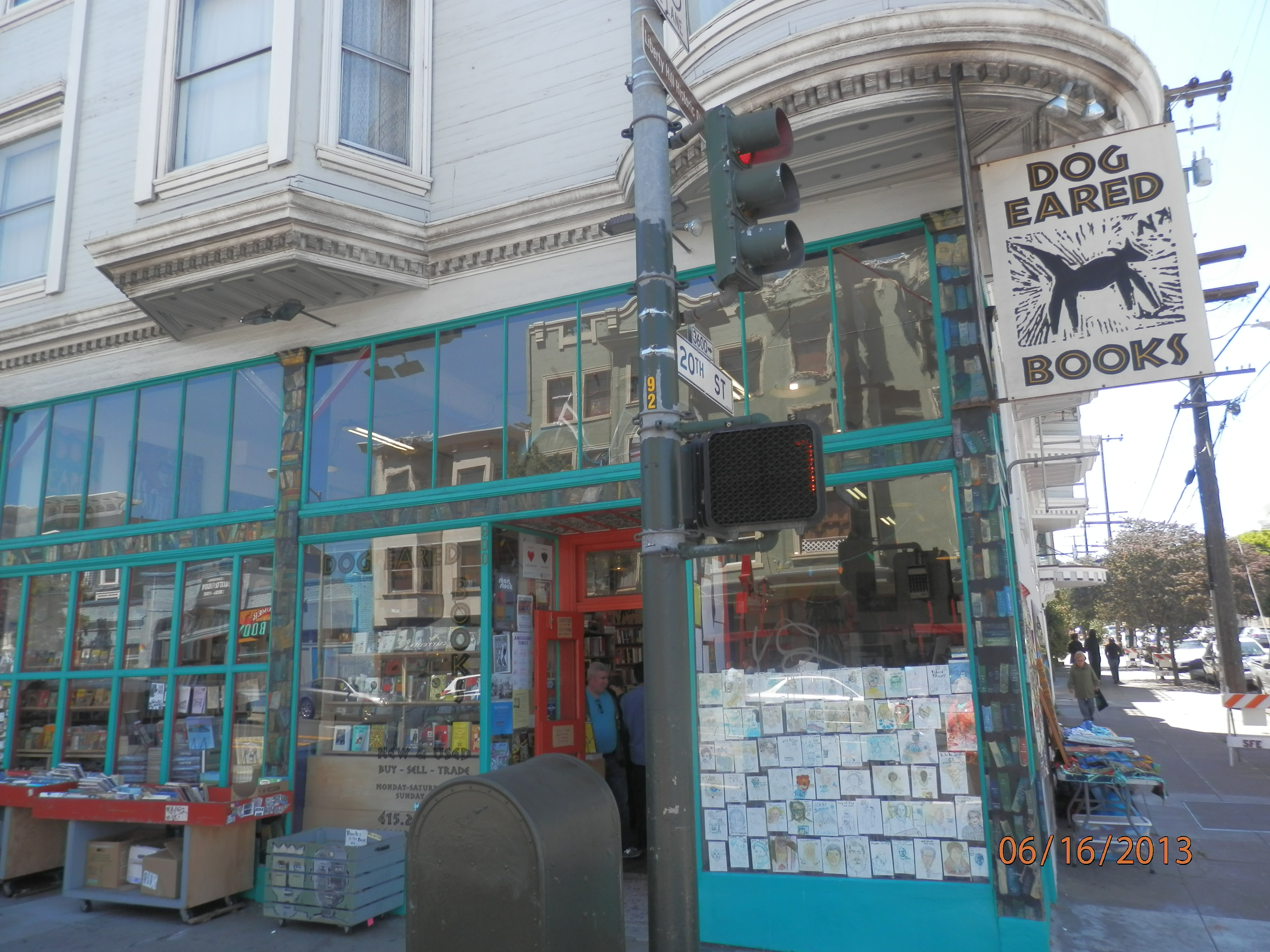
A Sunday afternoon stroll down Valencia Street in the Mission unveiled the dual delights of Dog Eared Books and Borderlands Books, though the latter’s sole focus on science fiction, fantasy, horror and mystery is not to my taste. But the painstakingly prepared coffee was! A happy birthday to Dog Eared Books, a partner of the aforementioned Phoenix Books, Badger Books (of which more below) and alley cat books, which turns 21 this very week! On the evidence of these two thriving outlets, the declaration on its website that ‘reports concerning “The Death of the Bookstore” have been greatly exaggerated’ rings resoundingly and joyfully true.

OLYMPUS DIGITAL CAMERA

What struck me most about all of the bookstores I visited was the sheer number of people frequenting them, not just browsing the shelves but writing their own blogs and engaging in social media on their laptops, drinking every conceivable coffee permutation and interrogating the community noticeboards for apartment lettings or reiki classes and, in some instances, all three.

OLYMPUS DIGITAL CAMERA

Badger Books on the corner of Cortland Avenue and Bennington Street in urbane Bernal Heights, displayed a particularly fine secondhand selection and boasted a lovely children’s section complete with multi-coloured stools.

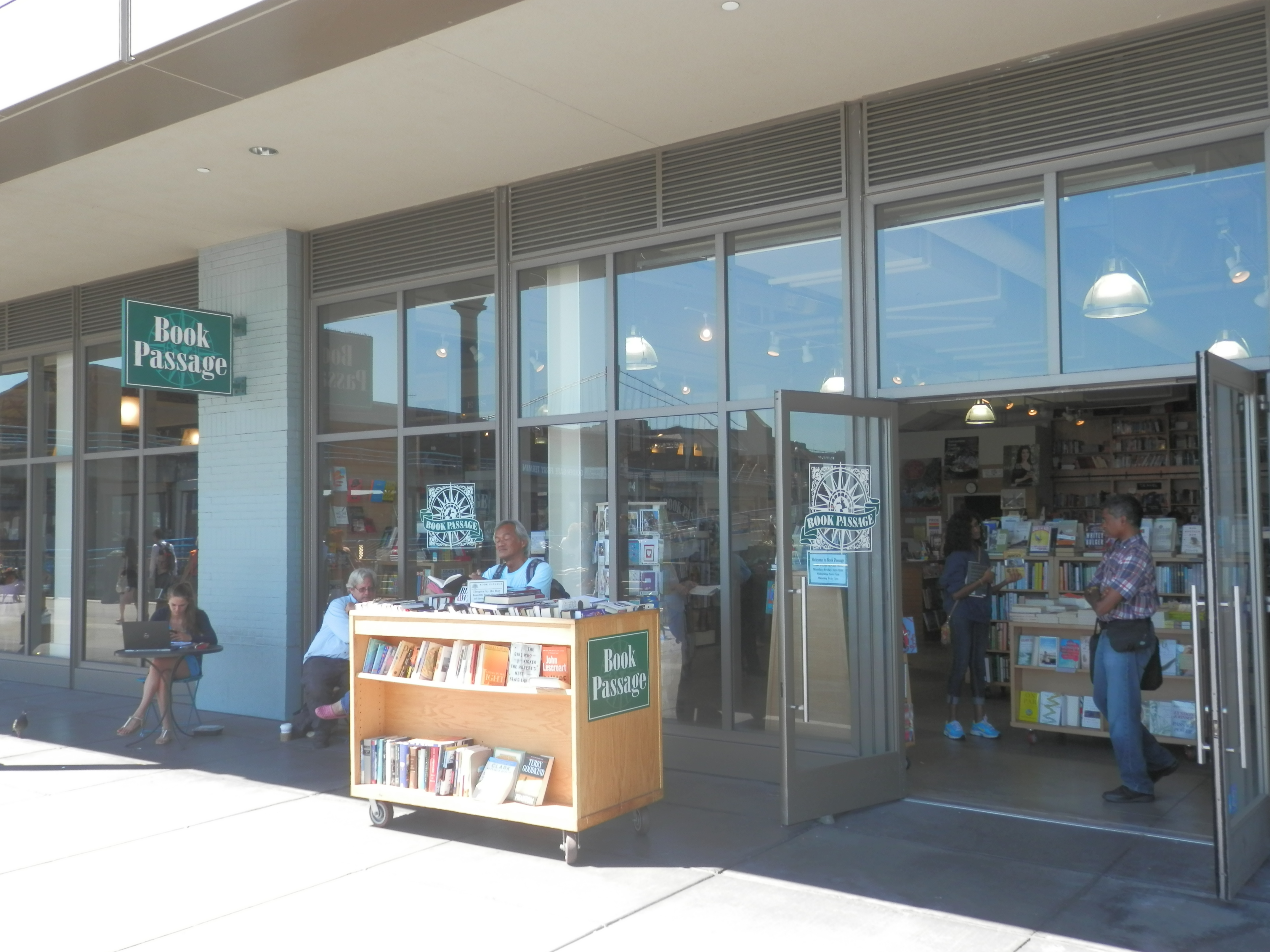
Needless to say, City Lights in North Beach afforded me several opportunities to part with my dollars and the Book Passage in the Ferry Building, though relatively small, always contains an interesting and eclectic collection. Besides, there are few better places to sit and read than outside with a cup of Peet’s coffee from the adjoining concession.

OLYMPUS DIGITAL CAMERA

Aardvark Books on Church Street near Market, where I bought a set of vintage San Francisco postcards at just fifteen cents each, The Booksmith (another regular haunt) and Browser Books on Fillmore between California and Sacramento are also fine places to stay awhile.

I may, to the purists, be about to join the dark side with my purchase of an Amazon Kindle, but I will never lose my love for plunging into bookstores (preferably those with adjoining cafes and a place to park the laptop), and divesting them of their stock. I expect that I only scratched the surface with San Francisco’s independent bookstores this time, but if the above branches are typical, their future is bright.

I dearly hope so.

Read Full Post »


“You guys really love this city don’t you? You know it better than many people who have lived here all their lives”.

Thus spoke the balding young Oakland man with neat goatee beard, with whom my wife and I had struck up a conversation over our eggplant wraps and blueberry smoothies on the outdoor patio of the Progressive Grounds coffee house in the civilised neighbourhood of Bernal Heights one warm June afternoon.

 “You’re certainly no tourists – you’re San Franciscans”.

Whilst such a statement would have incurred the wrath of the natives who fiercely proclaim their privileged status on internet forums devoted to the subject, it was, nonetheless, pleasing to hear, especially coming from a lifelong Bay Area resident.

OLYMPUS DIGITAL CAMERA

As regular readers of my blog will attest, I invariably turn to Herb Caen, the legendary San Francisco Chronicle columnist, for his trusted opinion on such matters. In one of his many ruminations on what made a San Franciscan he said:

 I don’t think that place of origin or number of years on the scene

have anything to do with it really. There are newcomers who

become San Franciscans overnight – delighted with and interested

in the city’s traditions and history. They can see the Ferry Building

for what it represents (not for what it is), they are fascinated

with the sagas of Sharons, Ralstons, Floods and Crockers, they

savor the uniqueness of cable car and foghorn. By the same token, I

know natives who will never be San Franciscans if they outlive

Methusalah. To them a cable car is a traffic obstruction, the fog is

something that keeps them from getting a tan, and Los Angeles is

where they really know how to Get Things Done.

So, after ten visits of increasing length, we have gravitated from being “sophisticated tourists” who are “charmed and fascinated” by the city to anointment as “San Franciscans”. If I harboured any doubt, perhaps the existence of this article is further evidence. And statements like the one from the Cortland Avenue coffee shop, and that of the usher at the ballpark who thanked me for both loving her city as much as she did, and articulating that love so passionately in my writing, reinforce that judgement still further.

OLYMPUS DIGITAL CAMERA

Moreover, they act as a useful counterpoint to the recent assertion by Travel & Leisure magazine that San Francisco is the snobbiest city in the States. Anybody – whether natives, “transplants” or wide-eyed, first time tourists – with a willingness to learn, understand, appreciate and celebrate everything it has to offer, should equally be capable of qualifying for such an accolade.

Read Full Post »


With my first book, A Half-Forgotten Triumph, co-written with Martin Moseling, now in print, I am keen to proceed with the second. It will represent a significant departure from my first publication which explored in detail the fortunes of one sports team a century ago.  Not only will I be writing on my own this time but I will also be focusing on a subject that exceeds even my passion for cricket – San Francisco.

I am grappling at the moment, however, with the precise form that the book might take.  Initially, I envisaged writing a standard travel diary, based on my experiences over ten visits to the city, varying between three and twenty eight nights, during the past eighteen years. Of course, I would try to make it witty and interesting but it would still be a travel diary.

But there are other options.

I have written nearly twenty blog articles on San Franciscan characters and eccentrics, some famous, others notorious (the characters, not the posts). An expanded work on that subject – along the lines perhaps of “50 Great San Francisco characters” is still an objective. But perhaps not now.

I am intrigued by the unanimously thrilled reaction of my countrymen – and women – to their first acquaintance with San Francisco. Though many may never return, and certainly not as often as I have and will continue to do, they retain fond memories of their visit. The most recent figures from the San Francisco Travel Association show that, at 11.6% of the total of 15.92 million, the proportion of visitors from the United Kingdom only just falls short of those from Canada, the country unsurprisingly supplying the most.

The British have a clear affinity with the city, as witnessed by such literary luminaries as  Dylan Thomas (“you wouldn’t think such a place as San Francisco could exist”) and John Lennon (“we’re crazy about this city”), as well as countless thousands of tourists from its isles.

i think there may, therefore, be some mileage in assessing the British impact on San Francisco since Sir Francis Drake first landed the Golden Hind near the Golden Gate in June 1579, almost two hundred years before the city was officially “founded” by the Spanish. But again perhaps not yet.

Despite its popularity and the literature it has spawned, there are still aspects of the San Francisco story that have yet to be explored.

My final approach, and possibly the most likely at present, is a more fluid series of reminiscences and reflections on the everyday life and culture of the city. More challenging would be to convert that material into a fictional narrative, partly because I doubt that I have the skill to do so, but equally because I would have the massive shadow of Armistead Maupin standing over me. An English angle might mollify the challenge but it would still be a daunting task to set myself.

But in a sense, it doesn’t quite matter yet as I am currently pulling together all the pieces I have written on the subject in my blog over the past two and a half years. The strength – or otherwise – of that content might actually help me to identify in which direction I need to go.

So there is no immediate urgency to make that decision while I carry out the necessary research and review the existing material. Equally, however, I cannot afford to let it drift as I want to have some material available to present to prospective publishers towards the end of the year.

I will continue to use this blog to relay my emerging thoughts and perhaps trail some of the content.

Wish me luck! 

Read Full Post »


One of the most endearing but infuriating features of San Francisco’s characteristically quirky public transport system are the historic streetcars that run along the F Line between the Castro and Fisherman’s Wharf via Market Street and the Embarcadero.

OLYMPUS DIGITAL CAMERA

Redolent of a bygone age, they are fascinating historical constructs that appeal primarily to tourists because anyone, local or frequent visitor alike, who has travelled on one, knows that they are built neither for speed nor comfort. One journey my wife and I took from Church and Market to Fisherman’s Wharf last month took an hour and twenty minutes, admittedly extended due to roadworks on Market. 

But, at the best of times, expect a rough, cramped, hot ride that goes nowhere very fast. 

OLYMPUS DIGITAL CAMERA

Whilst there are a number of home-grown, or rather home-built, cars, many have been imported from all over the globe, including as far afield as Tokyo and Melbourne. As I write this now, five and a half thousand miles and eight hours away, streetcars from the following cities are operating inbound towards Fisherman’s Wharf: Louisville Kentucky, El Paso Texas, Juarez Mexico, Detroit Michigan, Brooklyn New York, Boston Elevated Railway, Cleveland Ohio and Milan, Italy. Other cities to have “donated” vehicles from their collection include Birmingham Alabama and Cincinnati Ohio.

OLYMPUS DIGITAL CAMERA

There’s even one from the seaside resort of Blackpool in the north west of England, one I may well have sat on in decades past! We first encountered it in its new San Francisco home whilst waiting for the gleaming, modern MUNI Metro J Church train a couple of blocks from our Noe Valley apartment!

OLYMPUS DIGITAL CAMERA

Many “experts” opine that your best chance of boarding a cable car (which, by the way, costs three times as much for a single journey as a streetcar) is a few blocks away from the Powell Street and Hyde Street termini. That may well be true, but if you wish to ride a streetcar, your best chance of a) getting aboard at all, and b) finding a seat (though the likelihood of you feeling ill may actually be lessened by standing up), you would do well to start at either end of the route (especially alongside Walgreen’s at Fisherman’s Wharf), as the following photograph taken aboard the Baltimore bus at Church and Market would indicate.

OLYMPUS DIGITAL CAMERA

In conclusion, do NOT prise yourself onto one if you need to be somewhere any time the same week (sorry, I exaggerate to make a point). But if you have plenty of time on your hand, do not get stressed very easily and enjoy being part of history, go ahead, sit back and – ahem – enjoy the ride.

Read Full Post »


As our month’s stay in San Francisco’s Noe Valley sadly draws to a close, here are a few photos we took of the neighbourhood.

OLYMPUS DIGITAL CAMERA

Flowers and Festivals

OLYMPUS DIGITAL CAMERA

Bougainvillea sprouting everywhere

OLYMPUS DIGITAL CAMERA

Saturday morning Farmer’s Market

OLYMPUS DIGITAL CAMERA

Can never leave here without parting with our money

OLYMPUS DIGITAL CAMERA

Excellent local bookstore

OLYMPUS DIGITAL CAMERA

Constant lines outside Chloe’s café 

OLYMPUS DIGITAL CAMERA

But we preferred this one – the Eggs Benedict has it!

OLYMPUS DIGITAL CAMERA

Famous movie location  (“Sister Act”)

OLYMPUS DIGITAL CAMERAOur favourite 24th Street bar

OLYMPUS DIGITAL CAMERA

Excellent coffee and bagels at Martha’s just a block away

OLYMPUS DIGITAL CAMERA

If we run out of anything, there’s always the corner store

Read Full Post »

Many who have read my pieces on San Francisco will have concluded that Haight-Ashbury is my spiritual home, and they are probably right, principally because of the music that exploded out of there in the mid-sixties. But it is the cultural movement that pre-dated the hippies by a decade and more that most plays to my sensibilities.

The Beats, with their emphasis on free expression in literature, poetry, music, theatre and lifestyle (sex and drugs), were, whether they knew it or not at the time, the major inspiration for those young people in London and other urban areas in Britain who flocked to coffee bars and folk clubs in the late fifties and early sixties, just at the time that I was becoming aware of wider societal issues. Moreover, many of the rock stars that, a decade later, I worshipped, for example Jerry Garcia of the Grateful Dead and Jorma Kaukonen of the Jefferson Airplane, learnt their trade in the coffee houses of the Bay Area, heavily influenced by the events a few miles away.

Although the Beat Generation originally emerged in New York with the early works of Jack Kerouac, Allen Ginsberg and William S. Burroughs, it was San Francisco’s North Beach, the “Little Italy” neighbourhood nestling beneath Telegraph Hill and rubbing shoulders with bustling Chinatown, where it arguably took root.

And, although North Beach may not quite be the Italian enclave it was half a century ago, the influence of the Beats remains to this day. Certain landmarks are place of pilgrimage for both my generation and anyone who believes in free expression and alternative perspectives on the issues of the day.

My walk begins at my favourite San Francisco watering hole, Vesuvio, interestingly still called a café rather than a bar, and not just because it is where Neal Casady, inspiration for the character of Dean Moriarty in Kerouac’s classic Beat novel On The Road, first met the writer at a poetry reading in 1955.

OLYMPUS DIGITAL CAMERA

OLYMPUS DIGITAL CAMERA

OLYMPUS DIGITAL CAMERA

A few groggy steps across Jack Kerouac Alley stands one of America’s most famous and important bookstores, City Lights, which celebrates its sixtieth birthday this year. Lawrence Ferlinghetti, now 94 and San Francisco’s unofficial poet laureate, and Peter D. Martin, first opened its doors at around the time of the coronation of the new Queen, Elizabeth II, across the Atlantic.

OLYMPUS DIGITAL CAMERA

I never leave San Francisco without visiting the bookstore and coming away with at least one book. Many of the more interesting and challenging books on the city’s past, present and future are published by City Lights and they are not easy to get hold of elsewhere. Two and counting at present on this trip!

OLYMPUS DIGITAL CAMERA

With the addition of The Beat Museum on Broadway in 2003, the devotees’ experience of the area has been enriched still further. Aside from the fascinating exhibit in the museum itself, the adjoining shop sells an amazing collection of books, DVDs, posters, t shirts and other Beat memorabilia. Whilst I managed, at least on my previous visit, to resist the blandishments of a signed book by Wavy Gravy at $45 (but there’s still another trip), I still bought another. If distance makes visiting the museum itself out of the question, they run an excellent online store too.

OLYMPUS DIGITAL CAMERA

Although I am not qualified to say whether Broadway, which cuts across Columbus, has the same caché as it once had (though I think I do know the answer to that), there can be no question that the days of Lenny Bruce’s risqué comedy act at the hungry i and Carol Doda’s historic breast baring at the Condor are long past.

OLYMPUS DIGITAL CAMERA

P1020235

North Beach is still awash with coffee houses, many of which were haunts of unemployed writers and musicians in the heyday of the Beats. Café Trieste is perhaps the most prestigious with its live opera, oh so cool attitude and blisteringly strong espresso. Seats are hard to come by for all those reasons – well, at least inside! 

OLYMPUS DIGITAL CAMERA

I think it’s only fitting that we should finish back at Vesuvio – I hear that Bob Dylan has dropped in for an espresso.

And I’ll leave you with an image that describes the Beat’s relationship to polite society like no other.

OLYMPUS DIGITAL CAMERA

Read Full Post »


Not so much a hike, more a leisurely uphill stroll.

The view to the east from the deck of our apartment is dominated by Bernal Heights Hill, a rocky outcrop with stunning 360 degree views of the Bay and inland areas.

OLYMPUS DIGITAL CAMERA

Staying in Noe Valley, this was one of our local “things to do”. We set out from the apartment, joined Cesar Chavez Street, crossing Mission and Folsom before turning right up Harrison into pretty Precita Park, the starting point for the walk. Inevitably, dogs outnumbered humans in this neat green space adjacent to the Leonard R. Flynn Elementary School.

The walk began from the southwestern corner of the park, the steepest part being up tree-lined Folsom Street with fine views of the City through the treetop leaves.

OLYMPUS DIGITAL CAMERA

The top of Folsom merges left into Bernal Heightd Boulevard and the entrance to the park.

OLYMPUS DIGITAL CAMERA

You are immediately aware that this is dog territory as the profusion of signs describe the best trails, advertise dog walking and grooming services and, less happily, contain heartfelt pleas for for the restoration of lost animals to their owners.
OLYMPUS DIGITAL CAMERA

The route to the top takes a gentle, winding path, though the adventurous or merely mad might be tempted to clamber up the green-brown hill itself.

The dazzling vistas begin by the entrance and become increasingly spectacular as you ascend the path.

OLYMPUS DIGITAL CAMERA

No tourists, and, by my understanding, few local residents, make this journey, but they are missing a treat. Step aside Twin Peaks, this is by far the  best vantage point to enjoy the San Francisco panorama.

OLYMPUS DIGITAL CAMERA

Downtown, the “bracelet of bridges”, Mount Davidson, Twin Peaks  and Candlestick Park are all clearly visible from this spacious peak. The wide expanse stretches almost into the bay itself.

OLYMPUS DIGITAL CAMERA

On the opposite side are Noe Valley, Diamond Heights and Glen Park, nestling under the benign family of Twin Peaks and Sutro Tower.  

OLYMPUS DIGITAL CAMERA

We can almost reach over and touch our apartment, two minutes walk from the stately St. Paul’s Catholic Church, where the movie Sister Act  was filmed.

OLYMPUS DIGITAL CAMERA

OLYMPUS DIGITAL CAMERA

OLYMPUS DIGITAL CAMERA

At the summit we felt even more like human intruders in doggie heaven, and the canine armies continued to assemble as we passed through the small car park beneath it.

OLYMPUS DIGITAL CAMERA

We dipped down Anderson Street into Cortland Avenue, the main shopping and dining thoroughfare of the Bernal Heights neighbourhood, and after an excellent lunch at the Progressive Grounds coffee house, took the surprisingly short and relatively flat walk back into Noe Valley. This would – and may – warrant a separate article in itself, but suffice to say that we found it a delightful spot. 

But the final word goes to the characters that dominate this wonderful open space.

OLYMPUS DIGITAL CAMERA

Read Full Post »

« Newer Posts - Older Posts »