Feeds:
Posts
Comments

Posts Tagged ‘Tony Quarrington’


One of the iconic images of the great British seaside holiday of the fifties and sixties is of happy families playing beach cricket.  Everyone joined in, playing with child-size bats, balls and stumps that reduced fathers who fancied themselves as Dexter or Sobers to the same level of competence as their seven year old sons, non-sporting wives and even the family dog (when they were still allowed on the beach between May and September).

Sadly, the advent of the foreign package holiday, breakdown in traditional family structures and expansion of leisure pursuits, all contrived to render such a scene virtually obsolete.  Over the past weekend, therefore, I embarked upon a one man (at least for now) campaign to revive this venerable but floundering tradition, pitching up on Ramsgate Main Sands with my wife at 2pm on Sunday for an impromptu game. 

I say impromptu because my planning had left something to be desired – a brief glance at the tide times beforehand would have revealed that this was the worst time of the day to start.  Nevertheless, after 20 minutes inspecting the fast diminishing slither of sand along the bay, I found a strip that was marginally more playable than the Rose Bowl.  It quickly became clear, however, that if the game was to be remotely watchable, or attract other participants, it was pointless bowling anything other than full tosses because once the ball had pitched, it was firmly plugged into the sand.

Pudding-like wicket aside, it proved a batsman’s paradise as the leg side boundary shortened sharply with the onrushing scum brown tide, ensuring that the merest of flicks resulted in a four or six.  That said, the smacking of  my extra cover drives against the sea wall was more satisfying.  Frank Keating once wrote that Ian Botham played a net “as if he is on Weston-super-Mare beach and the tide is coming in fast”.  I’d like to think that if you substituted Broadstairs for Weston, that might accurately describe my batting on this day. 

Public interest was negligible, evidenced by a succession of families, oblivious of the sacred nature of my work, plodding across the wicket at regular intervals.  It reminded me of my primary school football pitch which had a public footpath running diagonally across it, constantly trodden by young mothers with prams during vital matches against our bitter rivals from the adjoining parishes of Luton, Delce and Arden.  Understandably, dribbling was a skill particularly valued at Glencoe Road.  

But back to the summer game.  

Human indifference was not mirrored in the behaviour of the indigenous bird population. An improbable infield of seagulls occupying short square leg, silly mid on, mid wicket and mid on loitered, more, I suspect, in anticipation of the next tasty titbit thrown up by the thrashing waves than hovering in hope of a bat pad.  Eventually, with the wicket completely submerged, the players were forced to dash from the square to the nearest ice cream van.

Undaunted, I resumed my missionary work on Monday with a game on the much larger and more suitable Viking Bay beach in Broadstairs.  Low tide was scheduled for 2.04pm but, conscious that the tide came in a lot quicker than it went out, I decided that play should get underway an hour earlier.

An early inspection of prospective wickets revealed not only a soft, dune-like sand texture inconducive to a meaningful contest, but also an unmanageable abundance of people, deckchairs, windbreaks and bouncy castles, along with the ubiquitous volleyball court, populated by hordes of young latin youths, led me to cancel plans to play there.  However, we rounded the bend at the end of the beach to enter Louisa Bay which, a full hour before the scheduled start of play,  sported a vast expanse of dark, compacted sand and only sporadic handfuls of spectators scattered around what would serve as the boundary. 

My anticipation was heightened by the sight of  TWO sets of wickets already pitched further along the beach.  This was promising.  Our game got  underway and soon acted as a magnet for every bored child on the beach.  Questions such as “can I play?” and “can my brother / sister join in?” (only the absence of the suffix “mister” reminded me I had not been transported back to 1960) were music to my ears as I suddenly found I was setting fields for TEN kids and having to remember in what order they all batted and bowled to avoid arguments. The majority exuded more willing than competence, all wanting to field at mid wicket for some unaccountable reason, but uncomplainingly hared after every ball, regardless of how far and in what direction it had been despatched.  Falling into a rock pool or getting entangled in the profusion of seaweed were no barriers to their enthusiasm.

On a more serious note, it was heartening to learn that you could still play an innocent game in public with a group of children that you had never met before, without being accused of wanting to take salacious photographs of, or interfere with, them.  In fact, the parents seemed content to allow them to play, even the mother who was called upon to console her ten year old when he retired hurt after being hit on the left thigh by one of my rising 80mph inswingers.

The only poignant moment arose when one small boy advised me, with evident pride, and in hushed tones, that the reason his brother was scoring so freely with quasi-classical strokeplay and bowling off a run up that started just to the left of the Goodwin Sands, was because “he PLAYS cricket”.

The game lasted nearly three hours, interrupted only by obligatory lunch and tea intervals, dictated more by my need for regular rest than by the tyranny of the clock.  Each succeeding resumption of play appeared to draw even more players until the insistent tide washed the wicket away. 

So beach cricket is alive and flourishing in the cradle of the game, not quite the High Weald, but still in God’s own county.  Next stop on the campaign trail is likely to be the East Cliff Sands in Folkestone, a firm wicket similar to the one played on today, though that  may have to wait until later in the summer.

Read Full Post »


In the past two years, I have re-established contact with a series of people from my past whom I had not seen for a total of more than 130 years – a schoolfriend from 38 years ago, a good friend from university (36 years), a group of work colleagues (nearly 30 years), a couple with whom my wife and I had previously enjoyed a great relationship  (18 years) and an ex-boss (12 years).  And I suspect that many other people have similar tales to tell about rediscovering, if not recapturing (which I doubt is ever possible), some of the more enjoyable periods in our lives.

So, what are the motives for doing this?  Is it because I need to recapture a past that was much better than the present? (it was certainly simpler, but today’s comforts – including the ability to communicate my thoughts in the way I’m doing now – make it difficult to counter that argument).  Or is it just safer to “live in the past” in order to escape from a present that is complicated, stressful, even frightening?  Short of becoming a hermit I just don’t see how such an escape could be effected. Or is it because in most instances I was considerably younger, healthier and fitter then?    Well, that is undeniable, but life on a personal level is “all good” as my Californian friends would say.

Or, maybe, for me at least, it is purely because I have more time (far too much, some might say) on my hands now that I am no longer a wage slave.  There may be something in that, but these matters had concerned me before that, but I did not, or chose not, to articulate them in this public fashion.  And, finally, and on a shallower level, is it mere vanity, a means whereby I can induce more people to say how well I have aged and how young I look?  I would hope not, though I can’t deny, nor could you I suspect, that it is nice to told that from time to time!

It may, at least in part, be an intimation of mortality, an understandable symptom of the ageing process, even possibly a need to “make my peace” with those people; to confirm that, when we do part again, as we will surely do, we do so on unequivocally good terms.  But that presupposes that the people I am back in touch with, I had fallen out with in the first place – which is palpably untrue.   It is a fact that the pace and demands of modern living can, sometimes unaccountably, disconnect us  from people we have long regarded as good friends, leaving the embers of Christmas cards and the occasional e mail – and, perhaps, your displacement by other people from their past!

Whilst there is some truth in all of the above, I suppose the simple answer to the question is “because I can” – four  of the five reunions have been triggered or facilitated by social networking, with the other the result of the reporting of a major life event.  In none of these cases have I pursued or sought out those people because I needed to – in fact, in the majority of instances, it has been the other party that has contacted me, though the experience of resuming contact, once the approach had been made, has been a wholly positive one.

Indeed, regardless of either the route taken to the reunion or the current state of play between the parties, the relationship has enriched my life now, as it had done in the past when we took it more for granted.  And not just because it’s “nice” to see “so and so” again.  I believe that  revisiting some of the good times in our past with people we still value, though we had been long separated, prompts us to think about how we behaved and reacted to experiences then, and how we might learn lessons from that that would enable us to lead more caring, inclusive and uncomplicated lives now in what is unquestionably a more sophisticated and dangerous world.

Psychobabble?  Old hippie drivel?  Perhaps, but if you find that you too are investing an increasing amount of your time in re-engaging with the scenes and characters in your past, consider how that has affected how you live your life now, and whether it has reacquainted you with values that you may have, on occasion, lost sight of.     

Read Full Post »


“You must be mad”.
“The game could be over in a couple of minutes”.
“They’re sure to lose”.
“And you’re going to pay a £16 rail fare and possible £10 admission price for that?”
 
The sort of comments to be expected from the sensible and soulless.
 
After three days in which they have been also rans in the game, Kent need 52 runs to win with just two wickets left.  But one of the undefeated batsmen is captain Rob Key who has already made 144, over half the team’s score of 270 for 8, chasing 322 for a victory that seemed remote when they had been 87 for 6 in their first innings in response to the home side Surrey’s 387 all out.
 
So why am I going? The match could be lost in just two deliveries, and it will seem pointless and anticlimatic.  Key and his tail end partners, Robbie Joseph and Ashley Shaw, will be facing a formidable attack comprising England’s premier fast bowler and two other promising right arm seamers with a new ball in helpful conditions.
 
Would anyone in their right mind make a nearly two hour journey by public transport to catch the last five minutes of a football (soccer) match in which their team are already losing 2-0?  Or the final innings of a baseball game when their favourites are 4-0 behind in the bottom of the ninth with no runners on base and two out?
 
Probably not………but.  There is a chance, an admittedly slim one, that Key, with doughty support from his numbers 10 and 11. might just pull off an unlikely and famous victory.  And I would be able to say “I was there!”.  Very few people who follow sports with any fervour would deny the exhilarating feeling that that engenders –  such events live in the memory long after dozens of dreary defeats have been forgotten.
 
And perhaps that feeling is no more acute than in cricket when, however uninspiring the preceding 18 hours of play might have been (this has, however, been an absorbing game throughout), everything comes down to a matter of minutes, perhaps as much as an hour, where every ball leaving the bowler’s hand has the potential to destroy and every run scrambled stokes up the tension.
 
Or as J.M. Kilburn memorably put it: “cricket never was and never can be a game of continuous excitement or of great achievement every day.  The quiet hours, the simple strivings, are as much a part of the attraction as the unforgettable moments of high drama”.  The quiet hours and simple strivings are now done with in this match – it is high drama from now on.
 
Despite Key’s five and a half hour heroics, Surrey remain strong favourites to complete the win.  And were I at home listening to the inevitable denouement I would shrug my shoulders, accept that the result had been on the cards and be thankful that I hadn’t wasted considerable time and money trekking to South London to witness it.  The emotional impact would be minimal.
 
But if Kent won and I hadn’t been there!  Any sports fan will know that, thrilling though that might be, their response would be tempered with a certain frustration and disappointment that they had not shown sufficient faith to have witnessed it.  A part of them will have rather craved a glorious failure in order to vindicate your judgement.
 
As I approach Bromley South on my inbound train journey from Gillingham to London Victoria, an elderly, greying, gap toothed woman lovingly folds sprigs of purple heather in aluminium foil.  I’m almost inclined to ask her for one there and then in the hope that it might bring Kent luck!  But I resist as she is clearly intent on wrapping as many as she can in the remaining twenty minutes of the journey before foisting her wares on unsuspecting tourists.
 
It is standing room only after Bromley South and a three year old girl chuckles to her “granny” that this must be the “wobbliest train I ever saw……….I keep bumping into everyone”.  Even the commuters hypnotised by their laptops and Blackberries cannot avoid a smirk.
 
After a short underground journey I reach the Oval tube station forty minutes before play, pleased to see that admission is free, though membership cards are still required to enter the pavilion (the “disgusted of Tunbridge Wells” streak in me is glad to see standards are being maintained even with such a sparse crowd).  It is more February than July – the glowering skies and brisk wind make the choice between cold beer and hot tea an easy one.
 
The players vigorously going through their paces in the net area on the Harleyford Road side of the ground almost outnumber the spectators.  As if conscious that the game will be over soon the dozen pigeons that would usually set up their encampment on the edge of the square at around tea time are already circling the playing area.  The talk amongst the members, Surrey and Kent alike, in the middle tier of the pavilion, is of Key’s “magnificent” innings and the prospect of the Surrey pace attack of Tremlett, Linley and Meaker rolling over the last two visitors’ wickets quickly.
 
And the outcome? Predictable valiant failure on the behalf of the Kent batsmen. For forty minutes  Key and Joseph looked comfortable – the former thumping 4/5 balls an over at the dispersed field before taking a single on the 5th or last ball, and his partner  judiciously leaving or solidly playing the remaining deliveries.  As the score mounted towards 300 the sense of unease in the Surrey camp became palpable, provoking lengthy discussions between Rory Hamilton-Brown, the  captain, and his senior players. Shredded nerves induced a wayward shy at the stumps that went for four overthrows and a wild delivery from Linley that flew for four byes. But to his credit, with only 29 needed, the Surrey captain turned to his spinners, Batty and Ansari, both of whom promptly took a wicket, including Key’s for 162, to complete a 21 run win for the home side.
 
Scars of sweet paradise indeed or as Sir Neville Cardus said: “Dear, lovely game of cricket that can stir so profoundly, that can lift up our hearts and break them, and in the end fill them with pride and joy”.  Being there, the overwhelming feeling as I returned to the tube station was one of pride.
 
But I could not help also feeling regret that I had not purchased that sprig of lucky purple heather when I had had the chance.


Read Full Post »


My first recollection of going to a county cricket match was a trip to the Nevill Ground in Tunbridge Wells on Saturday 15th June 1963 when I was ten.  Although the cricket I witnessed was characteristically utilitarian for that era, the game evolved, in the words of Wisden, into one “without parallel in the history of first class cricket”.  On Monday morning (there was no play on a Sunday then), the Middlesex first innings of 121 for 3, in reply to Kent’s paltry 150 all out, was declared closed by the umpires because nine members of the visiting team, allowed home for the weekend rather than staying in a local hotel as they had done the night before, were delayed in a massive traffic jam, and did not reach the ground in time for the start of play.  There is little else to commend the game, however, as rain on the final day condemned it to a draw.

In those days my father and I travelled to the traditional festival weeks at “the Wells”, Maidstone, Gravesend and Canterbury on the special double decker buses laid on by the Maidstone and District Motor Services Ltd.  With virtually no one day cricket – the Gillette Cup competition was in its first year and only test matches were televised – championship games represented the only opportunity a young boy had of seeing his cricketing heroes, in my case the Kent captain, Colin Cowdrey, play live.

The bus journey was uncomfortable, a combination of sitting upstairs, poor suspension and unforgiving road surfaces.  Nonetheless, it was exciting, not least because of the animated, sometimes, coarse, banter engaged in by the adult male company, speculating on how many runs Cowdrey might score today or, equally pertinently, how much weight he had put on since they last saw him, a fact belied by his graceful batting and nimble slip fielding (the manner in which he pocketed a catch and then looked behind him to see if the ball had reached the boundary always deceived and delighted this marvelling supplicant).

Sadly, he made just 8 runs on this fateful day, caught and bowled by medium pace bowler Ron Hooker.  And ten days later his season was over when his left arm, just above the wrist, was broken by a delivery from the fearsome fast bowler, Wes Hall, on the final afternoon of the second test match against the West Indies at Lord’s.  However, with England needing six runs to win with two balls left, he returned to the wicket with his arm in plaster.  Fortunately, he did not need to face a ball and the game was saved. 

In his autobiography he stated that he “felt confident that even if I had to face a couple of overs I could keep the ball out of my wicket one-handed”.  Now, that’s a true hero!

Already a cricket fanatic and no mean schoolboy player either, I was forever hooked on the three, now four, day format of the game.  Equally captivating was the arena itself, set in a shallow, tree-lined bowl, with rich splashes of pink and mauve rhodedendron bushes in full bloom.  At the lower end of the ground a group of marquees curving gently from the ladies’ stand to the Cumberland Walk entrance.  The large, decorated tents were home for the week to dignitaries such as the Mayor of Tunbridge Wells, the Band of Brothers and the Men of Kent and Kentish Men.  Their elaborate lunches stretched long into the afternoon session of play, providing a raucous if refined aural backdrop to the almost incidental action on the field.

Furthest from the pavilion were smaller tents populated, amongst others, by the less privileged, but no less respectable, denizens of the Association of Kent Cricket Clubs (my father and I often sat here) and the Civil Service Sports Council, where beer and sandwiches were more likely to be the luncheon of choice, but where attention was firmly directed on the cricket.

The open seating area opposite was shared by the middle and lower orders, the former in their own deckchairs, parked, along with picnic tables and baskets, behind the boundary ropes where the family dog snoozed contentedly, dreaming of its next walk during the lunch or tea interval, but intermittently jolted from its slumbers by the polite applause that greeted a well struck boundary or the fall of a wicket.

The “free seats” were where you were most likely to find those hardy souls who had endured the bumpy bus rides from around the county.  Dressed in jacket, collar and tie (this was “Royal” Tunbridge Wells after all and the “sixties” had still not quite announced themselves), they dined on pork pies and cheese and pickle sandwiches wedged into tupperware containers, whilst drinking tea from flasks prepared by their wives earlier that morning.  As a special treat, they might visit the public beer tent to fortify themsleves for delivering fruity retorts to the gentry laughing and clinking their wine glasses across the other side of the wicket. 

It is hard to argue in one sense with Philip Larkin’s assertion that “life was never better than in nineteen sixty-three…..between the end of the Chatterley ban and the Beatles first LP”.  It may have been an eventful year, with the Profumo scandal, the assassination of John F. Kennedy and the explosion of the British pop scene, but it was cricket, county cricket, Kent County Cricket Club and the Nevill Ground in particular that stirred the soul of at least one ten year old boy that day.

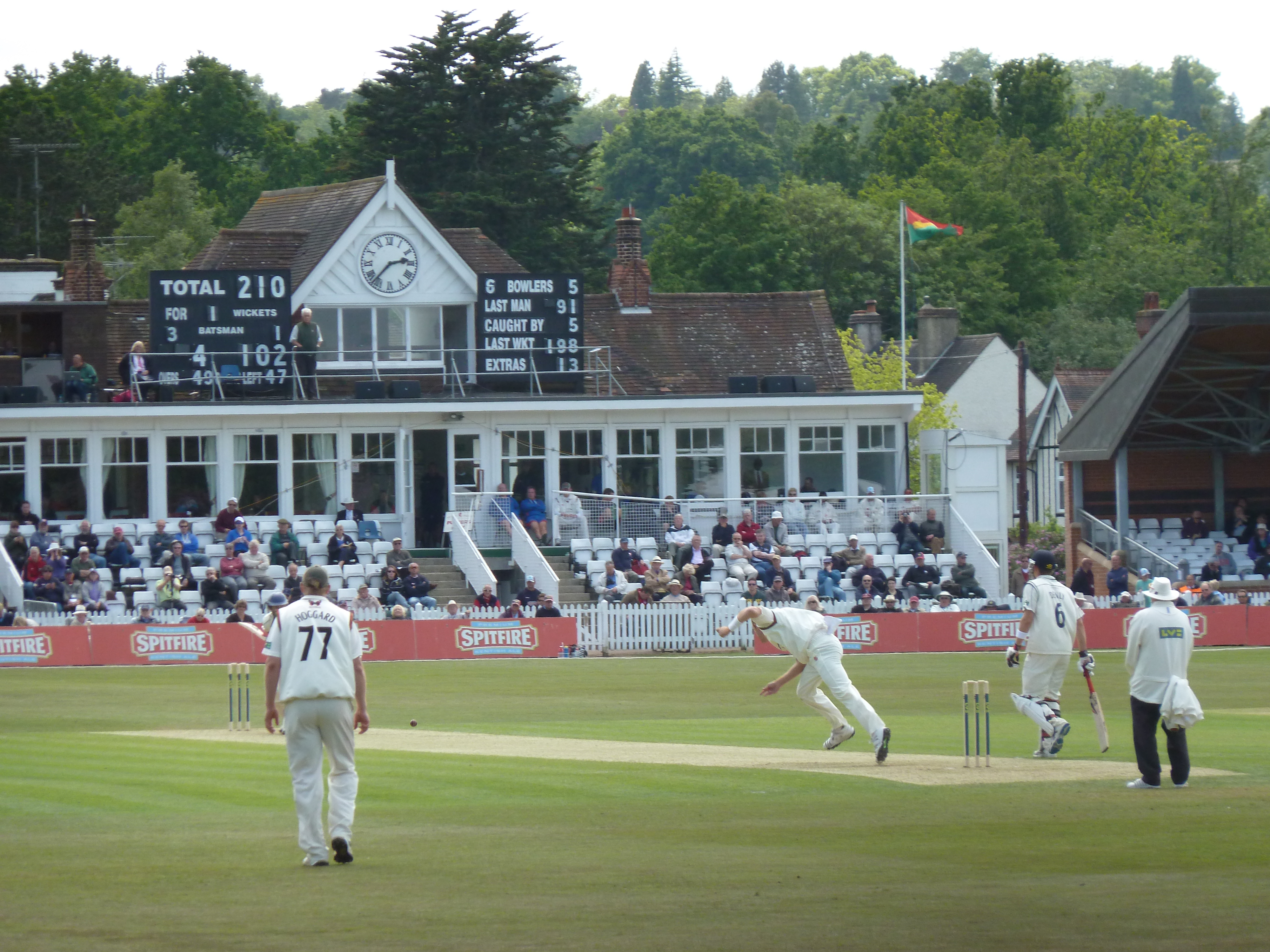
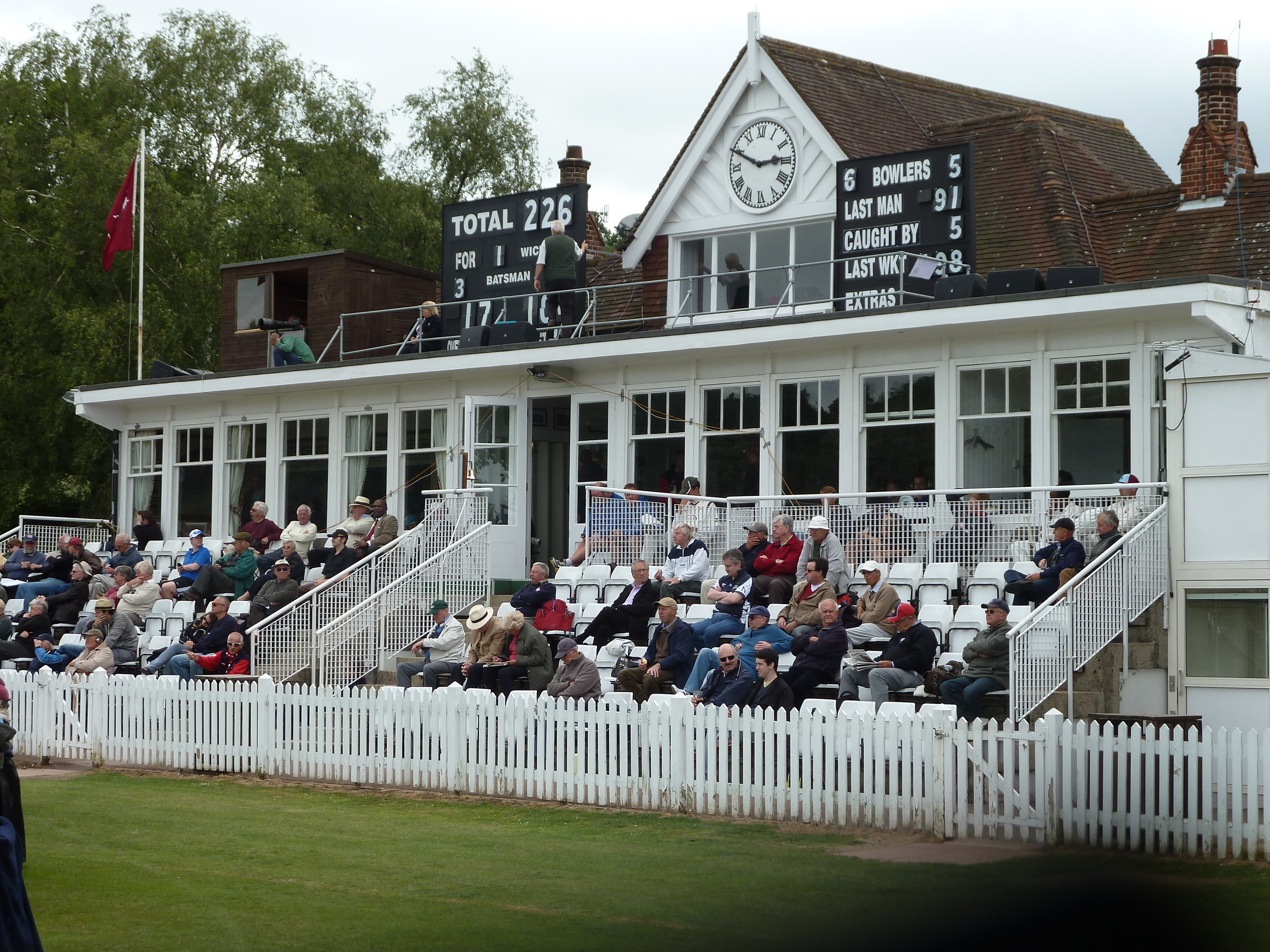
The ground had, and still has, a timeless quality.  If you didn’t look too closely, the photographs I have taken in the past two years that accompany this article, could almost have been taken back in 1963, were it not for the fact that there are now new stands either side of the pavilion, spectators, other than those in the grander marquees, are more casually attired and the rhodedendrons are now less abundant and colourful (or has lady nostalgia seduced me too well on this sensitive subject?).  The absence of houses from any vantage point completes the idyll.

There were many more such  “outgrounds” on the county circuit fifty years ago, including those at Blackheath, Dartford, Dover, Folkestone, Gillingham, Gravesend and Maidstone, but none were, or remain, lovelier, or more eagerly anticipated, than the Nevill.  But then, as a Man of Kent, born a few hundred years from the east bank of the River Medway, I’ll freely admit to being biased.

The ground had hosted county cricket since 1901 and held its inagural cricket week a year later.  Like its venerable counterpart at the club’s headquarters in Canterbury, the town embraced the event with a series of social gatherings, music and plays throughout the week.  Anyone arriving in the town would be greeted by bunting and flags flapping gently above the main streets of the old High Street and the elegant Pantiles.

The cricket week remained a highlight of my summers (though I could only attend on the Saturday due to the annoying necessity of attending school on the other five days of play), until I left home for university in the rough, upstart cricketing county of Essex in 1972.  I saw little county cricket during the rest of the decade, preferring to play, mainly in the serious, competitive world of the Yorkshire club game.

The love affair with the Nevill was resumed in the early eighties when my wife and I took the festival week off work each year and stayed in one of the town’s hotels (the Royal Wells, Russell and Beacon all had the dubious pleasure of our patronage).  Kent victories were rare during those years in seamer friendly conditions, and my most vivid – and sad – memory is of Bob Woolmer being carried from the field against Sussex, never to play again.  I had been less often in recent years, though since I escaped the clinging clutches of the home civil service a little over two years ago, I have returned to more frequent hours of worship.

The nearly sixty year old man still experiences the same thrill entering the ground as the ten year old boy.  And any visit would not be complete without performing certain rituals beforehand.  Whether arriving by car or train the first stops are the secondhand bookshops of Hall’s and the Pantiles, both of which, as befitting the rich Kentish heritage, maintain excellent stocks of cricket books.  A hearty breakfast is a prerequisite for a day at the cricket and there are several good options in the old High Street, Chapel Place and the Pantiles.  Finally, there is only one way in which to approach the Nevill, and that is by taking the ten minute amble up delightful Cumberland Walk, an alleyway that separates townhouses on the left from the more spacious properties and expansive gardens of Warwick Park.

Much as I want my county side to do well, watching well contested cricket in pretty surroundings under a cloudless June sky, has always been more important than seeing Kent win.  It does not invest me with the same measure of partisanship that following my local football club has done.  And that is no more the case than at Tunbridge Wells, where the setting and serenity are paramount – though it was gratifying to be present on the final day of the championship game against Leicestershire this year to witness their first home victory of the season!

The traditional week has assumed a different shape in recent years, with the ground now hosting a single championship game and two one day matches.  Relatively large crowds have placed pressure on the county club to commit to playing at the Nevill even when facilities  at Canterbury are being upgraded and the T20 programme is to be curtailed next year.

Many in the membership, including myself, would welcome more, rather than less, county cricket at Tunbridge Wells but, financial considerations aside, would it retain its lustre later in the season when those famed rhodedendrons have long faded?  I know my answer.

Read Full Post »


Current estimates are that there are 200 million people with a Twitter account, a mere third of the number of registered Facebook users.  I count myself a member of both communities, but it is the value of Twitter that I want to consider here.

Until recently I had used it essentially as a vehicle for providing me with breaking news on subjects that interest me whilst I am on the move.  And it is simple – just identify the information you want, select the accounts you need to follow to enable you to obtain that information, and away you go.  I just leave my mobile logged into Twitter and I can follow the rolling news as it happens. I can even programme it to provide instant text alerts, something, however, that I would not recommend unless you want to wake up, as in my case, to more than a hundred alerts detailing, literally, the blow by blow account of a baseball game played six thousand miles away whilst you were asleep.  

A more recent and useful example was when I was able to read over by over updates on Kent’s T20 cricket match against Glamorgan whilst dining in an Indian restaurant.  Unlike the chicken dansak, sag paneer and Tiger beer, it didn’t go down too well with the other diners, including my wife, but learning of Kent’s spectacular victory, grasped from the jaws of defeat, made my evening!

I am now taking a more active role in the exchange of information, and it is very satisfying when your contribution is valued sufficiently that your  tweets are responded to, particularly by people in the public eye (be assured, however, that these are artists and sportsmen and women, not “celebrities”!).  Moreover, the number of people following my tweets has been gradually expanding.

There is the added benefit, as many established authors increasingly claim, of using Twitter both to hone your writing skills by creating pithy, relevant tweets of no more than 140 characters and marketing yourself to prospective readers and agents by adding links to your work. 

But it is a double edged sword.  The pace at which news spews into my inbox, some of which compels me to respond to (I am a writer after all (keep telling yourself Tony)), takes up time that could, and should, be expended on “proper” writing i.e. drafting more serious and substantial pieces.  There has been a clear ratio between the increased time I have spent on social networking sites and the lack of blog activity in recent weeks.  The balance needs to be restored, and if it takes this analysis of my relationship to Twitter to help me to understand that, then I am half way to achieving that.

There is still an important place for Twitter in keeping me engaged in issues that interest me, including sport, travel, writing and current affairs, provided it is not allowed to divert me from “real” writing.

However, if, like most of my acquaintances, you haven’t tried it, give it a go and see for yourself.  Be warned though – you may get addicted!

Read Full Post »


The occasion of Bob Dylan’s 70th birthday today has already spawned millions of words in the printed media and on the internet (“the whole world is filled with speculation”) about his place in the popular culture of the last half century. Many purport, as much Dylan literature does, to be serious, learned pieces about what status he has as a poet, what religion, if any, he adheres to, what really happened when he fell off his motorcycle in 1966 or even what his garbage tells us about his alleged drug use (the list goes on).

Well, this modest contribution to the cacophany has no more pretensions than to be an unashamedly heartfelt postcard – though not of any hanging – from a fan.

I know that there are many people who don’t “get” Dylan – they say that he can’t sing and he’s no longer relevant, having written nothing worth listening to for over 40 years and so on.  As far as the voice is concerned, I’ll grant them that it has always been an acquired taste, and even for many of his devotees, his current growl, the consequence of a lifetime of heavy smoking and punishing tour schedules, leaves them puzzled and dissatisfied.  Yet, even today, I believe that, in concert, the passion, intelligence and honesty in his phrasing are unrivalled.  But let’s agree to disagree on that one.  

These criticisms also tend to emanate from people whose acquaintance with Dylan’s work barely extends beyond a handful of “early” songs such as Blowin’ in the Wind, The Times They Are A Changin’, Mr Tambourine Man and Like A Rolling Stone, astonishing works of art though each of those are and enough alone of a legacy for any other artist

How many of them realise, for instance, that Make You Feel My Love, now a modern standard recorded by artists as varied as Bryan Ferry, Billy Joel, Adele and Garth Brooks, and regularly heard in popular TV shows like Holby City and Strictly Come Dancing, was written and first performed by Dylan in 1997? 

His continued relevance in the music world is incontrovertible, manifested in the stream of testimonies by modern day bands as to his influence upon them.  And anyone who has been to a recent Dylan concert will know that they are frequented by as many enthusiastic young fans as pony tailed baby boomers.  His gigs in Beijing and Shanghai last month drew crowds of mainly Chinese youth turning to him, as their American and European counterparts had done fifty years earlier, for inspiration in their quest for a more open and inclusive society.

In the past decade alone he has issued several critically acclaimed (and chart topping) albums (including a Christmas one with ALL the proceeds going to the World Food Programme and Crisis), published the first volume of his Chronicles, hosted one hundred episodes of his peerless Theme Time Radio Hour, showcasing his vast knowledge of his musical roots and hilarious patter, exhibited his paintings and continued to tour the world with his band.  Oh, and he played The Times They Are A Changin’ for President Obama in the White House. No longer relevant huh?

Some people who are kindly disposed towards his art still have difficulty with the man, citing his uncommunicative (sic) manner on stage and perceived instances of “selling out” in recent years   But those minor and arguable lapses apart, it is rather his integrity and refusal to compromise in order to curry popular favour, in the manner in which contemporaries such as Iggy Pop and Steve Tyler have, that make him all the more impressive. Like any genius, he is a flawed human being, but I for one am prepared to accept from him what he is prepared to give me, even when, as was the case with much of his eighties output, he lets his standards slip – and that is so much more than I could ever have had a right to expect.  The debt is all mine.    

Perhaps one day I will attempt the thankless task of listing my favourite 10, 20, 50 or even 100 Dylan songs, but the reason I probably won’t is that I would feel uncomfortable at leaving so many great ones out. What I do know is that any list would include compositions from the whole spread of his career.  

Many artists have enriched my life immeasurably – Shakespeare, Mozart, Jerry Garcia, Samuel Beckett, Puccini, Jane Austen and Fra Angelico to name a few.  But none come close to providing such profound excitement and sense of challenge that I experience when I listen to the music of Bob Dylan.

So thanks Bob for everything (even though you will never read this).  We sure have seen nothin’ like you yet, nor are ever likely to see again.  It is certainly not dark yet, carry on being busy being born and may you stay forever young!

Read Full Post »


I have never been a great fan of Starbucks on the grounds, pun absolutely intended, that I don’t find their coffee strong enough (perhaps I should order something other than latté in future).  I prefer the more astringent taste found in Caffe Nero or Costa Coffee or, even better, a traditional, independent Italian coffee house, though they are becoming, along with corner bookshops and record stores, increasingly hard to find.

That said, I think Starbucks has more to commend it than its core product.  Firstly, it plays the best music, with a lot of classic jazz and blues and a smattering of folk rock.  As I write this in the large branch in Bluewater (Kent), Bob Marley, is singing Three Little Birds, and we’ve just had Joni Mitchell’s Big Yellow Taxi and Ella Fitzgerald’s Paper Moon – a fine playlist in my books.

The company also has a history of selling CDs exclusively from its outlets.  I was lucky enough to stumble across the live One Man Band by James Taylor whilst on a long, lonely road in California a few years back, but sadly missed out on the live Gaslight recording of Dylan because the offer was only available in the US (a long, expensive way to travel for a $10 album, even for Bob).

Then there is the ambience, which is particularly appealing in this branch – massive picture window opening out onto a sparsely populated mall, a casual mix of comfortable armchairs and stiff backed seating, and wooden framed photographs celebrating the coffee making process and posters advertising the latest special offers.

Shelves of packets of tea and coffee, assorted cups and other merchandise are arranged in the corner by a long perspex fronted counter that displays a tantalising array of things to eat, including tuna melt and mature cheddar panini, skinny lemon and poppyseed muffin and roasted chicken with herb mayonnaise sandwich.

I’ll confess that the food in Starbucks is another selling point for me.  My favourite delicacy is the toasted cheese and marmite panini, whilst my wife, who has a decent claim to being a connoisseur on the subject, asserts that the carrot cake is the best anywhere.  This reminds me that, although I usually eschew the (hot) coffee, I cannot resist a coffee flavoured frappuccino, which may actually be the best frozen / cold concoction available in any coffee chain.

With the busy lunch period past, the branch is now half empty.  The muted lighting generated by small, widely dispersed clusters of yellow and blue lamps, the gentle hum of conversation and the unobtrusive yet satisfying music all contribute to a civilised atmosphere.

Opposite me, two new mothers compare breastfeeding strategies, in word rather than deed, which acts as the perfect sleeping pill for their previously irritable daughters.   In the far corner, a gaggle of young shop girls from Zara, Gap and Hollister meet up in their mid afternoon break to slurp strawberries and crème and caramel frappuccinos and relay tales of annoying customers and bossy supervisors, whilst simultaneously maintaining text conversations with their boyfriends.

An elderly couple on an organised coach trip, nibbling at blueberry muffins and sipping “traditional” tea, suspicious of the exoticism of coffee that isn’t instant, bemoan their blistered feet and the cost of everything.  A bald, middle aged man with paunch protruding through ill fitting suit leers over his espresso macchiato at a female employee, and potential lover, young enough to be his daughter yet flattered by his worldly patter (not an entirely civilised scene then).

As my wife approaches (is that solitary slice of carrot cake still available?) I suddenly reflect – I like the ambience, the food, the fairtrade commitment, the music and some of the drinks  – should I not consider rewriting that first sentence?

Read Full Post »


Of all the eccentric characters that have graced San Francisco’s history, Oofty Goofty must rank amongst the most bizarre.  His real name (Leonard Borchardt appears to be the most likely contender), background (he may have been a deserter from the US Cavalry), and place and date of  both his birth and death are all bones of contention, yet his strange antics intrigued and entertained residents of the City during the latter part of the nineteenth century.

Herbert Asbury‘s 1933 book The Barbary Coast, An Informal History of the San Francisco Underworld, upon which most of the limited knowledge we have of of Oofty is based, explained that he acquired his name during his first sideshow appearance before the San Francisco public as a wild man on Market Street:

“From crown to heel he was covered with road tar, into which were stuck great quantities of horsehair, lending him a savage and ferocious appearance.  He was then installed in a heavy cage, and when a sufficiently large number of people had paid their dimes to gaze upon the wild man recently captured in the jungles of Borneo and brought to San Francisco at enormous expense, large chunks of raw meat were poked between the bars by an attendant.  This provender the wild man gobbled ravenously, occasionally growling, shaking the bars, and yelping these fearsome words: “Oofty goofty! Oofty goofty!””

This frightening spectacle lasted no more than a week before he became ill, unable to perspire through his thick covering of tar and hair.  Doctors at the Receving Hospital tried in vain for several days to remove his costume, and only when he was “liberally doused with a tar solvent” and “laid out upon the roof of the hospital” did it finally come off.

His wild man career abruptly cut short, Oofty turned to the theatre, initially securing a spot at Bottle Koenig’s, a Barbary Coast beer hall.  After just one song and dance, however, he was flung into the street, a humiliating and painful experience had it not been for the fact that it showed him the direction in which his career, or “work” as he termed it, should now turn.

Despite being kicked ferociously and landing heavily upon a stone sidewalk, he discovered that he felt no physical pain. For the next 15 years he exploited this new found talent by touring the city and allowing himself, at a price dependent upon the degree of brutality inflicted, to be kicked and battered by others.  Let Asbury again describe his modus operandi:

“Upon payment of ten cents a man might kick Oofty Goofty as hard as he pleased, and for a quarter……..with a walking stick.  For fifty cents Oofty Goofty would become the willing, and even prideful, recipient of a blow with a baseball bat, which he always carried with him…..It was his custom to approach groups of men, in the streets and in bar-rooms, and diffidently inquire:  “Hit me with a bat for four bits, gents.  Only four bits to hit me with this bat, gents”.

It was only when heavyweight boxer John L. Sullivan struck Oofty with a billiard cue, fracturing three vertebrae, that he finally called it a day. He will no doubt have enjoyed Sullivan’s later World Championship defeat at the hands of San Francisco’s own James J. Corbett.  The blow from Sullivan caused Oofty to walk with a limp for the rest of his life, and he was no longer immune to pain, flinching at the slightest touch.

There are many other colourful stories surrounding Oofty, for example:

  • acting as a human skittle in Woodward’s Garden where customers could win a cigar if they hit him with a baseball;
  • performing alongside Big Bertha (another candidate for inclusion in this series) in a Shakespearean parody entitled “Borneo and Juliet”;
  • attempting to push a shiny red wheelbarrow to New York for a bet (a challenge that failed after just 40 miles when he was knocked over in the dark and landed head first in a creek); and
  • being shipped upside down in a box to Sacramento as a joke gift for a young lady and being left in the unopened package over the weekend.

Despite his physical debility he moved to Texas where he continued to play the fool for his living, drinking beer with a bar spoon and engaging in quail eating contests.

Read Full Post »


The great German philosopher Nietzsche said it induced all truly great thoughts, Dickens felt it was the only thing that prevented him from exploding and perishing, and Ellen DeGeneres said her grandmother had taken it up at the age of 60 and now, at 93, nobody “knew where the hell she was”!  Moreover, it can boast almost two and a half million “likes” on Facebook.

If you haven’t already guessed, it is walking – simple, old-fashioned, placing of one foot in front of the other, the “first thing an infant wants to do and the last thing an old person wants to give up”.  It is the  most perfect form of exercise – health giving, stress busting, sociable and sustainable.   It is no longer the sole preserve of gaggles of retired teachers and postmistresses hiking from pub to pub, though organised Ramblers trips remain popular, but it has increasingly become the focus for major fund-raising events (witness the many “walks for life” around the globe), and many couples and families view it as a key part of their social life.

It may surprise readers who cannot buy their daily paper from the corner shop without getting into the car that walking is by far the most popular outdoor recreation in the UK – the proliferation of guide books on the shelves of your local WH Smith store is striking evidence.  Even in the home of the enemy  – the internal combustion engine – the number of walking trips has more than doubled, from 18 billion to 42.5 billion, in the last 20 years.

Over the past couple of years my wife and I have, armed with one of those guide books, increasingly devoted our Sundays to a countryside or coastal walk of between five and ten miles in Kent.  Lovely scenery – oast houses, meadow flowers, orchards and hedgerows –   accompanied by birdsong and captivating glimpses of wildlife, all richly compensate for the occasional hardships of mud, barbed wire fences and impossibly steep stiles. A visit to a local hostelry or tea rooms, either en route or at the end of the walk, completes the perfect afternoon. 

Yesterday was a case in point when, setting off from Frittenden church, we took a seven mile walk in the surrounding countryside, the mid point of which was the National Trust owned Sissinghurst Castle, the former home of writer Vita Sackville-West.  Here we sat outside the newly refurbished Granary restaurant with a coffee and a scone before taking a stroll around the acclaimed gardens, designed by Sackville-West herself, and then resuming our adventure. 

No walk would be complete without at least one unplanned detour, adding to the challenge and provoking a temporary raising of voices whilst the map is turned every which way and the book’s author is cursed for his imprecise use of the language.  But we haven’t got completely lost yet!

Walking in the countryside also provides the perfect environment in which, free from the noisy distractions of TV, neighbours and traffic, we can chat calmly and clearly about our plans –  the decisions to get married after 27 years and for me to take early retirement were both made on a cold February afternoon in a muddy field halfway between Shoreham and Otford!

Cynics will accuse me of over-romanticising the subject, of portraying a rural idyll that no longer exists (if it ever did), to which I plead not guilty.  Walking is the perfect antidote to today’s rushing, thoughtless world and an refuge, if only a temporary one, from its bombardment. 

On a more pragmatic level, it supplements the more frenetic gym regime and helps to prepare us both physically and mentally for the challenge of those lung bursting San Francisco hills and Lake Tahoe ski trails!

So, if you haven’t already, try it!  Approach it with an open mind and you might just find it’s the perfect workout and therapy.

Read Full Post »


Those of you who had the stamina and will to follow the daily diary of our recent vacation in Lake Tahoe, Las Vegas and San Francisco will recall that we stayed in an apartment in the North of Panhandle (NoPA) in the latter for two weeks.  I made reference on numerous occasions to the comfort and quality of the apartment, and the following slideshow provides a visual accompaniment to that narrative.  If you should be so inspired by it as to enquire about its availability for yourself in the future, you can find the link on the right hand side of the page.  

This slideshow requires JavaScript.

Read Full Post »

« Newer Posts - Older Posts »