One of the most familiar figures in Folkestone town centre, with a shock of white hair sprouting out of his hat, and a bag of papers on his arm, is an octogenarian Irishman who reluctantly moved here in 1963 and never left.
The first time I met this man was shortly after I moved to the town in late 2016. I had decided to offer walking tours and was anxious to consult as many people as possible, not only to assess the interest in the project but also to tap into the experience of those who had previously done this.
The name that kept coming up as the best person to speak to was Eamonn Rooney, whom I was already aware of through buying some of his books on the history of the town.
But there was one snag – he was not the easiest person to track down as he was not on social media. But I managed to find him in his favourite coffee shop where he went every morning. He was sat in a corner of the restaurant with mug, pen, paper and books spread across the table.
And now, almost a decade later, I sat down with him again, in that very same cafe, on the eve of his 82nd birthday, to chat with him about his long association with Folkestone.
Born in Newry in 1944, spanning the counties of Armagh and Down, Eamonn was an average but lazy student. It was the influence of Mr O’Neill, his English teacher, and Mr McCourt, his Art teacher, that encouraged him to take his studies more seriously, though he was later told he “would never amount to anything” by the nuns who ran the school he attended in Belfast.
It was his parents who brought the name of Folkestone to his attention. So, in the spring of 1963, he took a trip, only intending to stay for a short while.
On arriving at Folkestone Central he was struck by the flower displays on roundabouts (after all, it was “Floral Folkestone”). He was impressed with The Leas (a “pleasant surprise”) and Kingsnorth Gardens (still a “hidden gem”).
His first encounter with a Folkestone “celebrity” occurred in the photocopy shop opposite Grace Hill Library. He started talking to American actress, singer (she starred in the long-running rock musical “Hair”), and mother of Mick Jagger’s son, Karis, Marsha Hunt, who was sending a fax (remember those?) to the USA. She said that she would never be able to remember his name, so christened him the “History Man”, and thereafter referred to him as that whenever they met, usually at the supermarket or Metropole jazz club.
On the recommendation of his brother who had just been demobbed from Shorncliffe, he took a summer job, but it was as a bus conductor that he first established himself in the town, and for which he is still fondly remembered. His route for 8 years primarily covered Cheriton, Morehall and the bus station and, as a result, the rest of the town remained largely an unknown quantity for him.
Time to buy a street map!
He had been told that Folkestone was primarily a Victorian town, so had “written off” the Bayle and the Old High Street as places of interest. But one day he met the watermills and windmills expert, C.P.Davies, whom he regards reverentially to this day as the preeminent local historian, who told him that there was “a lot of history” in Folkestone with a (buried) Roman Villa, significant Anglo-Saxon heritage, not to mention an extensive military history.
That was the moment when the “History Man” discovered his holy grail, starting a decades long love affair with the Heritage Room on the first floor of the Grace Hill Library. Eamonn was devastated when Davies retired shortly afterwards.
He also fondly remembers Amanda Oates of Shepway District Council who was responsible for organising events at the Lower Leas park Amphitheatre. Since she left, the facility has been sadly neglected.
The history research was all well and good, but he still had to earn a living. After being rejected by several Park Farm factories he was offered a job at FWM Plastics, followed by Silver Spring and Portex, for whom he worked for 15 years. It was during this time there that his writing career began with articles in the company’s Blue Line magazine and then the Portex and Folkestone camera clubs. And in 1985 he founded the local history society with Charles Whitney (chair), Alan Taylor and Peter Bamford.
In the early nineties, he took a three day a week job at the much lamented Martello No.3 visitor centre with an evening security role in the Leas Cliff Hall, followed by a winter job at the seafront car park. Between 1989 and 1996 he not only performed the role of town greeter but also delivered tours on behalf of the New Folkestone Society.
But it was in 1995 that the role for which most people remember him presented itself. Shepway Council had a vacancy at the Leas Lift, a position for which Eamonn’s undoubted customer facing skills made him ideally suited. When the council relinquished the lift in 2009, he was approached by the Folkestone Estate to take responsibility through a management agreement (CIC). With Terry Begent agreeing to handle all the business affairs, they formed a “dream team” until the lift closed in 2017, and it is a matter of great sadness to Eamonn that it remains closed (though, we hope, not for much longer).
Eamonn has more stories from his time as a tour guide than I have space for. One I particularly like is when he showed an American party into the British Lion pub, and as they were leaving, was asked “hey, buddy, aren’t we going to have what you Brits call a swift half before we go”? After the obligatory few drinks, Eamonn began to thank the group for joining the tour when the same guest enquired “hey, aren’t you going to finish the tour?”. Which, of course, like any self-respecting guide, he did.
Eamonn finds it remarkable that the young teenager who left Northern Ireland with no immediate prospects should meet an array of prominent individuals in his adopted town over the next sixty years. In addition to Marsha Hunt, these included Lord Radnor himself at his Wiltshire castle, Eastenders actress, Michelle Collins, whom he met at a BBC Wales interview, and Prince Harry at the opening of the Step Short Arch on the centenary of the outbreak if the Great War on 4th August 2014.
Eamonn has utilised his research to publish many books and pamphlets on Folkestone’s history, both on his own and in collaboration with others, notably Alan Taylor and Terry Begent. Asked which he was most proud of, he cited the history of the Belgian refugees at the outbreak of the Great War and the illustrations and text he provided for
John Rice’s Folkestone: A Photographic Record.
And the next? Probably Stuart Folkestone.
Whatever it might be, I for one will be buying it.
Happy Birthday Eamonn, may you have any more!
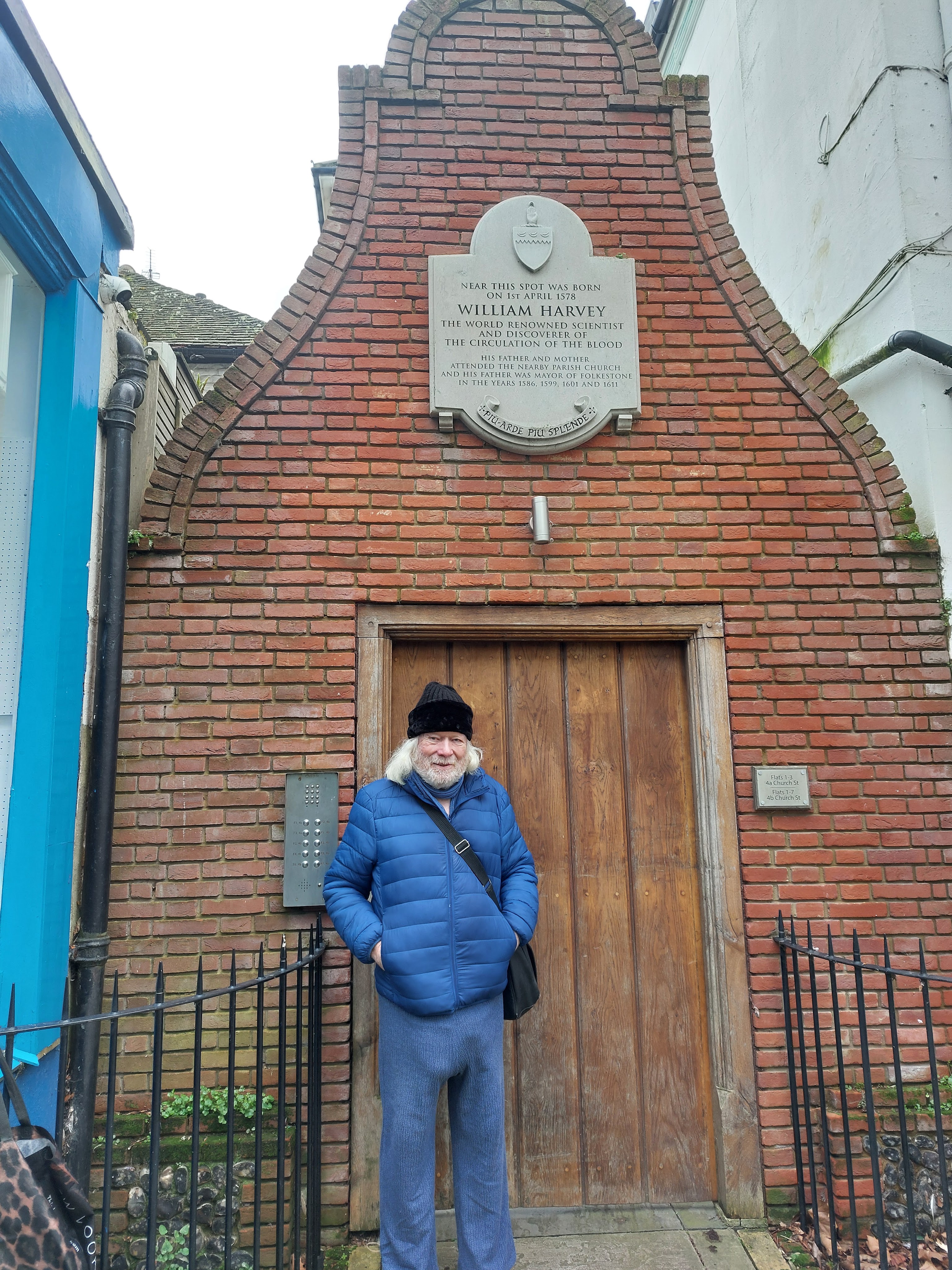


 Tony Quarrington