Feeds:
Posts
Comments

Archive for the ‘Kent’ Category


1.

The seven year old boy

In crew cut and tiny shorts

Sits cross-legged on

The chilly wooden floor of

The school assembly hall,

Singing, or rather miming

Along to his favourite carol.

Little Jesus, sweetly sleep,

Do not stir,

We will lend a coat of fur,

We will rock you,

Rock you, rock you

We will rock you,

Rock you, rock you

See the fur to keep you warm.

Snugly round your tiny form.

2.

As the clock strikes two

On a cold Christmas morning,

A short, portly figure,

Fuelled by Watney’s Red Barrel,

Creeps up creaking stairs,

And through half-closed bedroom door

Of the half-sleeping boy

To leave a bulging white paper sack,

Complimenting himself on fooling his son

That he is a certain someone else.

But the child has known better

These past two years,

And through half-open eyes

Perpetuates the falsehood.

3.

In the snow-sprinkled back yard,

The thrill of Meccano set,

Beano and Dandy Annuals

And Cadbury’s selection box

Still fresh in his giddy mind,

The boy is struck between the eyes

By a neatly rolled and deadly fastball

Flung by the same fake Santa

That visited him seven hours before.

But there is neither time for crying

Nor testing the capacity

Of the new chemistry set

To blow up the house

As the main event approaches.

4.

Three tables of differing design,

Height, width and degree of wonkiness

Are wedged together with an

Equally eccentric assortment of chairs

Looted from every room in the house,

Fifteen pews laid for a congregation

Spanning three generations.

The grandfather, prior to the

Ceremonial carving of the turkey,

Leads the toast to his wife

And four daughters-in-law

For the preparation of the feast.

Secretly, he prays there will be

Enough of the bird left over

To lie with his beloved piccalilli

In sandwiches he will take for lunch

At Chatham Dockyard

The day after Boxing Day.

5.

As the tables are cleared away,

The children squabble over

The sixpences and threepenny bits

Found in their Christmas pudding,

While the cooks sit down to squint

At Billy Smart’s Circus

On the seventeen inch

Black and white television,

Precariously perched beneath

The curtained budgerigar cage,

And husbands are grudgingly

Despatched to the kitchen

For washing up duties.

6.

The family singalong takes centre stage

When a favourite uncle, worse for wear

From a cocktail of cheap fizz,

Gassy beer and Bols advocaat,

Leads the traditional rendition

Of the “music master”

Who “comes from down your way”.

The children wrestle weariness

As they pi-a-pi-a-pi-a-no

And umpa-umpa-umpa-pa

To their heart’s content,

Their giggling intensified

By the bandleader flicking

A loose premolar with his tongue

In time to the music.

7.

Wives ascend the stairs to sleep,

But only after mock protests

At having to prepare Irish coffees

For their sozzled spouses,

A ritual as venerable as

The monarch’s festive message

Or overdone brussel sprouts.

8.

As the boy finally succumbs

To slumberous thoughts,

He dreams of the highlight to come –

The Boxing Day football match.

Read Full Post »


A biting breeze and thin drizzle denote December’s inevitable but uninvited return. Twilight descends on the ancient churchyard.

Never has the phrase “quiet as the grave” seemed more apt. 

As I pause to tie my bootlaces by the Town Cross, venue for the making of mayors for many centuries, my body shudders as a young woman brushes past me, the hem of her blue dress grazing the grass border, and her white headpiece fluttering in the wind. She carries provisions – bread, leeks and a small flagon of beer – for the poor in a round wicker basket, forswearing another potentially lucrative tryst with a Northumbrian nobleman, orchestrated by her frustrated father.

Her head bowed, she whispers “Good evening, sir, God be with you”. Before I can frame an intelligible response, she disappears behind the west window.  

Composing myself as best I can in the circumstances, I shamble on past the crumbling tombs, narrowly avoiding a collision with a rat, scurrying across my path to the sanctuary of the lopsided lychgate leading into Church Street. The Pullman pub is empty, save for a few flickering candles and a lone member of bar staff deep in conversation with his mobile phone. 

The lanterns of Rendezvous Street are unusually dim, and the restaurants are sparsely populated. 

The stillness is unnerving, but strangely thrilling.

I turn into the narrow, twisting, rain drenched street that slides down towards the harbour.

Many months have elapsed since chaotic, cacophonous Charivari had snaked up that old thoroughfare, all drums and whistles and cymbals, and other less conventional instruments. More recently, the ground had groaned beneath the burden of polished, red-laced “Doc” Martens, worn by follicly challenged pilgrims lumbering towards Gillespie’s and The Ship for an afternoon of Special Brew, and worship at the altars of Prince Buster and The Specials.

I am alone.

But am I?

The fog in my brain mirrors the slowly enveloping mist approaching from the bottom of the hill. Images of times past in this salty, saintly town start to consume my thoughts. 

Nothing is quite what it seems.

My longing for one last lingering look at the dazzling, daily alchemy conjured up in the rock shop near the top of the street Dickens christened a “crippled ladder” is soon answered. The heady, fashionable aromas of craft beer and Nicaraguan coffee cannot compete with the memory of the sickly sweet perfume radiating from that beloved spot, where, nose squashed against the glass, a small boy gasped in awe at the thick, long sticks of heaven being rolled.

“Let me in at the front, Michael, you’ve been stood there for ages”, pleads his tearful younger sister, Anna, her view obscured by the taller girl stood in front of her.

“Have they started giving out the bags of broken bits yet?”, another boy bellows from further back in the crowd.

A sudden, excited scrum confirms his suspicion as I catch an intoxicating whiff of granulated sugar.

It was often claimed that if Rowlands were to shut its doors for good, Folkestone would die; a prediction, thankfully, since proven dramatically wrong, 

I stumble into Steep Street Coffee House for cake and cappuccino, a combination that never fails to comfort. I am their last customer of the day and the staff, without being obtrusive, are cleaning up around me. The self-styled Folkestone Poet has vacated his customary sales pitch across the cobbles at Big Boys Burger, his heavy overcoat and leather balaclava no longer a match for the diminishing temperatures. 

I pass by Marley’s – or what I thought was Marley’s. From a dark upstairs room, redolent of patchouli and cigarette smoke, a loud, piercing jukebox exhorts me to “go to San Francisco” a seductive reminder of the original Summer of Love on such a bleak winter’s evening.

Two young men in afghan coats, and a messy profusion of facial hair, are huddled at the foot of the crippling, crumbling Bayle Steps. 

“Hey man, how’s it going?”

“Far out, whatcha doing’ tonight?”

“Going’ to Archies. The Lonely Ones are playing”.

Nice. I hear there’s some hot Swedish chicks in town too”.

“That’s settled then, Archie’s it is”. 

“Yeah, and I could kill for one of his salami rolls right now”.

I start to follow them through the door, only to find that the closer I get, the scene dissolves in the moist air, and I am left once more outside Marley’s rather than the Acropolis

The piercing cold slices through my flimsy denim jacket and hastens my progress to the bottom of the street. Everything is still again as I try to rationalise the scenes I have encountered in the past half an hour. 

I cross a deserted Tram Road car park and pass under the arch by Ovenden’s old forge into the empty fish market, tiptoeing around the grimy puddles that tend to settle there, whether it has rained or not. 

A solitary gull plods apologetically past, pining for Spring and the reopening of Chummy’s and Bob’s seafood stalls, when it will again be afforded means, motive and opportunity to ambush tourists for their fish and chips and tubs of whelks.

Pausing outside The Shell Shop, I appear to have stepped into an earlier time again. Men in cloth caps and heavy, seaweed encrusted boots trudge up the slipway opposite, lobster pots and herring nets half empty after an exhausting and disheartening shift. They slap their meagre catch on the floor of Fish Shed One, light cigarettes and congregate in whispered conversation.

‘Darkie” Fagg, “Cottage” Featherbe and “Lobby” Spearpoint are leaning on the railing and reminiscing about better days, while Old Ned Saunders, retired these ten years, is mending the sprat nets for a “free” pint or two in The Oddfellows Arms later this evening. 

On The Stade, wives and daughters juggle the demanding tasks of cleaning fish and supervising the smaller, and not so clean, children. 

Observing this picture, it is difficult to gauge which gender had the tougher life.

Meanwhile, grubby, barefoot young boys, oblivious to the dedication and drudgery of their elders all around them, chalk stumps on the wall of Clouts Alley.

“I’ll be Jack “Obbs, you can be Clarrie Grimmett. I’ll ‘it you into the “arbour, every time, just you see” brags nine year old Harry Sharp.

But with his first delivery, Clarrie, better known about these parts as Edmund, and, later years, “La La”, Taylor, traps Jack in front of his wicket and appeals for leg before.

“Owzat! Got you with me flipper, pom”.

A heated dispute follows, culminating in the great English batsman hurling his bat against the wall and storming off in the direction of Redman’s boat builders.

His mother, ankle deep in half gutted dogfish and three scruffy toddlers, calls: 

“Harry, your tea is ready. And find your brother before you come in”.

“Five more minutes, mum. I’ve got to bowl Don Bradman out first. it won’t take long”.

“Five more minutes, my arse – you’ve got thirty seconds. This tea won’t wait. If you don’t get to the table soon, the other kids will have your share”

A case of bad mum stopped play.

As this scene of family harmony evaporates, I hear, from across the harbour, a sergeant major’s earsplitting admonition to “Step Short”  to a long procession of uniformed men stomping down the slope from the Leas above.

The rhythmic sound of boots on concrete is accompanied by raucous renditions of Pack up Your Troubles in Your Old Kit Bag and It’s a Long Way to Tipperary, as the soldiers march to the waiting ships that will take them to the Western Front.

But there is one last treat before their sombre adventure begins.

Inside the harbour station waiting room, two formidable middle aged women adjust their pinafores and rearrange any curls that have slipped beneath their flower bestrewn boaters. They inspect the massive urns containing the last hot, strong tea most of these men will ever drink.

“Come on boys, form a straight line, you don’t have long, you know”, Flora Jeffrey cries out with a tinge of regret in her voice, while her sister Margaret cuts thin slices of trench cake and bread pudding to complete what, for many of these condemned men, will be their last meal.  

“And don’t forget to sign the visitors’ book before you do”.

“All right, all right, you sound like me muvver – nag, nag, nag”, one private who claims to be twenty one but looks barely sixteen, retorts, as he lurches towards Margaret and slurs:

“Give us a kiss”.

But before he can perfect this unwise manouevre, a grizzled veteran of Mafeking and Ladysmith yanks him back by his collar and barks:

“Show the ladies some respect, young ’un’. You ain’t in the playground now, y’know”.

“Sorry, old timer, I didn’t mean nuffin’ by it, it was just a bit of fun”.

Flora chuckles: “You got off lightly there, my boy, that’s nothing to what Margaret would have done to you if you’d got any nearer!”.

An outpouring of communal hilarity is unleashed, and the embarrassed teenager slinks back into the anonymity of the crowd.

I separate from the excited, but fearful, throng with the final strains of Keep the Home Fires Burning ringing in my ears, and join the boardwalk that connects the station with the base of the thirty year old water lift along the beach to the west. 

But I have hardly stepped foot on the old railway sleepers before finding myself in the midst of a large conglomeration of buildings, including a swimming pool, boating lake and fairground rides.

As I try to take all this in, a crew cut kid in knitted cardigan and khaki shorts can be seen rushing into a huge, dimpled dome that is destined to be his whole world for the next two weeks. He will never tire of rolling a penny for plastic motor cars or shooting a steel ball into a hole for packets of mints.

His father and mother, the latter clutching a wad of what appear to be tickets, frown as they dismount from the blue plastic seats they have occupied for the past two hours, where they had been subjected to an increasingly annoying loop of “legs eleven”, “two little ducks, twenty two” and “two fat ladies’ eighty eight”. 

The boy drags himself from the penny pusher slot machine and scampers towards them in a frenzy of excitement.

“How many wins did you get, mum?”.

“Eight”.

His heart sinks. “Oh no, that big cuddly monkey on the bottom shelf is nine wins. Can you play some more games and win it for me?”.

“We don’t have time, darling; besides dad and I want that nice set of tea trays that are eight wins. They will be just perfect for our TV dinners when we get home”.

“Boring”. 

Feeling betrayed and despondent, the boy skulks off in the direction of the Runaway Coaster.

But he is soon appeased by a promise to go to his favourite fish and chip restaurant in Tontine Street for tea.

Intermittent drizzle and mist has given way to steady rain and a thickening gloom. Hungry and shivering, I resolve to return home. 

Christmas lights bestride the street across the ragged rooftops, and retailers and restaurateurs contend for the accolade of best dressed window, though tonight there is nobody about to judge them. 

Apart from the echo of my boots upon the sodden cobbles, silence is restored.

Until I reach Archie’s.

From that same gloomy upstairs window from whence the Flowerpot Men had serenaded me two hours – and a hundred and fifty years – earlier, the Small Faces remind me that:

“It’s all too beautiful”. 

After the battering my senses have taken this evening, I remain to be convinced of the veracity of this hypothesis.

So I try, for the second time, to gain access to the old haunt of hippies and radicals.

As I take my first hesitant steps in its direction, fully expecting to find myself in Marley’s again, the doors open of their own accord and I am permitted to enter.

And there, waiting to greet me, is the original owner, Mickey Argegrou, who is anxious to introduce me to his special guests for the night. 

To my astonishment, St Eanswythe is here. The modest blue and white garments she had been wearing during our perfunctory encounter in the churchyard earlier have been replaced by brightly coloured, patterned flower dress and matching peaked hat. She is sampling her first ever cup of coffee and, judging by the uncharacteristic grimace that quickly follows, she is unlikely to order a second. Water from her own spring and the occasional small goblet of mead will remain her preferred tipples. 

With the final troop ship of the day, Engadine, set sail for Boulogne, and the Mole Cafe consequently closed, the indomitable Jeffrey sisters have swapped their pinafores for elegant three quarter length dresses. They appear to be conducting a taste test of Mickey’s famed rum babas, comparing them in the process with their revered fruit cake.   

John Brickell, still in his overalls and safety cap, is here too. He has disappointed his vast army of young fans by holding back the remnants of today’s rock rolling, handing the broken bits around to the grateful regulars, who find them a perfect accompaniment to their cocktails. 

And Harry Sharp, grown in the past hour into a handsome young man, but still smarting from his first ball duck at the Clouts Alley Oval, is feeding the jukebox, while Old Ned Saunders, released from his net repairing duties, though not separated from his favourite fisherman’s jumper, for the evening, is leading a communal sing along to the latest tune selected by Harry:

“Those were the days, my friend”.

After the scenes I have witnessed this evening, I am inclined to agree. 

Read Full Post »


Waves sweep through railway arches

And Rip Tide and Isabella,

Sea Warrior and Connemara,

Long time inner basin residents,

Swing and sway

To a soaring seagull symphony.

Folkestone’s Marmite building too

Comes to life once more;

Buses from Runcorn, Rhyl and Redcar

Offload oversized congregations,

Suitcases outnumbered by

Disability impedimenta.

The quayside is converted

From pedestrian thoroughfare

To geriatric racetrack

As mobility scooters

Scatter unwary walkers,

While rickety zimmer frames

Clog up the wide, windowed doorway.

An elderly couple from Cleckheaton,

Weary and windswept from seafront stroll,

Stagger from harbour fish bar

To plant their tired torsos

On the refuge of roadside benches.

Weekend specials are back on the menu,

With almost every still standing Sixties star

Scheduled to perform in the coming months.

Inside, there’s not a spare seat

In the suffocating heat of the lounge bar;

Tables are laden with leftover sandwiches

And half empty glasses of gassy beer;

Debate lurches from Covid controls

To rabid rants about refugees,

Inflamed by hate-filled headlines

In the crumpled copies of the

Daily Mail and Daily Express

Left lying on abandoned chairs.

Another bus, bound for Margate,

Sandwich, Canterbury or Chatham,

Parks outside to await the sedentary rush

From couch to coach in thirty seconds;

Its passengers forsaking Folkestone

No sooner than they have arrived,

Only to return to eat and sleep tonight

Before escaping again to towns

No more deserving of their patronage.

Dover Docks and Cap Gris-Nez

Lurk somewhere beyond the growing gloom;

What catastrophes might be unfolding

On that slim, unstable stretch of water?

A headless chicken on Rocksalt’s roof

Reddens and revolves in sudden frenzy,

While in the ballroom along the road

A bingo caller hollers “two fat ladies”

To a sparse but satisfied audience.

As the sun punctually dips down

Beyond the Jelly Mould Pavilion,

The receding tide meanders 

Through the East Head gateway,

And the inner harbour boats

Collapse back on their sides.

Read Full Post »


I was recently asked by a local magazine a series of questions about my poetry, its provenance and future plans. This is a transcript of the “interview”.

Can you remember your earliest interaction with poetry?

I suppose, like most children, nursery rhymes would have been the first poems that I engaged with. And then, as I progressed through primary and grammar school, I was exposed to Shakespeare, Wordsworth and the “classic” English poets. 

When did you realise that you not only had the talent and skill to be a successful poet but that you wanted to pursue a career in poetry?

That is making a big assumption! But, like most adolescent boys, I wrote soppy “love” poetry that, fortunately, has not survived! 

To readers who may not have heard you before, how would you describe your poetry?

I subscribe to Leonardo da Vinci’s claim that “simplicty is the greatest sophistication”, so don’t try to over cook the imagery or make the poems too wordy and obscure. I still, on occasions, like to use rhyme and traditional metre, whereas so much of modern poetry is now free verse (which I also do). If there is one goal I try to obtain in an individual poem, it is the creation of a mood, at atmosphere – show not tell I suppose. 

If you could pick the three most memorable moments in your career, what would they be and why?

I did write a three volume “novel” at the age of seven based upon the Tommy Steele song, “Little White Bull”. I am equally proud of the book on Kent cricket I co-wrote ten years ago which was very well received. But, aside from the adolescent stuff, it is only really since I retired from work and moved to Folkestone that I was inspired to write poetry regularly. There was a significant increase in my output during the first Covid-19 lockdown when I was producing a poem a day for several months. Some of those verses feature in my collection, Tickled by the Turning Tide: The Folkestone Poems, which was published only a week ago on 7th April. 

You are both stranded on a desert island and can only take one book with you, what book are you choosing and why?

As with the radio programme, I am assuming that I can take a complete works of Shakespeare as well? That is an almost impossible question to answer, and my view might change, dependent upon my mood on a particular day. But I will say – today – Ulysses by James Joyce for its radical approach to the novel but especially its humour and evocation of a place (as my Folkestone poetry testifies, it is a sense of place that often appeals to me).

What do you enjoy most about living in Folkestone and do you have any particular favourite go-to spots in the town?

How long is this piece meant to be?! Being by the sea, with all its benefits, has to be the most important factor, though Folkestone’s creative vibe has helped inspire my own work. And then there is the dining scene – one of my poems is entitled I Sit in Coffee Shops, and that pretty much sums up my everyday life! I could recommend so many places, but Marley’s, Django’s, Folklore (where I had my recent book launch) and Steep Street Coffee House are probably my top four, though there are several others that meet different needs at different times.

Has living in Folkestone and being by to the sea helped inspire any of your poems?

Clearly!

Given the past 36 months and the evolving digital world, what are your thoughts on the current status of poetry, will it still have a future in say 40, 50 years’ time and will it need to adapt to survive?

Judging by the growing attendances at the local Poets’ Corner, Folkestone group, the town’s poetry scene seems to be thriving. Whilst I found that Covid gave my poetry a significant boost, providing me with a mechanism by which I could come to terms with what was happening, I know that others were completely floored and could, or wanted, not to write anything. I believe we have now moved out of that depression and many, maybe even more, people are writing again. Poetry has been with us for thousands of years, and I expect it to continue to have a role in attempting to make sense of the world and articulating it in a thought-provoking and – important for these days – manageable way. 

Do you have any upcoming books that readers should look out for?

I have already mentioned the Folkestone poetry book, which is available online through all the major retailers and also being sold on my behalf in a several outlets throughout the town.  The best way at present to get your hands on a copy – and a signed one at that – is direct from me by messaging me on my Facebook pages or email at tonyquarrington@msn.com.

Do you have a future vision of what you would like to achieve over the next 5-10 years?

Absolutely – I have several projects on the go. For the past twelve years I have been putting together a book about my love for San Francisco, and with the immediate Folkestone project completed now, I can return to that. Since I moved to the town I have been keen to produce a modern tourist guide, based upon my walking tours that I have been delivering for the past six years. And with an Italian holiday on the horizon, I am hoping to write a travel diary, hopefully in poetic form. And possibly a second volume of poetry!

Read Full Post »


I am pleased to announce that my first collection of poetry, Tickled by the Turning Tide: The Folkestone Poems will be published on 6th April 2023.

When I was first taken on holiday by my parents to Folkestone at the age of ten, I could never have thought that, more than half a century later, I would not only return to the town to live but be publishing a book of poetry inspired by it.

All thirty three verses reflect my adopted coastal home, covering key moments in the town’s history, from its fishing heritage to its role as a port of embarkation for war, and from its period as a fashionable seaside resort, which welcomed royalty and writers, to its decline and subsequent regeneration as an art and dining destination.

I also explore aspects of modern living in a town that is changing rapidly.

Since I moved here with my wife in 2016, I have not only written and performed my poetry in a variety of locations, including coffee houses, bars and even on the steep, cobbled Old High Street, but also created and run a successful series of literary evenings, initially as a lockdown solution but still going strong after three years, and delivered award winning walking tours of the local area.

The official launch will take place at Folklore on Tuesday 11th April 2023 at 7pm, at which I will be signing copies and reading a handful of the poems.

I will also be delivering more readings at the Steep Street Coffee House on Thursday 4th May in the coming weeks in addition to running walking tours on 22nd and 26th April to promote the collection.

The book will retail at £10.99 in the UK (USA £12.99) but, for the first two months, I will be offering it at the discount price of £8. For those living in and around Folkestone, I will be happy to deliver or arrange collection. I will also be delighted to sign the book (for those wanting its value to diminish immediately!).

It will also be available for sale from 1st May  at the Folkestone Bookshop, Town Hall/Musuem, Steep Street Coffee House and The Great British Shop on the Old High Street. I am currently negotiating with other outlets to do the same. If you have any questions in the meantime or wish to purchase a copy once it is available, please either message me on one of my social media platforms or email me at tonyquarrington@msn.com.

Read Full Post »


I know I must accept that you are gone,
But I will look for you in rain and snow,
Where pilgrims trod through Black Boy Alley,
Up Castle Hill and Minor Canon Row.

I still sense your warm breath upon my cheek
In College Yard, The Vines and Blue Boar Lane;
Each whispered female voice renders me weak,
And shock of dark brown hair inflames the pain.

Thick Medway mud mocks my unavailing search
And careless castle pigeons torment me,
But La Providence provides brief release
And no shortage of shops for books and tea.

I pass where Estella taunted poor Pip,
As bat and ball collide on King’s School field,
Reminder of what I loved most till you
Bowled me over and my devotion sealed.

I turn up Boley Hill by Northgate arch
For sanctuary under cool Catalpa tree,
Spreading its graceful arms on holy ground,
I sit down and let my mind roam free.

For one perfect moment I see your face,
Hear your voice, smell your hair and taste your mouth,
But it’s all a foolish afternoon dream
In cathedral doorway in Keats’ warm South.

When I wake, to adjoining gardens I go
Where sun shines bright and birds sing oh so sweet;
Yellow roses wave in warm, gentle breeze,
But there’s no one beside me on “our” seat.

I know I must accept that you are gone,
But I will look for you in rain and snow,
Where pilgrims trod through Black Boy Alley,
Up Boley Hill and Minor Canon Row.

Read Full Post »


This is an adaptation, and considerable shortening, of a piece I wrote a couple of years ago.


Mermaid Beach at Dusk

On a night like this, the Cote d’Opale
Might as well be a thousand miles away.

It is a calm, quiet, otherworldly evening
After a dank, dreary December day;
Sky and sea present an ashen canvas.
Tonight it is impossible to tell
Where one ends and the other starts.

Despite slimy conditions underfoot,
I elect to descend from
The well-lit comfort of the Leas
To the chilly Channel seashore.

Barely a whisper from the surf tonight.
I cannot even hear Matthew Arnold’s
“Grating roar of pebbles
Which the waves draw back”,
So faint is nature’s melody this evening.

Across town, an artwork springs to mind,
Above Tontine Street’s old post office
Proclaims that heaven is a place
Where nothing ever happens.

Because nothing is happening tonight
In this desolate speck of paradise.

But then, everything is happening.

To the east, the lighthouse blinks
Through the thick, enfolding gloom;
A tuneless, abandoned church bell
Hangs silently suspended above
Where once stood rotunda, swimming pool,
Boating lake and fairground rides.

A dalmatian puppy snuffles among
The seaweed encrusted pebbles
On the dark shoreline, while its
Fretful owner punctures the peace
With impassioned and fruitless pleas
To follow her back across the beach,
To the refuge of her Range Rover.

A lone fisherman sets out his stall
For what appears a long night ahead,
Reminding me of all night sessions
With my teddy boy uncle fifty years ago,
On the shingle beach at Dungeness.

I wonder now why I ever went,
I was never interested in fishing!

Pastel hued beach chalets are now
Padlocked up for the winter,
Along with the Mermaids Cafe Bar,
Welcome pit stop on the promenade
From Folkestone to its upstart neighbours,
Sandgate, Seabrook and “posh” Hythe.

I defy anyone to assert that they
Do not like to be “beside the seaside”;
And I look forward to a first full summer
Season in my coastal home next year.

However, it is at moments like this,
With the cold, dark sea alone for company,
When enjoyment is such a feeble word
To evoke the effect of this magical place;
I can only equate it to a profound love,
Both infatuation and long term comfort.

Read Full Post »


One of the iconic images of the great British seaside holiday of the fifties and sixties is of happy families playing beach cricket.  Everyone joined in, playing with children’s bats, balls and stumps that reduced fathers who fancied themselves as Dexter or Sobers to the same level of competence as their seven year old sons, non-sporting wives and even the family dog (when they were still allowed on the beach between May and September). Truly, we had “never had it so good”.

Sadly, the advent of the foreign package holiday, breakdown in traditional family structures and expansion of alternative leisure pursuits, all contrived to render such a scene virtually obsolete.  Over the past weekend, therefore, I embarked upon a one man (at least for now) campaign to revive this venerable but floundering tradition, pitching up on Ramsgate Main Sands with my wife at 2pm on Sunday for an impromptu game.

I say impromptu because my planning had left something to be desired – a brief glance at the tide times beforehand would have revealed that this was the worst time of the day to start.  Nevertheless, after twenty minutes inspecting the fast diminishing slither of sand along the bay, I found a strip that was marginally more playable than the Rose Bowl.  It quickly became clear, however, that if the game was to be remotely watchable, or attract other participants, it was pointless bowling anything other than full tosses because once the ball had pitched, it was firmly plugged into the sand.

“Sticky dog” wicket aside, it proved a batsman’s paradise as the leg side boundary shortened sharply with the onrushing scum brown tide, ensuring that the merest of flicks resulted in a boundary.  That said, the smacking of  my extra cover drives against the sea wall was more satisfying.  Frank Keating once wrote that Ian Botham played a net “as if he is on Weston-super-Mare beach and the tide is coming in fast”.  I’d like to think that if you substituted Broadstairs for Weston, that might accurately describe my batting on this day.

Public interest was negligible, evidenced by a succession of families, oblivious of the sacred nature of my work, plodding across the wicket at regular intervals.  It reminded me of my primary school football pitch which had a concrete public footpath running diagonally across it, constantly trodden by young mothers with prams during vital matches against our bitter rivals from the adjoining parishes of Luton, Delce and Arden.  Understandably, dribbling was a skill particularly valued at Glencoe Road.

But back to the summer game.

Human indifference was not mirrored in the reaction of the indigenous bird population. An improbable infield of gulls occupyied short square leg, silly mid on and extra cover loitered, more, I suspect, in anticipation of the next tasty titbit thrown up by the thrashing waves than hovering in hope of a bat pad.  Their noisy sledging would have done justice to any Australian test team in history. Eventually, with the wicket completely submerged, the players were forced to dash from the square to the nearest ice cream van.

Undaunted, I resumed my missionary work two days later with a game on the much larger and more suitable Viking Bay beach in Broadstairs.  Low tide was scheduled for 2.04pm but, conscious that the tide came in a lot quicker than it went out, I decided that play should get underway an hour earlier.

An early inspection of prospective wickets revealed not only a soft, dune-like sand texture inconducive to a meaningful contest, but also an unmanageable abundance of people, deckchairs, windbreaks and bouncy castles, along with the ubiquitous volleyball court, populated by hordes of young Latino youths, led me to cancel plans to play there.  However, we rounded the bend at the end of the beach to enter Louisa Bay which, a full hour before the scheduled start of play,  sported a vast expanse of dark, compacted sand. Only sporadic handfuls of spectators scattered around what would serve as the boundary.

My excitement was heightened by the sight of  TWO sets of wickets already pitched further along the beach.  This was promising.  Our game got underway and soon acted as a magnet for every bored child on the beach.  Questions such as “can I play?” and “can my brother / sister join in?” (only the absence of the suffix “mister” reminded me I had not been transported back to 1960) were music to my ears as I suddenly found I was setting fields for TEN kids of assorted ages and having to remember in what order they all batted and bowled to avert tantrums.

The majority displayed more willing than competence, all wanting to field at mid wicket for some unaccountable reason (maybe the proximity of the tea hut and toilets had something to do with that), but uncomplainingly hared after every ball, regardless of how far and in what direction it had been despatched.  Falling into a rock pool or getting entangled in the profusion of seaweed were no barriers to their enthusiasm.

On a more serious note, it was heartening to learn that you could still play an innocent game in public with a group of children that you had never met before, without being accused of wanting to take salacious photographs of or, worse still, interfere with, them.  In fact, the parents seemed content to allow them to play, even the mother who was called upon to console her ten year old when he retired hurt after being struck on the left thigh by one of my rising eighty mile per hour inswingers.

The most poignant moment arose when one small boy advised me, with evident pride, and in hushed tones, that the reason his brother was scoring so freely with quasi-classical strokeplay and bowling off a run up that appeared to start just to the left of the Goodwin Sands, was because “he PLAYS cricket”.

The game lasted nearly three hours, interrupted only by obligatory lunch and tea intervals, dictated more by my need for regular rest than by the tyranny of the clock.  Each succeeding resumption of play appeared to draw even more players until the relentless waves washed the wicket away completely.

So beach cricket is alive and flourishing in the cradle of the game, not quite the High Weald, but still in God’s own county.  It can be no coincidence that shortly after this pilgrimage, I moved to Folkestone which boasts one of the firmest wickets on the coast at Sunny Sands.

Read Full Post »


I was born with cricket in my blood. My father was an enthusiastic if modest club performer who played for a team that, where once it had consisted largely of doctors from the local hospital from which it derived its name, and had been one of the strongest in the Medway area, had declined by the early sixties into a dad’s army of clerks, TV repair men and shipwrights (not to denigrate those trades but rather to demonstrate the disconnection over time from the medical profession).

My father’s skills were confined to a stubborn resistance to giving his wicket away easily (though, despite himself, he invariably did), and an aptitude for both pocketing slip catches himself, and occasionally by redirecting the ball from his commodious stomach into the hands of more agile teammates in the vicinity.

The team was my extended family – every player was an “uncle”, though not in the biological sense of the word, and I revered them, despite their limitations on the field. At the age of ten I graduated from mascot and scoreboard operator to become its official scorer. I fulfilled this role for the next five years, spending summer afternoons in cramped, rotting wooden sheds, invariably sat alongside grizzled, gap-toothed septuagenarians with a life long chain smoking habit.

But I loved it.

It wasn’t just the game that captured my young heart, but the environment surrounding it – the rickety double decker bus journeys through the Kent countryside, the team being forced to change on the bus if it was behind time, the sing-songs on the journey back (my party piece for some reason was Wouldn’t It Be Loverly from My Fair Lady) and the regular stops at pubs such as the Chequers at Loose and the Five Bells in Snodland. “Home” games at the Civil Service Sports Ground and Langton Playing Fields in Gillingham did not generate the same romance but were, nonetheless, events to be savoured. And then there was Tuesday night net practice, when I spent two hours building up a fearful sweat scurrying to retrieve balls that had been clubbed hither and thither (funny how they never managed it at weekends), was bliss.

At fifteen I made my own “first class” debut at Blue House Marden, a short walk from the Stile Bridge Inn and, “batting” at number eleven, notched a magisterial 0 not out in the customary crushing defeat. My other memory of that game was landing in a jungle of nettles, vainly chasing an edge down to third man. I could not sit down at school for the next three days.

And then there was the county side, on the cusp of its glory years of the seventies. Club commitments limited our outings to the Nevill, Garrison, Mote, Crabble, St Lawrence and Bat and Ball grounds, but my father and I managed a handful of days each season, courtesy of his Association of Kent Cricket Clubs pass.

OLYMPUS DIGITAL CAMERA

My greatest thrill came when our annual holiday to Folkestone in August coincided with the traditional Cricket Week. My parents would deposit me at the Cheriton Ground around ten o’clock in the morning and went off for a day of beach, bingo and Bobby’s shopping, allowing me to indulge in my busman’s holiday of scoring every ball of both matches and haring after Cowdrey, Knott and Underwood for their autographs as they left the field at lunch, tea and close. It was an era when, aside from newspaper photographs and occasionally black and white television coverage, we only saw our sporting idols “in the flesh” – yet they were more accessible for that.

Of course, I was playing cricket too at school, on both playground concrete and playing field grass. At Glencoe Road primary school I was the proud custodian of the chalk required to repaint the wicket on the wall at each break, lunchtime and long after the bell sounded to send us home. The only spectator sport that could compare were the regular fights outside the school gates at home time.

Although, unlike football, we did not play against other schools, I opened the batting in games at the Maidstone Road recreation ground in Chatham. My finest cricketing hour in those pre-eleven plus days was, however, imbued with tragedy when having, like Hutton at the Oval in 1948, carried my bat in a pathetically low team total, I arrived home to be informed by my mother that my pet dog, Patch, had been put down. I suppose the events of that afternoon taught me the value of treating those “twin imposters” of triumph and disaster equally.

Moving to Sir Joseph Williamson’s Mathematical School I was converted in my first year from an opening bat into a medium quick (for a twelve year old) bowler with a capacity for late swing – an pubescent Jimmy Anderson if you like. After flirting with the styles of Fred Trueman, Wes Hall and the mercurial Alan Brown, I began to model both my bowling action and fielding demeanour, if not my batting, which suffered in the process, on the mighty John Shepherd (though there was still the occasional Wes Hall whirl of the arms for variety).

My school had always been strong at cricket, competing successfully with teams from the Judd School, Skinner’s, King’s School Rochester and Dartford and Maidstone Grammar Schools to name but a few. At under twelve, thirteen, fourteen and fifteen levels I was a prolific wicket taker, with regular six and seven wicket hauls. My proudest moment, and I suspect my father’s too, was when he slipped away from work early in London one evening to watch me play for the under fourteens against Chatham South Technical School. I took eight wickets for three runs in eight overs and we won by ten wickets. I don’t recall him coming again – perhaps he just wanted to cherish that moment always.

The most publicly acclaimed performance was seven for fifteen against Faversham Grammar School. The school headmaster, a fine club cricketer himself for, I believe, Linton Park, who umpired a number of the age group games, announced at the school assembly on the following Monday morning that my spell had been the finest he had ever witnessed by a schoolboy of my age.

My exploits caught the eye of the Kent under fifteen selectors and I played in a handful of trial games, including the final eliminator for the county team. Playing for East against West Kent, I chose that match, however, to misplace my customary accuracy and spray the ball continually down the leg side of Graham Clinton who, when he managed to reach it, clipped it to fine leg for four. He made the Kent team, and forged a strong county career – I did not.

But I didn’t fade into cricketing obscurity – yet. In the second of three years in the First XI at “the Math” I took forty nine wickets, falling just three short of the all-time record. I followed this with a couple of highly successful seasons at university, and subsequently – albeit briefly – played at a decent level in both Yorkshire club cricket and around south east London in the late seventies and early eighties, where, oddly, I reverted to being a middle order batsman who bowled a little.

OLYMPUS DIGITAL CAMERA

My playing is now limited to fielding the occasional ball on the boundary at the St Lawrence or Nevill Ground, and the beach (I recommend Sunny Sands in Folkestone and Viking Bay at Broadstairs). I wonder too if I’m alone in strolling around the ground in the breaks between innings or along the seashore in the hope of being called upon to pouch a skier or pounce on a straight drive from one of the ever diminishing number of impromptu games.

Read Full Post »


1 It Was Always Folkestone (January 2016)

Most of my summer holidays between the ages of ten and eighteen (when I became too cool to trail behind my parents) were spent in the once fashionable seaside resort of Folkestone, a gull’s glide along the coast from the fabled White Cliffs of Dover.

Although there was only one small, inevitably packed, patch of sandy beach along its largely pebble and shingle seafront, the magnificent Rotunda amusement arcade, fringed by fairground rides, putting green, boating lake and swimming pool, kept a young boy handsomely entertained for two weeks in August.

Just occasionally, the vacation coincided with cricket at the Cheriton Ground where the county team hosted opponents from what appeared then to be exotic, faraway places such as Derbyshire and Northamptonshire.  My parents would install me in the stand around 10 o’clock in the morning and head for the shops, bars and arcades. Equipped with sandwiches, suncream and scorebook, I drooled over the godlike exploits of Cowdrey, Knott and Underwood. The sun always seemed to shine and Kent always seemed to win, though I’m not convinced that the history books corroborate either assertion.

But I didn’t care.

I was in Heaven.

In the absence of “the summer game” in town, I could be found being blown around the pitch and putt course on the windswept cliffs overlooking the small but bustling harbour, where saucers of fresh cockles and whelks were in abundant supply. If the cliff top links seemed too challenging, a round of crazy golf could be had on The Stade, the narrow strip of land between the harbour and the East Cliff (now Sunny) Sands. The family, who went by what, to a ten year old in 1963, was the hysterically funny name of Clutterbuck, not only ran our bed and breakfast on Foord Road, but also the kiosk selling buckets, spades and fishing nets at the beach end.

Finally, there was a daily ferry service to Boulogne-sur-Mer in Northern France, where I spent my first few hours on foreign soil. Unfortunately, my recollections of a youthful life on the ocean wave have more to do with leaning over the side of the boat depositing what I hadn’t eaten, than tucking into a full English breakfast in the café below deck. It was several more years before I could indulge in what became lifelong passions for croissants, Roquefort cheese and Burgundy wine.

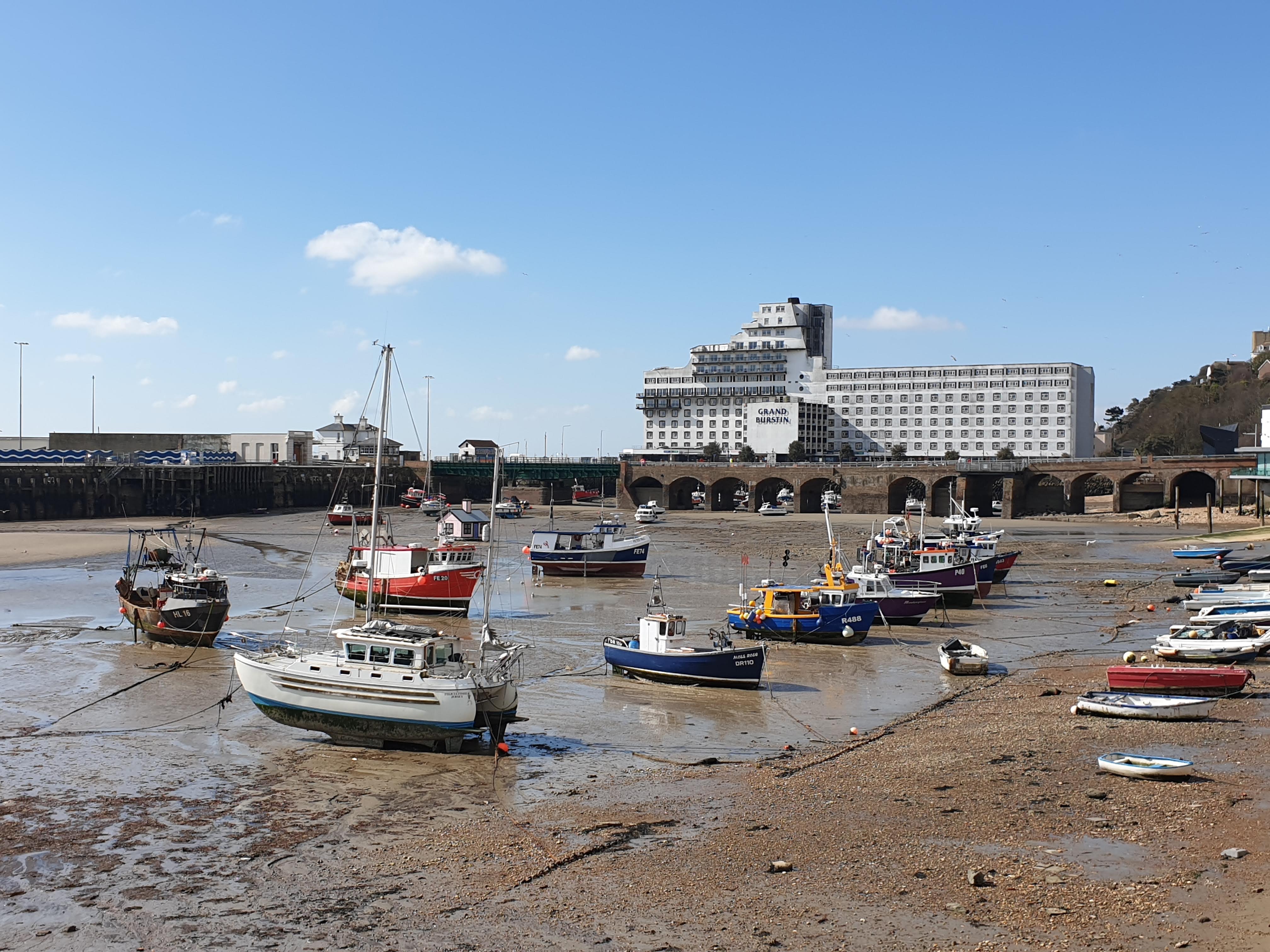
Folkestone may not have enjoyed the cheeky, “kiss me quick” ambience of Margate or Southend, but I loved its quieter, more refined atmosphere. My parents even spoke on occasion of retiring to the resort but, sadly, it never happened – and with my father’s recent death, never will. I’m comforted, however, by the thought that the last break they shared together was in their favourite location (where they thoroughly enjoyed their stay in the much maligned Grand Burstin).
And now my wife and I have means, motive and opportunity to live that dream ourselves. We have been frequent visitors to Folkestone and the other Kentish seaside towns of Herne Bay, Margate, Ramsgate, Broadstairs, Deal and Whitstable in recent years, and loved each for its particular attractions and atmosphere.

But when it became apparent that my father’s life was approaching its end, I asked her which resort she would like to make her home should circumstances one day permit. To my surprise and delight she replied, without hesitation, “Folkestone”.

So now we are presented with the small task of selling two homes in Medway and buying a property on our favoured part of the coast. It is a daunting, but undeniably exciting prospect. At the moment of that fateful decision six months ago, I announced that I hoped we would be able to take up residence by mid to late summer of 2016.

And it isn’t going to be for want of trying – even our customary lengthy foreign holidays might need to take a back seat this year.

So, apart from the obvious charms that the recollection of childhood still wove, what is it that has lured me to Folkestone?

After all, the past forty years have seen the town, in common with many other resorts around the British coastline, decline dramatically as a holiday destination as people took advantage of extended leisure time and the resources to travel abroad. The rotunda and surrounding attractions have long been demolished, the lively, cobbled Old High Street that winds up to the modern town centre fallen into disrepair and many of the businesses dependent upon holidaymakers closed. Even the Sunday market on the rotunda site lost its appeal for the hordes that had once descended upon it from all parts of the county.

Gone were many of the shops selling postcards, beach balls and buckets and spades. Gone were the traditional tea rooms and fish and chip restaurants. Gone were the abundant amusement arcades where I might while away hours on the Roll a Penny, Skee Ball and Coin Pusher games. And gone was the shop with the big picture window at the top of the Old High Street, through which generations of children and adults alike had gaped in awe at luscious sticks of Folkestone rock being mgically brought to life.

But, with extensive investment, much of it courtesy of a notable sugar daddy in Sir Roger de Haan, there have been signs in recent years that the resort is beginning to stir again. The Old High Street has undergone a makeover. One of a kind gift shops, artisanal food stores, and trendy restaurants are emerging, along with a burgeoning artistic community focused on the Creative Quarter.

There may no longer be any cross-channel services, and the former harbour railway station remains overgrown with weeds, but the town’s accessibility from London and the rest of the county has been enhanced by the arrival of a high speed rail service, reducing the journey to the capital to under an hour. And, of course, it is home to the Channel Tunnel and the swiftest escape to the continent.
The East Cliff beach has been re-branded Sunny Sands and is as rammed as it ever was with humanity on a warm day. And there are few better places to play beach cricket when the tide is out.

And, during the summer of 2015, the Harbour Arm, after years of abandonment, re-opened for several weekends with live music and eclectic food and drink outlets decorating its bracing promenade, providing “new” thrilling vistas back across the harbour. Closed for the winter, it is scheduled to resurface on a larger scale in May 2016.

So our permanent residence could not be better timed.

For me, however, the jewel in Folkestone’s crown (only just ahead of the harbour) remains the Leas, once described as “indisputably the finest marine promenade in the world”, a wide clifftop walk with lovingly tended flower beds and glorious views across the channel.

Imposing old hotels speak of the resort’s former glory, none more so than the Grand and Metropole, though now they provide private apartment living. The Leas Cliff Hall is a popular stopping off point for musicians and comedians on tour. I will never forget a hilarious and seemingly never-ending night in the company of Frankie Howerd there during one of those wonderful sixties’ holidays.

On a clear day, you can almost pick out individual buildings on the French coast as you walk past Mermaid Beach en route to the charming neighbouring resorts of Sandgate and Hythe with its access to the world class attractions of Port Lympne Reserve and the Romney, Hythe and Dymchurch Railway, still the smallest regular light rail system in the world, and as thrilling a ride more than a half a century after the first.

At the end of the line, you arrive at Dungeness on the tip of Romney Marsh with its remote beauty (and venue for all night fishing trips with my uncle fifty years ago), and where the abundant birdlife share the shingle with two nuclear power stations and an elegant lighthouse. Dover Castle, Canterbury and Ashford Designer Outlet are all a short drive away.

Despite the loss of the ferry service and crazy golf course, as well as the diminution in the fishing trade, the pretty little harbour and adjoining Stade with its seafood stalls still retain some of the atmosphere that first captivated me fifty years ago.The Guardian newspaper recognised the efforts being made to enhance Folkestone’s appeal by rating it among the world’s best holiday destinations to visit in 2014. Many, especially those who had not visited in recent years, might snigger at the idea, but the town is showing signs that it has a future.

Now, if they could only rebuild the Rotunda and resume playing first class county cricket there ………….

2 So Glad We Made It (August 2016)

Twelve months, two house sales, one flat purchase and much frustration and spasmodic heartache later, we took up permanent residence in Folkestone in early August, on schedule with my wishful prediction when the decision to move here was made. And every night over the dinner table we have interrogated each other as to why we hadn’t done this many years before.

But, of course, there were a number of viable reasons (or were they excuses?) – proximity to ageing parents, financial constraints borne of a meaty mortgage and a bank-busting propensity for expensive, primarily American, holidays, or maybe it was just unwarranted caution.

But there is no value in dwelling on those now.

It is the future that matters.

And the future is Folkestone.

We might have settled into our new apartment a month or so earlier had our sellers – now, let’s put this kindly – not taken a more relaxed approach to moving than us. Firstly, they refused to let the estate agents have a set of keys, insisting that they show prospective buyers around their property themselves. Their prerogative, of course, and they did afford us nearly an hour of their time on two separate occasions, making us tea and establishing a strong personal rapport (or so we thought).

However, the fact that they engineered a seven week gap between those two viewings and prevented the surveyor from examining the apartment for a further month thereafter, explained by a combination of work commitments and regular retreats to their French holiday home, proved immensely frustrating and stressful, by contrast, as progress on the sale of our house in Gillingham proceeded smoothly.

Moreover, half way through the process, and completely out of the blue, their solicitor delivered an ultimatum to us to the effect that we pay a non-refundable deposit of 1% within 24 hours or they would pull out and place the property back on the market. Disaster was averted by the estate agent persuading them that fairness dictated that they put up a similar deposit. An open-ended exclusivity agreement sealed the deal, barring subsequent major catastrophe.

We had viewed eight other properties in the West End of town, none of which remotely matched up in terms of visual appeal, character or size. Once we had seen the property on Radnor Park and submitted an offer at the asking price within five minutes of leaving the viewing it, we were determined that it would be ours. We even took a significant financial hit following the survey on our own house to secure it.
And the physical move was not without its difficulties either. Firstly, despite valiant and agonising attempts to reduce my book collection before the move, enriching the minds of the populace of the Medway Towns into the bargain, there were still a huge number of heavy boxes of books for the removal men, not only to load onto their van at our former house, but to carry up forty one steps to our apartment in the sky at the other end. We may not have taken much in the way of furniture and white goods, planning to buy long overdue new items on arrival, but this was still a challenging task for them in addition to the ninety mile round trip.

They were brilliant by the way.

We have already bought a new washing machine (to replace the one that had served us so well for twenty years) and our first king size bed, incurring the wrath, in the process, of two teams of delivery men doomed to lug them up those aforementioned stairs. I know it’s their job, but we felt a little guilty as we witnessed the grunts and groans that accompanied the manipulation of the items round and over the bannister at each level.

I dread what expletives might reverberate around the building when a new oven, fridge/freezer and wardrobe are delivered in the coming weeks!

But – let’s be fair – they have it easy.

Because, at least in the case of furniture, they don’t have to assemble the blighters!

The manufacturer’s instructions for the bed stated that it would take two people an hour and a half to accomplish.

Yeah right!

Now, I’m arguably the least competent do-it-yourself person on the planet, though my wife, having been brought up by a handyman father and two equally proficient brothers, has some aptitude (and, miraculously, managed to translate the nineteen pages of obtuse drawings into a workable plan).

I may never have been more impressed by her than on that day.

My contribution, such as it was, was to supply the occasional burst of brute strength (again an attribute not commonly associated with me).

So how long did it take us?

Only the seven hours!

Usain Bolt could have run the hundred metres 2,520 times in the time it took us to put that  together!

But it was worth it, even if there is still a niggling worry as we lay our heads down at night that it’s going to collapse beneath us.

The washing machine is working well. It even seems to know when the clothes haven’t quite dried and takes it upon itself to add a few minutes to the cycle. Modern technology eh?

Well, at least we were able to slump in front of the television after our mammoth Saturday morning/afternoon ordeal.

Wrong!

Despite assertions before the move that our Virgin Media services would be installed within a few days of our arriving in Folkestone, we were then informed that we would have had to wait three weeks before we have an operational landline, broadband or TV in the apartment.

Consequently, we did not see a single minute of the Olympics or the start of the Premier League season – oh, and I must not forget the soaps (my wife instructed me to include that). That said, we did catch up with a lot of movies and television series on DVD that we have not seen for years, or, in some cases, not even taken the outer sleeve off!

Telephone access is not a problem as we have mobile phones, but obtaining meaningful Wifi access (other than on said devices) has necessitated expensive daily trips to the coffee shops of Folkestone (I’m on my second flat white of the morning in Costa Coffee as I write this).

I would not wish any of the above to give you the impression that we are regretting the decision to move.

Far from it.

The glorious skies, near constant sunshine (so far), even the noisy but necessary birdlife have all been a joy, and Bob’s and Chummy’s at the harbour, Rocksalt, Copper and Spices, Django’s, the Lighthouse Champagne Bar at the end of the Harbour Arm, the Grand, Steep Street coffee house and others have all benefited from our custom over the past fortnight.

A significant added and unexpected bonus has been my wife’s transfer from Chatham to Folkestone, converting a round trip drive of more than two hours into a ten minute walk to her new office.

We had planned to head out west in late September for a few weeks. This was diluted to a week in Italy as the exchange rate plummeted following the EU referendum (I refuse to use THAT word).

Now, we have decided to stay at “home” and acclimatise ourselves to our new surroundings. After all, there is a sense that we are still on holiday and staying in somebody else’s apartment, but I’m sure that will recede as autumn and winter approach (or will it?).

But when I can gaze upon views like those below every day I feel blessed, and any temporary and trivial hardships, before, during and after the move, simply fade away (unlike love).

3 Calling Folkestone Home (September 2016)

Now that another month has passed, and with the climate gods continuing to shine upon us, we are beginning to feel that this is now our permanent home.

The frustrating saga of our landline, cable and broadband installation is finally over after forty two tortuous days.

Hold on, the more discerning among you will exclaim, you said it was being completed after three weeks. And you would be right.

The engineer duly arrived (very late) on the appointed date and immediately announced that he was unable to carry out the job because he would need a longer ladder (you couldn’t make it up), and he had not been informed that we lived on the second floor (the company was fully aware of this).

This resulted in a further three week delay before our services would be installed. No amount of pleading, complaining or threatening on our part could bring the appointment date forward.

The more observant reader would also have wondered why, in the absence of cable television coverage, we did not invest in an indoor aerial and take advantage of the Freeview channels installed in any modern appliance.

We did.

But only after four weeks!

And, again, that was my wife’s idea.

But the saga is now well and truly over.

We have now, in addition to the aforementioned bed and washing machine, purchased a new fridge/freezer and oven, perpetrating an epidemic of hernia repairs among local delivery men in the process.

My wife has settled into her new office in town.

We are on first name terms with two pair of crows that have taken up residence in our beech tree. They love nothing more than to join the ducks in the fishing lake and the gulls on the roof in a chaotic (pre-) dawn chorus.

Our collection of eateries and watering holes continues to rise, with the Cliffe Restaurant in the View Hotel quickly becoming a favourite.

And we have entertained guests from Norwich and Philadelphia.

For now then, it is fair to say that the fabulous Folkestone fairytale continues.

Cynics will sneer at what they perceive to be an overly positive initial impression, and I acknowledge that the rose-tinted spectacles haven’t been discarded yet. However, I offer the following:

1 The people of Folkestone, especially in the retail and hospitality sectors, have largely been friendly and cheerful. And I have been particularly impressed by the courtesy of drivers towards pedestrians around town; and

2 Folkestonians appear to care for their physical surroundings too – flower displays and other open spaces are lovingly tended, littering is less visible than in many other places I have lived in and visited and there is extensive renovation and redecoration of buildings going on, especially near the seafront.

I am very conscious, however,  that Folkestone is no more immune from the contagion of drunkenness and lawlessness that infects town centres across the country. The recent attack on a group of innocent bystanders in the early hours of the morning in Sandgate Road is not the only such incident since we have been here. I will not shy away in future from highlighting negative as well as positive features.

As the council gardening staff begin to dig up the flower beds along the Leas under another limpid blue sky that belies the reality of today’s Autumn Equinox, my thoughts turn to the next six months. Most of the time I have spent in Folkestone, as child and man, until now has been during the summer or in the late spring. But whilst I might mourn the imminent passing of hot, sunny days, I am excited at the prospect of witnessing winter storms crashing (but not damaging further) Coronation Parade and walking from Mermaid Beach into Sandgate and Hythe on cold, crisp February mornings.

The next phase of our Folkestone story awaits!

wp-image-437107990jpg.jpg

Read Full Post »

Older Posts »