Feeds:
Posts
Comments

Posts Tagged ‘Folkestone’


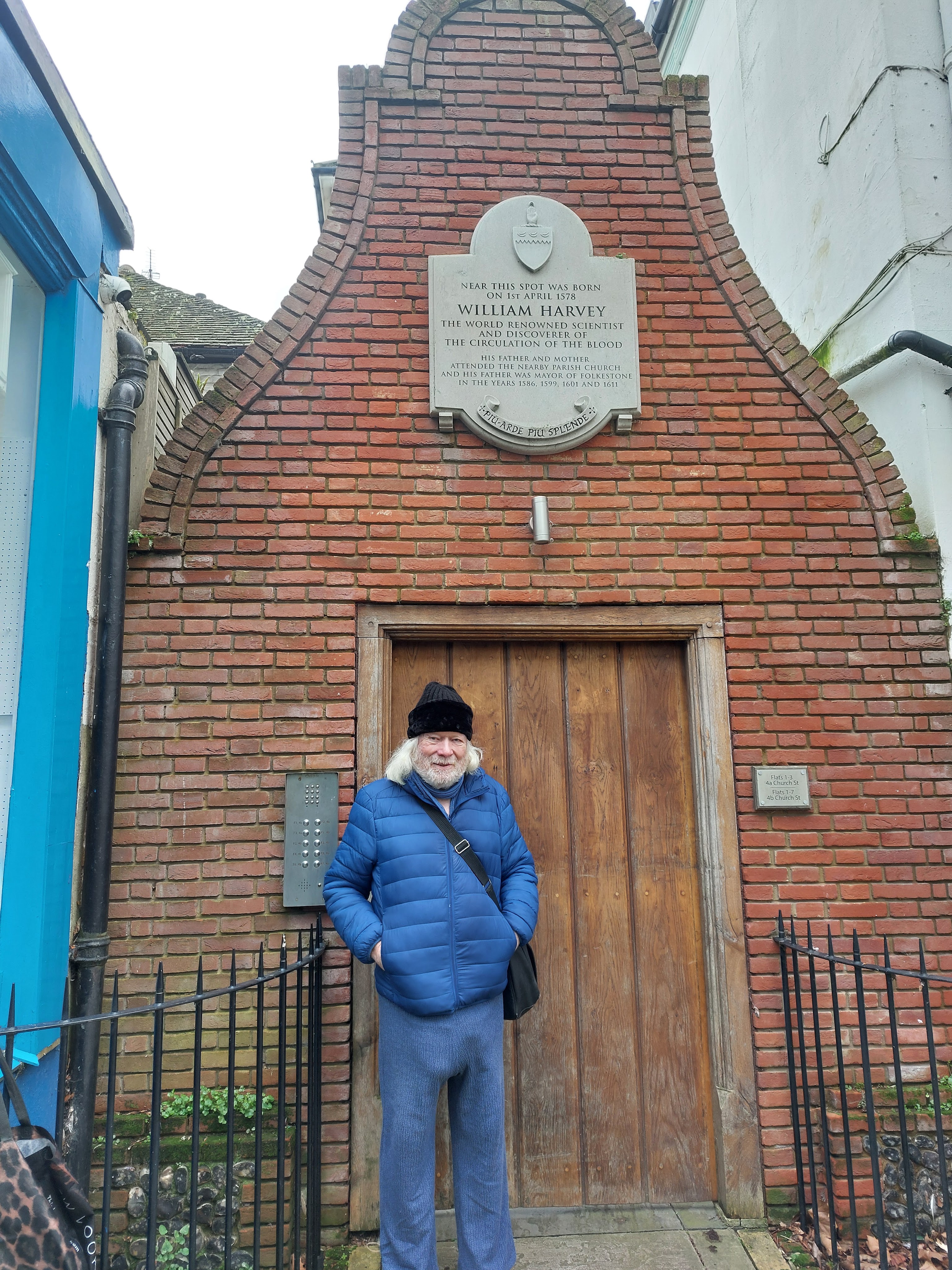
One of the most familiar figures in Folkestone town centre, with a shock of white hair sprouting out of his hat, and a bag of papers on his arm, is an octogenarian Irishman who reluctantly moved here in 1963 and never left.

The first time I met this man was shortly after I moved to the town in late 2016. I had decided to offer walking tours and was anxious to consult as many people as possible, not only to assess the interest in the project but also to tap into the experience of those who had previously done this.

The name that kept coming up as the best person to speak to was Eamonn Rooney, whom I was already aware of through buying some of his books on the history of the town.

But there was one snag – he was not the easiest person to track down as he was not on social media. But I managed to find him in his favourite coffee shop where he went every morning. He was sat in a corner of the restaurant with mug, pen, paper and books spread across the table.

And now, almost a decade later, I sat down with him again, in that very same cafe, on the eve of his 82nd birthday, to chat with him about his long association with Folkestone.

Born in Newry in 1944, spanning the counties of Armagh and Down, Eamonn was an average but lazy student. It was the influence of Mr O’Neill, his English teacher, and Mr McCourt, his Art teacher, that encouraged him to take his studies more seriously, though he was later told he “would never amount to anything” by the nuns who ran the school he attended in Belfast.

It was his parents who brought the name of Folkestone to his attention. So, in the spring of 1963, he took a trip, only intending to stay for a short while.

On arriving at Folkestone Central he was struck by the flower displays on roundabouts (after all, it was “Floral Folkestone”). He was impressed with The Leas (a “pleasant surprise”) and Kingsnorth Gardens (still a “hidden gem”).

His first encounter with a Folkestone “celebrity” occurred in the photocopy shop opposite Grace Hill Library. He started talking to American actress, singer (she starred in the long-running rock musical “Hair”), and mother of Mick Jagger’s son, Karis, Marsha Hunt, who was sending a fax (remember those?) to the USA. She said that she would never be able to remember his name, so christened him the “History Man”, and thereafter referred to him as that whenever they met, usually at the supermarket or Metropole jazz club.

On the recommendation of his brother who had just been demobbed from Shorncliffe, he took a summer job, but it was as a bus conductor that he first established himself in the town, and for which he is still fondly remembered. His route for 8 years primarily covered Cheriton, Morehall and the bus station and, as a result, the rest of the town remained largely an unknown quantity for him.

Time to buy a street map!

He had been told that Folkestone was primarily a Victorian town, so had “written off” the Bayle and the Old High Street as places of interest. But one day he met the watermills and windmills expert, C.P.Davies, whom he regards reverentially to this day as the preeminent local historian, who told him that there was “a lot of history” in Folkestone with a (buried) Roman Villa, significant Anglo-Saxon heritage, not to mention an extensive military history.

That was the moment when the “History Man” discovered his holy grail, starting a decades long love affair with the Heritage Room on the first floor of the Grace Hill Library. Eamonn was devastated when Davies retired shortly afterwards.

He also fondly remembers Amanda Oates of Shepway District Council who was responsible for organising events at the Lower Leas park Amphitheatre. Since she left, the facility has been sadly neglected.

The history research was all well and good, but he still had to earn a living. After being rejected by several Park Farm factories he was offered a job at FWM Plastics, followed by Silver Spring and Portex, for whom he worked for 15 years. It was during this time there that his writing career began with articles in the company’s Blue Line magazine and then the Portex and Folkestone camera clubs. And in 1985 he founded the local history society with Charles Whitney (chair), Alan Taylor and Peter Bamford.

In the early nineties, he took a three day a week job at the much lamented Martello No.3 visitor centre with an evening security role in the Leas Cliff Hall, followed by a winter job at the seafront car park. Between 1989 and 1996 he not only performed the role of town greeter but also delivered tours on behalf of the New Folkestone Society.

But it was in 1995 that the role for which most people remember him presented itself. Shepway Council had a vacancy at the Leas Lift, a position for which Eamonn’s undoubted customer facing skills made him ideally suited. When the council relinquished the lift in 2009, he was approached by the Folkestone Estate to take responsibility through a management agreement (CIC). With Terry Begent agreeing to handle all the business affairs, they formed a “dream team” until the lift closed in 2017, and it is a matter of great sadness to Eamonn that it remains closed (though, we hope, not for much longer).

Eamonn has more stories from his time as a tour guide than I have space for. One I particularly like is when he showed an American party into the British Lion pub, and as they were leaving, was asked “hey, buddy, aren’t we going to have what you Brits call a swift half before we go”? After the obligatory few drinks, Eamonn began to thank the group for joining the tour when the same guest enquired “hey, aren’t you going to finish the tour?”. Which, of course, like any self-respecting guide, he did.  

Eamonn finds it remarkable that the young teenager who left Northern Ireland with no immediate prospects should meet an array of prominent individuals in his adopted town over the next sixty years. In addition to Marsha Hunt, these included Lord Radnor himself at his Wiltshire castle, Eastenders actress, Michelle Collins, whom he met at a BBC Wales interview, and Prince Harry at the opening of the Step Short Arch on the centenary of the outbreak if the Great War on 4th August 2014.

Eamonn has utilised his research to publish many books and pamphlets on Folkestone’s history, both on his own and in collaboration with others, notably Alan Taylor and Terry Begent. Asked which he was most proud of, he cited the history of the Belgian refugees at the outbreak of the Great War and the illustrations and text he provided for   

John Rice’s Folkestone: A Photographic Record.

And the next? Probably Stuart Folkestone.

Whatever it might be, I for one will be buying it.

Happy Birthday Eamonn, may you have any more!
Read Full Post »


A biting breeze and thin drizzle

Denote December’s inevitable

If uninvited return;

Twilight descends

In the ancient churchyard.

Never has the phrase

“Quiet as the grave”

Seemed more apt.

As I pause to tie my bootlaces

By the Town Cross, venue for

Mayor making for centuries,

My body shudders as

A young woman brushes past,

The hem of her blue dress

Grazing the grass border

And her white headpiece

Fluttering in the wind.

She carries provisions –

Bread, leeks and a

Small flagon of beer –

For the poor of the parish

In a round wicker basket,

Forswearing another

Potentially lucrative tryst

With a Northumbrian nobleman,

Orchestrated by a despairing father.

Her head bowed, she whispers

“Good evening, sir, God be with you”.

Before I can frame

An intelligible response,

She disappears behind the west window. 

Composing myself as best I can,

I shamble past unremembered tombs,

Narrowly avoiding a collision

With a rat scuttling across my path

To the comparative sanctuary

Of the lopsided lychgate

Leading into Church Street.

Read Full Post »


This is a writer’s town.

Where, in quiet corners of coffee shops,

Caressing cake and cappuccino,

On new varnished cliff top benches, 

In tiny studio apartments,

And above galleries and gift shops,

Diligently, they polish their craft

In solitude and patient struggle.

Where, down the steep, unforgiving hill,

Past higgledy-piggledy buildings

That shelter the secrets of centuries,

Old men, like modern day gunslingers,

Shuffle with shabby, sagging satchels

Stuffed with story scraps and post-it notes,

Lassoed around their wrinkled necks.

Where restless waves wash over shingle,

Shifting the site of a billion pebbles,

And where small, redundant, fishing boats,

Their hulls rotting and history forgotten, 

Are nudged and tickled by the turning tide

And then left for dead as the sea sweeps back.

Where, on a mile long thoroughfare

Of lawn and flowers and grand hotels,

Echoes of genteel, whispered discourse

Float across the unremitting breeze,

And the plaintive cry of a seagull chick

Resonates across the ragged rooftops.

Where the solemn chimes of an ancient church

Dedicated to an Anglo-Saxon girl,

Ring out at dusk under Shelley’s pale moon,

And where cracked, crippling, steep steps

Unsettle the anxious wandering scribe

Searching seaward for that elusive line.

This is a writer’s town.ffee shops,

Caressing cake and cappuccino,

On new varnished cliff top benches, 

In tiny studio apartments,

And above galleries and gift shops,

Diligently, they polish their craft

In solitude and patient struggle.

Where, down the steep, unforgiving hill,

Past higgledy-piggledy buildings

That shelter the secrets of centuries,

Old men, like modern day gunslingers,

Shuffle with shabby, sagging satchels

Stuffed with story scraps and post-it notes,

Lassoed around their wrinkled necks.

Where restless waves wash over shingle,

Shifting the site of a billion pebbles,

And where small, redundant, fishing boats,

Their hulls rotting and history forgotten, 

Are nudged and tickled by the turning tide

And then left for dead as the sea sweeps back.

Where, on a mile long thoroughfare

Of lawn and flowers and grand hotels,

Echoes of genteel, whispered discourse

Float across the unremitting breeze,

And the plaintive cry of a seagull chick

Resonates across the ragged rooftops.

Where the solemn chimes of an ancient church

Dedicated to an Anglo-Saxon girl,

Ring out at dusk under Shelley’s pale moon,

And where cracked, crippling, steep steps

Unsettle the anxious wandering scribe

Searching seaward for that elusive line.

This is a writer’s town.

Read Full Post »


Oh, where have you been, my blue-eyed son?
And where have you been, my darling young one?

I stumbled and I fell into a dozen large potholes
I slipped and I slid on a hillock of dog poo

I tripped and I got cut on steps to the harbour
I’ve been by the seashore where waves were a-lashin’

I’ve been stood by a tower whose paint was a-peelin’

And it’s a hard, it’s a hard
It’s a hard, it’s a hard
It’s a hard times in Folkestone.

Oh, what did you see, my blue-eyed son?
And what did you see, my darling young one?

I saw piles of old clothes in empty shop doorways

I saw neglected buildings with sharp, shattered windows

I saw roadworks and barriers on every street corner

I saw half-eaten hamburgers tossed in the gutter

I saw discarded needles in the narrow, dirty alley

And it’s a hard, it’s a hard
It’s a hard, and it’s a hard
It’s a hard times in Folkestone.

And what did you hear, my blue-eyed son?
And what did you hear, my darling young one?

I heard the sound of the seagulls circling the chip shops

I heard the whistling of wind around beachfront apartments

I heard teenagers speak with scanty vocabulary

I heard adults speak with swear words a-plenty

I heard a helicopter hovering above a small park

And it’s a hard, it’s a hard
It’s a hard, it’s a hard
It’s a hard times in Folkestone.

Oh, what did you meet, my blue-eyed son?
And who did you meet, my darling young one?

I met visitors staring at signs near the station

I met lines of sad people queuing up for free food

I met rough sleepers drunk in a garden of flowers

I met men passing white packets to children

I met women who asked if I wanted company

And it’s a hard, it’s a hard
It’s a hard, it’s a hard
It’s a hard times in Folkestone.

Read Full Post »


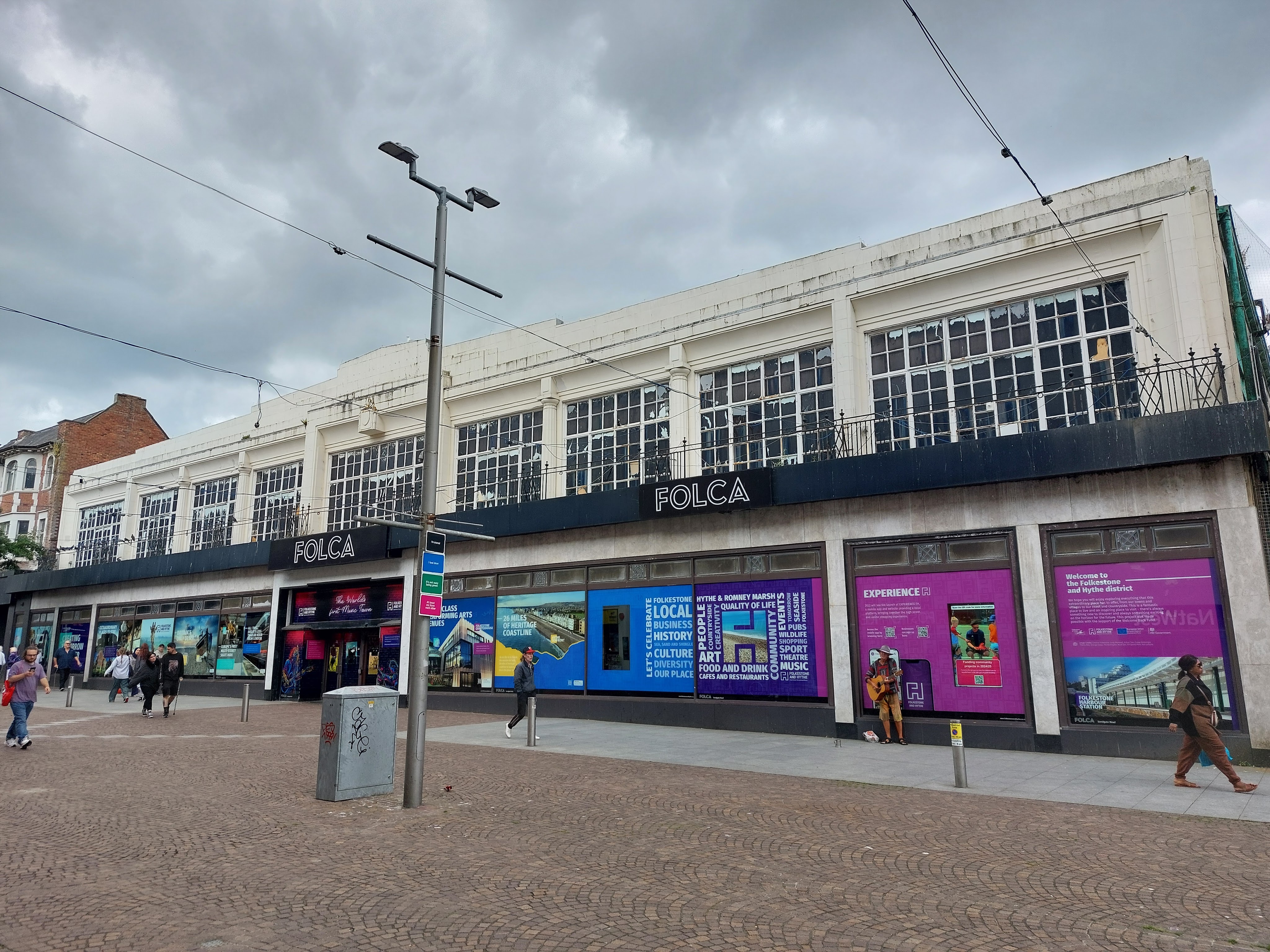
Picture the scene – one of the checkouts at Morrisons supermarket on Cheriton Road in the late summer of 2018.

I have placed my shopping on the conveyor belt along with my walking tour embossed satchel.

As the middle aged woman on the till begins to ring through my fresh tagliatelle, packet of arrabbiata sauce and bottle of Montepulciano d’Abruzzo – enough to begin with to raise her eyebrows at – she spies my bright red bag.

The conversation goes like this.

Woman (sniffily)

Folkestone Walking Tours – hmmm. What’s that mean?

Me (enthusiastically)

I deliver walking tours of Folkestone.

Woman (inquisitively)

Oh. You’re from Folkestone then, are you?

Me (informatively)

No, I moved here two years ago.

Woman (aggressively)

I’ve lived here all my life. What makes you think you know all about it then?

Me (pleasantly if defensively)

I certainly don’t. But I love Folkestone, having spent my holidays here as a child. And I want to share that with visitors and others,

I’ve also done a lot of research and talked to many people who are lifelong residents.

Woman (distrustfully)

Well, it doesn’t sound right to me.

Me (helpfully)

Perhaps you could come on one of my tours and see for yourself? You’d be very welcome.

Woman (irritatingly)

That’s not my sort of thing. Besides, I can’t walk very far.

I bag my Italian feast for two, pay and make my excuses.

I should finish by making it clear that I had nothing to do with the fire that raged through the building a couple of months later.

Read Full Post »


Many of our trips to San Francisco have coincided (intentionally) with the free Hardly Strictly Bluegrass festival in Golden Gate Park over the first, invariably warm, weekend of October.

There have been a number of high spots over recent years with regular performances in particular from Steve Earle (with a guest appearance from Bob Weir of the Grateful Dead), Emmylou Harris (who traditionally closes the festival), Jack Casady and Jorma Kaukonen, guitar gods from Jefferson Airplane, the Neville Brothers, John Prine, Robert Plant, the Blind Boys of Alabama and Moonalice who performed a set of songs penned by the then recently deceased Robert Hunter, principal lyricist for the Grateful Dead.

The atmosphere could not be further from the corporate, money-driven ethos of Glastonbury and similar events and fitting that San Francisco where, along with other Californian venues, the concept of free outdoor rock festivals effectively originated in the late sixties.

But the highlight for me came in 2019 with Judy Collins. But before that I need to take you back twelve months to San Rafael in Marin County. A store owner friend of mine in Folkestone asked if I could deliver a note to Phil Lesh, the former Grateful Dead bass player, at his performance/dining venue at Terrapin Crossroads (sadly now closed, though the music lives on).

Not only was I able to deliver the note, which stated that she had adored him since the Europe ’72 tour, successfully but I also had the opportunity of a few minutes chat with the great man, who signed a postcard of his own for me to pass on to her on my return.

So pleased was my friend that I had succeeded in achieving a task that might not unreasonably have been perceived as unlikely – after all, Phil didn’t rap with random British guys in his bar every day – that she set me an even more challenging task twelve months later.

It appears that she had been as besotted with Judy Collins’s music for more than half a century as she had been with Phil Lesh’s music over the same period of time. So she asked me to deliver a letter from her to Judy on the afternoon that she was performing.

Now walking across a barroom floor to request a quick chat with a music superstar is a piece of cake compared to gaining access to another legendary artist in the middle of one of the world’s largest parks and when there are tens of thousands of other people in close proximity.

The afternoon arrived, and as the appointed time for Judy’s set approached, I gingerly made my way to the front of the stage – there did not appear to be an obvious place to go “backstage” – I was accosted, firmly but politely, by a burly African-American gentleman who may have been thinking I was getting a little too close.

I explained my predicament – which, even to my own mind, seemed a bit odd. He listened carefully and took the letter from me without making any promises. I did not hold out much hope for a positive response, but around five minutes later he returned in a similarly measured way and informed me that “Miss Collins has received the note”.

My joy would have been unconfined had Judy referred to it whilst she was on stage, but she did not. She did, however, sing Both Sides Now to me – well, me and many others – on my birthday.

Read Full Post »


A biting breeze and thin drizzle denote December’s inevitable but uninvited return. Twilight descends on the ancient churchyard.

Never has the phrase “quiet as the grave” seemed more apt. 

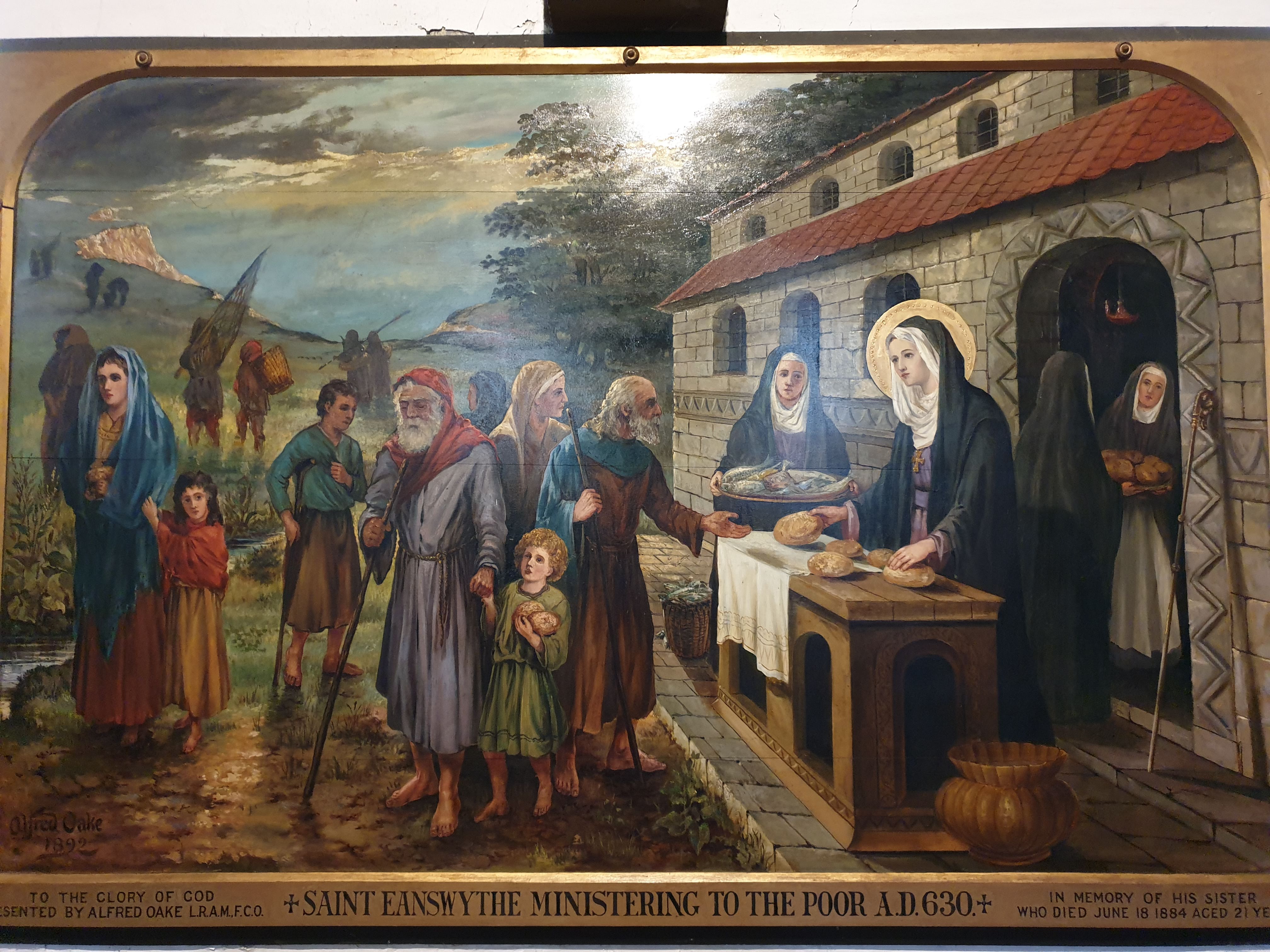
As I pause to tie my bootlaces by the Town Cross, venue for the making of mayors for many centuries, my body shudders as a young woman brushes past me, the hem of her blue dress grazing the grass border, and her white headpiece fluttering in the wind. She carries provisions – bread, leeks and a small flagon of beer – for the poor in a round wicker basket, forswearing another potentially lucrative tryst with a Northumbrian nobleman, orchestrated by her frustrated father.

Her head bowed, she whispers “Good evening, sir, God be with you”. Before I can frame an intelligible response, she disappears behind the west window.  

Composing myself as best I can in the circumstances, I shamble on past the crumbling tombs, narrowly avoiding a collision with a rat, scurrying across my path to the sanctuary of the lopsided lychgate leading into Church Street. The Pullman pub is empty, save for a few flickering candles and a lone member of bar staff deep in conversation with his mobile phone. 

The lanterns of Rendezvous Street are unusually dim, and the restaurants are sparsely populated. 

The stillness is unnerving, but strangely thrilling.

I turn into the narrow, twisting, rain drenched street that slides down towards the harbour.

Many months have elapsed since chaotic, cacophonous Charivari had snaked up that old thoroughfare, all drums and whistles and cymbals, and other less conventional instruments. More recently, the ground had groaned beneath the burden of polished, red-laced “Doc” Martens, worn by follicly challenged pilgrims lumbering towards Gillespie’s and The Ship for an afternoon of Special Brew, and worship at the altars of Prince Buster and The Specials.

I am alone.

But am I?

The fog in my brain mirrors the slowly enveloping mist approaching from the bottom of the hill. Images of times past in this salty, saintly town start to consume my thoughts. 

Nothing is quite what it seems.

My longing for one last lingering look at the dazzling, daily alchemy conjured up in the rock shop near the top of the street Dickens christened a “crippled ladder” is soon answered. The heady, fashionable aromas of craft beer and Nicaraguan coffee cannot compete with the memory of the sickly sweet perfume radiating from that beloved spot, where, nose squashed against the glass, a small boy gasped in awe at the thick, long sticks of heaven being rolled.

“Let me in at the front, Michael, you’ve been stood there for ages”, pleads his tearful younger sister, Anna, her view obscured by the taller girl stood in front of her.

“Have they started giving out the bags of broken bits yet?”, another boy bellows from further back in the crowd.

A sudden, excited scrum confirms his suspicion as I catch an intoxicating whiff of granulated sugar.

It was often claimed that if Rowlands were to shut its doors for good, Folkestone would die; a prediction, thankfully, since proven dramatically wrong, 

I stumble into Steep Street Coffee House for cake and cappuccino, a combination that never fails to comfort. I am their last customer of the day and the staff, without being obtrusive, are cleaning up around me. The self-styled Folkestone Poet has vacated his customary sales pitch across the cobbles at Big Boys Burger, his heavy overcoat and leather balaclava no longer a match for the diminishing temperatures. 

I pass by Marley’s – or what I thought was Marley’s. From a dark upstairs room, redolent of patchouli and cigarette smoke, a loud, piercing jukebox exhorts me to “go to San Francisco” a seductive reminder of the original Summer of Love on such a bleak winter’s evening.

Two young men in afghan coats, and a messy profusion of facial hair, are huddled at the foot of the crippling, crumbling Bayle Steps. 

“Hey man, how’s it going?”

“Far out, whatcha doing’ tonight?”

“Going’ to Archies. The Lonely Ones are playing”.

Nice. I hear there’s some hot Swedish chicks in town too”.

“That’s settled then, Archie’s it is”. 

“Yeah, and I could kill for one of his salami rolls right now”.

I start to follow them through the door, only to find that the closer I get, the scene dissolves in the moist air, and I am left once more outside Marley’s rather than the Acropolis

The piercing cold slices through my flimsy denim jacket and hastens my progress to the bottom of the street. Everything is still again as I try to rationalise the scenes I have encountered in the past half an hour. 

I cross a deserted Tram Road car park and pass under the arch by Ovenden’s old forge into the empty fish market, tiptoeing around the grimy puddles that tend to settle there, whether it has rained or not. 

A solitary gull plods apologetically past, pining for Spring and the reopening of Chummy’s and Bob’s seafood stalls, when it will again be afforded means, motive and opportunity to ambush tourists for their fish and chips and tubs of whelks.

Pausing outside The Shell Shop, I appear to have stepped into an earlier time again. Men in cloth caps and heavy, seaweed encrusted boots trudge up the slipway opposite, lobster pots and herring nets half empty after an exhausting and disheartening shift. They slap their meagre catch on the floor of Fish Shed One, light cigarettes and congregate in whispered conversation.

‘Darkie” Fagg, “Cottage” Featherbe and “Lobby” Spearpoint are leaning on the railing and reminiscing about better days, while Old Ned Saunders, retired these ten years, is mending the sprat nets for a “free” pint or two in The Oddfellows Arms later this evening. 

On The Stade, wives and daughters juggle the demanding tasks of cleaning fish and supervising the smaller, and not so clean, children. 

Observing this picture, it is difficult to gauge which gender had the tougher life.

Meanwhile, grubby, barefoot young boys, oblivious to the dedication and drudgery of their elders all around them, chalk stumps on the wall of Clouts Alley.

“I’ll be Jack “Obbs, you can be Clarrie Grimmett. I’ll ‘it you into the “arbour, every time, just you see” brags nine year old Harry Sharp.

But with his first delivery, Clarrie, better known about these parts as Edmund, and, later years, “La La”, Taylor, traps Jack in front of his wicket and appeals for leg before.

“Owzat! Got you with me flipper, pom”.

A heated dispute follows, culminating in the great English batsman hurling his bat against the wall and storming off in the direction of Redman’s boat builders.

His mother, ankle deep in half gutted dogfish and three scruffy toddlers, calls: 

“Harry, your tea is ready. And find your brother before you come in”.

“Five more minutes, mum. I’ve got to bowl Don Bradman out first. it won’t take long”.

“Five more minutes, my arse – you’ve got thirty seconds. This tea won’t wait. If you don’t get to the table soon, the other kids will have your share”

A case of bad mum stopped play.

As this scene of family harmony evaporates, I hear, from across the harbour, a sergeant major’s earsplitting admonition to “Step Short”  to a long procession of uniformed men stomping down the slope from the Leas above.

The rhythmic sound of boots on concrete is accompanied by raucous renditions of Pack up Your Troubles in Your Old Kit Bag and It’s a Long Way to Tipperary, as the soldiers march to the waiting ships that will take them to the Western Front.

But there is one last treat before their sombre adventure begins.

Inside the harbour station waiting room, two formidable middle aged women adjust their pinafores and rearrange any curls that have slipped beneath their flower bestrewn boaters. They inspect the massive urns containing the last hot, strong tea most of these men will ever drink.

“Come on boys, form a straight line, you don’t have long, you know”, Flora Jeffrey cries out with a tinge of regret in her voice, while her sister Margaret cuts thin slices of trench cake and bread pudding to complete what, for many of these condemned men, will be their last meal.  

“And don’t forget to sign the visitors’ book before you do”.

“All right, all right, you sound like me muvver – nag, nag, nag”, one private who claims to be twenty one but looks barely sixteen, retorts, as he lurches towards Margaret and slurs:

“Give us a kiss”.

But before he can perfect this unwise manouevre, a grizzled veteran of Mafeking and Ladysmith yanks him back by his collar and barks:

“Show the ladies some respect, young ’un’. You ain’t in the playground now, y’know”.

“Sorry, old timer, I didn’t mean nuffin’ by it, it was just a bit of fun”.

Flora chuckles: “You got off lightly there, my boy, that’s nothing to what Margaret would have done to you if you’d got any nearer!”.

An outpouring of communal hilarity is unleashed, and the embarrassed teenager slinks back into the anonymity of the crowd.

I separate from the excited, but fearful, throng with the final strains of Keep the Home Fires Burning ringing in my ears, and join the boardwalk that connects the station with the base of the thirty year old water lift along the beach to the west. 

But I have hardly stepped foot on the old railway sleepers before finding myself in the midst of a large conglomeration of buildings, including a swimming pool, boating lake and fairground rides.

As I try to take all this in, a crew cut kid in knitted cardigan and khaki shorts can be seen rushing into a huge, dimpled dome that is destined to be his whole world for the next two weeks. He will never tire of rolling a penny for plastic motor cars or shooting a steel ball into a hole for packets of mints.

His father and mother, the latter clutching a wad of what appear to be tickets, frown as they dismount from the blue plastic seats they have occupied for the past two hours, where they had been subjected to an increasingly annoying loop of “legs eleven”, “two little ducks, twenty two” and “two fat ladies’ eighty eight”. 

The boy drags himself from the penny pusher slot machine and scampers towards them in a frenzy of excitement.

“How many wins did you get, mum?”.

“Eight”.

His heart sinks. “Oh no, that big cuddly monkey on the bottom shelf is nine wins. Can you play some more games and win it for me?”.

“We don’t have time, darling; besides dad and I want that nice set of tea trays that are eight wins. They will be just perfect for our TV dinners when we get home”.

“Boring”. 

Feeling betrayed and despondent, the boy skulks off in the direction of the Runaway Coaster.

But he is soon appeased by a promise to go to his favourite fish and chip restaurant in Tontine Street for tea.

Intermittent drizzle and mist has given way to steady rain and a thickening gloom. Hungry and shivering, I resolve to return home. 

Christmas lights bestride the street across the ragged rooftops, and retailers and restaurateurs contend for the accolade of best dressed window, though tonight there is nobody about to judge them. 

Apart from the echo of my boots upon the sodden cobbles, silence is restored.

Until I reach Archie’s.

From that same gloomy upstairs window from whence the Flowerpot Men had serenaded me two hours – and a hundred and fifty years – earlier, the Small Faces remind me that:

“It’s all too beautiful”. 

After the battering my senses have taken this evening, I remain to be convinced of the veracity of this hypothesis.

So I try, for the second time, to gain access to the old haunt of hippies and radicals.

As I take my first hesitant steps in its direction, fully expecting to find myself in Marley’s again, the doors open of their own accord and I am permitted to enter.

And there, waiting to greet me, is the original owner, Mickey Argegrou, who is anxious to introduce me to his special guests for the night. 

To my astonishment, St Eanswythe is here. The modest blue and white garments she had been wearing during our perfunctory encounter in the churchyard earlier have been replaced by brightly coloured, patterned flower dress and matching peaked hat. She is sampling her first ever cup of coffee and, judging by the uncharacteristic grimace that quickly follows, she is unlikely to order a second. Water from her own spring and the occasional small goblet of mead will remain her preferred tipples. 

With the final troop ship of the day, Engadine, set sail for Boulogne, and the Mole Cafe consequently closed, the indomitable Jeffrey sisters have swapped their pinafores for elegant three quarter length dresses. They appear to be conducting a taste test of Mickey’s famed rum babas, comparing them in the process with their revered fruit cake.   

John Brickell, still in his overalls and safety cap, is here too. He has disappointed his vast army of young fans by holding back the remnants of today’s rock rolling, handing the broken bits around to the grateful regulars, who find them a perfect accompaniment to their cocktails. 

And Harry Sharp, grown in the past hour into a handsome young man, but still smarting from his first ball duck at the Clouts Alley Oval, is feeding the jukebox, while Old Ned Saunders, released from his net repairing duties, though not separated from his favourite fisherman’s jumper, for the evening, is leading a communal sing along to the latest tune selected by Harry:

“Those were the days, my friend”.

After the scenes I have witnessed this evening, I am inclined to agree. 

Read Full Post »


Waves sweep through railway arches

And Rip Tide and Isabella,

Sea Warrior and Connemara,

Long time inner basin residents,

Swing and sway

To a soaring seagull symphony.

Folkestone’s Marmite building too

Comes to life once more;

Buses from Runcorn, Rhyl and Redcar

Offload oversized congregations,

Suitcases outnumbered by

Disability impedimenta.

The quayside is converted

From pedestrian thoroughfare

To geriatric racetrack

As mobility scooters

Scatter unwary walkers,

While rickety zimmer frames

Clog up the wide, windowed doorway.

An elderly couple from Cleckheaton,

Weary and windswept from seafront stroll,

Stagger from harbour fish bar

To plant their tired torsos

On the refuge of roadside benches.

Weekend specials are back on the menu,

With almost every still standing Sixties star

Scheduled to perform in the coming months.

Inside, there’s not a spare seat

In the suffocating heat of the lounge bar;

Tables are laden with leftover sandwiches

And half empty glasses of gassy beer;

Debate lurches from Covid controls

To rabid rants about refugees,

Inflamed by hate-filled headlines

In the crumpled copies of the

Daily Mail and Daily Express

Left lying on abandoned chairs.

Another bus, bound for Margate,

Sandwich, Canterbury or Chatham,

Parks outside to await the sedentary rush

From couch to coach in thirty seconds;

Its passengers forsaking Folkestone

No sooner than they have arrived,

Only to return to eat and sleep tonight

Before escaping again to towns

No more deserving of their patronage.

Dover Docks and Cap Gris-Nez

Lurk somewhere beyond the growing gloom;

What catastrophes might be unfolding

On that slim, unstable stretch of water?

A headless chicken on Rocksalt’s roof

Reddens and revolves in sudden frenzy,

While in the ballroom along the road

A bingo caller hollers “two fat ladies”

To a sparse but satisfied audience.

As the sun punctually dips down

Beyond the Jelly Mould Pavilion,

The receding tide meanders 

Through the East Head gateway,

And the inner harbour boats

Collapse back on their sides.

Read Full Post »


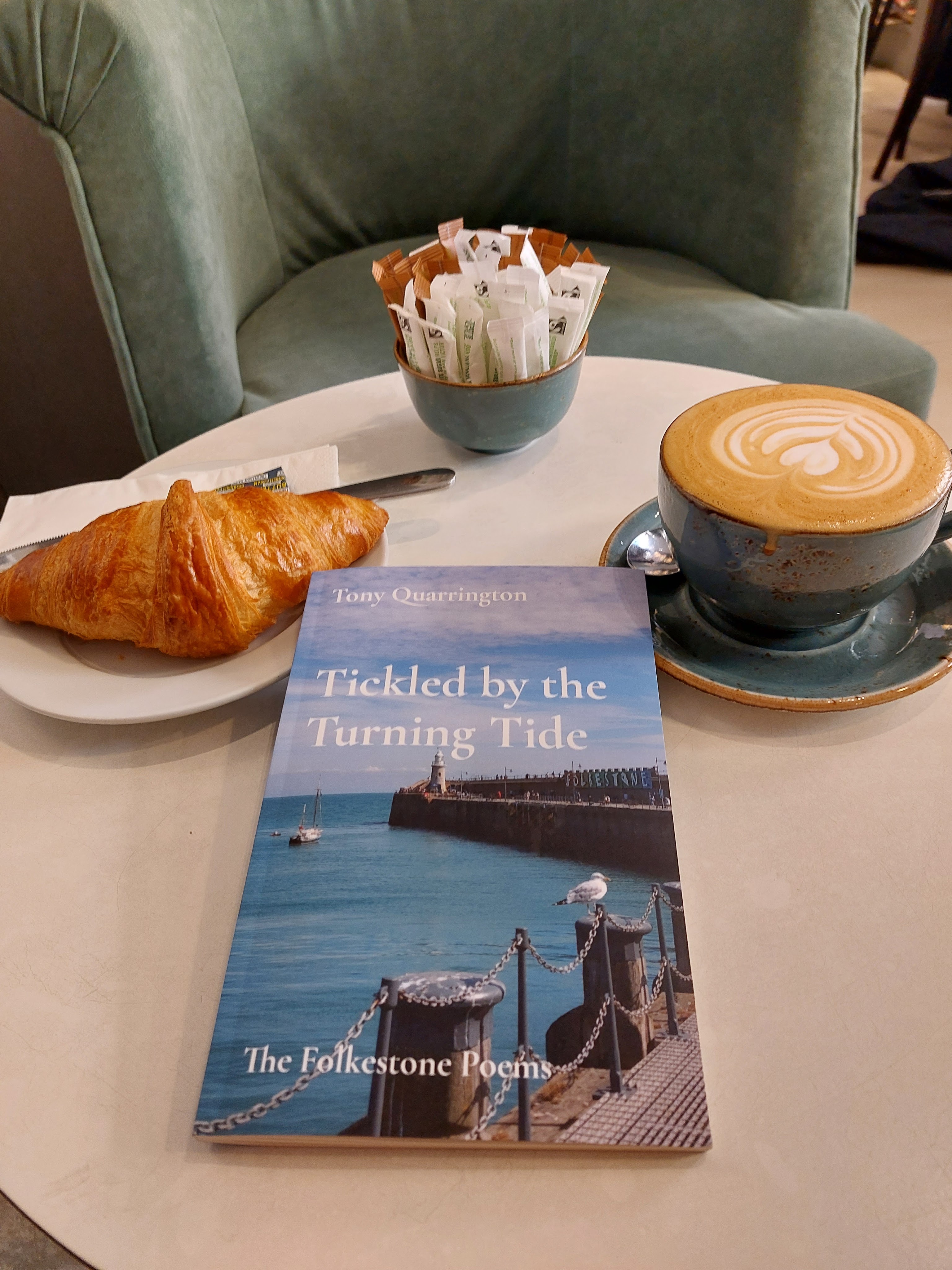
I am pleased to announce that my first collection of poetry, Tickled by the Turning Tide: The Folkestone Poems will be published on 6th April 2023.

When I was first taken on holiday by my parents to Folkestone at the age of ten, I could never have thought that, more than half a century later, I would not only return to the town to live but be publishing a book of poetry inspired by it.

All thirty three verses reflect my adopted coastal home, covering key moments in the town’s history, from its fishing heritage to its role as a port of embarkation for war, and from its period as a fashionable seaside resort, which welcomed royalty and writers, to its decline and subsequent regeneration as an art and dining destination.

I also explore aspects of modern living in a town that is changing rapidly.

Since I moved here with my wife in 2016, I have not only written and performed my poetry in a variety of locations, including coffee houses, bars and even on the steep, cobbled Old High Street, but also created and run a successful series of literary evenings, initially as a lockdown solution but still going strong after three years, and delivered award winning walking tours of the local area.

The official launch will take place at Folklore on Tuesday 11th April 2023 at 7pm, at which I will be signing copies and reading a handful of the poems.

I will also be delivering more readings at the Steep Street Coffee House on Thursday 4th May in the coming weeks in addition to running walking tours on 22nd and 26th April to promote the collection.

The book will retail at £10.99 in the UK (USA £12.99) but, for the first two months, I will be offering it at the discount price of £8. For those living in and around Folkestone, I will be happy to deliver or arrange collection. I will also be delighted to sign the book (for those wanting its value to diminish immediately!).

It will also be available for sale from 1st May  at the Folkestone Bookshop, Town Hall/Musuem, Steep Street Coffee House and The Great British Shop on the Old High Street. I am currently negotiating with other outlets to do the same. If you have any questions in the meantime or wish to purchase a copy once it is available, please either message me on one of my social media platforms or email me at tonyquarrington@msn.com.

Read Full Post »


My upcoming poetry book, “Dust in my Cappuccino” is a collection of thirty two poems inspired by the coastal town of Folkestone in the south east corner of England. In order to provide some context to the poems for those readers unfamiliar with the town, I have written a short history of the town. This will feature as the introduction to the collection when it is published next month.

Located on the south east coast of England, a handful of miles from the famed White Cliffs, and only twenty two miles from continental Europe, Folkestone has had a long, varied history, boasting both Bronze and Iron Age settlements and a prominent Roman Villa, sadly now perilously close to the cliff erosion that has always afflicted this coastline.

Descended from the the Anglo-Saxon Kings of Kent, Eanswythe, a devout young princess, founded a nunnery in the town in the seventh century AD, and was subsequently made a saint. Her bones, discovered in the parish church by workmen in 1885, were radiocarbon tested and confirmed in 2020, and the church is now becoming a growing site of pilgrimage.

For a thousand years, Folkestone was a modest fishing village and, for most of that time, as a limb of the Cinque Port of Dover, also a busy trading port. Smuggling was a not insignificant business from the eighteenth century too. But it was the coming of the railway and associated cross-channel ferry industry from 1843, and the construction in later decades of grand hotels and white stuccoed family homes, notably in the West End, that contributed to its rise as a fashionable resort that attracted royalty, artists and writers in addition to the Victorian and Edwardian middle class. Much of this development was conceived, funded and overseen by the Earl of Radnor, who still owns land in the town and surrounding area.

The “golden age” that began around 1880 arguably came to a sudden halt with the outbreak of the Great War, which had a profound effect on Folkestone. It became a major port of embarkation for the Western Front, and the final sight of England for millions of troops, many of whom will have marched from the neighbouring Shorncliffe army camp. The bombing of Tontine Street in 1917 brought about the highest number of British civilian dead as a result of an air raid during the war up until that point.

The inter war years saw a revival, with Folkestone exploiting its natural beauty – the Channel views, rolling hills, delightful parks and gardens – by marketing itself as “Fashionable” and “Spacious and Gracious”. Moreover, its popularity as a resort was enhanced by the Earl of Radnor’s “foreshore development” that included the building of the Rotunda, the largest unsupported concrete dome in Europe, swimming pool and boating lake, supplementing the existing Victoria Pier, switchback railway and the 1885 Leas water lift.

The town suffered heavy bombardment during the Second World War, destroying much of the harbour, but recovered as a seaside destination during the fifties and early sixties, which is when my Folkestone story began. The Rotunda, quaint, steep Old High Street with the revered Rock and Joke shops and the popular ferry route to Boulogne-sur-mer, kept the visitors coming and the locals entertained.

But, like so many other UK coastal resorts, it suffered a deep decline as the advent of cheap air fares, duty free and longer annual leave allowance, led to an escape to resorts where the sun was twenty degrees warmer and the beer ten degrees colder. Many of the much loved attractions and hotels closed, were demolished and converted into flats, and trade in the town slumped. Although the cross-channel ferry industry stopped at the turn of the century, Folkestone has retained its role as a point of departure to the continent with the opening of the Channel Tunnel in 1994.

The new Millennium brought a revival, aided by the philanthropy of former Saga owner, Sir Roger De Haan, who renovated and refurbished many of the buildings in the old town, offering the properties to creatives, provided education and sporting facilities (the latest of which the world’s first multi-storey skatepark), and restored and remodelled the derelict harbour area. The construction of up to a thousand apartments along the shoreline between the Leas Lift (currently closed) and the Harbour Arm is also now underway.

Since 2008, the Folkestone Triennial has showcased new works from established British and International artists, around half of each remain in the town once the exhibition is over. There are now around ninety such pieces placed outdoors around town.  

De Haan’s influence and the arrival of the high speed rail link (only fifty four minutes from London) in 2007, has proved a happy marriage in rendering Folkestone more accessible. Comparatively cheap (but rising) house prices, the advantages of living by the sea, a vibrant dining scene and improving facilities, not least for children, have all led to a growing relocation of people, many of them young families, predominantly from London.

My love affair with Folkestone began at the age of ten when I was brought by my parents from my hometown of Rochester, forty-five miles away on the North Kent coast, on the first of a succession of summer holidays to the town. It was my mother’s admitted but modest pretensions to social mobility which led to the choice of Folkestone rather than the traditional “bucket and spade” resorts such as Herne Bay, Margate or Broadstairs.

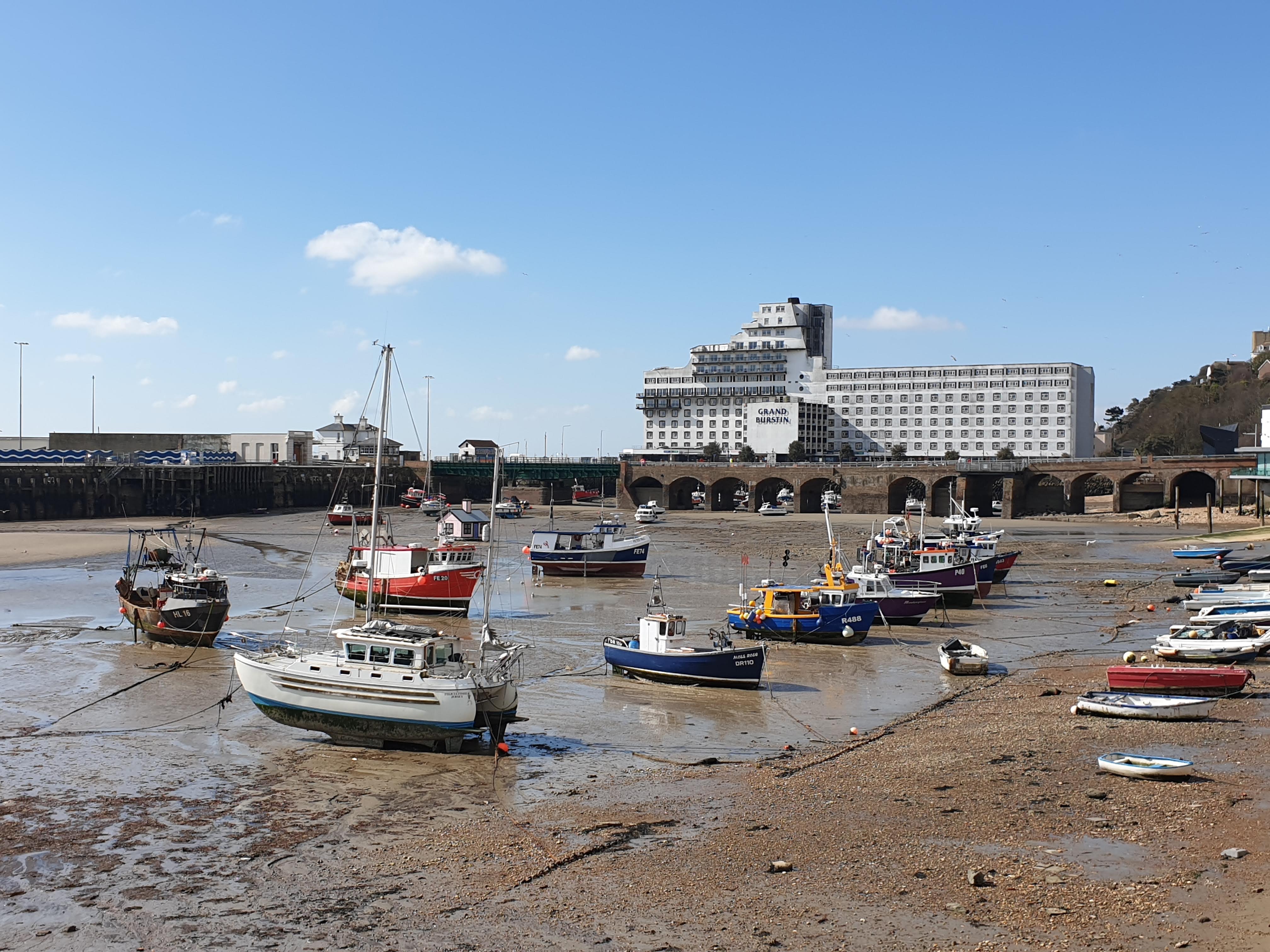
Once I left home and moved around the country for study or work, visits became much less frequent, though I always retained my affection for the town. In fact, my parents long harboured the desire of retiring to Folkestone (on their last holiday together they had stayed in the Grand Burstin Hotel at the harbour), but with my mother’s relatively early passing, it never materialised. But their groundwork was not done in vain, as when the opportunity arose in 2016, my wife and I had no hesitation in moving here.

I have gathered together thirty two of my poems inspired by Folkestone, in which many of the themes and events I have outlined above are referenced and explored. One particular challenge has been whether to present them in a systematic way, for example, chronology, geography or subject matter, but ultimately, they are laid before you in an essentially random form, at least superficially.

Read Full Post »

Older Posts »